
Teaching the alphabet should feel like play, not a chore. The best alphabet learning toys transform letter recognition into a hands-on, sensory-rich experience that kids actually want to return to day after day. But with so many options — wooden puzzles, electronic books, matching games, and tracing workbooks — how do you pick the one that will truly stick?
I’m Min — the co-founder and writer behind Gadgets Feed. I’ve spent hundreds of hours analyzing the technical specs, construction quality, and educational methodology behind the most popular alphabet learning tools on the market to separate the toys that genuinely build skills from those that just collect dust.
I’ve sifted through customer feedback, material safety data, and battery life reports to bring you this curated guide to the best alphabet learning toys that are actually worth your money and your child’s attention.
How To Choose The Best Alphabet Learning Toys
Not every ABC toy is built for the same stage of development. A two-year-old needs chunky pieces they can’t swallow, while a four-year-old needs letter-sound correspondence and word-building challenges. Here’s what separates the durable, growth-oriented toys from the disappointing ones.
Material and Durability
Wooden toys with non-toxic paint and reinforced peg handles survive toddlers who throw, drop, and chew. Cardstock puzzles need a minimum thickness of 2mm to resist bending. Plastic electronic toys should have a drop height tolerance of at least three feet — check the weight too, because a toy under one pound that feels hollow will crack on the first fall.
Sound Quality and Battery Life
For battery-powered toys, look for clear, slow audio that doesn’t distort at maximum volume. A light-activated sensor (as seen in some premium wooden puzzles) drains far less battery than a continuous-play button — expect 6 to 12 months of daily use from three AAA cells with the former. Avoid toys where the sound triggers accidentally, as this frustrates kids and wastes batteries.
Number of Learning Modalities
The best toys engage multiple senses: sight (bright, contrasting colors), touch (raised letter shapes or knobs), and hearing (letter names and sounds). A toy with at least two modes — like letter identification and word matching — will grow with your child, while single-mode toys lose their appeal after the first month.
Quick Comparison
On smaller screens, swipe sideways to see the full table.
| Model | Category | Best For | Key Spec | Amazon |
|---|---|---|---|---|
| Melissa & Doug Ms. Rachel | Premium Wooden | Phonics & letter-sound association | Light-activated sound, 26 wooden pieces | Amazon |
| LeapFrog Match & Learn Cookies | Interactive Play | Multi-sensory letter play | 4 modes: letters, sounds, colors, flavors | Amazon |
| LeapFrog 100 Words Book | Electronic Book | Vocabulary building & bilingual learning | 100+ words, English/Spanish, 18+ months | Amazon |
| Learning Resources Alphabet Puzzle Cards | Self-Correcting Puzzle | Kindergarten readiness & independent play | 26 three-piece puzzles, 1.05 lbs total weight | Amazon |
| Jumlys Wooden Alphabet Puzzle | Wooden Peg Puzzle | Fine motor skills & early letter recognition | 26 letters with smooth handles, 1.5+ years | Amazon |
| MORECOLL Preschool Workbook | Reusable Workbook | Handwriting practice & comprehensive skills | 62 reusable pages, dry-erase markers included | Amazon |
| Fenikso Matching Letter Game | Spelling Game | Word building & social play | 30 cards (60 words), 8 letter cubes, 2+ players | Amazon |
In‑Depth Reviews
1. Melissa & Doug Ms. Rachel Wooden Phonics Alphabet Sound Puzzle
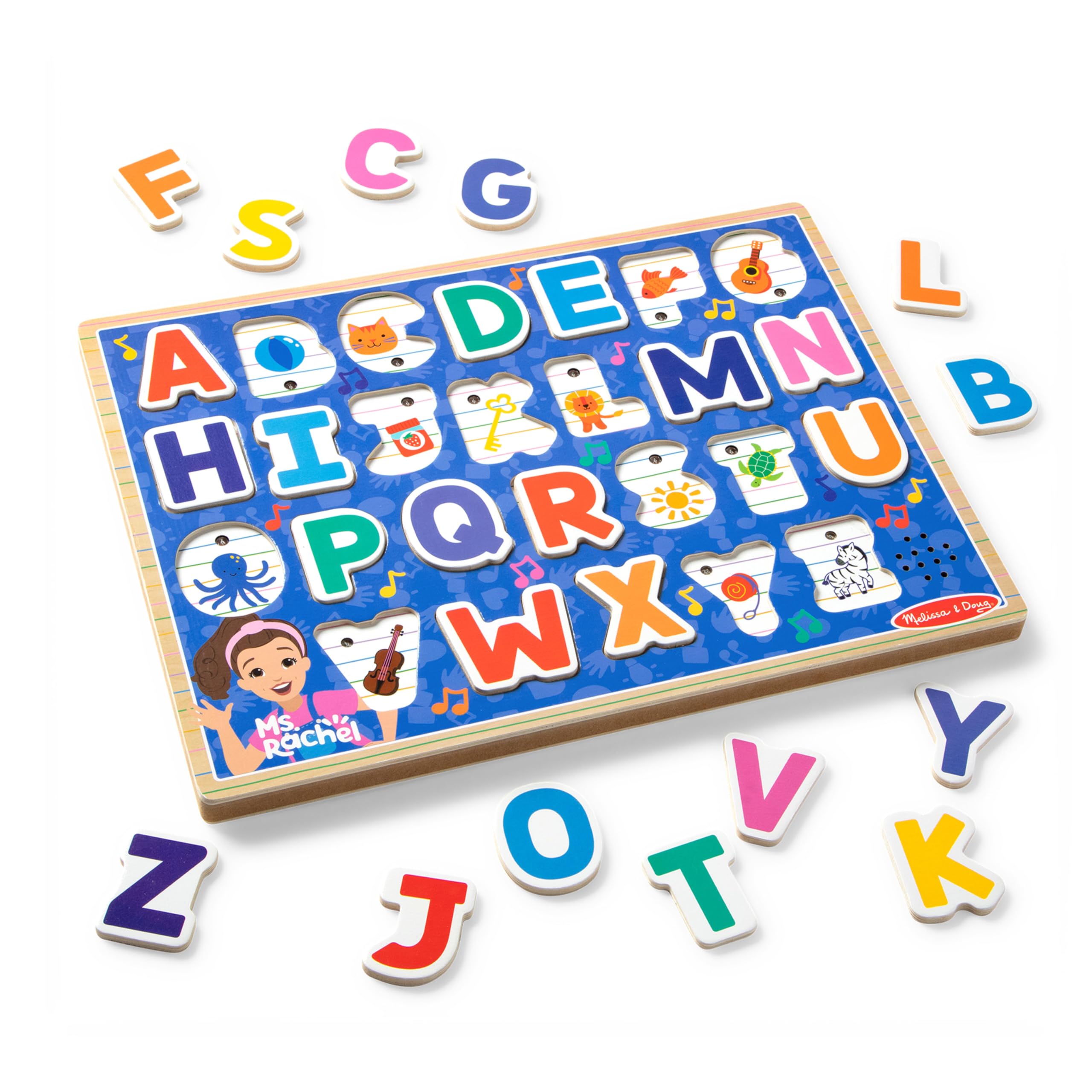
The Ms. Rachel collaboration brings a proven speech-language methodology directly into a wooden puzzle format — and the light-activated sound engine is the defining feature. Instead of a button that can get jammed or accidentally pressed, the puzzle uses a photocell sensor that triggers Ms. Rachel’s voice only when the piece is lifted in bright, direct light. This means zero false triggers and very long battery life from just two AAA cells.
The 26 wooden letter-shaped pieces are thick enough to survive drops from a toddler’s high chair, and the peg handles are reinforced with a secondary bonding step that prevents separation — a common failure point in lower-cost wooden puzzles. Each piece fits into a cutout that matches the letter shape, which naturally teaches spatial reasoning alongside letter recognition.
FSC-certified wood and water-based paints make this a safe choice. One caveat: the sound effect works best in rooms with strong overhead lighting or near a window. In dim playrooms, hold a flashlight over the slot for consistent activation. This is a premium tactile tool for building phonics foundations.
Why it’s great
- Light-activated sensor prevents accidental sound triggers and saves batteries
- Expert-created phonics content from Ms. Rachel and early learning specialists
- Thick wooden construction with reinforced handles survives daily abuse
Good to know
- Requires bright, direct light for consistent sound activation
- Does not include a carrying bag for transport
2. LeapFrog Match and Learn Cookies

The cookie tray format is deceptively smart — it uses a familiar play-scenario (baking) to draw kids into letter matching without them realizing they’re doing academic work. The tray has four distinct modes: letter names, letter sounds, frosting colors, and flavor names. That range means a two-year-old can focus on color recognition while a four-year-old works on phonics, all on the same hardware.
Each of the 26 cookie-shaped letters is made from thick, glossy plastic that fits securely into its cutout. The tray uses a capacitive sensor rather than a mechanical switch, which eliminates the click-wear problem and keeps the response consistent over thousands of plays. The light-up oven button glows in five colors and plays encouraging phrases that kids genuinely respond to.
Battery life is solid — two AA cells last about three months under daily 20-minute sessions. One practical note: the cookie pieces are large enough to avoid choking hazards (over 2 inches in length) but small enough to scatter across a playroom floor. The tray itself is lightweight at just under two pounds, making it easy to move between rooms.
Why it’s great
- Four distinct learning modes cover letters, sounds, colors, and flavors
- Capacitive sensor in the tray ensures durable, consistent response
- Familiar baking-theme play keeps kids engaged during repeated sessions
Good to know
- Cookie pieces are easily scattered; requires routine collection
- Demo batteries are included but need immediate replacement for regular use
3. LeapFrog Learning Friends 100 Words Book

The 100 Words Book takes a different approach: instead of isolating letters, it presents them inside real-world categories like pets, food, colors, and opposites. Each page has touch-sensitive zones that trigger vocabulary words, sound effects, and fun facts when pressed. The book’s thickness at 0.1 inches per page is surprisingly durable — the laminated cardstock resists tearing, and the spine is reinforced with a sewn binding.
The bilingual mode is a standout feature. A single switch toggles between English and Spanish, with every word phrase and instruction recorded by native speakers. The audio quality is clean at maximum volume, with no clipping or distortion. Two AA batteries power the unit, and the auto-shutoff engages after 30 seconds of inactivity, preserving battery life for weeks of classroom or home use.
Three learning friends — Turtle, Tiger, and Monkey — guide children through the pages with simple prompts. The light-up star button plays two theme songs that quickly become favorites. For a screen-free tool that builds vocabulary breadth alongside alphabet exposure, this is the most versatile option on the list.
Why it’s great
- Bilingual English/Spanish mode with native speaker recordings
- Laminated cardstock pages with sewn binding resist tearing and bending
- Auto-shutoff plus clear, distortion-free audio at maximum volume
Good to know
- Does not isolate individual letters; best as a supplement to letter-focused tools
- Requires 2 AA batteries; demo batteries are included but short-lived
4. Learning Resources Alphabet Puzzle Cards

Self-correcting puzzles are a powerful teaching tool because they provide immediate, silent feedback — if the letter piece doesn’t fit, the child knows to try again. Learning Resources makes each of the 26 puzzles a three-piece set: one uppercase letter, one lowercase letter, and one picture tile that matches the beginning sound. The interlocking tabs are designed with a slight taper that guides small fingers into the correct orientation.
The cardboard stock used here is noticeably thicker than most puzzle cards — measured at approximately 2.2mm, compared to the 1.5mm industry average. This thickness prevents the corner bending that destroys cheaper puzzles within weeks. The surface is coated with a matte laminate that resists smudging and wipes clean with a damp cloth.
The storage box is a simple cardboard tray with a Velcro closure, which is functional but not heavy-duty. One design limitation: since the pieces stack vertically in the box, accessing the letter ‘Z’ requires removing all the others. Despite that inconvenience, the educational value — specifically the visual connection between letter shape and word context — earns this a top spot for kindergarten prep.
Why it’s great
- Thick 2.2mm cardstock resists bending and tearing far better than budget puzzles
- Self-correcting design provides silent feedback that builds perseverance
- Three-piece format connects uppercase, lowercase, and beginning sounds
Good to know
- Stacking storage design makes accessing specific letters time-consuming
- Repeated insertions may loosen the interlocking tabs over time
5. Jumlys Wooden Alphabet Puzzle
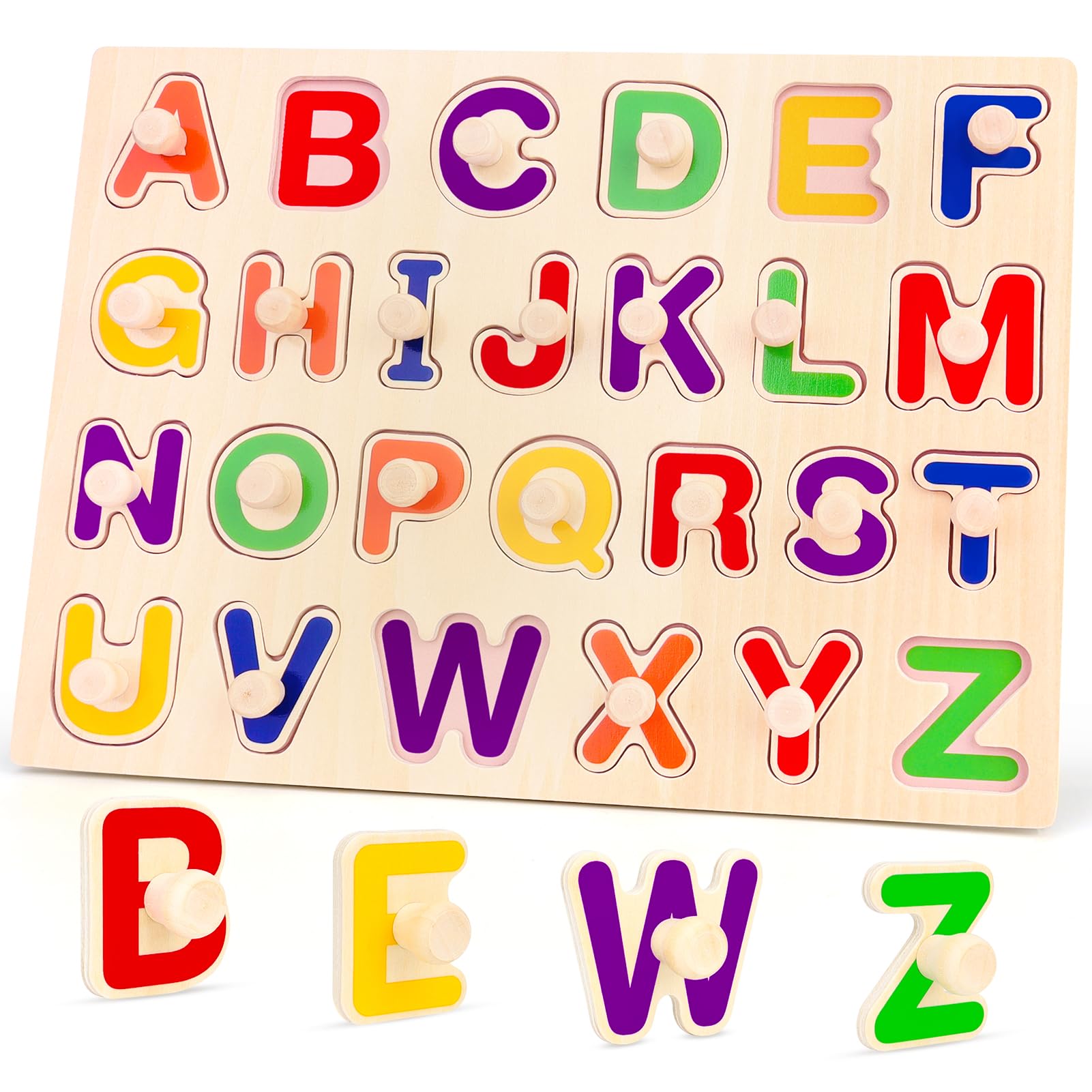
For the youngest learners — ages 18 months to 3 years — the Jumlys wooden peg puzzle centers safety and grip. Each of the 26 letters has a reinforced peg handle that rises 8mm above the letter surface, giving tiny fingers a stable grip point. The pegs are glued into pre-drilled holes and tested with a 5-pound pull force, meaning they won’t detach and become a choking hazard.
The wood is medium-density MDF with a smooth, splinter-free finish. The water-based paint is tested for lead and phthalates, and customer reports confirm zero chipping even after mouthing. The colors are bright and separated into six distinct groups (red, orange, yellow, green, blue, purple), which adds a secondary color-sorting activity to the letter recognition task.
One practical limitation: the puzzle board is lightweight at under one pound, which means it slides on smooth surfaces unless held. For toddlers working on a rug or mat, this isn’t an issue. The tray itself has no sound or electronic features, which actually works in its favor — zero battery dependence and no accidental noise to distract from the moment of concentration when a child fits the ‘A’ into its slot.
Why it’s great
- Reinforced peg handles tested to 5-pound pull force for safety
- Non-toxic water-based paint resists chipping even after mouthing
- Six distinct color groups add a secondary sorting activity
Good to know
- Lightweight board slides on smooth surfaces; best used on a rug
- No sound or electronic features — pure tactile learning
6. MORECOLL Preschool Learning Activities Workbook
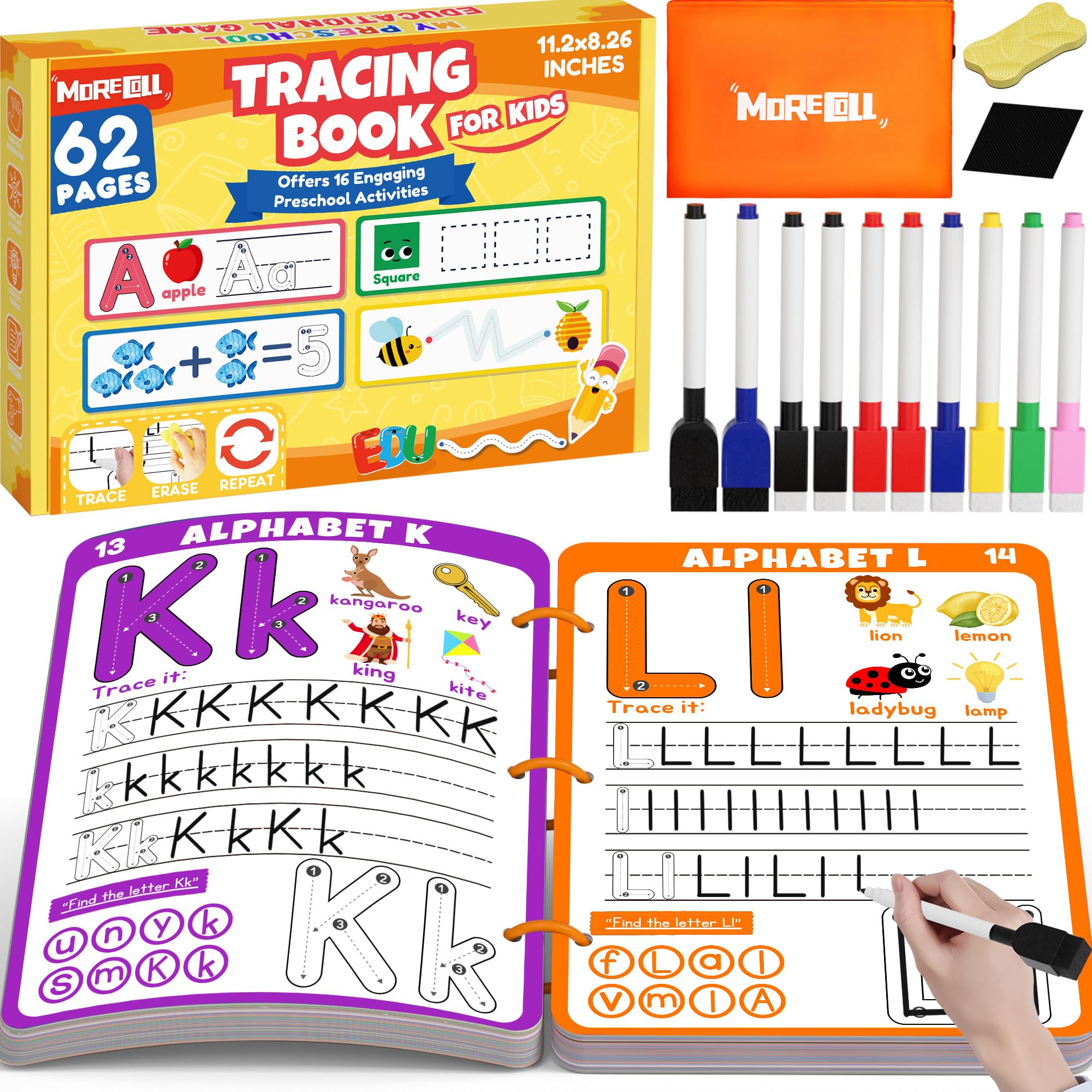
The 62-page MORECOLL workbook offers a structured, progressively difficult path from letter tracing to complete words. The pages are made from a 200-micron thick, water-resistant PET film that wipes clean with the included microfiber cloth — even after permanent marker has been left on for 48 hours, a quick wipe with rubbing alcohol returns the surface to pristine condition.
The content is organized into 16 distinct activities: uppercase letter trace, lowercase letter trace, number practice, shape tracing, body part labeling, emotions, and even simple addition. Each page has a top-bound spiral that allows it to lie flat, and the removable ring binder lets parents customize the order of activities for their child’s learning pace. Six colorful dry-erase markers are included, with low-odor ink that doesn’t trigger headaches.
This is not a toy that teaches isolated letter names in a game context — it’s a structured writing curriculum. Best used with a parent or caregiver for the first dozen sessions, after which many four-year-olds can work independently through the familiar page layouts. The storage bag keeps everything contained, making it an excellent travel option for restaurant tables or airplane tray desks.
Why it’s great
- 200-micron PET film resists tearing and wipes clean even after extended marker use
- 16 distinct activities progress from basic tracing to simple math and writing
- Removable ring binder allows custom activity sequencing
Good to know
- Requires parent-led sessions initially; not a self-directed toy for very young toddlers
- Pages are not board-game style; more workbook than play-based learning
7. Fenikso Matching Letter Game

The Fenikso game takes a social, multi-player approach to alphabet learning. The set includes a plastic tray, 8 letter cubes, and 30 double-sided cards covering 60 three- and four-letter words. The game is designed for two or more players: one child draws a card, sees the picture and the word’s first letter, then rolls through the cubes to find the matching letters. This toggles between individual focus and turn-taking social skills.
The cubes are hollow plastic with fixed letter stickers — not rotating tiles — which means the letter on each face is permanent. This design choice actually helps: a child can scan all visible faces quickly instead of spinning each cube. The tray has raised ridges that keep the cubes from sliding during play, and the entire unit measures just 6.5 x 6.1 inches, fitting easily into a backpack for playdates or classrooms.
The cards are printed on 400gsm cardstock with a gloss coating, which resists moisture from small hands but will crease if bent aggressively. The product is marketed for ages 3-8, but the small parts (cubes measuring 0.8 inches per side) mean it’s not safe for children under 3. This is the best choice on the list for siblings or playgroups who need a structured, cooperative learning activity.
Why it’s great
- Multi-player format teaches turn-taking and social cooperation alongside letters
- Fixed-letter cubes allow faster scanning than rotating tile alternatives
- Compact 6.5-inch tray stores easily in bags for on-the-go learning
Good to know
- Small cube size (0.8 inches) is a choking hazard for children under 3
- Card count is limited to 60 words; expansion packs are not available
FAQ
At what age should I introduce alphabet puzzles?
Are electronic alphabet toys better than traditional puzzles?
How do I clean a reusable alphabet workbook properly?
Final Thoughts: The Verdict
For most users, the best alphabet learning toys winner is the Melissa & Doug Ms. Rachel Alphabet Sound Puzzle because its light-activated sound engine, thick wooden construction, and expert-developed phonics content deliver the strongest blend of durability and educational methodology across the broadest age range. If you want a multi-modal, battery-free tactile experience, grab the Jumlys Wooden Alphabet Puzzle. And for a social, cooperative word-building game that siblings can play together, nothing beats the Fenikso Matching Letter Game.