
A by-date printer is the difference between a warehouse that runs on schedule and one that ships mislabeled product. The wrong unit costs you overtime re-stamping boxes or, worse, a compliance violation that halts a shipment. You need a machine that lays down crisp, permanent codes on cardboard, plastic, metal, and glass — day after day, without jams or dried-out nozzles.
I’m Min — the co-founder and writer behind Gadgets Feed. I’ve spent hundreds of hours dissecting the technical specifications, customer feedback, and real-world performance data of date-coding printers to separate the reliable workhorses from the gadgety disappointments.
Whether you run a small-batch kitchen or a mid-volume production line, these research-backed picks guide you to the right best by date printer for your printing volume, surface types, and budget.
How To Choose The Best By Date Printer
The right date coder isn’t about price tags — it’s about matching your packaging mix, daily volume, and operator skill level. A budget-friendly handheld might be perfect for a small bakery but cripple a factory line that needs continuous photoelectric printing. Walk through these checkpoints before you buy.
Print Technology: Thermal Inkjet vs. Document Impact
Thermal Inkjet (TIJ) printers like the BENTSAI and v4ink models deliver 600 DPI resolution on nearly any surface — cardboard, foil pouches, glass, even curved plastic bottles. They use quick-dry solvent ink that bonds in seconds. Document impact printers, like the Lathem LT5000, rely on a ribbon mechanism and are limited to paper documents and flat envelopes. If you’re coding secondary packaging (boxes, cases, pallets), a TIJ handheld is non-negotiable.
Print Height, Lines, and Throughput
Single-line date stamps (2 mm height) suffice for tiny expiry codes on medicine bottles. Multi-line printers (up to 10 lines, 25 mm height) are needed for cases that carry batch numbers, barcodes, and QR codes alongside the date. Print speed is measured in meters per minute (m/min) — 60 m/min is standard for handheld swipe units, while desktop stamps are rated in cycles per minute. Choose based on whether you’re stamping one box at a time or walking a conveyor line.
Quick Comparison
On smaller screens, swipe sideways to see the full table.
| Model | Category | Best For | Key Spec | Amazon |
|---|---|---|---|---|
| Epson TM-T20III | POS Receipt | Square POS integration | USB / 7 ppm mono | Amazon |
| Phezer P16 | Handheld TIJ | Versatile multi-surface coding | 42 ml / 2600 mAh battery | Amazon |
| TOAUTO HP12.7 | Handheld TIJ | 8-hour run time + curved surfaces | 600 DPI / 60 m/min | Amazon |
| Lathem LT5000 | Document Stamp | Office document date/time stamping | 1/2 million cycle life | Amazon |
| BESHENG TIJ2590 | Desktop TIJ Coder | Foot-pedal/photoelectric batch printing | 5-inch touch / 12.7 mm height | Amazon |
| BENTSAI BT-HH62 | Handheld TIJ | Ultra-long battery heavy daily use | 16 h run / 25.4 mm height | Amazon |
| v4ink BENTSAI B2 | Handheld TIJ | Smooth printing + reliable nozzle | 600 DPI / 8 h battery | Amazon |
| BENTSAI BT-HH6105B2 | Handheld TIJ | Field use on farm/grocery packaging | 12.7 mm / 600 DPI | Amazon |
| UPRINTJET BT-HH6105B2 | Handheld TIJ | Lightweight portable coding (450 g) | 41 cm max single print length | Amazon |
In‑Depth Reviews
1. BENTSAI BT-HH62 Handheld Inkjet Printer

The BENTSAI BT-HH62 stands apart with a 16-hour continuous run time, double what most handhelds manage. That kind of endurance matters in a production environment where you can’t stop mid-shift to recharge. Its 1-inch (25.4 mm) print height handles up to 10 lines of text — enough for a full case label with batch, expiration, barcode, and QR code on a single swipe.
The upgraded 5-roller guide system delivers noticeably smoother prints on curved surfaces like aluminum cans or PE bags compared to the 3-roller designs on cheaper units. Weighing just 0.9 kg (the 410 g body plus cartridge), it won’t fatigue your wrist during extended runs. The 42 ml fast-dry ink bonds to porous and non-porous surfaces almost instantly, so there’s zero smudge when boxes stack.
Users consistently report that the touch interface is intuitive and the included accessories (metal positioner, roller guide, Type-C cable) make it usable out of the box. A small number of units have experienced charging failures after a few months, but the support team generally resolves these quickly. For sustained, high-volume date coding across mixed surfaces, this is the most capable handheld on the list.
Why it’s great
- Industry-leading 16-hour battery covers a full shift without recharging
- 25.4 mm print height supports up to 10 lines with 600 DPI
- 5-roller system prints smoothly on curved and uneven surfaces
Good to know
- A handful of units have developed charging issues after a few months
- Initial setup of custom content takes about 30 minutes
2. v4ink BENTSAI B2 Handheld Inkjet Printer

The v4ink BENTSAI B2 earns its premium spot with a 600 DPI resolution that makes tiny 2.5 mm expiration dates razor-sharp, even on glossy foil pouches where low-res printers blur. The 42 ml ink cartridge delivers up to 2 million characters, so replacement costs stay predictable for medium-volume runs. It prints up to 5 lines within a 12.7 mm height band — enough for batch, date, and a small barcode side-by-side.
What seasoned buyers notice is the consistency. Users who upgraded from budget handhelds say the B2’s print glide feels smoother, the ink doesn’t skip, and the nozzle rarely clogs when capped between uses. The 4.3-inch LED touch screen is bright enough for warehouse lighting, and the Android-based controller makes content editing straightforward without a laptop.
The 8-hour battery is adequate for a full shift, and the included photoelectric sensor enables automatic printing on conveyor lines. A handful of users report that a dry nozzle on a fresh cartridge can cause blank white lines, but cleaning with alcohol resolves it, and the customer service team is responsive. If you need reliable, high-resolution codes on non-porous surfaces like glass and metal, this is the refined choice.
Why it’s great
- 600 DPI produces crisp codes on glossy and non-porous surfaces
- One cartridge prints up to 2 million characters with fast-dry ink
- Photoelectric sensor enables hands-free conveyor printing
Good to know
- Standard ink cartridges cost roughly to replace
- Nozzle may require alcohol cleaning after 80+ prints
3. BENTSAI BT-HH6105B2 Handheld Inkjet Printer

The BENTSAI BT-HH6105B2 is built for environments that would destroy an office-grade stamp — field work on farms, outdoor markets, and damp warehouse docks. It prints reliably on cardboard, wood, fabric, plastic, and even wet-stick glass with its waterproof quick-dry ink that dries in 2 to 5 seconds without smudging when wet. The 12.7 mm print height (0.5 inches) is perfect for medium-size date and batch codes on standard case boxes.
The 4.3-inch touch screen is intuitive enough that field staff reported easy use without referring to the manual. The design includes a self-locking cartridge clip that prevents the ink cartridge from shifting during a rough ride. The battery lasts over 8 hours, and the included photoelectric sensor makes it easy to mount to a small conveyor line for automatic printing.
Some operators note that the ink dry speed is slower than premium units, and using the metal guide plate can smudge fresh prints on non-porous surfaces. The unit is heavier than a pound, which some users find tiring after extended sessions. But for a rugged date coder that handles farm conditions, warehouse dust, and high moisture without failing, this is a solid mid-range workhorse.
Why it’s great
- Waterproof ink stays legible after exposure to moisture and cleaning
- Self-locking cartridge clip survives rough transport and tilt
- Photoelectric sensor allows conveyor integration for automatic runs
Good to know
- Ink dries slower than premium models, requiring a few extra seconds before handling
- Units weigh over a pound, which can fatigue the wrist during long sessions
4. BESHENG TIJ2590 Desktop Inkjet Coder

The BESHENG TIJ2590 shifts away from hand-swiping to a desktop footprint with three activation modes: foot pedal for hands-free operation, hand press for short runs, and a photoelectric sensor for conveyor integration. This makes it a strong fit for small-to-medium production lines where consistency matters more than mobility. The 5-inch HD touch screen provides ample space for template design and previewing without squinting.
Its 42 ml fast-dry ink works on both porous (cardboard, wood) and non-porous surfaces (glass, ceramic, PE bags). The print height adjusts from 2 mm to 12.7 mm, and the pre-positioning plate ensures codes land exactly where you set them — eliminating the guesswork that handheld swipe units introduce. The built-in font library also supports importing TTF fonts for custom branding.
Users report plug-and-play simplicity with clear guidance on setup. A small number of units have arrived with defective connections or were dead on arrival, but the manufacturer’s support team has resolved replacements within days. If you want a stationary date coder that speeds up repetitive batch marking without operator fatigue, this is the most versatile desktop option at this level.
Why it’s great
- Three printing modes (foot pedal, hand press, photoelectric sensor) for flexibility
- Large 5-inch touch screen simplifies template editing and preview
- Works on non-porous surfaces like glass, metal, and PE bags
Good to know
- Small number of units have arrived with connection defects
- Not designed for mobility — requires a permanent workstation
5. Phezer P16 Handheld Inkjet Printer
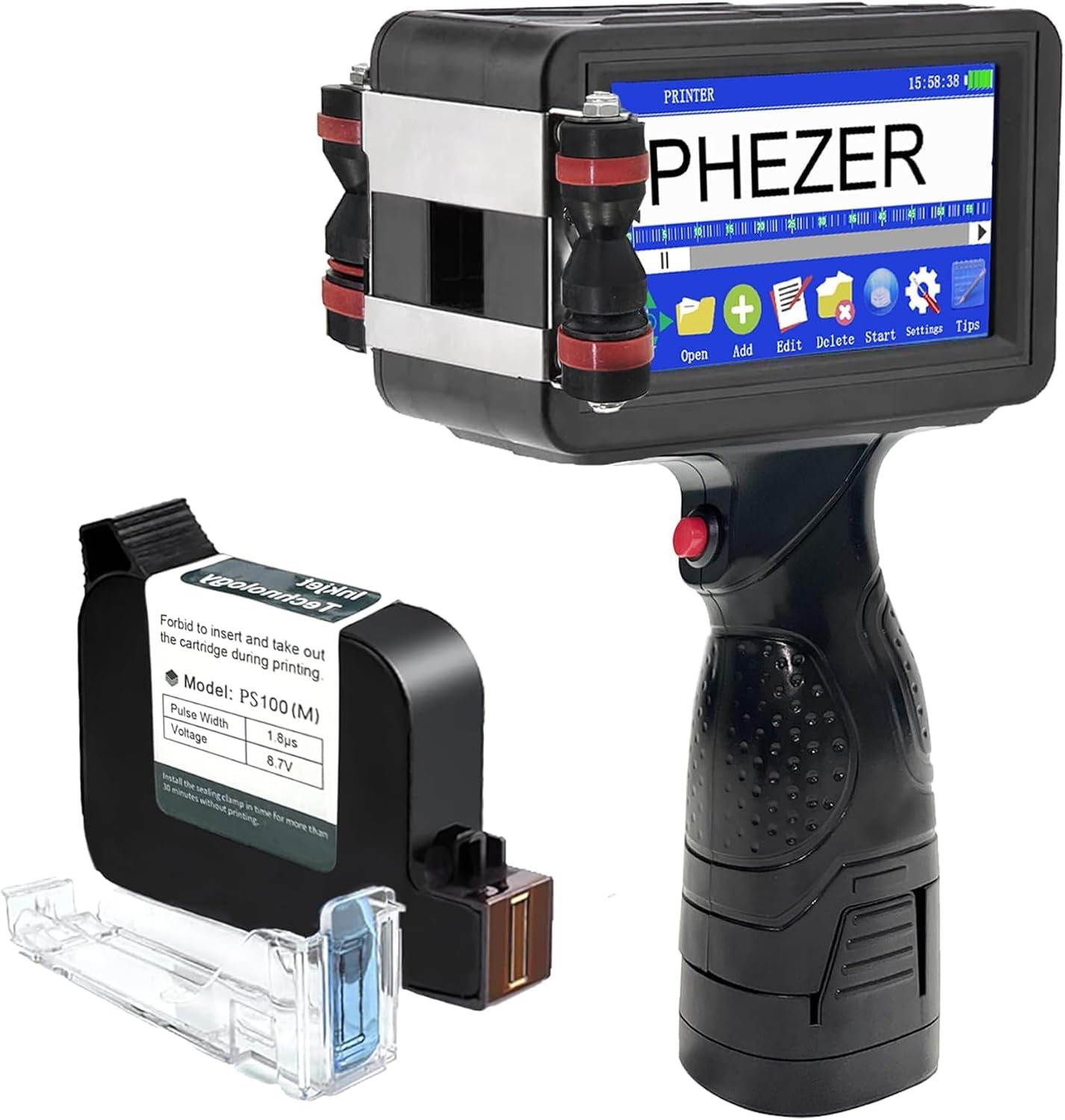
The Phezer P16 packs a Cortex-A9 quad-core processor and a standalone operating system — meaning it runs independently with zero dependency on a smartphone app or a computer. The 4.3-inch capacitive touch screen responds quickly, and the 2600 mAh battery lasts a full day for moderate print volume. At 1.54 pounds total weight, it’s slightly heavier than some competitors but balances well in one hand with its ergonomic grip.
Print quality is solid at 300 DPI with adjustable heights from 2 mm to 12.7 mm. The 42 ml quick-dry ink cartridge resists nozzle-blocking better than the generics found on ultra-budget models. Users report that it excels at printing sequential lot numbers and expiration dates on glass, plastic bottles, and folded cartons — the kind of mixed daily runs a small-batch food or cosmetic producer needs.
The touch screen has been found unresponsive on arrival for a few units, which suggests batch-to-batch quality variation. Setup is straightforward for printed content but the manual could be clearer for advanced features like logo import. For a first handheld date coder that won’t break the bank, the P16 gives impressive functionality at a modest entry point.
Why it’s great
- Standalone operation — no app or computer required
- 2600 mAh battery covers full-day usage
- Works on 10+ surface types including glass, metal, and plastic
Good to know
- Touch screen sensitivity varies between units
- Manual lacks detail for advanced template features
6. TOAUTO HP12.7 Handheld Inkjet Printer

The TOAUTO HP12.7 sets itself apart with a 5.6-inch capacitive touch screen — larger than any other handheld in this lineup. This makes template editing and font selection much more comfortable, especially for operators with gloves or less-than-perfect eyesight. Print speed reaches 60 meters per minute with 360-degree nozzle spurting, meaning you can swipe fast without dropouts on flat cardboard and drywall.
The 42 ml quick-drying ink is waterproof and dries instantly on most surfaces. Users praise it for printing on ziplock bags, leather, and even drywall without bleeding. The included alignment plate helps position content on curved surfaces, though results on complex curves are hit-or-miss. The battery delivers up to 8 hours of run time, which covers a full shift for moderate daily use.
Long-term durability is a concern — several units have failed after 7 months, and the manufacturer’s support has been unresponsive for some warranty claims. The optional restocking fee for returns adds to the risk. If you need a large-screen handheld date coder for small indoor batch runs and don’t mind a shorter expected lifespan, this is a capable tool for the price.
Why it’s great
- Largest 5.6-inch touch screen of any handheld date coder reviewed
- 60 m/min print speed enables fast, continuous swiping
- Works well on unconventional surfaces like leather, drywall, and ziplock bags
Good to know
- Several reports of units failing after 6 to 7 months
- Manufacturer support has been unresponsive for warranty claims
7. UPRINTJET BT-HH6105B2 Handheld Printer

The UPRINTJET BT-HH6105B2 is the lightest handheld date coder on this list at just 450 grams, making it the best choice for operators who spend long hours applying codes to boxes and pallets. Despite the light weight, it manages a maximum single print length of 406 mm — enough to cover a full case side in one smooth swipe without lifts or gaps. The 300/600 DPI switchable resolution gives flexibility to balance ink consumption and sharpness.
Users consistently mention that the guided roller system produces clear, consistent codes even on uneven surfaces like steel pipes and textured timber. The 42 ml fast-dry ink supports all standard date, batch, barcode, and QR code formats, plus picture import via USB flash drive. The photoelectric sensor can be mounted to a conveyor for automatic production line integration.
Ink cartridge costs are on the higher side (roughly each), and the unit doesn’t ship with extra ink in the box, so you’ll need to plan your first cartridge purchase alongside the printer. A few users encountered a learning curve on curved surfaces, but overall reliability after six months of daily use has been strong. For a lightweight, portable date coder that doesn’t sacrifice print length or quality, this is a smart pick.
Why it’s great
- Ultra-lightweight 450 g design minimizes operator fatigue
- 406 mm single print length covers full case sides in one swipe
- Switchable 300/600 DPI resolution balances ink usage and clarity
Good to know
- Replacement ink cartridges are expensive at roughly each
- Learning curve required for consistent prints on curved surfaces
8. Lathem LT5000 Electronic Document Stamp

The Lathem LT5000 is not a handheld inkjet coder — it’s an electronic multi-line stamp designed for office document workflows like stamping payment receipts, incoming mail, and internal forms. Its heavy-duty construction is rated for 500,000 print cycles, which translates to years of daily desktop use. The patented single-insertion mechanism prints two lines (time and date, or custom text) with one push, making it faster than manual date stamps.
Setup is straightforward via the SetupMyStamp.com software, and the internal smartphone-based clock keeps time during power outages while auto-adjusting for daylight saving time and leap years — a nice feature for compliance documents.
The software interface can be finicky: custom text presets sometimes fail to load on a USB drive larger than 32 GB, and the software doesn’t support Mac. Technical support resolution has been mixed, though most issues can be resolved by emailing the working file. If you need a dedicated office date stamper for paper documents and envelopes, not a production-line inkjet coder, the LT5000 is a durable purpose-built tool.
Why it’s great
- Rated for 500,000 cycles — built for heavy office stamping volume
- Single-insertion, two-line printing saves seconds per document
- Auto-adjusts for DST and leap years without manual intervention
Good to know
- SetupMyStamp.com software has bugs when loading custom presets
- Does not support Mac computers for programming
9. Epson TM-T20III Thermal Receipt Printer

The Epson TM-T20III is a thermal receipt printer, not a date inkjet coder in the traditional sense. It earns a place here because it serves food trucks and small retail counters that need to print expiration dates and batch info directly on receipts or kitchen labels through a POS system. It connects exclusively via USB and is designed to work with Square Stand and Square Register when paired with the correct Square hardware.
The thermal mechanism prints 7 pages per minute at 203 DPI — adequate for text-based dates and item names on monochrome receipt paper. It supports duplex printing and is compatible with Epson-branded cartridges. Users in mobile food operations report solid connectivity and no jams, though the printer requires a dedicated USB connection without Bluetooth or Wi-Fi flexibility.
The primary trap: it only works with Square Stand or Square Register, not a generic tablet setup. A small number of users have received units with a different model number that refused to connect to Square, missing the return window. If you operate a Square-based food truck or pop-up shop and need a rugged printer for date-stamped receipts, this is the right pick. For actual box or bottle date coding, look at the handheld TIJ options.
Why it’s great
- Reliable thermal printing with no jams in mobile food environments
- Direct Square Stand / Square Register integration
- Compact footprint fits small countertops and truck kitchens
Good to know
- USB-only — no Bluetooth or Wi-Fi connectivity
- Only works with Square Stand or Square Register, not generic tablets
FAQ
What is the difference between a handheld date printer and a desktop document stamp?
Can a by date printer print on curved surfaces like bottles or cans?
Final Thoughts: The Verdict
For most users, the best by date printer winner is the BENTSAI BT-HH62 because its 16-hour battery, 25.4 mm print height, and 5-roller system handle high-volume mixed-surface coding better than anything else in this price tier. If you want a lighter, more portable unit with the longest single-print reach, grab the UPRINTJET BT-HH6105B2. And for a stationary desktop solution with foot-pedal and photoelectric modes that reduce operator fatigue on repetitive batch runs, nothing beats the BESHENG TIJ2590.