
Bolting on shiny parts that don’t actually make your car faster is a mistake too many enthusiasts make. Whether you’re building a mini bike for trail dominance or squeezing every tenth out of a street-legal Civic, the difference between a functional upgrade and a paperweight comes down to specific engineering choices — intake manifold taper, spring rates measured in kg/mm, and camber curve geometry — not marketing hype.
I’m Min — the co-founder and writer behind Gadgets Feed. I’ve spent hundreds of hours cross-referencing dyno charts, suspension kinematics, and real-world install feedback to separate the hardware that genuinely transforms a vehicle from the parts that just look the part.
This guide cuts through the noise, zeroing in on the components that deliver measurable gains in power delivery, chassis control, and driver safety so you can buy the best auto racing parts with total confidence.
How To Choose The Best Auto Racing Parts
Throwing random aftermarket components at a car or mini bike often leads to drivability headaches, wasted money, and sometimes dangerous failure points. The smart approach focuses on parts that solve a measurable problem — inadequate air/fuel mixture, excessive body roll, inconsistent launch, or insufficient safety restraint — and match the specific engine platform, chassis generation, and intended use case.
Match the Part to the Engine Platform
A carburetor that works on a Hemi Predator 212cc may not bolt onto a Tillotson 212 without adapter issues, and the jetting baseline differs by elevation and compression ratio. Always verify intake manifold bolt pattern, bore spacing, and whether the engine uses a 24x or 58x trigger wheel for ignition modules like an MSD Launch Control. Ignoring platform-specific fitment turns a bolt-on upgrade into a fabrication project.
Read Spring Rates, Not Just Drop Height
Coilovers and lowering springs are often marketed by how many inches they drop, but the real performance spec is the spring rate in kg/mm or lbs/in. A 8 kg/mm front spring on a Civic delivers track-ready stiffness but punishes daily commuters. Camber kits matter when lowering beyond 1.5 inches — without adjustable upper arms, excessive negative camber chews through tire shoulders and ruins straight-line stability.
Safety Gear Is Not Optional
A 4-point harness without Ultra Kush padding or proper anti-submarine design can cause internal injury in a crash, not prevent it. For off-road UTV and SXS use, look for quick-release latch mechanisms, pull-up adjusters for varied driver sizes, and hardware that includes Grade 8 bolts — the harness is only as strong as its mounting points. Street-only harnesses lack DOT approval and should never be used on public roads.
Quick Comparison
On smaller screens, swipe sideways to see the full table.
| Model | Category | Best For | Key Spec | Amazon |
|---|---|---|---|---|
| MSD Ignition 8733 | Launch Control | Consistent drag-race holeshots | Works with 24x or 58x trigger wheels | Amazon |
| maXpeedingrods Coilovers | Suspension Kit | Budget-friendly adjustable ride height | Front 8 kg/m rear 5 kg/m spring rates | Amazon |
| Skunk2 Camber Kit | Suspension | Precise alignment after lowering | Low-profile forged ball joints | Amazon |
| D2 Pro Lowering Springs | Lowering Springs | Simple drop with minimal cost | 1.8F / 1.4R inch drop | Amazon |
| 50 Caliber Racing 4-Point | Safety Harness | UTV/ATV off-road safety | 3.4 lbs with Ultra Kush padding | Amazon |
| NIBBI PE24mm Kit | Carburetor Kit | Precise tuning on 212cc engines | 24 mm venturi with intake manifold | Amazon |
| YOXUFA Stage 2 Kit | Carburetor Kit | Budget mini-bike upgrade bundle | 62 mm pleated air filter included | Amazon |
In‑Depth Reviews
7. MSD Ignition 8733 2-Step Launch Control for GM LS Engines

The MSD Ignition 8733 is the definitive solution for LS-powered vehicles that demand repeatable, consistent holeshots at the drag strip. It connects directly to the factory coil packs — no separate ignition box required — and allows you to set a hard launch RPM limit that holds the engine at the perfect torque peak while the trans brake is engaged. Releasing the button sends full power without the guesswork of foot-braking.
Compatibility spans both 24x and 58x crankshaft trigger wheels, covering Gen III and Gen IV LS engines across cars and trucks. The wiring integration takes roughly ten minutes, tying into the clutch switch wire on manual cars or the brake switch on automatics. Users report consistent 2,500 RPM launches on LS1 Camaros and years of trouble-free service in turbo Silverado builds.
For the price of a single dyno session, this module shaves tenths off your 60-foot time every pass. It is a focused, single-function tool — no gimmicks, no app, no RGB — just a rock-solid ignition interrupt that works exactly as designed.
Why it’s great
- True plug-and-play with factory LS coil packs
- Works with 24x and 58x trigger wheels
- Ten-minute install for immediate launch control
Good to know
- Only compatible with GM LS engines
- No included wiring harness extension
6. maXpeedingrods Coilovers for Honda Civic 1988-2000 / Acura Integra

This coilover kit covers an enormous range of chassis: 1988-2000 Honda Civic, 1988-1991 CR-X, 1992-1995 del Sol, and 1990-2001 Acura Integra (DA/DB/DC2/DC4). Twin-tube construction provides a longer stroke than monotube designs, which translates to a more compliant ride over rough pavement while still allowing 1-3 inches of height adjustability. The 6061 aluminum with T6 tempering gives the threaded bodies corrosion resistance and structural integrity.
Front spring rate sits at 8 kg/mm (448 lbs/in) and rear at 5 kg/mm (280 lbs/in) — a sporty split that reduces understeer and allows the rear to rotate on corner entry. Owners of EF and EG sedans report immediate improvement in steering response and turn-in sharpness. The ride is noticeably firmer but not punishing, and the height adjustment uses a straightforward C-spanner system that doesn’t require spring compressor tools.
Some installers note that rear fork mounts on EK chassis may require stacked washers to avoid bending the bracket, and the front upper mount spacers can be a tight fit on certain strut towers. These are minor packaging quirks, not fundamental design flaws, and the overall ride quality at this price point is genuinely impressive.
Why it’s great
- Broad chassis fitment covering 1988-2001 Honda/Acura
- Twin-tube design for acceptable daily comfort
- Height adjustable 1-3 inches with simple tools
Good to know
- Rear fork mounts may need shimming on EK models
- Will not achieve extreme “slammed” ride height
4. Skunk2 Racing Tuner Series Front Camber Kit for 1996-2000 Honda Civic

Once you lower a 6th-gen Civic more than 1.5 inches, the factory upper control arm geometry pushes the top of the tire inward, causing excessive negative camber that shreds the inner shoulder and dulls turn-in response. The Skunk2 Tuner Series front camber kit solves this with low-profile forged ball joints and slotted square washer plates that restore alignment range. This kit provides enough positive camber adjustment to pull the contact patch back flat.
Build quality is visibly superior to generic eBay arms — the one-piece forged ball joints eliminate the play and premature wear common with stamped-steel designs with pressed-in joints. Rubber bushings are used instead of polyurethane, which keeps noise, vibration, and harshness low while still offering the necessary articulation for aggressive alignment settings. The square washer plates clamp securely without slipping under hard cornering loads.
Vehicle-specific fitment is exact for 1996-2000 Civic (CX/DX/EX/GX/HX/LX/Si) and installation is a direct swap with no drilling or modification. Users report immediate tire wear improvement and the ability to run up to -3 degrees of camber for track days without destroying daily-driver tires. At roughly 8 pounds for the pair, it is a lightweight, long-term suspension investment.
Why it’s great
- Forged one-piece ball joints outperform stamped arms
- Square washer plates resist clamp slip
- Direct fit for 1996-2000 Civic — no modifications
Good to know
- Only works on 6th-gen Civic — not universal
- Rubber bushings limit ultimate camber range
5. D2 Pro Lowering Springs (20+ Corolla Sedan)

Lowering springs are the simplest suspension upgrade that still makes a meaningful difference in cornering stability and visual stance. The D2 Pro springs deliver a 1.8-inch front and 1.4-inch rear drop for 2020+ Corolla Sedan, a progressive rate design that stiffens under compression to resist bottoming while maintaining reasonable compliance over daily road imperfections. The 28-pound total weight reflects thick, durable spring steel.
Install on the front struts for the 2023 Civic Sport Touring required no spring compressor, but rear springs on both the Corolla and Challenger applications are straightforward. After settling, the actual drop measured approximately 2 inches on some builds, slightly more than advertised. The ride firms up noticeably over sharp impacts — potholes and expansion joints transmit more vibration — but body roll in corners tightens significantly.
One reviewer on a 2014 Challenger reported no compressor needed for front struts, and multiple users with 7,000+ miles report zero sagging or corrosion issues. The trade-off is straightforward: you lose some ride plushness, but you gain a substantially flatter cornering attitude and a purposeful stance that factory suspension simply cannot match.
Why it’s great
- Progressive rate design resists bottoming out
- Noticeable cornering stability improvement
- No sag reported after 7,000+ miles
Good to know
- Ride is firmer over sharp road impacts
- Actual drop may exceed advertised 1.8 inches
3. 50 Caliber Racing 4 Point Harness with Ultra Kush Padding
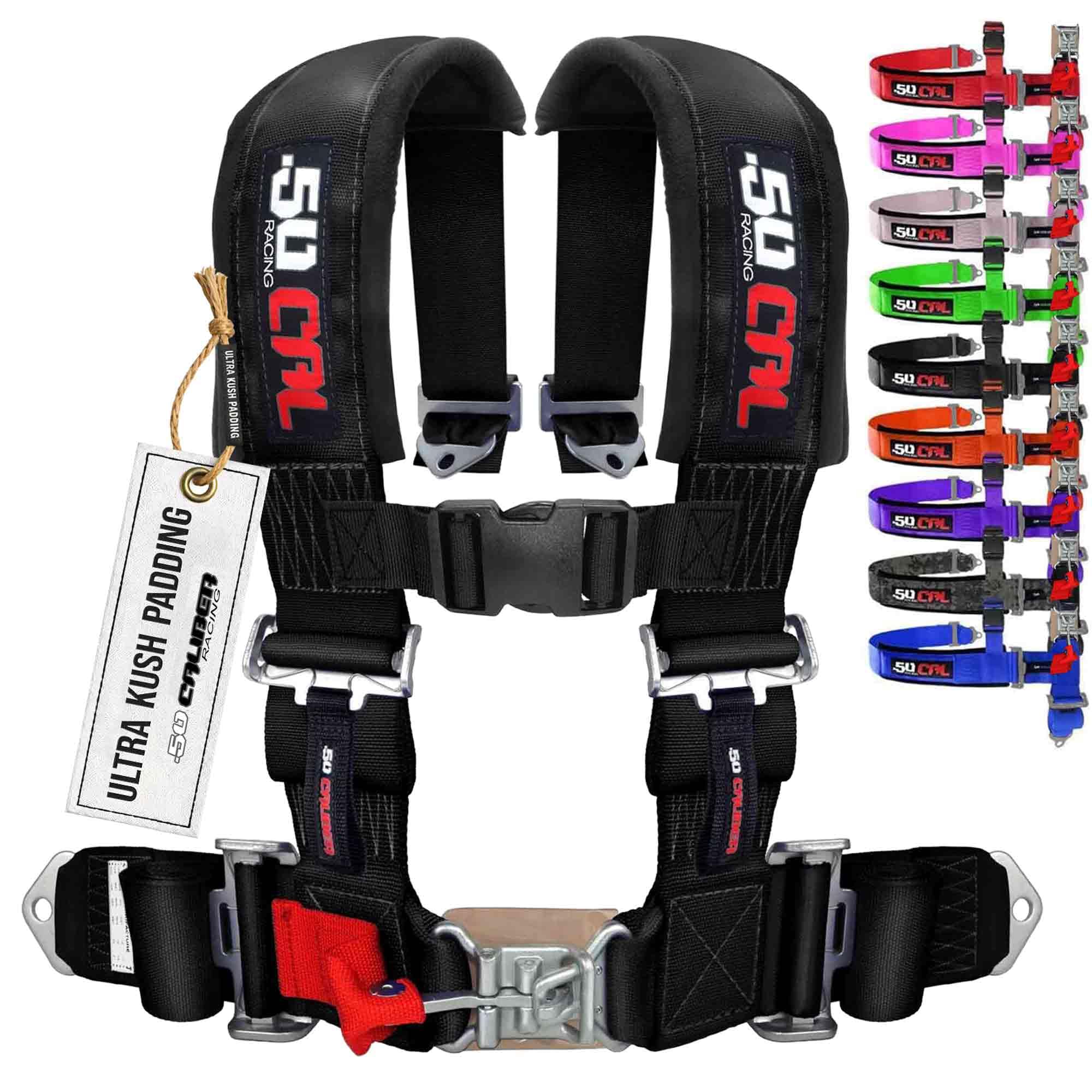
Stock UTV and ATV seatbelts lack the anti-submarine design and shoulder restraint needed for aggressive off-road driving where sudden weight shifts and hard braking are constant. The 50 Caliber Racing 4 Point Harness addresses this with a quick-release latch mechanism that allows rapid exit in an emergency while the pull-up adjusters let drivers of different heights dial in a secure fit. The Ultra Kush padding distributes pressure across the shoulders and lap evenly.
Made from high-strength polyester webbing with reinforced stitching and corrosion-resistant hardware, this harness is rated for off-road and competition use only — it is not DOT approved and should never be used on public highways. Owners of Yamaha R-max 4-seaters and Polaris RZR models report that installation is straightforward using the included hardware, and the color-matched options align well with interior schemes.
The difference over stock belts is immediate: the 4-point system locks your torso and hips into the seat so you feel the chassis movement through the steering wheel rather than sliding against the plastic seat bottom. For dune riding and high-speed trail work, where quick directional changes are constant, this harness transforms driver confidence and reduces fatigue significantly.
Why it’s great
- Ultra Kush padding distributes load across shoulders
- Quick-release latch for emergency exit
- Pull-up adjusters fit different driver sizes
Good to know
- Not DOT approved — off-road use only
- Mounting requires strong anchor points
2. NIBBI PE24mm Carburetor Kit for Predator 212 / Coleman 196cc-224cc
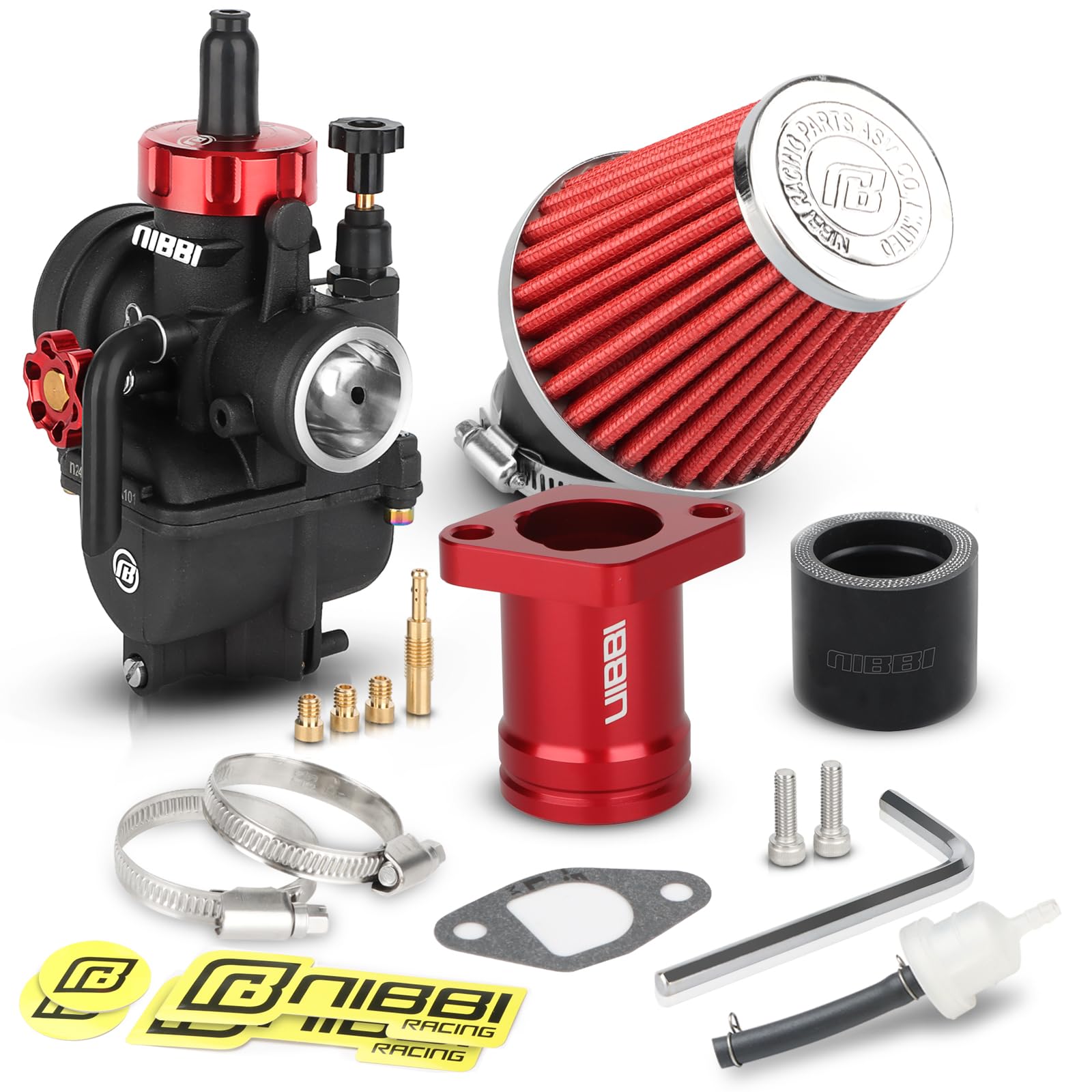
The PE24mm carb is a step above the generic VM22 clones that flood the mini-bike market, offering a true 24mm venturi with a properly machined intake manifold that eliminates the frustrating task of aligning multiple gaskets. This kit includes the NIBBI carburetor, an aluminum intake manifold, and a 48mm air filter, all engineered to bolt onto Predator 212cc, Coleman CT200U, and Tillotson 212 engines with minimal fuss.
Out of the box, the jetting is lean — a 35 pilot and 120 main jet is the recommended starting point at sea level, with fine-tuning required for elevation changes above 3,000 feet. Owners report that throttle response is noticeably smoother than VM22 carbs, with cleaner modulation across the RPM range rather than just a peak-power hit. One builder at 5,300 feet ran a 118 main jet with the needle clip on #3 and achieved strong midrange pull with instant response.
The 360-day warranty and the brand’s reputation for consistent QC make this a low-risk upgrade. For anyone building a 212cc mini bike or go-kart who wants linear power delivery without constant readjustment, this kit delivers a significant drivability improvement over a stock carburetor at a sensible cost.
Why it’s great
- True 24mm venturi with proper intake manifold alignment
- Smoother throttle response than VM22 clones
- 360-day manufacturer warranty
Good to know
- Jetting is lean from factory — requires tuning
- Needs jet assortment for elevation changes
1. YOXUFA 212cc Stage 2 Kit (Carburetor + Exhaust + Air Filter)

For budget-conscious builders who want to upgrade airflow and exhaust on a single purchase, the YOXUFA Stage 2 kit bundles a 212cc carburetor, a polished exhaust pipe and muffler, two 62mm pleated air filters, a fuel filter, fuel line, throttle cable, spark plug, jets, gaskets, and hardware — everything except the engine itself. The 62mm pleated air filter design increases the surface area for cleaner, larger-volume intake.
The exhaust silencer uses continuous welding to reduce the chance of cracking under vibration, a common failure point on cheaper mufflers. Fitment spans the widest range in the lineup: Hemi and non-Hemi Predator 212cc 6.5hp, Coleman CT200U/BT200X/KT196, Baja Warrior MB200/MB165, Massimo MB200, TrailMaster Interceptor and MB200 series, and Mega Moto MM-B212MX/PRO models.
Reviews highlight that the carburetor may need jet swapping out of the box — the supplied jets are a starting point, not a final tune. One buyer described installation as a “nightmare” due to difficult carburetor adjustment and no power increase, but multiple others praise the value and fitment accuracy for the price. This is a DIY tuning project, not a bolt-and-go kit.
Why it’s great
- Complete Stage 2 bundle with exhaust, carb, and filters
- Broadest fitment list for 212cc mini-bike engines
- Welded muffler resists vibration cracking
Good to know
- Carburetor needs jet tuning out of the box
- Quality consistency varies between units
FAQ
What jet sizes should I start with on a PE24 carb for a Predator 212 at sea level?
Can I use a 4-point racing harness on public roads?
How much camber adjustment does the Skunk2 Tuner kit provide on a 1996 Civic?
Final Thoughts: The Verdict
For most users, the best auto racing parts winner is the maXpeedingrods Coilovers because they deliver genuine chassis performance, broad Honda/Acura fitment, and adjustable height at a price that undercuts name-brand coilovers by hundreds. If you want precise ignition control for consistent drag-strip launches, grab the MSD Ignition 8733. And for off-road safety where stock belts just don’t cut it, nothing beats the 50 Caliber Racing 4 Point Harness with Ultra Kush padding.