
That musty smell when you first flip on the A/C isn’t just annoying — it’s a cloud of trapped pollen, exhaust gases, and mold spores being blown directly into your face. The automotive cabin air filter is the only barrier between the tailpipe of the car in front of you and the air your kids breathe on the morning school run, yet most drivers ignore it until airflow drops to a trickle.
I’m Min — the co-founder and writer behind Gadgets Feed. My approach to this guide involved cross-referencing thousands of verified customer experiences with the actual media density, carbon layer thickness, and electrostatic charge specs that determine whether a filter truly captures sub-2.5 micron particles or just looks good in the box.
After analyzing seven top contenders across the most popular Japanese, Korean, German, and American platforms, this guide delivers a clear verdict on the best automotive cabin air filters for allergy season, urban commutes, and long-haul road trips.
How To Choose The Best Automotive Cabin Air Filters
The cabin air filter is a consumable that directly impacts your respiratory health, HVAC efficiency, and windshield fogging behavior. Choosing poorly means either reduced airflow from overly dense media or bypassed unfiltered air from a loose seal. Focus on three variables: media type, physical dimensions, and carbon layer quality.
Media Type: Electrostatic vs. HEPA vs. Activated Carbon
Standard electrostatic pleated paper captures down to ~5 microns — fine for dust but useless against smoke or diesel soot. True HEPA-rated media (Bosch 6055C, Richwei CF10285) traps 99.97% of particles at 0.3 microns, critical for allergy and asthma sufferers. Activated carbon layers add gas-phase adsorption for ozone, VOCs, and road odor. If you drive in heavy traffic or wildfire-prone regions, a carbon-HEPA hybrid is the minimum acceptable choice.
Fitment Precision: OEM Cross-Reference Numbers
A filter that is 1/16″ too long, as some users reported with the Spearhead BE-966 in certain Acura models, will bulge the filter door and let unfiltered air bypass the media. Always verify the exact OEM cross-reference numbers (e.g., Toyota 87139-02020 or Hyundai 97133-L1000) against your vehicle’s parts catalog rather than relying on generic “fits model year range” claims.
Carbon Density and Airflow Trade-Off
Thicker carbon layers improve odor removal but increase static pressure drop across the filter. A user of the Richwei CF10285 noted a 25% airflow reduction on the highest fan setting. If your vehicle’s blower motor is already marginal, a high-density carbon filter may reduce cooling performance in summer. Balance media density with your climate control system’s capacity.
Quick Comparison
On smaller screens, swipe sideways to see the full table.
| Model | Category | Best For | Key Spec | Amazon |
|---|---|---|---|---|
| BOSCH 6055C HEPA | Premium HEPA | Allergy relief, maximum particle capture | 99.97% filtration at 0.3 microns | Amazon |
| Richwei CF10285 | Premium Carbon | Heavy odor, Toyota/Lexus fleet coverage | HEPA + activated carbon, 11.68 oz weight | Amazon |
| PureFlow PC99594X | Premium Carbon | Hyundai/Kia/Genesis modern platforms | 4-level filtration with baking soda layer | Amazon |
| ECOGARD XC10218C | Mid-Range | Lexus OEM replacement at low cost | Carbon layer, fits 2014-2025 Lexus IS | Amazon |
| Mann-Filter CUK 2939 | Mid-Range | VW/Audi German engineered fit | Activated charcoal, made in Germany | Amazon |
| Spearhead BE-966 | Mid-Range | GM/Cadillac/Honda full-size SUV fleet | 2X heavier media, 15,000-mile life | Amazon |
| EPAuto CP733 | Entry-Level | Mini Cooper specific fit | Soda and carbon infused, 17.72″ length | Amazon |
In‑Depth Reviews
1. BOSCH 6055C HEPA Cabin Air Filter

The Bosch 6055C sets the benchmark for residential-grade HEPA filtration in a vehicle cabin filter. Its melt-blown electrostatic layer combined with a dense pre-filter media achieves the true 99.97% capture rate at 0.3 microns that allergy and asthma sufferers demand. Structural ribs along the frame prevent the media from collapsing under high fan speed static pressure — a common failure point in cheaper pleated filters.
Fitment is precise across the broad Toyota, Lexus, Subaru, and Scion platforms that share the 6055C form factor. Users report effortless 5-minute swaps on vehicles as varied as the 2019 Highlander, 2018 Subaru Outback, and Toyota Venza. A critical detail: the airflow direction arrow points toward the blower motor (downward in many installations), opposite to some OEM Subaru filters — follow the arrow, not the old filter’s orientation.
The trade-off is that Bosch omits a formulated chemical odor neutralizer, trusting the HEPA media and electrostatic charge to do the work without adding ozone or perfumes. If you prioritize absolute particulate filtration over scent masking, this is the filter to beat. Its price reflects genuine HEPA certification, not just a marketing label.
Why it’s great
- Certified HEPA captures 99.97% of particles down to 0.3 microns
- Structural ribs prevent media collapse and maintain consistent airflow
- Multi-layer construction with static cotton layer for high dust-holding capacity
Good to know
- No chemical odor neutralizer for heavy smoke or skunk scenarios
- Airflow arrow orientation differs from some OEM Subaru filters — verify direction
2. Richwei CF10285 Cabin Air Filter

The Richwei CF10285 combines a true HEPA media layer with an activated carbon layer, targeting the broadest vehicle compatibility list in this guide — spanning Toyota 4Runner, Camry, Corolla, Highlander, RAV4, and Lexus ES/GS/RX models from 2006 through 2022. At 11.68 ounces, it is notably heavier than most competitors, indicating denser media and a thicker carbon bed that adsorbs diesel exhaust and industrial VOCs.
Users report instant improvement in cabin air freshness, with one owner noting it eliminated beef gravy odor from a carpet spill — a testament to carbon’s adsorption capacity. The fitment against OEM cross-references (87139-02020, 87139-02090, and 87139-YZZ16) is precise, though the filter’s density does reduce top fan speed airflow by roughly 25% according to a 2024 4Runner owner. This is the price of high-efficiency gas-phase filtration.
For drivers in urban corridors, wildfire areas, or regions with heavy agricultural odors, the trade-off of slightly reduced max airflow for dramatically improved air purity is worthwhile. The filter’s construction uses a nonwoven activated carbon layer that won’t shed carbon dust into your HVAC system, a concern with cheaper carbon-impregnated papers.
Why it’s great
- True HEPA + activated carbon hybrid for both particulate and gas removal
- Extensive cross-reference coverage across Toyota, Lexus, and Subaru platforms
- Dense construction holds more contaminants without passing them through
Good to know
- Observed 25% airflow reduction at highest fan speed in some vehicles
- Verify fitment year range carefully — some model years have revised filter slots
3. PureFlow PC99594X Cabin Air Filter
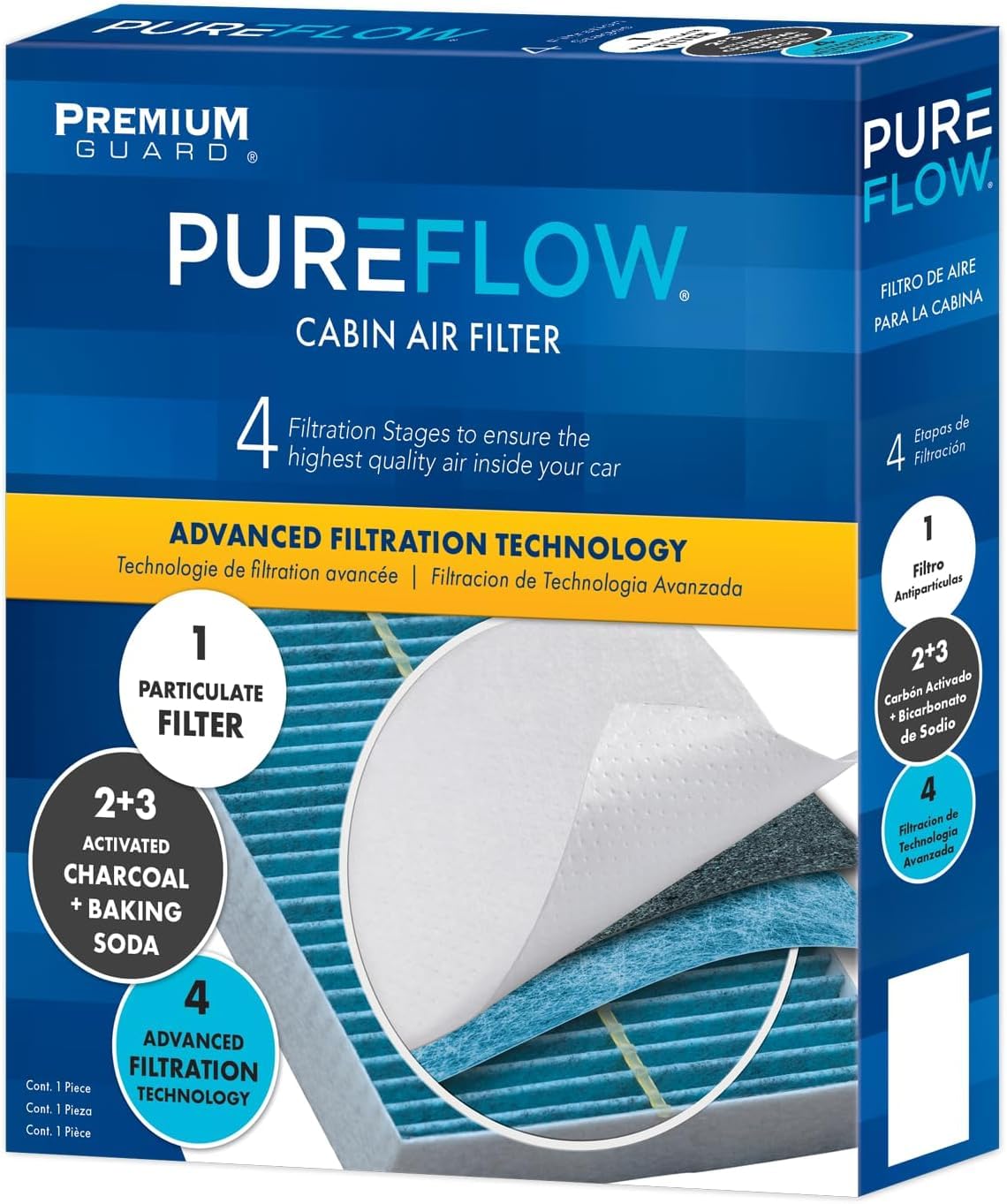
PureFlow’s PC99594X is engineered specifically for the modern Hyundai/Kia/Genesis GMP platform generation, including the 2022-2025 Tucson, 2021-2025 Elantra, Santa Fe, Kia Sportage, and the Ioniq 5/Kia EV6 electric models. Its four-level filtration architecture adds a baking soda-infused layer to the standard particulate pre-filter, carbon media, and fine particulate layer, targeting odors that carbon alone cannot fully neutralize.
The 8.9″ x 8.23″ x 1.19″ dimensions drop into the glove box slot with zero modification, and the gasketed edges ensure no unfiltered bypass. The baking soda layer is particularly effective for pet odors and organic smells that carbon struggles with.
While the PureFlow lacks a formal HEPA certification, its electrostatic particulate media captures the majority of pollen and dust mite allergens. For the growing number of Hyundai and Kia drivers on the road, this is the most targeted OEM-grade option available, backed by Premium Guard’s quality control and fitment verification tool on Amazon.
Why it’s great
- Four-layer design includes baking soda for pet and organic odor adsorption
- Precision fit for Hyundai/Kia/Genesis GMP platforms without modification
- Electrostatic media captures fine dust and pollen effectively
Good to know
- Not certified HEPA — misses some sub-micron particles
- Limited to 2021+ Hyundai/Kia/Genesis models only
4. ECOGARD XC10218C Premium Cabin Air Filter

The ECOGARD XC10218C targets Lexus and Toyota IS, GS, RC, and GS F platform owners who want activated carbon filtration at a fraction of the dealer’s price. Its pleated paper construction with carbon impregnation filters 99.5% of airborne solids, and users of the 2023 Lexus IS 500 and 2024 Lexus IS 350 F Sport confirm drop-in fit with zero modification required. The 8.7″ x 7.95″ x 1.14″ dimensions mirror the OEM Toyota 87139-30100 exactly.
Multiple reviewers note that while the carbon layer is less thick than premium options, it eliminates the musty A/C smell that develops after 12 months of use. One owner of a 2018 Lexus GS observed fewer pleats per inch compared to the OEM Denso filter but concluded that annual replacement at 10,000 miles keeps performance consistent. The included instructions walk through the 5-minute glove box removal process common to most Lexus models.
The carbon layer’s surface area is adequate for light urban commuting and general odor reduction, but drivers in heavy traffic or wildfire areas may find the gas-phase adsorption capacity insufficient for prolonged exposure to diesel exhaust. For the price, it is a legitimate OEM-grade replacement with no fitment issues.
Why it’s great
- OEM-grade fitment across Lexus IS/GS/RC platforms at a low cost
- Carbon layer eliminates standard musty A/C odors effectively
- Simple DIY installation with clear instructions
Good to know
- Fewer pleats than OEM Denso — may clog faster in dusty environments
- Carbon density is lighter than premium carbon options
5. Mann-Filter CUK 2939 Cabin Filter
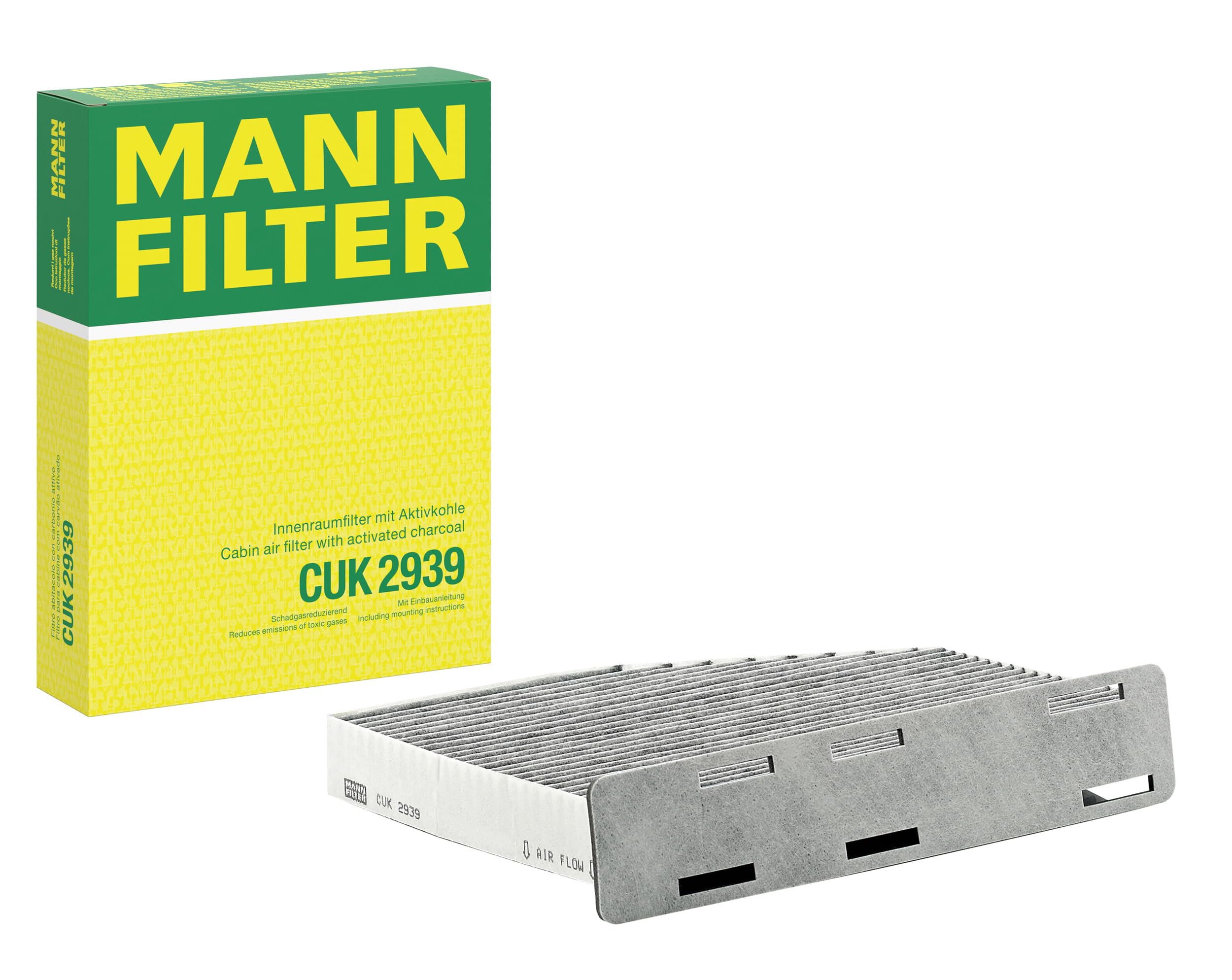
Mann-Filter is the original equipment supplier for many Volkswagen Group vehicles, and the CUK 2939 is the exact filter that would ship from the factory on Audi A3, Volkswagen Jetta, Passat, Golf, and Beetle models from the mid-2000s onward. Its 8.66″ x 2.36″ x 11.42″ dimensions and slide-in mounting design match the tight glove box compartments of German platforms precisely. The activated charcoal layer is densely packed and thermally bonded to the pleated paper substrate, preventing carbon migration into the HVAC plenum.
Owners of 2016 Jetta, 2009 MK5 Rabbit, and 2017 Passat report that the CUK 2939 fits with zero trimming and that the charcoal layer produces noticeably cleaner air with reduced pollen ingress during spring. One reviewer noted the immediate improvement in interior air smell after replacing a neglected 2-year-old filter — the difference was dramatic enough to warrant a second purchase. The low flow resistance design ensures that VW’s already modest blower motors don’t struggle to move air.
The CUK 2939 uses electrostatic attraction combined with mechanical filtration to achieve high efficiency at low restriction. For VAG owners who want the same filter their dealer would install without the dealer markup, this is the definitive choice. The carbon layer is effective for standard road odors but may not be sufficient for extreme smoke or chemical exposure.
Why it’s great
- OEM supplier to Volkswagen Group — exact factory fitment guarantee
- Electrostatic + mechanical filtration for high efficiency with low flow restriction
- Thermally bonded charcoal prevents carbon dust shedding
Good to know
- Limited to VW/Audi platforms — not universal
- Carbon density is moderate, not suitable for extreme chemical odors
6. Spearhead Odor Defense BE-966 Cabin Filter
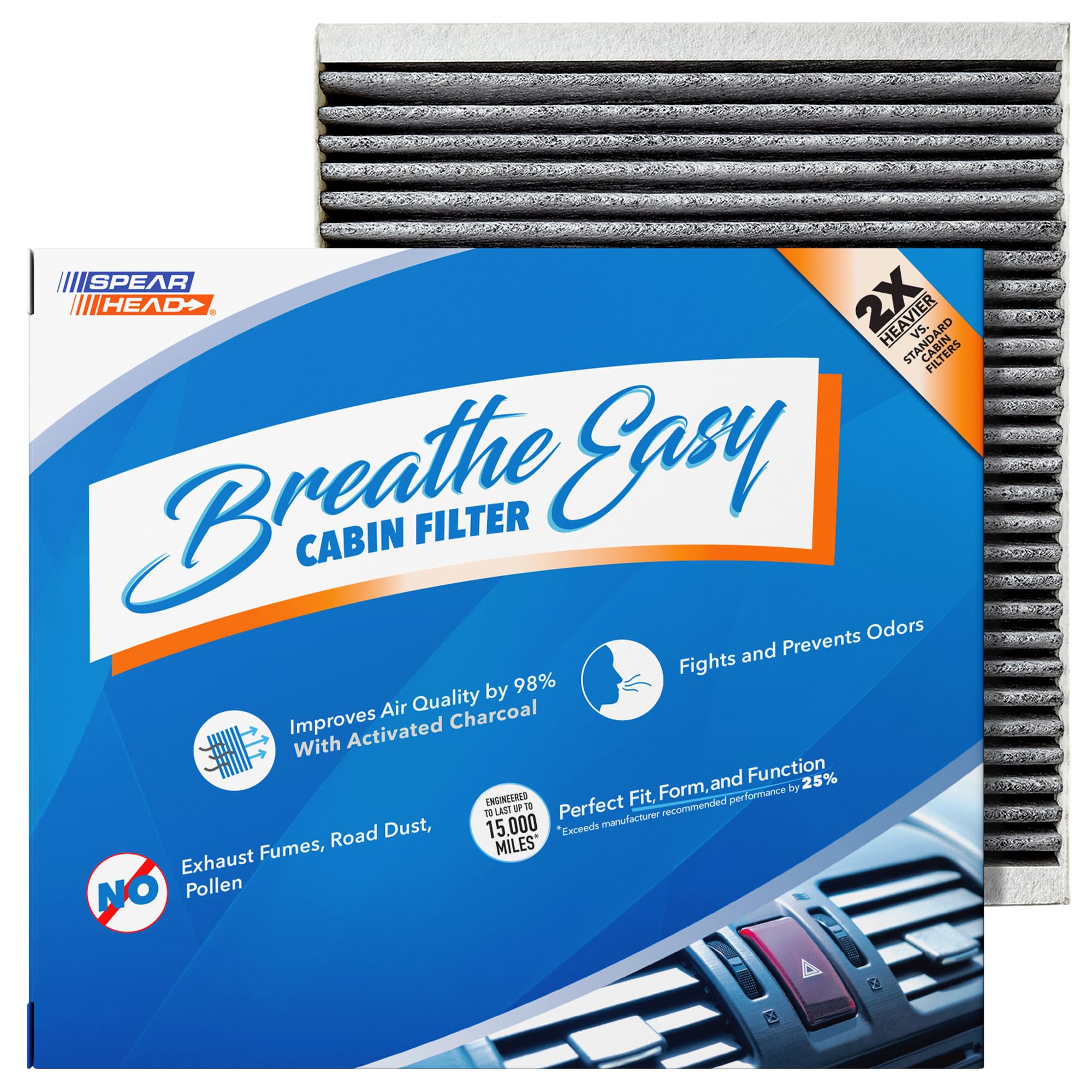
Spearhead’s BE-966 is purpose-built for the General Motors full-size SUV and truck family — including Suburban, Tahoe, Yukon, Escalade, Sierra, and Silverado, plus the Honda- and Acura-badged variants like the ZDX and TLX. Its claim of 2X heavier media than standard filters is backed by the 0.3-pound weight and industrial-grade electrostatic media that attracts particles down to the micron range. The coconut shell activated carbon layer is densely packed and engineered for 15,000 miles of service.
Users report that the BE-966 eliminates musty smells within hours of installation and matches the fitment of the dealer OEM filter. One owner of a 2023 Acura TLX noted the filter was 1/16″ too long, requiring slight trimming — a known issue for certain Acura models, so verify fitment carefully. For GM full-size owners, the media density ensures that exhaust fumes from highway driving and construction site dust are effectively captured.
The precision-woven media layers include a pre-filter for large particulates and a fine filter for sub-micron particles. Spearhead’s claim of 25% longer life than the standard 12,000-mile replacement interval is supported by the media’s dust-holding capacity, though the actual lifespan depends on the driving environment. Rural and highway drivers will reach 15,000 miles easily; urban commuters in smog should still replace annually.
Why it’s great
- 2X heavier electrostatic media captures more particulate mass
- Rated for 15,000-mile service life — 25% longer than standard
- Coconut shell activated carbon adsorbs gases and odors effectively
Good to know
- Fitment tolerance issue in some Acura TLX models — verify before purchase
- Media density may reduce airflow in vehicles with marginal blower motors
7. EPAuto CP733 Premium Cabin Air Filter

The EPAuto CP733 is the only filter in this guide designed specifically for the quirky Mini Cooper platform, covering the 1.6L Cooper, Cooper Countryman, and Cooper Paceman from 2007 through 2016. Its 17.72″ x 1.18″ x 4.65″ dimensions and curved guide rail design match the unique under-glove-box slot that Mini engineers conceived. The soda and carbon infusion generates what the manufacturer calls “fresh breeze air” — effectively a mild deodorizing effect beyond standard carbon filtration.
Reviewers of 2012 Cooper hardtops and 2014 Countryman R60 confirm that the filter slides smoothly into the curved guide rails without jamming, and that the activated carbon layer eliminates the musty A/C smell that Minis are notorious for developing. One owner noted that the orientation arrows point downward on the Countryman, which differs from some aftermarket filters — a critical detail for proper filtration direction.
The recommendation is to replace every 12,000 miles or 12 months, and the filter’s pleated construction with soda and carbon provides adequate filtration for standard driving conditions. However, the media density is lower than premium options, so drivers in high-pollen areas may need more frequent changes. For the price, it is the definitive budget option for Mini owners who want an improvement over the stock paper filter.
Why it’s great
- Precision fit for Mini Cooper 1.6L and Countryman platforms
- Soda and carbon infusion provides effective deodorizing
- Curved guide rail design prevents improper installation
Good to know
- Lower media density may clog faster in high-pollen environments
- Limited to Mini Cooper models only — no broader vehicle compatibility
FAQ
How often should I replace my automotive cabin air filter?
What is the difference between a carbon filter and a HEPA filter for cabin air?
Will a thicker cabin filter reduce my car’s HVAC airflow?
Final Thoughts: The Verdict
For most users, the best automotive cabin air filters winner is the BOSCH 6055C HEPA Cabin Air Filter because it delivers certified 0.3-micron HEPA filtration with structural integrity and precise cross-platform fitment. If you want maximum odor and gas adsorption for heavy traffic or wildfire zones, grab the Richwei CF10285. And for Hyundai/Kia/Genesis owners looking for a platform-specific upgrade with baking soda deodorization, nothing beats the PureFlow PC99594X.