
A portable recorder that doubles as your primary microphone must solve one problem above all others: capturing clean, usable audio without the anxiety of setting gain levels mid-interview or worrying about sudden peaks ruining a take. The difference between a keeper and a ruined file is often a matter of milliseconds, and the right device delivers confidence that a sub- gadget simply cannot provide.
I’m Min — the co-founder and writer behind Gadgets Feed. I track this market obsessively, comparing bit depth, preamp noise floors, and battery endurance across dozens of models to separate genuine pro-grade tools from overpriced plastic boxes.
Whether you are recording interviews, ambient soundscapes, or podcast dialogues from two XLR mics, the best audio recorder microphone is the device that delivers studio-grade reliability in a handheld form factor without forcing you to babysit the input level.
How To Choose The Best Audio Recorder Microphone
An audio recorder microphone is not a simple dictation device. You are selecting a preamp, an ADC, storage logic, and a microphone capsule all in one. The wrong choice means noisy recordings, clipped transients, or a workflow that leaves you fighting the menu system instead of focusing on the content.
Bit Depth and Float Recording
Standard 16-bit and 24-bit recorders require precise gain staging before you press record. Exceed 0 dBFS and the waveform is permanently clipped. 32-bit float recorders store the signal at a level that can be normalized in post without any distortion, effectively giving you a safety net that forgives hot inputs. If you record unpredictable sources like live music or loud interview guests, 32-bit float is the single most useful feature you can buy.
XLR vs. 3.5mm Inputs
A 3.5mm microphone jack is common on budget recorders and delivers acceptable results with lavalier mics or consumer-grade shotguns. XLR inputs with locking connectors give you access to professional dynamic and condenser microphones, phantom power, and balanced audio that rejects electrical interference. A dual XLR recorder elevates your setup from voice-memo quality to broadcast-ready capture, especially for two-person interviews.
Battery Type and Runtime
AA batteries are the safe, replaceable standard — dead batteries in the field are solved by a quick trip to any convenience store. Internal lithium-ion packs are lighter and charge via USB but leave you helpless when the battery depletes. Premium recorders that support USB power delivery allow continuous recording when plugged into a power bank, which is essential for long-form recording sessions or all-day field work.
Quick Comparison
On smaller screens, swipe sideways to see the full table.
| Model | Category | Best For | Key Spec | Amazon |
|---|---|---|---|---|
| Zoom H4 Essential | Premium | Multi-track recording with XLR mics | 4-track 192kHz / 32-bit float | Amazon |
| Zoom H1 XLR | Mid-Range | Interviews with two XLR mics | 2 XLR/TRS inputs / 32-bit float | Amazon |
| TASCAM DR-05XP | Mid-Range | Field recording with USB-C interface | 32-bit float / 96kHz / 17.5hr battery | Amazon |
| Xvive XV1-R | Mid-Range | Compact recorder with tripod mount | 32-bit float / 96kHz / 130dB SPL | Amazon |
| TASCAM DR-10X | Mid-Range | XLR plug-on news gathering | Dual recording / 48kHz 24-bit WAV | Amazon |
| Olympus WS-883 | Entry-Level | Voice memo and lecture capture | 8GB internal / 2080hr recording time | Amazon |
| OM System WS-882 | Budget | Simple dictation and phone calls | 4GB internal / 1040hr MP3 recording | Amazon |
In‑Depth Reviews
1. Zoom H4 Essential Handheld Recorder

The Zoom H4 Essential packs the largest microphone capsule on any handheld recorder at 19.4mm, delivering a rich X/Y stereo field that captures nuances a smaller capsule would miss. With 32-bit float recording at up to 192kHz sample rate across four tracks simultaneously, you can run two XLR microphones and the built-in stereo mics without ever worrying about gain staging or clipping.
The dual XLR/TRS combo inputs with dedicated gain knobs give you hands-on level control for live environments, while the USB audio interface mode routes all four channels directly into your DAW. Battery life reaches 20 hours on two AAs, and the unit can also draw power from a USB battery pack for all-day field sessions — essential for long-form podcast or film set capture.
Post-processing is required to normalize 32-bit float files since the recording level appears low on import, but the absence of any distortion artifacts more than justifies this extra step. The slight bulk (243 grams) is the only compromise for the feature density, making it a better studio-on-the-go than a pocket dictation tool.
Why it’s great
- Four-track simultaneous recording with zero-clip 32-bit float
- 19.4mm X/Y capsule delivers the richest onboard stereo sound
- Dedicated gain knobs and USB-C audio interface for studio workflow
Good to know
- Heavier than pocket recorders at 243 grams
- Handling noise requires a windscreen or isolation mount in windy conditions
- Post-processing needed to normalize 32-bit float levels
2. Zoom H1 XLR 2-Channel Recorder

The Zoom H1 XLR redefines the entry point for professional XLR recording by offering two locking combo inputs and 32-bit float at 96kHz in a sub- package. An OLED waveform display lets you confirm your levels are clean at a glance, and the 3.5mm stereo input accepts a second external mic or line-level source, giving you three capture channels in a pocket-sized body.
SDXC support up to 1TB means you can record weeks of high-resolution audio without swapping cards, and the USB-C port serves as both a data transfer link and an audio interface for direct computer recording. Battery life is a solid 10 hours on two AAs, and the unit auto-switches to USB power when connected — a feature that eliminates the anxiety of dying batteries mid-interview.
The plastic housing feels lighter than premium metal recorders, and some users report fragility from drops, so a carrying case is a practical investment. For journalists, podcasters, and musicians who need two XLR mic inputs without jumping to a recorder, the H1 XLR delivers pro-grade results at a fraction of the cost.
Why it’s great
- Two XLR/TRS combo inputs with 32-bit float recording
- OLED waveform display for instant level confirmation
- SDXC support up to 1TB with USB-C audio interface mode
Good to know
- Plastic build is lightweight but less durable than metal chassis
- Requires reading the manual to access advanced features
- No internal storage; relies entirely on microSD card
3. TASCAM DR-05XP Portable Field Recorder

The TASCAM DR-05XP is a field recorder that bridges the gap between simple voice memo devices and professional multi-track units. It supports 32-bit float, 24-bit, and 16-bit recording at up to 96kHz, giving you the flexibility to choose the format that matches your post-production workflow. The omnidirectional condenser mics handle up to 125dB SPL, making them suitable for loud environments like live music or crowded events.
Its 2-in/2-out USB-C audio interface feature allows you to use the recorder as a high-quality sound card for your laptop, eliminating the need for a separate interface in portable setups. Battery life reaches 17.5 hours on two AA alkalines, and the unit saves the file automatically if power dies — a critical safeguard for unattended recording sessions. The TASCAM preamps are notably clean, with users reporting zero noise when using line-level inputs at zero gain.
The internal speaker is essentially non-functional for monitoring, so you will rely on the headphone jack for playback. A small number of users report minimal left-right separation from the built-in mics, but with an external stereo mic via the 1/8-inch jack, the DR-05XP punches well above its weight for field recording and backup capture.
Why it’s great
- Flexible recording modes from 32-bit float to MP3
- USB-C audio interface eliminates separate hardware
- Auto file-save on power loss and 17.5-hour battery life
Good to know
- Built-in mics produce subtle mono character with limited stereo width
- Internal speaker is nearly unusable for monitoring
- Single record-button press does not guarantee recording start
4. Xvive XV1-R Portable Stereo Recorder
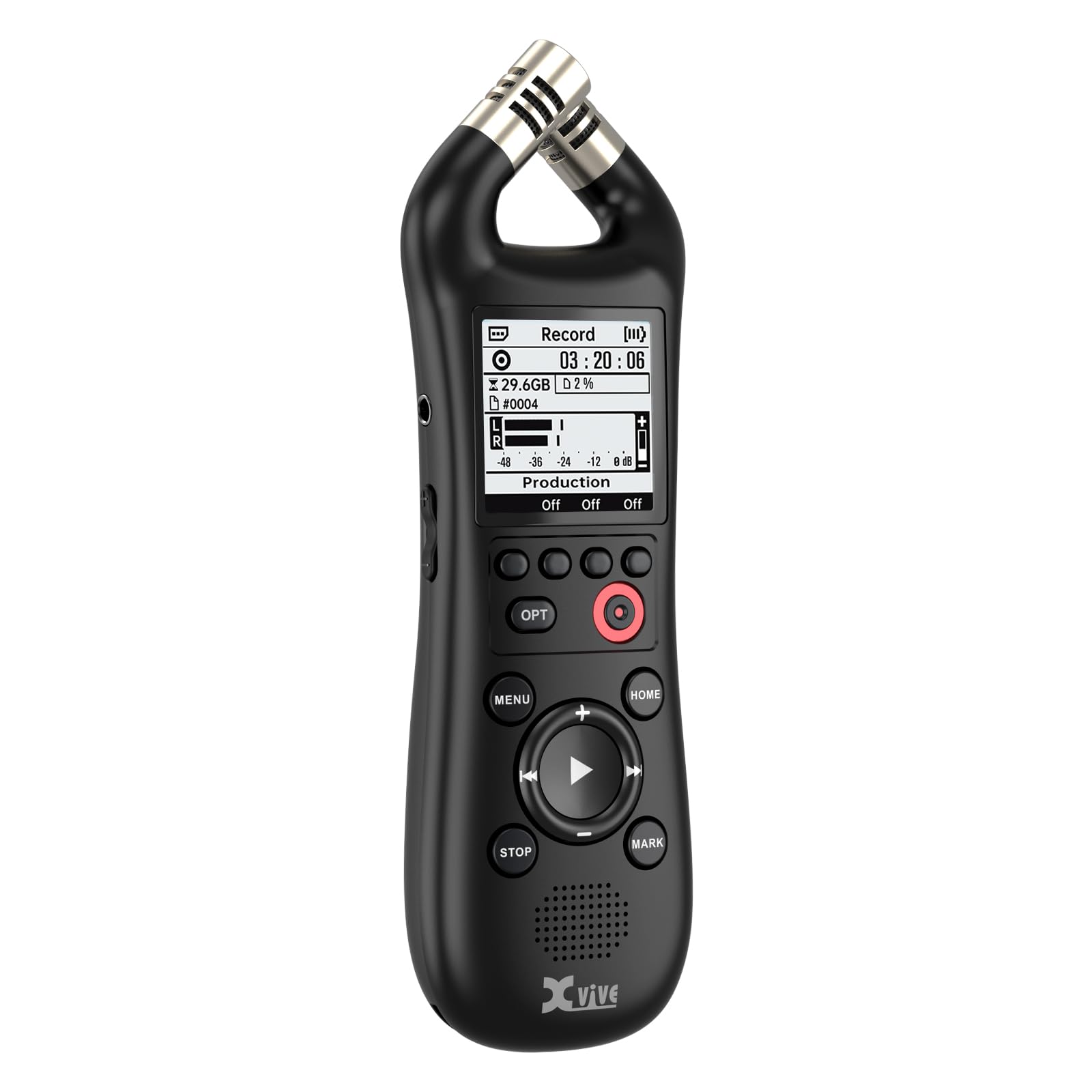
The Xvive XV1-R is a pint-sized stereo recorder that delivers high-fidelity 32-bit float audio up to 96kHz in a form factor that fits in a coat pocket. Its maximum SPL of 130dB means you can place it right next to a drum kit or a guitar amp without overloading the preamps, making it a strong candidate for music rehearsals and live sound capture. Supported file formats include WAVF32, WAV24, HE-AAC, and AAC-LC, accommodating both archival-quality WAV files and space-efficient MP3s.
A threaded tripod mount, slate tone generator, and film markers allow seamless integration with DSLR and video cameras for audio-for-video workflows. The onboard limiter, noise gate, and lo-cut filter provide real-time sound shaping that reduces post-production work. Operation on two AA batteries delivers up to 12 hours of recording, and the USB-C port handles both data transfer and continuous power from a battery pack.
The XV1-R lacks USB power-only operation, meaning it still draws from batteries when connected to a computer for data transfer, which is a minor inconvenience for users who prefer to run solely on external power. Despite that, the sound quality and feature density in this price range are exceptional for a recorder that weighs only 8.4 ounces.
Why it’s great
- 130dB SPL handling for loud sources like live drums
- 32-bit float recording in a highly portable 8.4 oz package
- Tripod mount and slate tone for video synchronization
Good to know
- No USB-only power mode; batteries drain during data transfer
- Limited to 3.5mm input — no XLR connectivity
- Brand is less established than TASCAM or Zoom
5. TASCAM DR-10X XLR Micro Recorder
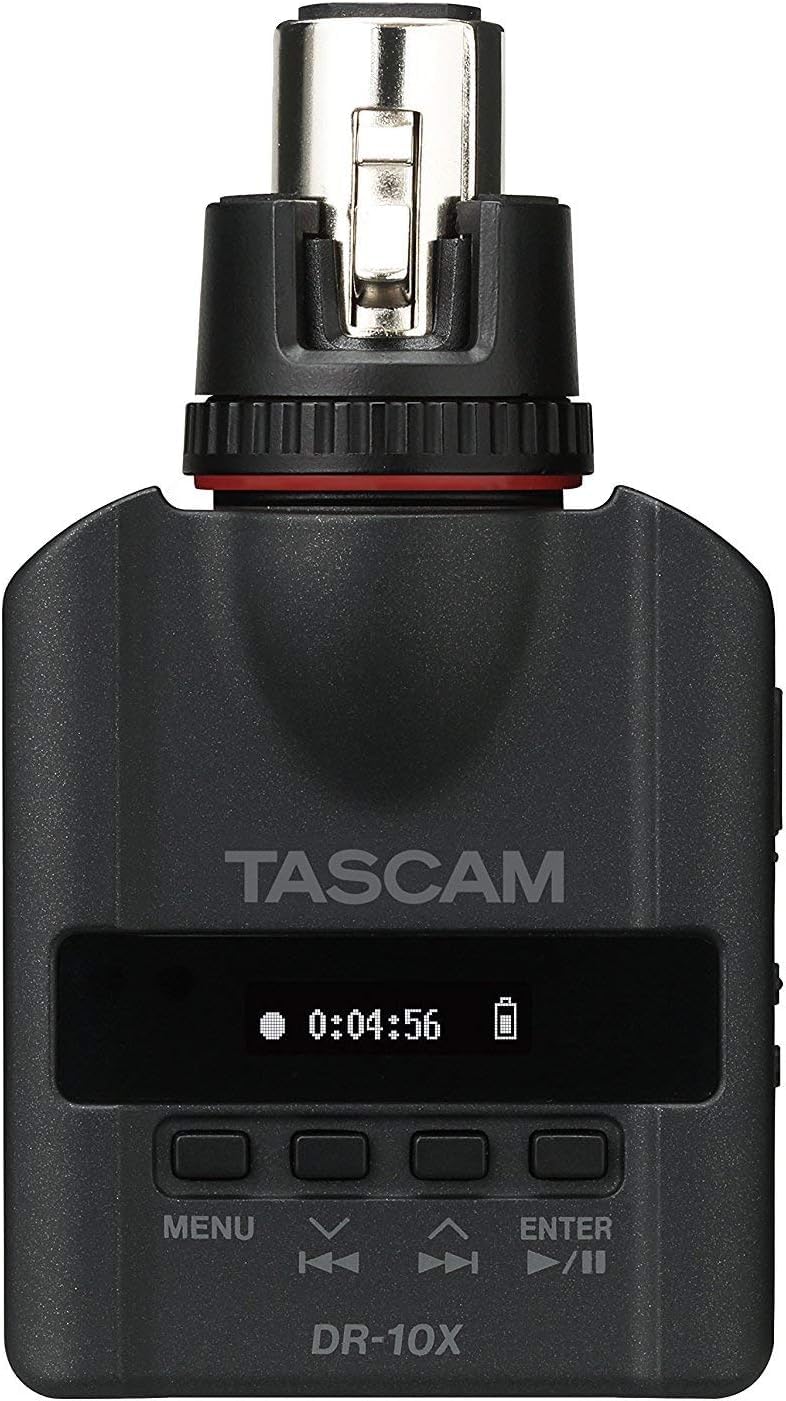
The TASCAM DR-10X takes a unique approach: it is a plug-on recorder that attaches directly to a handheld XLR microphone, converting any dynamic mic into a complete news-gathering system. The captive XLR connector locks securely, and the sliding record switch prevents accidental activation — a thoughtful design element for on-the-go journalists. Dual recording mode captures a safety track at -6dB or -12dB, ensuring you have a usable backup even if the main track clips.
Recording in 48kHz/24-bit WAV or high-bitrate MP3, the DR-10X stores files on microSD cards up to 32GB. Manual and automatic gain settings, a low-cut filter at 120Hz, and a limiter give you multiple layers of protection against overload. The unit weighs just 0.16 pounds and runs on a single AAA battery for approximately 10 hours, making it the most lightweight XLR recorder on the market.
The DR-10X lacks phantom power, so it is restricted to dynamic microphones only — condenser mics require an external power source. The plastic housing feels utilitarian, and the maximum SD card size of 32GB is restrictive compared to modern SDXC support. For reporters and interviewers who already own a good dynamic handheld mic, this is the smallest, most purpose-built XLR recorder available.
Why it’s great
- Ultra-compact plug-on design for XLR handheld mics
- Dual recording with safety track prevents audio clipping
- Sliding record switch prevents accidental activation
Good to know
- No phantom power — dynamic microphones only
- Maximum SD card size is 32GB
- Plastic build lacks the heft of metal XLR adapters
6. Olympus WS-883 Digital Voice Recorder

The Olympus WS-883 (now under the OM System brand) is a linear PCM/MP3 recorder built for voice capture, offering 8GB of internal memory plus a microSD slot for expansion up to 32GB. Its true stereo microphones with a low-cut filter deliver clear recordings in lecture and meeting environments, and the 2080-hour maximum recording time in MP3 mode means you will rarely need to manage storage. The USB-A connector doubles as a battery charger for NiMh cells — a convenience feature not found on most recorders.
The one-switch, two-button operation with a dedicated lecture preset makes this recorder ideal for elderly users or anyone who wants a simple point-and-record experience. The 68-hour battery life on two AAA alkaline cells is among the best in its class, and the threaded USB slider keeps the connector protected when not in use. At 77 grams, it is barely noticeable in a pocket or bag.
The auto power-off feature cannot be disabled and may shut down the unit before you start recording, requiring a quick re-power. The screen lacks backlighting on playback, and the sampling fidelity is lower than pro-level recorders — this is a voice memo device, not a field recorder. For students, researchers, and professionals who need reliable dictation without editing overhead, the WS-883 is a proven workhorse.
Why it’s great
- 8GB internal memory with 2080-hour recording capacity
- USB-A connector charges NiMh batteries directly
- Extremely simple operation with lecture preset
Good to know
- Auto power-off cannot be disabled, risking missed recordings
- Lower sampling fidelity than pro field recorders
- No button backlighting on the screen
7. OM System Olympus WS-882 Digital Voice Recorder

The OM System WS-882 is the entry-level sibling of the WS-883, offering 4GB of internal memory and support for microSD cards up to 32GB. Like its higher-capacity counterpart, it records in linear PCM and MP3 formats, and the built-in stereo microphones produce surprisingly good audio quality for interviews and phone calls. The 1040-hour maximum recording time in internal memory is sufficient for months of meetings before offloading is needed.
The hold switch prevents accidental button presses during transport, and the USB direct connection makes file transfer as simple as plugging into a computer — no software or drivers required. Battery life extends to 68 hours on two AAA alkalines, which is market-leading for this price tier. The WS-882 boots faster with internal storage (4 seconds) compared to large SD cards (20 seconds), so using internal memory for quick recordings is the better workflow.
The dated user interface and sparse manual require some patience to learn advanced features. Phone-to-recorder duplication for music is poor, and the recorder cannot be recharged via USB — you must use NiMh rechargeable batteries or alkalines. For voice-first use cases like interviews and dictation, the WS-882 is the most affordable way to get Olympus build quality and stereo recording capability.
Why it’s great
- Exceptional 68-hour battery life on two AAA batteries
- 4-second boot time from internal memory
- Hold switch prevents accidental recording
Good to know
- Dated UI and sparse manual make learning curve steeper
- No USB charging — batteries must be replaced or externally charged
- Music duplication from phone is poor quality
FAQ
Do I need 32-bit float recording?
What is the difference between XLR and 3.5mm inputs?
Final Thoughts: The Verdict
For most users, the best audio recorder microphone winner is the Zoom H4 Essential because its 19.4mm capsule, four-track 32-bit float recording, and dual XLR inputs cover everything from field interviews to music production. If you want two XLR inputs at a lower cost, grab the Zoom H1 XLR. And for ultra-light news gathering with a handheld mic, nothing beats the TASCAM DR-10X.