
When the lights flicker and the room goes dark, the real disaster isn’t the inconvenience—it’s the corrupted file, the crashed server, or the abruptly halted firmware update that bricks a device. A battery backup (UPS) isn’t a luxury for those who value their data; it’s the cheapest insurance policy against the silent damage that power dips and spikes inflict on sensitive electronics. Choosing the right one means understanding the specific load of your equipment and the waveform your power supply demands.
I’m Min — the co-founder and writer behind Gadgets Feed. My research process for this guide involved cross-referencing hundreds of verified customer reports against manufacturer datasheets to isolate which UPS units actually deliver on their runtime claims under real-world loads.
After comparing capacity, waveform output, and battery chemistry across seven distinct models, you’ll find the definitive analysis of the best battery backup for your home office, network closet, or workstation setup right here.
How To Choose The Best Battery Backup
Selecting a UPS starts with a simple load calculation. List every device you intend to connect—monitor, desktop, router, NAS—and add their wattage. The UPS you choose must have a watt rating that exceeds that total by at least 20% to allow for startup surges and future expansion. VA ratings alone can be misleading; always check the watt specification.
Waveform Type: Pure Sine Wave vs. Simulated Sine Wave
This is the single most overlooked spec. Modern computers with Active PFC (Power Factor Correction) power supplies will shut down or behave erratically on simulated sine wave output. Pure sine wave UPS units cost more but guarantee compatibility with any PSU, network gear, and sensitive audio-visual equipment. If your hardware uses external power bricks or legacy PSUs, simulated sine wave (sometimes called “stepped approximation”) is usually fine.
Battery Chemistry and Runtime
Traditional sealed lead-acid (SLA) batteries dominate the budget and mid-range market. They are heavy, have a lifespan of 3–5 years, and require periodic replacement. Lithium Iron Phosphate (LiFePO4) units are emerging as a premium alternative—lighter, offering 10+ year lifespans with thousands of charge cycles, and consistent runtime over their entire life. Runtime is always inversely proportional to load: a 600W UPS may run a router for 90 minutes but only a gaming PC for 10 minutes.
Quick Comparison
On smaller screens, swipe sideways to see the full table.
| Model | Category | Best For | Key Spec | Amazon |
|---|---|---|---|---|
| CyberPower CP1500PFCLCD | Premium Mid-Tower | Gaming PCs / Workstations | 1500VA / 1000W Pure Sine Wave | Amazon |
| Eaton Tripp Lite OMNI1500LCDT | Premium Tower | Home Servers / Security Cameras | 1500VA / 810W Simulated Sine Wave | Amazon |
| APC SMC1500C Smart-UPS | Enterprise Smart UPS | Network Racks / Remote Monitoring | 1500VA / 900W Pure Sine Wave | Amazon |
| GOLDENMATE 1000VA Lithium UPS | LiFePO4 Compact | Desktops / AV Gear (Long Life) | 1000VA / 600W Pure Sine Wave | Amazon |
| CyberPower BRG1000AVRLCD | Mid-Range Mini-Tower | Home Office / Entertainment | 1000VA / 600W Simulated Sine Wave | Amazon |
| APC BE600M1 | Compact Entry-Level | Routers / Modems / Basic PCs | 600VA / 330W Simulated Sine Wave | Amazon |
| SKE SK425 | Budget Basic | Network Devices / Light Loads | 425VA / 240W Simulated Sine Wave | Amazon |
In‑Depth Reviews
1. CyberPower CP1500PFCLCD PFC Sinewave UPS

The CP1500PFCLCD is the gold standard for high-performance desktops and workstations because it delivers true pure sine wave output at a price point well below enterprise-class units. With 1500VA and a full 1000W capacity, it handles the demanding Active PFC power supplies found in modern gaming rigs and Mac Pros without the random shutdowns that plague simulated sine wave backups.
Its 12 total outlets—six providing battery backup and six surge-only—offer generous expansion, and the tilt-adjustable color LCD panel cycles through input voltage, load in watts, estimated runtime, and battery charge level. The unit includes two USB charging ports (Type-A and Type-C), which is rare at this tier, and CyberPower’s PowerPanel software enables automatic shutdown over USB.
Customer reports confirm that this unit sustains a 260W idle gaming PC for roughly 25 minutes and handles transient loads up to 870W without tripping. The only downsides are a temporary “new electronics” smell during the first day of operation and sensitivity to large appliance startups on the same circuit, but neither affects long-term reliability.
Why it’s great
- Pure sine wave output ensures full PFC PSU compatibility
- 12 outlets and 1000W capacity cover even high-power gaming rigs
- Color LCD with real-time watt and runtime readouts is genuinely useful
Good to know
- Initial “burn-in” smell is strong but fades within a day
- Heavy at nearly 25 pounds; plan for desk or floor placement
2. APC 1500VA Smart-UPS with SmartConnect (SMC1500C)

The SMC1500C is APC’s answer to network administrators who need remote manageability without a full data-center budget. Its pure sine wave output (900W continuous) protects Active PFC servers and network switches, while the SmartConnect portal delivers automatic firmware updates, email alerts, and remote monitoring via a secure web interface—a feature absent from most consumer units.
With eight NEMA 5-15R outlets and automatic voltage regulation that corrects both brownouts and overvoltages between 75V and 147V back to 120V, this UPS handles dirty power conditions without draining its battery. The sealed lead-acid battery is user-replaceable, and APC backs it with a 2-year warranty and a connected equipment guarantee.
Real-world users report that the unit provides approximately 70 minutes of runtime for a Mac Studio and monitor combo. The SmartConnect service requires a subscription after the initial 6-month trial, which is a consideration for cost-conscious buyers. Overall, this is the most reliable option for unattended server closets and remote locations.
Why it’s great
- SmartConnect remote monitoring with proactive alerts
- Pure sine wave output for sensitive enterprise hardware
- Wide AVR correction range preserves battery life
Good to know
- SmartConnect requires a subscription after 6-month trial
- Premium price reflects its commercial-grade feature set
3. Eaton Tripp Lite Series OMNI1500LCDT

The OMNI1500LCDT offers the highest VA rating in this guide at a mid-range price, delivering 1500VA and 810W of simulated sine wave output. This makes it an excellent fit for non-PFC hardware: home servers, security camera systems, network switches, and AV receivers that don’t require pure sine wave compatibility. Its 10 outlets include 5 with battery backup, and the LCD cycles through runtime, wattage load, and AVR status.
Automatic voltage regulation corrects voltages between 92V and 150V without drawing from the battery, which is especially valuable in areas with frequent brownouts. The replacement battery cartridge (RBC51) is readily available, and Tripp Lite includes RJ11 and RJ45 dataline protection to safeguard your modem and router from surges traveling through the cable line.
Users consistently report strong longevity—one reviewer noted their unit ran a cable modem and network drive for hours on a 5-year-old battery. However, the included PowerAlert monitoring software is widely criticized as difficult to configure. For hardware reliability alone, this unit is a standout in the simulated sine wave category.
Why it’s great
- High 1500VA capacity at a competitive mid-range price
- AVR and dataline protection built in
- User-replaceable battery with proven longevity
Good to know
- Simulated sine wave not suitable for Active PFC PSUs
- PowerAlert management software is poorly rated by users
4. GOLDENMATE 1000VA/600W Lithium UPS

GOLDENMATE’s 1000VA lithium UPS is the first mainstream unit in this roundup to use LiFePO4 battery chemistry, promising a 10-year lifespan and over 5,000 charge cycles without degradation.
The eight outlets (four battery-backed, four surge-only) are fronted by an intelligent LCD panel showing input voltage, load percentage, and battery capacity. A built-in BMS manages temperature and charge limits, and an integrated cooling fan stays below 50 dB under heavy load. The unit also offers a buzzer mute function for silent operation in bedrooms or home theaters.
Customer feedback highlights the lightweight build and consistent runtime—one user ran a 22W load for 40 minutes with over 90% remaining. However, the lack of a USB data port for automatic PC shutdown is a notable omission for computer users, and the outlet spacing is tight, making bulky AC adapters block adjacent sockets. For non-PC connected gear or those prioritizing battery longevity, this is a forward-looking choice.
Why it’s great
- LiFePO4 battery offers 10-year lifespan with 5000+ cycles
- Lightweight and compact compared to lead-acid counterparts
- Pure sine wave output for broad device compatibility
Good to know
- No USB/network data port for automated PC shutdown
- Outlet spacing is too close for bulky power adapters
5. CyberPower BRG1000AVRLCD Intelligent LCD UPS
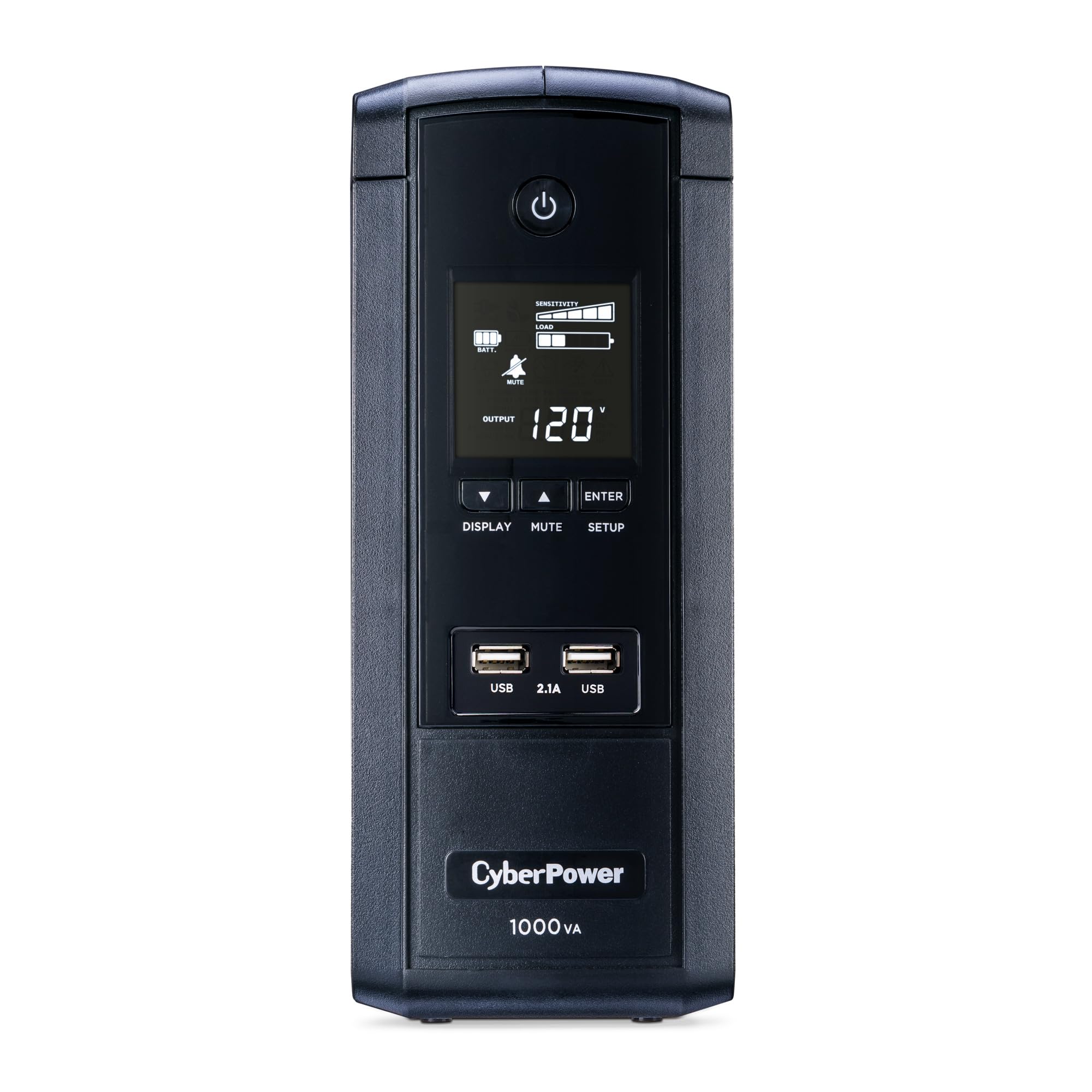
For users who need a reliable UPS for a standard home office or entertainment setup without breaking the bank, the BRG1000AVRLCD hits the sweet spot. Its 1000VA/600W simulated sine wave output is perfectly adequate for non-PFC power supplies, networking gear, and game consoles. The 10 outlets are split evenly between backup and surge-only, and the two integrated USB charge ports are a convenient addition.
The multifunction LCD panel provides immediate readouts of estimated runtime, battery capacity, and load level—data that lets you optimize which devices you connect. Automatic voltage regulation adjusts minor fluctuations without cycling the battery, extending its 3-year average lifespan. CyberPower’s 5-year warranty (including the battery) and connected equipment guarantee add significant peace of mind.
Long-term users report exceptional durability, with one reviewer stating their unit lasted 8 years before exhibiting any issues. The compact mini-tower form factor takes up minimal desk space, and the right-angle input plug allows for flush placement against walls. The primary limitation is the simulated sine wave output, which may cause issues with modern PFC power supplies in some desktop PCs.
Why it’s great
- Excellent price-to-performance ratio for home office use
- 5-year warranty covers both unit and battery
- Compact design with clear LCD feedback
Good to know
- Simulated sine wave limits compatibility with Active PFC gear
- Battery replacement is not user-friendly on some revisions
6. APC BE600M1 UPS Battery Backup

The BE600M1 is the quintessential entry-level UPS for users whose primary concern is keeping their internet connection alive during outages. With 600VA and 330W of simulated sine wave capacity, it’s not designed to run a full desktop setup for extended periods—but it excels at powering a router, modem, and a single light PC load for 23 minutes at 100W draw.
APC’s design philosophy here is focused on simplicity and reliability. The unit features 7 outlets (5 battery-backed, 2 surge-only), a built-in 1.5A USB port for phone charging during blackouts, and a recessed power button that prevents accidental shutdowns. The battery is user-replaceable with APC’s RBC154 cartridge, which extends the unit’s useful life well beyond its 3-year battery rating.
Customer reviews highlight the compact size that fits easily under a desk, and the silent operation that doesn’t distract in a home office. The 3-year warranty plus equipment protection policy is standard for APC. The main trade-off is the limited runtime: a typical desktop PC with monitor will only get 10–15 minutes, just enough for a graceful shutdown.
Why it’s great
- Highly compact footprint ideal for small desks or shelves
- Recessed on/off button prevents cat or foot activation
- User-replaceable battery reduces long-term waste
Good to know
- 330W limit means it cannot support large gaming PCs
- Simulated sine wave output not for Active PFC power supplies
7. SKE SK425 425VA/240W UPS Battery Backup

The SKE SK425 proves that effective battery backup doesn’t require a significant investment. At 425VA and 240W, this is strictly a device for low-power networking gear and a single office PC for safe shutdown purposes. Its 6 outlets include 4 battery-backed and 2 surge-only, plus an integrated LCD that tracks input voltage, battery capacity, and load level—a surprising feature at this tier.
Automatic voltage regulation helps stabilize fluctuating mains power without draining the battery, and the unit operates quietly with a mute function for the alarm. SKE includes UPS management software for automatic PC shutdown, which is uncommon among budget models. The metal enclosure adds durability at a slight cost increase over plastic competitors.
Some users note that the unit trips off more readily than expected during minor power spikes, though this reflects its sensitivity settings rather than a defect. For pure networking backup or protecting a basic office PC, this is an unbeatable entry point.
Why it’s great
- LCD display provides real-time power data at a budget price
- Long runtime for low-power network gear (1+ hour on router)
- AVR and management software included
Good to know
- 240W maximum limits device selection to basics only
- May trip during minor grid fluctuations due to high sensitivity
FAQ
Can I use a UPS with a power strip or extension cord?
How do I calculate the runtime I will get from a UPS?
Why does my UPS alarm constantly even when the power is on?
Final Thoughts: The Verdict
For most users, the best battery backup winner is the CyberPower CP1500PFCLCD because it delivers pure sine wave output, 1000W of continuous capacity, and a feature-rich LCD at a price that undercuts enterprise alternatives while outperforming everything else in its class. If you need remote network monitoring for an unattended server closet, grab the APC SMC1500C Smart-UPS. And for a compact, long-life solution that uses cutting-edge LiFePO4 chemistry, nothing beats the GOLDENMATE 1000VA Lithium UPS.