
That drawer full of dead alkaline AAs is costing you more than just space. Every single disposable cell you toss represents a compound of raw material waste, repeated retail trips, and consistent voltage sag under load. The switch to a chemistrically stable, high-cycle NiMH platform eliminates that entire cycle — but only if you pick cells with real low self-discharge (LSD) technology and a cycle life that actually hits its rated count. The market is flooded with generic 2800mAh claims that fade after 50 charges, so separating the genuine Japanese-spec cells from the overprinted commodity packs is the only move that saves real money.
I’m Min — the co-founder and writer behind Gadgets Feed. I’ve spent hundreds of hours dissecting battery datasheets, cross-referencing independent capacity tests (Opus, SkyRC, ZKE), and mapping charge-retention curves across the most popular NiMH SKUs to build this guide on real, measurable performance rather than marketing mAh numbers.
After sorting through cycle-life ratings, internal resistance data, and real-world drain tests across seven top-tier options, this guide narrows the field to the cells that consistently deliver on every metric that matters for the best nimh rechargeable batteries.
How To Choose The Best NiMH Rechargeable Batteries
NiMH chemistry offers a sweet spot of high capacity, stable voltage, and environmental safety — but not every cell on the shelf delivers the same longevity or consistency. To avoid buying a pack that fades after a dozen cycles, you need to focus on three key pillars: true cycle-life rating, self-discharge rate, and internal resistance consistency across the batch.
Cycle Life — The Real Cost Per Charge
A budget NiMH cell rated at 400 cycles will cost you more per recharge cycle than a premium cell rated at 2100 cycles, even if the premium pack costs double upfront. Cycle-life claims vary wildly: Amazon Basics states 400–500 cycles, while Panasonic Eneloop guarantees 2100 cycles. Independent testing shows Eneloop cells often exceed that mark, while generic brands sometimes fade by cycle 200. When calculating break-even, multiply the pack price by the number of times you’ll re-use it before voltage drops become unusable.
Low Self-Discharge (LSD) — Readiness Matters
Classic NiMH cells lose 10–15% of their charge within 24 hours of charging. Modern LSD NiMH — branded as “pre-charged” or “ready-to-use” — retains 70–80% capacity after 3–10 years of storage. All cells in this guide are LSD types, but the retention curve varies widely: Eneloop claims 70% after 10 years, while mid-range options like Granicell and EBL claim 80% after 3 years. For emergency kits, TV remotes, or smoke detectors, a flatter retention curve is actually more valuable than a high mAh number.
Internal Resistance (IR) — High-Drain Gatekeeper
Measured in milliohms (mΩ), internal resistance determines how well a cell delivers current under heavy load. Higher IR cells suffer voltage sag in high-drain devices like camera flashes, vacuum cleaners, or motorized toys, causing devices to cut off early even though the battery still has residual capacity. Premium Japanese cells typically measure 15–25 mΩ fresh off the charger. Budget cells can range anywhere from 25–60 mΩ per cell, and a single high-IR outlier in a multi-cell device can bottleneck the entire series string.
Quick Comparison
On smaller screens, swipe sideways to see the full table.
| Model | Category | Best For | Key Spec | Amazon |
|---|---|---|---|---|
| Eneloop Panasonic (6-Pack AA) | Premium LSD | Everyday high-drain/reliability | 2100 cycles, 2000mAh min | Amazon |
| Eneloop Panasonic (10-Pack AA) | Premium LSD | Bulk replacement / high cycle needs | 2100 cycles, 2000mAh min | Amazon |
| Granicell AA (16-Pack) | High Capacity | Long runtime between charges | 2800mAh, 1300 cycles | Amazon |
| EBL AA+AAA Combo (20-Pack) | Mixed Capacity | Variety pack / household variety | 2800mAh AA, 1100mAh AAA | Amazon |
| BEVIGOR AA+AAA + Charger | Kit Combo | First-time NiMH starter kit | 1500 cycles, smart 8-bay | Amazon |
| Amazon Basics AA (12-Pack) | Mid-Range Capacity | Budget-conscious high capacity | 2400mAh, 400 cycles | Amazon |
| Amazon Basics AAA (24-Pack) | Budget Bulk AAA | Low-drain devices / bulk AAA need | 850mAh, 500 cycles | Amazon |
In‑Depth Reviews
1. Eneloop Panasonic BK-3MCCA6BA AA (6-Pack)

The Eneloop Panasonic 6-pack represents the benchmark that every other NiMH cell is measured against. Rated for 2100 cycles with a minimum capacity of 2000mAh, these cells consistently test closer to 2100–2200mAh in independent analyzer runs. The LSD formulation is the gold standard: pre-charged at the factory using solar energy, they retain 70% of their charge after a decade of storage — meaning you can pull them from a drawer years later and they’ll still power a remote control or a wireless mouse.
Internal resistance on fresh Eneloop cells sits around 18–22 mΩ, which keeps voltage sag minimal even under the pulsed loads of an Xbox controller or a high-CRI flashlight. This low IR also means they run cooler during rapid charging cycles compared to budget cells that can spike past 50 mΩ. Customer reviews consistently report years of service without a single dead cell — a rarity in the rechargeable battery space where consistency across a 6-pack batch matters.
The only tradeoff is the upfront premium relative to bulk options, but at 2100 cycles, your cost per cycle works out to fractions of a cent. These cells are made in Japan and packaged in the US, with strict quality control that eliminates the wide cell-to-cell variance seen in cheaper packs. For households that cycle through batteries daily — game controllers, camera flashes, kid toys — Eneloop is the most cost-effective long-term investment.
Why it’s great
- Industry-leading 2100 cycle rating with verified longevity
- Ultra-low self-discharge retains 70% after 10 years
- Consistent low internal resistance for high-drain devices
Good to know
- Higher per-pack cost compared to generic options
- 2100mAh typical capacity is lower than some 2800mAh labels
2. Eneloop Panasonic BK-3MCCA10FA AA (10-Pack)

This is the same industry-defining Eneloop cell chemistry as the 6-pack but expanded to a 10-battery count, making it the ideal replenishment pack for high-volume households or professionals who cycle through multiple sets weekly. Each cell delivers the same 2100-cycle lifespan, 2100mAh typical capacity, and the famous solar-pre-charged LSD that holds 70% charge after 10 years. The 10-pack format works perfectly for radio-control hobbyists, wedding photographers burning through flash packs, or smart-home systems with multiple sensor nodes.
Batch consistency is where Eneloop truly justifies its price: independent testers have measured cell-to-cell capacity variance as low as 30–50mAh across a 10-pack, compared to 200mAh+ spreads on budget brands. This tight distribution matters when you’re running multi-cell series devices like a DJI remote or a mechanical keyboard that demands balanced discharge. The cells also handle extreme cold down to -4°F without significant capacity loss, outperforming standard alkaline cells that freeze-drain below freezing.
The main consideration is capacity relative to the promotional 2800mAh cells — Eneloop’s 2100mAh typical is deliberately conservative to maximize cycle life. If you need maximum runtime between charges and don’t mind shorter absolute cycle life, a higher-capacity cell might suit you better. But for longevity, reliability, and the lowest total cost of ownership over a decade, this 10-pack is the smartest bulk buy.
Why it’s great
- Same legendary Eneloop quality in a 10-battery bulk format
- Minimal cell-to-cell variance for balanced multi-cell devices
- Excellent low-temperature performance down to -4°F
Good to know
- 2100mAh is lower than competing 2800mAh cells
- Higher up-front investment for a 10-pack
3. Granicell AA Rechargeable (16-Pack, 2800mAh)
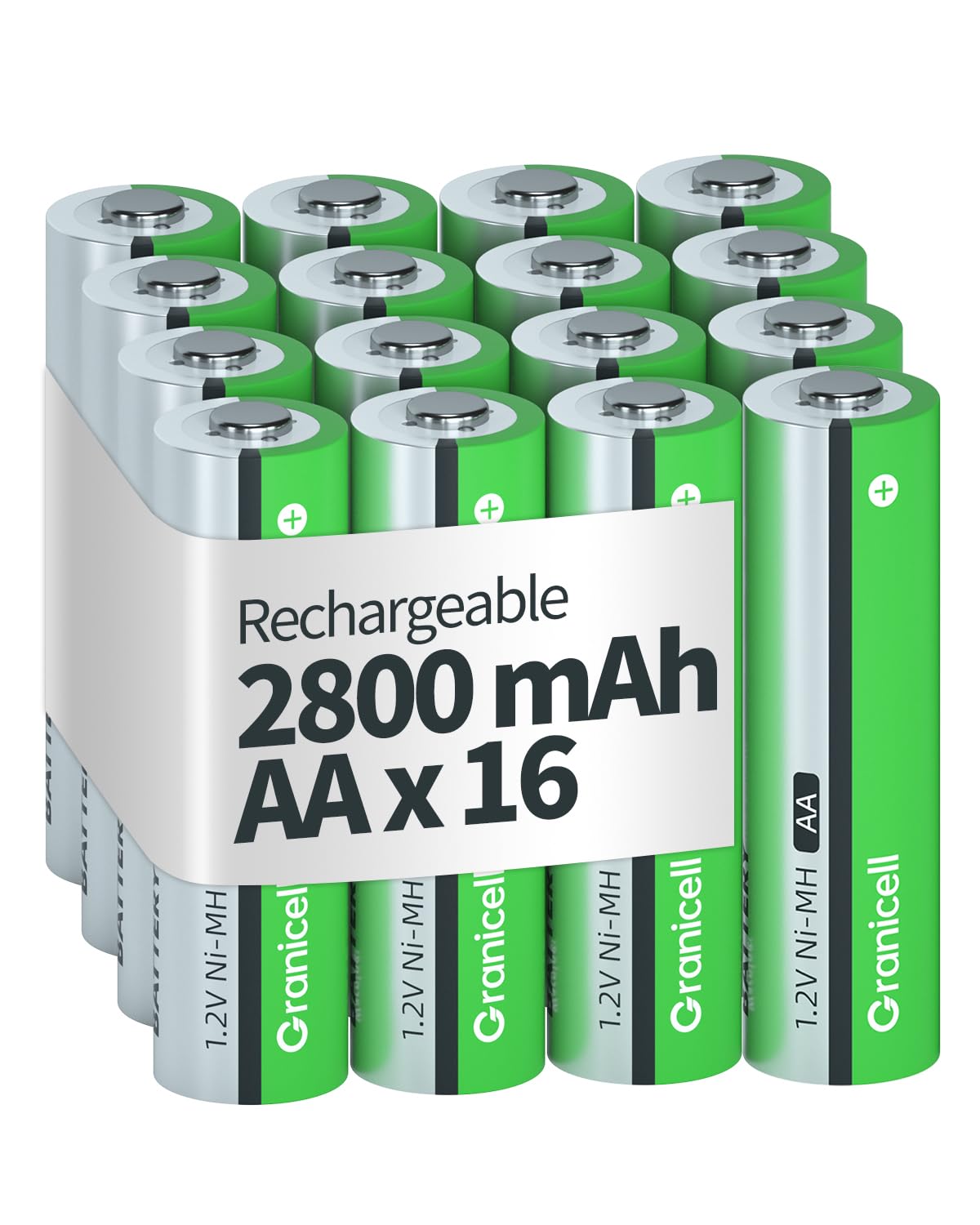
Granicell’s 2800mAh AA cells stake a claim as the highest claimed capacity in this comparison, offering 1300 recharge cycles with a low self-discharge that retains 80% capacity after three years of storage. Independent teardown tests have shown that these cells deliver capacity close to their rated 2800mAh from the first few cycles, making them a strong candidate for long-burn-rate devices like LED lanterns, portable fans, or trail cameras where maximum runtime between charges is the primary goal.
The safety testing is notable — these cells passed six professional safety tests including overcharge, short-circuit, and thermal abuse scenarios, backed by advanced electrolyte formulations that reduce internal gas buildup. The DBCK steel shell adds a layer of mechanical protection against physical damage, which is relevant if you’re dropping batteries into a bag or storing them loose. The pre-charged feature using solar power is also aligned with the eco-friendly NiMH ethos, reducing heavy metal content compared to standard alkaline cells.
The tradeoff is the cycle rating: 1300 cycles is a step down from Eneloop’s 2100 cycles, and internal resistance may climb faster over the pack’s lifetime. Early users report consistent performance in the first year, but long-term cycle retention data is still sparse compared to the decade of data on Eneloop. For high-capacity needs where you’ll cycle the pack 50–100 times a year, these deliver excellent capacity per dollar.
Why it’s great
- Highest claimed capacity at 2800mAh for long runtime
- Passed six professional safety tests with steel shell
- Low self-discharge retains 80% after 3 years
Good to know
- 1300 cycles is below premium 2100-cycle cells
- Long-term internal resistance data is limited
4. EBL Rechargeable Combo (10 AA + 10 AAA, 2800/1100mAh)

EBL’s combo pack provides 10 AA cells at 2800mAh and 10 AAA cells at 1100mAh, plus a molded organizer box for storage. For any household that uses both sizes — TV remotes (AAA), game controllers (AA), flashlights, wireless mice, kids toys — this combo effectively stocks your entire battery drawer in a single purchase. The 1200 Tech and ProCyco charging optimization is designed to push maximum capacity into the cells during the break-in phase, which helps the capacity stabilize closer to the rated numbers after 3–5 full cycles.
The LSD retention here is solid: 80% capacity after three years of storage, which matches Granicell’s claim. Customer reviews spanning 6+ years of usage confirm that these cells hold charge well in infrequently used devices and don’t exhibit the rapid capacity fade seen in some no-name imports. The included organizer box with a wall hook keeps cells segregated by size and prevents short-circuiting from loose metal contact in drawers.
One recurring user note is that the AAA cells measure slightly larger in diameter than standard alkaline cells — about 0.2–0.3mm extra — which can cause a tight fit in some devices with precision battery compartments. Also, the unit count is 10 of each, not a 20-pack of AA or AAA, so if you exclusively need AA cells, you’re better off with a dedicated AA pack. For mixed households, however, this is the most efficient way to manage inventory.
Why it’s great
- Balanced 10 AA + 10 AAA mix for household variety
- Organizer box with wall hook for neat storage
- ProCyco technology optimizes break-in capacity
Good to know
- AAA cells may be slightly oversized for tight compartments
- Not ideal if you need only AA cells
5. BEVIGOR AA+AAA with 8-Bay Smart Charger
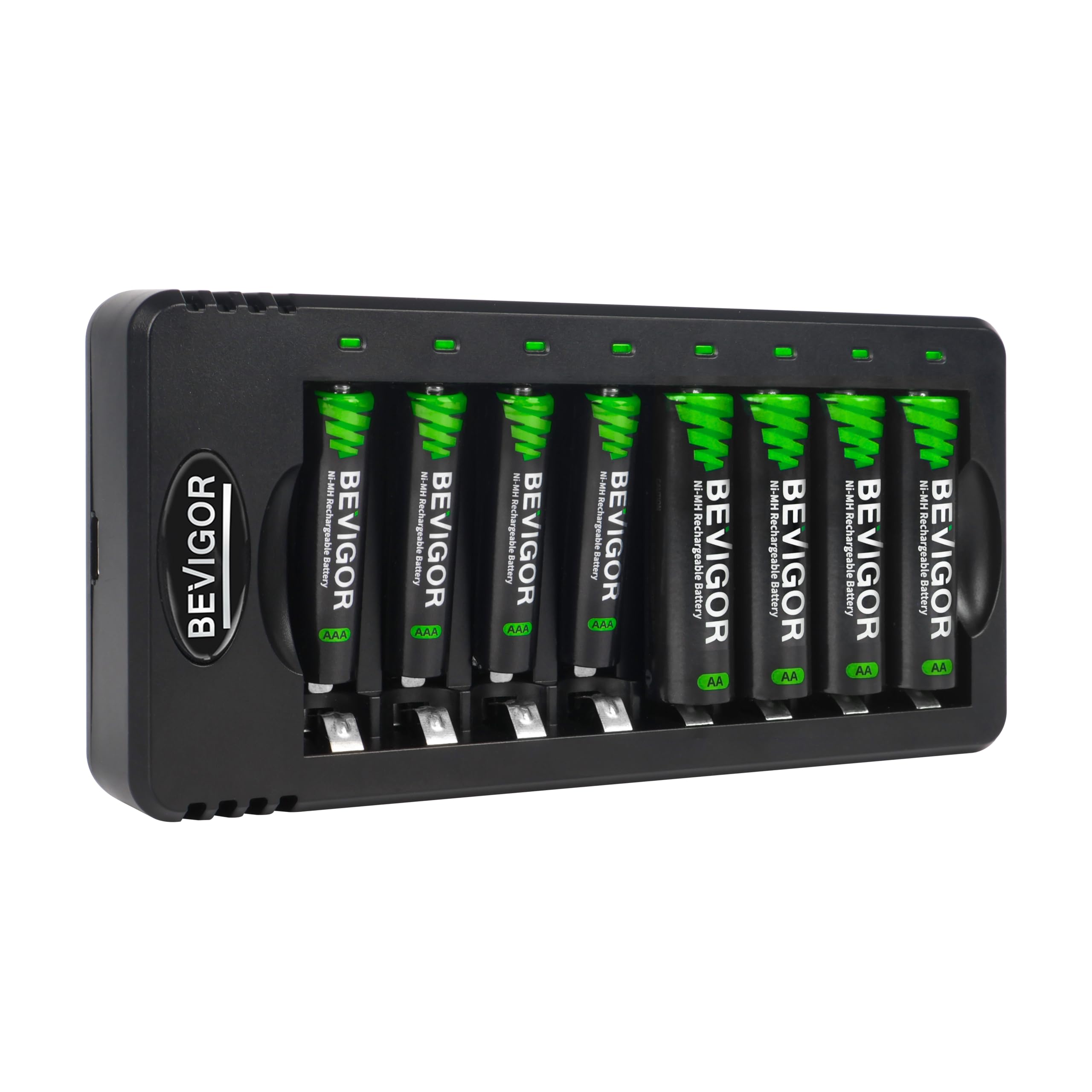
The BEVIGOR kit is the complete drop-in solution for anyone new to NiMH rechargeables — it bundles 4x AA (2800mAh), 4x AAA (1100mAh), and an 8-bay smart charger with independent charging channels. The charger detects each cell’s voltage and applies trickle charge to prevent overcharging, then switches to a maintenance mode that keeps cells topped up without cooking them. The red/green LED indicators give instant feedback on charge status per slot, and the isolated circuits mean you can charge a mix of 1–8 AA or AAA cells in any combination.
The cells themselves are rated for 1500 recharge cycles with LSD that retains 80% after three years — a solid mid-range cycle rating that splits the difference between budget 400-cycle cells and premium 2100-cycle Eneloop. The Type-C charging cable is a modern convenience that eliminates the need for a separate barrel adapter, and the charger meets FCC and UL certification standards for safety with automatic power-off and thermal protection.
User feedback notes that the battery life, while good, doesn’t rival the absolute longest-running cells under continuous high-drain load. One reviewer reported the cells lasting about 3 weeks in a daily-use device, which is respectable but not class-leading. However, the real value here is the intelligent charger — buying a smart charger separately can cost as much as this entire bundle, making the BEVIGOR kit the most cost-effective entry point for someone who owns no NiMH equipment and wants a turnkey solution that works out of the box.
Why it’s great
- Complete starter kit with 8-bay smart charger included
- Independent channels charge 1–8 cells safely
- Type-C charging cable and FCC/UL certification
Good to know
- Cell runtime is mid-range, not the longest available
- AA and AAA count is limited to 4 each
6. Amazon Basics AA High-Capacity (12-Pack, 2400mAh)

The Amazon Basics AA high-capacity cells offer 2400mAh rated capacity in a 12-pack at a fraction of the cost-per-cell of premium Japanese packs. Independent testing from hobbyist analyzers has shown these cells often deliver 2500–2600mAh fresh out of the package, which is a pleasant bonus. The LSD rating is set at 50% retention after one year (and a 5-year shelf life), which is adequate for regular-use devices but falls short of the 80% retention after 3+ years that premium cells guarantee.
The cycle life here is rated at 400 cycles — significantly lower than Eneloop’s 2100, but for the price per cell, you can replace the entire pack several times before reaching the break-even point of a premium pack. User reviews highlight that the cells charge quickly and perform well in high-drain devices like LED flashlights and game controllers, with some users reporting they last as long as lithium primary cells in constant-on usage. However, there is a documented fit issue: these cells are slightly thicker and longer than standard AA dimensions, rendering them unusable in about 25% of devices with tight battery compartments.
The value proposition is strong for low-cycle applications — remotes, clocks, emergency flashlights — where you might only recharge a cell 10–20 times before retiring it for other uses. The 12-pack format means you can dedicate a set to heavy-use devices and rotate them without worrying about maximizing cycle count. Just verify device fitment before committing if you have compact electronics with no extra space in the battery tray.
Why it’s great
- Excellent capacity per dollar at 2400mAh average
- Low per-cell cost ideal for high-volume households
- 12-pack provides ample rotation cells for multiple devices
Good to know
- Only 400 cycles vs premium 2100-cycle cells
- Oversized dimensions cause fit issues in ~25% of devices
- LSD retention drops to 50% after 1 year
7. Amazon Basics AAA High-Capacity (24-Pack, 850mAh)

This 24-pack of Amazon Basics AAA cells at 850mAh rated capacity is the undisputed value champion for AAA users. Independent testing revealed that these cells often test significantly higher than their rating — an average of 1079mAh across a 12-cell sample, with the highest hitting 1171mAh. For a pack that costs a fraction of premium Japanese AAA cells, that overdelivery makes them compelling for any low-to-moderate-drain AAA device: TV remotes, wireless mice, wall clocks, blood pressure monitors, and small flashlights.
The 500-cycle rating is paired with LSD that holds 80% capacity for 24 months, which is a better retention curve than Amazon’s own AA cells. The 24-pack basically eliminates the need to ever buy disposable AAA batteries again — you can dedicate one set to heavy-use devices and keep the rest in rotation for emergencies. The cells ship pre-charged in certified frustration-free packaging with no excess cardboard.
The main limitation is that NiMH AAA cells output 1.2V nominal, which will cause some 1.5V-optimized devices to show a low-battery indicator sooner than alkaline cells, even if the device still operates fine. Some users report that smart locks or high-precision devices may refuse to function at the lower voltage floor. Additionally, these cells, like the AA version, may be slightly oversized in diameter, though the AAA fitment complaints are less frequent. For bulk inventory of reliable, low-cost AAA power, this pack is unmatched.
Why it’s great
- Exceptional value at 24 AAA cells per pack
- Independent tests show capacity exceeds 850mAh rating
- 80% retention after 24 months is strong for the price tier
Good to know
- 1.2V may trigger low-battery warnings in 1.5V devices
- Oversized cells may cause fit issues in some compartments
FAQ
Can I use NiMH 1.2V batteries in devices designed for 1.5V alkalines?
What is the difference between 2000mAh and 2800mAh NiMH cells?
Do I need a special charger for NiMH batteries?
Final Thoughts: The Verdict
For most users, the best nimh rechargeable batteries winner is the Eneloop Panasonic AA 6-Pack because its 2100-cycle lifespan, ultra-low self-discharge, and consistent low internal resistance make it the most cost-effective cell over a decade of use. If you want a bulk supply for a high-consumption household, grab the Eneloop Panasonic AA 10-Pack. And for maximum runtime between charges in low-cycle devices, nothing beats the Granicell 16-Pack 2800mAh.