
The single biggest mistake a backpacker can make on a multi-night trek is bringing a battery bank that is either too heavy to justify the miles, too weak to revive a dead GPS or inReach, or too fragile to survive a river crossing. Every ounce in your pack is a trade-off, and the charging brick you choose determines whether you arrive with a functioning phone for navigation, photos, and emergency communication or a dead slab of glass.
I’m Min — the co-founder and writer behind Gadgets Feed. I’ve spent hundreds of hours cross-referencing capacity, weight, ruggedness ratings, charging speeds, and real-world user endurance reports to separate the trail-worthy battery banks from the gear-closet clutter for this guide.
Whether you are hiking the PCT, bikepacking across state lines, or heading for a weekend in the backcountry, choosing the right backpacking battery bank means balancing three non-negotiable factors: weight carried, power delivered, and durability under duress.
How To Choose The Best Backpacking Battery Bank
Selecting a battery bank for the trail is a fundamentally different exercise than buying one for daily commutes or airport lounges. You are optimizing for grams, survival in wet and dusty environments, and enough juice to recharge your essential electronics for the duration of your trip without carrying dead weight.
Capacity Versus Weight
The most common trap is equating higher milliamp-hours with a better product. A 40,000 mAh bank can weigh over a pound, while a 10,000 mAh unit may weigh only five ounces. For a weekend trip where your phone and headlamp are the only devices needing power, the lighter bank saves you significant pack weight. For a week-long traverse with a GPS device, camera, and phone, you need to calculate your total watt-hour requirement and match it to the bank’s real-world output — not the label claim.
Ruggedness and Weather Sealing
Backcountry conditions are unforgiving. A bank with an IP67 rating can survive immersion in a stream and will keep functioning after being dropped onto granite. Shockproof construction and sealed port covers prevent grit and moisture from destroying the charging circuitry mid-trip. The difference between a bank that works after a capsized canoe and one that doesn’t is often a single silicone gasket.
Charging Speed and Port Configuration
When you have a limited window to charge at a hut or before a dawn start, a bank that supports USB-C Power Delivery at 20W or higher can bring a phone from single digits to eighty percent in under an hour. Banks with multiple output ports let you charge a phone and a headlamp simultaneously. Integrated cables reduce the number of loose items you can lose on the trail, but they also create a potential failure point if the cable frays.
Quick Comparison
On smaller screens, swipe sideways to see the full table.
| Model | Category | Best For | Key Spec | Amazon |
|---|---|---|---|---|
| Anker Prime 20K | Premium | Multi-day laptop + device charging | 220W total output, 20,100mAh | Amazon |
| EF ECOFLOW 25K | Premium | Integrated cable convenience | 170W total, dual built-in retractable USB-C | Amazon |
| UGREEN Nexode 25K | Mid-Range | Laptop fast charging | 145W max, 25,000mAh, 2hr recharge | Amazon |
| Nitecore NB Plus 10K | Mid-Range | Ultralight backpacking | 5.47 oz, 10,000mAh, IPX7 | Amazon |
| MINRISE Solar 40K | Value | Extended off-grid emergency backup | 40,000mAh, 20W PD, 4 built-in cables | Amazon |
| ELECOM NESTOUT 5K | Value | Extreme weather durability | IP67, -30°F rated, 5,000mAh | Amazon |
| SOXONO Solar 40K | Value | Solar-assisted topping off | 40,000mAh, 1.8W solar panel, IP67 | Amazon |
In‑Depth Reviews
1. Anker Prime Power Bank, 20,100mAh 3-Port Portable Charger with 220W Max Output
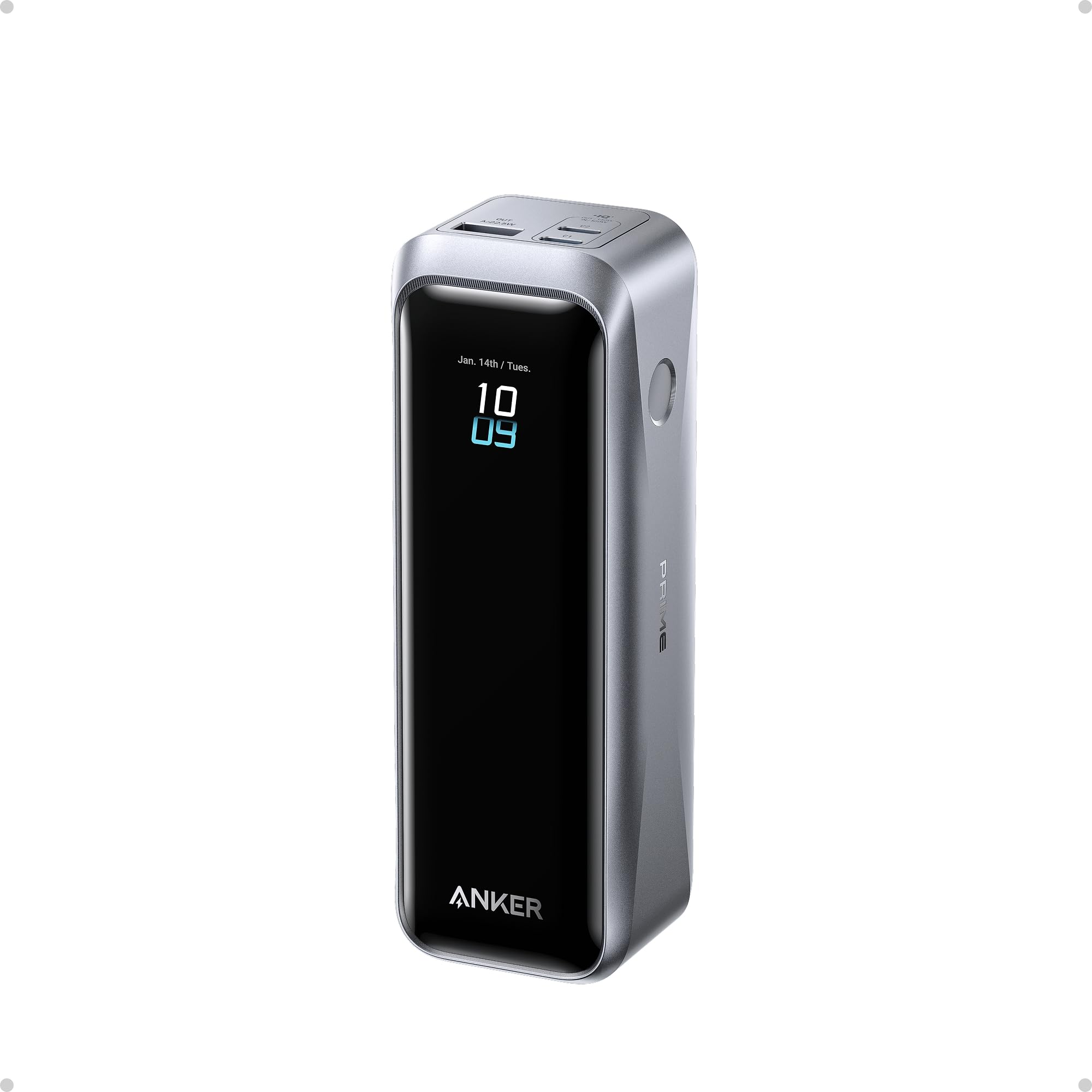
The Anker Prime 20K sets the benchmark for what a premium backpacking battery bank can achieve. Its 220W total output means you can simultaneously fast-charge a MacBook Pro at 140W via the USB-C port and still have juice left for a smartphone or camera battery. The 20,100mAh capacity (72.36Wh) keeps it TSA-compliant for air travel, yet it holds enough power for over four days of video streaming on an iPhone 17 Pro Max — or in real-world terms, a full week of nightly phone top-offs and GPS device charging.
The standout feature here is the two-way 100W max recharging capability. You can take the bank from empty to fifty percent in just 25 minutes, which is critical when you have a limited layover or a brief hut stop. The build quality is unmistakably Anker: the Phantom Gray shell feels dense and premium, with a digital display that shows remaining charge percentage and an embedded Bluetooth module that links to the Anker app for real-time monitoring of charge cycles and output wattage.
At 510 grams (1.12 pounds), this bank is not ultralight, but its power density is exceptional for the output it delivers. The 3.3-foot USB-C to USB-C 240W cable and travel pouch are welcome inclusions. The one trade-off is the price — it sits at the high end of the market — but for backpackers who need to charge laptops, drones, or multiple high-drain devices in the field, this is the most versatile and reliable option available.
Why it’s great
- 220W total output charges up to three devices simultaneously at full speed
- 140W single-port laptop charging recharges a 16-inch MacBook Pro to 50% in 28 minutes
- Bluetooth app control provides real-time monitoring and firmware updates
Good to know
- Heavier than dedicated ultralight options at 510 grams
- Premium price point may exceed budget for short-trip hikers
2. EF ECOFLOW Laptop Power Bank, 25000mAh Rapid Portable Charger
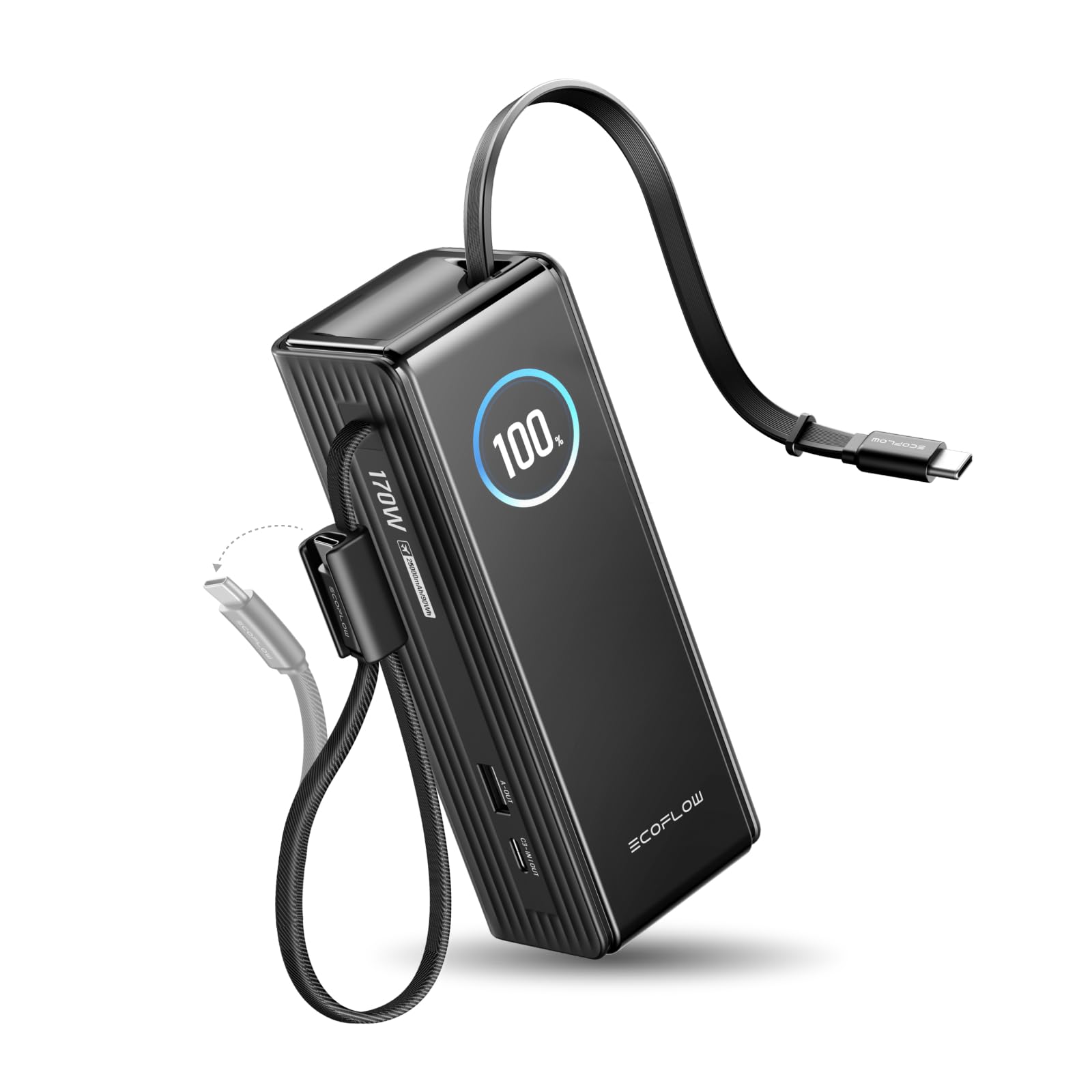
EF ECOFLOW has engineered a battery bank that solves one of the most persistent annoyances of trail charging: cable management. The 25,000mAh unit integrates two 100W USB-C cables — one retractable at 2.2 feet and a shorter fixed 0.8-foot cable — so you never have to dig through your pack for a frayed cord. This design is especially valuable when charging devices in the rain or in the dark, where fumbling with loose cables means lost time and potential moisture exposure to ports.
The power delivery architecture is generous. With 170W total output and a maximum of 100W per single port, this bank can fast-charge a laptop while simultaneously keeping a phone and a tablet topped off. The 100W high-speed self-recharging input is equally impressive — fifty percent charge in just 26 minutes — so you can rapidly replenish the bank during a meal stop at a cafe or a short resupply point. The 25,000mAh capacity translates to one to two full days of remote laptop work or four to five full phone charges.
The unit measures 6.18 by 2.12 by 1.92 inches and weighs 20.46 ounces (580 grams), making it one of the more compact 25K banks on the market. It is airline-safe for carry-on, and the retractable cable mechanism has a satisfying, positive lock that suggests long-term durability. The main consideration is that the built-in cables are fixed-length; if you need to charge a device that is farther away, you may still want a separate longer cable for flexibility.
Why it’s great
- Dual integrated 100W USB-C cables eliminate loose cable clutter in your pack
- 100W self-recharge gets the bank to 50% in just 26 minutes
- 170W total output allows simultaneous laptop, phone, and tablet charging
Good to know
- Fixed cable lengths may not reach a device on your opposite shoulder strap
- Retractable mechanism adds a potential moving part failure point over years of use
3. UGREEN Power Bank 25,000mAh 145W Laptop Portable Charger, Nexode

UGREEN’s Nexode 25K strikes an impressive balance between raw charging power and affordability. With a total output of 145W and a single USB-C1 port capable of delivering 140W, this bank can push a 16-inch MacBook Pro from zero to 56% in just 30 minutes, which is class-leading performance at its price tier. The 25,000mAh capacity gives you roughly 1.3 full laptop charges or over five full phone charges, enough for extended backcountry trips where resupply points are days apart.
The bi-directional charging architecture is a practical advantage on the trail. You can recharge the bank itself in about two hours using a standard 65W PD charger, and simultaneously charge both the bank and a connected device at full speed. The digital display on the front shows remaining battery life as a percentage, removing guesswork when you are rationing power. The Space Grey chassis is compact and smooth, fitting easily into a side pocket of a hiking pack without snagging on gear.
At 70 grams for the battery cell itself (the full unit is heavier), the Nexode is not the lightest 25K bank, but its power-to-weight ratio is competitive. Compatible devices span from the latest iPhone 16 series and Samsung Galaxy S24 to Steam Deck, DJI drones, and virtually any USB-C laptop. The only real compromise is the plastic housing, which feels robust but lacks the soft-touch premium feel of the Anker Prime. For the price, however, this bank delivers more watt-per-dollar than nearly anything in its class.
Why it’s great
- 140W single-port output charges a 16-inch MacBook Pro to 56% in 30 minutes
- Two-hour full recharge via 65W PD adapter minimizes downtime
- Wide compatibility includes laptops, phones, drones, and gaming handhelds
Good to know
- Plastic shell lacks the ruggedized feel of more expensive competitors
- Requires a 65W adapter for fastest recharge; using a 20W adapter takes up to six hours
4. Nitecore NB Plus 10,000mAh Power Bank
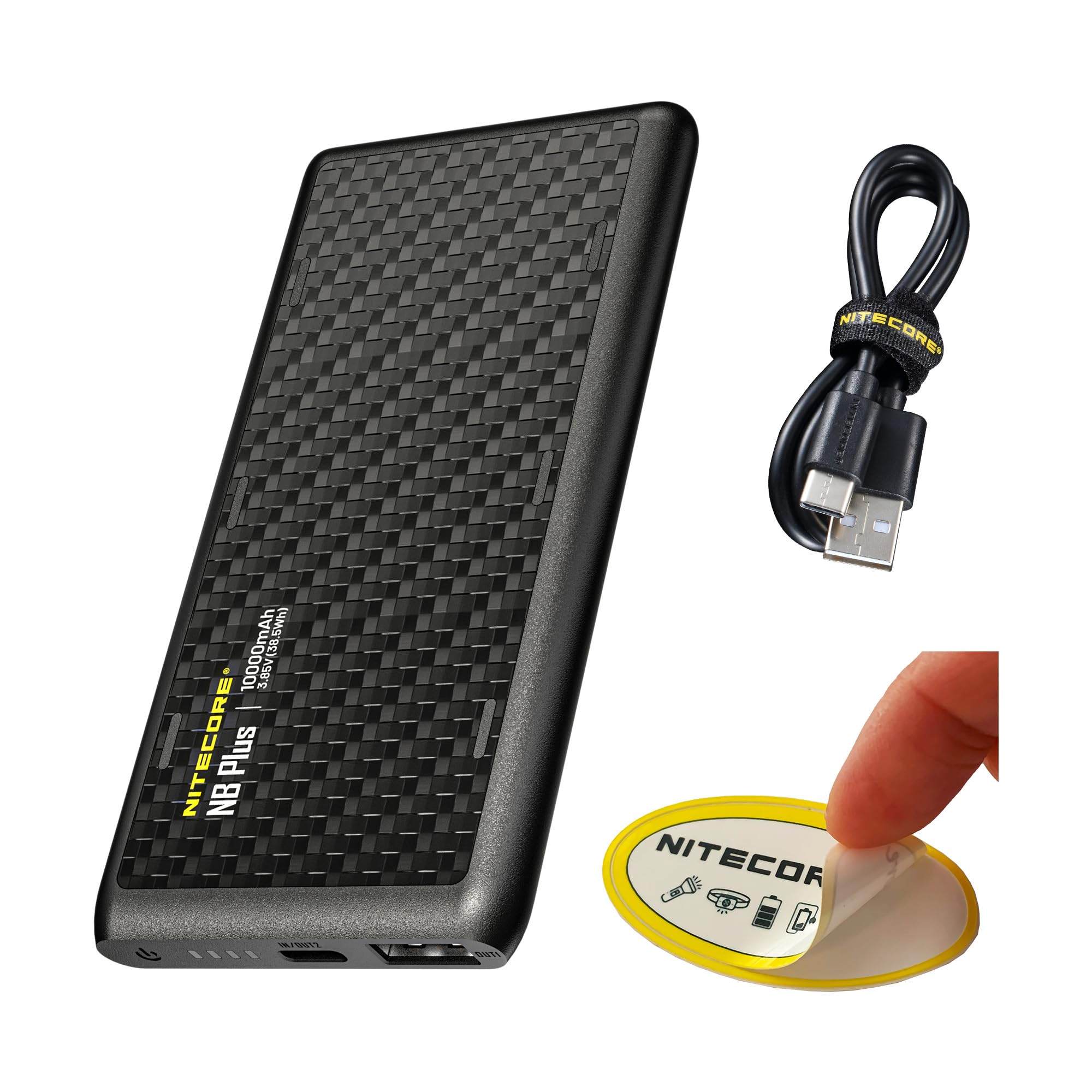
For ultralight backpackers and bikepackers where every gram dictates your daily mileage, the Nitecore NB Plus is the definitive choice. Weighing just 5.47 ounces (155 grams) and measuring 4.82 by 2.35 by 0.46 inches — smaller and thinner than most modern smartphones — this 10,000mAh bank disappears into a hip belt pocket or a framebag. The IPX7 waterproof rating means it can survive full immersion in up to one meter of water for thirty minutes, which is invaluable for river crossings or sudden downpours.
The power delivery is straightforward and effective. It supports 5V/3A QC PD fast charging via both USB-C and USB-A ports, which provides approximately 2.5 full charges for an iPhone 14 Mini or about two charges for a standard iPhone 15 from twenty percent. The pass-through charge function is a smart addition — you can charge the bank while simultaneously charging a connected device, which saves precious time when you have a single wall outlet at a backcountry lodge. The rounded corners and textured grip make it easy to handle with cold or wet hands.
The build quality is typical of Nitecore, a brand better known in the flashlight world for durability. The lithium-ion cells are well-protected, and the slim anodized aluminum casing resists abrasion from being packed against other gear. The only limitation is the slower charging speed compared to higher-wattage banks — this is a top-off companion, not a rapid laptop charger. But for hikers who need to keep just a phone, headlamp, and GPS battery alive for a week, the NB Plus is the lightest reliable solution at this capacity.
Why it’s great
- Ultralight at 5.47 oz — lighter than many 5,000mAh competitors
- IPX7 waterproof rating ensures survival in wet camping conditions
- Pass-through charging allows simultaneous replenishment of bank and device
Good to know
- 15W max output is slower than larger PD 3.0 banks for laptop charging
- 10,000mAh is adequate for short trips but insufficient for week-long treks without power management
5. MINRISE Solar Power Bank 40000mAh
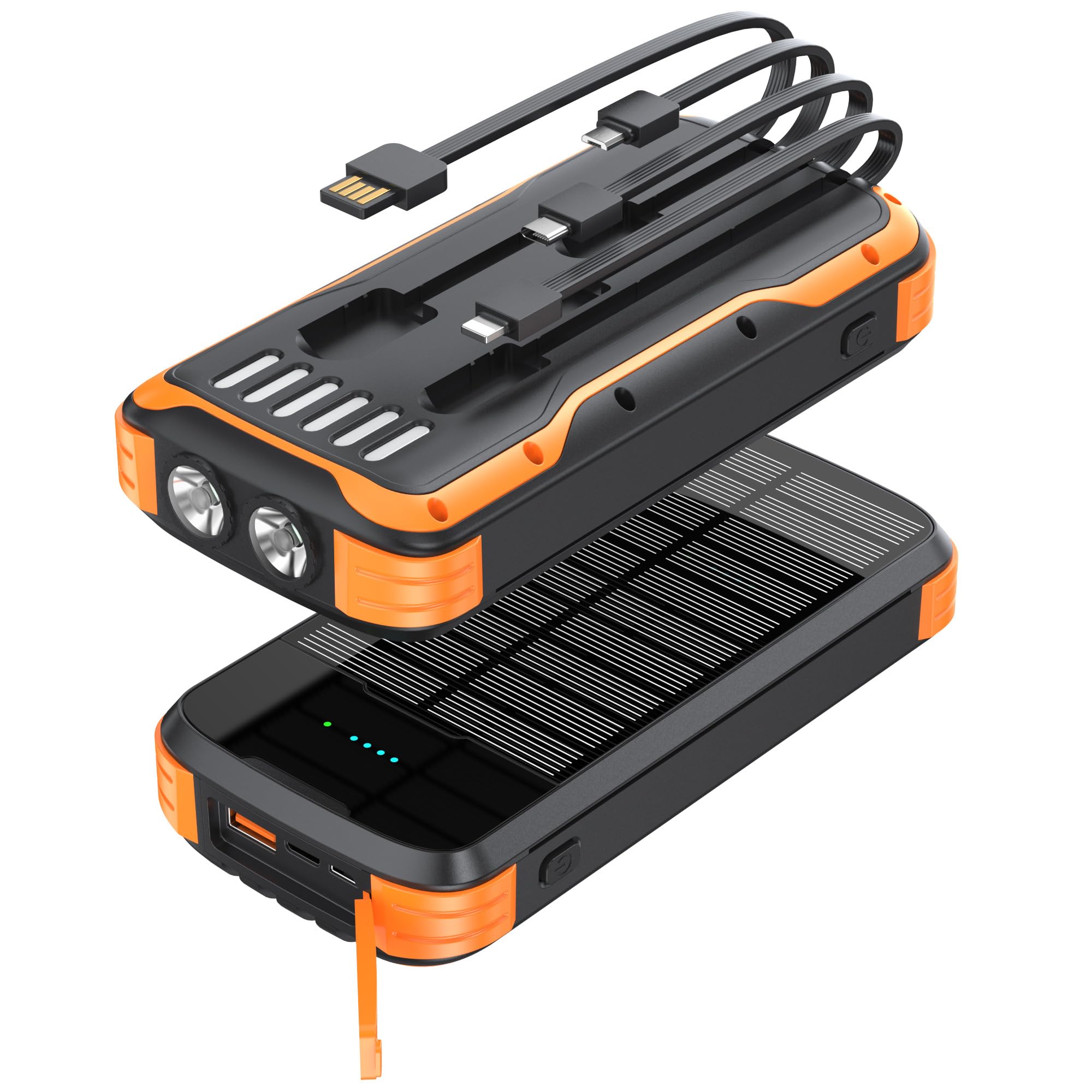
The MINRISE Solar 40K is the epitome of a “go-big-or-go-home” approach for extended backcountry trips where power access is nonexistent. At 40,000mAh, this bank holds enough charge to fully replenish a modern smartphone eight to ten times and can keep multiple devices running for weeks on a single full charge of the bank itself. The 20W PD fast charging via USB-C brings an iPhone 15 from 15% to 65% in just 30 minutes, delivering respectable speed despite the massive capacity.
The integrated cable system is genuinely practical: three built-in output cables (USB-C, iOS Lightning, and Micro USB) plus a built-in USB-A input cable mean you have nine different charging methods without carrying a single separate cord. The dual LED flashlights, rated at 165 feet of illumination distance and 25 hours of run time, double as an emergency beacon and camp light. The Orange-black color scheme is highly visible, making it harder to misplace in a dark tent. The ABS shell with silicone corner protectors and sealed port covers gives it a credible anti-fall, dustproof, and waterproof rating for outdoor abuse.
The trade-off is unavoidable: at 1.07 pounds (450 grams) and dimensions of 6.67 by 3.35 by 1.22 inches, this is a dense brick. It is not a bank you casually toss into a daypack — it belongs in the bottom of a larger expedition pack where weight distribution is less critical. The solar panel is explicitly marketed as an emergency backup only; recharging via sunlight is slow and dependent on direct, strong sun. For car camping, base camps, or long-term field work where weight is secondary to endurance, the MINRISE delivers unmatched staying power.
Why it’s great
- 40,000mAh capacity provides weeks of off-grid power for multiple devices
- Four built-in cables eliminate the need for separate charging cords
- Dual 165-lumen flashlights add emergency lighting without extra gear
Good to know
- Heavy at 1.07 pounds — unsuitable for ultralight or fastpacking loads
- Solar charging is extremely slow and only useful as a backup in direct sunlight
6. ELECOM NESTOUT Rugged Power Bank, 5000mAh Outdoor Battery Pack

The ELECOM NESTOUT is not designed for raw capacity — it is designed to survive when everything else fails. With an IP67 rating for full dust and water immersion, a MIL-STD 810G shockproof rating, and a reported ability to function after being tested at -30°F without capacity loss, this is the bank for alpine climbers, kayakers, and military EDC users who expect their gear to endure extremes. The 5,000mAh capacity is modest, but it is enough for a single full phone charge or a dual charge for a smaller smartphone plus a headlamp.
The design is genuinely innovative. The bank mimics the shape of a vintage fuel bottle and won an iF Design Gold Award for its aesthetic and functional coherence. The bottom features a standard ¼-20 tripod mount, which lets you attach it to a mini tripod or mount it to a backpack strap with compatible accessories. The modular ecosystem includes a detachable lantern (LAMP-1) and LED panel (FLASH-1) that draw power directly from the bank, turning a simple charger into a lighting system. At just 4.9 ounces (139 grams), it is one of the lightest ruggedized options on the market.
The USB-C port supports Power Delivery up to 15W, which is adequate for topping off a phone or a handheld two-way radio but will not fast-charge a laptop. The smart power delivery detection automatically allocates energy based on the connected device’s needs. The battery itself recharges in approximately two hours via a standard USB-C wall adapter. The mustard color and durable silicone cushion minimize vibration transmission during rough travel. The principal limitation is capacity — 5,000mAh is strictly for short overnights or emergency backup, not multi-day trips without access to a primary charging source.
Why it’s great
- MIL-STD 810G drop-test certified and IP67 waterproof for extreme environments
- Ultralight at 4.9 oz with a ¼-20 tripod mount for versatile attachment
- Modular accessory ecosystem with lantern and LED panel attachments
Good to know
- 5,000mAh capacity is too low for multi-day trips without a secondary power source
- 15W max output will not fast-charge modern laptops or high-drain devices
7. SOXONO Solar Charger Power Bank, 40000mAh
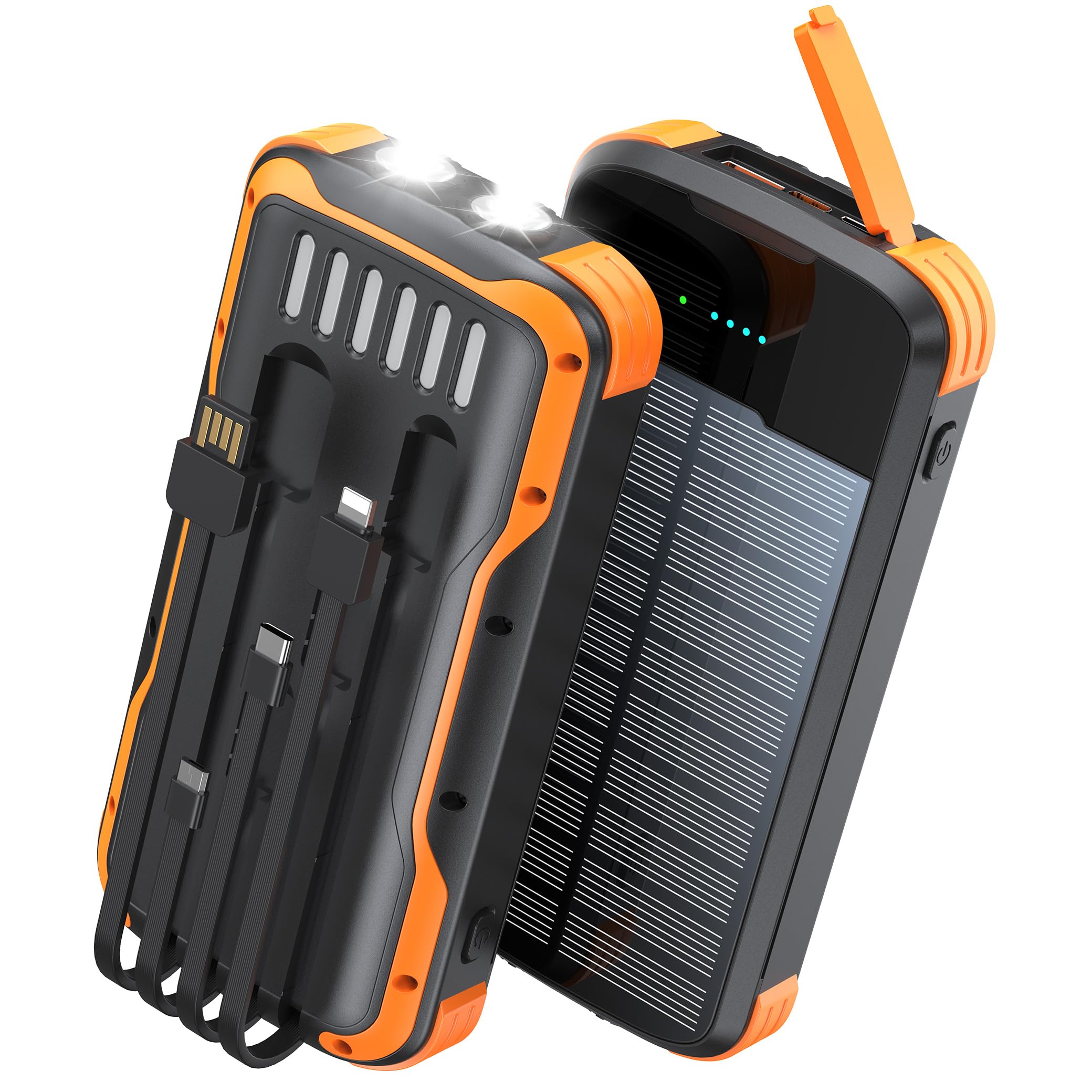
The SOXONO Solar 40K is the entry-level workhorse for backpackers who want maximum capacity without the premium price tag. Like the MINRISE, it packs a 40,000mAh battery, but adds a dedicated 1.8W solar panel and the same IP67 waterproof and dustproof rating. The dual super-bright LED flashlights claim up to 30 hours of continuous operation, making this a viable base-camp power hub for groups who need to charge multiple phones, headlamps, and rechargeable batteries over several days.
The built-in cable configuration mirrors the MINRISE: three output cables (USB-C, iOS, Micro USB) and one USB-A input cable, plus separate USB-C and USB-A ports for five-device simultaneous charging. The 20W PD fast charging via USB-C output brings modern smartphones to sixty-five percent in about half an hour. The Black-orange color scheme is rugged-looking, and the chemical-resistant ABS shell has high surface hardness and heat resistance, so it can sit in a hot car or under direct sun without deforming.
The weight is essentially the same as the MINRISE at roughly one pound, so this is not a bank for fast-and-light purists. The solar panel is helpful for trickle-charging during a sunny day at camp, but will not replenish the full 40,000mAh in any reasonable time frame — it remains an emergency supplement, not a primary recharging method. Some users report a persistent chemical smell from the unit when new, which typically dissipates over time. For car campers, festival-goers, and budget-conscious backpackers who prioritize raw capacity over weight, the SOXONO delivers extraordinary power per dollar.
Why it’s great
- 40,000mAh capacity at a budget-friendly price offers unmatched power-per-dollar
- IP67 dust/water resistance and heat-resistant ABS shell for harsh conditions
- Dual 30-hour flashlights and 1.8W solar panel for extended camp utility
Good to know
- Heavy at roughly one pound — unsuitable for ultralight through-hikes
- Solar panel is a slow trickle charger, not a fast recharging solution
FAQ
How many milliamp-hours do I need for a week-long backpacking trip?
Is solar charging on a battery bank actually useful for backpacking?
Can I bring a 25,000mAh battery bank on an airplane?
What does IP67 mean for a battery bank?
Should I get a bank with built-in cables or separate ports?
Final Thoughts: The Verdict
For most users, the backpacking battery bank winner is the Nitecore NB Plus 10K because it delivers the absolute lightest carry weight for a 10,000mAh capacity while maintaining IPX7 waterproofing and reliable PD fast charging, making it the ideal companion for ultralight and fastpacking trips. If you need to charge a laptop alongside your phone in the backcountry, grab the UGREEN Nexode 25K for its class-leading 140W output and fast two-hour recharge. And for multi-week expeditions or group base camps where capacity trumps all other concerns, nothing beats the extended endurance and built-in cable convenience of the MINRISE Solar 40K.