
Imagine dropping thousands on a 4K OLED and a surround speaker set, only to hear tinny, flat dialogue and action sequences that sound like a wet blanket. That is the reality of a weak or poorly matched AV receiver — the unsung hero (or villain) of any home theater. A great receiver doesn’t just pass audio through; it decodes object-based formats, applies sophisticated room correction, and delivers clean wattage to every channel, transforming your living room into a sonic venue.
I’m Min — the co-founder and writer behind Gadgets Feed. I specialize in dissecting the technical specifications of home theater components, from HDMI 2.1 bandwidth requirements to the nuances of room correction algorithms, to help you make a purchase that won’t leave you wanting more in six months.
Whether you are building your first surround system or upgrading a dedicated listening room, finding the right best home theater av receiver requires understanding how channel counts, power ratings, and video features align with your specific speaker setup and content habits.
How To Choose The Best Home Theater AV Receiver
Choosing a receiver is less about the highest wattage number and more about the ecosystem it plugs into. Your speaker impedance, room acoustics, and source devices (gaming console vs. Blu-ray player) will dictate whether a premium unit truly justifies its cost or a mid-range model will serve you better.
Channel Count and Speaker Configurations
The number before the decimal (5, 7, 9, 11) is the number of traditional speaker channels. The number after the decimal (1 or 2) represents dedicated subwoofer outputs. The third number, if present (like in 5.1.2), indicates height channels for Dolby Atmos. A 7.2-channel receiver powers a standard surround setup with rear surrounds. A 9.2-channel unit enables a 5.1.4 Atmos layout (four height speakers) without external amplification. Future-proofing to 7.1.4 or 9.1.4 requires an 11-channel processor or a receiver with pre-outs for an external amp.
HDMI 2.1 and Gaming Features
If you own a PlayStation 5, Xbox Series X, or a high-end PC, HDMI 2.1 is mandatory. Look for full 40Gbps or 48Gbps bandwidth to support 4K/120Hz and 8K/60Hz pass-through. Features like Variable Refresh Rate (VRR), Auto Low Latency Mode (ALLM), and Quick Frame Transport (QFT) reduce screen tearing and input lag. Some early HDMI 2.1 receivers had bandwidth issues, but current models from Denon, Yamaha, and Onkyo have largely resolved these.
Room Correction and Calibration
Room correction software analyzes your speaker placement and compensates for acoustic issues like standing waves and poor bass response. Basic systems like YPAO (Yamaha) and AccuEQ (Onkyo) handle essential EQ. Audyssey MultEQ (Denon) offers more granular control. Dirac Live (Onkyo TX-RZ50 and higher-end units) is the gold standard, providing professional-grade correction that can dramatically tighten bass and improve imaging. Sony’s Digital Cinema Auto Calibration IX uses 360 Spatial Sound Mapping for a wide, immersive soundstage.
Quick Comparison
On smaller screens, swipe sideways to see the full table.
| Model | Category | Best For | Key Spec | Amazon |
|---|---|---|---|---|
| Marantz SR8015 | Premium Flagship | Ultimate 11.2ch reference system | 140W x 11 channels | Amazon |
| Sony STRAZ3000ES | Premium ES | 360 Spatial Sound & custom integration | 120W x 9 channels | Amazon |
| Onkyo TX-RZ50 | High-End | Dirac Live calibration & THX Select | 120W x 9 channels | Amazon |
| Yamaha RX-A4A | Premium AVENTAGE | Surround:AI & Auro-3D | 110W x 7 channels | Amazon |
| JBL MA9100HP | Mid-Range | Class D efficiency & shallow depth | 9.2 channels | Amazon |
| Sony STR-AN1000 | Mid-Range | Works with Sonos & 360SSM | 165W (6 ohms) x 7 channels | Amazon |
| Denon AVR-S970H | Mid-Range | 8K gaming with VRR/ALLM/QFT | 90W x 7 channels | Amazon |
| Onkyo TX-NR6100 | Mid-Range | THX Certified & 8K/40Gbps HDMI 2.1 | 210W/Ch (6 ohms) x 7 channels | Amazon |
| YAMAHA RX-V6A | Mid-Range | MusicCast multi-room & reliable build | 100W x 7 channels | Amazon |
| Denon AVR-X1700H | Entry-Level | Best beginner 7.2ch with 8K readiness | 80W x 7 channels | Amazon |
| Pioneer VSX-935 | Budget-Friendly | Value 7.2ch with Dolby Atmos Virtualization | 80W x 7 channels | Amazon |
In‑Depth Reviews
1. Marantz SR8015 11.2 Channel AV Receiver

The Marantz SR8015 is a true flagship that delivers 140 watts per channel across 11 channels, enabling a full 7.1.4 Dolby Atmos configuration without needing an external amplifier. It features Audyssey MultEQ XT32 room correction, which provides incredibly precise bass management and speaker distance calibration. Owners report that the transient response and high-frequency clarity outperform competitors like the Yamaha RX-A6A, especially when paired with high-efficiency speakers like Klipsch.
This receiver handles 8K/60Hz and 4K/120Hz pass-through via HDMI 2.1, making it future-proof for both the latest consoles and streaming devices. The HEOS multi-room streaming platform is built-in, allowing seamless integration with other Marantz and Denon wireless speakers. The build quality is exceptional, with a hefty chassis and high-quality binding posts that inspire confidence.
The primary criticisms center on software quirks. The remote control is often described as cheap-feeling and unresponsive for a unit at this price point. Bi-amping setup requires careful configuration, and the receiver runs quite hot, demanding at least 8 inches of clearance above it for proper ventilation. If you are building a no-compromise 11.2-channel system, the SR8015 delivers reference-grade audio.
Why it’s great
- Full 11.2-channel processing with 140W per channel for massive headroom.
- Audyssey MultEQ XT32 provides professional-grade room calibration.
- HDMI 2.1 with 8K/60 and 4K/120 pass-through for next-gen gaming.
Good to know
- Runs hot; requires significant ventilation space.
- Included remote feels cheap compared to the receiver’s build quality.
- Bi-amping setup is not straightforward and requires manual menu navigation.
2. Sony STRAZ3000ES 9.2 CH AV Receiver

The Sony STRAZ3000ES is part of Sony’s premium ES (Elevated Standard) series, designed for custom installers and serious enthusiasts. Its 9.2 channels deliver 120 watts each, and the proprietary 360 Spatial Sound Mapping technology creates an exceptionally wide and immersive soundstage, even in rooms with imperfect speaker placement. Users transitioning from older Pioneer or Denon units note that the Sony’s calibration, Digital Cinema Auto Calibration IX, produces a remarkably cohesive phantom center and precise imaging.
Connectivity is robust with 6-in/2-out HDMI 2.1, supporting 8K/60 and 4K/120. It includes Chromecast, Apple AirPlay 2, and “Works with Sonos” integration. The ES line is optimized for IP control, making it a favorite for smart home integration with systems like Control4 and Crestron. The front panel design includes a detachable cover for a clean, professional look.
Notably, it lacks HDR10+ and QMS (Quick Media Switching) support. It runs quite hot during extended high-volume sessions, and an external cooling fan is a common recommendation from owners. The auto-calibration can occasionally fail if height channels are active without rear surrounds present. For those who prioritize a wide, enveloping soundstage and custom integration, the AZ3000ES is a top contender.
Why it’s great
- 360 Spatial Sound Mapping creates a huge, immersive soundstage.
- Excellent custom integration with IP control for automation systems.
- Built-in Wi-Fi, Bluetooth, Chromecast, and Sonos compatibility.
Good to know
- No HDR10+ or QMS support.
- Runs hot; external cooling may be necessary.
- Calibration can be finicky with complex speaker layouts.
3. Onkyo TX-RZ50 9.2-Channel AV Receiver

The Onkyo TX-RZ50 is widely celebrated for including full-bandwidth Dirac Live room correction out of the box, a feature typically reserved for receivers costing significantly more. With 120 watts per channel across 9 channels (capable of 11.2-channel processing), it supports 7.1.4 and 5.1.4 configurations. Owners upgrading from older units report that Dirac Live dramatically tightens bass response and improves soundstage precision compared to Onkyo’s standard AccuEQ.
Connectivity includes three HDMI 2.1 inputs with 40Gbps bandwidth, supporting 8K/60 and 4K/120. It is THX Select certified, guaranteeing reference-level performance in medium-sized rooms. Onkyo’s partnership with Klipsch includes optimized crossover settings for Klipsch Reference speakers, a thoughtful feature for a common pairing. The unit also supports “Works with Sonos” for up to three separate zones.
Users have reported some reliability concerns, including faulty Wi-Fi cards on early units and long HDMI switching delays. The dual subwoofer outputs are not independently adjustable, limiting fine-tuning for dual sub setups. The included remote is basic, and the app does not control Zone 2 HDMI. For pure sound quality per dollar, especially with Dirac, the TX-RZ50 is a standout.
Why it’s great
- Full Dirac Live room correction included at a mid-premium price point.
- THX Select certification ensures reliable performance.
- 11.2-channel processing allows for 7.1.4 Atmos setups.
Good to know
- Some units have reported early reliability issues (WiFi card).
- Dual subwoofer outputs are not independent.
- Input switching can have noticeable lag.
4. Yamaha RX-A4A AVENTAGE 7.2-Channel AV Receiver

The Yamaha RX-A4A belongs to the AVENTAGE line, known for premium build quality including an anti-resonance chassis and high-quality DACs. It delivers 110 watts per channel across 7 channels, supporting 5.1.2 or 7.1 setups. Yamaha’s proprietary Surround:AI analyzes audio scenes in real-time and adjusts surround effects to enhance dialogue clarity and directional cues without manual interference. The YPAO R.S.C. with 3D and multipoint measurement provides accurate calibration, though it is less aggressive than Dirac Live.
This receiver is a fan of music enthusiasts, supporting Auro-3D upmixing and Roon Tested certification for high-res audio streaming. It features a phono input for turntables and the MusicCast multi-room platform for easy whole-home audio. All seven HDMI inputs support 8K60 and 4K120 with 40Gbps bandwidth, along with ALLM and VRR for gaming. The setup process, however, is notoriously complex, and firmware updates require a USB flash drive, making initial configuration a multi-step chore.
Owners appreciate the robust build and reliable sound signature. The analog section processes guitar and acoustic music with a natural, uncolored quality. Some users find the Surround:AI overly aggressive on older stereo content, pushing vocals to the center channel. For those who prioritize music fidelity alongside home theater, the RX-A4A is a well-rounded choice from a trusted manufacturer.
Why it’s great
- Surround:AI optimizes sound in real-time for movies and games.
- Exceptional music fidelity with Auro-3D and Roon Tested support.
- Phono input and premium anti-resonance chassis design.
Good to know
- Setup process is complex and firmware updates require a USB drive.
- Surround:AI can over-process older stereo content.
- No front HDMI port for easy temporary connections.
5. JBL MA9100HP 9.2-Channel AV Receiver

The JBL MA9100HP is a 9.2-channel receiver that uses low-noise Class D amplification, making it more energy-efficient and cooler-running than traditional Class A/B designs. It supports 9.1, 7.1.2, or 5.1.4 channel configurations, decoding both Dolby Atmos and DTS:X. Its chassis is notably shallow at just 15.6 inches deep, making it easy to fit into standard media consoles that might reject deeper flagship units.
Connectivity includes 6 HDMI inputs and 2 outputs with eARC, supporting 8K video passthrough. Wireless streaming is handled via Bluetooth, Apple AirPlay 2, and Google Chromecast. The graphical on-screen setup menu is intuitive, and the unit integrates seamlessly with smart TVs via HDMI ARC, automatically powering on and off with the TV. Owners driving Polk Audio and Athena towers report clean, detailed sound with ample headroom for medium rooms.
Downsides include a non-backlit remote that users find frustrating in dark home theater rooms. The auto shut-off default of 20 minutes must be manually disabled. A notable limitation is that it does not downmix DTS-HD Master Audio to stereo, which poses an issue for small 2.1-channel setups. For a 5.1.4 or 7.1.2 system seeking efficient power and a compact footprint, the MA9100HP delivers solid performance.
Why it’s great
- Energy-efficient Class D amplification runs cool.
- Shallow chassis depth fits in most AV cabinets.
- Clean, detailed sound quality for the price.
Good to know
- Remote is not backlit, making night use difficult.
- Does not downmix DTS-HD Master Audio to 2.1 channels.
- Firmware updates are infrequent.
6. Sony STR-AN1000 7.2 CH AV Receiver

The Sony STR-AN1000 is a 7.2-channel receiver that punches above its mid-range price tag thanks to its 360 Spatial Sound Mapping technology, which creates virtual height and surround effects from a traditional speaker layout. It delivers a claimed 165 watts per channel at 6 ohms, providing solid power for bookshelf and floor-standing speakers. Users upgrading from older Sony or Denon models report that the AN1000 produces crisp, clear audio with excellent dialogue intelligibility.
Its integration with the Sonos ecosystem is a key differentiator. The “Works with Sonos” certification allows you to incorporate this receiver into an existing Sonos system, using the Sonos app for control. It also supports Chromecast, Apple AirPlay 2, and Spotify Connect. The auto-calibration (Digital Cinema Auto Calibration IX) is straightforward and effective.
The receiver lacks a phono input, a significant omission for vinyl enthusiasts. A known issue is that it does not pass Dolby Vision to the Apple TV 4K, which may be a dealbreaker for some. The front display is small and difficult to read from a distance. For users wanting a capable surround sound hub that plays nicely with Sonos, the STR-AN1000 is a smart pick.
Why it’s great
- “Works with Sonos” certification for easy multi-room integration.
- 360 Spatial Sound Mapping creates immersive audio without height speakers.
- Excellent dialogue clarity and crisp surround effects.
Good to know
- No phono input for turntable users.
- Does not pass Dolby Vision through Apple TV 4K.
- Front display is small and hard to read.
7. Denon AVR-S970H 8K 7.2 Channel AV Receiver

The Denon AVR-S970H is a 7.2-channel receiver designed with gamers in mind, featuring full HDMI 2.1 support including 8K/60Hz and 4K/120Hz pass-through, Variable Refresh Rate (VRR), Auto Low Latency Mode (ALLM), and Quick Frame Transport (QFT). This ensures smooth, tear-free visuals from a PS5 or Xbox Series X. It delivers 90 watts per channel, which is ample for medium-sized rooms filled with efficient speakers.
Beyond gaming, it includes a phono input for turntables and HEOS multi-room streaming, allowing you to send audio to other Denon wireless speakers. The on-screen setup guide is clear and color-coded, making installation straightforward even for beginners. Owners report that eARC works flawlessly with modern TVs, and the Bluetooth and Wi-Fi connectivity is stable.
The primary limitation is that powered Zone 2 uses the rear surround channels, restricting the main room to a 5.2 setup when Zone 2 is active. The remote lacks a dedicated TV power button, which is a minor inconvenience for universal remote users. For a dedicated gaming rig or a primary home theater where Zone 2 is unnecessary, the S970H delivers exceptional video features.
Why it’s great
- Full HDMI 2.1 gaming features (VRR, ALLM, QFT).
- Phono input included for vinyl playback.
- HEOS multi-room streaming is intuitive and stable.
Good to know
- Zone 2 disables rear surround channels (limits to 5.2).
- Remote lacks a dedicated TV power button.
- No tape deck or legacy analog inputs.
8. Onkyo TX-NR6100 7.2 Channel AV Receiver
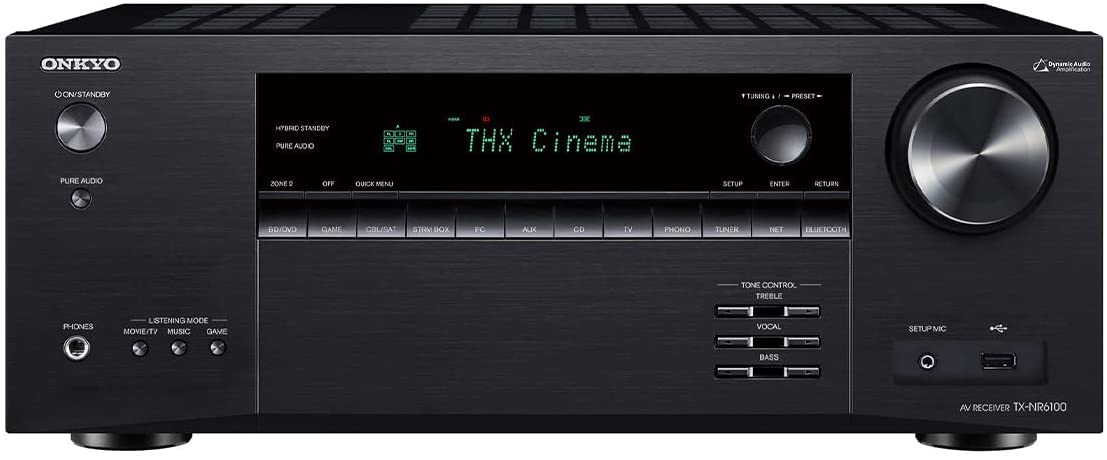
The Onkyo TX-NR6100 is a 7.2-channel receiver that brings THX Select certification and HDMI 2.1 with 40Gbps bandwidth to a competitive price point. It features a Dynamic Audio Amplification system rated at 210 watts per channel (6 ohms) and supports 5.2.2 Dolby Atmos and DTS:X playback. Users pairing it with Klipsch and other high-sensitivity speakers report powerful, dynamic sound that fills a room with authority.
The receiver includes three HDMI 2.1 inputs for 8K/60 and 4K/120 pass-through, making it ideal for multi-console households. It boasts discrete Zone 2 audio and video output and supports streaming via Chromecast, AirPlay 2, and DTS Play-Fi. The Onkyo Controller app provides reliable music browsing and source selection. Many owners find its sound signature warmer and more musical than comparable Denon models at similar price points.
Known issues include a non-backlit remote and limited input capability on HDMI ports 4-6 (4K only, not 8K). Some users have reported HDMI 2.1 handshake issues with Xbox Series X and inconsistent Sonos integration. The bi-amp function also uses two channels, limiting the speaker configuration to 5.1 when engaged. For those seeking THX-certified performance and authoritative power, the TX-NR6100 is a compelling choice.
Why it’s great
- THX Select certification ensures reference-quality audio.
- Powerful 210W/ch (6 ohms) Dynamic Audio Amplification.
- Three 8K/40Gbps HDMI 2.1 inputs for next-gen consoles.
Good to know
- Remote is not backlit.
- Only three inputs support full 8K bandwidth.
- Some reports of HDMI 2.1 handshake issues.
9. YAMAHA RX-V6A 7.2-Channel AV Receiver

The Yamaha RX-V6A is a 7.2-channel receiver that has built a reputation for rock-solid reliability and excellent sound quality. It features YPAO R.S.C. with multipoint measurement for room calibration and supports Dolby Atmos with Height Virtualization and DTS:X. With 100 watts per channel, it comfortably drives most bookshelf and floor-standing speakers. Owners frequently mention that this unit replaces older Yamaha receivers that lasted over a decade, reinforcing the brand’s dependability.
It offers three 8K/60 and 4K/120 HDMI 2.1 inputs, eARC support, and the MusicCast multi-room ecosystem for streaming Spotify, TIDAL, and Amazon Music HD. Voice control works with Alexa and Google Assistant. The setup process is straightforward via the on-screen menu, typically taking under 30 minutes. The audio imaging is described as wide and clear, with dialogue cutting through even in busy action scenes.
Some users report that the unit does not auto-power on with Sony Bravia TVs via eARC, requiring a manual power-on. The eARC handshake can also be complex, with some finding a soundbar a simpler solution for improving TV audio. For a durable, great-sounding mid-range receiver that handles both movies and music without fuss, the RX-V6A is a safe bet.
Why it’s great
- Excellent track record for long-term reliability and build quality.
- Straightforward setup via intuitive on-screen menus.
- MusicCast multi-room streaming supports all major services.
Good to know
- eARC auto-power on may not work with all TV brands.
- HDMI handshake can be complex with multi-device chains.
- Some users find the learning curve for advanced features steep.
10. Denon AVR-X1700H 7.2ch AV Receiver (Renewed)

The Denon AVR-X1700H is a 7.2-channel receiver that serves as the perfect entry point into 4K and 8K home theater. It delivers 80 watts per channel and includes Audyssey MultEQ room calibration, which handles basic EQ and distance adjustments effectively. Owners describe the sound as clean and detailed, a noticeable improvement over older budget receivers or soundbars. It supports Dolby Atmos, DTS:X, and Dolby Atmos Height Virtualization for an immersive experience without ceiling speakers.
It features three dedicated 8K/60Hz and 4K/120Hz HDMI 2.1 inputs, along with HDR10+, Dolby Vision, and HLG support. The award-winning on-screen setup guide uses color-coded labels to simplify speaker wire connections, making it ideal for first-time builders. HEOS multi-room streaming is built-in, and the receiver works with Alexa and Google Assistant. Users appreciate the phono input for turntables and the dual subwoofer pre-outs.
The renewed (refurbished) condition means the price is attractive, but some users report needing certified 48Gbps HDMI cables for stable 4K/120 performance. The power output is sufficient for small to medium rooms but may struggle with low-sensitivity speakers at high volumes. For a budget-friendly, future-proofed entry into home theater, the X1700H is hard to beat.
Why it’s great
- Excellent value for 7.2 channels with 8K/60 HDMI 2.1.
- Easy guided setup with color-coded connections.
- Audyssey MultEQ provides solid basic room correction.
Good to know
- Renewed unit may require certified 48Gbps cables for reliability.
- 80W/ch may be underpowered for large rooms or inefficient speakers.
- No physical manual included; setup is entirely digital.
11. Pioneer VSX-935 7.2 Channel AV Receiver
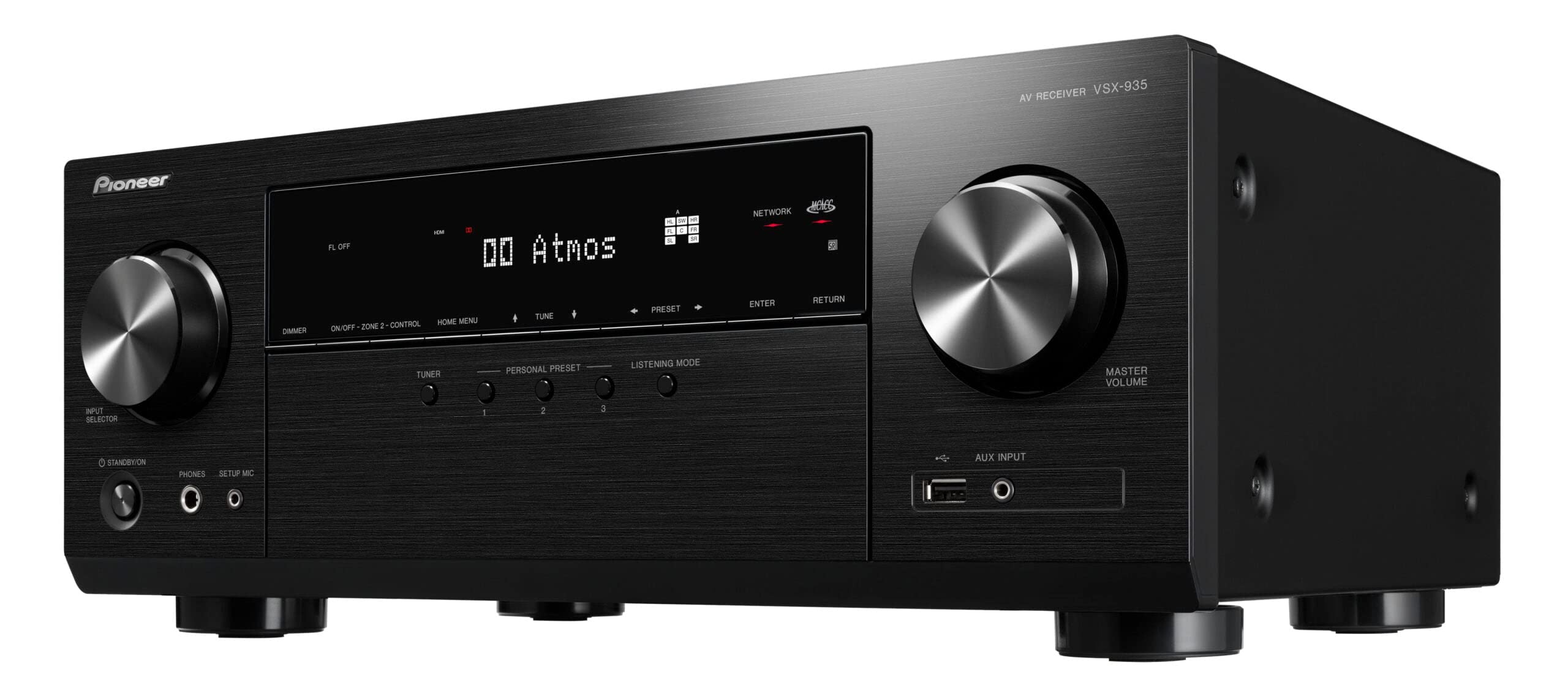
The Pioneer VSX-935 is a 7.2-channel receiver that offers a remarkable feature set for its budget-friendly position. It includes Dolby Atmos Height Virtualization, which creates a convincing overhead effect from standard 5.1 or 7.1 speaker layouts without needing in-ceiling speakers. It also supports 8K/60Hz and 4K/120Hz HDMI 2.1 pass-through, making it one of the most affordable gateways to next-gen gaming features. Users consistently praise its crisp, clear audio and balanced sound signature.
Connectivity includes Bluetooth, Wi-Fi, and access to streaming music services. The RF remote offers reliable control through walls, and the dual-zone output allows for different audio in a second room. The front display is clear and includes a dimmer function for dark theaters. Owners replacing older Onkyo and Sony units report that the Pioneer handles music detail well, with rich midrange and clean highs.
The primary drawbacks are software and interface issues. The Bluetooth implementation is described as unreliable, with complex menu navigation and no dedicated button. Some users have experienced unit-to-unit quality issues, such as dead displays or sound dropouts. The room correction is not as sophisticated as Audyssey or YPAO. For the price-conscious buyer who needs HDMI 2.1 and object-based audio, the VSX-935 delivers real value.
Why it’s great
- Dolby Atmos Height Virtualization works well without height speakers.
- 8K/60 and 4K/120 HDMI 2.1 pass-through at a low price.
- Clear, loud audio with good detail and dynamics.
Good to know
- Bluetooth connection is unreliable and menu navigation is poor.
- Room correction is basic compared to competitors.
- Some quality control issues reported on early units.
FAQ
What does the third number in 5.1.2 or 7.2.4 mean?
Is HDMI 2.1 necessary if I only stream movies?
Can I use a 9.2-channel receiver with a 5.1 speaker setup?
Final Thoughts: The Verdict
For most users, the best home theater av receiver winner is the Onkyo TX-RZ50 because it combines professional-grade Dirac Live room correction, THX certification, and 11.2-channel processing at a price that undercuts competitors. If you want a massive 11.2-channel reference system, grab the Marantz SR8015. And for a budget-friendly entry point that still offers HDMI 2.1 and Dolby Atmos Virtualization, nothing beats the Pioneer VSX-935.