
Choosing the wrong 4-gauge wire is the fastest way to starve your amplifier, strand your battery, or introduce voltage drop you will chase for weeks. The conductor material, strand count, and jacket rating determine whether a cable delivers its rated current or runs hot under load. This guide breaks down the specific specs that separate a reliable high-current path from a fire risk.
I’m Min — the co-founder and writer behind Gadgets Feed. I built this guide by parsing hundreds of customer reports, cross-checking conductor composition claims against actual strand counts, and mapping price tiers against UL and ABYC compliance data to surface only the cables that earn their rating.
If you are shopping for a power or ground cable that can sustain real amperage without overheating or corroding, you have come to the right place. This analysis of the best 4 gauge wire spans seven models covering budget CCA spools, pure OFC duos, and tinned-copper marine assemblies purpose-built for harsh environments.
How To Choose The Best 4 Gauge Wire
Four-AWG cable is used in applications that demand 100–150 amps of continuous current: car audio amplifiers, inverter feeds, battery bank interconnects, welding leads, and solar combiner boxes. Selecting the wrong wire type can introduce excessive resistance, voltage sag, or insulation breakdown. Focus on three factors.
Conductor Material: CCA, OFC, or Tinned Copper
Copper-clad aluminum (CCA) is the cheapest option but carries roughly 62% of the conductivity of pure copper for the same cross-section. It works for short, low-stress runs but can create hot spots under sustained load. Oxygen-free copper (OFC) — also called bare copper — delivers full conductivity and is the baseline for car audio and battery systems. Tinned copper adds a corrosion-resistant coating that makes it mandatory in marine and outdoor use; the tin layer prevents oxidation when the jacket is nicked or exposed to salt air.
Strand Count and Flexibility
Fewer, thicker strands (Class K or M welding cable with 259–364 strands) yield extreme flexibility and resist work-hardening from vibration. Class B battery cable uses coarser strands (around 133 strands for 4 AWG) and is stiffer but easier to terminate in ring lugs. For tight engine-bay routes or repeated flex applications like trolling-motor power leads, a higher strand count is essential. For fixed runs inside a battery box, standard battery cable is sufficient.
Jacket Material and Temperature Rating
PVC jackets are standard on automotive and general-purpose cable but can become brittle below -20°C and soften above 105°C. Rubber or TPE jackets tolerate wider temperature swings (-40°C to +140°C) and resist oil, fuel, and abrasion — critical for engine-compartment and bilge runs. Always check the voltage rating: 600V is the common standard for 4 AWG welding and battery cable. A jacket rated to 600V and 105°C dry (75°C wet) covers nearly every 12V–48V installation.
Quick Comparison
On smaller screens, swipe sideways to see the full table.
| Model | Category | Best For | Key Spec | Amazon |
|---|---|---|---|---|
| EWCS 4 AWG Welding Cable | Welding / Power | High-flex, high-current runs | 364-strand fine copper, 600V | Amazon |
| GEARit OFC 2-Pack | OFC Car Audio | Color-coded amp installs | OFC conductors, 25+25 ft | Amazon |
| NOVINO Marine Wire | Marine / Outdoor | Saltwater corrosion resistance | Tinned copper, UL 1426 / ABYC | Amazon |
| Kimbluth OFC Welding Cable | Pure Copper | OFC value for solar/welding | 99% pure copper, 5+5 ft | Amazon |
| GEARit CCA Automotive Wire | CCA Budget | Low-cost ground runs | CCA conductor, 25 ft red | Amazon |
| End Game Marine Battery Cable | Pre‑Crimped | Drop‑in battery replacement | Tinned lugs, USCG/ABYC | Amazon |
| ExtreSpo Jumper Cables | Jumper Set | Roadside emergency kit | 600-amp clamps, 20 ft | Amazon |
In‑Depth Reviews
1. EWCS 4 Gauge Premium Extra Flexible Welding Cable
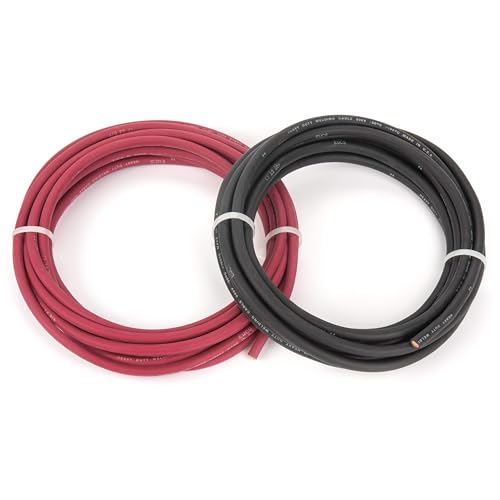
This EWCS cable uses 364 strands of fine bare copper — the highest strand count in this roundup — which makes it substantially more flexible than standard battery cable. The 600-volt TPE jacket resists sunlight, water, and abrasion without stiffening in cold weather, a genuine advantage when routing through engine compartments or conduit.
Users consistently report accurate gauge sizing and a jacket that strips cleanly without nicking conductors. The 25-foot pair (one black, one red) ships as a coil, so you cut exactly what you need. Many have used this cable for the Big Three automotive upgrade, inverter feeds, and solar combiner box interconnects.
The finely stranded copper requires careful crimping — use a hydraulic crimper with a proper 4 AWG die to avoid strand pushback. The jacket is slightly thicker than typical car audio wire, which means it occupies more space in a distribution block, but the flexibility and conductivity justify the extra bulk.
Why it’s great
- Exceptional 364-strand flexibility for tight routing
- Verified OFC, not CCA — full conductivity at rated gauge
- Sunlight and water-resistant TPE jacket
Good to know
- Requires a quality hydraulic crimper for best termination
- Thick jacket can crowd a 4 AWG distribution block
2. GEARit 4 Gauge Wire OFC Black & Red 2-Pack

GEARit delivers 50 total feet of oxygen-free copper in a color-coded two-pack for less than many single-spool OFC offerings. The translucent PVC jacket lets you see the strand construction, and the cable remains pliable enough for trunk runs and under-seat amp racks. Each 25-foot spool covers a typical power or ground leg in a car audio system with room to spare.
OFC construction ensures the rated 4 AWG cross-section carries its ampacity without the resistance penalty of CCA. Reviews from car audio installers highlight consistent jacket dimensions and easy stripping. The wire works equally well for RV battery banks and inverter feeds where clean power transfer matters.
PVC jackets soften under sustained engine-bay heat but are fine for interior or protected runs. The included translucent jacket is prone to scuffing against metal edges — use grommets or split loom if routing through a firewall or chassis holes.
Why it’s great
- 50 feet of OFC in two colors — ideal for amp installs
- Good flexibility for trunk and interior routing
- Color-coded jackets simplify positive/ground identification
Good to know
- PVC jacket not recommended for continuous engine-bay exposure
- Jacket scuffs easily against sharp metal edges
3. NOVINO 4 Gauge Marine Wire

NOVINO’s 4 AWG marine wire uses tinned copper strands with a thick PVC jacket rated to UL 1426 and ABYC standards. The tin coating prevents galvanic corrosion in salt-air environments, and the jacket resists heat to 105°C dry and 75°C wet. The 20-foot red and 20-foot black lengths give enough coverage for a dual-battery boat setup or a long winch run.
Reviews consistently note the wire’s flexibility for its class and the clean finish after crimping tinned lugs. Owners installing trolling-motor batteries and bilge pumps report no oxidation after months in damp bilge compartments. The jacket also withstands fuel and oil splash better than standard PVC.
Tinned copper costs noticeably more than bare OFC, and the thicker insulation reduces flexibility in tight corners. For freshwater use or interior automotive work, untinned OFC is sufficient and more budget-friendly. Confirm your lug ring size — NOVINO’s wire is bare-ended without pre-attached terminals.
Why it’s great
- Certified tinned copper resists saltwater corrosion
- UL 1426 and ABYC compliant for marine codes
- Thick jacket handles fuel, oil, and temperature swings
Good to know
- More expensive than bare OFC or CCA
- Stiffer jacket than equivalent welding cable
4. Kimbluth 4 Gauge Battery Cable Copper Wire

Kimbluth’s 4 AWG cable is built from 99% pure oxygen-free copper with a 90-mil PVC jacket rated to 600 volts. The multi-strand construction (0.256mm individual strands) strikes a balance between flexibility and crush resistance. The ten-foot total length (five each red and black) is short enough to avoid waste on battery-to-inverter or battery-to-bus-bar runs.
Buyers using this wire with Victron solar charge controllers and lithium battery banks report a noticeable reduction in voltage drop compared to the CCA cable they replaced. The fine strands accept solder well and produce clean crimps in 4 AWG lugs. The jacket also resists abrasion from contact with battery terminals and metal enclosures.
The shorter length limits its use to point-to-point connections — you will not cover a long amp power run with just five feet. Verify your strand crimp technique; the fine copper strands can push back inside a poorly sized die, creating a loose connection.
Why it’s great
- Verified 99% pure OFC for maximum conductivity
- 90-mil PVC jacket resists abrasion and battery acid
- Priced competitively against bulk spools of unknown copper content
Good to know
- Only 5 feet per color — too short for most amplifier power runs
- Fine strands require a tight crimp die to prevent pushback
5. GEARit 4 Gauge Wire CCA Automotive Cable
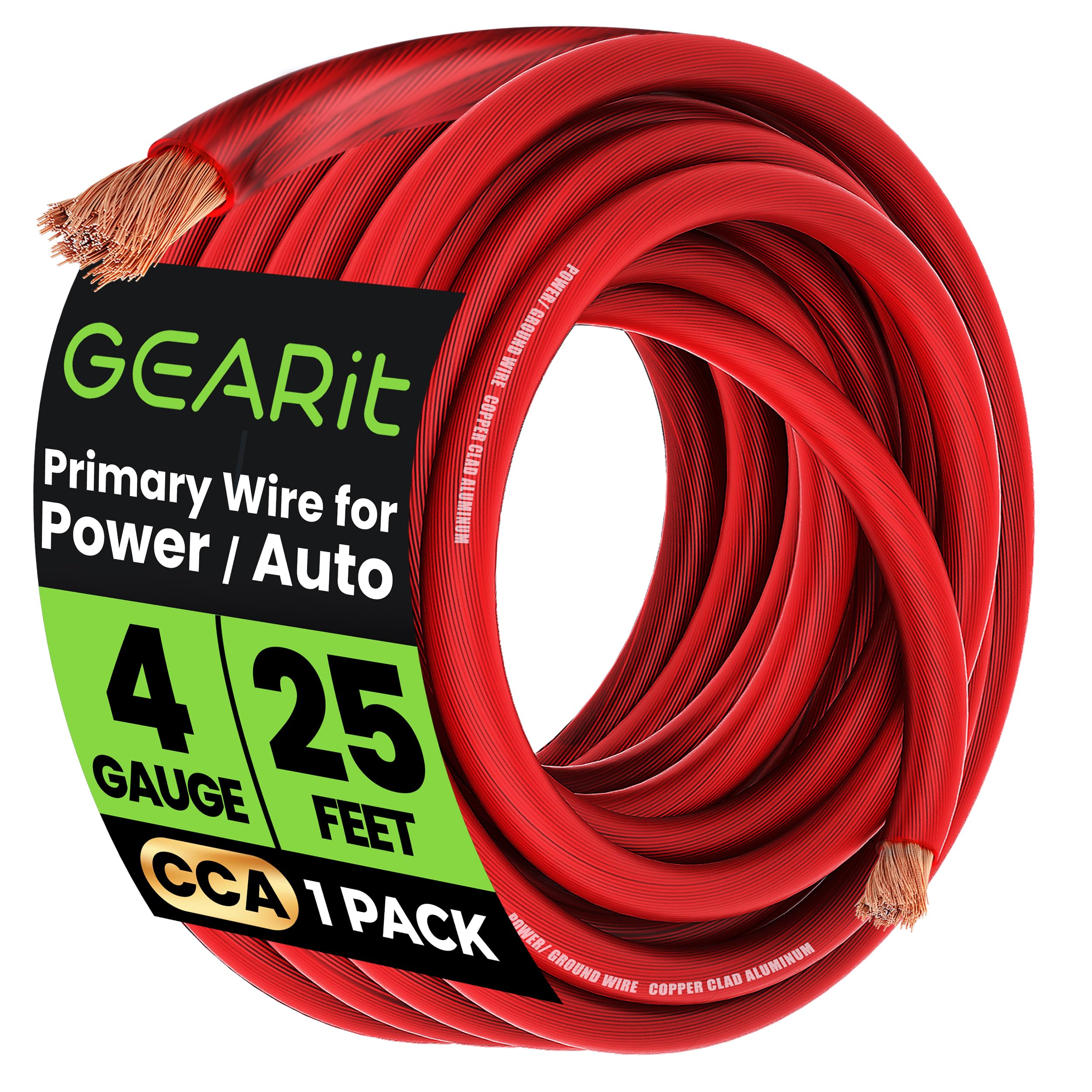
GEARit’s CCA automotive wire uses a copper-clad aluminum conductor to achieve 4 AWG cross-section at a lower entry cost than pure copper. The translucent PVC jacket shows the conductor color, and the stranded construction offers reasonable flexibility for trunk and under-seat routing. This is a 25-foot red spool intended for a power lead; you will need a separate ground cable or a black spool.
CCA conducts roughly 62% of the current of OFC for the same gauge, so a 4 AWG CCA run behaves like a 2 AWG copper run in terms of resistance. For a modest subwoofer amp pulling 80 amps or less over a short distance, CCA is functional. Reviews confirm the wire is accurately sized and strips cleanly.
Under continuous high-current loads (above 100 amps sustained), CCA can heat up and the aluminum core may corrode at termination points over time. Avoid using this cable in marine, engine-bay, or battery-to-inverter applications where reliability is critical.
Why it’s great
- Cost-effective for low-stress automotive ground runs
- Accurate 4 AWG sizing and clean stripping
- Flexible enough for interior routing
Good to know
- CCA conducts only ~62% of pure copper ampacity
- Not suitable for sustained loads above 100 amps
- Aluminum core can corrode at terminations in damp environments
6. End Game 4 Gauge Marine Grade Battery Cable
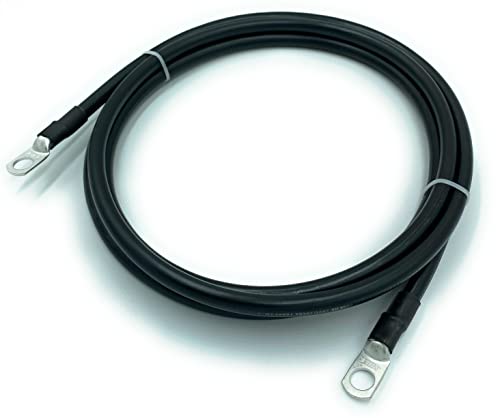
End Game’s pre-terminated 4 AWG marine battery cable ships with heavy-duty tinned ring lugs already crimped, saving you the tools and time of cutting and crimping yourself. Each cable is built in the USA on a hydraulic press for a consistent crimp. The 3/8-inch lugs fit standard battery posts, battery switches, and starter terminals.
The conductor uses tinned copper that meets USCG and ABYC specifications, making it a legal drop-in replacement for marine battery cables. Buyers using these cables on boats, RV house banks, and camper van conversions confirm the lengths are accurate and the crimps do not pull apart under reasonable tension. The 4-foot single black cable is ideal for a ground leg from a battery to a common bus.
The fixed 4-foot length cannot be altered — if you need a custom run, you will need to cut the lug off and re-terminate, which defeats the pre-made convenience. Also, the cable is sold as a single black lead; you must purchase a red power lead separately for a complete positive/negative pair.
Why it’s great
- Factory-crimped tinned lugs — no crimper required
- USCG/ABYC certified for marine and RV use
- Tinned copper resists corrosion in wet installations
Good to know
- Fixed 4-foot length cannot be shortened or lengthened easily
- Sold as single black cable — power lead sold separately
7. ExtreSpo Heavy Duty Jumper Cables — 4 Gauge

ExtreSpo’s jumper cables use copper-clad aluminum conductors in a UL-listed assembly rated to deliver 600 amps of instantaneous starting current. The 20-foot length is generous for nose-to-nose or nose-to-tail jump scenarios. Each clamp features heavy-duty springs and serrated teeth designed to bite through corrosion on battery posts.
The kit includes a carry bag, insulated gloves, and terminal brushes — a complete roadside setup. Vinyl insulation rated from -40°F to 140°F keeps the cables flexible in winter. Reviews praise the sturdy feel of the clamps and the tangle-free storage in the included bag.
CCA conductors are standard for jumper cables because the duty cycle is short (seconds), but sustained cranking on a deeply discharged battery can heat the clamps. The bag’s instruction diagram has been reported to show reversed vehicle order — follow the printed instructions on the cable itself for safe connection order.
Why it’s great
- 20-foot reach works for awkward parking configurations
- UL listed with 600-amp peak rating
- Complete kit with bag, gloves, and cleaning brushes
Good to know
- CCA conductor can heat up during extended cranking
- Clamp jaw teeth protrusion may hinder flush attachment on recessed terminals
FAQ
Can I use CCA 4 gauge wire for my car audio subwoofer amplifier?
What is the difference between welding cable and battery cable for 4 AWG?
Does tinned copper wire provide better corrosion resistance than bare OFC?
Final Thoughts: The Verdict
For most users, the best 4 gauge wire overall is the EWCS 4 AWG Welding Cable because its 364-strand OFC construction delivers exceptional flexibility and full ampacity for automotive, solar, and inverter applications. If you need a pre-terminated solution or are working in a marine environment, grab the NOVINO Marine Wire for its tinned-copper corrosion resistance. And for a budget-conscious ground run or light-duty install on a low-current system, the GEARit CCA Automotive Wire gets the job done without breaking the bank.