
A 2-inch pressure reducing valve sits at the heart of any serious commercial or high-demand residential water system — it is the single component that decides whether your pipes last decades or burst from uncontrolled pressure spikes. Choosing the wrong one means either water hammer damage, constant dripping, or a system that cannot deliver the flow volume your application demands.
I’m Min — the co-founder and writer behind Gadgets Feed. I’ve spent hundreds of hours analyzing plumbing system designs, cross-referencing flow coefficients, and comparing thread standards across the most critical valve categories to separate genuine industrial-grade hardware from overpriced retail stock.
This guide cuts through the noise to deliver the most practical, spec-backed recommendations available today for the 2″ pressure reducing valve category so you can make an informed purchase with absolute confidence.
How To Choose The Best 2″ Pressure Reducing Valve
A 2-inch valve is not a trivial purchase — it handles the main water line for large homes, irrigation zones, or commercial branch lines. The wrong choice means restricted flow, fluctuating downstream pressure, or premature seal failure. Focus on these three factors before adding anything to your cart.
Body Material & Corrosion Resistance
Brass alloys (typically CW617N or lead-free dezincification resistant DZR brass) dominate potable water applications because they resist scaling and maintain a smooth bore. Stainless steel (304 or 316) handles higher temperatures and aggressive fluids but costs more and may gall on threads. For standard municipal water, a lead-free brass body offers the best balance of longevity and cost. Always verify NSF/ANSI 61 or 372 certification if the valve touches drinking water.
Thread Type & Installation Method
National Pipe Taper (NPT) threads are the standard for North American residential and commercial plumbing — they rely on thread-seal tape or paste and provide a mechanical interference fit. Press-fit connections (like ProPress-style) require a specialized crimping tool but install in seconds with zero risk of over-tightening or cross-threading. Tri-clamp ferrules are sanitary-industry connections used in food and beverage lines. Match the connection type to your existing pipe termination; adapter fittings introduce extra leak points.
Flow Capacity & Pressure Rating
The valve’s flow coefficient (Cv) tells you how many gallons per minute can pass through with a 1 PSI pressure drop. For a 2-inch valve, expect a Cv between 50 and 120 depending on the port design — full-port ball valves deliver the highest flow, while globe-style PRVs restrict flow slightly. Do not exceed the valve’s WSP (working steam pressure) rating for hot water lines. A 150 PSI WSP / 600 PSI WOG (water, oil, gas) rating is typical for heavy-duty 2-inch brass ball valves used in residential mains.
Quick Comparison
On smaller screens, swipe sideways to see the full table.
| Model | Category | Best For | Key Spec | Amazon |
|---|---|---|---|---|
| Cash Acme EB45 | PRV | Precise pressure regulation | 60 PSI preset, 10-70 PSI adj. | Amazon |
| PROCURU Press Ball Valve | Press Ball Valve | Fast copper pipe installations | 250 PSI, 2-pack, NSF 61 | Amazon |
| U.S. Solid Solenoid Valve | Solenoid Valve | Remote or automated control | 12V DC, Viton seal, 7 bar | Amazon |
| Watts 2000 Float Valve | Float Valve | Tank level maintenance | 165 PSI, bronze body | Amazon |
| JMCOLMT Butterfly Valve | Butterfly Valve | Sanitary / tri-clamp systems | 304 SS, 217 PSI max | Amazon |
| Watts LFFBV-4 Ball Valve | Full Port Ball Valve | Maximum flow, minimal drop | 600 PSI WOG, lead-free | Amazon |
| inruwo Brass Ball Valve | Full Port Ball Valve | Budget-friendly 2″ shutoff | 600 PSI WOG, FNPT | Amazon |
In‑Depth Reviews
1. Cash Acme EB45 Pressure Regulating Valve
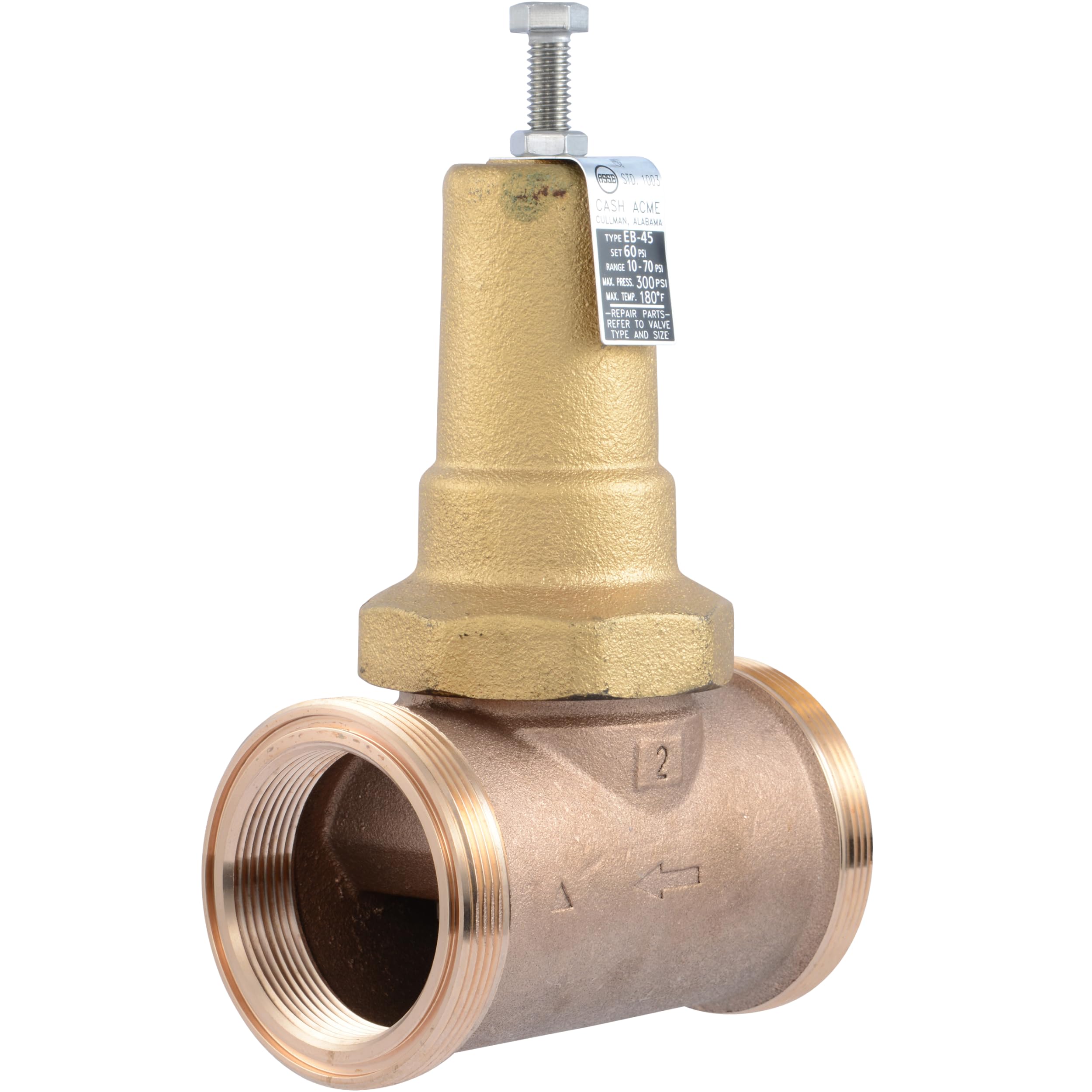
The Cash Acme EB45 is the only true dedicated pressure reducing valve (PRV) on this list, which makes it the correct choice for anyone who needs to regulate downstream pressure rather than simply shut off flow. Its half-cartridge design gives direct access to the adjustment screw — you can dial in anywhere from 10 to 70 PSI without disassembling the valve body. The tamper-resistant locking ring prevents accidental setting changes, a feature that matters when the valve is buried in a crawl space or mechanical room.
Rated for 60 PSI at the inlet and suitable for hot water up to 180°F, the EB45 uses a brass and stainless steel construction that passes NSF/ANSI 372 for lead-free potable water compliance. The internal cartridge design delivers smoother regulation than traditional diaphragm-style PRVs, meaning less chatter and pressure creep during high-demand events like sprinkler system startup or simultaneous shower usage. The compact inline profile fits easily into existing 2-inch NPT lines without requiring extra support brackets.
The trade-off is cost — this is the most expensive unit in the roundup, but when you need guaranteed pressure consistency from a brand that has been field-tested in thousands of municipal installations for decades, the premium is justified. The adjustment range of 10-70 PSI covers virtually every residential and light commercial application, from protecting water heaters to preventing slab leaks.
Why it’s great
- True pressure regulation with 10-70 PSI adjustment range
- Tamper-resistant locking ring for set-and-forget reliability
- Lead-free brass construction — safe for drinking water
Good to know
- Requires a pressure gauge and second person for precise setup
- Higher initial investment than simple ball valves
2. PROCURU 2-Inch Press Copper Ball Valve
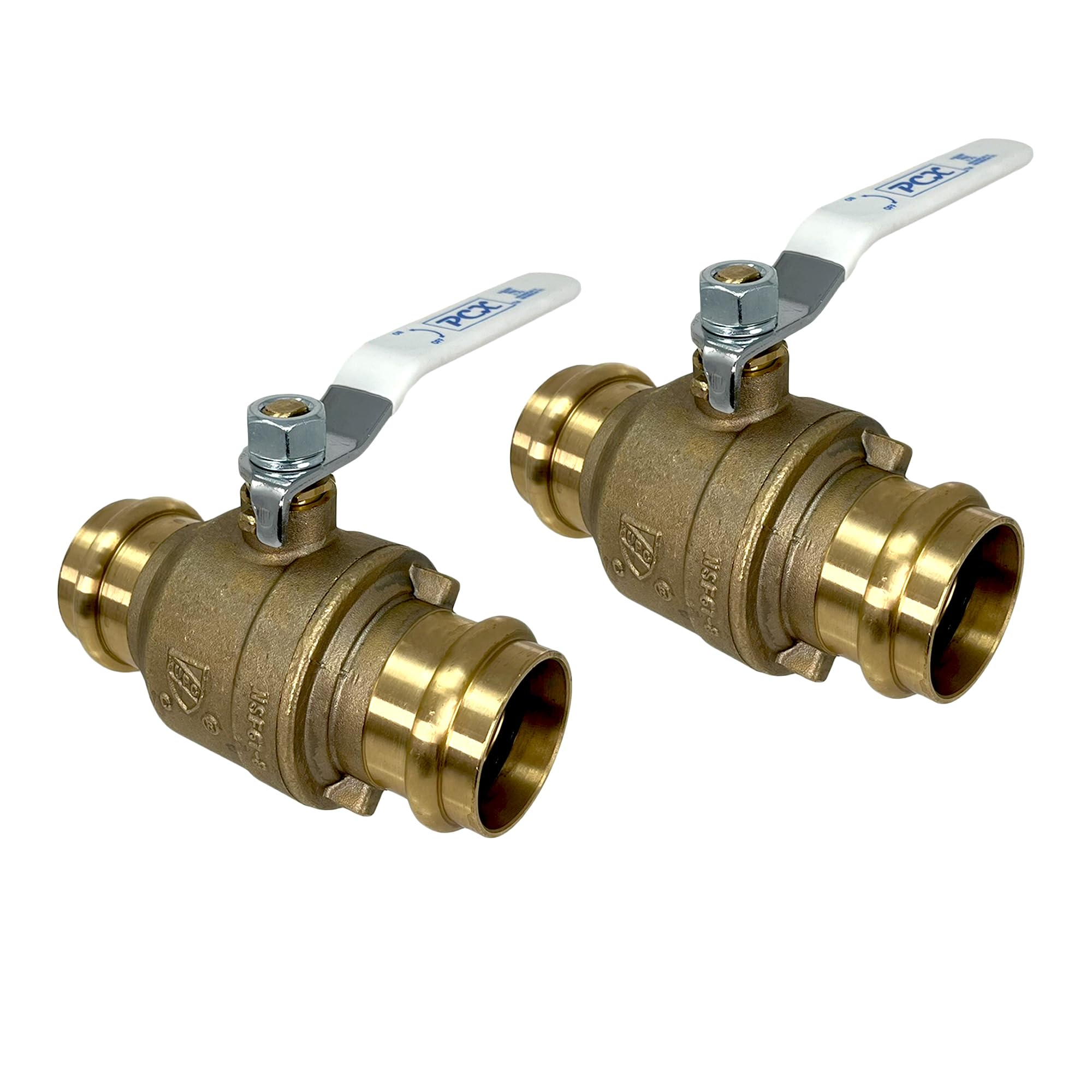
The PROCURU press ball valve stands out as the fastest-installing option for copper pipe systems, assuming you own or can rent a press tool. Each of the two valves in the pack uses a 2-inch press connection compatible with hard copper types K, L, and M, replacing the ProPress standard. The heavy-duty brass body and full-port design ensure that the 2-inch bore delivers unrestricted flow — critical for main water line applications where every GPM matters.
Rated at 250 PSI, these valves exceed the typical municipal water pressure range by a wide margin, providing a solid safety buffer for pressure spikes. The valves come with a 10-year limited warranty and carry NSF/ANSI 61 certification for potable water, meaning they meet the same safety standards as the fixtures in your kitchen. The 2-pack format saves significant cost per valve compared to buying individual press valves from local supply houses.
The main limitation is tool dependency — if you do not have a press tool, installation requires buying or renting one, which adds upfront cost. Additionally, press connections are less forgiving than NPT threads if you need to reposition the valve after crimping. For new construction or major retrofits where labor time is the primary cost, this valve pays for itself in minutes saved.
Why it’s great
- Press-fit installs in seconds without threading or sealant
- 250 PSI rating and full-port design for maximum flow
- Two-pack value beats big-box store pricing on equivalent ProPress
Good to know
- Requires a press tool (not included) for installation
- Press connections are permanent — no rework after crimping
3. U.S. Solid 2″ Solenoid Valve
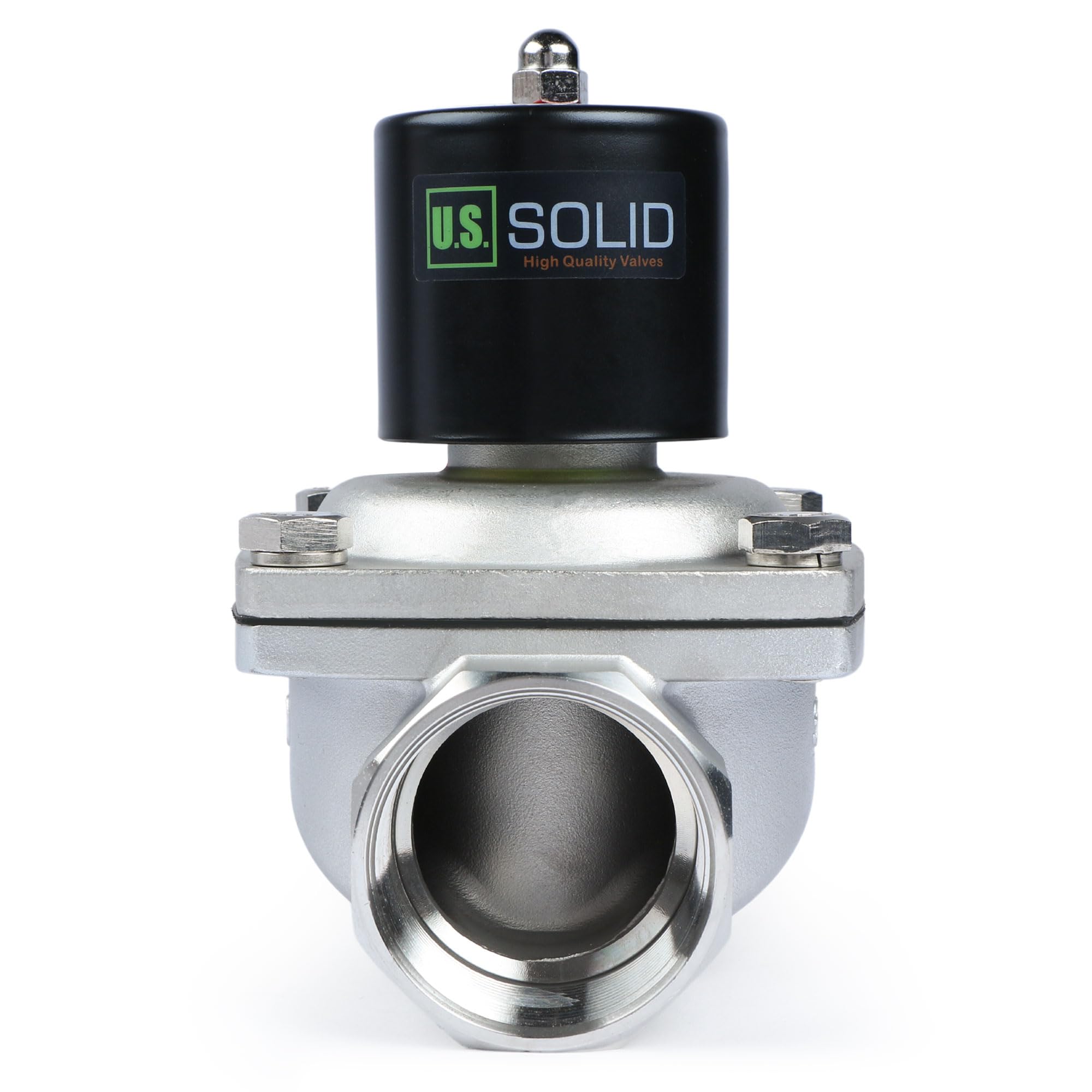
The U.S. Solid solenoid valve brings electrical actuation to the 2-inch line, enabling remote or timer-based shutoff for irrigation, fuel transfer, or industrial process control. The normally closed (NC) configuration means the valve stays sealed until 12V DC is applied, providing fail-safe operation — if power drops, the valve closes automatically. The Viton seal handles aggressive fluids including gasoline, diesel, oils, and high-temperature chemicals far beyond what standard fluorocarbon seals can tolerate.
The valve actuates in under one second and is rated for over one million cycles, making it suitable for frequent-duty applications like automatic tank filling or diesel transfer systems. The stainless steel body resists corrosion in marine or chemical environments where brass would eventually pit. With a maximum pressure of 7 bar (approximately 101 PSI), it is designed for moderate-pressure lines rather than high-pressure mains.
Critical caveat: this is an intermittent-duty valve — the manufacturer explicitly warns against continuous energization beyond 8 hours. Users running it on constant duty for reverse osmosis systems report coil temperatures reaching 180°F, which can degrade the winding insulation. For continuous flow applications, U.S. Solid recommends their motorized ball valve instead. If you need intermittent automated control in a corrosive fluid environment, this valve delivers exceptional value at half the cost of industrial solenoid options.
Why it’s great
- Viton seal resists fuels, oils, and high-temperature chemicals
- Fast actuation under one second with fail-safe NC design
- Over one million cycle lifespan with proper intermittent use
Good to know
- Not designed for continuous duty exceeding 8 hours
- 12V DC power supply not included — requires separate purchase
4. Watts 2000 Series Bronze Float Valve

The Watts 2000 float valve is the correct solution when your application involves maintaining a precise water level in a tank — cooling towers, boiler hot wells, irrigation reservoirs, and livestock tanks. The 2-inch NPT inlet feeds water through a bronze body with a machined flange on the inlet side, and the high-tensile manganese bronze arms support the float. The serrated arms allow quick water level adjustment by simply repositioning the float along the teeth.
Rated for 165 PSI maximum working pressure and 180°F maximum temperature, this valve is built for the continuous duty cycles of industrial environments. The replaceable seals and no-jam single lever action mean that when wear eventually occurs after years of service, you rebuild the valve rather than replacing the entire assembly. The bronze construction eliminates the galvanic corrosion risk that would occur with a brass valve mounted directly to a steel tank wall.
The main consideration is that this is a mechanical float valve, not an electrically actuated one — the water level is controlled purely by the buoyancy of the float, which means the valve body must be mounted at the correct height relative to the desired water surface. It also requires adequate clearance for the float arm arc. For applications requiring remote level sensing or integration with building automation systems, a solenoid or motorized valve would be more appropriate.
Why it’s great
- Mechanical float operation — no power or control wiring needed
- Serrated arms for tool-free water level adjustment
- Replaceable seals extend service life significantly
Good to know
- Requires adequate tank wall clearance for float arm swing
- Not suitable for inline pressure regulation — tank mounting only
5. JMCOLMT 2″ Butterfly Valve

The JMCOLMT butterfly valve uses a 2-inch tri-clamp ferrule connection, the standard in sanitary and food-grade piping systems where clean-in-place (CIP) protocols require smooth, crevice-free internal surfaces. The 304 stainless steel construction with a polished finish prevents bacterial harborage and withstands aggressive cleaning chemicals. The pull-handle design allows three-position flow control — fully open, partially throttled, or fully closed — by simply pulling and rotating the handle.
Rated for a maximum pressure of 217 PSI and a temperature range of 15°F to 200°F, this valve handles both chilled water lines and hot CIP loops. The blue silicone cover on the handle tail provides a comfortable grip and protects the operator’s hand during repeated operation. Each valve is 100 percent pressure hydraulic tested before shipping, which accounts for the consistently positive user feedback regarding leak-free performance right out of the box.
The price is remarkably low for a fully stainless 2-inch valve, and the two-valve bundle makes it even more cost-effective. However, this is a butterfly valve — it introduces a slightly higher pressure drop than a full-port ball valve when fully open, and the disc sits in the flow path even in the open position. It is also not a true pressure reducing valve; it serves as a manual shutoff and throttling valve for sanitary applications. If your system uses tri-clamp connections and you need a cleanable, corrosion-resistant shutoff, this is a compelling buy.
Why it’s great
- 304 stainless steel resists acids, alkalis, and CIP chemicals
- Tri-clamp design enables quick disassembly for cleaning
- 100 percent pressure tested — zero leak complaints from users
Good to know
- Butterfly disc creates flow restriction vs. full-port ball valve
- Tri-clamp requires matching ferrule fittings — not NPT compatible
6. Watts LFFBV-4 Full Port Ball Valve
The Watts LFFBV-4 represents the gold standard in 2-inch full-port ball valves for potable water systems. The lead-free copper silicon alloy body (bronze) combined with a chrome-plated brass ball provides a combination of corrosion resistance and smooth quarter-turn operation that budget valves cannot match. The 600 PSI WOG (water, oil, gas) rating means this valve handles industrial pressures far beyond residential mains, while the 150 PSI WSP rating confirms it is safe for saturated steam applications up to its temperature limit.
Engineering details set this valve apart: a bottom-loaded blowout-proof stem prevents catastrophic stem ejection under pressure, virgin PTFE seats provide consistent sealing torque over thousands of cycles, and the adjustable stem packing seal allows tightening without disassembly. The fluorocarbon elastomer O-ring handles a wider temperature range and chemical exposure than standard nitrile O-rings. These details matter when the valve is buried underground or installed in a location where replacement requires excavation.
The primary drawback is the price premium over generic brass ball valves — you are paying for the Watts name, the decades of engineering refinement, and the one-year warranty. The chrome-plated ball, while smooth, may eventually wear if operated frequently in dirty water applications. For a main shutoff valve in a potable water system where reliability is non-negotiable, this valve justifies its cost through build quality alone.
Why it’s great
- Blowout-proof stem and virgin PTFE seats for extreme reliability
- 600 PSI WOG rating handles industrial and high-pressure systems
- Lead-free construction fully compliant for drinking water
Good to know
- Higher cost than generic 2-inch brass ball valves
- Chrome-plated ball may wear faster in abrasive applications
7. inruwo Full Port Brass Ball Valve
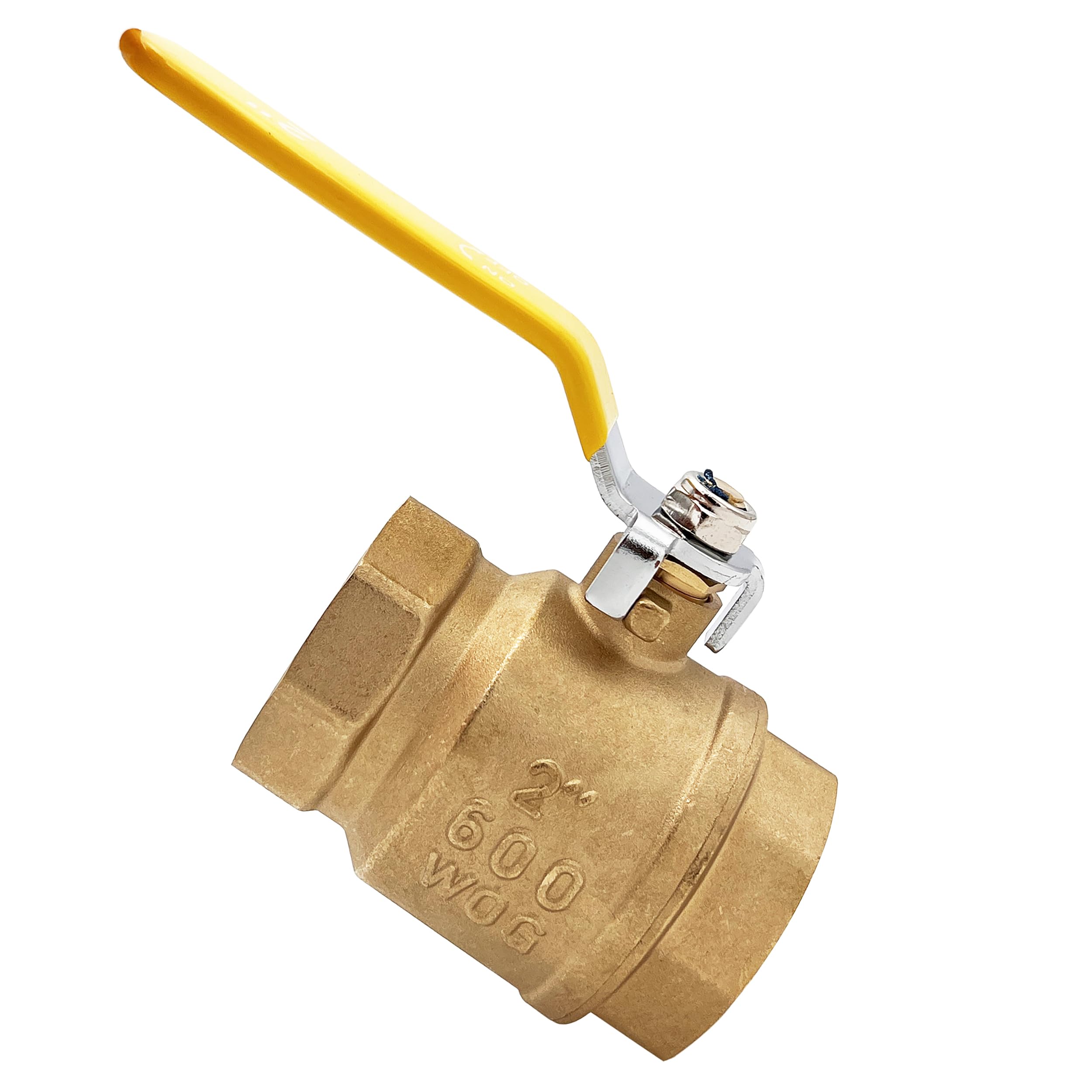
The inruwo ball valve delivers the same 600 PSI WOG pressure rating and 150 PSI WSP rating as the more expensive Watts valve for a fraction of the cost. The forged brass body and chromium-plated ball provide corrosion resistance adequate for standard potable water, irrigation, and industrial fluid applications. Both ports use 2-inch female NPT threads, allowing direct installation onto male threaded pipe with standard seal tape.
The quarter-turn steel handle with plastic cover operates smoothly with low torque, and the bidirectional design means you cannot install it backward. The temperature range of -60°F to 450°F covers everything from freezing outdoor spigots to hot water recirculation lines. User reviews confirm consistent quality — the valve works right out of the box, holds pressure without leaks, and the metal ball (rather than plastic) provides reliable long-term sealing compared to ultra-budget competitors.
The compromise is in the intangible details: no blowout-proof stem, no adjustable packing gland, and no recognizable brand warranty backing. The valve may require slightly more torque to operate after years of infrequent use, and the plastic handle cover is less durable than an all-metal handle. For secondary shutoffs, irrigation manifolds, or projects where multiple valves are needed, this represents the best value per dollar in the 2-inch category.
Why it’s great
- Full 600 PSI WOG rating at a budget-friendly price point
- Forged brass body with chromium-plated ball resists corrosion
- Bidirectional full-port design ensures no flow restriction
Good to know
- No blowout-proof stem or adjustable packing features
- Plastic handle cover less durable than all-metal alternatives
FAQ
Can I install a 2-inch pressure reducing valve vertically?
What is the difference between a pressure reducing valve and a pressure regulating valve?
How do I measure the correct 2-inch pipe connection type?
Final Thoughts: The Verdict
For most users, the 2″ pressure reducing valve winner is the Cash Acme EB45 because it is the only dedicated PRV in the lineup, delivering exact downstream pressure control with a tamper-resistant dial that commercial and high-end residential systems demand. If you need a fast-installing shutoff for copper pipe, grab the PROCURU press ball valve. And for automated remote control on intermittent-duty fluid lines, nothing beats the U.S. Solid solenoid valve — just remember to respect its duty cycle limits.