
Stepping up from a smartphone to a dedicated camera opens a world of creative control, but the sheer number of specs, lens options, and price points can paralyze a first-time buyer. You need a tool that teaches you the fundamentals without punishing mistakes or draining your budget, delivering sharp video and clear photos right out of the box.
I’m Min — the co-founder and writer behind Gadgets Feed. To build this guide, I spent dozens of hours analyzing sensor sizes, lens reach, battery capacities, and autofocus systems across the current market to identify the models that genuinely serve someone learning the craft rather than overwhelming them.
Whether you’re vlogging, documenting travel, or exploring photography as a hobby, finding the right beginner video camera means prioritizing ease of use without sacrificing the image quality that will keep you motivated to improve.
How To Choose The Best Beginner Video Camera
The perfect entry-level video camera balances image quality with an intuitive interface. You want a model that grows with your skills without frustrating you with complicated menus or poor performance in common shooting environments like your living room or a local park. Focus on these three pillars to make the right choice.
Sensor Size and Low-Light Performance
The sensor is the heart of any camera. A larger physical sensor, measured in inches or by type (1-inch, APS-C, Micro Four Thirds), captures more light, which translates directly to cleaner video with less grain when you’re shooting indoors or during twilight. A 1-inch sensor found in many compact vlogging cameras is a significant step up from a smartphone’s tiny sensor, while an APS-C sensor in a DSLR or mirrorless body offers even better depth of field and low-light capability. Do not rely on megapixel count alone — a 64MP sensor in a budget camera can produce noisier video than a 24.1MP sensor in a quality interchangeable-lens camera.
Optical Zoom vs. Stabilization
For video, optical zoom is king because it uses the lens glass to magnify the image without losing resolution, unlike digital zoom which merely crops and enlarges the pixels. A camera like the Kodak PIXPRO with 52x optical zoom brings distant wildlife or sports action into crisp frame. However, zooming at high magnification amplifies every hand tremor, making built-in optical image stabilization (OIS) or gimbal stabilization essential. For vloggers who film themselves at arm’s length, a wide-angle lens with reliable stabilization — whether electronic or mechanical — matters far more than extreme telephoto reach. Consider your primary shooting scenario before prioritizing one over the other.
Autofocus and Usability Features
Missed focus is the fastest way to ruin a video. Look for a camera with face and eye detection autofocus (AF), which keeps you or your subject sharp even when moving unpredictably. Phase-detection AF, found in Canon’s Dual Pixel system and many mirrorless cameras, is faster and more reliable for video than standard contrast detection. A fully articulating touchscreen is non-negotiable for solo content creators who need to frame themselves while recording. Built-in Wi-Fi for quick file transfers to your phone and a clean HDMI output for webcam use are valuable extras that ease the beginner’s workflow.
Quick Comparison
On smaller screens, swipe sideways to see the full table.
| Model | Category | Best For | Key Spec | Amazon |
|---|---|---|---|---|
| Sony ZV-1F | Compact Vlog | Everyday Vlogging | 1-inch Sensor / 20mm f/2.0 | Amazon |
| Canon EOS R100 | Mirrorless Kit | Learning Photography & Video | APS-C 24.1MP / 4K 24fps | Amazon |
| Canon EOS Rebel T7 | DSLR Kit | Traditional Photography Start | APS-C 24.1MP / 1080p Video | Amazon |
| Kodak PIXPRO AZ528 | Superzoom Bridge | Wildlife & Distant Subjects | 52x Optical Zoom / 16MP | Amazon |
| Xtra Muse | Pocket Gimbal | Ultra-Smooth Moving Shots | 1-inch Sensor / 3-Axis Gimbal | Amazon |
| Insta360 GO Ultra | Wearable Action | Hands-Free POV Footage | 53g / 4K60fps / Magnetic Mount | Amazon |
| Xtra Edge Pro | Action Camera | Outdoor Sports & Water Use | 1/1.3″ Sensor / 4K60fps / 65ft | Amazon |
| NBDDIGITAL 8K Cam | Entry-Level Kit | Budget Intro to Photography | 64MP / 16x Digital Zoom | Amazon |
| ABJURNJ 6K Camcorder | All-in-One Camcorder | Complete YouTube Starter Pack | 4.0″ Touch / IR Night Vision | Amazon |
In‑Depth Reviews
1. Sony ZV-1F Vlog Camera

The Sony ZV-1F is purpose-built for creators transitioning from a phone to a dedicated camera. Its 20mm ultra-wide f/2.0 lens captures a generous field of view at arm’s length, making solo vlogging effortless. The large 1-inch sensor delivers sharp 4K video with natural defocused backgrounds, and Sony’s Eye-AF tracking ensures you remain the focal point even as you move through your frame.
The side-articulating touchscreen simplifies selfie composition, and the directional 3-capsule microphone with the included windscreen produces clean audio that reduces post-processing work. It lacks optical zoom and its in-body stabilization is purely digital, meaning you’ll want a gimbal or steady hands for walking shots. The touchscreen interface is intuitive, and the dedicated “background defocus” button is a brilliant teaching tool for beginners learning depth of field.
Battery life runs around 45 minutes of continuous recording, so purchasing a spare battery is a smart move for day-long shoots. The Product Showcase mode smoothly racks focus from your face to an object held up to the lens, a feature that’s invaluable for unboxing or review creators. If you prioritize vlogging ease and image quality over telephoto reach, this is the most refined entry point available.
Why it’s great
- Excellent 1-inch sensor and fast f/2.0 lens for low light and background blur
- Reliable Eye-AF and Product Showcase mode simplify solo shooting
Good to know
- No optical zoom; relies on digital crop
- Battery lasts roughly 45 minutes; purchase spares
2. Canon EOS R100 with RF-S18-45mm Lens

Canon’s EOS R100 brings the power of interchangeable lenses and an APS-C sensor to the budget-conscious beginner. The 24.1-megapixel CMOS sensor paired with the DIGIC 8 processor captures 4K video at 24fps and Full HD at up to 60fps, providing a substantial image quality leap over any smartphone. The RF-S18-45mm kit lens offers a versatile zoom range for everyday scenarios from landscapes to portraits.
The Dual Pixel CMOS AF system covers 143 zones with human face and eye detection, delivering smooth autofocus transitions that keep subjects sharp during video recording. The camera body is the lightest and smallest in the EOS R series, making it exceptionally portable for travel. A dedicated beginner GUI explains shooting modes, helping you learn aperture and shutter speed priority without needing a separate tutorial session.
Video features are limited to 4K at 24fps without the option for higher frame rates at that resolution, and the LCD screen is fixed rather than articulating. A separate battery charger is not included, so you charge directly in-camera via USB. For roughly half the price of many competing mirrorless models, this camera provides a genuine path into the Canon RF lens ecosystem with room to grow as your skills advance.
Why it’s great
- Excellent APS-C image quality and Dual Pixel AF in a compact, affordable body
- Beginner-friendly interface with guide mode explains shooting concepts
Good to know
- 4K video limited to 24fps; 1080p at 60fps available
- Screen is fixed, not flip-out for selfie framing
3. Canon EOS Rebel T7 DSLR

The Canon EOS Rebel T7 is a classic entry-level DSLR that has launched countless photographers and videographers. Its 24.1-megapixel APS-C sensor delivers vibrant, detailed photos and Full HD video at 30fps. The included EF-S 18-55mm lens with image stabilization provides a standard zoom range ideal for learning composition and controlling depth of field via the optical viewfinder.
The optical viewfinder offers 95% frame coverage and is powered by a 9-point autofocus system with AI Servo AF for tracking moving subjects. The camera’s Guide mode is exceptionally well-designed for beginners, walking you through the effects of different settings before you capture the shot. Built-in Wi-Fi and NFC allow for quick image transfers to your smartphone for social sharing, a feature often missing from older budget DSLRs.
At roughly one pound for the body, it feels substantial in hand without being burdensome. The key compromise is video: there is no 4K recording, only Full HD at 30fps. The Live View autofocus is slower than phase-detect systems on mirrorless cameras, making it less ideal for run-and-gun vlogging. For a beginner focused mainly on photography who also wants solid 1080p video, the Rebel T7 remains a reliable, affordable gateway.
Why it’s great
- Student-friendly Guide mode and optical viewfinder teach core photography skills
- Excellent battery life for full-day shooting without recharging
Good to know
- No 4K video; only Full HD at 30fps
- Live View autofocus is slow, limiting video versatility
4. Kodak PIXPRO Astro Zoom AZ528
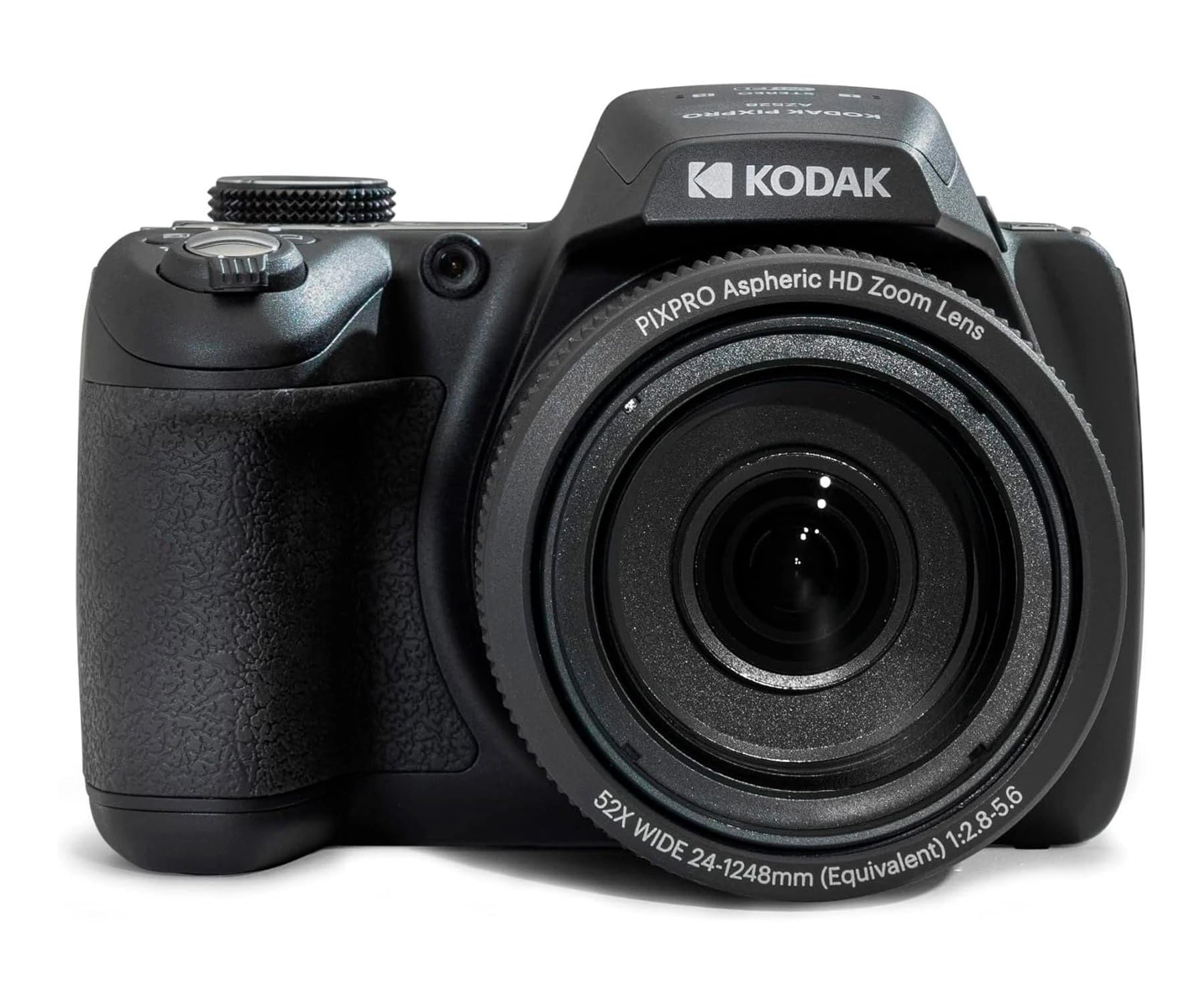
The Kodak PIXPRO AZ528 solves the beginner’s problem of “my phone can’t zoom that far” with an impressive 52x optical zoom lens, reaching subjects that remain invisible to most other cameras in its class. The 24mm wide-angle end captures sweeping scenes, while the telephoto reach brings birds, wildlife, and sports action into sharp, optically magnified detail. The built-in optical image stabilization compensates for hand shake even at maximum zoom, a critical feature for handheld telephoto shooting.
The 16-megapixel BSI CMOS sensor performs well in good light, and the camera shoots 1080p Full HD video with stereo sound. The 3-inch LCD screen is clear for composition and review, and the camera includes a hot shoe for adding an external flash or microphone. Wi-Fi connectivity allows wireless transfer to your phone, making it easy to post images directly from the field without a computer.
Battery life is adequate for a day of casual shooting, though heavy zoom usage drains it faster. The plastic body feels less premium than a DSLR but keeps the weight manageable for travel. The contrast-detection autofocus is not as fast as phase-detect systems, so tracking fast-moving subjects requires practice. For a beginner whose primary passion is nature observation or spectating sports, this camera offers unprecedented reach for the price.
Why it’s great
- 52x optical zoom delivers genuine reach for distant wildlife and sports shots
- Optical image stabilization helps keep telephoto shots sharp handheld
Good to know
- Autofocus uses contrast detection, which can be slower in low light
- Body is plastic; feels less durable than DSLR/mirrorless alternatives
5. Xtra Muse Pocket Vlogging Camera

The Xtra Muse packs a 1-inch CMOS sensor and a 3-axis gimbal stabilizer into a pocket-sized body, delivering exceptionally smooth 4K footage at up to 120fps. The gimbal eliminates the need for a separate stabilization rig — walk, run, or dance while recording, and the footage remains fluid. The 2-inch touchscreen flips for selfie framing, and the Master Follow mode keeps you centered in the frame automatically using face and object tracking.
True 10-bit X-Log color grading captures up to one billion colors, providing flexibility in post-production for those who want to color-correct their footage. The included carrying case and handle with a 1/4-inch thread add mounting versatility for tripods or selfie sticks.
Battery life averages roughly 2 hours of continuous recording, and the camera does not have an onboard zoom lens — it relies on a fixed wide-angle lens, which is ideal for vlogging but limits reach. The build quality feels solid, though the small screen can be challenging to review details on. For the creator who wants buttery-smooth video without learning complex stabilization workflows, the Xtra Muse is a powerful, purpose-built tool.
Why it’s great
- Built-in 3-axis gimbal provides professional-level stabilization without extra gear
- 4K at 120fps and 10-bit color for flexible creative output
Good to know
- Fixed wide-angle lens with no optical zoom
- Battery life around 2 hours; keep a power bank handy
6. Insta360 GO Ultra Creator Bundle
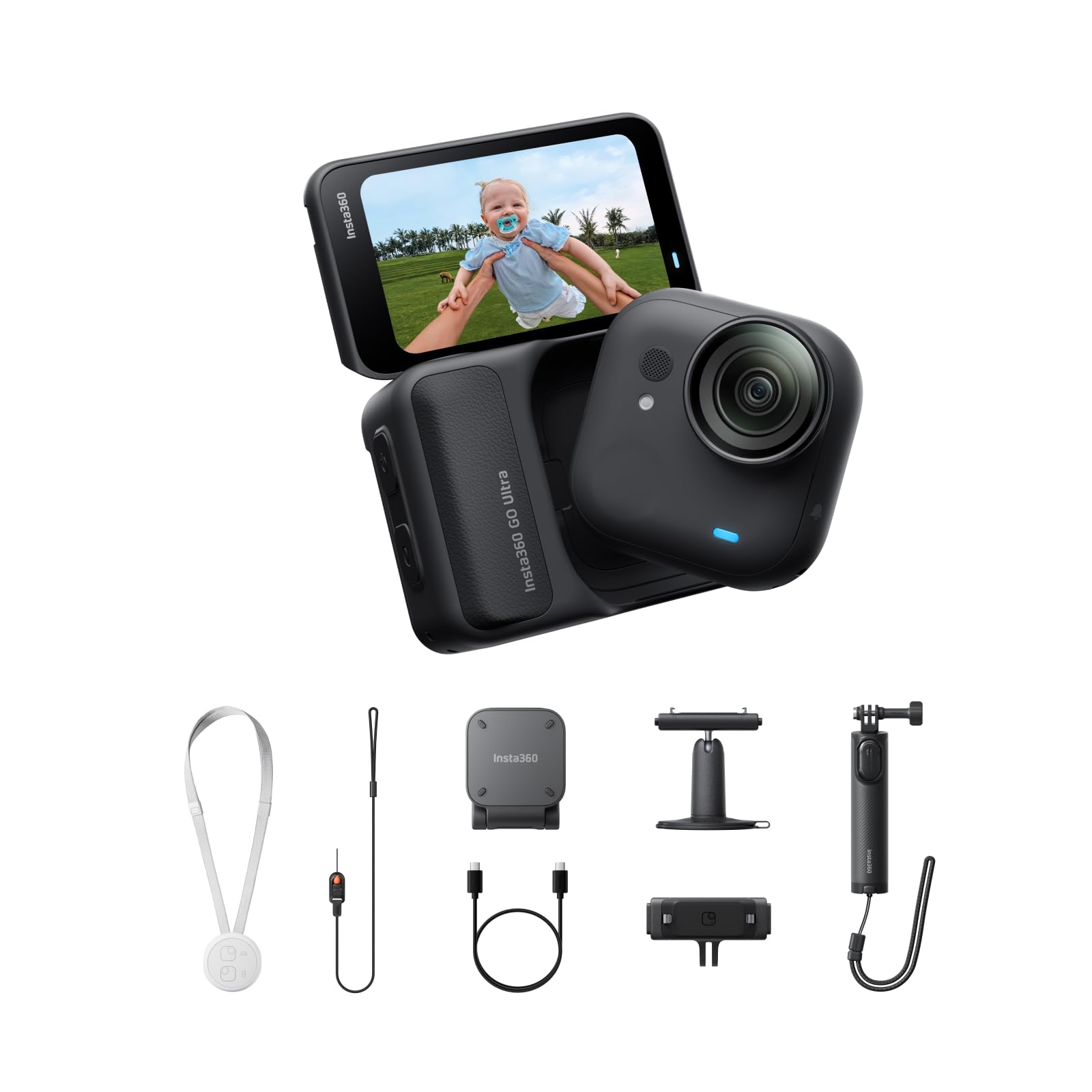
The Insta360 GO Ultra redefines what a beginner video camera can be by shrinking a 4K system down to just 53 grams with magnetic mounting. You can clip it to a cap, wear it on a pendant, or attach it to a bike frame for true hands-free first-person perspective footage. The 1/1.28-inch sensor and 5nm AI chip deliver sharp 4K Active HDR video, and the FlowState Stabilization with 360 Horizon Lock keeps the horizon perfectly level regardless of how much you move.
The combination of the standalone camera and the Action Pod provides up to 200 minutes of total shooting time, and the fast-charging feature reaches 80 percent in just 12 minutes. The IPX8 waterproof rating allows diving to 33 feet without a housing, and the magnetic accessories make mounting creative and quick. The auto-editing AI finds your highlights and turns them into shareable videos with transitions and music, a massive time-saver for beginners who don’t want to learn editing.
The standalone camera’s battery is non-swappable, and the Action Pod is only splashproof, not fully waterproof. The module is slightly larger than previous GO generations, though still tiny compared to any action camera. For a beginner who wants 4K POV footage of cycling, hiking, or daily life without carrying a camera in their hands, the GO Ultra is an innovative and uniquely capable choice.
Why it’s great
- Ultra-light 53g magnetic design enables creative, hands-free POV shots
- 200-minute total battery life with 12-minute fast charge to 80%
Good to know
- Standalone camera battery is non-swappable
- Action Pod is splashproof only; not for submersion
7. Xtra Edge Pro Action Camera
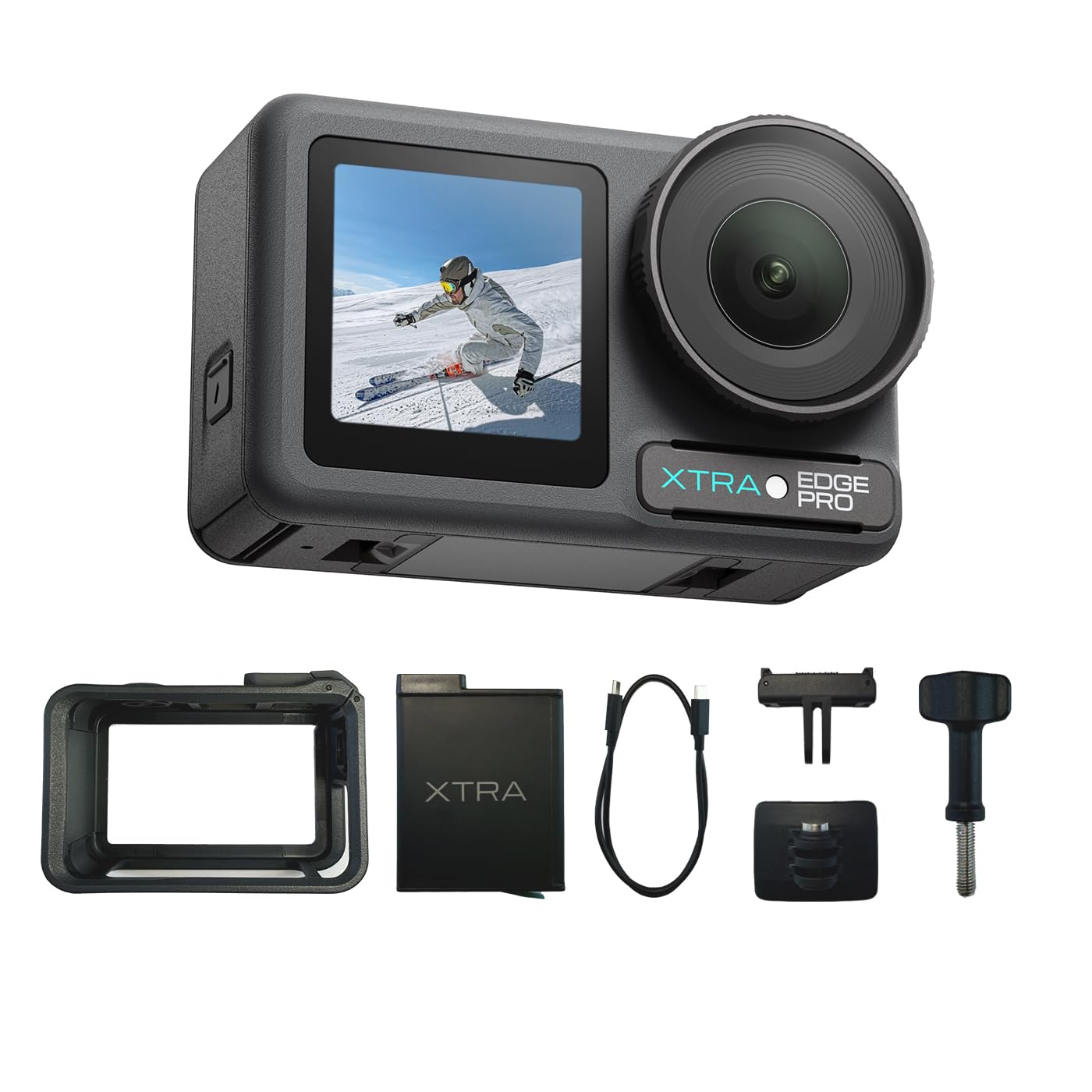
The Xtra Edge Pro brings a large 1/1.3-inch sensor to the action camera market, capturing 4K video at 60fps with vibrant colors and improved low-light performance. The camera is waterproof to 65 feet without a housing, making it ready for snorkeling, surfing, or rainy hikes right out of the box. The Night View Mode extends usable shooting into dusk and evening scenarios where smaller sensor cameras would produce unusable footage.
Stabilization is handled by a three-pronged system including 360 Lock, TiltGuard, and MotionMaster, which smooth out bumps from biking, running, or off-roading. The Standard Bundle includes a Dual-Facing Mount Adapter, a Cold-Resistant Battery, and a Dual-Orientation Protective Frame, providing everything needed to start filming immediately. The camera is compatible with DJI accessories, expanding its mounting options significantly.
Battery life averages around 4 hours on a single charge, and the camera uses a microSD card for storage. The wide-angle lens captures a cinematic field of view typical of action cameras, but the lack of optical zoom means all reach is digital. For an outdoorsy beginner who wants a durable, waterproof camera that delivers sharp 4K footage of their adventures without spending premium-tier money, this is a strong contender.
Why it’s great
- Large sensor and 65ft waterproof rating without extra housing
- Long 4-hour battery life for full-day outdoor shoots
Good to know
- Relies on digital zoom; no optical reach
- Requires microSD card, not included
8. NBDDIGITAL 8K 64MP Digital Camera
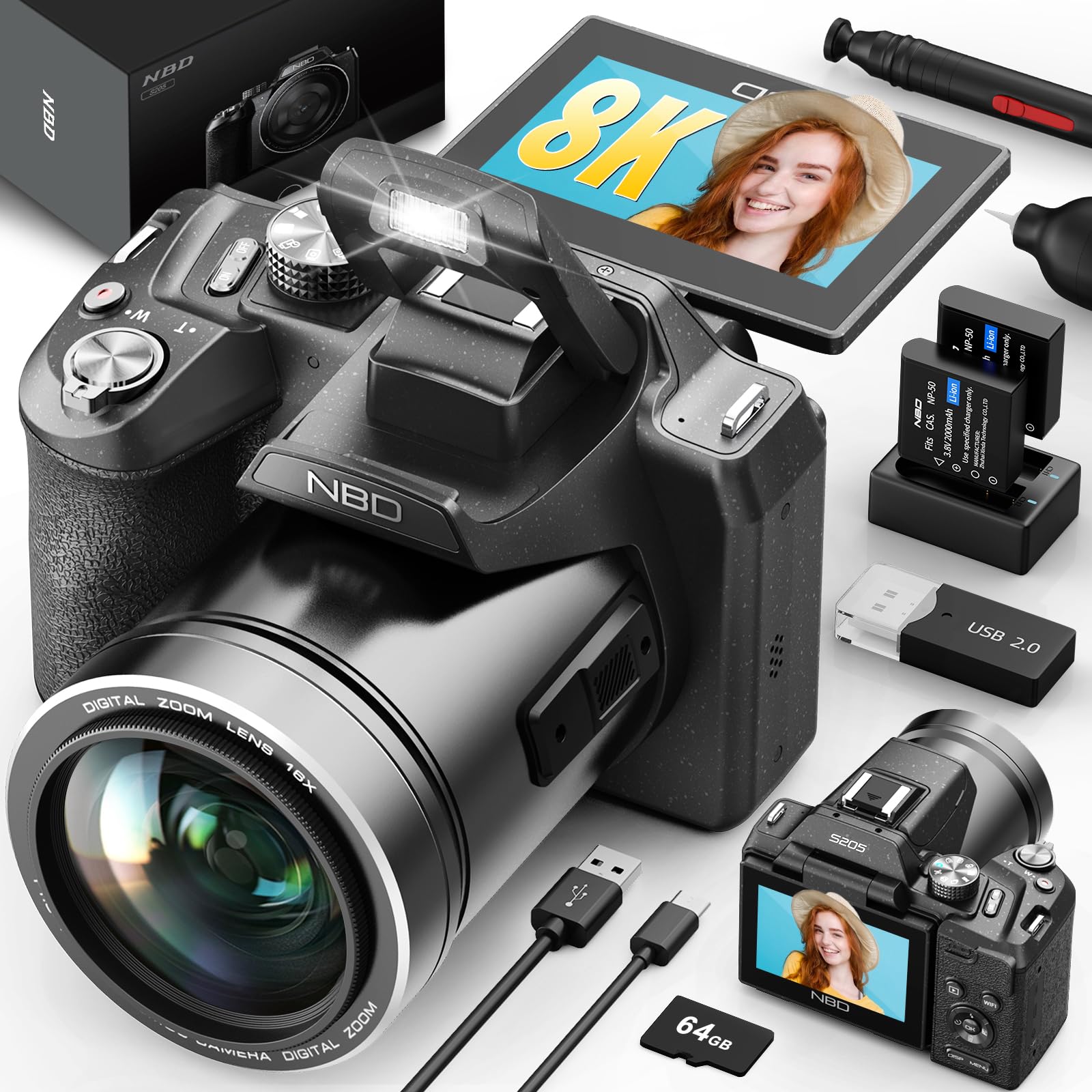
The NBDDIGITAL 8K camera is an all-in-one bundle that removes the guesswork for a first-time buyer by including two batteries, a 64GB memory card, and multiple accessories. It records video at resolutions up to 8K and captures 64-megapixel stills, though it’s important to understand that much of this resolution is achieved through interpolation rather than native sensor performance. The 180-degree flip screen is a welcome feature for vloggers who need to frame themselves while recording.
The 16x digital zoom allows you to get closer to subjects, but it crops and enlarges the image rather than magnifying optically, so image sharpness degrades at high zoom levels. The anti-shake technology helps reduce blur, and the hot shoe supports an external flash for better lighting. Wi-Fi and micro HDMI connectivity make it easy to transfer files or use the camera as a webcam for live streaming.
The camera feels lightweight and the menu system is straightforward, making it accessible for complete beginners. Image quality in good light is acceptable for social media sharing, but low-light performance is limited by the smaller sensor.
Why it’s great
- Complete value bundle including batteries, memory card, and accessories
- 180-degree flip screen and hot shoe support for vlogging and external flash
Good to know
- 8K and 64MP specs are interpolated; real resolution is lower
- 16x digital zoom reduces sharpness significantly compared to optical zoom
9. ABJURNJ 6K Camcorder Video Camera

The ABJURNJ 6K camcorder is designed as a complete YouTube starter package, packing a 4.0-inch ultra HD touchscreen, a 4500mAh battery, and a 64GB SD card into the box. It records 6K video at 30fps and 4K at 60fps, and the 18x digital zoom provides framing flexibility. The 270-degree rotatable screen allows for creative angle choices, and the built-in IR night vision lets you capture usable black-and-white footage in total darkness.
The included external microphone and handheld stabilizer significantly improve audio clarity and video smoothness out of the box. The 2.4G wireless remote controls the camera from up to 65 feet away, which is excellent for group shots or solo filming without touching the camera. The camera can also function as a webcam via USB, supporting live streaming and video calls.
The 4500mAh battery provides up to 4.2 hours of 6K recording, and the camera supports recording while charging for extended sessions. The digital zoom is the limiting factor for image quality at long range, and the touchscreen interface, while responsive, may take some getting used to. For the beginner who wants a camcorder-style solution with all accessories included and a focus on video rather than photography, this kit delivers robust capability.
Why it’s great
- Huge accessory bundle including mic, stabilizer, remote, and 64GB card
- Long 4.2-hour battery life with IR night vision for 24/7 shooting
Good to know
- 18x zoom is digital, not optical; sharpness degrades at high magnification
- Menu system requires initial learning for advanced features
FAQ
Is a DSLR or mirrorless camera better for a beginner video creator?
What is the minimum resolution I should look for in a beginner video camera?
Do I need a gimbal for my first video camera?
How does the image stabilization system affect my footage quality?
Final Thoughts: The Verdict
For most users, the beginner video camera winner is the Sony ZV-1F because it combines a large 1-inch sensor, intuitive vlogging features, and excellent autofocus in a compact, transportable body that feels natural for creators moving up from a smartphone. If you want interchangeable lenses and a mirrorless system with room to grow, grab the Canon EOS R100. And for ultra-smooth handheld video without extra gear, nothing beats the Xtra Muse.