
That chalky, oxidized look on your aluminum hull isn’t just cosmetic — it’s the metal breaking down from UV and salt, and the wrong paint choice will flake off within a season. Marine-grade aluminum demands a coating system that flexes with the metal, bonds to the oxide layer, and withstands constant water immersion, so picking a paint based on chemistry rather than color is the only way to get lasting results.
I’m Min — the co-founder and writer behind Gadgets Feed. I’ve dug deep into the formulation of two-part epoxies, single-stage urethanes, and copper-free antifouling paints to break down exactly which coatings protect riveted seams, resist galvanic corrosion, and hold up against mud and sand abrasion.
Whether you’re restoring a jon boat or prepping a pontoon, this guide cuts through the chemical jargon to help you find the best aluminum boat paint for your hull and your working conditions.
How To Choose The Best Aluminum Boat Paint
Aluminum is reactive — alkaline and copper-based paints will eat through it, causing blistering and corrosion. That means your buying decision starts with paint chemistry, not color. Focus on the coating’s intended substrate and whether it includes a dedicated primer step.
Surface Prep & Barrier Coats
Bare aluminum needs an etch primer or a two-part epoxy barrier coat before any topcoat. Without that layer, adhesion fails within weeks on a trailer or within a single season in salt water. A barrier coat like the TotalBoat Aluminum Barrier Coat seals pinholing around rivets and prevents electrolysis between dissimilar metals.
Abrasion Resistance & Slickness
If you beach your boat, slide over mud, or scrape against docks, look for a coating with PTFE or a high-build epoxy binder. The Fasco Epoxies Super Slick 2000 uses a PTFE additive that reduces drag and absorbs light abrasion without exposing bare metal. For pontoon bottoms that never touch anything but water, a standard urethane enamel offers enough protection.
Antifouling for Submerged Hulls
Boats that stay in the water need an ablative antifouling paint that sloughs off biocide-laden layers over time. Stick to copper-free formulas — TotalBoat Alumipaint AF is designed specifically for aluminum to avoid galvanic corrosion. Hard racing bottom paints are not compatible with aluminum without a barrier layer underneath.
Quick Comparison
On smaller screens, swipe sideways to see the full table.
| Model | Category | Best For | Key Spec | Amazon |
|---|---|---|---|---|
| TotalBoat Alumipaint AF | Antifouling | Submerged aluminum hulls & pontoons | Copper-free, 500 sq. ft./gal | Amazon |
| Fasco Epoxies Super Slick 2000 | Epoxy Slick | Airboats, jon boats, jet skis | PTFE additive, 30 sq. ft./qt | Amazon |
| TotalBoat Barrier Coat | Epoxy Primer | Corrosion barrier for raw aluminum | Two-component, 225 sq. ft./gal | Amazon |
| Aluma Hawk Jon Boat Green | Single-Stage | Freshwater jon boats & skiffs | Fast-dry, 60 sec dry time | Amazon |
| Seahawk ALUMA Hawk Gray | Single-Stage | Aluminum canoes & utility boats | Ready-to-spray, no reducer needed | Amazon |
| Diamond Brite Aluminum Paint | Enamel | Metal roofs & chain-link fences | Gloss finish, 300 sq. ft./gal | Amazon |
| 3M Marine Aluminum Restorer | Polish | Restoring oxidized & chalked aluminum | Medium-grit, 18 oz tube | Amazon |
In‑Depth Reviews
1. TotalBoat Alumipaint AF Copper Free Bottom Paint
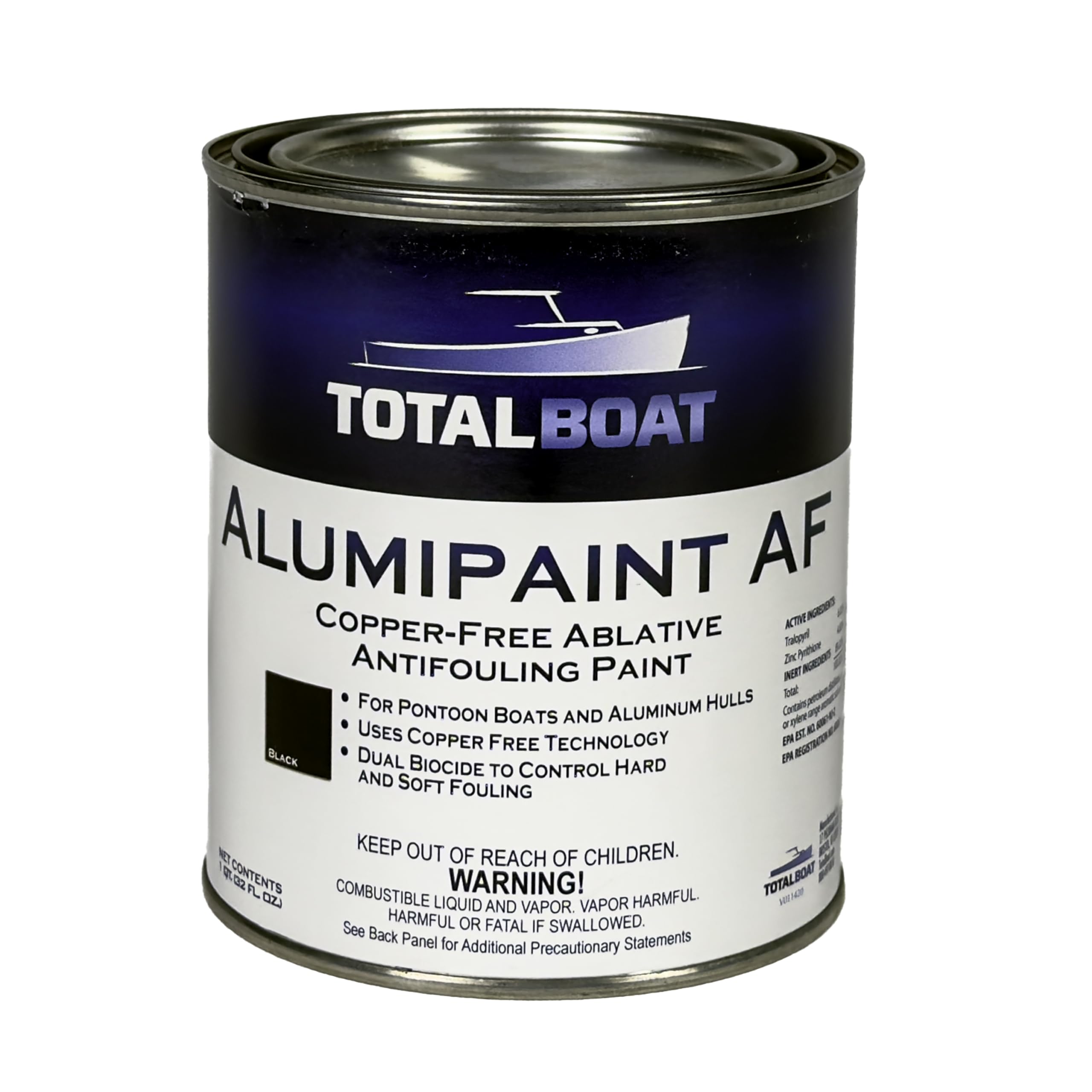
This copper-free ablative bottom paint is purpose-formulated for aluminum hulls and pontoons, eliminating the galvanic corrosion risk that traditional copper-based antifouling paints cause on reactive metals. The quart covers a 14-foot boat with two coats at the recommended 125 sq. ft. per quart, and the ablative chemistry wears away gradually to expose fresh biocide throughout the season.
Application requires a multi-step process: surface prep with an etch primer followed by a two-part barrier coat before laying down the Alumipaint AF. Users report excellent adhesion on properly prepped aluminum and outdrives, though the paint is sensitive to moisture during curing — a light misty rain within the first 24 hours can leave a polka-dotted finish. The bright blue variant shows noticeable color fade after extended saltwater exposure.
For boaters who leave their hull in the water all season, this paint delivers single-season antifouling protection without attacking the aluminum itself. It also works well on outdrives and running gear where copper-based paints would cause rapid pitting. Just be prepared for a 3-day project window and protect the fresh coat from any rain.
Why it’s great
- Copper-free formula prevents galvanic corrosion on aluminum
- Ablative design continuously exposes fresh biocide
- Adequate coverage for 14-foot hulls with 2 coats
Good to know
- Rain during curing ruins the finish — needs shelter
- Requires dedicated etch primer and barrier coat beneath
- Color can fade noticeably in bright saltwater conditions
2. Fasco Epoxies Super Slick 2000 Epoxy Bottom Coating
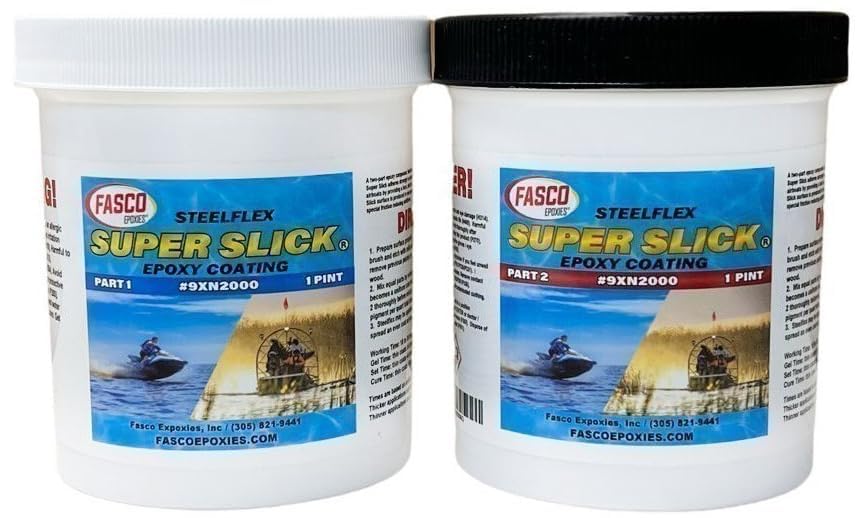
This two-part epoxy coating incorporates PTFE and friction-reducing additives to create an exceptionally slick surface that slides over mud, grass, sand, and gravel without hanging up. It’s field-tested on airboats, jon boats, and aluminum canoes for decades, and the quart kit covers roughly 30 square feet with two thin coats — just enough for a 14-foot jon boat bottom.
The 1:1 mix ratio is straightforward, but the pot life is short; users describe the paint thickening fast and becoming difficult to spread within minutes. Once applied, one coat seals leaky rivets and small pinholes effectively — several reviewers report zero water intrusion after coating. The cured finish is extremely slick to the touch, and boats slide off trailers noticeably easier after application.
There are minor trade-offs: the coating can crinkle or develop an orange-peel texture if applied too thick or if the ambient temperature fluctuates during cure. It also sands back to bare metal quickly under heavy abrasion, acting as a sacrificial layer. For shallow-water boats that scrape bottom frequently, this is the most effective wear layer available in this product tier.
Why it’s great
- PTFE additive delivers true slickness on mud and sand
- Seals rivets, pinholes, and leaky seams in one coat
- Sacrificial layer protects aluminum from direct abrasion
Good to know
- Short pot life — work quickly and in small batches
- Can crinkle if applied too thick or in variable temps
- Not intended as a decorative topcoat; dull finish
3. TotalBoat Aluminum Barrier Coat

This high-build, two-component epoxy barrier coat is designed specifically to prevent corrosion on aluminum hulls and pontoons, both above and below the waterline. It acts as the chemical shield between bare aluminum and the topcoat, blocking electrolysis and sealing microscopic pores in the metal surface. Coverage is estimated at 225 sq. ft. per gallon at 7 mils wet.
The paint goes on thick — multiple reviewers describe it as having the consistency of bedliner, even when thinned with the recommended TotalBoat Epoxy Primer Thinner 200. It dries fast without sanding between coats, which speeds up a multi-coat project significantly. The precise mixing ratio (3:1 by volume, 5.6:1 by weight) has caused confusion; some users ran out of activator mid-project after using the wrong ratio.
Once cured, this primer is extremely tough — welders report having to sand and torch through three layers of it to get back to bare metal. That level of durability makes it ideal for high-wear areas like boat bottoms and pontoons. Just be aware that it is not rated as waterproof on its own; a marine topcoat is still required for full immersion protection.
Why it’s great
- Chemically bonds to aluminum to stop galvanic corrosion
- No sanding required between coats for fast layering
- Extremely tough cured film — resists abrasion
Good to know
- Mixing ratio is critical — easy to miscalculate by weight
- Goes on very thick; requires thinning for spray application
- Requires a marine topcoat for full waterproofing
4. Seahawk Aluma Hawk Jon Boat Green

This single-stage paint from Seahawk is formulated to bond directly to bare aluminum without a separate primer, which saves hours of prep time on freshwater boats and skiffs. The paint dries to the touch in roughly 60 seconds, allowing rapid recoating and same-day completion on small hulls. A quart covers a 10-foot jon boat with one coat, though a second coat is recommended for full coverage.
Application works best with a sprayer — the paint is thick and difficult to brush without visible strokes. Users who sprayed it through a Harbor Freight gun needed to add reducer to prevent clogging. The finish is durable enough to stop leaks in a 30-year-old jon boat, effectively sealing rivet holes that had been seeping for years. The Jon Boat Green color leans closer to black than green, which disappointed some buyers expecting a true forest green.
Ventilation and respiratory protection are mandatory: the paint contains strong solvents that require a respirator and outdoor application. One quart costs notably more per ounce than gallon-sized alternatives, so larger boats will need multiple quarts or a switch to a different product for cost efficiency.
Why it’s great
- No separate primer needed — bonds straight to aluminum
- Extremely fast drying — recoat in minutes
- Seals leaky rivets and seams effectively
Good to know
- High cost per ounce — expensive for larger hulls
- Color is much darker than expected — almost black
- Strong solvents require full respirator and outdoor work
5. Seahawk ALUMA Hawk Aluminum Gray

The companion gray variant of Seahawk’s ALUMA Hawk line offers the same no-primer direct-to-aluminum adhesion in a neutral color that blends with raw metal. It’s a ready-to-spray formulation that applies cleanly out of the quart without thinning for most gravity-feed spray guns, making it a straightforward choice for restoration projects on aluminum canoes, skiffs, and utility boats.
Coverage is typical for the single-stage category — users with larger hulls reported needing just over a quart for a full two-coat job. The paint lays down smooth and levels well, leaving a consistent semi-gloss finish that resists chalking from UV exposure for a full season. Older sediment in cans can settle hard on the bottom, making hand-stirring difficult; a paint shaker or vigorous mechanical stirring is advised before use.
Quality control on fill volume has been inconsistent — some buyers received quarts that were only three-quarters full, which is frustrating given the per-quart cost. Despite this packaging issue, the paint itself performs well on properly prepped surfaces and offers good corrosion resistance for freshwater use.
Why it’s great
- Spray-ready directly from the can without thinning
- Neutral gray matches raw aluminum aesthetics
- Good UV resistance against chalking
Good to know
- Inconsistent fill levels reported by multiple buyers
- Heavy sediment settles hard — needs vigorous mixing
- Higher cost per quart than gallon aluminum enamels
6. Diamond Brite Aluminum Paint
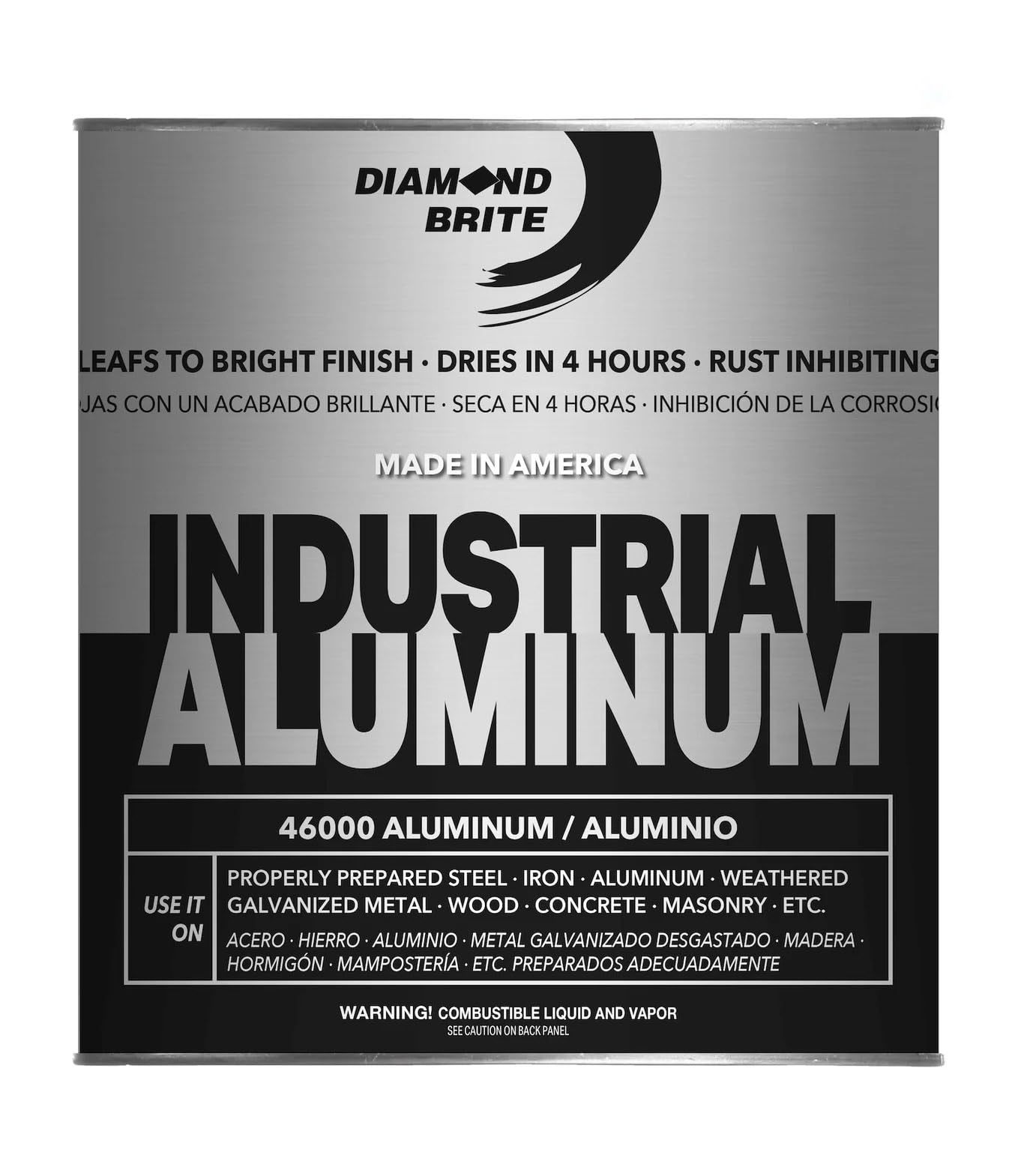
This single-part aluminum enamel is formulated for metal surfaces that don’t face constant water submersion — chain-link fences, metal roofs, machinery, and campers. The quart covers roughly 300 square feet, which makes it the most economical option for large surface-area projects above the waterline. The gloss finish dries to a bright, mirror-like sheen that outshines typical rustoleum products.
The paint is extremely thin and requires thorough mixing to suspend the aluminum particles evenly. Users who applied it to vintage campers and outdoor playhouses report that it levels nicely and forgives minor runs when applied in three thin coats. It sprays well through a conventional siphon gun at higher pressure, though the thin consistency can cause drips on cold or non-porous surfaces if applied too heavily.
This paint is not waterproof and should not be used on hull sections that sit below the waterline. It’s best suited for dry applications where aesthetics and corrosion resistance matter but immersion protection is not required. Drying time is roughly 1-2 hours under normal conditions, with full hardness developing after 24 hours.
Why it’s great
- Excellent gloss finish — mirror-like sheen
- High coverage rate — 300 sq. ft. per gallon
- Forgiving of runs; levels nicely on vertical surfaces
Good to know
- Not waterproof — do not use below the waterline
- Requires extensive stirring to suspend aluminum flakes
- Very thin consistency can cause drips on cold metal
7. 3M Marine Aluminum Restorer and Polish

This is not a paint — it’s a medium-grit polishing compound formulated to remove heavy oxidation and chalking from bare aluminum surfaces. The 1000-grit formula cuts through weathered aluminum oxide and restores a mirror shine without the hazardous fumes of muriatic acid. It’s best used on boats, RVs, and trailers where the goal is to recover the original aluminum finish rather than paint over it.
Application requires significant elbow grease, especially on pitted areas where sea air has eaten into the metal. The compound produces a black residue that requires many soft cloths to buff off, but users who commit to the process report a bright, shiny finish that lasts through a full summer season. It works equally well by hand on small sections or with a machine polisher on larger flat panels.
The polish performs poorly on surfaces with major pitting — deep crevices hold residue and prevent the finish from reaching full shine. It also dulls relatively quickly on older aluminum finishes that have been exposed to years of unchecked weathering. For lightly oxidized trailers and boats, however, it’s a safer and more effective alternative to acid-based brighteners.
Why it’s great
- Removes heavy oxidation without hazardous acid fumes
- Restores mirror shine on chalked aluminum
- Works by hand or with a machine buffer
Good to know
- Ineffective on deep pitting from saltwater exposure
- Produces heavy black residue — uses many cloths
- Finish may dull quickly on older, weathered aluminum
FAQ
Can I use regular rustoleum paint on my aluminum boat?
Do I need to sand the aluminum before painting?
Why can’t I use copper-based bottom paint on aluminum?
How long does aluminum boat paint last before recoating?
Final Thoughts: The Verdict
For most users, the best aluminum boat paint winner is the TotalBoat Alumipaint AF because it combines copper-free antifouling technology with proper aluminum-safe chemistry for boats that stay in the water. If you need a tough sacrificial layer for shallow-water running, grab the Fasco Epoxies Super Slick 2000. And for a fast-drying single-stage system on a freshwater jon boat, nothing beats the Seahawk Aluma Hawk Jon Boat Green.