
The difference between a good stereo and a truly great one isn’t volume — it’s the absence of noise. An audiophile receiver is the heart of a system designed to reproduce recorded music with such low distortion and high resolution that the electronics disappear, leaving only the performance. For anyone who has felt that a live concert sounds fundamentally different from a home playback, finding the right receiver is the single most important step toward closing that gap.
I’m Min — the co-founder and writer behind Gadgets Feed. I’ve spent countless hours dissecting the technical specifications of integrated amplifiers, DAC chipsets, and discrete amplification stages to build this guide, ensuring every recommendation here is backed by measurable performance data, not marketing claims.
Whether you are powering a pair of bookshelf monitors or a full home theater system, the decision starts here with the best audiophile receiver that matches your speakers, your room, and your listening habits.
How To Choose The Best Audiophile Receiver
Selecting an audiophile receiver forces a critical fork in the road: do you need a pure stereo integrated amplifier for two-channel music listening, or a full multichannel A/V receiver for movies and gaming? The wrong choice wastes money on channels you don’t use or leaves you without the connectivity your system demands.
DAC Architecture and Digital Conversion
The digital-to-analog converter is the single most important component for sound quality in a modern receiver. Chips like the ESS SABRE ES9039Q2M or the AKM AK4490 determine how faithfully your digital files are translated into an analog signal. Look for receivers that specify THD+N (Total Harmonic Distortion plus Noise) below 0.001% — that’s the threshold where distortion becomes inaudible to trained listeners.
Amplifier Topology and Power Delivery
Audiophile receivers use either Class A/B or Class D amplification. Class A/B offers linear, warm sound but runs hot and heavy. Modern Class D, like the TI TPA3255, delivers comparable fidelity with lower heat and higher efficiency. Ignore peak wattage claims — what matters is continuous power per channel into your speakers’ nominal impedance, typically 8 ohms, without audible distortion.
Room Correction and Setup Flexibility
No listening room is acoustically perfect. Room correction systems like Audyssey MultEQ XT32, Sony’s Digital Cinema Auto Calibration IX, and YPAO apply digital filters to compensate for reflections and standing waves. For a purest setup, a “pure direct” or “analog mode” bypass allows you to disable all digital processing entirely when listening to vinyl or high-resolution files.
Quick Comparison
On smaller screens, swipe sideways to see the full table.
| Model | Category | Best For | Key Spec | Amazon |
|---|---|---|---|---|
| WiiM Amp Ultra | Streaming Integrated | All-in-one streaming clarity | ESS ES9039Q2M DAC | Amazon |
| Denon PMA-1700NE | Integrated Amp | Pure two-channel vinyl & digital | 140W/ch, AL32 Processing | Amazon |
| Yamaha A-S1200 | Integrated Amp | Musicality with retro VU meters | Floating Balanced Amp | Amazon |
| Sony STR-AZ3000ES | AV Receiver | 8K home theater with 360 Spatial Sound | 9.2 ch, 120W/ch | Amazon |
| Marantz Cinema 40 | AV Receiver | Analog-rich home theater immersion | 9.4 ch, HDAM circuitry | Amazon |
| Sony STR-AZ7000ES | AV Receiver | Ultimate 13.2 ch flagship system | 13.2 ch, 150W/ch | Amazon |
| Yamaha R-N2000A | Network Receiver | Hi-Res streaming & DAC versatility | ESS SABRE ES9026PRO | Amazon |
In-Depth Reviews
1. WiiM Amp Ultra with Voice Remote 2
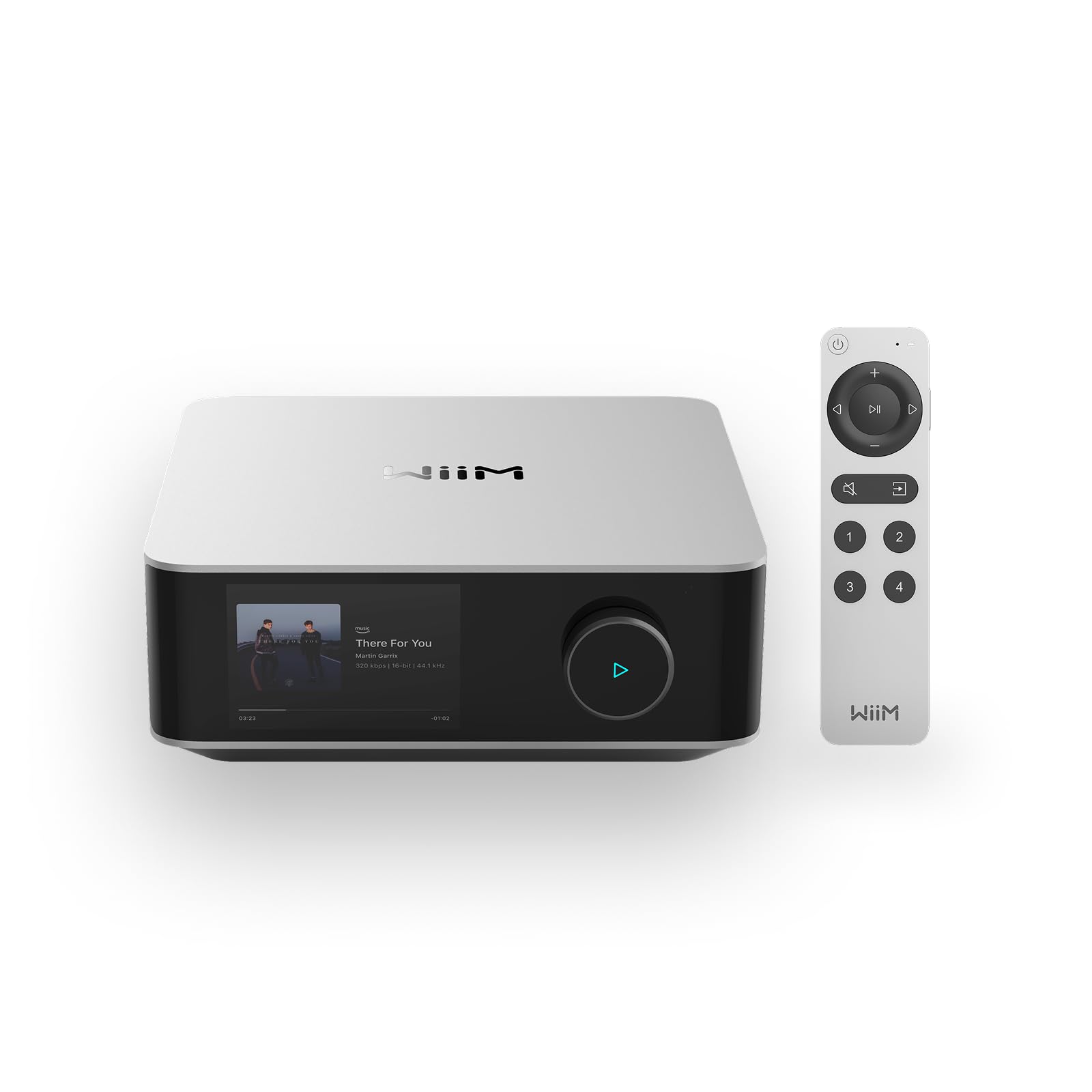
The WiiM Amp Ultra redefines what an entry-point to high-fidelity should cost. It packs a premium ESS SABRE ES9039Q2M DAC — the same chip found in separates costing three times as much — and dual TI TPA3255 Class-D amplifiers delivering 100W per channel into 8 ohms with total harmonic distortion measured at -106 dB. That distortion figure puts it well below the threshold of human audibility, meaning the amplifier adds practically nothing to the signal.
Connectivity is where the Amp Ultra pulls ahead of traditional integrated amps. Wi-Fi 6 and Bluetooth 5.3 with LE Audio provide rock-solid streaming from TIDAL, Qobuz, and Amazon Music at up to 24-bit/192 kHz. The built-in RoomFit EQ uses the microphone on your phone to automatically measure and correct for room acoustics — a feature typically reserved for AVRs costing over . The 3.5-inch touchscreen display shows album art and system settings, keeping control intuitive without requiring a smartphone.
Real-world performance backs up the specs. Users report cleaner, more detailed sound compared to the previous Amp Pro, with better bass management when paired with a powered subwoofer. The auto input switching using audio detection works reliably, and the unit runs remarkably cool despite its compact dimensions (5.4 lbs). The only notable omission is AirPlay support, so Apple ecosystem users should verify their streaming workflow before committing.
Why it’s great
- ESS ES9039Q2M DAC offers studio-grade conversion
- RoomFit EQ auto-corrects for speaker placement
- Wi-Fi 6 + Bluetooth 5.3 for stable high-res streaming
Good to know
- No AirPlay support
- Lacks coaxial digital input
2. Denon PMA-1700NE Integrated Amplifier

The Denon PMA-1700NE is a heavyweight champion in the pure two-channel arena. At 38.8 pounds, its chassis is dominated by a massive toroidal transformer and high-current discrete amplifier stage delivering a conservative 140W per channel into 6 ohms. Denon’s Advanced AL32 Processing Plus upscales digital signals to 384 kHz/32-bit before conversion, reducing quantization noise in the audible band.
Vinyl enthusiasts will appreciate the built-in phono equalizer supporting both Moving Magnet (MM) and Moving Coil (MC) cartridges — a feature that eliminates the need for a separate phono preamp that could cost or more. The “Analog Mode” switch physically disconnects power to the digital circuitry when listening to analog sources, removing any electrical noise from the DAC and USB circuits that could bleed into the signal path.
Users consistently praise its ability to drive difficult 4-ohm loads like the KEF R3 Meta with authority while maintaining a non-fatiguing, smooth tonal character. The PCM1795 DAC inside is excellent but some listeners with high-end separate units may notice the difference. The plastic remote and lack of a volume knob indicator are minor quality-of-life compromises at this price level.
Why it’s great
- Built-in MM/MC phono stage saves on external gear
- Analog Mode eliminates electrical interference
- High-current design handles 4-ohm speakers easily
Good to know
- No Wi-Fi or Bluetooth
- Plastic remote feels out of place
3. Yamaha A-S1200 Integrated Amplifier

The Yamaha A-S1200 occupies a special place in the audiophile landscape — it delivers high-end musicality wrapped in a design that celebrates the analog era. Its Floating Balanced Power Amplifier topology uses a fully symmetrical circuit layout to cancel common-mode noise, while the toroidal transformer provides the current reserves needed for dynamic transients. The mechanical ground concept rigidly connects the chassis to minimize microphonic vibrations.
The retro analog VU meters are not just aesthetic — they provide real-time visual feedback of power output, letting you see the dynamic range of your music. The phono stage outperforms many dedicated external units, especially with 180-gram pressings, delivering wide soundstaging and deep bass extension. Users moving from the A-S700 report noticeably improved high-frequency detail retrieval and a warmer sonic signature despite the 10W per channel reduction in published power.
One area requiring attention is the vintage indicator. This model was introduced in 2020, and several buyers have reported that used units sold as “new” may actually be earlier production runs with potential quality concerns. Always verify the manufacture date on the bottom sticker. The lack of any streaming or digital inputs means it is strictly an analog purist’s tool.
Why it’s great
- Floating Balanced design minimizes noise floor
- VU meters provide real-time dynamic feedback
- Outstanding phono stage for MM and high-output MC
Good to know
- No digital inputs or streaming capabilities
- Check production date carefully on used units
4. Sony STR-AZ3000ES 9.2 CH A/V Receiver

The Sony STR-AZ3000ES is a reference-quality A/V receiver that bridges the gap between home theater and high-fidelity music. Its 9.2 channel configuration (120W per channel into 8 ohms) supports full Dolby Atmos and DTS:X object-based audio, while Sony’s proprietary 360 Spatial Sound Mapping creates a remarkably convincing sound field even with fewer physical speakers than the format nominally requires.
HDMI 2.1 connectivity covers six inputs and two outputs with 8K/60Hz and 4K/120Hz pass-through, supporting ALLM, VRR, and eARC for gaming and modern television sources. The Digital Cinema Auto Calibration IX system uses a supplied microphone to measure speaker distances and adjust timing, although users achieving the best results report manually verifying distances with a tape measure. The “Works with Sonos” integration lets it serve as a hub for a distributed multi-room system.
Sound quality is described by owners as the best they have ever heard from a receiver, with outstanding vocal clarity in movies and a capable Neural X upmixer that creates a compelling surround field from two-channel music. The unit runs extremely hot during extended use — a dedicated cooling fan is strongly recommended by the community. It also lacks support for HDR10+ and the QFT/QMS features found on competing units at similar prices.
Why it’s great
- 360 Spatial Sound Mapping creates immersive phantom channels
- Full HDMI 2.1 with 8K/120Hz and eARC
- Seamless Sonos integration for multi-room audio
Good to know
- Runs very hot — external cooling recommended
- No HDR10+ or QFT support
5. Marantz Cinema 40 9.4-Ch Receiver
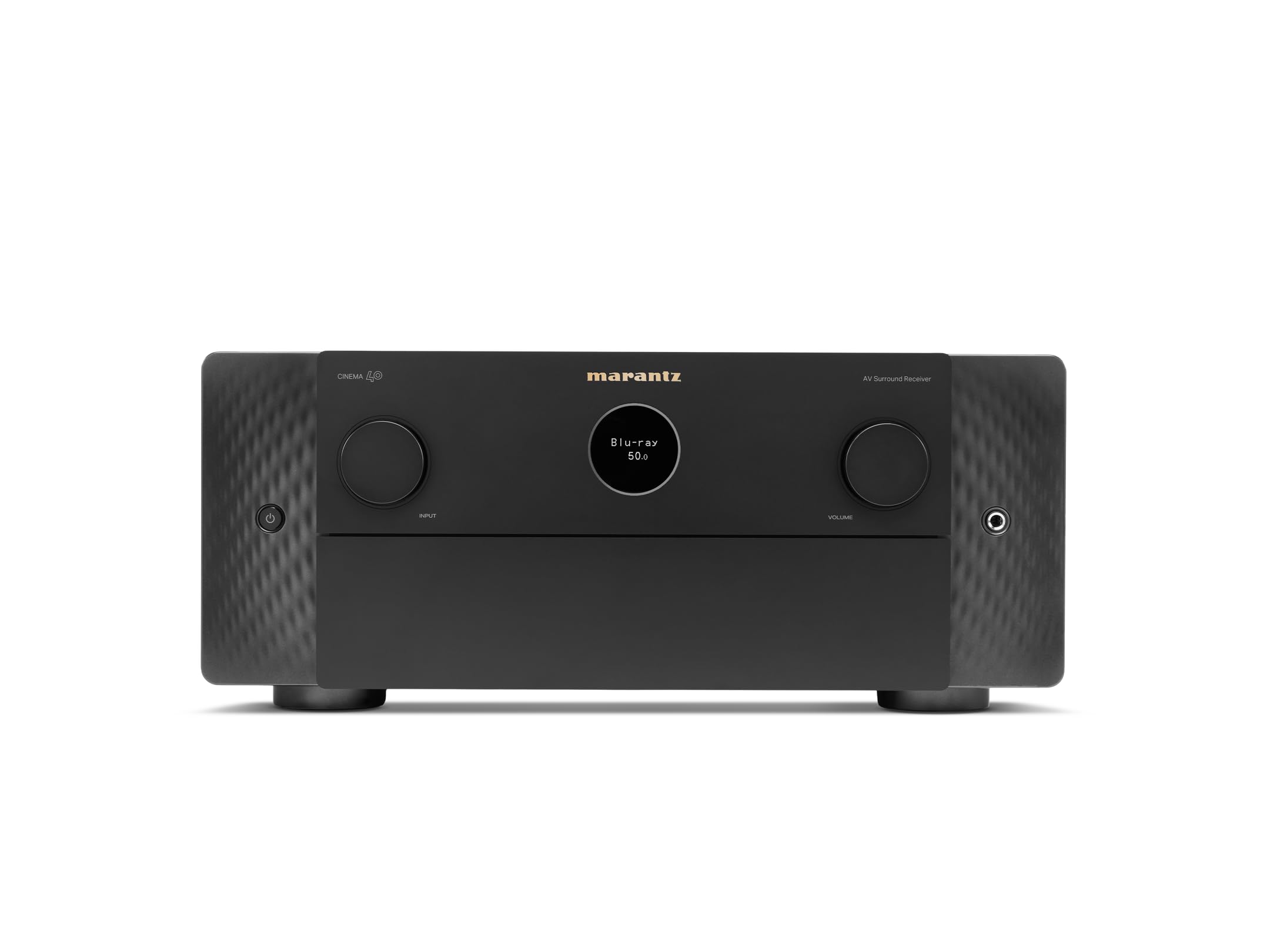
Marantz has cultivated a reputation for “musical” amplification, and the Cinema 40 delivers on that promise with its Hyper Dynamic Amplifier Module (HDAM) discrete circuitry. Unlike the op-amp-based designs common in competing AVRs, HDAM uses individual transistors and resistors to create a current feedback topology that the company argues retains more transient detail and harmonic texture. Blind tests against the Denon X4800H confirm a subtly warmer, more “analog” presentation on music.
Channels-wise, the Cinema 40 offers 9.4 channels with 125W per channel, supporting Dolby Atmos, DTS:X Pro, IMAX Enhanced, and Auro 3D. The four independent subwoofer outputs allow for precise bass management across multiple subwoofers to reduce room mode issues. It features ten HDMI ports (seven inputs, three outputs) with full 8K/60Hz and 4K/120Hz capability including ALLM and VRR for gaming.
The HEOS multi-room system provides reliable streaming from Pandora, Spotify, and TIDAL, while Audyssey MultEQ XT32 handles room correction with impressive precision. One major trade-off: the unit is physically large and many standard AV cabinets cannot accommodate its depth. Several users note that adding an active cooling system like the AC Infinity AIRCOM T8 is good practice to maintain longevity.
Why it’s great
- HDAM discrete circuitry delivers warm, rich tonal character
- Four independent subwoofer outputs for flexible bass
- Full HDMI 2.1 with 8K/60Hz and gaming features
Good to know
- Very deep chassis — measure your cabinet first
- HDMI-CEC may require troubleshooting
6. Sony STR-AZ7000ES 13.2 CH A/V Receiver

The Sony STR-AZ7000ES is the flagship of the ES line, and it leaves little on the table. With 13.2 channels and 150W per channel into 8 ohms, it is designed to drive the most ambitious home theater configurations — 7.2.6 or 9.2.4 setups — without breaking a sweat. The same 360 Spatial Sound Mapping algorithm from the AZ3000ES is present here but with far more headroom and processing power to handle the additional channels.
HDMI 2.1 support spans seven inputs and two outputs with the same 8K/60Hz and 4K/120Hz pass-through as its smaller sibling. The Digital Cinema Auto Calibration IX system works in conjunction with the additional channels to create a truly seamless sound field. Owners report that the Neural X upmixer for two-channel music creates an extraordinarily convincing surround experience, and Dolby Atmos performance is described as reference-grade.
At 55.9 pounds, this is not a device you move casually. The heavy chassis and toroidal transformer are necessary to deliver the current required for high dynamic range movie soundtracks without clipping. As with the AZ3000ES, thermal management is critical — the unit generates significant heat, and an external cooling solution is nearly mandatory for extended high-volume sessions. The lack of HDR10+ support remains a minor gap in an otherwise comprehensive feature set.
Why it’s great
- 13.2 channels for massive immersive installations
- 150W/ch gives real headroom for dynamic peaks
- 360 Spatial Sound Mapping creates phantom height channels
Good to know
- Extremely heavy at 55.9 lbs
- Runs hot — cooling fan strongly recommended
7. Yamaha R-N2000A Hi-Fi Network Receiver

The Yamaha R-N2000A bridges the gap between a pure integrated amp and a modern network streamer. Its ESS SABRE ES9026PRO DAC is an eight-channel chip (used here in dual-mono configuration) capable of resolving DSD 11.2 MHz natively and PCM up to 384 kHz. The toroidal power transformer and symmetrical circuit layout inherited from the A-S series give it the same sonic authority as a dedicated stereo amplifier.
Streaming capabilities are comprehensive: MusicCast supports TIDAL, Qobuz, Amazon Music HD, and Spotify Connect, while Apple AirPlay 2 and Chromecast built-in cover mobile devices. The built-in YPAO room correction — unusual on a stereo receiver — applies parametric EQ to tame room modes while preserving the tonal balance of your speakers. The retro VU meters, illuminated from above, provide visual feedback that is both functional and nostalgic.
Users upgrading from older AVRs consistently report that the R-N2000A plays with more authority and confidence — better transient response, deeper bass, and greater clarity at all volume levels. The MusicCast app is praised for reliability, though the YPAO EQ cannot be manually tweaked post-calibration. The lack of a moving coil phono stage means vinyl enthusiasts with MC cartridges will still need an external preamp.
Why it’s great
- ESS ES9026PRO DAC in dual-mono configuration
- MusicCast + AirPlay 2 for flexible streaming
- YPAO room correction on a stereo receiver
Good to know
- Phono stage is MM only — no MC support
- YPAO EQ not adjustable after calibration
FAQ
What DAC chip should I look for in an audiophile receiver?
Do I need a separate phono preamp or is a built-in phono stage good enough?
Will a 100W per channel amplifier damage my speakers?
Does room correction software affect sound quality negatively?
Final Thoughts: The Verdict
For most listeners, the best audiophile receiver is the WiiM Amp Ultra because it combines a premium ESS SABRE DAC, 100W of clean Class-D power, and built-in room correction at a price that undercuts traditional integrated amps by a wide margin. If you want a pure two-channel system with support for both MM and MC vinyl cartridges, the Denon PMA-1700NE offers heirloom build quality and a phono stage that eliminates the need for external gear. And for a massive home theater with 13 channels and seat-rattling 150W per channel, nothing beats the Sony STR-AZ7000ES.