
A dead laptop in a parked work truck isn’t an inconvenience — it’s a lost day. A CPAP machine without power halfway through a camping trip is a medical hazard. A fridge full of insulin supplies that goes warm because your cigarette lighter adapter couldn’t hold the load is a genuine emergency. The difference between a great AC Charger For Car and a cheap one isn’t about faster phone charging; it’s about whether your sensitive electronics get clean, stable power or a noisy signal that shortens their lifespan.
I’m Min — the co-founder and writer behind Gadgets Feed. For this guide, I spent dozens of hours cross-referencing technical data sheets, carefully analyzing real-world power draw reports from verified buyers, and stress-comparing the output waveform, USB-C PD wattage tiers, and cooling fan logic of seven specific 12V-to-110V inverters to find the models that actually deliver on their continuous wattage claims without frying your gear.
Whether you need to run a 90-watt laptop charger for a full shift or keep a mini-fridge cool on a cross-country road trip, picking the right ac charger for car comes down to matching your peak load to the inverter’s real sustained output — not just the number printed on the box.
How To Choose The Best AC Charger For Car
Buying an AC charger for your car feels straightforward until you plug in a 150W device and the inverter starts beeping or shuts down. The market is flooded with 300W and 400W claims that are technically true at peak surge but unsustainable through a 12V cigarette lighter socket limited to 10–15 amps. Understanding three core specifications separates a reliable power companion from a temporary paperweight.
Continuous Wattage vs. Peak Surge — Read the Fine Print
A “400W” inverter rarely delivers 400 watts continuously through a standard car plug. The continuous rating is what matters for devices that run for hours — laptops, CPAP machines, fans. The peak surge (often double the continuous number) only covers the brief startup spike of motors or compressors. Run a 300W hair dryer on a 300W continuous inverter and you’ll trip the overload protection instantly. Check the continuous wattage rating on the spec sheet, not the product title.
Output Waveform — Modified Sine vs. Pure Sine
Modified sine wave inverters are cheaper and fine for simple resistive loads like incandescent lights or basic phone chargers. Pure sine wave inverters produce power identical to household wall outlets — essential for sensitive electronics with switching power supplies (laptops, CPAP machines, audio equipment, medical devices). A pure sine wave inverter eliminates the audible hum, fluctuating voltage, and heat buildup that modified sine wave units can impose on your gear.
USB-C PD Wattage — More Than a Phone Charger
Modern laptops charge via USB-C at 45W to 65W or even 100W. An inverter with a built-in USB-C PD 65W port can power a MacBook Pro or Dell XPS directly without occupying one of the AC outlets, saving space and reducing the number of cables. Lower PD wattage (30W) will charge an iPhone quickly but won’t keep a laptop running under load. Look for PD 65W if you intend to charge a full-size laptop via USB-C.
Quick Comparison
On smaller screens, swipe sideways to see the full table.
| Model | Category | Best For | Key Spec | Amazon |
|---|---|---|---|---|
| BESTEK 400W | Pure Sine | Sensitive medical & laptop gear | 400W cont. / 800W peak | Amazon |
| Giandel 300W | Pure Sine | Audio equipment & game consoles | 300W cont. / 600W peak | Amazon |
| Pro Chaser 400W | Modified Sine | High-power road trip accessories | 400W cont. / 800W peak | Amazon |
| DrimMek 400W | Modified Sine | Multi-device family charging | 400W cont. / 65W PD USB-C | Amazon |
| DrimMek 300W | Modified Sine | Work truck & drill battery charging | 300W cont. / LED display | Amazon |
| RoyPow 300W | Modified Sine | Family vans with multiple devices | 300W cont. / PD 36W USB-C | Amazon |
| Vansoet 200W | Modified Sine | Compact road trip essentials | 200W cont. / PD 65W USB-C | Amazon |
In‑Depth Reviews
1. BESTEK 400W Pure Sine Wave Power Inverter

The BESTEK 400W stands alone in this roundup as the only pure sine wave inverter offering true grid-quality AC power from a cigarette lighter plug. Continuous 400W (800W peak) output and ETL certification mean it delivers stable voltage without the audible hum or voltage ripple that can degrade sensitive electronics over time. The dual 110V AC outlets and PD 30W USB-C port let you run a CPAP machine and charge an iPhone simultaneously without worrying about waveform noise damaging the motor in your medical device.
Buyers consistently report rock-solid performance even after a year of continuous outdoor use in extreme Arizona heat. The smart temperature-controlled fan stays whisper-quiet at moderate loads and only ramps up when internal temperatures climb. At 120W draw, the unit runs cool to the touch with no thermal shutdown issues — a clear sign of properly rated internal components compared to cheaper modified sine competitors.
One practical tradeoff: the unit is slightly bulkier (6.45 x 3.93 x 2.36 inches) than compact modified sine models, and the full 400W continuous load requires direct battery wiring rather than the cigarette lighter plug. For most road trip and emergency use cases, the included lighter plug handles 150–200W without issue. The BESTEK remains the smart long-term investment for anyone who prioritizes device safety and clean power delivery over upfront savings.
Why it’s great
- Pure sine wave output protects sensitive medical & laptop devices
- ETL safety certified with multi-speed silent fan
- Proven reliability in high-heat environments over extended use
Good to know
- Bulky footprint compared to modified sine units
- Full 400W requires hardwiring to battery, not lighter socket
- USB-C PD limited to 30W — not enough for high-power laptops
2. Giandel 300W Pure Sine Wave Power Inverter

The Giandel 300W delivers pure sine wave output at a more accessible price point than the BESTEK, making it the go-to choice for audiophiles and console gamers who need clean AC power in their vehicles. The aluminum alloy housing provides excellent heat dissipation and drop protection, while the dual 2.4A USB ports and PD 30W Type-C handle phone and tablet charging without occupying the AC outlets. Real-world testing confirms the fan stays silent at loads under 100W, only audibly ramping up under continuous high draw.
Buyer reports highlight its ability to power a PlayStation 4 Pro and monitor simultaneously from a Toyota Camry’s 12V socket, with no waveform distortion or overheating. The advanced isolated input-output safety design adds an extra layer of protection against voltage spikes and short circuits. Build quality is generally solid, though a small percentage of units show slightly misaligned end caps — a cosmetic issue that doesn’t affect performance.
The critical limitation is the 16AWG power cord, which gets hot at loads above 200W. The cigarette lighter plug’s built-in 10A fuse caps real-world sustained draw to roughly 120W. If you plan to run anything above that, direct battery connection with a thicker 11AWG cable is mandatory. The Giandel excels for low-to-moderate power applications where pure sine wave quality is non-negotiable — think medical devices, audio gear, and game consoles — but you must respect the lighter plug’s physical limits.
Why it’s great
- Pure sine wave for sensitive electronics without premium price
- Rugged aluminum housing with advanced safety isolation
- Quiet cooling fan at low-to-moderate loads
Good to know
- 16AWG power cord limits real-world output through lighter plug
- Output voltage runs slightly high at 122–125V AC
- USB-C PD limited to 30W, not 65W for modern laptops
3. Pro Chaser 400W Power Inverter
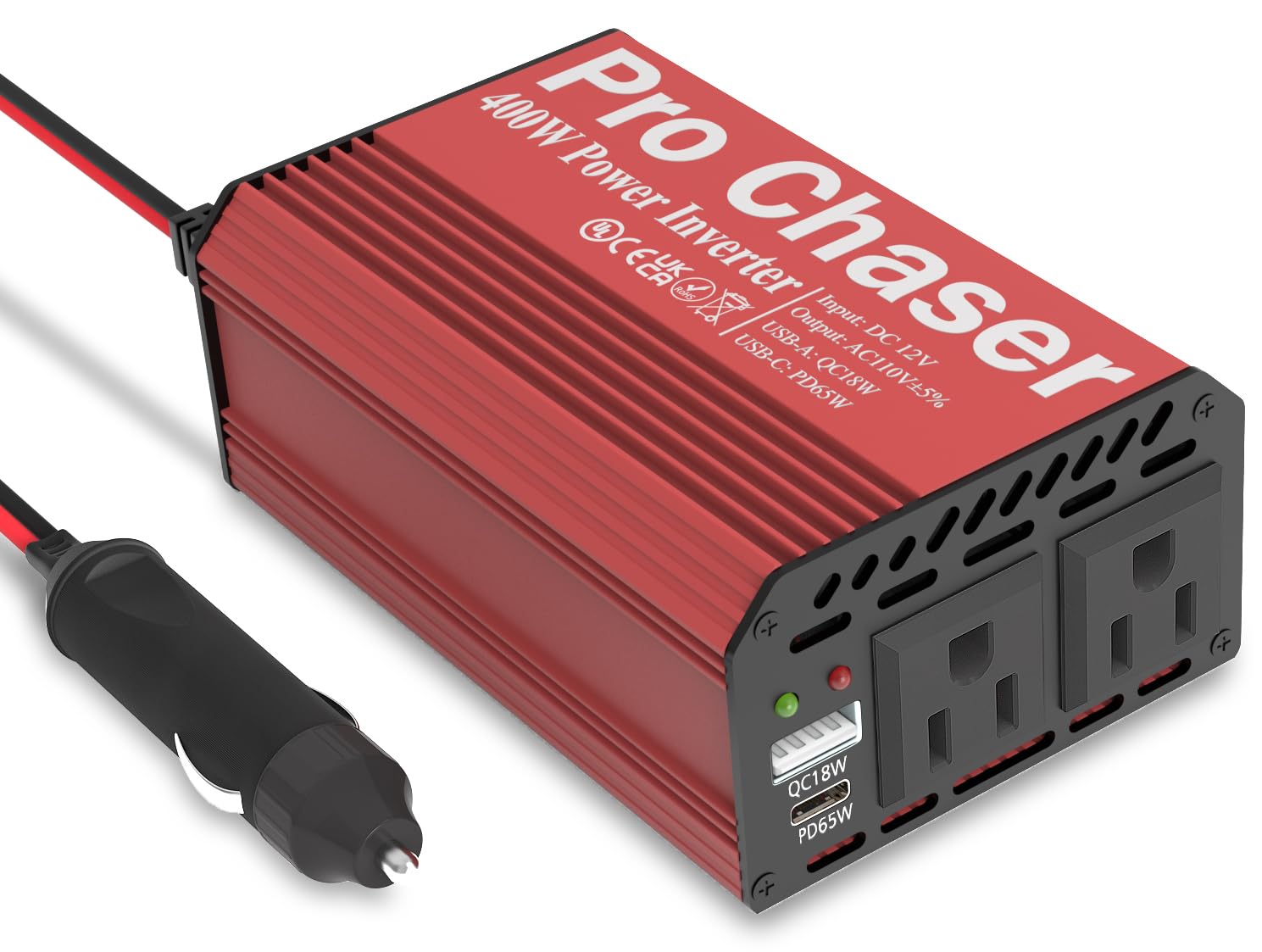
Pro Chaser’s 400W inverter packs the highest power rating in this roundup alongside a full PD 65W USB-C port — a rare combination that lets you charge a MacBook Pro at full speed directly from the USB-C port while freeing up both AC outlets for other accessories. The compact, cellphone-sized footprint and 30-inch cord make it easy to route from the front seat to the back row for passengers. The red aluminum alloy casing adds a visual punch but also serves as an effective heatsink during extended operation.
Verified buyers praise its ability to power a 300–400W appliance like an air compressor or heating pad for hours with only mild case warmth. The built-in fan activates at 113°F (45°C), keeping noise levels low during typical use. The safety fuse protection covers short circuits, overloads, low voltage, and overvoltage, giving peace of mind when running multiple devices simultaneously.
The modified sine wave output means this inverter is best suited for resistive loads and devices with universal power supplies — laptops, phone chargers, fans, heating pads. Avoid running sensitive medical CPAP machines or studio audio gear on it, as the modified waveform can introduce electrical noise. Additionally, running the PD 65W port alongside a high-draw AC appliance may exceed the vehicle socket’s 15A limit, so stagger high-power usage when possible.
Why it’s great
- PD 65W USB-C charges full-size laptops at full speed
- Highest 400W continuous rating in compact form factor
- 30-inch cord for flexible placement in any vehicle
Good to know
- Modified sine wave not ideal for sensitive medical or audio devices
- Simultaneous high-draw AC and PD 65W risks tripping socket fuse
- Fan noise becomes noticeable under sustained high load
4. DrimMek 400W Car Power Inverter

DrimMek’s 400W inverter delivers the best price-to-spec ratio in this lineup, combining dual 110V AC outlets, a PD 65W USB-C port, and a QC 24W USB-A port in a compact aluminum alloy body that measures just 3.9 x 2.5 x 1.49 inches. The aviation-grade aluminum casing ensures excellent passive heat dissipation, while the built-in intelligent monitoring system continuously checks current, voltage, and temperature, automatically cutting power during fault conditions. This is one of the few budget-tier inverters that includes no-questions-asked 30-day returns and 24/7 technical support.
Road trip families and work truck users consistently praise its ability to keep a laptop, tablet, and multiple phones charged simultaneously without noticeable power sag. The 65W PD port is genuinely fast — one reviewer notes it charges a 90W laptop charger adequately, though the cigarette lighter’s 10A fuse means you can’t push the full 400W. The inverter automatically shuts off when the vehicle is off, preventing battery drain during overnight parking.
The main compromise is the modified sine wave output, which generates audible fan noise under sustained loads and may cause slight electrical hum in audio equipment. A few buyers mention the lack of mounting brackets makes securing the unit in a cup holder or glove box tricky. For the price, however, the DrimMek 400W offers a compelling mix of power, port density, and build quality that’s hard to beat for general-purpose family use.
Why it’s great
- PD 65W USB-C plus QC 24W for fastest device charging
- Ultra-compact aluminum body with intelligent auto-shutdown safety
- Strong warranty and 24/7 customer support at budget price
Good to know
- Modified sine wave — avoid for CPAP or sensitive electronics
- Fan noise noticeable during continuous high-load operation
- No mounting brackets included — slides in cup holders
5. DrimMek 300W Car Power Inverter (LED Display)
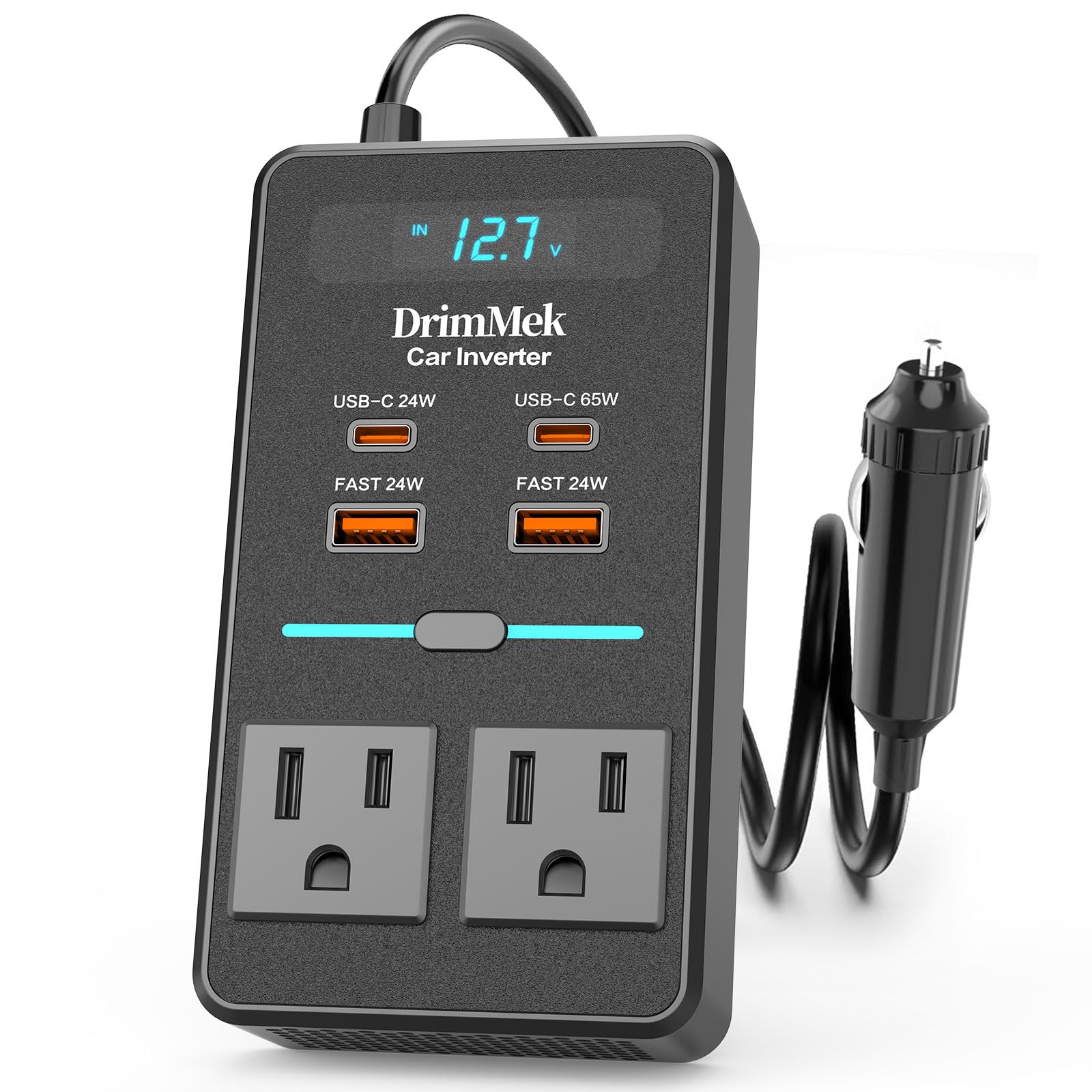
The 300W version from DrimMek trades 100W of peak capacity for a built-in LED digital display that shows real-time DC input voltage, helping you monitor your car battery’s health and avoid over-discharge during extended use. The compact 5.5 x 3 x 1.4-inch frame fits neatly into a glove box or center console, while the dual AC outlets and dual USB-C (24W + 65W) plus dual USB-A 24W ports provide the highest total port count in this roundup — six simultaneous charging points for a fully loaded family vehicle.
Buyers in work trucks and service vans report reliable performance charging drill batteries and power tool packs while driving, with no noticeable drain on the starting battery when the engine is running. The LED display is a genuinely useful feature — it allows you to see when the battery voltage drops below 12V, signaling it’s time to start the engine to prevent a dead battery. The quiet fan design is frequently mentioned as barely audible even during extended charging sessions.
The modified sine wave output is the same limitation as its 400W sibling — not suitable for medical CPAP machines, studio monitors, or sensitive audio equipment. Additionally, the secondary AC outlet has limited space between the two plugs, making it difficult to fit two bulky wall-wart adapters side by side. For general device charging and power tool battery top-ups on the road, the LED display feature alone makes this a smarter choice than blind inverters.
Why it’s great
- LED voltage display prevents accidental battery drain
- Six total charging ports — most in this roundup
- Quiet cooling fan barely audible in cabin
Good to know
- Modified sine wave limitations still apply
- AC outlets spaced too close for bulky wall warts
- 300W continuous may not start high-draw motor loads
6. RoyPow 300W Car Power Inverter

RoyPow’s 300W inverter focuses on family-friendly design with features like a dedicated AC power switch that lets you disable the 110V outlets while keeping the USB ports active — ideal for charging phones overnight without accidentally powering a laptop. The dual AC outlets are paired with four USB ports: a PD 36W Type-C, PD 30W Type-C, QC3.0 24W USB-A, and a standard 3.4A USB-A, covering every device type from the latest iPhone to older Android tablets. The flame-retardant ABS casing and built-in fuse add an extra safety layer for family use.
The compact 5.83 x 3.11 x 1.42-inch size and 0.74 lb weight make it one of the lightest 300W inverters available, easily storable in a seat-back pocket. The smart temperature-controlled fan keeps noise minimal during typical load scenarios. Buyers with large families particularly appreciate having enough ports for every passenger to charge simultaneously without arguing over cables.
RoyPow explicitly states this inverter is not compatible with Tesla vehicles due to the higher cigarette lighter output voltage (16–17V), which exceeds the unit’s 15.5V max input. There are also scattered reports of units failing after a few uses when powering 135W laptops — likely due to exceeding the inverter’s true continuous capacity through the lighter plug. Stick to devices under 200W total for reliable long-term performance.
Why it’s great
- Six total charging ports with independent AC power switch
- Flame-retardant ABS casing with built-in fuse safety
- Lightest 300W unit at 0.74 lb for easy storage
Good to know
- Not compatible with Tesla 16V cigarette lighter sockets
- Inconsistent reliability when pushing near 200W continuous load
- Modified sine wave output — limits device compatibility
7. Vansoet 200W Car Power Inverter
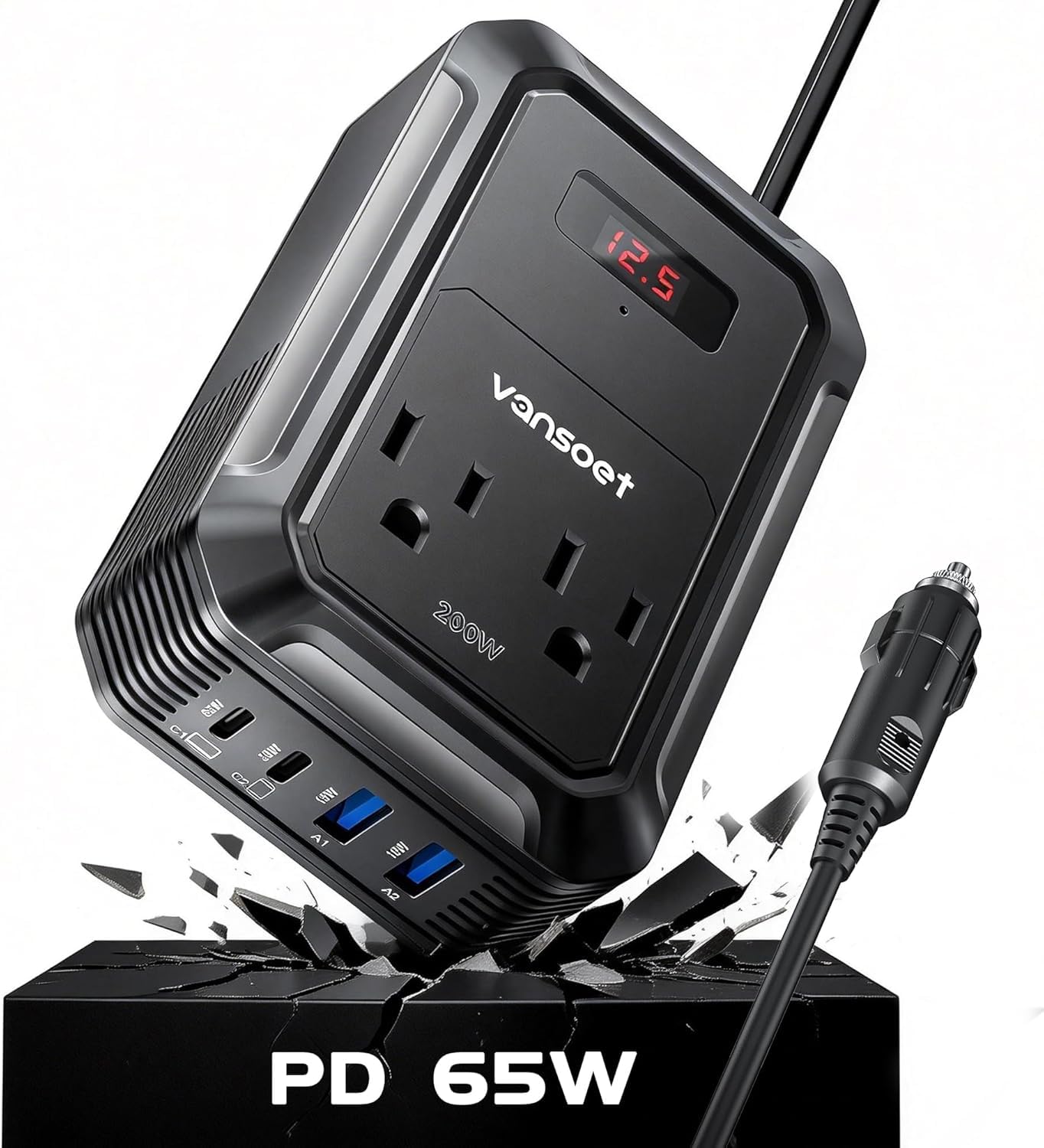
The Vansoet 200W inverter proves you don’t need 400W to handle most daily charging needs. Its continuous 200W rating (4.2A at 48V for the lighter plug’s practical limit) comfortably powers a laptop, two phones, a tablet, and a camera simultaneously without tripping your vehicle’s fuse. The standout feature is the PD 65W USB-C port — rare at this wattage tier — which can charge a MacBook Pro at full speed without even using the AC outlets. The built-in LCD display shows input voltage, and the smart cooling fan adjusts speed based on load and temperature, keeping noise minimal.
ETL certification ensures safety and quality, and Vansoet backs it up with an 18-month replacement warranty and 180-day refund window — the best protection in the budget tier. The compact design fits any cup holder, and the 23.8-inch cable reaches comfortably to back seats. Verified owners report flawless operation during 1,000-mile road trips, charging coolers, tablets, phones, and earbuds without a single hiccup.
The primary limitation is the 200W continuous ceiling. You cannot run a mini-fridge (typically 45–60W startup) alongside a laptop charger without approaching the limit. Hair dryers, toasters, and space heaters are entirely out of the question. For its intended purpose — keeping personal electronics charged and running a small cooler on long drives — the Vansoet 200W is the best value proposition for light users who don’t need the overhead of higher-wattage models.
Why it’s great
- PD 65W USB-C charges laptops at full speed in budget tier
- ETL certified with 18-month warranty and 180-day refund
- Compact cup-holder design with smart quiet cooling fan
Good to know
- 200W limit prevents running high-draw kitchen appliances
- Modified sine wave — not for sensitive medical gear
- Lighter plug fuse still caps real-world draw at ~120W continuous
FAQ
Can an AC charger for car run a CPAP machine all night?
Why does my inverter beep when I plug in a laptop charger?
Is a 400W inverter too much for a standard cigarette lighter socket?
Final Thoughts: The Verdict
For most users, the ac charger for car winner is the BESTEK 400W Pure Sine Wave because it delivers clean, stable grid-quality power that protects sensitive medical and laptop equipment while providing enough headroom for moderate road trip loads. If you want pure sine wave quality at a lower price, grab the Giandel 300W. And for maximum charging port density and value in a compact package, nothing beats the DrimMek 400W for family road trips where budget and versatility matter most.