
That single deep scratch on your windshield or the spiderweb of fine marks across your side windows doesn’t demand a costly replacement. The right abrasive compound, applied with patience and the correct pad, can return optical clarity to glass that seemed permanently damaged. The choice between a cerium oxide powder, a heavy-cut automotive polishing compound, or a multi-step finishing system defines how much time you’ll spend and the final level of clarity you’ll achieve.
I’m Min — the co-founder and writer behind Gadgets Feed. My analysis of this category focuses entirely on abrasive mineral chemistry, slurry consistency, particle breakdown rates during machine polishing, and real-world scratch depth thresholds that separate effective repair from wasted effort.
The market offers both ready-to-use liquids and powder-based kits, each suited to different scratch depths and surface types, so understanding how each formulation behaves determines which best auto glass polish actually delivers the clarity you expect without turning a weekend project into a month-long ordeal.
How To Choose The Best Auto Glass Polish
Selecting the right polish depends on matching the abrasive mineral type, particle grit size, and application technique to the specific scratch depth and glass surface you’re repairing. Beginners often grab the cheapest liquid compound, but understanding the difference between an aluminum oxide heavy cut and a cerium oxide glass-specific polish prevents wasted time and accidental etching.
Scratch Depth: The Fingernail Test That Decides Everything
If your fingernail catches inside the scratch, that defect is too deep for any polish to fully remove. Polish only levels the surface around a scratch—it doesn’t fill. For scratches you can feel, you need a grit sequence starting at 1000 or lower to cut the surrounding glass down to the scratch’s depth, then a finer grade to restore clarity. For light surface scuffs and hazing that your fingernail glides over, a fine cerium oxide compound with a felt wheel will produce a bright finish.
Mineral Chemistry: Cerium Oxide vs. Aluminum Oxide vs. Zirconia Alumina
Cerium oxide is the standard for dedicated glass polishing because it chemically reacts with the silica in glass to create a true optical-grade finish as it breaks down during use. Aluminum oxide compounds, like those in heavy-cut automotive polishes, are designed for paint clearcoat and are generally too aggressive for bare glass unless you are trying to remove deep scratches through progressive grit steps. Zirconia alumina blends offer a longer working life but require patience—they cut slower and need more passes to reach full clarity.
Application Method: Hand vs. Machine Polishing
Hand polishing a windshield with cerium oxide slurry is possible for small 2-inch scratches, but for any larger area, a random orbital polisher or variable-speed drill with a felt wheel is essential. The friction from machine polishing heats the compound, accelerating the chemical breakdown of cerium oxide and producing the bright finish. Without enough speed (1,500-2,500 RPM typical), the compound just sits on the glass and does almost nothing.
Quick Comparison
On smaller screens, swipe sideways to see the full table.
| Model | Category | Best For | Key Spec | Amazon |
|---|---|---|---|---|
| 3M 60150 | Premium Liquid | Professional windshield scratch removal | Cerium oxide, 1,500 grit, 2.2 lb | Amazon |
| Menzerna Polishing Set | 3-Step System | Multi-stage clearcoat and glass correction | Aluminum & Zirconia, 24 oz total | Amazon |
| Liquid Glass Ultimate | Abrasive-Free Finish | Protective mirror-finish coating on glass and paint | No wax, no abrasives, 16 oz | Amazon |
| Gordon Glass Cerium Kit | Powder Kit | Fine scratch removal on windshields and windows | Cerium oxide powder, 8 oz + felt wheel | Amazon |
| Menzerna Heavy Cut 1000 | Single-Step Compound | Deep scratch and sanding mark removal | Aluminum oxide, 1,000 grit, 8 oz | Amazon |
In‑Depth Reviews
1. 3M Glass Polishing Compound, 60150
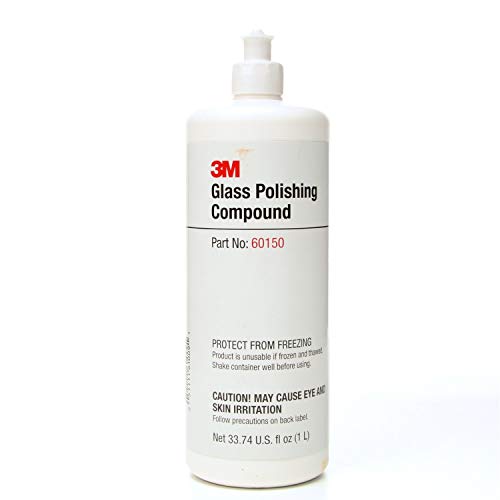
3M’s 60150 is the professional standard for glass defect repair, using a cerium oxide mineral formulation that breaks down progressively during polishing to yield a bright, haze-free finish. The 2.2-pound bottle is a significant investment in material, but professional detailers and serious enthusiasts consistently report that it outperforms smaller consumer-grade bottles when tackling full windshields with light to medium scratches. Its fine grit rating of 1,500 makes it ideal for removing wiper marks, water etching, and micro-pitting that leaves glass looking cloudy even after washing.
Applying the compound requires a variable-speed orbital polisher and a dedicated glass polishing pad—Meguiar’s specific glass pads are a common pairing. Users who successfully removed scratches from Audis, BMWs, and 20-year-old boat windshields all noted that two to three cross-hatch passes at high speed (around 2,000 RPM) with water misting to keep the compound wet were necessary to see full clarity. The product is sticky and generates a messy slurry that requires masking adjacent paint, but the result is a glass surface that looks optically “better than new” according to verified owners.
The premium price is justified by the consistency of the cerium oxide particles and the lack of fillers or glazing oils that can leave residues. For deep scratches where you can feel the defect with a fingernail, even 3M cannot perform miracles—these require progressive grit sanding before polishing. But for the vast majority of cosmetic glass damage, this is the compound that delivers the most reliable, repeatable results with the least amount of frustration.
Why it’s great
- Proven cerium oxide chemistry that breaks down to a true optical finish without haziness
- Generous 2.2-pound volume covers full windshields and multiple glass panels in one session
- Reliable performance across automotive and marine glass surfaces including tempered windows
Good to know
- Expensive relative to generic compounds, and the sticky slurry requires careful masking of surrounding paint
- Requires a machine polisher and glass-specific backing pads—ineffective by hand for any area larger than a few inches
2. Menzerna Polishing Set 8oz – HCC1000, MCC2500 & 3800
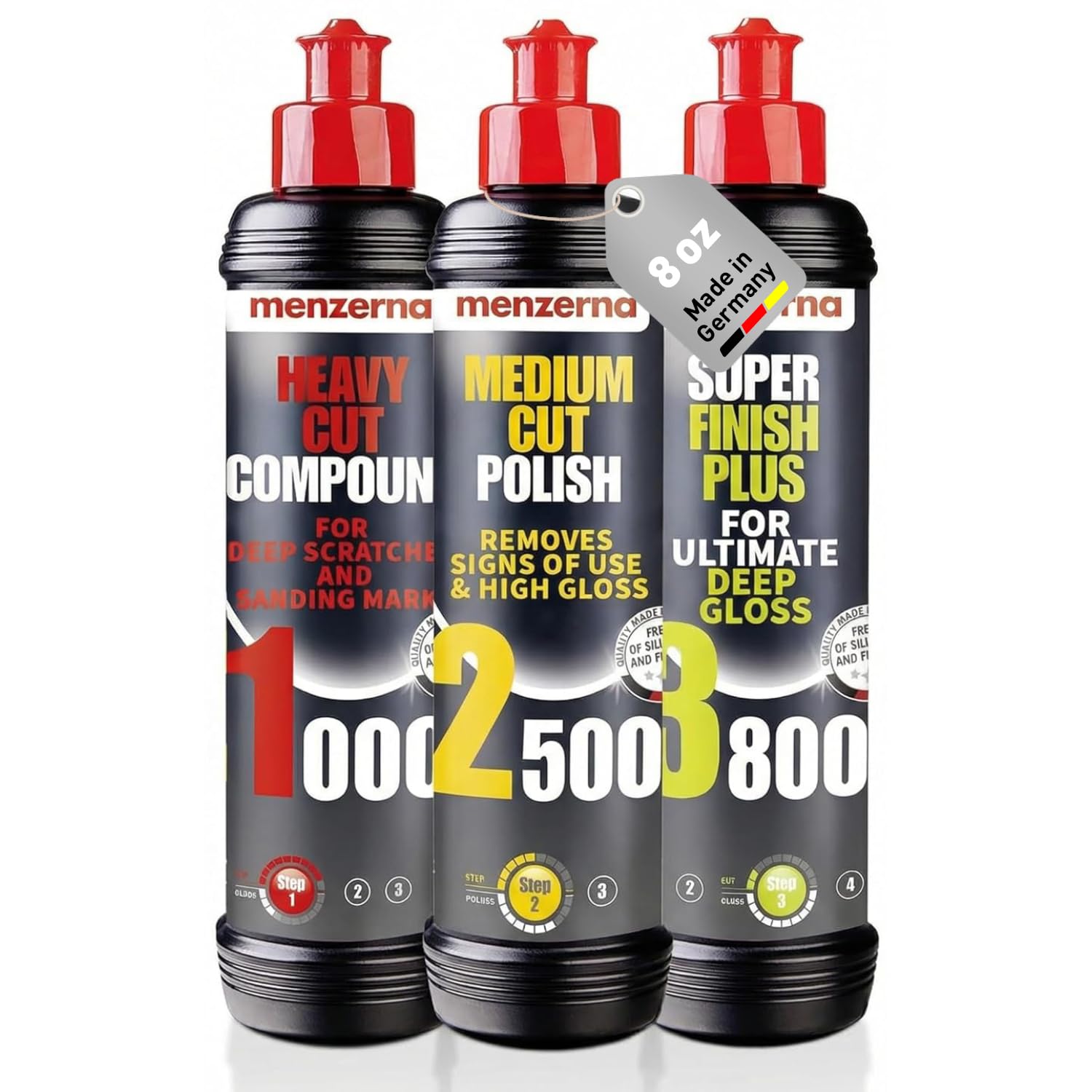
Menzerna’s 3-step system bundles the HCC1000 heavy cut compound, MCC2500 medium cut compound, and 3800 super finish polish into a single package that lets you work through deep scratches, hologram marks, and final gloss in progression. The HCC1000 uses aluminum oxide at a 1,000 grit equivalent to aggressively cut through clearcoat scratches and sanding marks on painted surfaces, while also being effective on glass when used with a foam pad. The 3800 finishing polish leaves a mirror-like gloss that rivals dedicated carnauba waxes.
What makes this set category-relevant is the HCC1000 compound’s ability to tackle both automotive paint correction and light glass scratches. Verified customers used the HCC1000 to remove paint transfer from a scrape, then stepped to the 2500 and 3800 to restore a clearcoat finish that looked professional. The set is especially popular with detailing enthusiasts working on dark paint colors, where the risk of holograming is highest—the progressive grit refinement eliminates these artifacts before they become visible.
The 8-ounce bottles per step are sufficient for a full car correction or multiple glass panels, but the set is priced competitively against buying each compound individually. The dust-free formula of the HCC1000 is a notable advantage over cheaper compounds that can create airborne particles during machine polishing. One drawback: the working time on the finishing polish is shorter than premium single-stage products, requiring you to work in small sections to avoid drying residue.
Why it’s great
- Integrated three-grit progression from heavy cut to mirror finish eliminates guesswork about which compound to use next
- HCC1000 cuts aggressively without dusting, a major hygiene advantage during machine polishing
- Works across both glass and automotive clearcoat, offering high versatility for a single buy
Good to know
- Finishing polish has a short working window—must be wiped off before it fully dries to avoid residue
- Requires intermediate cleaning with isopropyl alcohol between steps to prevent cross-contamination of grit levels
3. Liquid Glass Ultimate Auto Polish/Finish
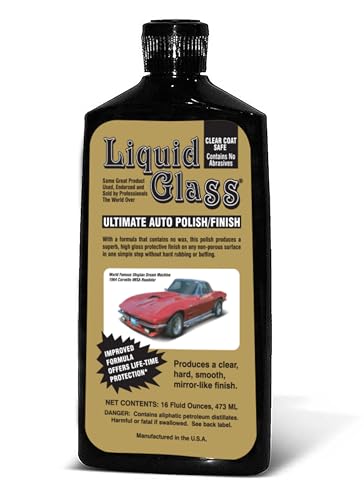
Liquid Glass Ultimate Auto Polish/Finish is not a scratch-removing polish in the traditional abrasive sense—it is a clear, hard, synthetic polymer coating that bonds to glass and paint surfaces to create a reflective, non-porous shield. The product contains no wax and no abrasives, meaning it cannot cut through existing scratches. However, its application after a proper ceramic oxide or aluminum oxide polishing step seals the surface and prevents future etching from water spots and UV exposure for up to six months.
Long-time users report applying seven or more coats over a weekend to achieve a depth of reflection that approaches liquid glass. The material bonds at a molecular level to the silica in both automotive glass and factory clearcoat, forming a barrier that makes bug splatter and tar rinse off with a garden hose. Verified owners with decades of experience confirm that the formulation from the late 80s is chemically identical to the current product—the color and smell are unchanged.
The primary limitation is that this product does zero correction. It will not remove wiper scratches, water etching, or any defect you can feel with your fingernail. It is strictly a finishing layer meant to be applied over a perfectly polished surface. For users who already own a compound like 3M 60150 or Menzerna HCC1000 and want the final protective shine, Liquid Glass is a benchmark product that has earned its reputation through consistency over four decades.
Why it’s great
- Produces an exceptionally hard, clear polymer layer that protects both glass and paint from environmental contaminants
- Longevity of six months to a year between applications with consistent water beading throughout the period
- Multiple coatings can be layered to build depth of reflection without any risk of yellowing or hazing
Good to know
- Contains no abrasives, so it cannot remove existing scratches—must follow a polishing compound
- Requires cool shaded application and meticulous surface preparation to avoid streaks in the final finish
4. Gordon Glass Co. Cerium Oxide Glass Polishing Kit

The Gordon Glass Cerium Oxide Polishing Kit is the budget-friendly entry point for anyone wanting to try cerium oxide polishing without committing to a large bottle of pre-mixed liquid. The 8-ounce bag of dry powder must be mixed with water into a slurry—the correct ratio is approximately 2 parts water to 1 part powder by volume, though the product itself lacks printed instructions. The included 3-inch felt polishing wheel fits any standard drill and provides the necessary friction to generate heat and activate the cerium oxide’s chemical cutting action.
Verified users report success on kitchen windows with fine scratches from Scotch-Brite pads and on windshields with light wiper tab marks. The process requires patience: a 14×12 inch window with fine scratches took around 4 hours of continuous slurry application with a drill. The felt wheel is durable and does not shed fibers, but the lack of instructions from Gordon Glass means beginners will waste time if they mix too thick or too thin. The powder can be re-wetted and reused, extending the 8-ounce supply across multiple projects.
The limitation is that this kit is best for fine scratches that are barely visible in indirect light. Deeper scratches that catch a fingernail cannot be removed by cerium oxide alone, and the kit supplies no coarse grit for initial leveling. For users facing deep defects, this kit must be supplemented with progressively finer sanding steps before using the cerium oxide. Despite this, the price-to-performance ratio is excellent—a fraction of the cost of 3M’s liquid with comparable results on light damage.
Why it’s great
- Very affordable way to access cerium oxide polishing with a included felt wheel suitable for drill mounting
- Dry powder stores indefinitely without separating or drying out, unlike pre-mixed liquids
- Can be re-wetted and reused in the same session, maximizing value from the 8-ounce supply
Good to know
- No instructions provided—you must independently determine the 2:1 water-to-powder ratio and optimal working speed
- Time-intensive process requiring hours of continuous polishing for even moderately sized glass panels
5. Menzerna Heavy Cut Compound 1000
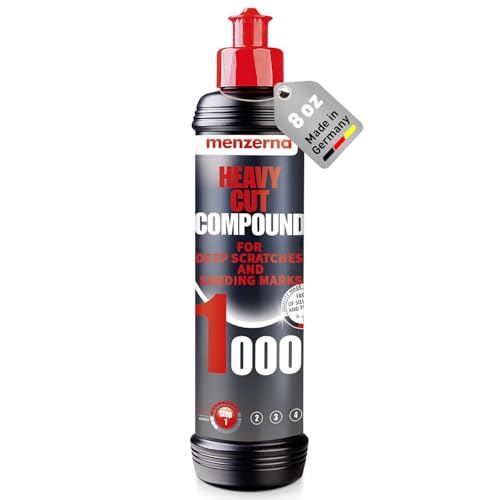
Menzerna Heavy Cut Compound 1000 is an 8-ounce single-step abrasive polish designed for aggressive scratch removal on automotive clearcoat, but its 1,000-grit aluminum oxide formulation also works effectively on glass when you need to level a deep defect before switching to a finer finishing compound. The product is engineered for use with a foam pad on a dual-action or rotary polisher, and experienced users report that it removed scratches caused by granite blocks and deep key marks that a 400-grit compound could not touch.
The compound is beginner-friendly in the sense that Menzerna provides clear instructions for application using the criss-cross method, and the milky film transition from opaque to translucent signals when to wipe off. Users noted that hand-polishing small areas (around 4×4 inches) is feasible with a round sponge, though the compound’s heavy cutting action generates heat quickly, so frequent stopping to check progress on glass is necessary to avoid burning through surrounding clearcoat or generating excessive surface haze.
At this price point, the 8-ounce bottle is smaller than consumer-grade tubs, but the concentration of the abrasive means you use significantly less per section. The compound is silicone-free, which is important if you plan to repaint or apply a ceramic coating afterward. The primary compromise is grit variety—this is a single-grade compound, so achieving a mirror finish after scratch removal requires a separate finer abrasive like Menzerna 3800 or a cerium oxide product. For deep scratch refinement, this is the most cost-effective heavy cut available.
Why it’s great
- Aggressive 1,000-grit aluminum oxide cuts deeper than typical consumer rubbing compounds, removing scratches that cheaper products cannot touch
- Silicone-free formulation makes it safe to use before painting or ceramic coating applications
- Works effectively both by hand on small spots and with a machine polisher for larger area correction
Good to know
- Single grit level demands a separate finishing step to restore optical clarity after the heavy cut
- Small 8-ounce bottle covers approximately one full hood or two side windows—limited for large projects
FAQ
Can I use automotive paint rubbing compound on my windshield?
How do I know if a scratch is too deep for glass polish to fix?
Do I need a machine polisher or can I polish glass by hand?
Will glass polish remove water spots and hard water stains?
How many times can I polish the same windshield before it weakens?
Final Thoughts: The Verdict
For most users, the best auto glass polish winner is the 3M 60150 because its cerium oxide formulation delivers consistent optical clarity with minimal effort on light to medium windshield scratches, and the large bottle provides enough compound for multiple full-windshield sessions. If you want a comprehensive paint and glass correction system, grab the Menzerna Polishing Set for its progressive three-step grit refinement. And for a protective seal after polishing, nothing beats the Liquid Glass Ultimate Auto Polish for creating a hard, beading barrier that extends your repair’s lifespan.