
A dead zone in your yard, a rain barrel system, or a remote garden bed — these are the spots where traditional wired irrigation controllers simply won’t reach. Without power nearby, you rely on a battery-operated irrigation controller that must balance scheduling flexibility, weather resistance, and battery longevity without leaking or locking up.
I’m Min — the co-founder and writer behind Gadgets Feed. This guide is the result of analyzing hundreds of spec sheets and customer reviews across battery-operated, off-grid watering systems to isolate the models that actually deliver reliable, programmable performance in real-world conditions.
Whether you need to water a vegetable garden, maintain a sloped lawn, or keep potted plants alive while traveling, choosing the right battery operated irrigation controller hinges on balancing brass fitting durability, battery life, and zone flexibility.
How To Choose The Best Battery Operated Irrigation Controller
Selecting a battery-powered watering timer is less about raw features and more about verifying that the unit will survive the season without leaking or draining its power. The following factors separate a hard-working controller from a frustrating failure.
Fitting Material: Brass vs. Plastic
The inlet and outlet threads take the most stress from temperature swings and tightening force. Brass fittings resist cracking and seizing far longer than plastic counterparts, especially on well water or municipal systems that exceed 80 PSI. Plastic fittings are lighter and cheaper but often develop hairline cracks within the first year of direct sun exposure.
Battery Type and Estimated Life
Alkaline batteries are standard, but some controllers drain them in six to eight weeks due to inefficient solenoid operation. Premium units using Zigbee protocols or optimized DC-latching solenoids can stretch battery life past two years. Units that accept lithium cells typically perform better in freezing temperatures and deliver more consistent voltage during valve actuation.
Zone Count and Independent Scheduling
If you have distinct irrigation zones — say, a lawn sprinkler versus a drip line for raised beds — a two-zone or multi-zone timer lets you stagger run times and durations. A single-zone timer forces you to physically swap hoses or accept a one-size-fits-all schedule. Multi-zone controllers also allow cycle-and-soak programming to prevent puddling on compacted or sloped soil.
Quick Comparison
On smaller screens, swipe sideways to see the full table.
| Model | Category | Best For | Key Spec | Amazon |
|---|---|---|---|---|
| LinkTap G1S | Premium Smart | Custom schedules & remote access | 2-year battery life / Zigbee | Amazon |
| Hunter X2 4 Zone | Premium Wired | Multi-zone permanent systems | 4 zones / Seasonal adjust | Amazon |
| Hunter Node 100 | Premium Battery | Off-grid valve control | IP68 / 2x 9V batteries | Amazon |
| RAINPOINT WiFi Timer | Smart Mid-Range | App & voice control on a budget | WiFi + Bluetooth / Brass | Amazon |
| Orbit 57860 | System Kit | Adding a valve to a timer | 1″ jar-top valve / 4 zone | Amazon |
| Diivoo 2 Zone Brass | Mid-Range | Two-zone hose scheduling | 2 zones / Brass inlet/outlet | Amazon |
| RAINPOINT Brass Timer | Budget-Friendly | Simple single-zone tasks | Brass connectors / Manual mode | Amazon |
In‑Depth Reviews
1. LinkTap G1S Wireless Water Timer & Gateway

The LinkTap G1S stands out because it solves the two biggest pain points of battery timers: battery drain and wireless range. Its proprietary Zigbee protocol communicates through walls up to 75 feet while sipping power, yielding a claimed 2-year battery life on alkaline or lithium cells — a genuine differentiator when most competitors drain within two months. The included gateway requires a wired ethernet connection, but once linked, the app provides remote on/off, weather-based skip logic, and scheduling down to 3-second durations for misting setups.
The aerospace-grade composite inlet is a deliberate choice over brass: it won’t seize to faucets, is 100% lead-free, and self-adapts to threads without Teflon tape. The IP66 enclosure shrugs off rain and direct hose spray. Users consistently report reliable 45 to 70-foot range through walls and flawless integration with drip systems, sprinklers, and propagation tents. The anti-freeze protection automatically opens the valve when temperatures drop, preventing ice damage in winter.
If you need a truly set-and-forget timer that works with complex schedules and provides real-time alerts, the G1S justifies its premium placement. The trade-off is the need for a gateway near your router and the lack of support for LinkTap flow meters. For remote gardens, greenhouses, and drip irrigation, this is the most capable battery-operated unit on the market today.
Why it’s great
- Zigbee gateway offers long range and extremely low power consumption
- Weather-aware smart scheduling prevents overwatering
- Anti-freeze protection adds winter durability
Good to know
- Gateway requires wired ethernet connection
- Does not support LinkTap flow meters
2. Hunter X2 4 Zone Sprinkler Controller

The Hunter X2 is technically a battery-powered controller — it runs on a single 9V battery for backup, but its primary operation depends on being wired to a transformer (included). It earns its place in this guide because its core scheduling engine, cycle-and-soak logic, and seasonal adjust are the gold standard for users who want professional-grade irrigation without paying for a full smart retrofit. The 4-zone design supports up to three custom programs with four start times each and run durations up to six hours.
Cycle and Soak is a genuine water-saver: it breaks long run times into shorter bursts, letting water absorb instead of puddling on compacted or sloped turf. This feature alone makes the X2 the best choice for clay soils and hillside lots. The optional Hydrawise WiFi module (sold separately) unlocks weather-based adjustments, remote access, and real-time flow alerts — but even without the module, the local LCD programming is intuitive with a backlit screen.
The QuickCheck wiring diagnostics detect shorts before they damage the valves, and the Easy Retrieve memory restores your full schedule if the battery dies. Reviews highlight trouble-free installation and reliable day-to-day performance. The main downside is the + cost of the WiFi wand if you later decide you want remote control. For a permanent 4-zone system with flexible programming and proven Hunter reliability, the X2 delivers exceptional value.
Why it’s great
- Cycle-and-soak prevents runoff on slopes and clay soil
- Backlit LCD display is clear in direct sunlight
- Built-in diagnostics protect valves from wiring faults
Good to know
- WiFi module is sold separately and adds significant cost
- Requires a wired transformer, not truly off-grid
3. Hunter Node 100 Battery Operated Sprinkler Timer

The Hunter Node 100 is the definitive off-grid irrigation controller. Its IP68-rated housing is waterproof to the point of submersion, making it suitable for valve boxes that collect rainwater or muddy environments. The unit comes pre-wired with a solenoid for direct mounting to most 24VAC irrigation valves, eliminating the need for a separate controller box, trenching, or external power. It runs on one or two 9V alkaline batteries — using two extends life to roughly one year under normal schedules.
Programming supports three independent programs with four start times each and run durations up to six hours, which is generous for a battery-powered device. The seasonal adjust feature lets you scale watering up or down without rewriting schedules, and the suspend mode can pause irrigation for up to 99 days during off-season. It also accepts Hunter’s Rain-Clik sensor to stop watering when it detects rainfall.
User reports confirm it survives years of outdoor exposure with annual battery swaps if corrosion is managed. The prewired solenoid and clear LCD make installation a 10-minute task. The Node 100 lacks WiFi or smartphone control, but that’s intentional — it’s built for reliability in remote or buried locations where connectivity isn’t an option. If you need a single-zone, professional-grade battery timer for a valve box, this is the unit.
Why it’s great
- IP68 rating allows direct burial or submersion in valve boxes
- Includes pre-wired solenoid for fast valve attachment
- Three independent programs with 6-hour max run times
Good to know
- Uses 9V batteries only; no AA or lithium option
- No smart features or remote control capabilities
4. RAINPOINT WiFi Water Timer
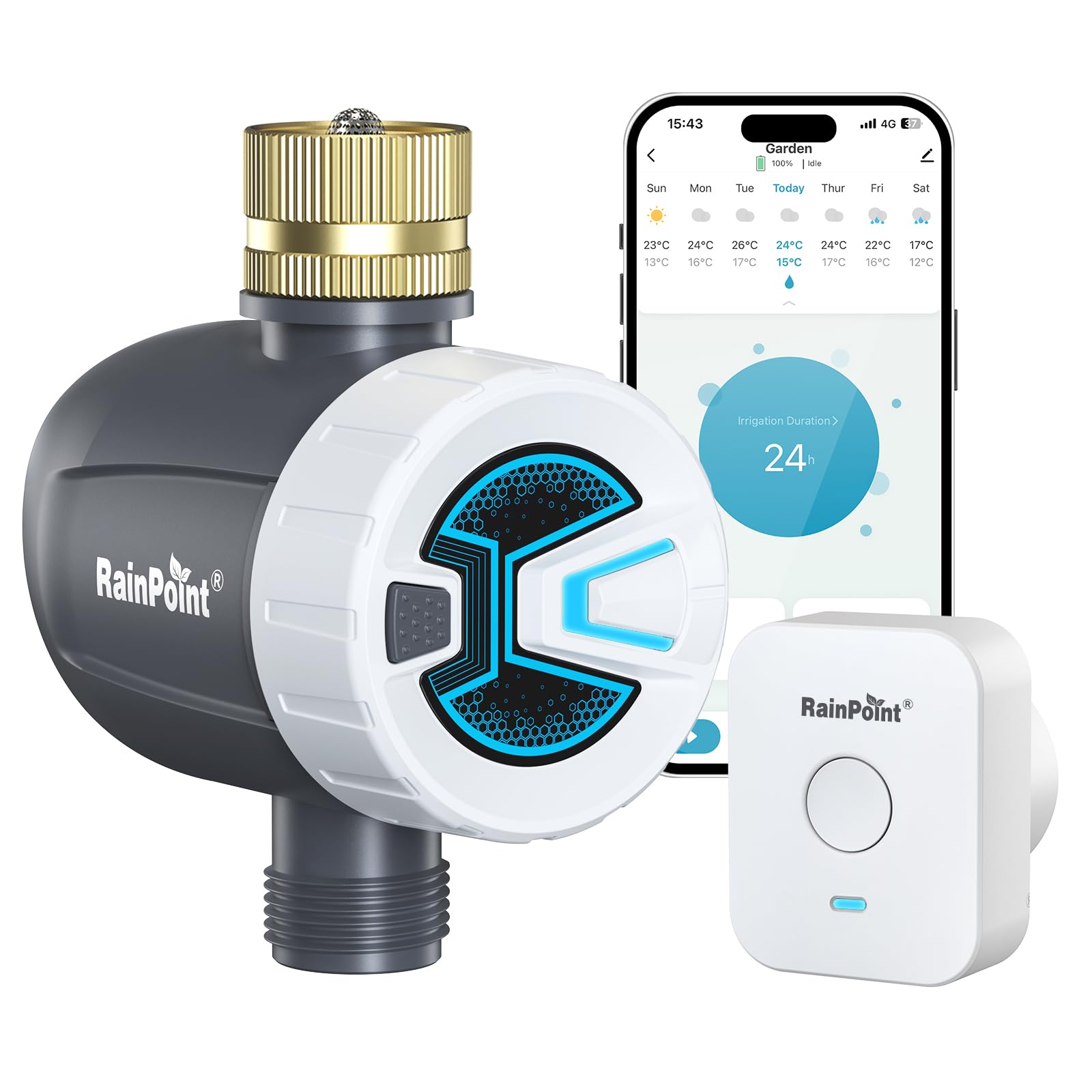
RAINPOINT’s WiFi timer brings app-based remote control to the mid-range without the separate gateway requirement. The unit connects directly to your 2.4GHz home network and the Tuya smart platform, enabling real-time monitoring, schedule editing, and voice control via Alexa and Google Assistant. A single hub can support up to four timers, and it can optionally pair with a soil moisture sensor to prevent overwatering.
The hardware is built around a reinforced 360° brass swivel at the inlet, which reduces stress on the connection and prevents leaks during adjustment. Three watering modes — automatic scheduling, rain delay (24/48/72 hours), and manual watering up to 24 hours — cover the essential use cases. The LCD screen on the timer itself lets you confirm schedules without pulling out your phone, though the app remains the primary interface for complex setup.
Users report that initial setup can take longer due to mandatory Bluetooth pairing before WiFi activation, and the timer only works with 2.4GHz networks — dual-band mesh systems may require temporary band separation during setup. Once running, the performance is reliable with no leaks and consistent schedule execution. A small number of users experienced hub connectivity issues at longer distances. For smart-ready hose-end watering on a budget, this unit is a strong contender.
Why it’s great
- Integrated WiFi eliminates need for a separate hub
- Reinforced brass swivel inlet resists leaks
- Alexa and Google Assistant voice control supported
Good to know
- Setup requires Bluetooth pairing before WiFi connection
- Only supports 2.4GHz networks
5. Orbit 57860 Battery Operated Timer & Valve

The Orbit 57860 pairs a battery-powered timer with a 1-inch FPT jar-top valve, creating a complete off-grid irrigation node. The timer compartment detaches from the valve body for easy programming and battery access, while the valve remains connected in-line. It supports up to four valves for multi-zone scheduling, with cycle-and-soak times to promote water infiltration and stacking runtimes to prevent multiple solenoids from firing simultaneously.
The plastic construction keeps weight low (1.5 pounds) and cost manageable, but the valve body itself is robust enough to survive buried installation in a ground box. Users have reported trouble-free operation for multiple seasons when the timer is removed and stored indoors over winter. The programmable start times and duration settings are straightforward, and the rain delay function pauses the schedule without erasing it. The included bracket for mounting is described as flimsy by some users, but this is a minor ergonomic point rather than a functional failure.
A few users note that the timer can be prone to water ingress in the lower box if not carefully installed, and the lack of a moisture sensor or solar charging accessory limits its smart capabilities. For adding an automated valve to a hose bib or integrating a battery timer into an existing sprinkler system without digging, the 57860 kit is a proven, widely used solution with excellent customer support.
Why it’s great
- Combines timer and valve in one kit for easy installation
- Cycle-and-soak programming prevents water runoff
- Supports up to 4 valves for multi-zone scheduling
Good to know
- Plastic housing may require winter removal in cold climates
- Mounting bracket is not very sturdy
6. Diivoo 2 Zone Brass Sprinkler Timer
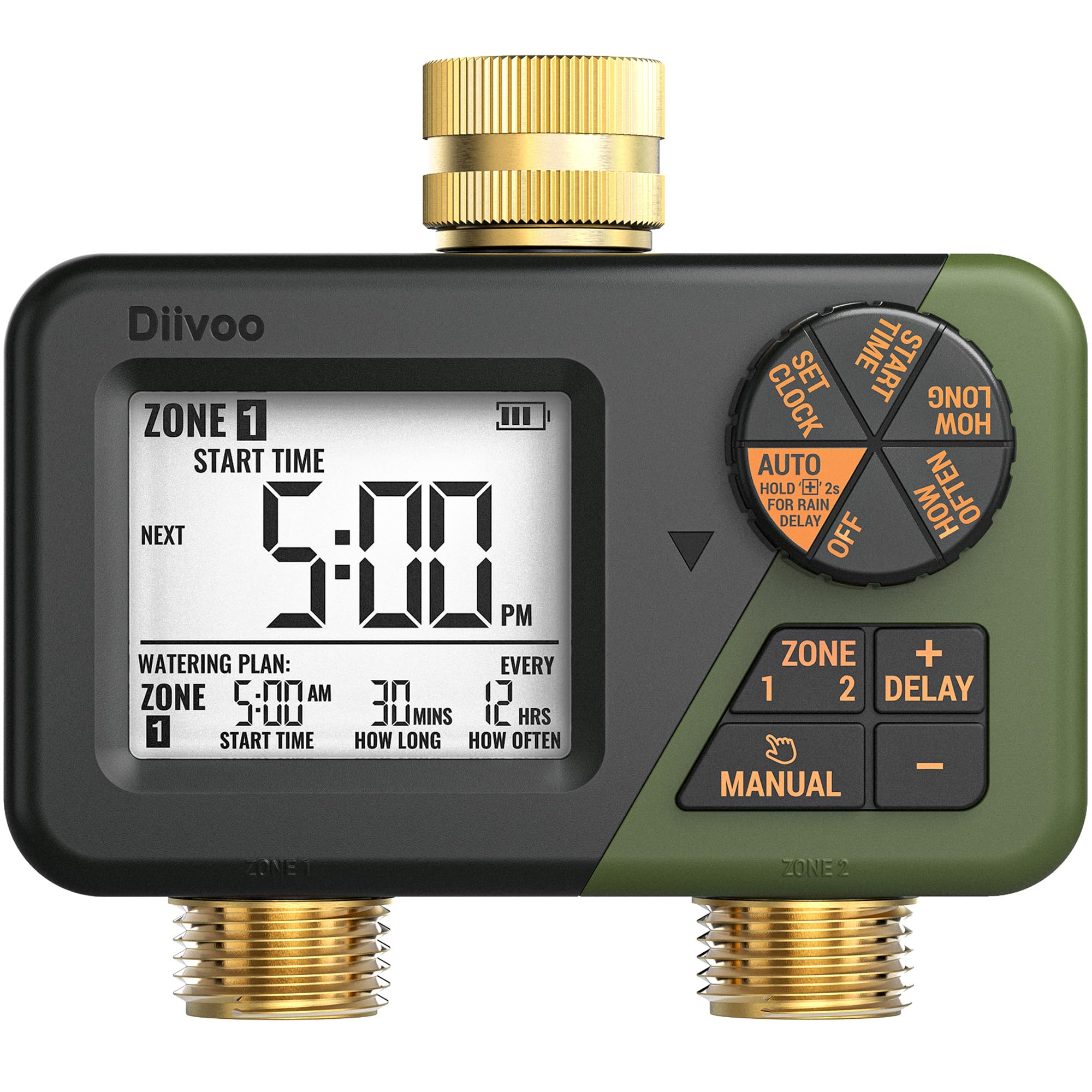
The Diivoo 2 Zone timer delivers independent scheduling for two separate watering areas — critical for users who need different durations for a lawn sprinkler and a flower bed drip line. Each zone supports a start time, run duration from 0 to 240 minutes, and frequency in 1/3/6/12-hour or 1-7 day intervals. The brass inlet and outlet threads eliminate the crack-prone weakness of all-plastic timers, and the IP66 weather rating ensures it withstands heavy rain and hose spray without failing.
The large LCD screen displays the current time, active zone, and a countdown to the next watering cycle, eliminating guesswork. Setup is straightforward with clearly labeled buttons — no smartphone needed, which is a genuine advantage for users who prefer physical controls. The unit recommends standard alkaline batteries only, and claims 6-8 months of life from a pair of AAs, which aligns with user reports when using quality cells.
The main concerns from user reviews center on long-term reliability; a small number of units became unreliable after the warranty period, failing to close the valve and leaking water continuously. Diivoo’s support team appears responsive in most cases, but this is a risk to consider for permanent installations. For a two-zone brass timer at a budget-friendly price point, the Diivoo offers compelling value for gardeners managing two distinct hose-fed zones.
Why it’s great
- Two fully independent zones with separate schedules
- Brass inlet and outlet prevent cracks and leaks
- Clear LCD screen shows next watering countdown
Good to know
- Some units reported failure to close valve after months
- Rechargeable batteries are not recommended for use
7. RAINPOINT Brass Inlet/Outlet Sprinkler Timer

The RAINPOINT single-zone timer proves that reliable battery-powered irrigation doesn’t require smart features or a high budget. The star feature is the pure brass inlet and outlet — a material upgrade that withstands up to 116 PSI and resists the corrosion and cracking that plagues plastic threads after a season of sun exposure. The built-in metal filter gasket prevents sediment from entering the valve, extending the life of the internal solenoid mechanism.
Programming is refreshingly simple: a single dial cycles through How Long (1 minute to 3 hours 59 minutes), How Often (1 hour to 12 hours or 1-7 days), Start Time, and Clock setting. The large LCD screen clearly displays all parameters. Rain delay pauses irrigation for 24, 48, or 72 hours, and manual mode lets you water on demand without disrupting the saved schedule. The weatherproof shell uses UV-resistant materials and has survived full Texas summers according to long-term user reports.
Multiple users note battery life of around two months with standard alkaline cells, and the unit’s heavy brass construction inspires confidence when handling. Some wish for Bluetooth connectivity for app-based convenience, but for straightforward hose-end watering where reliability and ease of use are the priorities, this timer is a smart choice. It’s the purest expression of the “does one thing and does it well” philosophy.
Why it’s great
- Brass inlet and outlet resist cracking at high water pressure
- Simple dial-based programming with large backlit display
- Rain delay and manual modes cover all basic needs
Good to know
- No smartphone or Bluetooth connectivity
- Battery life is roughly 2 months with alkaline cells
FAQ
Why do some battery timers leak from the outlet threads?
Can I use rechargeable AA batteries in my irrigation timer?
How many watering zones can a single battery timer handle?
Final Thoughts: The Verdict
For most users, the battery operated irrigation controller winner is the LinkTap G1S because its Zigbee protocol and 2-year battery life eliminate the need for constant cell changes while offering remote control and weather-aware scheduling. If you want a rugged off-grid solution for a valve box, grab the Hunter Node 100. And for a straightforward, brass-threaded timer that simply works without apps or gateways, nothing beats the RAINPOINT Brass Timer.