
The nightmare is familiar: you squeeze a perfect bead of glue onto a rubber gasket, press it against a plastic trim piece, and apply clamping pressure — only to watch the joint peel apart an hour later. Rubber and plastic expand and flex at different rates, and most household adhesives simply can’t manage the internal shear stress at the interface. Getting a permanent bond that holds through vibration, temperature swings, and moisture requires a chemistry specifically engineered for this exact mismatch.
I’m Min — the co-founder and writer behind Gadgets Feed. Over the last several weeks I analyzed cure chemistries, tensile strength ratings, viscosity levels, and real-world failure modes reported across hundreds of adhesive tests to isolate the formulations that actually solve the rubber-to-plastic bonding challenge instead of summing up as temporary fix.
Whether you are reattaching a car trim panel, repairing a rubber bumper on a home appliance, or assembling a marine hatch seal, these picks deliver the permanent adhesion you need. This guide cuts through the marketing to deliver the definitive analysis of the best adhesive for rubber to plastic currently available.
How To Choose The Best Adhesive For Rubber To Plastic
A successful bond between rubber and plastic is a material science problem, not a brute force one. The wrong adhesive either stays rigid and snaps under flex, or the plasticizers in the rubber migrate into the glue line and destroy adhesion within weeks. You need to match three variables — rubber type, plastic type, and service environment — to a specific cure chemistry.
Match the Adhesive Chemistry to the Rubber Type
Neoprene-based contact adhesives (like the RH Adhesives S-18) are the gold standard for bonding SBR rubber, neoprene sheets, and EPDM to rigid plastics because they remain flexible after full cure. Cyanoacrylate rubber instant adhesives (like the 3M PR100 and Loctite 404) bond aggressively to silicone, Santoprene, and highly plasticized PVC in under 20 seconds. Polyurethane sealants (like the Berkland 5200) are ideal for thick rubber strips on marine plastics where water immersion is constant. Spray adhesives (like the 3M 94 ET) work best for large-surface laminations of foam rubber to plastic panels.
Account for Plastic Surface Energy
Low-surface-energy plastics such as polypropylene (PP) and polyethylene (PE) resist nearly every adhesive unless you flame-treat or prime the surface first. Most of the adhesives in this guide are formulated for high-surface-energy plastics including ABS, polycarbonate, acrylic, PVC, and nylon — if your plastic part is unmarked, check the recycling triangle inside the part; a 5 (PP) or 2 (HDPE) means you need a special primer or a two-part adhesive system, not any single-component glue.
Evaluate the Cure Speed and Working Time
Fast-cure cyanoacrylates (3M PR100 sets in under 20 seconds) are perfect for small repairs where you can hold parts steady by hand, but they leave zero room for repositioning. Neoprene contact cements give you 5 to 15 minutes of open time, which is essential for large-area bonds like gluing a rubber mat to a plastic dashboard panel. Polyurethane sealants offer up to 30 minutes of repositioning before the skin forms, making them the best choice for complex assemblies like marine trim where alignment is everything.
Quick Comparison
On smaller screens, swipe sideways to see the full table.
| Model | Category | Best For | Key Spec | Amazon |
|---|---|---|---|---|
| 3M Scotch-Weld PR100 | CA Rubber Adhesive | Silicone & EPDM to Plastic | Handling time under 20 seconds | Amazon |
| Loctite 404 | Rubber Instant Adhesive | High-tensile rubber joints | 3500 psi tensile strength | Amazon |
| RH Adhesives S-18 | Neoprene Contact Cement | SBR & neoprene to metal/plastic | Water resistant, 24 hr cure | Amazon |
| Gorilla Max Strength | Hybrid Construction Adhesive | Gap-filling, wet surface bonds | 30 min working time | Amazon |
| Berkland 5200 Fast Cure | Polyurethane Sealant | Marine rubber strips & plastic | Tack-free in 2 hours | Amazon |
| LEENEXUS Super Glue for Plastic | CA Glue Gel | 3D prints & model kits | Sets in 10-45 seconds | Amazon |
| 3M Hi-Strength 94 ET | Spray Contact Adhesive | Large-area laminations | 60-minute bonding range | Amazon |
In‑Depth Reviews
1. 3M Scotch-Weld Plastic & Rubber Instant Adhesive PR100

The 3M PR100 is the closest thing to a universal weapon for rubber-to-plastic bonding. Its low-viscosity cyanoacrylate formulation wicks into microscopic surface pores and reaches handling strength in under 20 seconds on difficult substrates like silicone rubber, EPDM, and heavily plasticized PVC — materials that cause standard super glues to bead up and fail. The thin bond line also makes it invisible on clear plastics, which is critical for eyewear repair or acrylic assembly.
What separates the PR100 from commodity CA glues is its engineered compatibility with low-surface-energy elastomers. The adhesive achieves high overlap shear strength on ABS, nylon, and Santoprene without surface etching or primers, as long as the parts are clean and dry. The flexible bottle allows pinpoint drop application or a steady bead, and the 0.7-ounce size is small by design — this is an industrial-grade material meant for precise joints, not gap filling.
The trade-off is cost per ounce, which runs higher than general-purpose super glues. You also need to work fast; the 20-second handling time means clamping or fixturing must be ready before you squeeze. For any repair that mixes flexible rubber with rigid plastic and demands a bond that outlasts the part itself, the PR100 justifies every penny.
Why it’s great
- Bonds silicone, EPDM, and plasticized PVC where other CAs fail
- Handling strength in under 20 seconds speeds up complex repairs
- Low viscosity creates an invisible, high-shear bond line
Good to know
- High cost per ounce versus standard super glues
- Short working time requires perfect alignment before application
- Not a gap-filler — surfaces must mate closely
2. Loctite 404 General Purpose Quick Set Rubber Instant Adhesive

Loctite 404 is purpose-built for rubber bonding, and the specification that matters most is its 3500 psi tensile strength — a figure that exceeds most two-part epoxies while retaining the flexibility rubber joints require. The formula is designed to resist the plasticizer migration that typically embrittles standard CA bonds on neoprene, EPDM, and natural rubber. It cures clear and reaches full handling strength within seconds, making it a go-to for headphone headband repairs and automotive gasket attachment where the joint must flex repeatedly without snapping.
The 0.333-ounce bottle is small, but this is an occupational-use adhesive engineered for precision. Users consistently report that the bond holds under cyclic strain that destroys other glues — one review documented a disintegrated headphone headband restored to full function and still holding months later. The low-viscosity formula penetrates tight joints easily, and the cure can be accelerated with an activator for production-line speed.
The price per ounce is the highest in this guide, which makes the 404 a specialist tool rather than a general-purpose shop glue. It is the right choice when you need maximum bond strength on a rubber-to-plastic load-bearing joint and cannot afford a failure. For less demanding applications, a neoprene contact cement or a mid-range CA gel will save significant cost.
Why it’s great
- 3500 psi tensile strength with rubber-optimized flexibility
- Resists plasticizer migration that kills standard CA bonds
- Cures clear and fast — ideal for visible repairs
Good to know
- Extremely expensive per ounce compared to alternatives
- Small 0.333 oz bottle limits larger jobs
- Requires intimate surface contact — not for gap-filling
3. RH Adhesives S-18 All-Purpose Adhesive
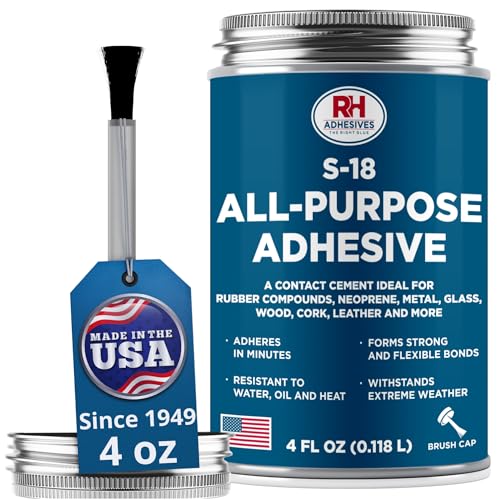
The S-18 is a neoprene-based contact cement that has been manufactured in the United States since 1949, and its formulation is optimized for exactly the rubber-to-metal and rubber-to-plastic applications that cause other adhesives to delaminate. The neoprene film cures into a permanently flexible layer that absorbs vibration and expansion without cracking, making it the standard choice for attaching SBR rubber strips to metal brackets or neoprene sheets to plastic panels. The 4-ounce can contains enough material for several medium-sized repairs, and the liquid form factor allows brush or dauber application for precise coverage.
Customer reviews highlight its effectiveness on leather boot repair and neoprene car covers, though one long-term test noted failure when the bond was exposed to prolonged heat and rain. This points to the S-18’s real strength: indoor and marine use where temperatures stay moderate, not extreme exterior exposure. The solvent is potent — reviewers unanimously recommend extreme ventilation — and full cure takes a full 24 hours. Unlike instant CAs, the S-18 gives you a 5-to-15-minute open window for repositioning, which is essential for large-area laminations.
If your project involves neoprene, SBR, or felt bonded to plastic or metal and you need a bond that remains flexible under load, the S-18 is the most cost-effective option here.
Why it’s great
- Flexible neoprene film absorbs vibration without cracking
- Excellent for large-area laminations with generous open time
- American-made with decades of proven formulation
Good to know
- Strong solvent odor requires well-ventilated workspace
- 24-hour full cure before bond reaches maximum strength
- Not recommended for extreme exterior or high-heat exposure
4. Gorilla Max Strength Construction Adhesive
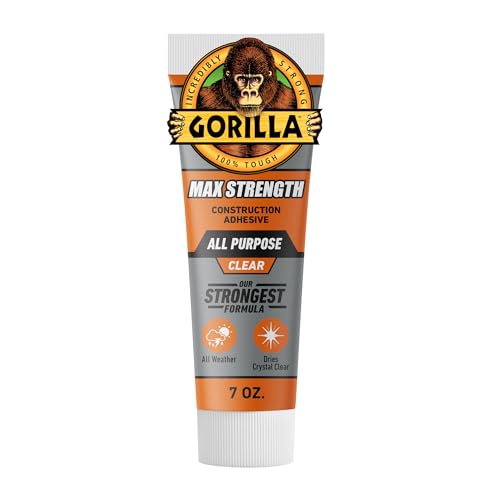
Gorilla Max Strength is a hybrid construction adhesive, not a traditional contact cement or CA, and its versatility for rubber-to-plastic bonding comes from a unique combination of properties: it dries crystal clear, it is 100% waterproof and bonds on wet surfaces, and it remains flexible after full cure. The paste-like consistency fills gaps up to a quarter-inch, which makes it the best choice when the rubber piece is warped or the plastic surface is uneven. The 30-minute working time allows careful positioning of large parts like a rubber bumper against a plastic fender without the panic of a fast-setting CA.
The bond strength is genuinely impressive. One user left a magnet glued to a car interior panel with this adhesive for weeks in direct summer heat without any failure, and another used it to attach rubber strips to wood in a marine setting where the joint stayed submerged. The clear finish is paintable after two hours and sandable once cured, which opens up cosmetic repair options that dark neoprene cements or black polyurethanes cannot match.
The limitation is that the hybrid chemistry requires clamping for the first several hours to achieve maximum bond — you cannot just press and hold. The adhesive is also very sticky and hard to remove from skin, so gloves are mandatory. For large, irregular, or waterproof rubber-to-plastic bonds, the Gorilla Max Strength provides a forgiving, high-strength solution that bridges the gap between contact cements and polyurethane sealants.
Why it’s great
- Dries crystal clear and remains flexible after full cure
- 100% waterproof — bonds on wet surfaces
- 30-minute working time and gap-filling consistency
Good to know
- Requires clamping for several hours to reach full bond
- Extremely sticky and difficult to clean off skin
- 24-hour full cure before subjecting to load
5. Berkland 5200 Fast Cure Marine Adhesive Sealant Black
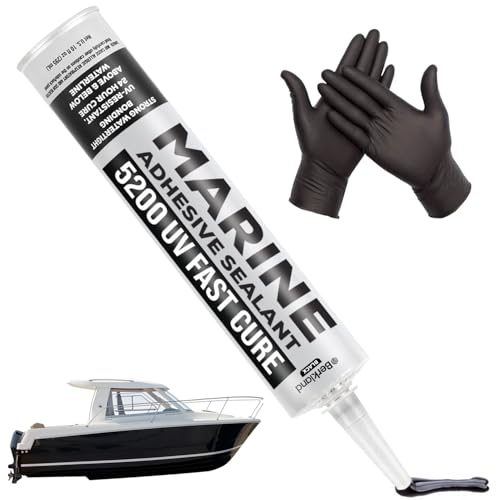
The Berkland 5200 is a polyurethane adhesive sealant formulated for permanent watertight bonds on boats, and it excels at attaching rubber rub rails, dark trim strips, and protective skags to fiberglass, gelcoat, and marine plastics. The fast-cure variant reaches tack-free state in just two hours, compared to the traditional 5200 formula that requires up to seven days. This speed translates directly into less time on the hard and faster return to service — critical for any marine repair. The black pigment blends invisibly into dark hull joints and deck hardware, avoiding the ugly white sealant line that plagues visible trim repairs.
Real-world testing from a master marine technician confirms the Berkland holds its own against the industry-standard 3M 5200 at a lower cost per cartridge. The polyurethane chemistry delivers a permanent bond that remains flexible enough to handle hull flex and thermal expansion. One reviewer successfully used it to glue rubber protective strips onto an inflatable boat, and the bond held through repeated inflation cycles and saltwater exposure.
The downsides are typical of polyurethane sealants: the material is extremely messy, requires solvent cleanup, and sticks aggressively to skin. It is also not a quick-fix item — while tack-free in two hours, the bond needs 24 hours to reach handling strength. If you need a marine-rated bond that holds rubber to plastic above or below the waterline, the Berkland 5200 delivers professional results at a budget-conscious price.
Why it’s great
- Permanent watertight bond for above and below waterline use
- Fast cure — tack-free in 2 hours versus 7 days for standard 5200
- Black pigment matches dark trim and rub rails perfectly
Good to know
- Messy application — gloves and solvent cleanup essential
- 24-hour cure before handling strength is achieved
- One-part cartridge requires a standard caulk gun
6. LEENEXUS Super Glue for Plastic, PLA, ABS
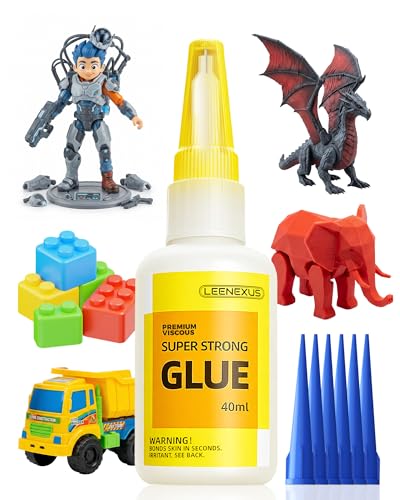
The LEENEXUS glue is a high-viscosity gel cyanoacrylate that targets hobbyists and DIYers working with 3D-printed PLA, ABS, PETG, and acrylic parts — but its formulation also performs well on rubber-to-plastic repairs where a thick, non-drip gel is preferable to a runny liquid. The Micro-Anchor Technology claim translates to a dual-molecular bond that penetrates surface pores, and the 40ml bottle with six precision needle tips delivers extremely accurate placement for small joints like RC car parts, model kit assemblies, and toy repairs. The gel consistency bridges small gaps and resists running onto clean surfaces.
Customer tests confirm the bond holds under surprising load — one user sealed a sidewall puncture on a zero-turn mower tire and inflated it to 35 psi, and the repair held for two months. The gel sets in 10 to 45 seconds, providing a comfortable window for alignment compared to thin CAs. The triple-protection cap system (cleaning needle, dual-threaded cap, moisture-proof seal) genuinely extends the shelf life beyond cheap single-use super glues, making the 40ml bottle a practical value for the workshop.
The LEENEXUS is not formulated for silicone, polypropylene, polyethylene, or wet surfaces, so project compatibility must be confirmed before use. It is also a rigid CA when fully cured, not a flexible bond — if the rubber part will experience repeated bending, a neoprene or polyurethane adhesive is a better choice. For small, precision rubber-to-plastic fixes that need instant hold and clear appearance, this is the most budget-friendly entry in the guide.
Why it’s great
- High-viscosity gel stays put on vertical surfaces without running
- Precision needle tips enable pinpoint application
- Triple-protection cap keeps glue usable for months
Good to know
- Not recommended for silicone, PP, PE, or wet surfaces
- Cures rigid — not ideal for flexing rubber joints
- Full 24-hour cure needed for maximum bond strength
7. 3M Hi-Strength 94 ET Spray Adhesive
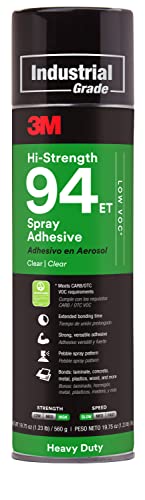
When the rubber-to-plastic bond covers a large area — think lining a plastic storage compartment with foam rubber or laminating a rubber mat to a plastic floor panel — brush-on contact cements and tube glues become impractical. The 3M Hi-Strength 94 ET is a spray contact adhesive that delivers uniform coverage over broad surfaces with a bonding range of up to 60 minutes, giving you ample time to align large panels. It forms an aggressive initial tack that holds foam rubber, carpet, and neoprene firmly against plastic substrates even in cold temperatures, as one user confirmed when installing foam soundproofing in a hunting blind during freezing weather.
The 19.75-ounce can covers roughly 20 square feet per full spray-out, making it the most economical option for large-area laminations. The Low VOC formulation is GREENGUARD Certified and contributes to LEED credits, so it meets indoor air quality standards for enclosed spaces. The bond is extremely durable — users report it is effectively permanent on foam and fabric laminations to plastic panels, holding through vibration and temperature cycling without delaminating.
The solvent odor is potent (reviewers note it smells like airplane glue), so a respirator and extreme ventilation are non-negotiable. The 30-minute drying time before mating the surfaces can feel slow if you are used to instant CAs, and the spray pattern makes it unsuitable for small, precise bonds. For covering a whole panel of rubber-to-plastic, however, the 3M 94 ET is the fastest and most consistent option in the guide.
Why it’s great
- Uniform spray coverage for large-area laminations up to 20 sq ft
- 60-minute open window for precise alignment
- Low VOC and GREENGUARD Certified for indoor use
Good to know
- Strong solvent odor requires respirator and ventilation
- 30-minute dry time before surfaces can be mated
- Not suitable for pinpoint or small-joint repairs
FAQ
Can I use super glue on rubber to plastic?
Will Gorilla Glue work on rubber to plastic?
What is the strongest adhesive for rubber to plastic?
How do I prepare rubber and plastic surfaces before gluing?
Final Thoughts: The Verdict
For most users tackling general rubber-to-plastic repairs, the best adhesive for rubber to plastic is the 3M Scotch-Weld PR100 because it bonds difficult rubber types like silicone and EPDM to plastic in under 20 seconds with a near-invisible bond line. If you are working with SBR or neoprene on a large area and need flexibility, the RH Adhesives S-18 delivers proven performance at a lower cost. And for marine applications where the bond must survive constant water exposure, the Berkland 5200 Fast Cure provides a permanent, flexible seal that no other category can match.