
Matching a subwoofer amplifier to your enclosure and voice coil configuration is the single most important audio decision in your car. An undersized amp clips and distorts, while an overpowered one shreds voice coils. The difference between bass that shakes your mirrors and bass that rattles your teeth comes down to continuous RMS power, impedance stability, and damping factor—not peak wattage figures printed on the box.
I’m Min — the co-founder and writer behind Gadgets Feed. I have spent countless hours analyzing amplifier datasheets, bench test results, and real-world owner feedback to separate the amps that deliver honest power from those that inflate numbers for marketing.
This guide cuts through the false peak-power ratings and wiring myths to help you select the best car amplifier for subwoofer that matches your subs, your electrical system, and your budget without wasting money on specs that don’t matter.
How To Choose The Best Car Amplifier For Subwoofer
Most buyers overestimate how much amplifier power they need and underestimate how important impedance matching and electrical system headroom are. A 500-watt RMS amplifier fed with proper voltage at the right impedance consistently outperforms a 1500-watt amp starving for current or wired to the wrong load. Focus on these three pillars before you look at max wattage.
Match RMS Power to Your Subwoofer’s Continuous Rating
The amplifier’s RMS rating at the impedance your subwoofer presents should land within 75–150% of the subwoofer’s RMS handling. Running an amp rated for 600 watts RMS at 2 ohms into a subwoofer rated for 400 watts RMS at 2 ohms gives you headroom to avoid clipping. Significantly exceeding the sub’s rating without clean signal management invites thermal failure.
Impedance Stability Dictates Wiring Flexibility
A mono amplifier rated down to 1 ohm allows you to wire multiple subwoofers or dual voice coil configurations without exceeding the amp’s minimum load. Amplifiers stable only to 2 ohms limit your wiring options—you may be forced into a series configuration that cuts total power output. Always check the minimum impedance rating before designing your enclosure wiring.
Electrical System Capacity and Class D Efficiency
Class D amplifiers convert input voltage into output power at over 80% efficiency, placing far less strain on your alternator and battery than Class A/B designs. For systems above 800 watts RMS, verify your alternator output and consider upgrading the Big Three wires. An efficient amp that runs cool protects itself and your subwoofer from thermal runaway.
Quick Comparison
On smaller screens, swipe sideways to see the full table.
| Model | Category | Best For | Key Spec | Amazon |
|---|---|---|---|---|
| Taramps Smart 3 Bass | Mono | Ultra-low frequency SPL | 3000W RMS @ 0.5–2 ohms | Amazon |
| CT Sounds CT-1000.1D | Mono | Compact daily driver | 1000W RMS @ 1 ohm | Amazon |
| Hifonics BXX1200.1D | Mono | Reliable mid-power daily | 1200W RMS @ 1 ohm | Amazon |
| Alpine S-A60M | Mono | Clean, reliable daily bass | 600W RMS @ 2 ohms | Amazon |
| Kicker 46CXA4001 | Mono | Budget-friendly entry | 400W RMS @ 2 ohms | Amazon |
| Stinger MT20001 | Mono | High-power compact build | 2000W RMS @ 1 ohm | Amazon |
| Kenwood KAC-D5101 | Mono | Small footprint, good power | 500W RMS @ 2 ohms | Amazon |
| Kicker 46CXA8001 | Mono | Medium-power premium | 800W RMS @ 1 ohm | Amazon |
| Rockford Fosgate R2-500X1 | Mono | Premium brand, modest power | 500W RMS @ 2 ohms | Amazon |
In‑Depth Reviews
1. CT Sounds CT-1000.1D

The CT-1000.1D delivers 1000 watts RMS at 1 ohm from a chassis that measures only 11.68 x 5.62 x 2.18 inches, making it one of the most space-efficient high-power mono blocks on the market. Its MOSFET pulse width modulated power supply and proprietary heat dissipation design keep the amplifier running cool even during extended high-volume sessions, which real owners confirm after months of daily abuse.
Frequency response spans 0 to 320 Hz with a bass knob included, allowing precise tuning for subwoofer duty. The 4-way protection circuitry covers high voltage, low voltage, over current, and high temperature—giving peace of mind that the amp will shut down cleanly rather than damaging your subwoofer or vehicle wiring. Owners pair it with 12-inch Skar and Kicker subs and report no clipping or protection mode trips.
The compact form factor fits under seats or in tight trunk spaces without sacrificing output. Multiple verified reviews note that the amp runs warm but never goes into thermal shutdown, even when pushed hard for hours. For a daily driver system needing honest 1000-watt RMS output in a small package, this amp represents the most balanced blend of power, efficiency, and protection available.
Why it’s great
- Compact chassis fits tight install locations
- 4-way protection circuitry prevents subwoofer damage
- Runs cool under sustained high-power use
Good to know
- RCA inputs are side-mounted, which may complicate some wiring layouts
- Gain adjustment requires a small screwdriver
2. Taramps Smart 3 Bass

The Taramps Smart 3 Bass uses Multi-Impedance technology to operate from 0.5 to 2 ohms while delivering 3000 watts RMS, automatically adjusting its output to match the connected load. This makes it uniquely suited for competition-level SPL builds where ultra-low impedance wiring is common. The amplifier supports input wire gauges up to 1/0 AWG, accommodating high-current electrical systems without bottleneck.
Real-world bench tests confirm the Smart 3 Bass exceeds its rated output at 1 ohm, though owners strongly recommend upgrading your alternator and battery—this amp draws a claimed 200 amps at full tilt. The crossover includes low-pass and subsonic filters along with a remote bass knob, giving you full control over frequency range and output level from the driver’s seat.
Several long-term users report the amp thrives on frequencies below 30 Hz, making it ideal for deep hip-hop and bass test tracks, but note that it becomes less effective above 50 Hz. The built-in fan is audible at idle, though most owners accept the noise for the power density. If your goal is ground-shaking lows and you have the electrical system to support it, this amp delivers SPL performance that rivals units costing significantly more.
Why it’s great
- Auto-impedance matching simplifies wiring
- 3000W RMS in a lightweight 6.6 lb package
- Excellent low-frequency extension below 30 Hz
Good to know
- Fan noise is noticeable during operation
- Requires upgraded alternator and battery for full output
3. Hifonics BXX1200.1D Brutus

The Hifonics BXX1200.1D Brutus produces 1200 watts RMS at 1 ohm using Super Class D technology with an NGSD digital chip, which keeps operating temperatures lower than conventional Class D designs. At 9.5 pounds and 13.25 inches in length, it is larger than the CT Sounds amp but offers a proven track record of reliability—multiple owners report running this amp for 7–8 years without failure.
Ultra-Fi MOSFET outputs are selected for balance and output power smoothness, which reduces distortion during demanding bass passages. The amplifier’s blue LED indicates normal operation while red signals a short circuit condition, making troubleshooting straightforward. Owners have successfully powered 12-inch Kicker Solo-baric and Sony Xplod subs without issues, and many describe it as a workhorse they would buy again.
Some users note that while the BXX1200.1D hits hard, it does not match the raw authority of higher-end Rockford Fosgate or JL Audio amplifiers at similar power levels. However, considering its price per watt, the Brutus line remains one of the most cost-effective ways to get reliable 1200-watt RMS performance. If maximum output per dollar is your priority, this amplifier delivers consistently.
Why it’s great
- Proven 7+ year reliability record
- Super Class D runs cooler than conventional designs
- Excellent value per RMS watt
Good to know
- Blue LED can be overly bright at night
- Slightly less dynamic authority than premium brands
4. Alpine S-A60M

The Alpine S-A60M delivers 600 watts RMS at 2 ohms with a signal-to-noise ratio of 85 dBA, emphasizing clean power over brute force. Benchmark testing from multiple owners shows it actually produces 667 watts RMS on the test bench, exceeding its conservative rating. The amplifier includes both preamp and speaker-level inputs, allowing direct connection to factory radios without a line output converter.
The chassis is remarkably compact and dense for its output class, with owners fitting it easily under seats in Jeep Wranglers and compact cars. The gain control includes a center detent that marks the point before clipping, verified by owners using oscilloscopes. Variable bass boost and variable low-pass filter let you tailor the subwoofer response without external processors.
Several users have run this amp for years without thermal issues, even during long road trips with extended high-volume playback. The only common criticism is that the bass boost center frequency is fixed at 50 Hz, while some users prefer a lower center point around 40 Hz for deeper bass. If you value sound quality and reliability over maximum output, the S-A60M is a Class D amplifier that sounds far more expensive than it is.
Why it’s great
- Exceeds its rated RMS output on bench tests
- Speaker-level inputs work with factory radios
- Gain center detent simplifies clipping prevention
Good to know
- Bass boost fixed at 50 Hz, not adjustable
- Limited to 600W RMS output for larger systems
5. Stinger MT20001

The Stinger MT20001 packs 2000 watts RMS at 1 ohm into a chassis that measures just 6.10 x 12.16 x 2.09 inches, making it one of the most power-dense mono amplifiers available for under . The HEXFET MOSFET power supply and Class X2 aluminum zinc capacitors deliver fast switching speed and low on-resistance, which translates into clean power delivery even under heavy load. Owners report actual dyno readings of 2800 watts before clipping, exceeding the conservative 2000-watt rating.
Reverse polarity protection saved at least one owner’s system when they accidentally reversed power and ground connections—the amp survived with no damage. Remote bass knob with dash bracket mounts flush for convenient subwoofer level control. The subsonic filter and variable low-pass crossover let you dial in the frequency range precisely, protecting your subwoofer from over-excursion below the tuning frequency.
A small number of users note that sustained operation at 2000 watts can trigger thermal protection in tight enclosures without airflow. One owner reported shutdown when attempting to maintain full output continuously, estimating realistic sustained power closer to 1200 watts. For most daily driving situations, where peak output is intermittent, the MT20001 delivers extraordinary value with power that rivals amplifiers costing significantly more.
Why it’s great
- Dyno-tested above rated output at 2800W peak
- Reverse polarity protection prevents damage from wiring mistakes
- Compact chassis for high power density
Good to know
- Thermal protection can activate under sustained full-power use
- Real-world continuous output is closer to 1200W
6. Kicker 46CXA4001

The Kicker 46CXA4001 delivers 400 watts RMS at 2 ohms with 1-ohm stability, meaning you can wire dual voice coil subs for maximum power without exceeding the amplifier’s minimum load. The CX-Series includes a variable 12 dB crossover, KickEQ 6 dB variable bass boost, and a 24 dB subsonic filter—features usually reserved for higher-tier amplifiers. Owners consistently praise its thermal stability, with several reporting that this amp runs for hours without shutdown after previous amplifiers failed within 45 minutes.
Kicker’s FIT+ technology allows the amplifier to accept high-level input signals up to 40 volts DC, making it compatible with factory radios that have built-in amplifiers. The DC offset remote turn-on eliminates the need to run a separate remote wire, simplifying installation in modern vehicles. The amplifier works with as little as 9 volts from the battery, which helps maintain performance during engine cranking or in vehicles with weak electrical systems.
Some owners note that the CXA4001 lacks built-in fuses and that the speaker terminals are too small to accept 12 gauge OFC wire without forcing the connectors. Additionally, the remote bass knob uses a 1/8-inch auxiliary connection that some users found prone to pulling out. Despite these minor hardware gripes, the amplifier’s bulletproof reliability and clean bass reproduction make it an excellent entry-level choice for a single subwoofer.
Why it’s great
- 1-ohm stable for flexible wiring options
- FIT+ technology works with factory radios
- Superior thermal stability over competitors
Good to know
- No built-in fuses—requires external fuse holder
- Speaker terminals too small for 12 AWG OFC wire
7. Kenwood KAC-D5101

The Kenwood KAC-D5101 produces 500 watts RMS at 2 ohms from a chassis that weighs just 3.3 pounds and measures 10 x 5 x 9.5 inches, making it one of the lightest mono amplifiers in its power class. It includes speaker-level input with signal sensing turn-on, which means no remote wire is needed when connecting to a factory head unit. The variable low-pass filter and bass boost give you basic tuning control for integrating with an existing subwoofer.
Owners report that the KAC-D5101 runs two Rockford Fosgate 10-inch subwoofers without issues, though they strongly recommend using 4 AWG OFC copper for the ground connection to prevent overheating and thermal cutoff. Some users found that the positive and negative terminals use very short screws with limited clearance, making standard 4 AWG lugs difficult to fit. One owner sourced custom lugs to solve the problem.
Despite the terminal compatibility issue, the amplifier’s sound quality and reliability are consistently praised. Multiple owners describe it as a “wow” amplifier that significantly outperforms its size and weight. If you need a lightweight, efficient, and trustworthy amplifier for a moderate-power subwoofer system and are comfortable sourcing non-standard terminal lugs, the KAC-D5101 delivers genuine Kenwood build quality.
Why it’s great
- Extremely lightweight at 3.3 pounds
- Signal-sensing turn-on eliminates remote wire
- Kenwood reliability and sound quality
Good to know
- Terminal screws are short—4 AWG lugs may not fit
- Grounded 4 AWG wire recommended to prevent overheating
8. Kicker 46CXA8001
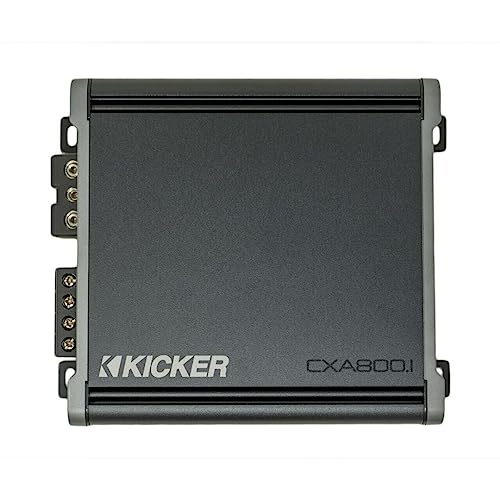
The Kicker 46CXA8001 delivers 800 watts RMS at 1 ohm, offering the same CX-Series feature set as its 400-watt sibling but with double the output for larger subwoofer systems. The variable 12 dB crossover, KickEQ 6 dB bass boost, and 24 dB subsonic filter give you comprehensive frequency control. Owners have successfully paired this amplifier with JL Audio Stealthboxes and single 15-inch subwoofers, reporting that it “hits hard” without shutting down.
Like all CX-Series amplifiers, the CXA8001 works with 9-volt minimum battery voltage and accepts speaker-level input signals up to 40 volts, making it compatible with factory-installed head units. The included vertical and horizontal mounting hardware lets you install the amplifier in tight spaces—multiple users have mounted it in two-door Jeep Wranglers and under truck seats with minimal effort.
Some owners note that the amplifier lacks built-in fuses and that the speaker terminals are too small to comfortably accept 12 gauge OFC wire or fork connectors, requiring some force to fit. A small number of users report that the sound quality is excellent but that the output does not quite match the authority of higher-priced competitors. For a mid-power system that balances features and reliability, the CXA8001 is a solid choice from a brand with decades of subwoofer amplifier expertise.
Why it’s great
- 800W RMS at 1 ohm for larger subwoofer setups
- Versatile mounting options for tight spaces
- Comprehensive crossover and filter controls
Good to know
- No built-in fuses—external fuse required
- Terminal size may not fit 12 AWG OFC wire without forcing
9. Rockford Fosgate R2-500X1 Prime

The Rockford Fosgate R2-500X1 Prime produces 500 watts RMS at 2 ohms in an ultra-compact chassis measuring 1.9 x 6.8 x 8.5 inches. It features C.L.E.A.N. circuitry that helps you set gain without distortion, a P.O.W.E.R. Supply that generates more output as voltage increases, and integrated Punch EQ that delivers up to 3x the bass output at selected frequencies. The variable infrasonic filter protects subwoofers from over-excursion at frequencies below the enclosure tuning.
Owners consistently report that this amplifier drives single 12-inch JL Audio and Pioneer subwoofers with clean, distortion-free power. One user powers a dual voice coil 10-inch Rockford Fosgate P3 subwoofer in a Chevrolet Colorado ZR2 and had to turn down the gain to avoid overpowering the factory Bose system—indicating the amplifier delivers more than its rated output. The remote level control gives you subwoofer volume adjustment from the driver’s seat.
The only common complaint is that the R2-500X1 requires an external fuse rated between 80 and 100 amps, which must be purchased separately. Some users also note that the Class D efficiency, while excellent, does not match the lowest-temperature designs. If you want the peace of mind that comes from Rockford Fosgate’s engineering reputation and C.E.A.-2006 compliant ratings, this amplifier justifies its higher price through build quality and features that protect your investment.
Why it’s great
- C.L.E.A.N. circuitry simplifies gain adjustment
- Punch EQ delivers up to 3x bass output
- Proven brand reliability and CEA-2006 compliance
Good to know
- External fuse (80–100A) not included
- Premium price for moderate power output
FAQ
What happens if my amplifier power exceeds my subwoofer RMS rating?
Can I use a mono amplifier with two subwoofers?
What size power wire do I need for a 1000-watt RMS mono amplifier?
Final Thoughts: The Verdict
For most users, the car amplifier for subwoofer winner is the CT Sounds CT-1000.1D because it delivers honest 1000-watt RMS output in a compact, well-protected chassis at a price that undercuts competitors with similar real-world performance. If you want deeper low-frequency extension and have the electrical system to support it, grab the Taramps Smart 3 Bass. And for a clean, reliable daily driver system where sound quality matters more than maximum SPL, nothing beats the Alpine S-A60M.