
A T-square that isn’t true is just an expensive paperweight. When you’re laying out a glue-up, marking a cut on sheet goods, or squaring a cabinet box, the difference between a perfect joint and a frustrating gap comes down to a single 90-degree reference. The all-aluminum construction eliminates the warping and squareness drift common in plastic or wood squares, but not every aluminum T-square on the shelf meets the same standard of flatness and accuracy.
I’m Min — the co-founder and writer behind Gadgets Feed. I’ve spent countless hours cross-referencing engineering drawings, factory spec sheets, and user-verified squareness reports to separate the tools that deliver repeatable, dead-straight reference edges from those that ship out of tolerance.
The best aluminum t square combines a rigid blade, a securely machined head, and clear laser-etched markings to give you confidence on every cut.
How To Choose The Best Aluminum T Square
Choosing an aluminum T-square is a balance of blade length, joint rigidity, and marking clarity. A square that shifts by even 1/32nd of an inch over its length introduces cumulative errors that ruin repeat cuts. Here are the three factors that matter most.
Blade Thickness & Alloy
A flimsy blade flexes when you apply pressure, causing your scribed line to drift. Look for blades made from 6061-T6 or similar heat-treated aluminum alloy with a thickness of at least 1.5 mm. The heavier the blade, the more reliably it registers flat against your material’s edge without bowing.
Head-to-Blade Joint
This is the single most failure-prone point on any T-square. A joint secured with aircraft-style rivets provides consistent clamping force that won’t loosen over time. Adjustable set screws allow you to re-square the head if it shifts, but cheap fixed rivets on a poorly aligned die can lock in a crooked angle right from the factory.
Marking Durability
Stamped or painted markings wear off quickly in a busy shop. Laser-engraved graduations are etched into the anodized surface, remaining readable even after years of being dragged across drywall, plywood, and MDF. Look for dual inch and metric scales if you work across both measurement systems.
Quick Comparison
On smaller screens, swipe sideways to see the full table.
| Model | Category | Best For | Key Spec | Amazon |
|---|---|---|---|---|
| Tydeey 31″ Precision T-Square | Premium | Fine woodworking & cabinet layout | CNC-machined 6061 aluminum, 0.0002″ squareness | Amazon |
| AMES 48″ Heavy Duty T-Square | Premium | Construction & sheet goods | 3/16″ thick aluminum blade, aircraft rivets | Amazon |
| Tydeey 12″ Precision T-Square | Mid-Range | Compact workshop & small parts | 12″ blade with scribing holes | Amazon |
| Alumicolor 24″ Standard T-Square | Mid-Range | Drafting & art framing | Tempered aluminum, metric & inch scales | Amazon |
| GRENPRO Sliding T-Square | Mid-Range | Angle marking & versatile layout | Adjustable 18″ blade, protractor scale | Amazon |
| Fairgate 24″ Aluminum T-Square | Budget | Basic sewing & light drafting | Plastic head, 1/8″ & 1/16″ calibration | Amazon |
| Pacific Arc 42″ T-Square | Mid-Range | Large-format drafting & quilting | Acrylic blade, detachable head, 42″ length | Amazon |
In‑Depth Reviews
1. Tydeey 31″ Precision T-Square Ruler
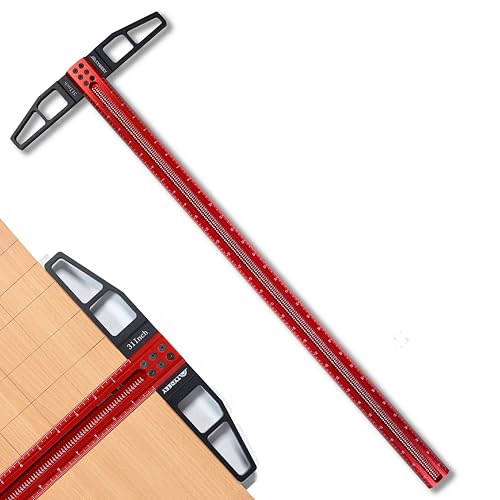
This Tydeey model uses CNC-machined 6061 aluminum alloy, and the difference shows immediately when you pick it up. The 31-inch blade sits flat on your workpiece with zero perceptible bowing, and the squareness tolerance reported by a retired toolmaker at roughly 0.0002 inches is exceptional for a T-square at this tier. The integrated scribing holes let you drop a mechanical pencil tip in for repeatable parallel line marking at exact distances.
The upgraded handle design provides a comfortable grip that makes one-handed positioning easy during layout work. Owners note the ruler is heavy enough to resist sliding when leaned against a sheet of plywood, yet balanced enough for extended use without fatigue. The clear laser-engraved scale remains sharp against the red anodized background, performing well in both bright shop lighting and dimmer workshop corners.
A few users report a slight 1/32-inch offset between the printed zero line and the true start of the ruler where the T-bar sits, but this is a predictable offset easily compensated for once you know it exists. For cabinet work, repeatable cut marking, and any project where a reliable 90-degree reference is non-negotiable, this Tydeey delivers accuracy that rivals squares costing significantly more.
Why it’s great
- CNC-machined aluminum holds squareness to ~0.0002 inches
- Scribing holes enable fast, repeatable parallel line marking
- Blade sits flat with no crown or bow across full 31 inches
Good to know
- Zero line sits slightly offset from the T-bar, requiring a ~1/32″ compensation
- Screws may benefit from thread lock to prevent loosening over time
2. AMES 48″ Heavy Duty T-Square
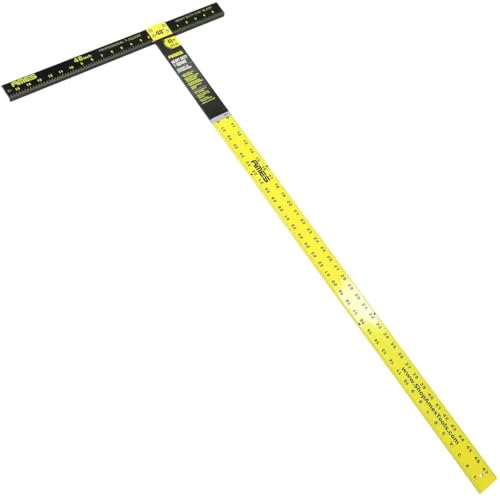
The AMES Heavy Duty T-square takes a different approach from precision drafting squares — it’s built for the job site, not the drawing board. The 3/16-inch thick aluminum blade is nearly twice as thick as standard consumer-grade squares, making it resistant to bending when you apply pressure for a cut line against drywall or plywood. The high-visibility yellow finish with reverse rulings and stud markings makes reading measurements easy even in awkward overhead positions.
Aircraft-style rivets secure the head to the blade, providing a durable joint that won’t loosen under repeated abuse. At 48 inches, this square is designed for full-sheet layout where a shorter tool forces you to shift and re-reference your edge. Owners consistently praise its accuracy straight out of the box and its ability to hold square after months of heavy use on renovation projects.
A single Spanish-language review reports rivets loosening over time, but the overwhelming majority of verified buyers describe this as the best heavy-duty square they’ve used. If your daily work involves full sheets of plywood, drywall cutting, or framing layout where a T-square needs to survive drops and rough handling, the AMES is the obvious choice.
Why it’s great
- 3/16″ blade thickness eliminates flex under cutting pressure
- Aircraft rivets provide a secure, long-lasting head-to-blade joint
- High-contrast yellow finish with stud markings aids readability
Good to know
- Occasional reports of rivets loosening with extended heavy use
- 48-inch length may be excessive for small workshop benches
3. Tydeey 12″ Precision T-Square Ruler

For smaller layout tasks where a 31-inch square feels cumbersome, this 12-inch Tydeey is a purpose-built companion. It shares the same CNC-machined aluminum construction and scribing hole design as its larger sibling, providing the same sub-0.001-inch squareness in a more pocket-friendly form. The compact length makes it ideal for cabinet hardware layout, drawer dovetail marking, and any job where you need a precise 90-degree reference in a tight space.
The red anodized finish resists scratches and the laser-etched markings remain crisp even after contact with glue, thinners, and shop grime. A retired toolmaker who reviewed this square confirmed it holds square to roughly 0.0002 inches with zero side play, which is remarkable at this price point. The integrated scribing holes allow you to create parallel lines at exact intervals by simply dropping in a mechanical pencil and running the square along your reference edge.
A few users note the printed zero line sits slightly on the T-bar, creating a 1/32-inch offset when measuring from the edge of your material. This is a minor adjustment once you’re aware of it, and the overall rigidity and flatness of this square make it a strong recommendation for any woodworker who needs a dedicated small-format layout tool.
Why it’s great
- CNC-machined aluminum delivers exceptional squareness for a 12″ tool
- Scribing holes enable fast parallel line marking at fixed distances
- Compact size fits easily in a tool belt or apron pocket
Good to know
- Zero-line offset may require compensation when measuring from edge
- Best suited for layout work, not as a framing or drywall square
4. Alumicolor 24″ Standard Aluminum T-Square

Alumicolor’s 24-inch T-square bridges the gap between precision layout tools and everyday drafting squares. The black tempered aluminum blade is 1.5 inches wide with an ultra-smooth inking edge that works well with technical pens and markers. The ABS plastic head is lightweight and nearly unbreakable, making this a solid choice for art studios, drafting tables, and picture framing where you need a straight edge but don’t want the weight of a full aluminum head.
The dual metric and inch calibrations are silkscreened onto the anodized surface. While not as permanent as laser engraving, the markings are clear and have proven durable in studio environments. Owners consistently rate this square highly for accuracy, noting it arrives square at 90 degrees and stays true through regular use. The available color options (black, blue, and others) add a small aesthetic bonus for anyone who wants their tools to look as good as they work.
A few users mention the blade is somewhat flexible compared to thicker heavy-duty squares, so it’s better suited for marking and drafting than for heavy cutting applications. But for the price, the Alumicolor delivers reliable squareness, a smooth reference edge, and a professional look that makes it a favorite among artists and architects who need a dependable everyday T-square.
Why it’s great
- Accurate 90° angle straight from the factory with consistent quality
- Lightweight ABS head and tempered aluminum reduce fatigue during extended use
- Dual metric and inch scales with ultra-smooth inking edge
Good to know
- Blade is flexible and not suited for heavy cutting or drywall scoring
- Silkscreened markings may wear over time with heavy shop use
5. GRENPRO Woodworking Scriber Marking Line Ruler
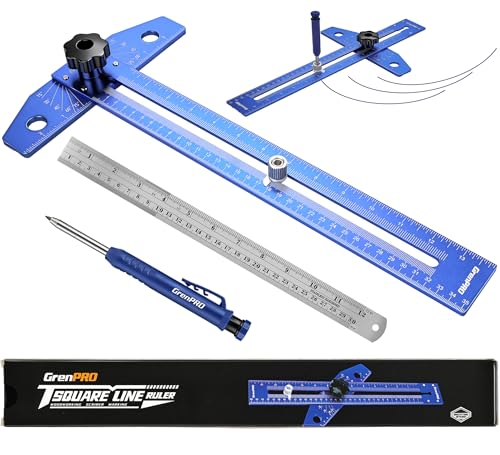
The GRENPRO sliding T-square takes a multi-function approach by combining a ruler, protractor, and adjustable angle finder into one aluminum alloy tool. The sliding head loosens with a nut to allow quick angle changes from 0 to 90 degrees, making it effective for marking bevels, radial lines, and compound angles without needing a separate protractor. The 18-inch blade provides a decent reach for most workbench projects.
The laser-engraved markings on the ruler and protractor scales are sharp and wear-resistant, maintaining readability in tough environments. Buyers who used this for LVP flooring installation report it holds the board edge securely and prevents sliding during marking. The included pencil and steel ruler add convenience for immediate marking and extended measurement range, though the steel ruler is basic rather than precision-grade.
This is not a replacement for a fixed, precision-machined T-square when absolute squareness is required. The adjustable joint introduces a potential point of play, and the slotted sliding design means it’s better suited for versatile marking than for repeated reference-edge squaring. For woodworkers and DIY enthusiasts who frequently switch between angle marking and straight-line layout, the GRENPRO offers excellent utility in a single tool.
Why it’s great
- Adjustable head with protractor enables angle marking without separate tools
- Laser-engraved scales resist wear and remain readable
- Included pencil and steel ruler add immediate marking convenience
Good to know
- Sliding joint may introduce slight play, reducing absolute squareness
- 18-inch blade length limits use on full-size sheet goods
6. Pacific Arc 42″ T-Square

The Pacific Arc 42-inch T-square is a different beast entirely — it uses a transparent acrylic blade rather than aluminum. That transparency is a key advantage for quilters, textile workers, and large-format artists who need to see pattern lines through the blade. The beveled acrylic edge works perfectly with a 45mm rotary cutter, making it a favorite in sewing and quilting studios where a metal blade would be too thick or opaque.
The detachable head makes it portable, and the included carrying case protects the long blade during transport. The acrylic blade is rigid enough for drafting and cutting but lighter than an equivalent aluminum square, reducing arm fatigue during extended use. The inch scale is graduated in 1/16-inch increments, and the reverse side includes a metric scale for maximum versatility.
Multiple verified buyers report the square arrives out of square and requires adjustment using the provided screws and a reference square. Some users also note the black plastic case emits a strong chemical odor that can be unpleasant. However, once adjusted, the Pacific Arc holds its setting and provides a reliable straight edge for large-format work where a 42-inch reach is essential.
Why it’s great
- Transparent acrylic blade allows full visibility of markings underneath
- Beveled edge works cleanly with rotary cutters for fabric and paper
- Detachable head with carrying case improves portability
Good to know
- Frequently requires adjustment to achieve true 90 degrees out of the box
- Carrying case emits a strong chemical odor that may require airing out
7. Fairgate 24″ Aluminum T-Square
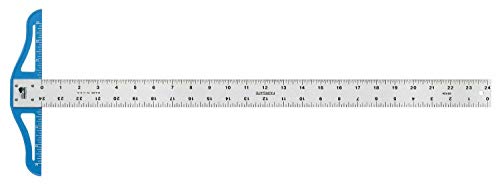
The Fairgate 24-inch T-square is an entry-level tool that serves basic layout needs for sewing, light drafting, and hobbyist use. It features a 24-inch aluminum blade with a plastic head, keeping the weight low and the cost accessible. The 1.5-inch wide blade carries 1/8-inch and 1/16-inch calibrations that are adequate for general measuring tasks where sub-millimeter precision is not critical.
Manufactured by Cutex Sewing Supplies and marked as Made in USA, this square targets the craft and sewing market where it competes against all-plastic squares. Some buyers report receiving a square that is perfectly accurate and works well for fabric cutting and pattern layout. The lightweight design makes it easy to handle for long sewing sessions.
The critical issue with this model is quality control. Multiple verified buyers report receiving units that are out of square by as much as half an inch over the full length, making them useless for any project requiring a true 90-degree reference. The plastic head is prone to loosening, and the aluminum blade is described as flimsy and flexible. For occasional sewing or basic school projects where perfect squareness is not essential, this square may suffice, but serious woodworkers and contractors should invest in a higher-tier option.
Why it’s great
- Lightweight aluminum blade reduces arm fatigue during extended use
- Affordable price point suits budget-conscious buyers
- Made in USA with basic sewing and craft applications in mind
Good to know
- Inconsistent quality control with frequent out-of-square units
- Plastic head and thin blade lack rigidity for precision work
FAQ
How do I check if my aluminum T-square is truly square?
Can I use an aluminum T-square as a drywall square?
Why does my new T-square have a gap between the head and the blade?
Final Thoughts: The Verdict
For most users, the best aluminum t square winner is the Tydeey 31″ Precision T-Square because it delivers CNC-machined accuracy and scribing-hole versatility at a mid-range price point. If you need heavy-duty performance for construction and sheet goods, grab the AMES 48″ Heavy Duty T-Square. And for compact precision work in a tight workshop, nothing beats the Tydeey 12″ Precision T-Square.