
Nothing ends a wrenching session faster than a seized bleeder valve or a brake line that snaps the moment you put a wrench on it. For anyone restoring a classic car, repairing a rusty daily driver, or building a custom off-road rig, the hard line that carries hydraulic pressure from the master cylinder to the calipers is a safety-critical component that demands the right material and the correct flare. Choosing the wrong tubing means chasing leaks, fighting corrosion, and re-doing the job twice.
I’m Min — the co-founder and writer behind Gadgets Feed. I analyze real-world customer data and technical specifications across dozens of automotive part categories, and I’ve spent many hours comparing wall thicknesses, fitting compatibility, and corrosion resistance claims to separate the lines that hold pressure from the ones that fail within a season.
Whether you are patching a single rusted section or replacing the entire hydraulic system, the right 3/16 brake line roll will save you time, money, and the headache of a failed connection down the line.
How To Choose The Best 3/16 Brake Line Roll
A 3/16″ brake line roll isn’t just a tube — it’s the conduit for the most critical hydraulic system on your vehicle. Selecting the wrong material or skipping the right fittings can lead to flare failures that leave you stranded. Here are the factors that separate a reliable line from a temporary fix.
Material Matters: Copper-Nickel vs. Steel vs. Copper-Coated Steel
Copper-nickel alloy (typically 90% copper, 10% nickel) is the gold standard for brake line replacement. It resists rust entirely, bends easily by hand without a bender, and flares cleanly with standard tools. Steel lines are cheaper and stronger in burst pressure, but they rust from the inside out. Copper-coated steel is a compromise — it offers better corrosion resistance than bare steel but the coating can chip during bending, exposing the steel core. For long-term reliability in wet or salt-belt climates, true copper-nickel is the only choice that will outlast the vehicle.
Wall Thickness and Flare Compatibility
Most 3/16″ brake line rolls use a nominal wall thickness of .028″ (0.028 inches). Thicker walls (like .035″) offer higher burst pressure but require more force to flare and may not fit standard double-flare dies. Thinner walls are easier to work with but sacrifice some safety margin. Always verify that the tubing’s outer diameter (0.1875″ or 3/16″) matches your flaring tool and that the wall thickness is consistent with SAE J527 and ISO 4038 specifications.
Fitting Kits and Thread Pitch
A bare roll of tubing is just raw material. Most buyers need inverted flare nuts and unions to connect the line to the master cylinder, proportioning valve, and calipers. The common thread pitches for 3/16″ line are 3/8-24 (the most frequent size), 7/16-24, 1/2-20, and 9/16-18. A kit that includes an assortment of nuts and unions saves a trip to the auto parts store — but make sure you have the correct size for your vehicle before you start flaring.
Quick Comparison
On smaller screens, swipe sideways to see the full table.
| Model | Category | Best For | Key Spec | Amazon |
|---|---|---|---|---|
| 4LIFETIMELINES CuNi | Premium | Rust-proof long-term install | 0.028″ wall, copper-nickel alloy | Amazon |
| The Stop Shop Gravel Guard | Accessory | Protecting exposed lines | Stainless steel spring, 16 ft length | Amazon |
| Vkinman Steel Kit | Mid-Range | Budget-friendly full line replacement | Zinc-coated steel, 20-piece fitting set | Amazon |
| MuHize Dual-Size Kit | Mid-Range | Projects needing 1/4″ and 3/16″ line | Copper-coated alloy, 32 total fittings | Amazon |
| TUBPRO CuNi Kit | Premium | Complete kit with extra unions | Copper-nickel, 20-piece fitting kit | Amazon |
| Ailbiuko 2-Roll Kit | Value | Multiple vehicles or spare stock | 2 x 25 ft rolls, 60 total fittings | Amazon |
| Racewill All-in-One | All-in-One | First-time DIY with no tools | Copper-coated steel + bender + flare tool | Amazon |
In‑Depth Reviews
1. TUBPRO Copper Nickel Brake Line Kit

The TUBPRO kit delivers 25 feet of genuine copper-nickel alloy tubing with a .028″ wall thickness, giving you the corrosion resistance and malleability that steel lines simply cannot match. The alloy bends smoothly by hand around tight chassis corners and flares into a clean double flare without cracking — a critical advantage when you are working under a truck on jack stands. The 20-piece fitting assortment covers the four most common inverted flare nut sizes (3/8-24, 7/16-24, 1/2-20, and 9/16-18) plus four unions for splicing sections together.
Real-world reviews confirm the tubing holds pressure on daily drivers like a 1995 Dodge Dakota as well as on boat trailers exposed to saltwater. The one common note is that the line comes coiled tightly, so a tubing straightener helps keep long runs professional-looking. The kit provides everything needed for a single-axle or short-wheelbase vehicle without forcing you to buy extra parts.
For a mechanic or serious DIYer who wants a rust-proof line that will last longer than the chassis it bolts to, the TUBPRO copper-nickel kit is the most balanced choice between material quality, included fittings, and value. The only downside is the lack of a flaring tool or bender in the box — but the tubing’s workability makes a dedicated tool optional for most simple bends.
Why it’s great
- True copper-nickel alloy for zero rust and easy hand bending
- Complete fitting set covers all common thread pitches for 3/16″ line
- Non-magnetic and SAE/ISO compliant construction
Good to know
- No flaring tool or tubing bender included
- Coil memory requires straightening for long straight runs
2. 4LIFETIMELINES Copper-Nickel Brake Line Tubing Coil

4LIFETIMELINES positions itself as the premium bare-coil option for buyers who already have fittings and just need raw tubing. The 25-foot roll is true non-magnetic copper-nickel with a .028″ wall, meeting SAE and ISO standards. Customer reviews consistently praise how the material cuts cleanly with a standard tubing cutter and flares without tearing — a frequent complaint with cheaper copper-coated steel lines.
The selling point here is the lifetime warranty. While many budget lines give up when the coating chips or the steel rusts, this alloy will not corrode even in road-salt environments. A Datsun 510 owner noted that the line bent easily around the tight frame rails and flared perfectly with an Eastwood tool after learning to skip pre-flare cleaning to avoid kinking. That level of workability saves time on complex routing jobs.
If you already own a set of inverted flare nuts and unions, this coil is the most cost-effective way to get true copper-nickel tubing without paying for extra fittings you do not need. The trade-off is the absence of any hardware — you will need to source your own nuts and unions unless you are repairing an existing line and reusing the old fittings.
Why it’s great
- Genuine non-magnetic copper-nickel alloy with lifetime warranty
- Flares cleanly without cracking or tearing
- Cost-effective for buyers with existing fitting inventory
Good to know
- No fittings, unions, or tools included
- Coil memory can make straightening required for long sections
3. Racewill Copper Coated Brake Line Kit with Bender & Flare Tool
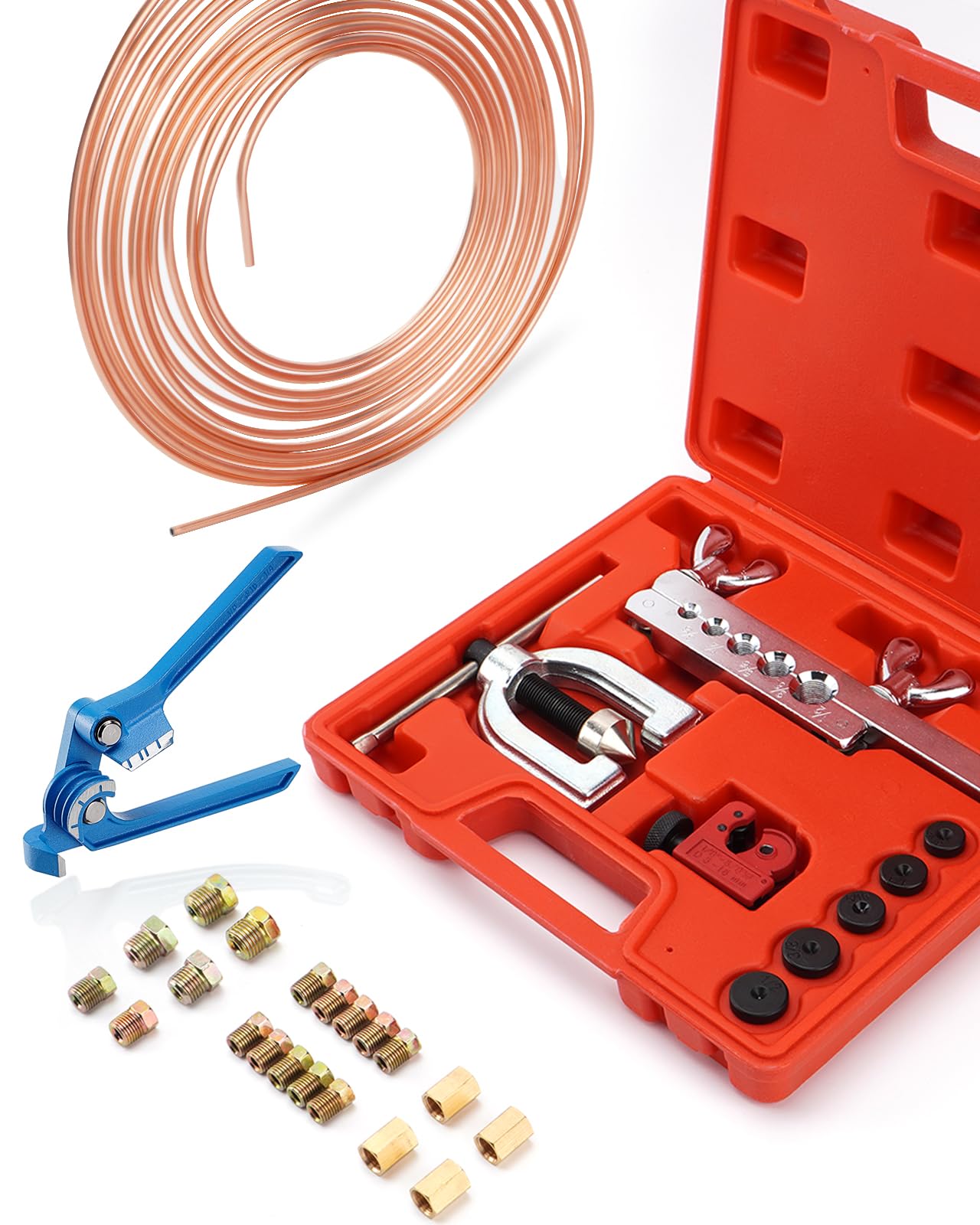
The Racewill kit is the most complete entry-level bundle on this list. You get 25 feet of copper-coated steel tubing, 20 inverted flare nuts and 4 unions, a double/single flaring tool that handles 3/16″ through 1/2″ tubing, and a three-position tubing bender. For a first-time DIYer who owns no specialty tools, this kit removes the need to buy anything else — you can roll the line, cut it, flare it, and bolt it up in one afternoon.
Reviews from Honda Accord and pickup truck owners confirm that the flaring tool produces acceptable double flares on the included copper-coated line, though the included tubing cutter is weak and may need replacing. The copper coating offers better corrosion resistance than bare steel, but it is not a permanent solution — one owner spray-painted the finished lines to prevent oxidation in a wet climate.
This kit is not the best choice for a long-term restoration or a salt-belt daily driver because the copper coating will eventually wear. But for a budget repair, a project car that lives in a garage, or a first practice run at flaring, the Racewill all-in-one package gives you everything you need to finish the job with zero tool investment.
Why it’s great
- Includes flaring tool, bender, fittings, and tubing in one box
- Copper-coated line is easier to bend than bare steel
- Generous 20-piece fitting assortment with 4 unions
Good to know
- Included tubing cutter is low quality and slow
- Copper coating can chip, requiring paint for long-term rust protection
4. Ailbiuko 2-Roll Brake Line Tubing Assortment Kit
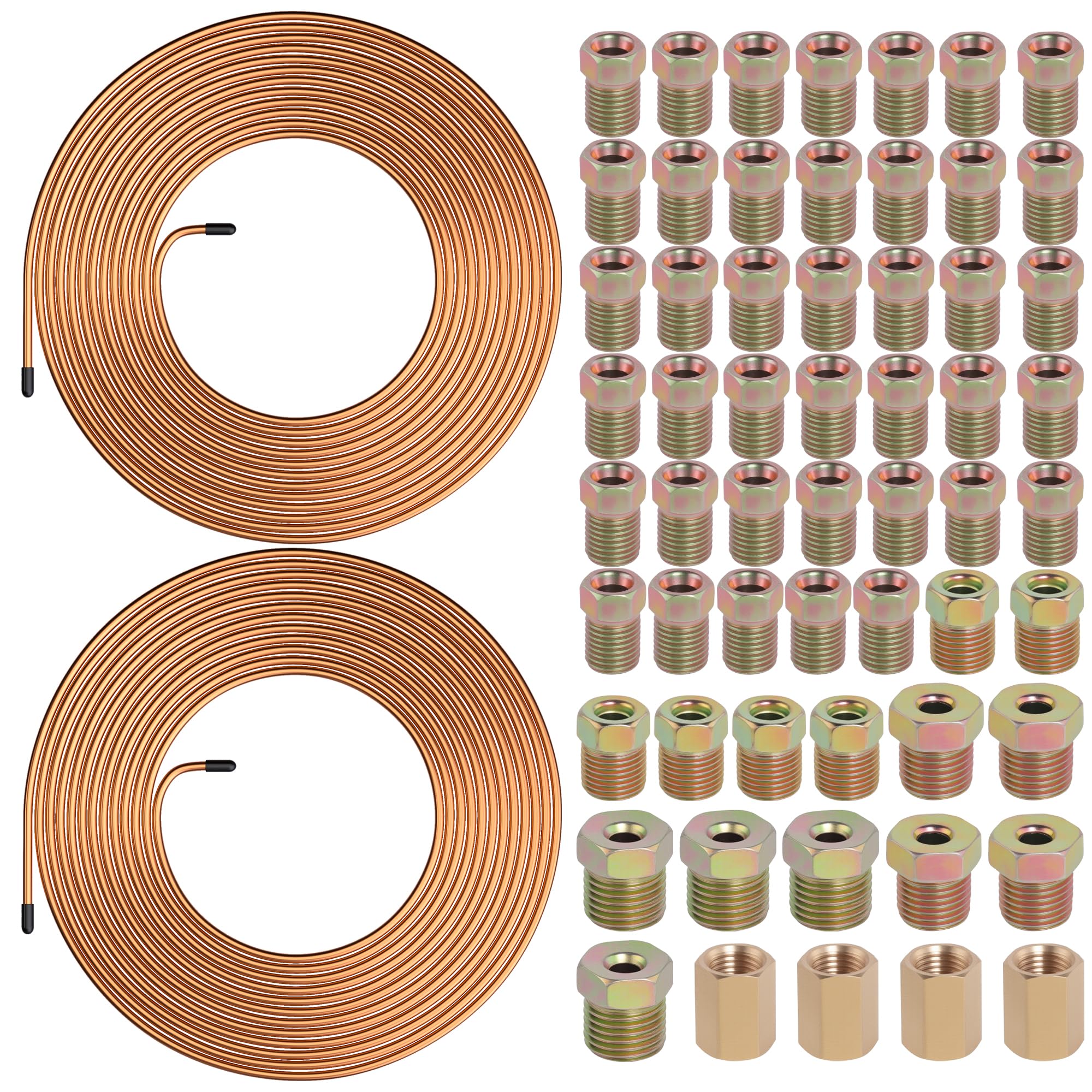
Ailbiuko’s kit gives you twice the tubing and an enormous fitting cache — two full 25-foot rolls of copper-coated steel line, 40 inverted flare nuts in the common 3/8-24 size, plus 6 nuts in 7/16-24, 4 in 1/2-20, 4 in 9/16-18, and 4 unions. That is enough material to re-plumb two separate vehicles or one long-wheelbase truck with plenty of spare line left over for future repairs.
The copper coating provides a noticeable upgrade in flexibility compared to bare steel. Bending by hand is feasible for gentle curves, and the line flares consistently with standard tools. One reviewer used the kit to replace all hard lines on a project car and noted the fittings were identical to store-bought quality. The sheer volume of nuts means you will almost certainly have the right thread pitch on hand, eliminating the frustration of a slow parts store run.
This is a bulk-buy option for the heavy user — a shop, a fleet mechanic, or a serious hobbyist who works on multiple vehicles per year. The copper-coated steel is not as corrosion-resistant as copper-nickel, but at this per-foot cost, you can afford to replace the lines in a few years if needed. The main limitation is that the kit offers only 3/16″ line; there is no 1/4″ option for transmission cooler lines.
Why it’s great
- Two full 25-foot rolls for multi-vehicle projects
- 60 total fittings cover almost every 3/16″ thread pitch
- Copper coating bends easier than plain steel
Good to know
- Copper-coated steel is not as rust-proof as copper-nickel
- Only 3/16″ tubing — no 1/4″ size included
5. MuHize Dual-Size Brake Line Tubing Kit

MuHize’s dual-size kit includes both a 25-foot roll of 3/16″ copper-coated alloy line and a 25-foot roll of 1/4″ line, along with 32 total inverted flare nuts covering both diameters. This is the only kit on the list that lets you handle brake lines and transmission cooler lines from the same purchase — a major convenience if you are working on a full drivetrain swap or a complete restoration.
The 3/16″ tubing earns high marks for flexibility. Multiple reviews note it bends without kinking and flares without cracking, making it suitable for beginners. The 1/4″ line is similarly easy to work with and includes its own dedicated fitting assortment. One caveat noted by a Honda Civic owner is that the 3/16″ fittings did not match the factory thread pitch on their specific vehicle, requiring reuse of the original nuts — always verify your vehicle’s thread pattern before discarding old hardware.
If your project requires both 3/16″ brake lines and 1/4″ fuel or transmission lines, this kit eliminates two separate purchases and the guesswork of matching fitting sizes. The copper coating is a mid-tier corrosion solution, so it works best for vehicles in dry climates or garage-kept projects rather than daily drivers in the rust belt.
Why it’s great
- Includes both 3/16″ and 1/4″ line for multi-system projects
- 32-piece fitting set covers both tube diameters
- Copper-coated steel bends and flares without cracking
Good to know
- Fittings may not match all factory thread pitches — verify before starting
- Copper coating is not a permanent rust solution in wet climates
6. Vkinman Steel Brake Line Kit with Fittings
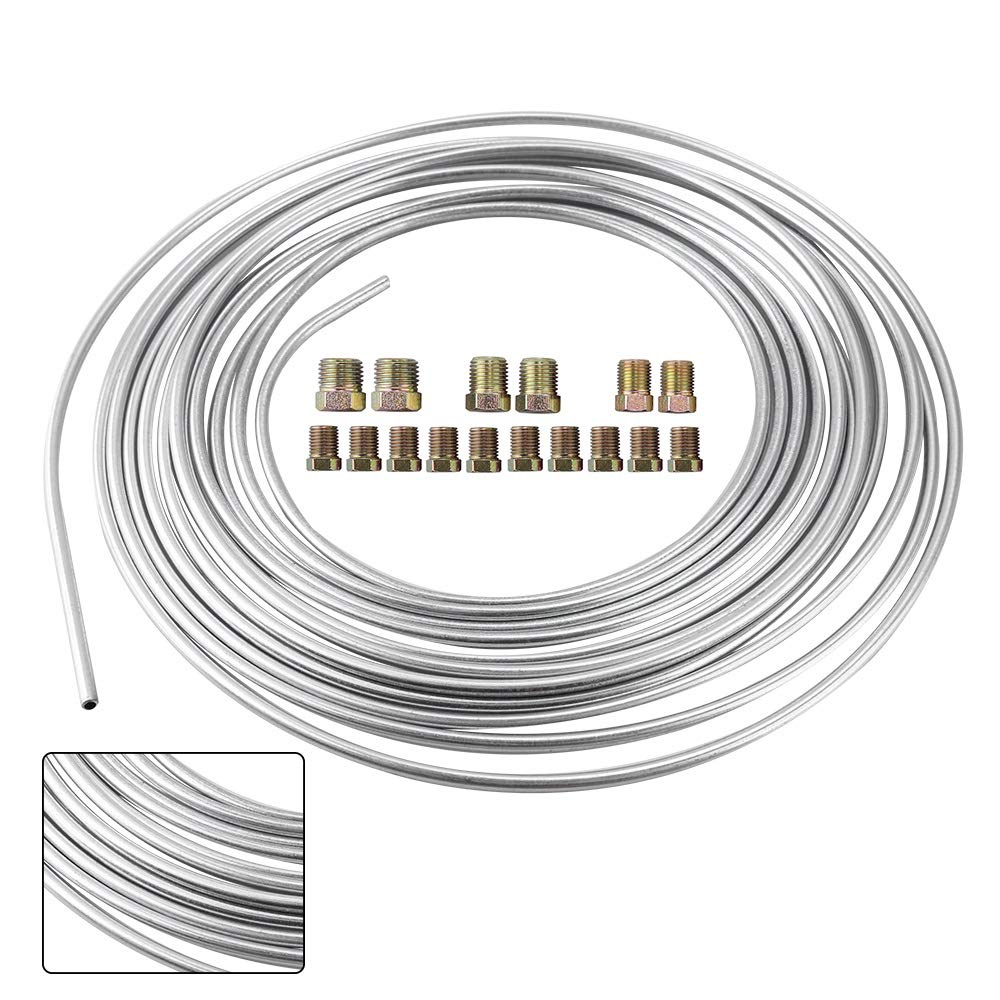
The Vkinman kit is the entry-level option that gets the job done at the lowest per-foot cost. You get 25 feet of zinc-coated steel tubing plus 20 inverted flare nuts in the most common 3/16″ thread pitches. The zinc coating provides a basic level of corrosion protection that is adequate for a dry-climate daily driver or a weekend trail rig that does not see road salt.
Customer feedback is consistently positive on the tubing’s ability to form accurate bends and hold a double flare without leaks. One user rebuilt the entire rear brake system on a pickup and reported that the fittings sealed as expected, with no weeping at the connections. The included nuts are a mix of 3/8-24, 7/16-24, 1/2-20, and 9/16-18, covering the full range of common 3/16″ applications. The main complaint is that the line comes off the roll with a noticeable coil memory — using a tubing straightener or carefully hand-straightening each section is recommended for a clean, professional look.
For a budget-conscious buyer who needs to replace a single rusted section or re-plumb an older vehicle that will not see extreme winter conditions, the Vkinman kit delivers reliable function without the premium cost of copper-nickel. The zinc coating will not hold up as long as a true alloy, but for the price, it is a perfectly serviceable line.
Why it’s great
- Lowest cost per foot with a complete fitting set included
- Zinc coating provides basic rust resistance
- Flares and bends accurately for proper double flares
Good to know
- Coil memory requires straightening for long, straight runs
- Zinc coating is not as durable as copper-nickel alloy
7. The Stop Shop Stainless Steel Gravel Guard Spring

This is not a brake line — it is a stainless steel spring gravel guard designed to slip over 3/16″ tubing to protect exposed sections from rock strikes and debris. If you run brake lines along the outside of a frame rail, under a lifted truck, or on an off-road buggy, this 16-foot coil of stainless spring wraps tightly around the line and absorbs impacts that would otherwise dent or rupture the tubing.
The spring is made from 316-grade stainless steel, so it will never rust — a critical feature for an off-road or marine application. It stretches easily over the line and springs back into place, fitting snugly around bends. One reviewer used it on a buggy with 3/16″ galvanized line and reported excellent fit and protection. The only installation challenge is that you cannot slide it over a line that already has a double flare and nut installed on both ends — you must install the guard before flaring the second end.
For anyone building a trail rig, a rock crawler, or a truck with lines routed in vulnerable locations, this gravel guard is a cheap insurance policy against a sudden brake failure caused by a thrown stone. It is not a standalone product — it is an accessory that complements any 3/16″ brake line roll on this list.
Why it’s great
- 316 stainless steel will never rust or corrode
- Flexible spring stretches over bends and grips securely
- Adds critical impact protection for exposed brake lines
Good to know
- Cannot install over a line with double flares on both ends
- Stainless steel is difficult to cut — use a rotary tool
FAQ
Can I use a magnet to verify if my brake line is real copper-nickel?
What is the difference between a double flare and a bubble flare for 3/16 brake line?
How much 3/16 brake line do I need to replace the lines on a typical car?
Final Thoughts: The Verdict
For most users, the best 3/16 brake line roll winner is the TUBPRO Copper Nickel Brake Line Kit because it combines a true rust-proof alloy with a complete fitting assortment at a fair price, making it suitable for both first-time DIYers and experienced mechanics working on any vehicle. If you want maximum corrosion resistance and already own fittings, grab the 4LIFETIMELINES Copper-Nickel Coil for its lifetime warranty. And for the budget-minded builder who needs a full tool kit with their line, nothing beats the Racewill All-in-One Kit.