
When the grid drops, your solar panels are useless without a place to store that energy. A dedicated backup battery bridges that gap, turning intermittent sunlight into 24/7 power for fridges, lights, and medical devices. But the market is flooded with portable power stations that look alike yet differ drastically in cycle life, inverter type, and expansion capability.
I’m Min — the co-founder and writer behind Gadgets Feed. I’ve spent hundreds of hours dissecting spec sheets, cross-referencing customer long-term reliability data, and comparing chemistry types to separate the real home backup solutions from the camping toys.
After analyzing eleven of the top-rated units, this guide narrows the field to the best choices for a true backup battery for solar panels, ranked by capacity, build quality, and real-world performance under load.
How To Choose The Best Backup Battery For Solar Panels
Not all batteries handle daily deep discharges the same way. A unit that works for weekend camping trips may degrade rapidly when cycled every night for home backup. Focus on these four factors to match the battery to your solar array and usage pattern.
Battery Chemistry and Cycle Life
LiFePO4 (lithium iron phosphate) dominates the category because it delivers 3000–6000 cycles before dropping to 80% capacity. That translates to 8–16 years of daily use. Older NMC or lead-acid chemistries offer lower cycle counts and higher fire risk. For a permanent solar installation, LiFePO4 is the only sensible choice.
Inverter Type and Surge Capacity
Pure sine wave inverters are mandatory for sensitive electronics like CPAP machines and refrigerators. Rated wattage tells you what the unit can sustain continuously; surge wattage (typically 2x rated) matters for starting compressors in fridges and pumps. If your solar array powers a well pump or window AC, check the surge spec carefully.
Solar Input and MPPT Efficiency
Maximum Power Point Tracking (MPPT) charge controllers extract more energy from panels in partial shade than PWM controllers. A higher solar input wattage means faster recharging during limited daylight. Look for at least 500W solar input for a 2kWh battery if you want a full recharge in one sunny day.
Quick Comparison
On smaller screens, swipe sideways to see the full table.
| Model | Category | Best For | Key Spec | Amazon |
|---|---|---|---|---|
| EF ECOFLOW DELTA 3 Max | All-in-One | Fast Recharge + App Control | 2048Wh / 3400W X-Boost | Amazon |
| BLUETTI Apex 300 | All-in-One | 120/240V Split-Phase | 2765Wh / 3840W (7680W surge) | Amazon |
| Segway Cube 2000 | Modular | Expandable 5kWh + IP56 | 2048Wh / 2200W (4400W surge) | Amazon |
| Jackery Explorer 2000 v2 | All-in-One | Lightest 2kWh + UPS | 2042Wh / 2200W | Amazon |
| Anker SOLIX C2000 Gen 2 | All-in-One | Ultra-Fast 58-Min Recharge | 2048Wh / 2400W (4000W surge) | Amazon |
| AFERIY P210 | All-in-One | 10-Year LFP Warranty | 2048Wh / 2400W (4800W surge) | Amazon |
| VTOMAN FlashSpeed Pro 3600 | All-in-One | 3kWh Capacity + Wheels | 3096Wh / 3600W (6000W surge) | Amazon |
| BLUETTI AC180 | Portable | Budget-Friendly 1.1kWh | 1152Wh / 1800W (2700W surge) | Amazon |
| BLAVOR S1600 | Solar-Integrated | Built-In 40W Solar Panel | 1024Wh / 1600W (3200W surge) | Amazon |
| ECO-WORTHY Cubix100 | Server Rack | Whole-Home 48V System | 5120Wh / 48V rack-mount | Amazon |
| Jackery HomePower 3600 Plus | Whole-Home | 21kWh Expandable + 240V | 3584Wh / 3600W (parallel to 7.2kW) | Amazon |
In‑Depth Reviews
1. EF ECOFLOW Portable Power Station DELTA 3 Max
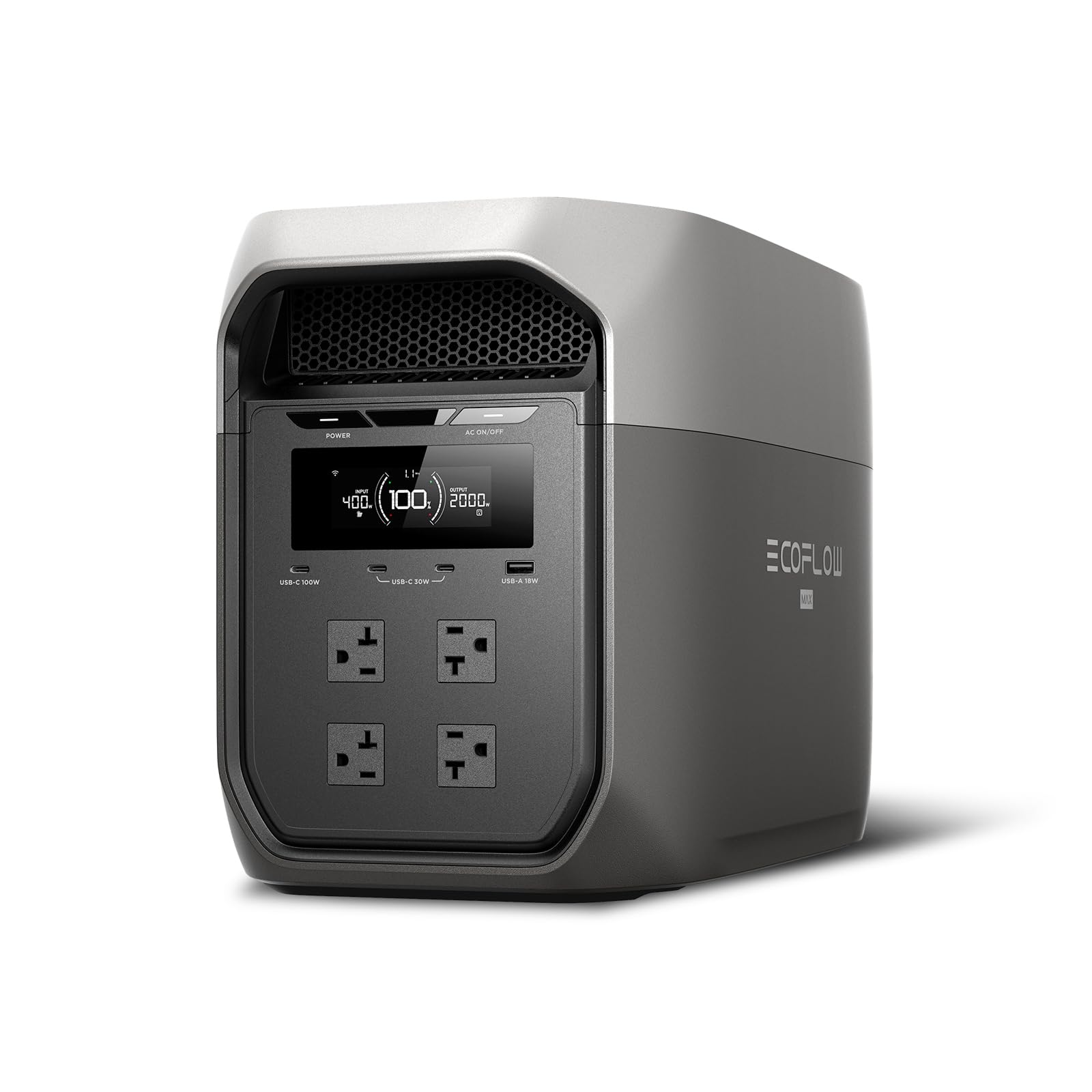
The DELTA 3 Max hits a rare sweet spot: 2048Wh of LiFePO4 storage combined with a true 3400W X-Boost output that handles 99% of household appliances. EcoFlow’s X-Stream technology refills 0–80% in just 1.13 hours, making it one of the fastest-recharging solar generators in this class. The ultra-quiet fan and 10ms UPS transfer time protect sensitive electronics without audible disturbance.
What sets this unit apart is its dual-handle design and relatively light 56-lb chassis, which makes repositioning from garage to RV feasible. The companion app provides real-time energy monitoring, schedule-based charging, and cost-saving automation that actually works. Users report reliable pass-through charging and seamless integration with EcoFlow’s 400W rigid solar panels.
One downside: the included accessories are minimal — no solar cable or carrying case. The button labeling is also hard to read in low light. But for a balanced combination of capacity, recharge speed, and smart features, the DELTA 3 Max is the most well-rounded backup battery for solar panels on this list.
Why it’s great
- Fastest recharge in class at 0–80% in 68 minutes
- 3400W X-Boost runs fridges, microwaves, and power tools
- Reliable <10ms UPS protects computers and medical devices
Good to know
- No solar charging cable included in the box
- Button visibility in dim conditions is poor
2. BLUETTI Apex 300 Portable Power Station
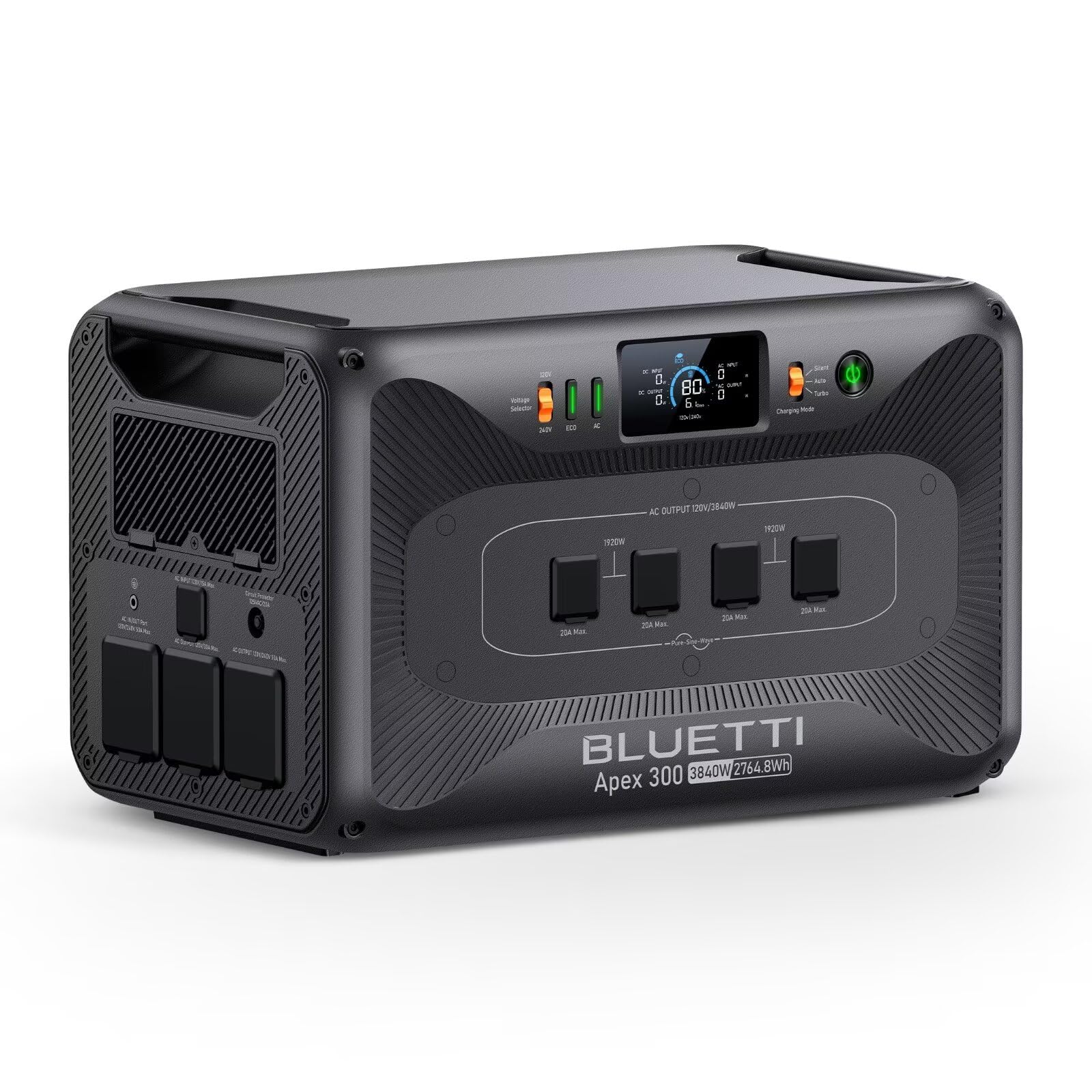
The Apex 300 is BLUETTI’s most versatile platform, packing 2764.8Wh of LiFePO4 capacity with the rare ability to output both 120V and 240V simultaneously. That split-phase capability means it can power a well pump or RV AC unit without requiring a step-up transformer. The 3840W rated output (7680W surge) gives generous headroom for starting inductive loads.
Modularity is a key differentiator — you can start with the base 2.7kWh unit and add B300K or B500K expansion batteries as your needs grow. The Hub D1 accessory enables 12V DC loads, while Charger 1/2 supports high-speed alternator charging while driving. BLUETTI’s BLUETOPUS AI-BMS manages thermal runaway prevention and delivers over 6000 cycles at 80% depth of discharge.
The main trade-off is weight: at 66 lb, it’s not a unit you’ll casually move daily. The PV input limit of 60Voc also means some 110Voc solar arrays fall into an unsupported voltage gap. For permanent or semi-permanent home backup with 240V appliances, however, the Apex 300 is unmatched in this price tier.
Why it’s great
- Native 120/240V split-phase output from a portable unit
- Expandable to multi-kWh with B300K/B500K modules
- 6000+ cycle LFP with AI battery management
Good to know
- Heavy at 66 lb — not ideal for frequent relocation
- 60Voc PV limit may conflict with higher-voltage solar arrays
3. Segway Portable Power Station Cube 2000
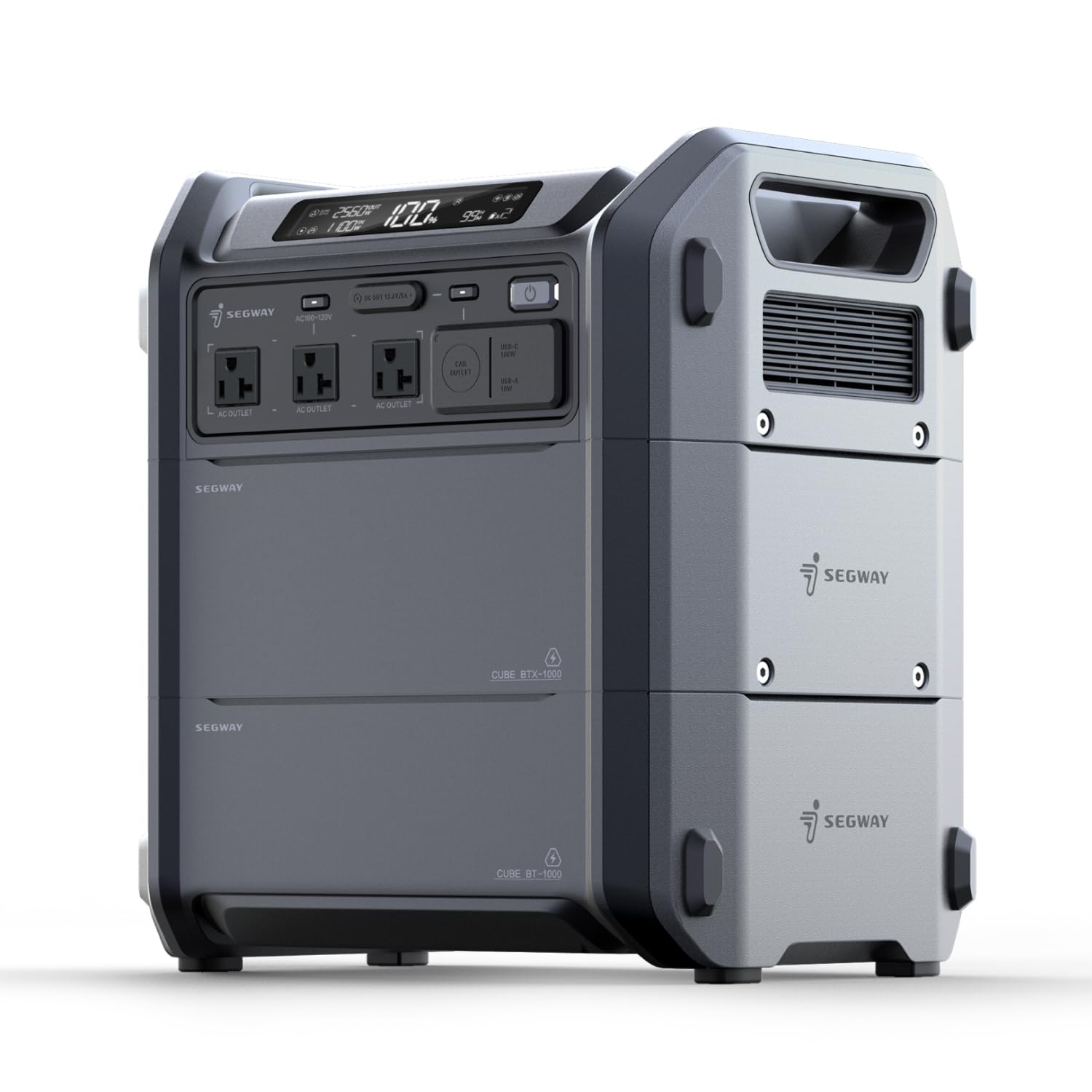
The Segway Cube 2000 impresses with its cordless stackable design — you can attach up to three BTX-1000 expansion batteries to reach 5kWh without messy cabling. The base 2048Wh LiFePO4 pack delivers 2200W continuous output (4400W with R-drive surge) and can recharge from 0–100% in just 1.8 hours. The IP56 dust and water resistance rating means it can live in a garage or outdoor shed without worrying about splashes.
Its feature set includes dual 100W USB-C ports, MPPT solar charging with up to 97% conversion efficiency, and a rugged handle system that makes the 58-lb unit surprisingly manageable. The Segway app adds car battery detection and real-time energy flow monitoring. Users consistently praise the build quality and the fact that the AC ports are spaced wide enough for bulky plugs.
One significant reliability concern emerged: several users reported the unit self-discharging to 0% within months of storage, which defeats the purpose of a backup battery. The app is required for initial activation and to disable the audible beeping during operation, which could be a frustration for less tech-savvy users.
Why it’s great
- Cordless stackable expansion up to 5kWh
- IP56 rated for outdoor/garage placement
- Dual 100W USB-C and 97% MPPT efficiency
Good to know
- Reported self-discharge issues in storage mode
- App mandatory for initial activation and beep control
4. Jackery Explorer 2000 v2 Portable Power Station

Jackery’s Explorer 2000 v2 sets a new benchmark for weight efficiency: 2042Wh of LiFePO4 storage packed into a 39.5-lb body using the same Cell-to-Body (CTB) tech found in EVs. That makes it 41% lighter than typical 2kWh competitors, a game-changer for anyone who needs to move the battery between rooms or load it into an RV. The 2200W pure sine wave inverter runs most household circuits, and the 20ms UPS transfer keeps devices online during grid flickers.
AC fast charging refills 0–80% in 66 minutes, and the Emergency Super Charging mode hits 100% in 102 minutes via the app. Silent Charging mode keeps noise below 30 dB, making it bedroom-safe. The built-in flashlight with SOS mode adds practical utility for emergency kits. Users report powering a fridge for over 21 hours on a single charge.
The weak point is the solar barrel input ports, which are mounted on a flexible plastic panel that bends inward when plugging in cables — a durability concern for frequent solar users. Bluetooth connection stability is also inconsistent, occasionally requiring a re-pair through the app.
Why it’s great
- Lightest 2kWh LFP at just 39.5 lb
- 66-minute 0–80% AC fast charging
- 20ms UPS with <30 dB silent mode
Good to know
- Solar barrel ports mounted on flexible plastic panel
- Bluetooth connection sometimes drops
5. Anker SOLIX C2000 Gen 2 Portable Power Station
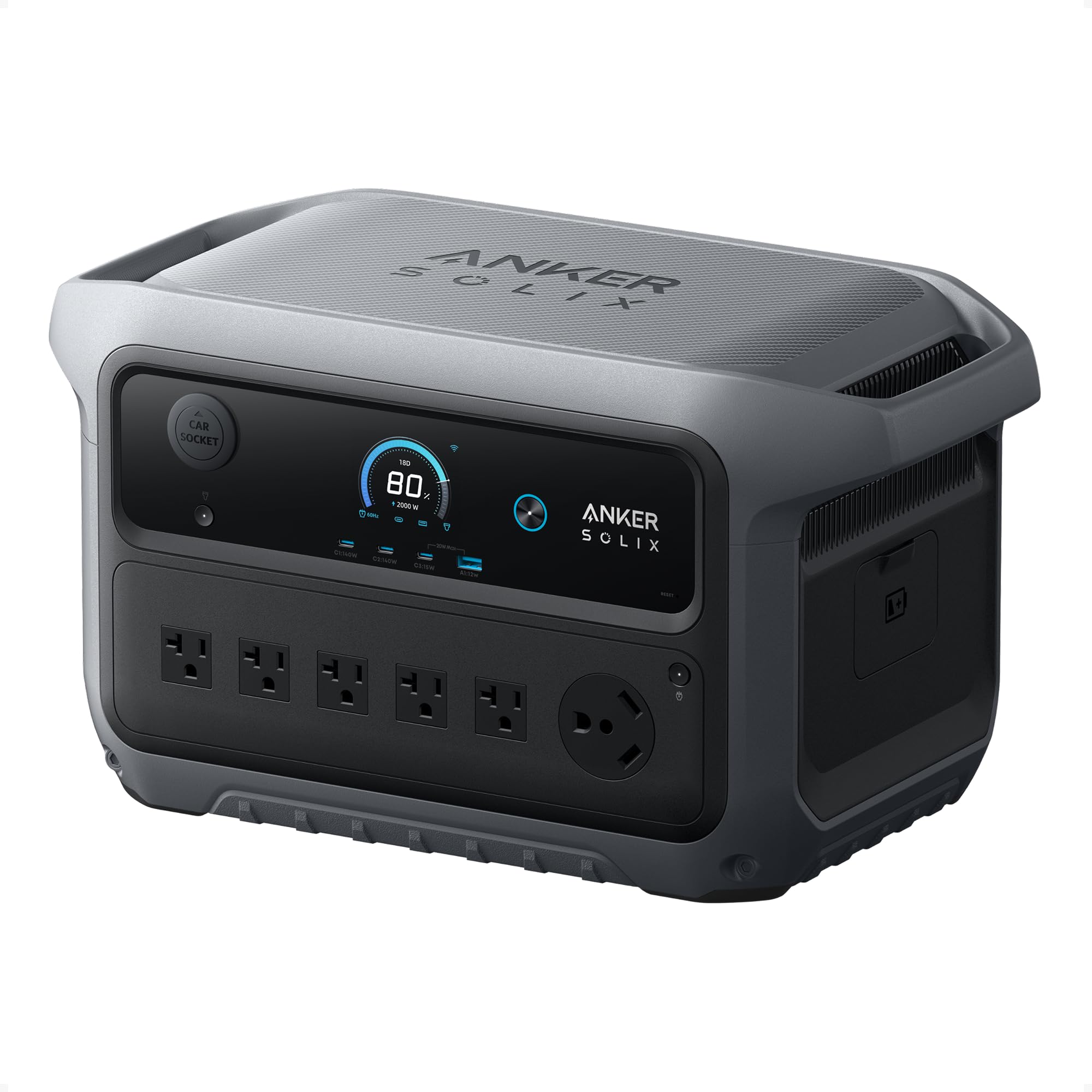
The Anker SOLIX C2000 Gen 2 is a dense 2048Wh powerhouse that charges from 0–100% in just 58 minutes — the fastest full recharge in this roundup. The 2400W rated output (4000W peak) comfortably handles a dual-door fridge for up to 32 hours, and adding an expansion battery doubles that runtime to 64 hours. The standby power draw of only 9W is best-in-class, making it ideal for always-connected backup setups.
At 41.7 lb and a compact 18.1 × 9.8 × 10.1 inches, it’s 25% lighter and 29% smaller than similar 2kWh units. The 800W UltraFast alternator charging enables full replenishment in 3 hours from a vehicle, which is 8x faster than a standard 12V car socket. The companion app provides granular usage predictions and charge scheduling.
The main drawback is the lack of a printed manual — all documentation is digital within the app, which may be inconvenient during an emergency setup. Users also note that the fan, while not loud, does run continuously during AC charging above 1000W.
Why it’s great
- Full charge in 58 minutes — fastest in class
- Ultra-low 9W standby for always-on UPS
- 800W alternator charging from vehicle
Good to know
- No printed manual included
- Fan runs continuously during high-speed AC charging
6. AFERIY 2048Wh Portable Power Station P210

The AFERIY P210 brings impressive specs at a competitive price: 2048Wh LiFePO4 capacity with a 2400W inverter (4800W surge) and a 7-year extended warranty that outpaces the industry standard by two years. The pure sine wave output ensures clean power for sensitive electronics, and the <10ms UPS response time is fast enough for servers and medical equipment.
Sound levels are remarkably low — under 30 dB at full load and just 16 dB under normal load, which is quieter than a library. The 16-port array includes 6 AC outlets, dual USB-C (100W + 20W), and an XT60 DC output for 300W solar or car charging. The AFERIY app enables energy management and automation scheduling.
Quality control is a concern. Multiple users reported that the display screen blacks out after solar charging and requires dozens of button presses to restart. The lack of schedule charging for the 2048Wh battery is also a missed feature. Customer support responsiveness varies, which is risky given the premium warranty promise.
Why it’s great
- 7-year warranty — longest in its price bracket
- Near-silent operation at 16 dB under normal load
- 16 ports including dual USB-C PD and XT60
Good to know
- Display screen glitches after solar charging
- No schedule charging option in the app
7. VTOMAN FlashSpeed Pro 3600 Portable Power Station
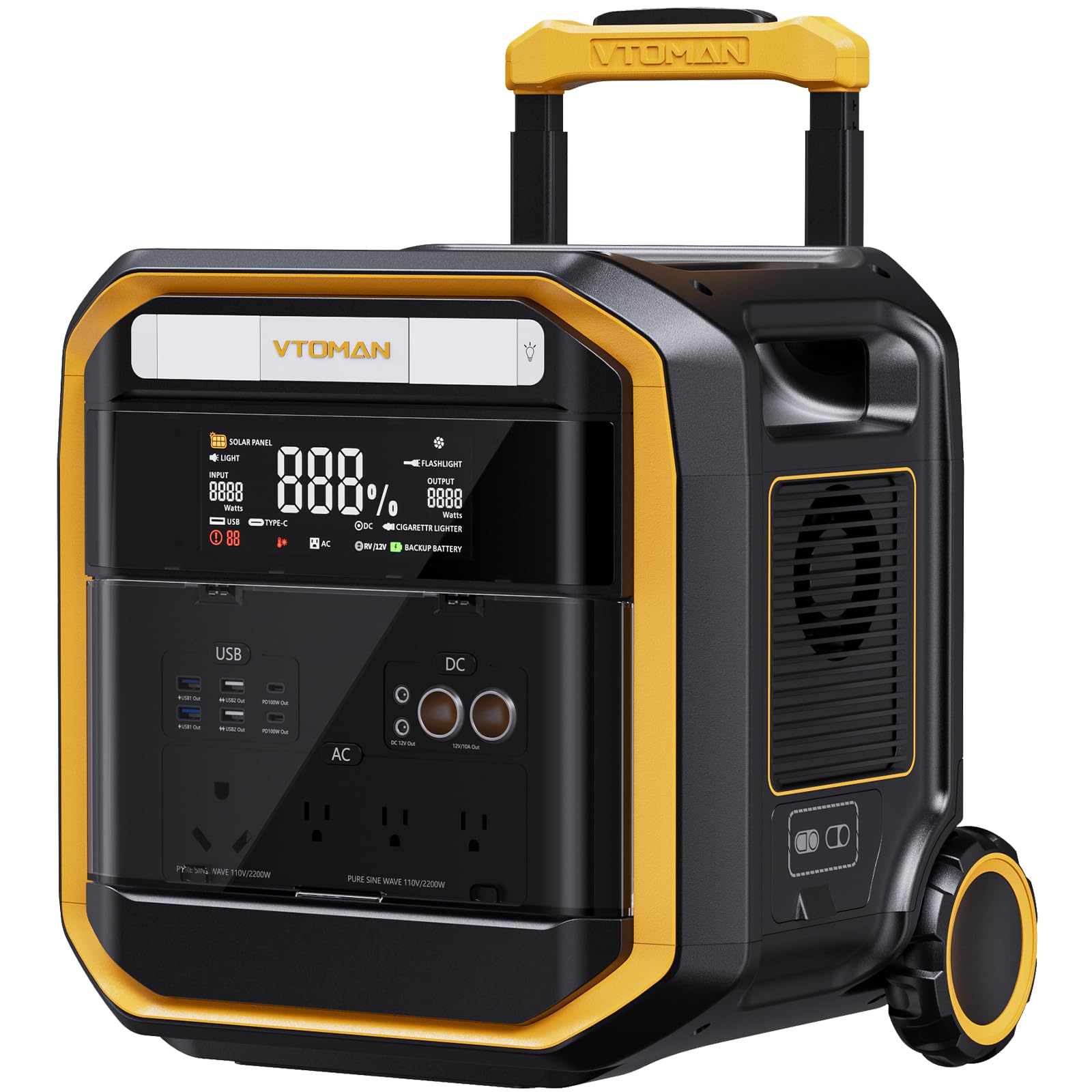
The FlashSpeed Pro 3600 packs a massive 3096Wh LiFePO4 battery with a 3600W inverter (6000W surge) into a wheeled chassis with an integrated pull handle. This mobility-first design makes it the most practical option for moving high-capacity backup power between garage, RV, and outdoor work sites. The 2-hour AC full recharge is respectable for a 3kWh unit, and 800W solar input keeps the panels busy.
The 14-output array includes 4 AC outlets, dual USB-C PD 100W, and two car outlets. The <20ms UPS mode covers essential loads without noticeable flicker. Users report the unit charged to 85% out of the box and seamlessly handled pass-through charging while running appliances.
At 83.8 lb, the wheels are necessary but the handle feels slightly plasticky under repeated full-load pulls. Some users note that the DC auto-shutdown feature can cut power to fridges during compressor cycling, and the loose-fitting USB-C ports suggest moderate connector strain over time. The buttons are also easy to trigger accidentally during transport.
Why it’s great
- 3kWh capacity with wheeled mobility
- 2-hour AC full recharge for 3096Wh
- 6000W surge handles heavy startup loads
Good to know
- DC auto-shutdown may interrupt fridge compressor
- USB-C ports are loose-fitting
8. BLUETTI Portable Power Station AC180

The BLUETTI AC180 is the top pick for budget-conscious buyers who still need a reliable LiFePO4 battery for solar panels. Its 1152Wh capacity and 1800W continuous output (2700W surge) handle mini fridges, CPAP machines, and power tools for several hours. The defining feature is the 0–80% charge in 45 minutes via 1440W AC input — a speed that rivals many 2kWh units.
At 37.4 lb, it’s light enough for one person to carry from house to car. The 20ms UPS mode provides seamless grid failure transition, and the clear LCD display shows input/output wattage and remaining run time. Users consistently praise the build quality and the quiet cooling fan that barely registers during operation.
The 1152Wh capacity is modest for whole-home backup — expect about 900Wh of usable power through the AC inverter due to conversion losses. Adding an external 12V/24V battery extends runtime but adds complexity. For emergency essentials rather than full-house backup, the AC180 delivers outstanding value.
Why it’s great
- 0–80% in 45 minutes — fastest sub-1.2kWh charging
- Lightweight 37.4 lb body for easy transport
- Reliable 20ms UPS and quiet fan operation
Good to know
- ~77% inverter efficiency reduces usable Wh
- Capacity too small for whole-home backup
9. BLAVOR Portable Power Station S1600
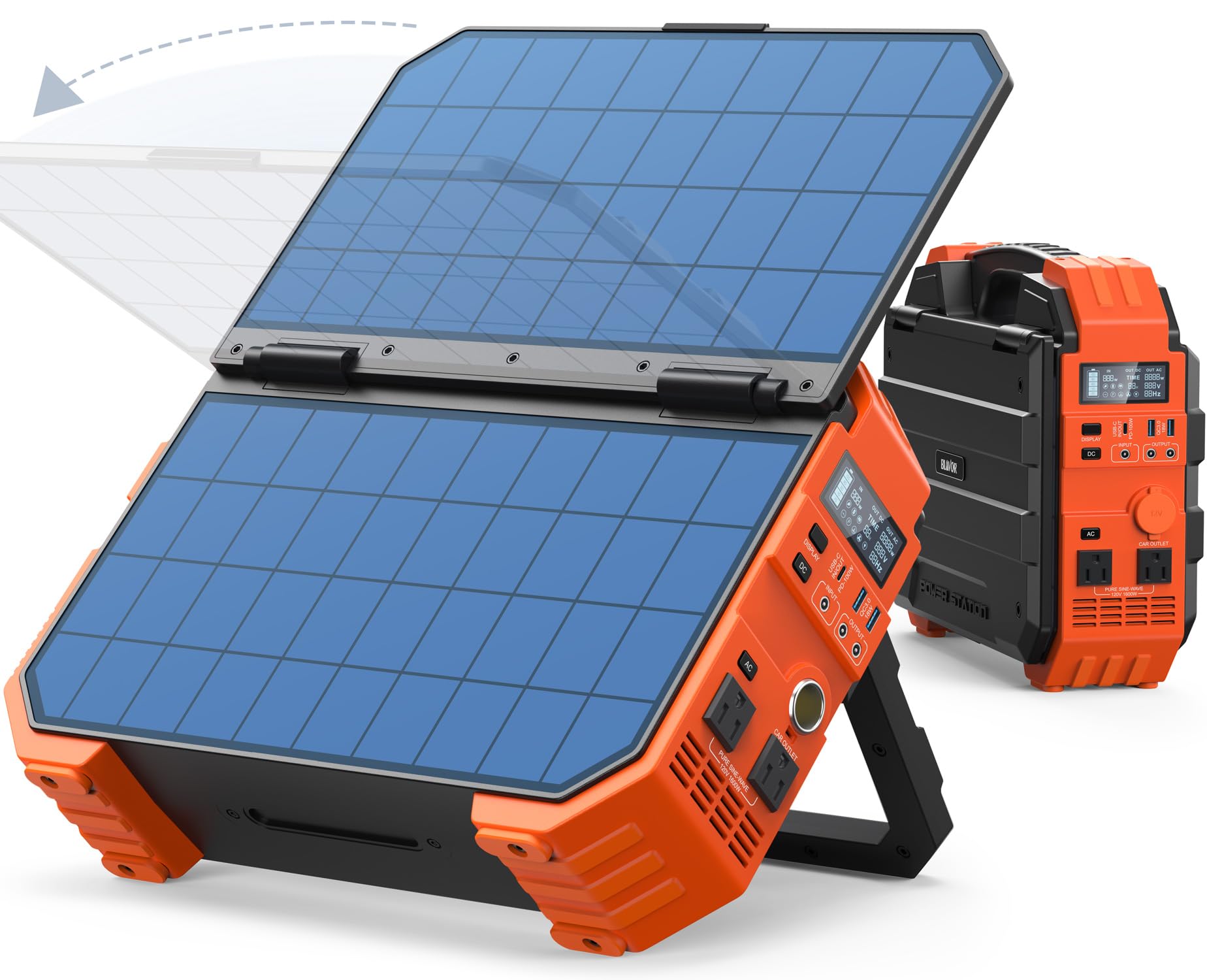
The BLAVOR S1600 stands alone with its integrated 40W foldable solar panel, a German iF Design Award winner that eliminates the need to carry a separate panel for trickle charging. The 1024Wh LiFePO4 battery powers 90% of common appliances through its 1600W inverter (3200W surge), and the 26-lb body is the lightest in this review for its capacity class.
Charging options are comprehensive: wall outlet, car socket, built-in panel, or external panels via the included adapters. The 100W USB-C port supports two-way fast charging for laptops. Users report the built-in panel delivers about 30W in winter conditions — slow but genuinely useful for maintaining charge during extended outdoor stays. The unit powered a deep freezer for ~20 hours on a single charge.
The built-in panel’s 40W output is insufficient for full battery recovery in a single day of direct sun — it’s a maintainer, not a primary charging source. Port labels have low contrast in dim light, making outlet identification frustrating. The ABS plastic shell feels sturdy but lacks the rubberized bump protection of higher-end competitors.
Why it’s great
- Integrated 40W solar panel for trickle charging
- Lightest unit at 26 lb with 1024Wh capacity
- Award-winning design with multiple charging methods
Good to know
- Built-in solar too slow for full recharge
- Port labels hard to read in low light
10. ECO-WORTHY Cubix100 48V 100Ah LiFePO4 Battery
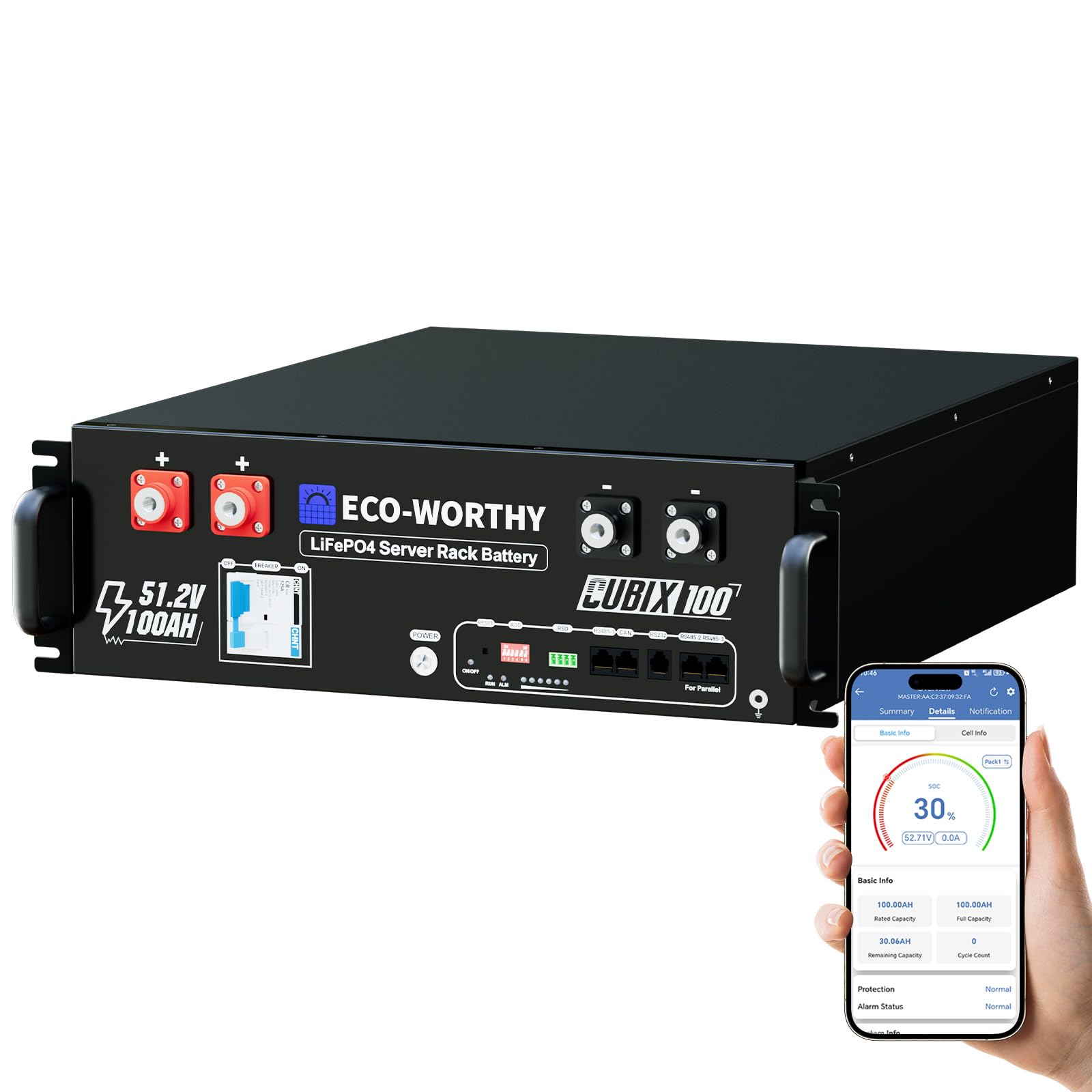
The ECO-WORTHY Cubix100 is not a portable power station — it’s a 48V server-rack battery designed for permanent solar storage integration. Holding 5120Wh (51.2V × 100Ah) with UL9540 and UL1973 certifications, it’s built for closed-loop communication with leading solar inverters via CAN/RS485. Up to 32 units can be paralleled for a massive 163.8kWh storage farm.
Bluetooth and WiFi monitoring through the ECO-WORTHY app provide real-time state-of-charge and cell voltage data. The Grade A LiFePO4 cells carry a 10-year limited warranty, and the plug-and-play kit includes parallel cables, communication cables, and grounding wires. Users report flawless integration with EG4 6000XP inverters and seamless capacity expansion.
This is a bare battery — no inverter, no AC outlets, no displays. It requires an external solar charge controller and inverter to function as a home backup system. Early production units had reversed positive/negative terminals (since corrected), so careful wiring is essential. The 100-lb weight and rack-mount form factor also demand a dedicated equipment rack.
Why it’s great
- Certified UL9540/UL1973 for safety compliance
- Scalable to 163.8kWh with 32 parallel units
- Closed-loop CAN/RS485 with major inverters
Good to know
- Requires external inverter and charge controller
- 100 lb — needs a server rack or sturdy shelf
11. Jackery HomePower 3600 Plus
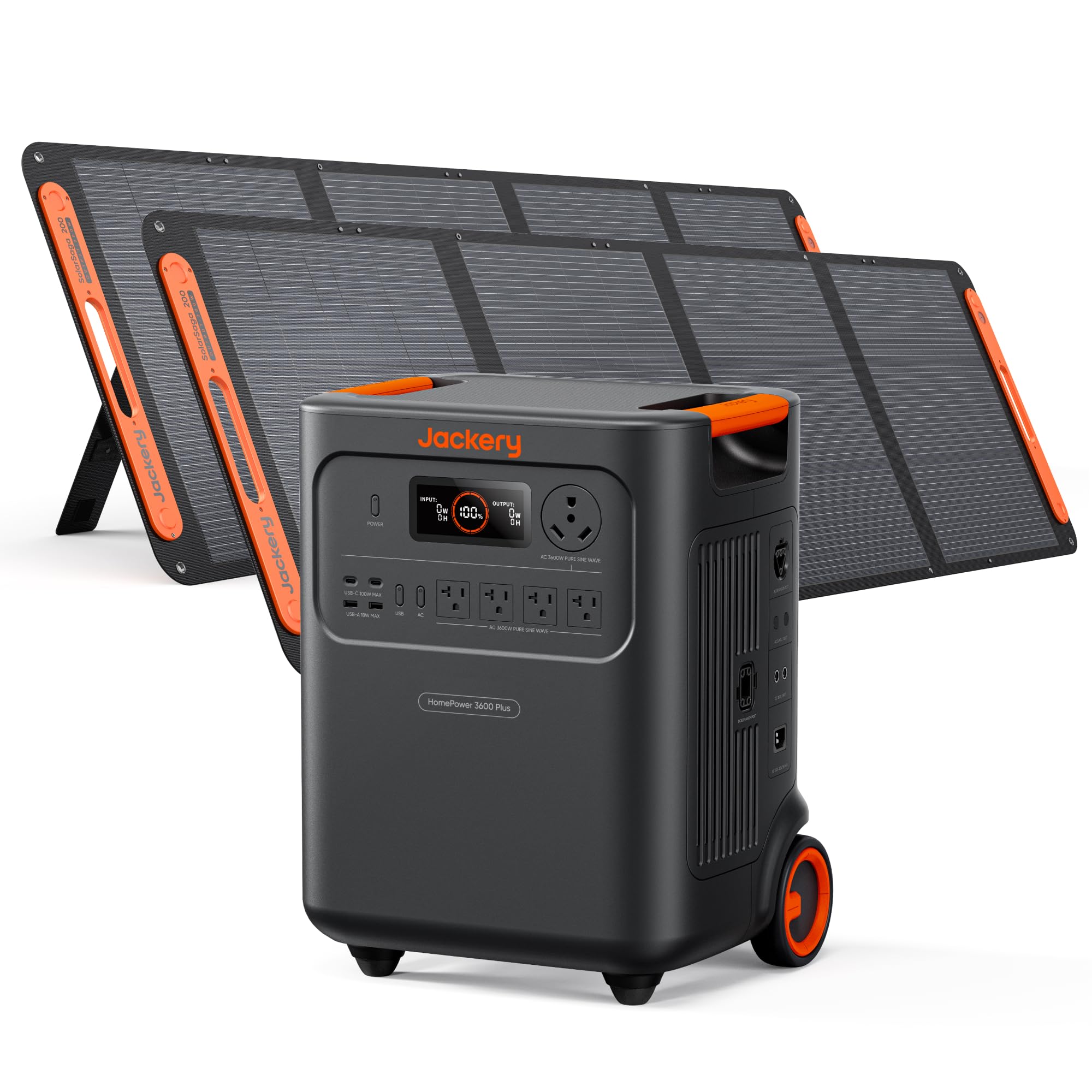
The Jackery HomePower 3600 Plus is the most complete whole-home backup solution in this lineup, delivering 3584Wh from a single unit with expandability to 21kWh per unit — or 43kWh across multiple units paired with the MTS transfer switch. The 3600W AC output jumps to 7200W in parallel mode, and dual-voltage support (120V & 240V) covers everything from lights to central HVAC blowers.
Safety is a standout: the ceramic membrane battery cells withstand 302°F without thermal runaway, and the system operates reliably down to -4°F. The luggage-style wheeled design and telescopic handle make the 77.2-lb unit easier to roll than carry. Charging from 0–100% takes 2 hours via hybrid AC+DC, or 4 hours from solar panels. Users praise the plug-and-play setup and the peace of mind from capacity that keeps a 3-person home running for over two weeks.
The price is a significant investment, and the solar panels included in the bundled kit are shipped separately. The app has a known issue where it loses connection to the unit when out of Bluetooth range and is difficult to re-pair. For those who need whole-home capacity with walk-away simplicity, however, this is the most complete turnkey package available.
Why it’s great
- Expandable to 21kWh per unit for whole-home coverage
- 120/240V dual-voltage parallel output
- Ceramic cell safety tested at 302°F
Good to know
- High initial investment for the complete kit
- App reconnection issues after Bluetooth range loss
FAQ
Can I connect a backup battery directly to my existing solar panels?
How many 100W solar panels do I need to recharge a 2kWh battery in one day?
What is the difference between a portable power station and a server rack battery?
How long will an LiFePO4 backup battery last if I use it every day?
Final Thoughts: The Verdict
For most users, the backup battery for solar panels winner is the EF ECOFLOW DELTA 3 Max because it combines 2048Wh of LiFePO4 capacity, blistering 68-minute recharge, and a 3400W X-Boost inverter that runs almost any home appliance. If you need native 240V output for well pumps or RV AC, grab the BLUETTI Apex 300. And for whole-home capacity with plug-and-play expansion, nothing beats the Jackery HomePower 3600 Plus.