
A pontoon that drifts on a breezy afternoon turns a relaxing swim stop into a stressful game of chase. The right anchor digs in, holds firm through shifting currents and passing wakes, and lets you enjoy the water without constantly checking your position. This guide breaks down the specific holding power, materials, and deployment designs that keep pontoons securely planted on sand, mud, or rock bottoms.
I’m Min — the co-founder and writer behind Gadgets Feed. I’ve spent countless hours analyzing customer feedback, corrosion resistance data, and holding capacity specs across dozens of marine anchor designs to separate the anchors that genuinely perform from those that just look the part on paper.
Whether you’re securing a 20-foot cruiser for a swim break or parking a tritoon on a sandbar for the afternoon, this guide to the best anchors for pontoons covers every bottom type, boat size, and storage constraint you need to consider before buying.
How To Choose The Best Anchor For Pontoons
Selecting the right anchor for a pontoon comes down to three interconnected factors: the type of bottom you anchor on most often, the size and windage of your boat, and whether you need deep-water holding or shallow-water parking. The wrong anchor choice leads to dragging, frustrating resets, and potential damage to your boat or others nearby.
Matching Anchor Weight to Pontoon Length
A pontoon’s flat profile and high railings catch wind far more aggressively than a deep-V hull of the same length. General guidelines suggest 8 to 10 pounds of anchor weight for pontoons up to 20 feet, 12 to 15 pounds for 21- to 25-foot pontoons, and 18 pounds or more for tritoons or boats over 26 feet. Going up one size step is usually wise if you anchor in exposed water with consistent wind or current.
Choosing the Right Anchor Type for Your Bottom
Fluke anchors (Danforth style) excel in sand and mud where their pivoting flukes dig deep on a horizontal pull. Box-style or cube anchors work well on mixed bottoms with rocks, gravel, or silt because their shape adjusts and re-buries as the boat swings. For shallow water anchoring on sandbars or beaches, a spike-style or auger anchor screwed into the sand provides holding power impossible to achieve with a fluke in that scenario.
Corrosion Resistance and Material
Hot-dip galvanized steel offers the best balance of cost and durability for both freshwater and saltwater use — the thick coating resists rust far longer than zinc-plated alternatives. Stainless steel is the premium choice for saltwater boaters who want zero rust stains and decades of service. Aluminum anchors are reserved almost exclusively for lightweight sand-spike designs where corrosion-free performance and easy portability matter more than brute holding power.
Quick Comparison
On smaller screens, swipe sideways to see the full table.
| Model | Category | Best For | Key Spec | Amazon |
|---|---|---|---|---|
| Better Boat Fluke Anchor Kit | Premium Kit | All-in-one setup for 15-24 ft boats | 8.5 lb fluke + 6 ft chain + 75 ft rope | Amazon |
| Extreme Max BoatTector Cube Anchor | Box Style | Mixed bottoms and strong currents | 19 lb zinc-plated steel | Amazon |
| Seachoice Fold-and-Hold Anchor | Box Style | Large pontoons up to 24 ft | 19 lb hot-dip galvanized steel | Amazon |
| Five Oceans Fluke Anchor Kit | Premium Kit | Larger pontoons 20-32 ft | 13 lb fluke + 100 ft rope + 6 ft chain | Amazon |
| SandShark Supersport 3.0 | Sand Spike | Shallow water and sandbar anchoring | 29-48 in adjustable auger | Amazon |
| SandShark Lite Series Spike Anchor | Sand Spike | Light craft and beach anchoring | 36 in 316 stainless steel spike | Amazon |
| WAVESRX Aluminum Spike Anchor | Budget Spike | Jet skis and small pontoons near shore | 12 in aluminum spike at 16 oz | Amazon |
In‑Depth Reviews
1. Better Boat Boat Anchor Kit with Rope and Chain

The Better Boat anchor kit delivers everything you need in one box: an 8.5-pound hot-dip galvanized fluke anchor, 6 feet of 1/4-inch galvanized chain, 75 feet of 3/8-inch nylon rope with a stainless steel thimble, and two bow shackles. The hot-dip galvanized finish on both the anchor and chain resists rust in saltwater far longer than the zinc-plated coatings found on budget anchors, which often flake after a single season. The pre-drilled recovery hole in the crown lets you attach a separate retrieval line to pull the anchor free if the flukes snag on rocks or submerged roots, saving you from cutting the main line.
Owners of 20- to 24-foot pontoons report that this anchor sets on the first attempt in sand and mud bottoms, holding steady through boat wakes and moderate wind. The 8.5-pound weight sits at the sweet spot for pontoons under 24 feet, though heavier 13-pound and 5-pound variants are available for larger or smaller vessels. The included chain adds critical weight near the fluke, improving the anchor’s angle of attack so it buries rather than skips across the bottom.
The shackles in the kit are functional but some buyers have replaced them with higher-grade stainless options for added peace of mind. The nylon rope is thick, well-spliced, and handles abrasion against the bow roller without fraying prematurely. For a boater who wants a turnkey anchoring solution without researching rope grades, chain lengths, and shackle sizes separately, this kit removes the guesswork entirely.
Why it’s great
- Complete ready-to-rig kit includes anchor, chain, rope, and shackles
- Hot-dip galvanized coating lasts years in saltwater without rusting
- Recovery hole lets you rig a trip line to free snagged flukes
Good to know
- Included shackles are serviceable but not marine-grade premium
- 8.5 lb version maxes out around 24 ft pontoons in moderate wind
2. Extreme Max 3006.6652 BoatTector Zinc-Plated Cube Anchor

The Extreme Max BoatTector Cube Anchor uses a box-style design that deploys quickly and adjusts its orientation automatically as wind or current shifts the boat. At 19 pounds, it provides substantial holding power for pontoons in the 18- to 30-foot range, and multiple verified owners of 24- to 25-foot pontoons confirm it holds firmly through storms and heavy boat wakes that caused their previous mushroom or fluke anchors to drag. The anchor folds flat to a collapsed dimension of 22.25 by 8 by 4.5 inches, which slides easily under a pontoon bench seat or into a storage locker without taking up the space a traditional fluke requires.
The zinc-plated finish works well in freshwater lakes, but buyers who anchor in saltwater or brackish conditions should expect accelerated corrosion compared to hot-dip galvanized alternatives. Several reviewers noted that the locking pin required minor modification with a grinder to fit properly — a manufacturing tolerance issue that is manageable with basic tools but frustrating on a new product. Once modified, the pin locks the anchor securely in its deployed position and prevents accidental folding during retrieval.
The cube’s self-orienting geometry means it re-buries itself if the boat swings, which is a distinct advantage over fixed-fluke anchors on changing wind days. On mixed bottoms with rocks, silt, and sand, this box style grabs and holds where a fluke might skip or foul. The trade-off is that the folded package is still fairly wide at 22 inches, so measure your storage space before ordering.
Why it’s great
- Self-orienting box design re-buries as boat swings in changing wind
- Folds flat to 22 x 8 x 4.5 inches for under-seat storage
- 19 pounds provides reliable hold on 24-25 ft pontoons in storms
Good to know
- Zinc-plated finish will corrode faster in saltwater than galvanized
- Locking pin may need grinding for proper fit on some units
3. Seachoice Hot-Dipped Galvanized Steel Fold-and-Hold Anchor

The Seachoice Fold-and-Hold Anchor combines the same 19-pound box-style weight as the Extreme Max but upgrades the finish to hot-dip galvanized steel, giving it a significant edge in corrosion resistance for anyone who boats in saltwater or brackish estuaries. The anchor sets quickly on the first drop in sand, mud, and gravel bottoms, with multiple pontoon owners in the 20- to 24-foot range reporting it holds securely even in high-traffic areas with constant boat wakes and wind gusts. The folding design collapses for storage, though at 24 inches long when open, it requires a bit more deck space than the Extreme Max’s folded footprint.
Buyers should check and tighten all bolts before the first use — a small number of units arrived with loose hardware that could allow the anchor to separate during deployment. The locking pin on some examples is cut short enough that it can pull free under extreme side loads, causing the anchor to fold unexpectedly.
For the price point, this anchor delivers hot-dip galvanized protection that should outlast a zinc-plated anchor by several seasons in freshwater and provide noticeable rust resistance in occasional saltwater use. The box-style design re-sets itself if the boat swings, and the 19-pound weight is appropriate for pontoons up to roughly 26 feet in exposed conditions.
Why it’s great
- Hot-dip galvanized finish resists rust far longer than zinc plating
- 19-pound weight holds pontoons up to 24 ft in wind and wake
- Folds for easier storage compared to fixed-fluke anchors
Good to know
- Bolts and locking pin may need tightening or replacement before first use
- Open length of 24 inches requires more storage space than some competitors
4. Five Oceans Fluke Boat Anchor Kit
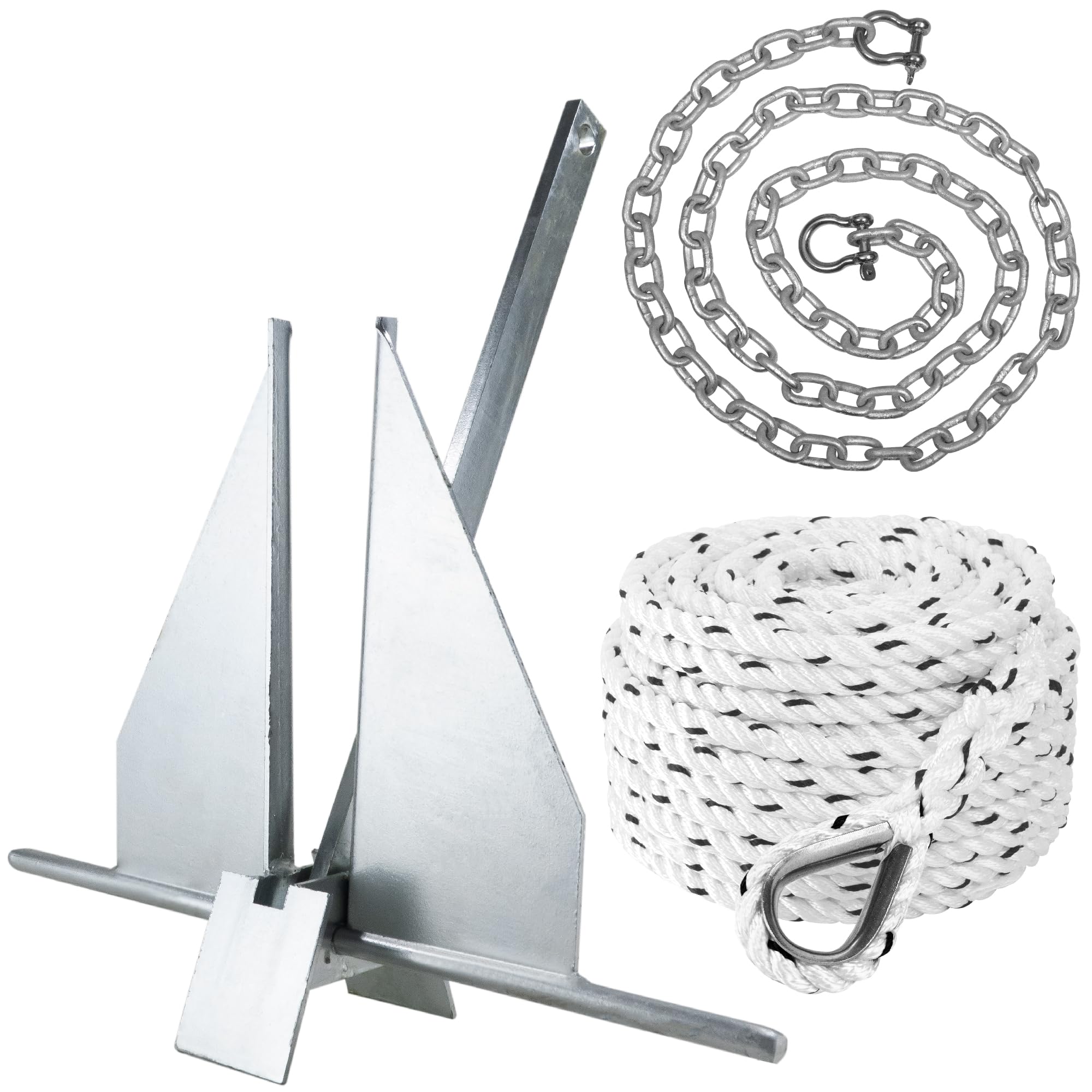
The Five Oceans fluke anchor kit is built for larger pontoons and tritoons in the 20- to 32-foot range, pairing a 13-pound hot-dip galvanized fluke with 100 feet of 3/8-inch nylon rope, 6 feet of 1/4-inch galvanized chain, and two 316 stainless steel shackles. The extra 25 feet of rope compared to the Better Boat kit gives you more scope options in deeper water, which directly improves holding power — a 7:1 scope ratio on a 10-foot depth requires 70 feet of line, leaving only 30 feet of slack for swing room. The 13-pound fluke provides roughly 50 percent more holding capacity than the 8.5-pound version, making it appropriate for heavier boats with higher windage.
Several owners report that this anchor sets on the first drop in sand and mud, with the fluke design digging deep and holding steady through strong currents that previously caused their old anchors to slide. The hot-dip galvanized finish on both the anchor and chain shows no signs of rust after multiple seasons in saltwater, and the stainless steel shackles eliminate the corrosion concern that plagues plated hardware. The anchor articulates smoothly at the hinge, ensuring the flukes pivot to the correct angle on any bottom type.
The package weight of 22 pounds means this is not a lightweight setup to haul around, but the holding power justifies the heft for anyone with a 24-plus-foot pontoon or a heavy tritoon. The 100-foot rope is three-strand nylon that handles abrasion reasonably well, though upgrading to a eight-plait or double-braid line would reduce stretch and improve feel on retrieval.
Why it’s great
- 13 lb fluke with 100 ft rope covers pontoons up to 32 ft
- 316 stainless steel shackles resist corrosion in saltwater
- Hot-dip galvanized fluke and chain last multiple seasons without rust
Good to know
- Heavy package at 22 lbs requires dedicated storage space
- Three-strand nylon rope has more stretch than premium braided lines
5. SandShark Supersport 3.0 Shallow Water Anchor

The SandShark Supersport 3.0 trades traditional fluke or box designs for an auger-style spike that you screw into the sand, creating a suction hold that standard anchors cannot replicate on shallow sandbars. The telescoping shaft adjusts from 29 to 48 inches, letting you reach the bottom from boats with high freeboards like pontoons and tritoons. The auger tip buries itself as you twist the collapsible handles, and once the sand settles around the shaft, extraction resistance is measured in hundreds of pounds — verified by an owner who reported it held a pontoon through 60 mph winds that bent the lower post but never pulled the anchor free.
The construction uses reinforced nylon and aircraft-grade aluminum, keeping the weight low enough for easy handling while maintaining structural integrity in high loads. The padded nylon storage case protects the boat’s upholstery and prevents rattling during transport. Owners of jet skis, 24-foot pontoons, and even floating docks have reported consistent holding in soft to moderately packed sand, though hard-packed sand can make initial insertion difficult without applying substantial downward force.
The primary limitation is that this anchor only works in sand or soft mud — it is useless in rock, gravel, or weed bottoms where the auger cannot penetrate. It also requires clear overhead space to twist the handles during deployment and retrieval. For pontoons that spend weekends parked on sandbars or beach shores, this anchor transforms the anchoring experience from constant dragging worry to walk-away confidence.
Why it’s great
- Auger screw design creates suction hold unmatched by flukes in sand
- Telescoping 29-48 inch shaft works with high-freeboard pontoons
- Padded storage case protects boat interior and reduces rattle
Good to know
- Only effective in sand or soft mud — useless on rock or gravel
- Requires overhead space to twist handles for deployment
6. SandShark Lite Series Shallow Water Anchor

The SandShark Lite Series anchor takes a simpler approach to shallow-water anchoring: a 36-inch spike of 316 stainless steel with a T-handle that you push or twist into the sand. The 316 stainless construction is the gold standard for marine corrosion resistance, completely eliminating rust stains on decks and upholstery — a real advantage for pontoon owners who store their anchor in a seat locker after every trip. The foam grips on the handle make turning comfortable even with wet hands, and the included padded storage bag prevents the spike from scratching gel coat or puncturing seat cushions during transit.
Several owners report this anchor holding through extreme conditions, including a 60 mph wind storm with 2-foot waves that pushed a 2,200-pound fiberglass boat sideways but never pulled the spike free. The elastic bungee rope included with the kit absorbs shock loads that would otherwise yank the anchor out of the sand on a hard pull. For smaller pontoons, jon boats, and kayaks, the 36-inch length reaches the bottom in water depths up to about 3 feet with the boat floating, making it ideal for beach-side anchoring where you want to wade ashore.
The polished stainless steel finish is difficult to spot if you drop it in murky water — several reviewers suggested adding bright tape or paint to the top handle for visibility. The Lite model does not telescope, so if your pontoon sits higher in the water, you may need the extended version or a separate extension piece to reach the bottom from a tall deck.
Why it’s great
- 316 stainless steel is fully rust-proof and won’t stain boat surfaces
- Bungee rope absorbs shock loads to prevent pullout in waves
- Holds boats through extreme wind when properly driven into sand
Good to know
- Fixed 36-inch length may not reach bottom from high pontoon decks
- Polished stainless is hard to see if dropped overboard in murky water
7. WAVESRX Patented Aluminum Spike Beach Anchor
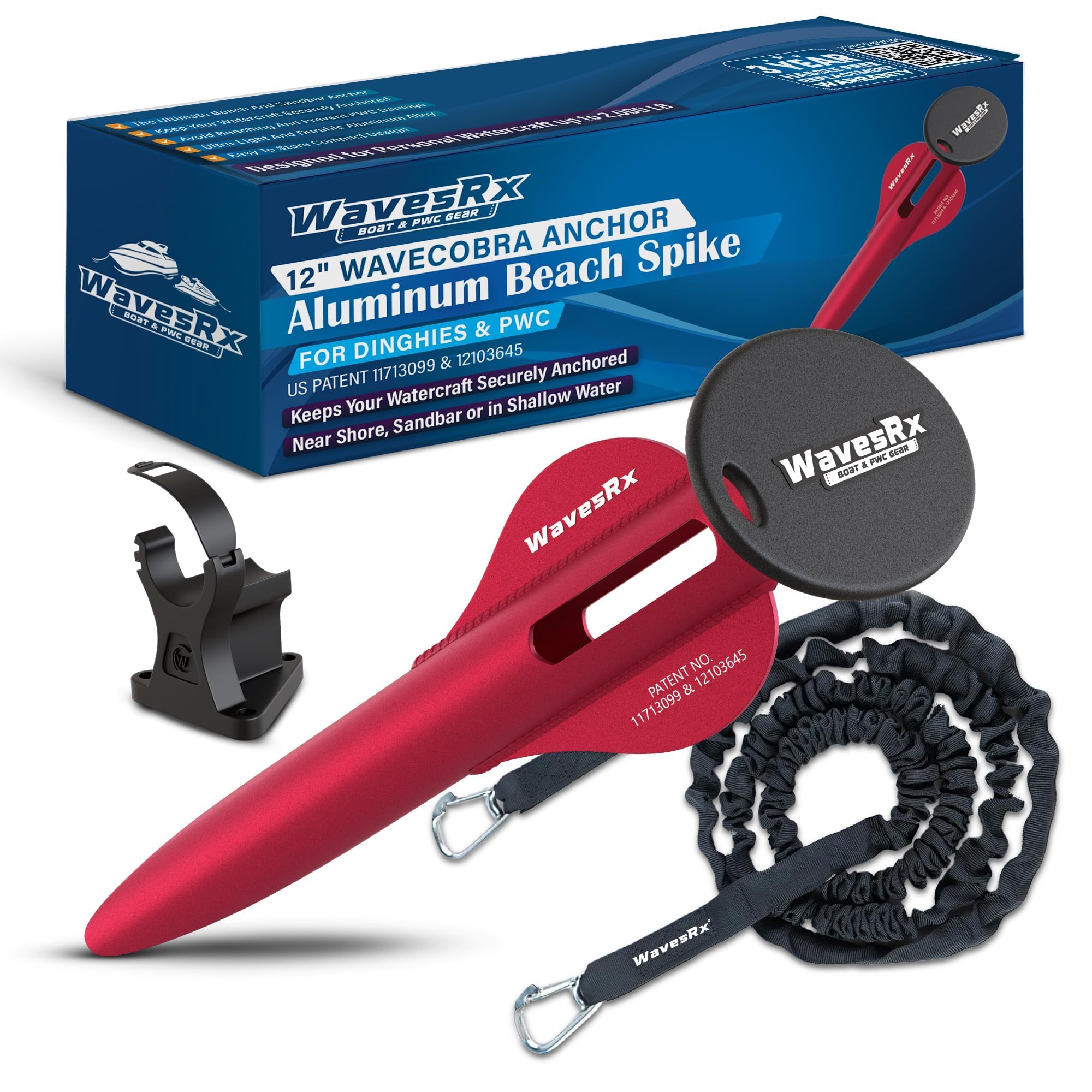
The WAVESRX Spike Anchor takes a minimalist approach at just 16 ounces, using a 12-inch aluminum spike that you step on at a 15-degree angle to drive it into the sand. This anchor is designed specifically as a shallow-water parking anchor for calm conditions near beaches or sandbars — it is not a replacement for a primary anchor in wind, current, or deep water. The 100 percent aluminum construction guarantees zero rust for life, making it ideal for storage in a pontoon seat box where any rust drip would stain upholstery.
The included rope and carabiner are functional for light use, though several reviewers noted the plastic clips broke under moderate tension and recommended upgrading to metal hardware. For jet skis, small pontoons under 18 feet, or as a stern anchor in tandem with a bow anchor, the WAVESRX provides a lightweight, rust-free option that stows in a fraction of the space of a traditional anchor.
The 12-inch spike length limits its use to water depths where the bottom is within arm’s reach — typically 1 to 2 feet of water. The manufacturer recommends it for boats up to 5,000 pounds dry weight, but practical experience suggests it works best on lighter craft under 2,500 pounds in protected waters. The 3-year replacement warranty adds peace of mind, and the anodized red finish makes the anchor easy to spot against the sand or grass.
Why it’s great
- Ultra-light 16 oz aluminum design is completely rust-proof
- Small enough to stow in any pontoon storage compartment
- 3-year hassle-free replacement warranty from the manufacturer
Good to know
- 12-inch spike only works in shallow water with reachable bottom
- Plastic included accessories may need upgrading to metal for durability
FAQ
Will a fluke anchor work on a rock or gravel bottom?
How much chain should I use with my pontoon anchor?
Can I use a sand spike anchor as my primary pontoon anchor?
Final Thoughts: The Verdict
For most pontoon owners who anchor in sand or mud and want a complete, ready-to-deploy system, the best anchors for pontoons winner is the Better Boat Fluke Anchor Kit because its hot-dip galvanized finish, pre-drilled recovery hole, and all-in-one rope-and-chain kit remove every hassle from the buying and rigging process. If you anchor in mixed or rocky bottoms and need an anchor that self-corrects as the boat swings, grab the Seachoice Fold-and-Hold Anchor for its corrosion-resistant galvanized construction at a mid-range price. And for shallow-water sandbar parking where traditional anchors fail, nothing beats the SandShark Supersport 3.0 for its auger-style suction hold that gives you walk-away confidence on the beach.