
If you’ve ever been shouted down by a screaming pancake compressor in your garage or on a jobsite, you know noise isn’t just an annoyance — it’s a barrier to actually using the tool when you need it. Modern air compressors have split into two camps: the budget-friendly screamers that punish your ears and the refined, quiet machines that let you hold a conversation while filling a tire or firing a finish nailer. The difference comes down to pump design, motor RPM, and tank capacity — specs that determine whether your compressor is a permanent table-top fixture or a portable workhorse you’ll actually haul out every weekend.
I’m Min — the co-founder and writer behind Gadgets Feed. I’ve spent hundreds of hours pouring over spec sheets, decibel ratings, CFM curves, and user reviews to separate the genuinely quiet compressors from the ones that merely claim it on the box.
The goal is to identify the best air compressor for anyone who values their hearing and wants a unit that won’t vibrate the entire workshop off its foundation. These picks balance real-world quiet operation with enough air delivery to handle trim work, tire inflation, and light framing.
How To Choose The Best Air Compressor
Choosing the right air compressor is about matching the machine’s output specs to your actual workload. For most home shops and trim carpenters, the sweet spot lives between 2.0 and 3.0 CFM at 90 PSI with a tank between 2 and 6 gallons. Below that, you stall out on continuous tools; above it, you pay for capacity you may never use. The real trap is buying on max PSI alone — a 150 PSI rating means little if the pump can’t sustain the flow your nailer or blow gun demands.
Decibel Rating & Pump Design
The loudest compressors (85–95 dBA) use high-RPM oil-free pumps that rely on plastic parts moving at speed. The quietest options (58–62 dBA) achieve their silence through two mechanisms: low-RPM motors (1,680 RPM vs. the typical 3,450 RPM) and oil-lubricated cast-iron pumps that damp vibration and run cooler. Oil-free pumps win on zero maintenance but typically die around 500–1,000 hours; oil-lubricated units can run 3,000+ hours but require periodic oil changes. For intermittent home use, oil-free at low RPM is the best compromise between quiet operation and convenience.
CFM at 90 PSI & Duty Cycle
CFM at 90 PSI tells you how much air volume the compressor delivers when the tank is at working pressure. A framing nailer needs 2.0–2.5 CFM; a spray gun demands 3.0–6.0 CFM; an impact wrench can pull 4.0–5.0 CFM. Match the compressor’s CFM to your highest-demand tool. Duty cycle matters next: most oil-free compressors tolerate a 50% duty cycle (6 minutes of run per 6 minutes of rest), while oil-lubricated units can run closer to 75–100% in the same period. If you plan to run a paint sprayer for 20 minutes straight, look for a compressor with a 100% duty rating or a large tank that can buffer the pump’s recovery time.
Tank Material & Portability
Steel tanks are heavy, cheap, and prone to internal rust over years of moisture accumulation. Aluminum tanks cost more but weigh roughly 30–40% less and never rust, making them ideal for portable compressors that move between garage and jobsite. A gallon of tank capacity roughly equates to one minute of tool runtime at moderate draw — so a 4.6-gallon aluminum twin-tank setup gives you about 4–5 minutes of continuous blow-off before the pump kicks in, which is enough for most trim and inflation tasks. For jobsite portability, look for a roll-cage frame with integrated handles or wheels.
Quick Comparison
On smaller screens, swipe sideways to see the full table.
| Model | Category | Best For | Key Spec | Amazon |
|---|---|---|---|---|
| California Air Tools CAT-4610AC | Premium | Ultra-quiet home shop | 60 dBA, 2.2 CFM @ 90 PSI | Amazon |
| Makita MAC320Q | Premium | Indoor trim work | 60 dBA, 2.6 CFM @ 90 PSI | Amazon |
| Metabo HPT EC28M | Mid-Range | Silent airbrushing & inflation | 59 dBA, ultra-compact | Amazon |
| DEWALT DWFP55130 | Mid-Range | Versatile garage use | 71.5 dBA, 3.0 CFM @ 90 PSI | Amazon |
| Makita MAC5200 | Premium | High-volume continuous use | 6.5 CFM @ 90 PSI, oil-lubricated | Amazon |
| ALL-TOP Dual Cylinder | Mid-Range | Off-road tire inflation | 12.35 ft³/min, 150 PSI max | Amazon |
| RYOBI P739 | Budget | Cordless portability | 0.5 CFM @ 90 PSI, 120 PSI max | Amazon |
In‑Depth Reviews
1. California Air Tools CAT-4610AC

California Air Tools has built its reputation on ultra-quiet performance, and the CAT-4610AC is the poster child for that philosophy. The 1.0 HP motor spins at just 1,680 RPM — half the speed of a typical compressor motor — and the oil-free dual-piston pump delivers 2.2 CFM at 90 PSI while humming along at only 60 decibels. That’s quieter than a normal conversation, and it means you can run this unit inside a home workshop without earplugs or disturbing anyone in the next room.
The 4.6-gallon aluminum twin-tank setup is a standout feature: aluminum tanks won’t develop internal rust over time like steel tanks do, and the combined weight of the unit is only 44 pounds. The 8.5-amp draw lets it plug into any standard 110V outlet or run off a 2,500-watt generator. With a pump lifespan rated over 3,000 hours, this compressor is built for the long haul. The trade-off is that 2.2 CFM at 90 PSI limits it to trim nailers, airbrushes, and inflation — it won’t keep up with a die grinder or sandblaster.
User reports consistently praise the remarkably low noise floor and reliable startup, though several owners note the on/off switch feels flimsy compared to the rest of the build. For the home DIYer who wants a compressor that lives on the bench and doesn’t announce itself every time it cycles, this is the benchmark. It’s the quietest unit in its class at this capacity point.
Why it’s great
- Ultra-quiet 60 dBA operation allows conversation nearby
- Lightweight aluminum tanks resist rust and make it easy to carry
- Low 1,680 RPM motor and oil-free design for extended lifespan
Good to know
- Limited to 2.2 CFM — not suitable for high-demand continuous tools
- On/off switch feels noticeably cheaper than the unit’s overall quality
2. Makita MAC320Q Quiet Series

Makita’s Quiet Series is a direct answer to the question “How do I get real work done without noise complaints?” The MAC320Q pairs a 1.5 HP motor running at 1,750 RPM with an oil-free dual-piston pump that delivers 2.6 CFM at 90 PSI — noticeably more flow than the California Air Tools unit — while staying at the same 60 dBA noise level. The 3-gallon steel tank fills quickly and the roll-cage construction adds serious durability for jobsite transport.
What sets the MAC320Q apart is its ability to sustain tools that demand more air. At 2.6 CFM, it runs a framing nailer comfortably and can keep up with moderate blow-off work without the pump running constantly. The dual 1/4-inch quick couplers let two trim nailers share the feed simultaneously, which speeds up production on a trim crew. The unit weighs about 57 pounds — heavier than California Air Tools’ offering but still manageable, though it lacks wheels, so you’ll be carrying it by the roll-cage handle.
Users report that the build quality is genuinely industrial-grade: thick gauge steel on the cage, metal fittings, and a regulator that holds pressure accurately without creeping. The main critique is the Amazon-listed dimensions (12x12x12 inches) are completely wrong — the actual footprint is closer to 18x19x14 inches — so measure your storage space before buying. For indoor remodelers and finish carpenters who need a whisper-quiet compressor that can actually keep a framing nailer fed, this is the top choice.
Why it’s great
- Delivers 2.6 CFM at 90 PSI — more than enough for framing nailers
- Roll-cage construction protects key components during transport
- Dual quick couplers for running two tools simultaneously
Good to know
- No wheels, making the 57-lb unit harder to move around a shop
- Physical footprint is much larger than what the product listing suggests
3. Metabo HPT EC28M

If your primary use case is finish carpentry, airbrushing, or inflating bike tires, the Metabo HPT EC28M offers the lowest decibel rating of any unit in this lineup at just 59 dBA. That’s barely above a library — you can hold a normal conversation standing right next to it while it cycles. The secret is the oil-free pump design that prioritizes low vibration and smooth rotation over raw CFM output, making it near-invisible in a quiet workspace.
The trade-off is immediate and real: this 1-gallon compressor is only suitable for very small tools. With a limited CFM output, it can drive a single brad nailer or stapler but will struggle with any continuous-flow accessory like a blow gun — users report about one second of reserve air before the pump needs to catch up. The lightweight 25.2-pound build and compact footprint make it exceptionally portable, and the universal quick coupler allows fast tool swaps without hunting for adapters. The steel roll cage adds surprising toughness for a unit this size.
Customer feedback highlights that while the EC28M is mechanically excellent, packaging quality from the factory can be inconsistent — a few units arrived with a broken manifold due to poor box padding. Once operational, it holds pressure for months and is genuinely the quietest compressor you can buy at this price. This is the right pick for a dedicated trim carpenter or hobbyist airbrusher who needs a silent companion, not a heavy-duty air source.
Why it’s great
- Remarkably quiet at 59 dBA — quieter than a normal conversation
- Ultra-lightweight (25.2 lbs) and compact for easy job site transport
- Holds pressure for months with no detectable air leaks
Good to know
- Very limited CFM output — not suitable for continuous-use tools or blow guns
- Inconsistent packaging from the factory can cause shipping damage
4. DEWALT DWFP55130
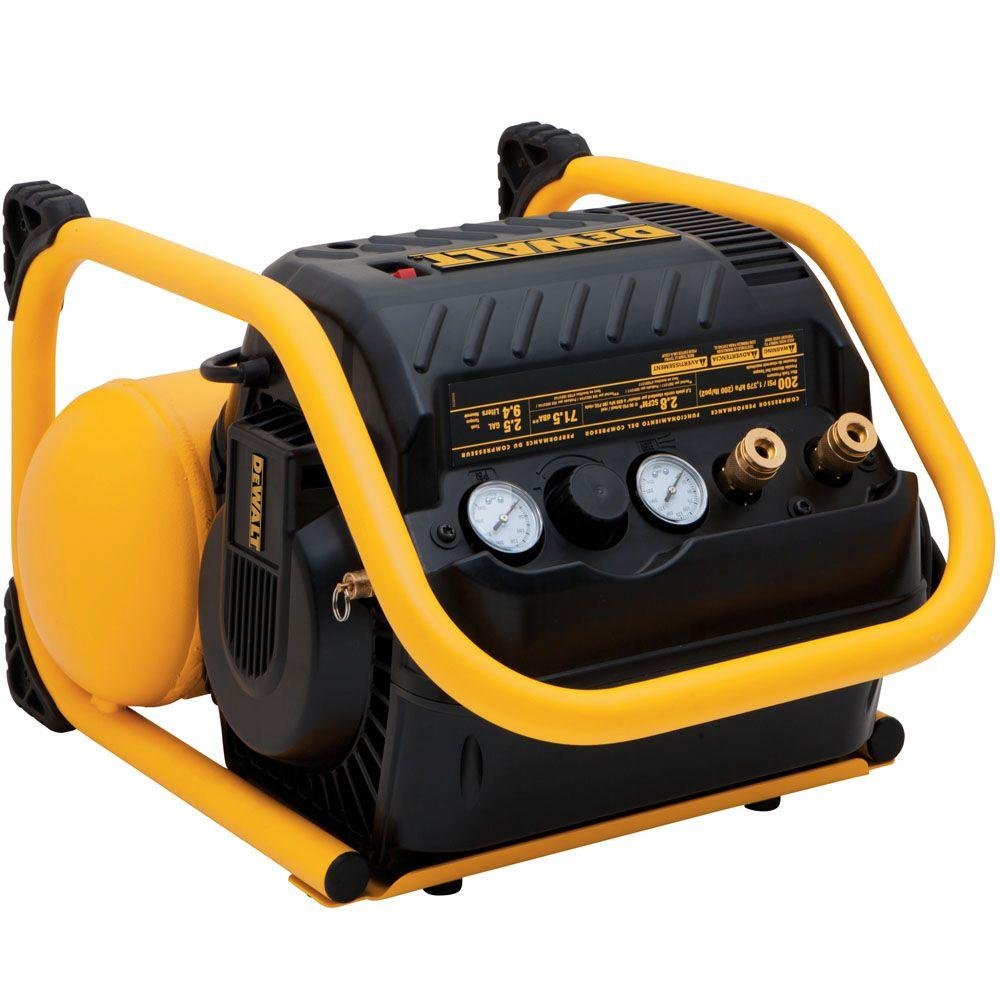
DEWALT’s DWFP55130 sits at the intersection of “quiet enough for indoor use” and “powerful enough for real work.” At 71.5 dBA, it’s about 10 decibels louder than the California Air Tools or Makita Quiet Series units, but that’s still a fraction of the volume produced by a typical pancake compressor (85-90 dBA). The 2.5-gallon tank holds 200 PSI max pressure, and the oil-free pump delivers a solid 3.0 CFM at 90 PSI — enough to run a framing nailer, inflate car tires, or power a small spray gun without feeling undergunned.
The design is thoughtful for garage use: the ball valve drain makes tank purging quick, the dual universal quick couplers support two nailers simultaneously, and the cord wrap keeps everything tidy. The roll cage protects the regulator and couplers during transport, and the unit can operate in either vertical or horizontal orientation, which is rare among portable compressors. The 40-pound weight and slim 12.5-inch profile mean it fits easily on a shelf or in a truck bed without dominating the space.
Owner impressions are overwhelmingly positive about the build quality and quiet operation relative to older generation compressors, but some note that the regulator dials are small and hard to read when laid flat. The 50% duty cycle means you should let the pump rest after 6 minutes of continuous run time, which makes this a poor fit for extended spray painting sessions. For the home mechanic or weekend woodworker who wants one compressor that strikes a practical balance between noise and capability, this is the most versatile option in the mid-range.
Why it’s great
- 3.0 CFM at 90 PSI handles framing nailers and small spray guns
- Can operate in vertical or horizontal orientation for flexible storage
- Ball valve drain makes tank maintenance quick and clean
Good to know
- Regulator dials are small and hard to read when the unit is laid flat
- 50% duty cycle limits continuous runtime for demanding tools
5. Makita MAC5200 Big Bore
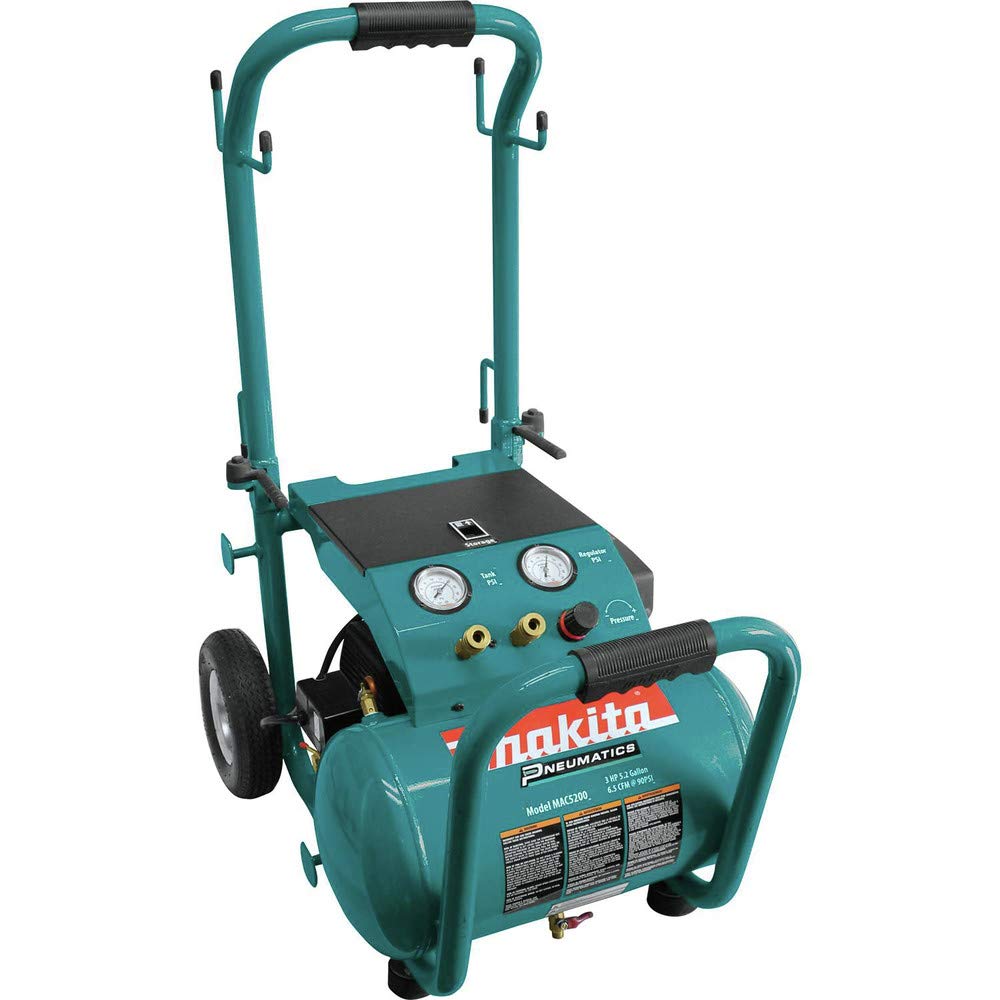
For users who need serious air volume — running a flooring nailer, an impact wrench, or even a small plasma cutter — the Makita MAC5200 is the most capable compressor on this list. The 3.0 HP motor drives a cast-iron, oil-lubricated Big Bore pump that delivers 6.5 CFM at 90 PSI and fills the 5.2-gallon tank to 120 PSI in under 80 seconds. This is enough air to zip off lug nuts with an impact wrench or blow out an entire sprinkler system zone by zone without waiting for the pump to catch up.
The oil-lubricated design is the key difference here: it runs cooler, lasts longer (estimated 3,000+ hours of pump life), and produces a deeper, lower-pitched tone that’s less irritating than the high-frequency whine of oil-free units. At roughly 78 dBA, it’s not exactly quiet, but it’s significantly less annoying than a comparably powerful oil-free compressor. The folding handle and 12-inch pneumatic wheels with steel centers make it easy to maneuver despite the 88-pound weight, though the front-heaviness requires care when rolling over uneven ground.
Long-term owners consistently report the MAC5200 lasting 10–15 years in active service with nothing more than periodic oil changes. The cast-iron cylinder is rebuildable, so this compressor can be a once-in-a-lifetime purchase for the serious home workshop. The downsides are the weight, the noise (still noticeable compared to Quiet Series units), and the lack of a pressure regulator with a fine-adjustment dial for precise low-PSI work like airbrushing. This is the correct choice if your projects demand real power and longevity over whisper-quiet operation.
Why it’s great
- 6.5 CFM at 90 PSI runs impact wrenches, floor nailers, and small plasma cutters
- Cast-iron oil-lubricated pump provides exceptional lifespan and cooler running
- Pneumatic wheels and folding handle make it easy to move around
Good to know
- Heavier than any other unit on this list at nearly 88 lbs
- Not as quiet as oil-free low-RPM alternatives; around 78 dBA
6. ALL-TOP Dual Cylinder 12V
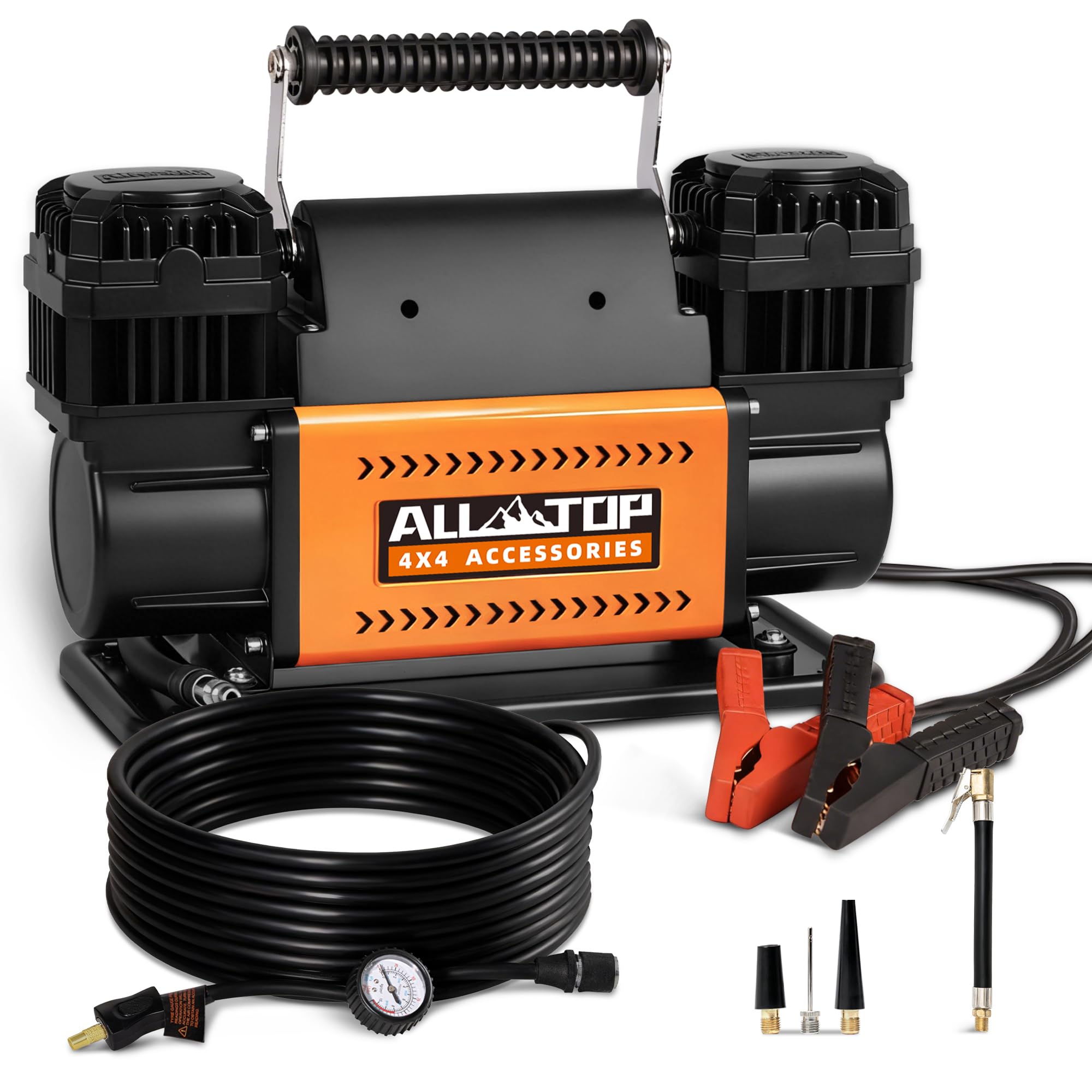
The ALL-TOP Dual Cylinder compressor is built for a completely different mission than the other compressors on this list: it’s a 12V portable inflator designed to air up 4×4 tires at the trailhead, not a stationary shop unit. The twin aluminum cylinders deliver a massive 12.35 ft³/min of flow at up to 150 PSI, letting you fill a 40-inch mud-terrain tire from flat to trail pressure in under 5 minutes. The 26-foot rubber air hose with an inline pressure gauge reaches all four corners of a truck without needing to reposition the compressor, and the included nylon storage bag keeps everything organized.
This unit connects directly to the vehicle’s battery via heavy-duty clamps — there is no 110V AC option — so it’s strictly for mobile use. The auto-thermal cut-off prevents motor burnout during extended inflation cycles, but there’s no auto-shutoff at target pressure, so you must monitor the analog gauge closely. Several users report the gauge reads about 10 PSI high, so it’s worth cross-checking with a digital tire gauge for precision. The unit weighs 24 pounds and produces a moderate noise level — not library-quiet, but far less aggressive than a standard 12V cigarette-lighter inflator.
For overlanders, off-roaders, and RV owners who frequently air down for traction and then reinflate on pavement, the ALL-TOP is the fastest 12V compressor in this group. The dual-cylinder design offers genuine redundancy: if one cylinder develops an issue, the other still provides usable flow to get you home. The build quality is aluminum and metal throughout, with anti-vibration rubber feet and an anti-scald handle. Just budget for your own pressure inflator with over-pressure protection to avoid hose damage, since the stock setup doesn’t include a regulator.
Why it’s great
- 12.35 ft³/min flow inflates large off-road tires faster than any 12V competitor
- 26-foot air hose reaches all four truck tires without repositioning
- Dual aluminum cylinders provide redundancy and better heat dissipation
Good to know
- No pressure regulator or auto-shutoff — requires manual gauge monitoring
- Analog gauge reads about 10 PSI high, needing cross-check with a digital gauge
7. RYOBI P739 ONE+

For the homeowner who needs a compressor for bike tires, basketballs, and the occasional quick air blast from a blow gun, the RYOBI P739 ONE+ is the most portable option available — and the most affordable. This 18V battery-powered unit throws out 120 PSI max and fills a typical car tire in about a minute, though the 1-gallon tank loses pressure after 30 seconds of continuous high-flow use. The beauty is total cordless freedom: no extension cord tether, no hunting for a wall outlet near the driveway. Just grab it, clip in a 4Ah battery, and go.
The noise level is moderate — quieter than a pancake compressor but not silent — and the 15-foot integrated hose reaches both sides of a car without dragging the unit across the driveway. The 0.5 CFM at 90 PSI output is the lowest in this comparison, so forget running any air tools beyond a tiny brad nailer. But for its intended use case — light inflation and cleanup — the P739 is genuinely convenient. It weighs only about 15 pounds with a battery, and the rubber handle and thick tank build give it surprising durability for the price.
Owner feedback over three-plus years of use shows the unit remains reliable with no major mechanical failures, though the battery drain is noticeable — a 4Ah pack can fill four car tires before needing a recharge. The biggest limitation is the lack of a hybrid power option: there’s no 110V plug for bench use, so if your battery goes flat, you’re dead in the water until it recharges. For the budget-conscious buyer who values portability over power and already owns RYOBI 18V tools, this is the entry-level compressor that actually gets used because it’s always ready to grab.
Why it’s great
- Fully cordless design lets you inflate anywhere without a power outlet
- Lightweight and compact at roughly 15 lbs with battery
- Reliable performance for inflation tasks with easy setup
Good to know
- 0.5 CFM output is too low for any continuous-use air tool or blow gun
- Battery-dependent — no 110V backup option if the battery dies
FAQ
Is 60 dBA quiet enough for indoor workshop use?
Will a 1-gallon compressor run a paint sprayer?
Can I leave an air compressor plugged in all the time?
How important is the duty cycle on an air compressor?
Why does my compressor say 150 PSI but barely runs my nailer?
Final Thoughts: The Verdict
For most home workshop owners, the best air compressor overall is the California Air Tools CAT-4610AC because it combines the quietest operation in its class with a rust-free aluminum tank, long pump life, and enough CFM for all common trim and inflation tasks. If you run framing nailers or spray guns regularly, the Makita MAC320Q offers higher flow at the same noise level. And for the dedicated overlander who needs fast trailside tire inflation, the ALL-TOP Dual Cylinder delivers unmatched portability and flow in a 12V package. Match your pick to your loudest tool, and you’ll buy exactly the compressor you need — once.