
For RVs, trolling motors, solar off-grid systems, and marine applications, a standard starting battery is a guaranteed failure. The constant, deep discharge cycles of these environments destroy thin-plate automotive batteries quickly. Deep cycle batteries, built with thicker plates and robust chemistries, are designed to be repeatedly drained to 50% or more of their capacity without suffering damage. Choosing the wrong chemistry or insufficient amp-hour (Ah) rating leads to frustrating power outages, damaged equipment, and frequent, costly replacements.
I’m Min — the co-founder and writer behind Gadgets Feed. This guide distills hundreds of hours of analyzing technical datasheets, cross-referencing real-world user capacity tests, and evaluating BMS safety features to separate marketing claims from genuine, long-term value in the deep cycle market.
Whether you are powering a weekend fishing trip or a full-time off-grid cabin, finding the best deep cycle batteries requires a clear understanding of chemistry, capacity, cycle life, and built-in protections.
How To Choose The Best Deep Cycle Batteries
Selecting the right deep cycle battery involves more than just picking a brand. You must align the battery’s chemistry, physical size (BCI group), capacity (Ah), and safety features with the specific demands of your application — whether that’s a 24V trolling motor or a 12V solar backup system.
Chemistry Decides Everything: AGM vs. LiFePO4
The two dominant chemistries in the deep cycle market are Absorbent Glass Mat (AGM) and Lithium Iron Phosphate (LiFePO4). AGM batteries are a mature, sealed lead-acid technology. They are maintenance-free, spill-proof, and significantly cheaper upfront. However, they are heavy, have a limited cycle life (typically 300-700 cycles to 50% depth of discharge), and suffer from voltage sag under high loads. LiFePO4 batteries are lighter by about 60-70%, deliver over 3,000 cycles, and maintain a stable voltage throughout the discharge curve. The trade-off is a higher initial purchase price. For weekend use or budget-restricted builds, AGM is effective. For full-time living, heavy daily use, or weight-sensitive applications like a kayak, LiFePO4 is the superior long-term value.
Capacity Is Not Usable Capacity
A battery’s amp-hour (Ah) rating tells you how much energy it holds, but the usable capacity depends on its chemistry. To maximize the lifespan of a lead-acid battery, you should never discharge it below 50% of its rated capacity. This means a 100Ah AGM battery only provides 50Ah of usable energy. LiFePO4 batteries, on the other hand, can be safely discharged to 80-100% without significantly reducing their cycle life. A 100Ah LiFePO4 thus delivers 80-100Ah of usable power. When comparing batteries, always calculate the true usable watt-hours (Ah x Voltage x Usable Depth of Discharge) to understand the real-world energy storage you are paying for.
The BMS: The Brain of a Lithium Battery
A Battery Management System (BMS) is a mandatory electronic circuit inside every lithium deep cycle battery. It monitors individual cell voltages, temperatures, and current flow. The BMS protects the battery from overcharge, over-discharge, short circuits, and overheating. A high-quality BMS with features like low-temperature charging cutoff (prevents charging below 32°F/0°C) is essential for safe operation in cold climates. Some premium BMS units offer Bluetooth connectivity, allowing you to monitor state of charge, cell balance, and historical data directly from your phone. A battery is only as reliable as its BMS.
Quick Comparison
On smaller screens, swipe sideways to see the full table.
| Model | Category | Best For | Key Spec | Amazon |
|---|---|---|---|---|
| Power Queen 12V 100Ah | Premium LiFePO4 | All-around RV & Boating | 1280Wh Energy, 24 lbs, 15K Cycles | Amazon |
| Litime 12V 100Ah TM | Premium LiFePO4 | High-End Trolling Motors | ABYC E-13 Standard, TVS Protection | Amazon |
| ECO-WORTHY 12V 280Ah | Premium LiFePO4 | High-Capacity Off-Grid | 3584Wh, 200A BMS, Bluetooth | Amazon |
| SOK 2-Pack 12V 206Ah | Premium LiFePO4 | Extreme Cold & Large Systems | Self-Heating, 12K Cycles, Metal Case | Amazon |
| DUMFUME 12V 150Ah | Mid-Range LiFePO4 | Value-Focused Solar & Camping | 1920Wh, 22.05 lbs, 4K Cycles | Amazon |
| HumsiENK 12V 100Ah | Mid-Range LiFePO4 | Compact & Portable Power | IP67, 19.73 lbs, Group 24 Fit | Amazon |
| FLLYROWER 12V 100Ah | Mid-Range LiFePO4 | DIY Backup & Budget Lithium | Included 7A Charger, 16.5K Cycles | Amazon |
| WEIZE 12V 100Ah AGM | Mid-Range AGM | Reliable Budget Backup | 63 lbs, Sealed AGM, 100Ah, 3% Self-Discharge | Amazon |
| Newport 12V 50Ah Marine | Budget AGM | Lightweight Kayak Trolling | 32 lbs, AGM, Trolling Motor Ready | Amazon |
In‑Depth Reviews
1. Power Queen 12V 100Ah LiFePO4 Battery
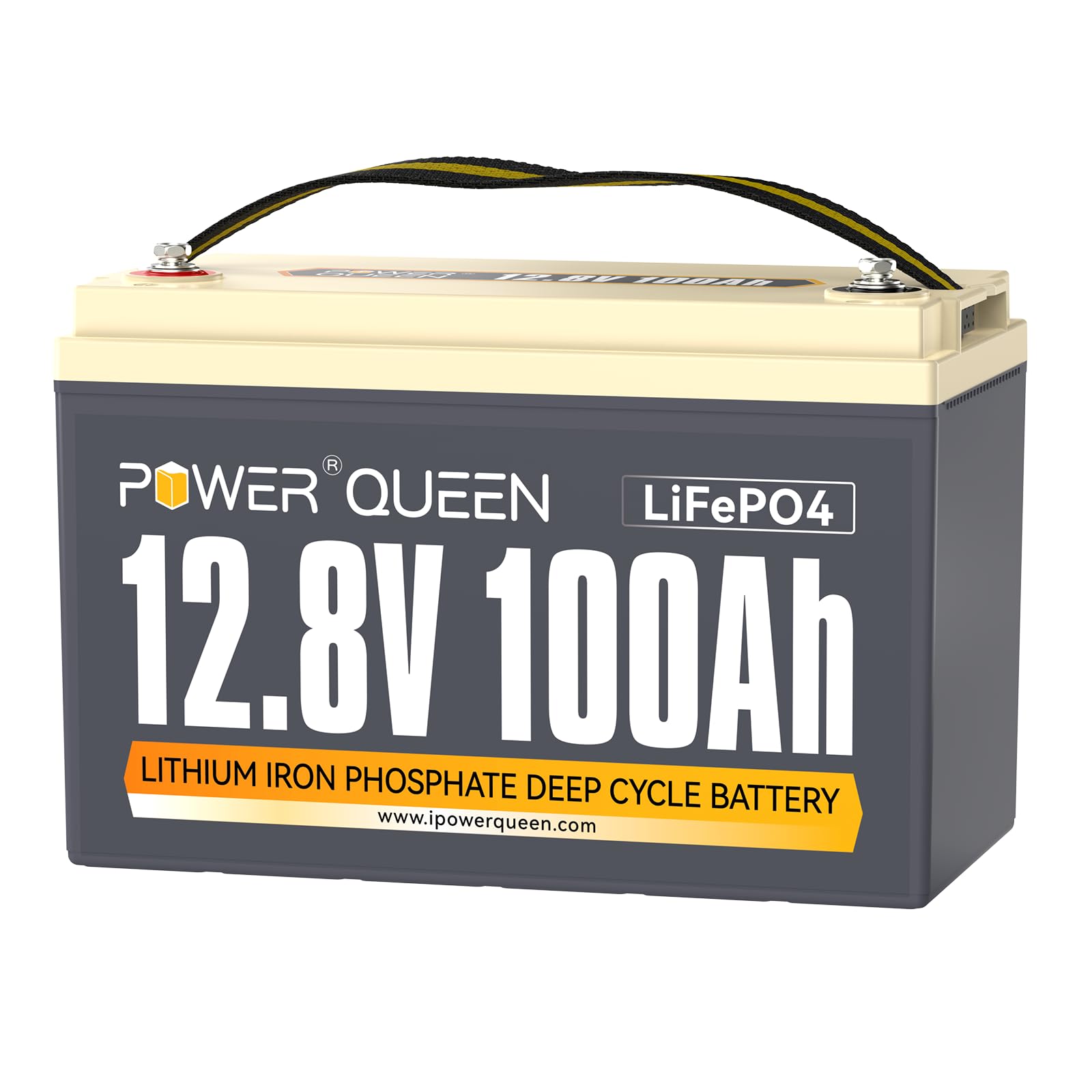
Power Queen’s 12V 100Ah battery hits the sweet spot for RV and marine users who want Grade-A LiFePO4 cells without the premium branding markup. With a tested capacity of 102Ah and a Group 31 form factor, it delivers a reliable 1280Wh of energy at just 24 pounds — roughly one-third the weight of a comparable AGM battery. The built-in 100A BMS protects against overcharge, over-discharge, short circuits, and overheating, while supporting series and parallel configurations up to 4S4P for a maximum system of 20.48kWh.
Real-world reports from sailboat and bass boat owners confirm this battery powers trolling motors, fish finders, and lighting for a full day on the water with minimal voltage sag. An experienced user found that after running a 55lb trolling motor all day, the battery still maintained 13.0-13.1V — a stability impossible with lead-acid chemistry. The battery’s lightweight design also makes installation and repositioning much easier compared to 60+ pound alternatives.
While the company claims up to 15,000 cycles, a more realistic expectation for daily use is still excellent at 4,000 cycles to 80% capacity. The 5-year warranty from Power Queen is a solid indicator of confidence in their BMS and cell quality. This is the definitive choice for the user seeking a premium, no-compromise lithium deep cycle battery that will last a decade.
Why it’s great
- Proven 102Ah real-world capacity from user testing
- Group 31 size fits standard marine and RV battery trays
- Stable voltage output even under sustained load
Good to know
- 6mm terminal bolts can be easy to cross-thread; consider an adapter kit
- No integrated Bluetooth for state-of-charge monitoring
2. Litime 12V 100Ah Trolling Motor LiFePO4

The Litime “Trolling Motor” (TM) series is specifically engineered to handle the unique electrical stress of electric outboards. It meets the ABYC E-13 standard for marine battery systems and includes a built-in Transient Voltage Suppressor (TVS) to shield your 12V-36V trolling motor from damaging voltage spikes caused by rough water or sudden load changes. Weighing just 22.16 pounds in a standard Group 31 case, it is about 64% lighter than an equivalent lead-acid battery, which noticeably improves boat handling and hole shot.
On-the-water reports are emphatic. One user documented eight hours of continuous fishing with a 45lb thrust trolling motor on a 16-foot jonboat with three people onboard; the battery was nearly full at the end of the day. Another bass boat owner replaced his 100Ah lead-acid setup and ran a 36V system for four hours with only a 10% capacity drain. The low-temperature protection stops charging below 32°F and discharging below -4°F, making it a safe winter option.
The BMS is robust, but some users noted the battery may arrive in “sleep mode” and require a specific wake-up procedure using a charger’s force mode. The 5-year warranty and proactive customer service from Litime have been praised, though the documentation could be clearer on initial setup. For anglers who demand all-day power without voltage sag, this is the top-tier pick.
Why it’s great
- TVS circuit protects expensive trolling motors from voltage spikes
- Extremely light weight improves boat performance
- Grade-A LiFePO4 cells with consistent power delivery
Good to know
- Battery may arrive in sleep mode; wake-up procedure is not immediately intuitive
- No built-in Bluetooth monitoring
3. ECO-WORTHY 3584Wh 12V 280Ah LiFePO4
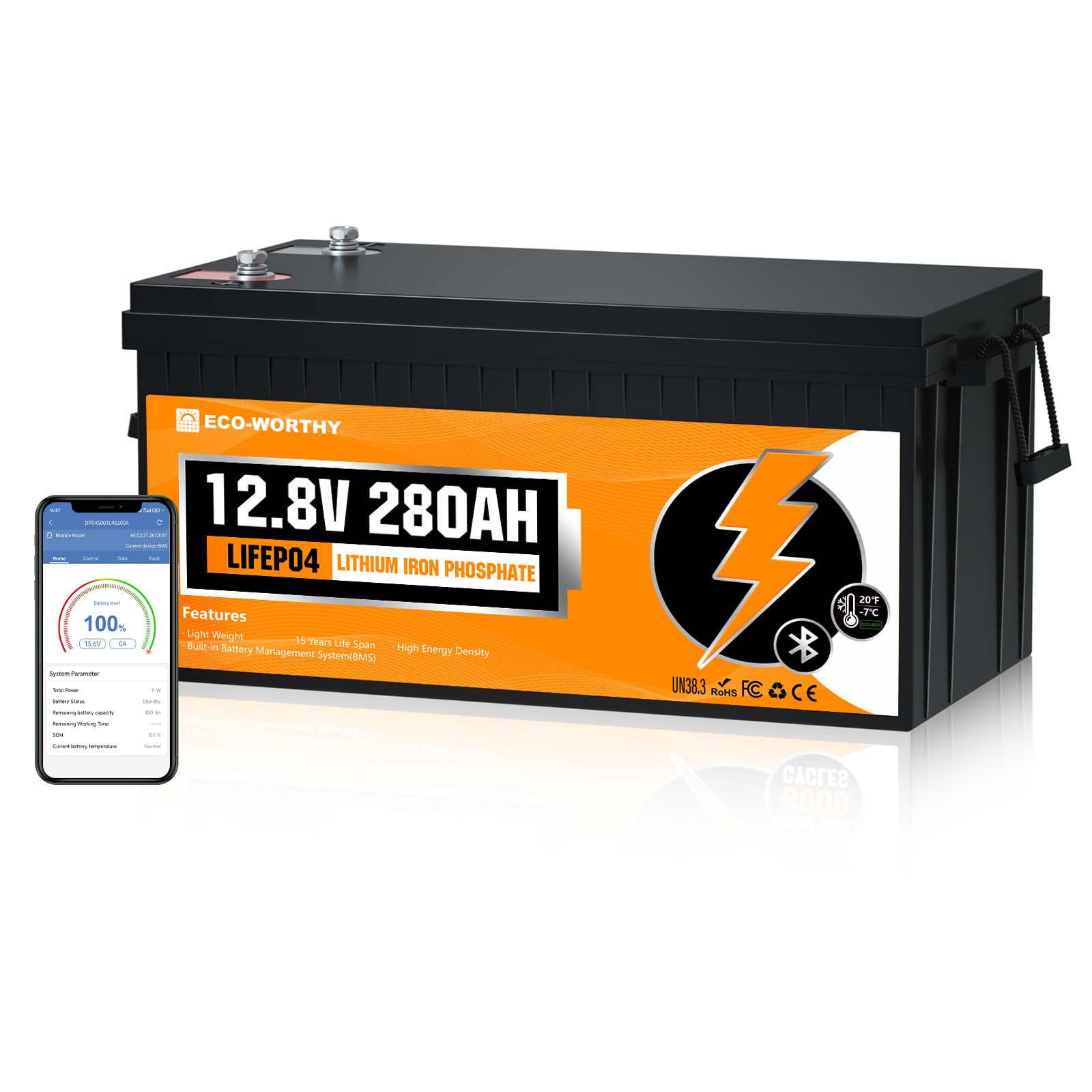
ECO-WORTHY’s 280Ah battery is a massive power station in a single unit. Providing 3584Wh of energy, it can run a 2000W inverter for extended periods, powering microwaves, induction cooktops, and electric heaters in an RV or off-grid cabin. The standout features are the metal compression case, which prevents cell expansion and adds structural rigidity, and the integrated Bluetooth module that allows real-time monitoring of voltage, current, and capacity via the ECO-WORTHY app.
Users upgrading from 110Ah AGM banks to a single 280Ah unit report a massive increase in usable capacity. One traveler in snowy 20°F conditions verified the low-temperature cutoff (charging stops below 19.4°F) works as advertised, protecting the cells from damage. The 200A BMS is a significant upgrade over the 100A units found in smaller batteries, allowing for higher continuous loads. The metal case also includes threaded inserts for secure mounting to a floor or battery tray.
At 61.7 pounds, this battery is heavy for a lithium unit — a trade-off for the high capacity and metal enclosure. It requires a lithium-capable converter for proper charging. The 3-year warranty is shorter than some competitors, but the build quality and cell balancing (reported as excellent) suggest this is a long-lasting investment for those who need bulk storage without wiring multiple smaller batteries in parallel.
Why it’s great
- Single 280Ah cell provides over 3.5kWh of usable energy
- Metal compression case prevents cell swelling and allows for secure mounting
- Bluetooth monitoring delivers real-time system visibility
Good to know
- Heavy at 61.7 lbs despite lithium chemistry
- Requires a LiFePO4-compatible charger or solar controller
4. SOK Battery 2-Pack 12V 206Ah LiFePO4
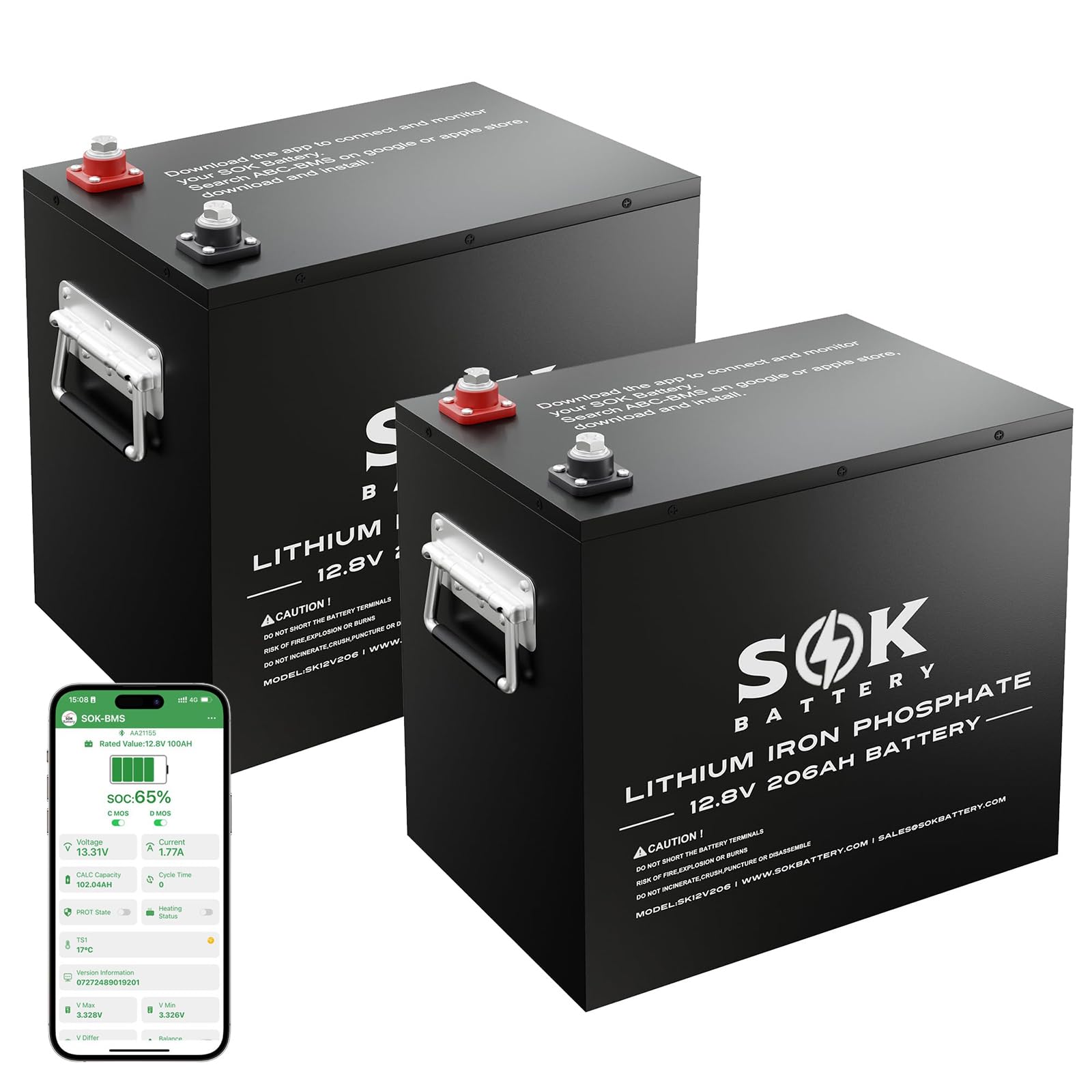
For demanding users who need reliable power in sub-freezing temperatures, the SOK 206Ah battery is the premium solution. It features an integrated self-heating system that activates during charging below 32°F, enabling safe operation down to -4°F (-20°C) without external heating pads. The 6mm-thick metal case is the most durable on this list, built to withstand the vibrations and impacts of long-term RV travel or marine use.
Users upgrading from 200Ah usable wet cells to a single 412Ah SOK bank report dramatically better reserve capacity for cloudy days and nighttime use. The Bluetooth monitoring via the ABC-BMS app provides detailed cell-level data. One long-term user reported flawless performance after three years of continuous use, noting that the battery required an initial “learning” period of two full charge/discharge cycles for accurate state-of-charge readings. With a 7-year warranty and a rated lifespan of up to 12,000 cycles, this is built to outlast the vehicle it powers.
The L16 size is larger than standard Group 31, so check your battery compartment dimensions carefully. Some users found the terminal bolts brittle in cold weather, so careful torquing with a torque wrench is advised. This is the ultimate choice for full-time winter RVers and cold-climate off-grid cabins.
Why it’s great
- Built-in self-heating allows safe charging in freezing conditions
- Exceptionally durable 6mm steel metal case
- 7-year warranty and up to 12,000 cycle lifespan
Good to know
- L16 size is larger and may not fit standard Group 31 trays
- Terminals can be brittle; use a torque wrench to avoid cracking
5. DUMFUME 12V 150Ah LiFePO4
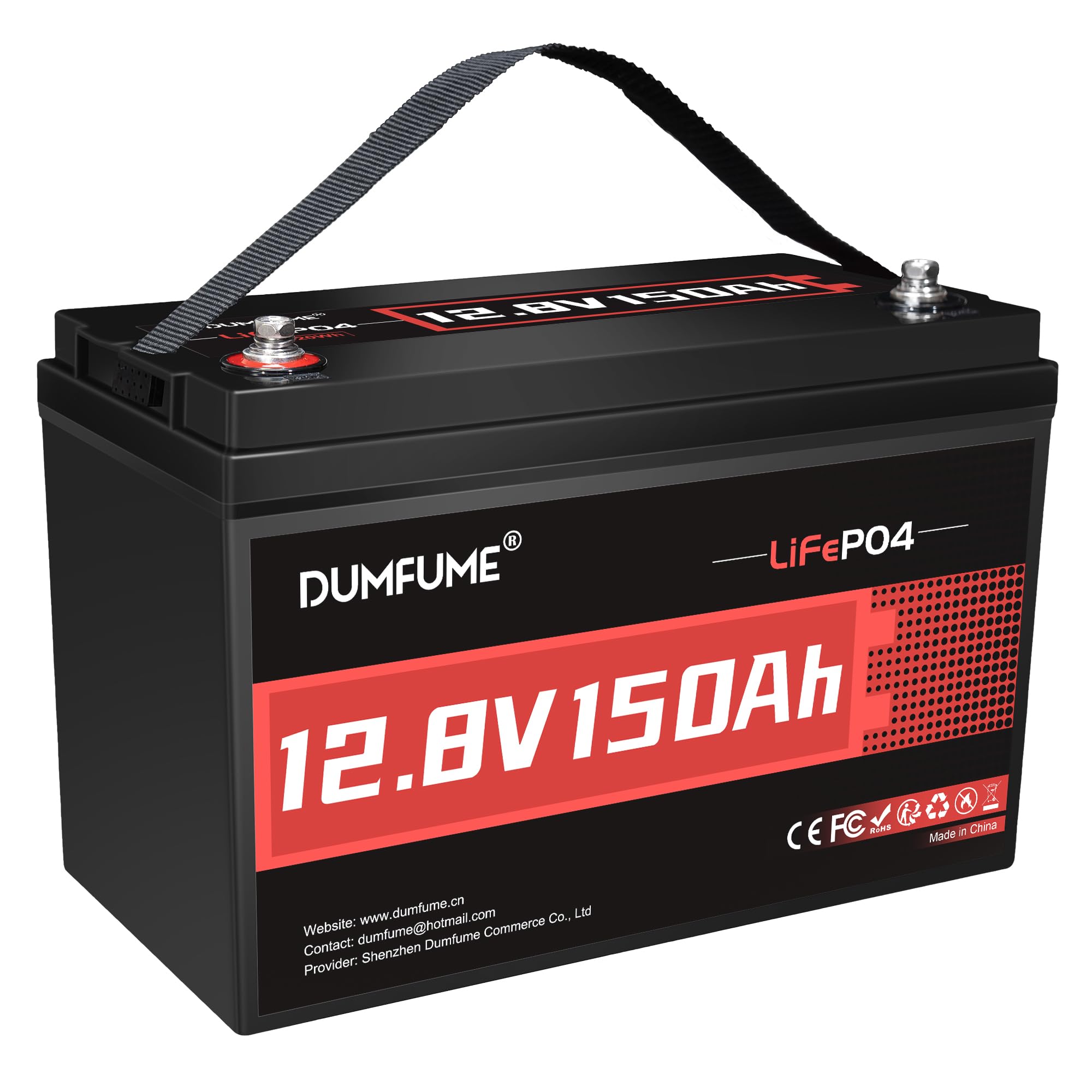
The DUMFUME 150Ah LiFePO4 battery offers a compelling 1920Wh of energy storage at a weight that defies its capacity — just 22.05 pounds. This makes it an excellent middle ground for solar camping and off-grid applications where 100Ah is too small but a 200Ah+ bank is overkill. It supports parallel connections up to 4P and series up to 4S, allowing you to scale to a 48V system.
User reports are generally strong, with several independent capacity tests showing the battery exceeding its 150Ah rated capacity by around 7Ah. One user who runs a 24V 100Ah version for home solar praised its stable power output and long runtime. However, there are quality control concerns with the BMS: one buyer received batteries that required a parallel “jump charge” to wake the BMS from deep sleep, and a 1-star report after a year of use indicated the battery failed to hold a charge overnight with a 3.5A fridge draw.
The 5-year warranty is a positive, but it requires a direct purchase from DUMFUME — Amazon purchases are not covered, which is a significant caveat. For budget-conscious buyers who can manage the initial setup quirks and accept the warranty limitation, this is a high-capacity lithium option at a competitive price point.
Why it’s great
- 150Ah of capacity at under 23 pounds is excellent for portable setups
- User tests often show capacity exceeding the rated spec
- Versatile series and parallel expansion options
Good to know
- BMS may arrive in deep sleep; jump-start procedure may be required
- 5-year warranty only valid for direct purchases, not Amazon
6. HumsiENK 12V 100Ah LiFePO4

HumsiENK’s 100Ah battery is built for the tightest spaces and the wettest environments. Its BCI Group 24 form factor is smaller than standard Group 31, making it ideal for compact RVs, kayaks, and trolling motors where every inch counts. The IP67 waterproof rating means it can survive submersion in up to 1 meter of water for 30 minutes — a critical safety feature for marine applications where splash and spray are unavoidable.
Users building 4kWh power stations have praised the Grade-A cells and the robust BMS, which provides comprehensive protection including low-temperature shutdown at -4°F. One golf cart owner replaced six 6V lead-acid batteries with three of these 12V units, reporting a massive weight reduction and much longer runtime. The included nylon handle is a practical addition for carrying the 19.73-pound battery.
While the BMS is intelligent, reactivating a battery that has gone into deep sleep requires a specific procedure using a low-current charger to bring the voltage back above 9V before switching to a LiFePO4 charger. This is not the most user-friendly process for beginners. The 5-year warranty is solid, and for those who need a lithium battery that fits physically where others won’t, the HumsiENK is the best fit.
Why it’s great
- IP67 waterproof rating ensures survival in wet marine environments
- Compact Group 24 size fits smaller battery compartments
- Grade A cells with reliable performance and 15,000+ cycle claim
Good to know
- BMS reactivation after deep sleep is a multi-step, technical process
- No Bluetooth monitoring for state-of-charge
7. FLLYROWER 12V 100Ah LiFePO4

FLLYROWER’s 100Ah LiFePO4 battery stands out because it includes a 7A AC charger in the box — a major convenience for buyers building their first DIY portable power station. The Grade A cells tested out at 103Ah in an independent user capacity test, exceeding the rated spec. The integrated dual USB-A ports are a nice touch for directly charging phones or tablets without an inverter.
Saltwater anglers have reported great success using this battery with Minn Kota trolling motors over a full year, praising the consistent all-day power and the massive weight savings compared to the 64-pound lead-acid batteries they replaced. Another user uses it with a 2000W inverter to power a fridge and computers during power outages, finding it much lighter and more capable than their old 50Ah SLA battery.
The included charger, while functional, is slow — taking about 9 hours to fully recharge a depleted 100Ah battery. There is also no app or display for checking the state of charge, which is a notable omission in this price range. The menu-style capacity expansion (up to 5S) is a plus for those planning to upgrade to a 48V system. For the user wanting a complete out-of-box solution, this is a strong entry point.
Why it’s great
- Comes with a dedicated 7A LiFePO4 charger, simplifying first-time setup
- Confirmed 103Ah capacity from user testing
- Lightweight (22 lbs) transform boat handling and cabin storage
Good to know
- Included charger is slow; a 20A or higher charger is recommended for faster top-ups
- No app or integrated display for state-of-charge monitoring
8. WEIZE 12V 100Ah Deep Cycle AGM

For users who do not want to invest in lithium, the WEIZE 12V 100Ah AGM battery is a gold-standard sealed lead-acid option. With 63 pounds of weight, it is built for stationary applications like emergency backup sump pumps, furnace blowers, and off-grid lighting systems. Its sealed construction means it is spill-proof and maintenance-free — no need to check water levels as with flooded batteries. The 3% self-discharge rate allows it to sit unused for months without significant power loss.
Users running four of these in parallel to create a 4.8kWh backup system for a 2,000W inverter praise the reliability and value. For condo dwellers or those in areas where gas generators are banned, this provides silent backup for critical 120V circuits. One long-term RV user has been running two 100Ah WEIZE units alongside 300W solar for two years, powering a 700W inverter for a crock pot and TV without any issues.
The primary limitation is weight and usable capacity. At 63 pounds each, they are physically demanding to move and install. Furthermore, to preserve their lifespan, you should only use 50% of the rated 100Ah, giving you effectively 50Ah of usable energy. For heavy daily cycling, lithium is superior, but for infrequent emergency backup or budget solar setups, the WEIZE AGM remains an excellent, trusted choice.
Why it’s great
- Reliable, spill-proof AGM construction with no maintenance needed
- 1150A max discharge current supports heavy inverter loads
- Proven track record in long-term RV and backup power setups
Good to know
- Heavy at 63 pounds, making transport and installation difficult
- Only 50Ah of usable capacity to maintain battery lifespan
9. Newport 12V 50Ah Deep Cycle Marine AGM
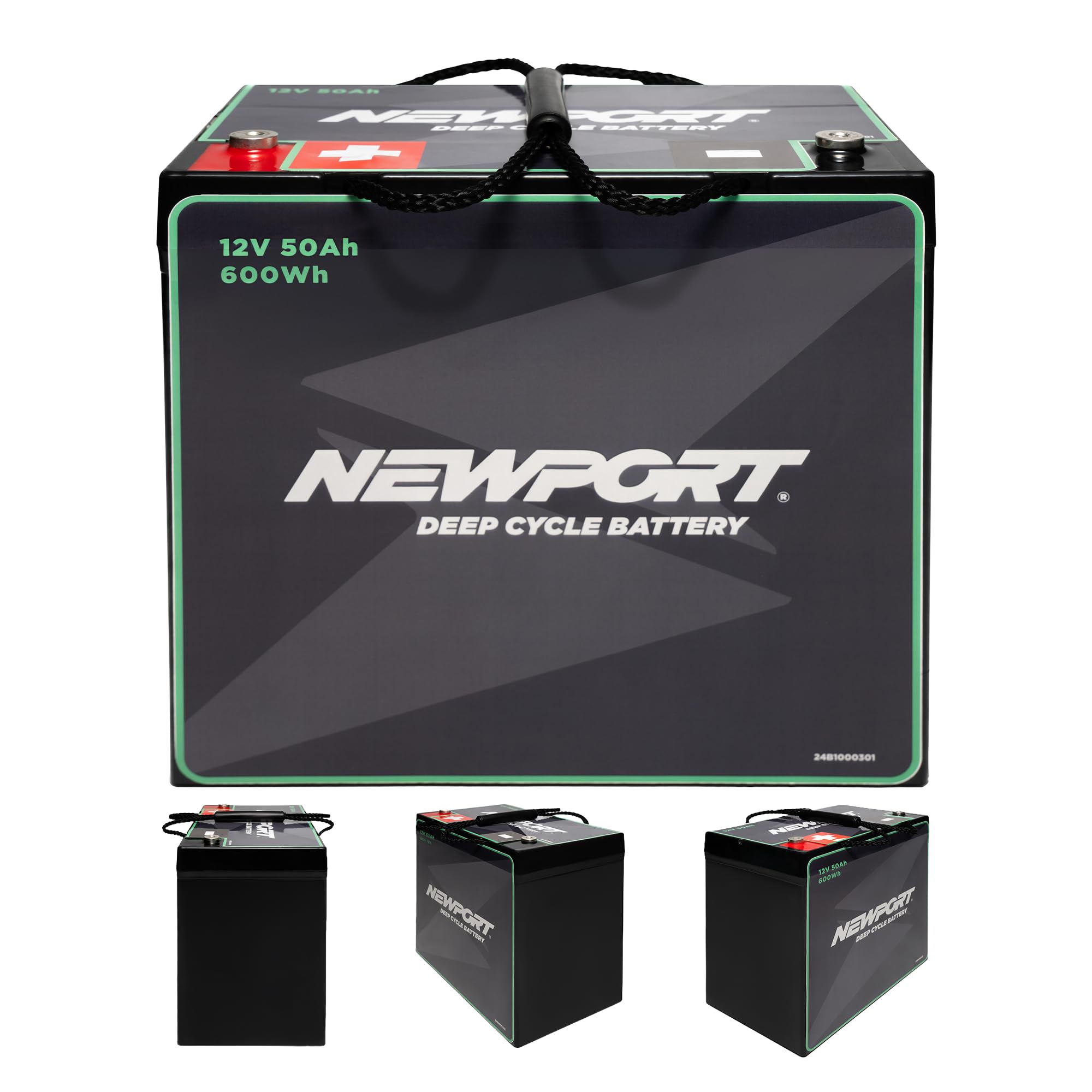
The Newport 12V 50Ah battery is the budget-friendly entry point into the deep cycle world. With a weight of just 32 pounds and a sealed AGM construction, it is the easiest battery on this list to maneuver and install, making it an ideal choice for small kayaks, jonboats, or as a lightweight backup for a sump pump. Its design is specifically validated for use with trolling motors, and the compact form factor means it can be stowed in tight compartments.
User stories highlight its surprising durability — one reviewer reported the battery survived a 20 MPH tumble from a truck bed onto asphalt with only cosmetic damage and zero performance issues. A kayaker using a 25lb trolling motor got about 7 hours of mixed up/downstream use on a single charge. Another user found it works perfectly as a dedicated backup for a basement sump pump, demonstrating its versatility beyond marine applications.
The trade-offs are clear: at 50Ah, this is a low-capacity battery. If you discharge it below 50% regularly, its lifespan will suffer. It lacks a built-in charge indicator, so pairing it with an external voltage meter is recommended. For the weekend kayak fisherman or light-duty backup user who does not want to spend hundreds of dollars, the Newport delivers reliable, accessible performance.
Why it’s great
- Lightweight (32 lbs) and easy to handle for mobile applications
- Sealed AGM is maintenance-free and durable in rough conditions
- Very affordable entry point for light marine and backup use
Good to know
- 50Ah capacity is low; only 25Ah is usable for maximum battery health
- No charge indicator; an external voltage meter is a necessary accessory
FAQ
Can I replace my lead-acid battery with a LiFePO4 battery without changing my charger?
How long will a deep cycle battery last if I use it every day?
What does the “BCI Group Size” mean for my battery?
Can I connect different deep cycle batteries together in parallel?
Final Thoughts: The Verdict
For most users, the best deep cycle batteries winner is the Power Queen 12V 100Ah because it offers the perfect balance of Grade-A LiFePO4 cells, proven reliability, and competitive pricing for both RV and marine use. If you want a battery specifically engineered for trolling motors with transient voltage protection, grab the Litime 12V 100Ah TM. And for those needing massive single-unit capacity and Bluetooth monitoring for an off-grid solar system, nothing beats the ECO-WORTHY 12V 280Ah.