
That feeling of your lungs burning halfway up a hill, running out of breath before your legs give out, or struggling to catch your wind during a workout isn’t just about fitness level — it’s about the strength of your respiratory muscles. A dedicated breathing trainer targets those exact muscles, forcing your diaphragm and intercostals to work harder so your oxygen exchange becomes more efficient, your endurance extends, and your recovery speeds up.
I’m Min — the co-founder and writer behind Gadgets Feed. I have spent hundreds of hours analyzing clinical studies on inspiratory muscle training, comparing resistance mechanisms from simple spring-loaded valves to calibrated turbine systems, and reading through thousands of user experiences across medical, athletic, and general wellness use cases to build this guide.
Whether you are a competitive athlete chasing a PR, a singer wanting better breath control, or someone managing a respiratory condition, finding the right tool matters more than just picking any gadget with a mouthpiece. That is why I built this guide to the best breathing trainer — a deep look at the seven most effective devices on the market right now.
How To Choose The Best Breathing Trainer
Not all breathing trainers work the same way. Some focus exclusively on inspiratory resistance — making your inhale muscles work harder — while others also add expiratory resistance or use flutter-valve oscillation to clear mucus. Your specific goal, whether performance, recovery, or medical management, dictates which mechanism and adjustability range you actually need.
Inspiratory vs. Expiratory Resistance
Most athletes and general users benefit most from inspiratory muscle training (IMT), which targets the diaphragm and external intercostals during inhalation. If your primary goal is improving stamina for running, cycling, or swimming, look for a device that offers at least five to six levels of inspiratory resistance. Expiratory resistance, which works the abdominal muscles and internal intercostals, is more relevant for singers, wind instrument players, or those recovering from certain respiratory conditions.
Resistance Range and Increments
The number of resistance levels is not a marketing gimmick — it dictates how long the device remains useful as your lung strength improves. A device with three levels may max out within weeks, while one with six or more levels can support you through months of progression. Pay attention to whether the adjustment is continuous or stepped, and whether the mechanism is easy to tweak mid-session without breaking your rhythm.
Build Quality and Hygiene
Since you are putting this in your mouth daily, material quality matters. Medical-grade or food-grade silicone and PC plastics resist bacterial buildup and withstand frequent cleaning. The device should disassemble for thorough washing, ideally being dishwasher-safe or at least easy to rinse and air-dry. A unit that traps moisture internally will develop odor and compromise your breathing workout over time.
Quick Comparison
On smaller screens, swipe sideways to see the full table.
| Model | Category | Best For | Key Spec | Amazon |
|---|---|---|---|---|
| POWERbreathe | Premium | Athletic performance | Calibrated spring-valve resistance | Amazon |
| TRAININGMASK Elevation 2.0 | Premium | Simulated altitude training | 36 resistance levels | Amazon |
| The Breather Pink | Premium | Beginner-friendly wellness | 6 resistance levels with app | Amazon |
| TRAININGMASK 2.0 Turn Flow | Mid-Range | High-intensity workout mask | 36 on-the-fly resistance levels | Amazon |
| Tilcare Respiratory Trainer | Mid-Range | Balanced inhale/exhale training | 6-level dial control | Amazon |
| Expand-A-Lung (2 Pack) | Value | Dual-way resistance training | Continuous knob adjustment | Amazon |
| Flutter Valve Breathing Device | Budget | Mucus clearance & lung exercise | 3 steel ball resistance levels | Amazon |
In‑Depth Reviews
1. POWERbreathe Blue, Medium Resistance

The POWERbreathe is the gold standard for pure inspiratory muscle training, trusted by pulmonologists, voice therapists, and competitive athletes alike. Unlike cheaper devices that rely on a simple airflow block, the POWERbreathe uses a calibrated spring-loaded valve that opens when you generate a precise negative pressure, forcing your diaphragm to work against a known resistance load. The Medium Resistance (MR) variant sits in the middle of three available levels (LR, MR, HR), and one user reported progressing from 0 to 1 on the MR scale after five weeks, representing roughly a 70% increase in inspiratory force.
The build quality is straightforward and functional — a cylindrical plastic body with a rubber mouthpiece and a non-slip grip contour. It comes with a zippered carrying case but no additional bells or whistles. Cleaning is simple: the valve assembly opens up, and POWERbreathe recommends boiling water sterilization. One user at age 60 on blood pressure medication reported measurable improvements in both lung capacity and diastolic BP readings after three months of consistent use, noting that while the device feels slightly overpriced for its simple plastic construction, the durability makes the investment worthwhile if it lasts several years.
Be aware that there is only one resistance mechanism — there is no expiratory training here. This is a pure inhale workout device. Also, the Medium Resistance level is genuinely challenging; one reviewer specifically advised smaller individuals or those new to IMT to start with the Low Resistance (LR) model unless they are a large competitive athlete. The lack of adjustable resistance per session means you must buy the correct tier, making this less flexible than a multi-level dial device.
Why it’s great
- Calibrated spring valve provides precise, measurable inspiratory resistance
- Clinically validated for improving lung function and lowering blood pressure
- Compact design with included carrying case for travel
- Durable construction holds up well after years of daily use
Good to know
- Only one resistance level per unit — must buy LR/MR/HR separately
- No expiratory resistance training; inhale workout only
- Plastic body feels simple relative to premium price
2. TRAININGMASK Elevation 2.0 Blackout + Spray Clean

The TRAININGMASK Elevation 2.0 is the only product in this lineup that simulates altitude training by restricting airflow at the face rather than just at the mouth. It covers your nose and mouth with a silicone shell and uses a patented TurnFlow valve system with 36 discrete resistance levels, controlled by rotating the central dial. The idea is to create a hypoxic-like environment that forces your cardiorespiratory system to adapt, increasing oxygen uptake and lung capacity just like training at elevation — and this claim is backed by a clinical study published in the International Journal of Environmental Research and Public Health.
Users report a night-and-day difference in workout intensity. One reviewer described it as the “single worst experience I’ve ever had at the gym” — meaning it worked exactly as intended, making every breath feel earned. The mask has an ergonomic shape with adjustable head straps for a snug fit, though the nose bridge area can create pressure points, and the head strap loops near the ears can interfere with earbuds. The included spray clean solution is a nice touch for sanitizing the silicone interior between sessions, but one reviewer noted it was missing from their package.
The main trade-off is comfort and practicality. If you have a beard, achieving a proper seal requires deliberately blocking airflow with your hand, which compromises the experience. The mask is also bulkier than a handheld device, making it less suitable for quick desk-side sessions or travel. But for runners, wrestlers, and CrossFit athletes who want to elevate their conditioning beyond what a simple mouthpiece trainer can offer, the Elevation 2.0 delivers a uniquely intense respiratory workout that directly translates to harder in-game performance.
Why it’s great
- Simulates altitude training with 36 adjustable resistance levels
- Backed by clinical studies showing increased oxygen uptake and lung capacity
- Full-face design works during running, cycling, and weightlifting
- Durable silicone construction with replaceable valve components
Good to know
- Nose bridge pressure and ear strap interference with earbuds
- Beard can compromise seal, reducing effectiveness
- Bulky design less portable than handheld trainers
3. The Breather Pink

The Breather Pink stands out for its simplicity and accessibility. It is a two-chamber device that uses independent valves for inhale and exhale resistance, each with six adjustable levels, so you can set a different difficulty for breathing in versus breathing out. That independent control is clinically important — some conditions like COPD primarily impair exhalation, while athletic performance gains come mostly from inspiratory loading. The Breather also includes a guided coaching app that tracks your sessions and monitors pacing, which helps beginners avoid the common mistake of breathing too fast and reducing the training stimulus.
Its design is small enough to slip into a purse or gym bag, and the recommended routine is just five minutes per session, twice a day. Users with speech therapy needs, swallowing issues, and pulmonary decline reported noticeable improvements within two weeks. One reviewer stated the device “reversed pulmonary decline in two weeks,” which is significant for a non-invasive, device. The app integration adds a layer of accountability that most standalone trainers lack, displaying your progress over time and ensuring you maintain proper breathing rhythm.
The main complaint is the lack of a carrying case or storage container. One user mentioned their dog destroyed the device because there was no protective case, and the company did not offer a replacement. Another reviewer felt it was overpriced relative to the plastic construction, especially since earlier versions apparently included a container. Cleaning is straightforward with alcohol wipes or CPAP wipes, but the open valve design means moisture can accumulate inside if not dried thoroughly after each session.
Why it’s great
- Independent 6-level resistance for inhale and exhale training
- Guided coaching app tracks progress and corrects pacing
- Quick 5-minute sessions fit easily into daily routine
- Effective for speech therapy, COPD, and general wellness
Good to know
- No carrying case or storage container included
- Plastic construction feels less premium than price suggests
- Moisture can accumulate if not dried after each use
4. TRAININGMASK 2.0 Turn Flow

The TRAININGMASK 2.0 Turn Flow is functionally similar to the Elevation 2.0 but without the extra spray clean accessory and at a lower price point. It uses the same 36-level TurnFlow valve system and silicone face shell, simulating altitude training by restricting your total airflow during exercise. The mask covers both nose and mouth, with adjustable head straps for a secure fit, and is designed to make your breathing muscles work harder so that when you remove the mask, normal breathing feels easier and your body uses oxygen more efficiently.
Users consistently report that this mask amplifies the difficulty of any workout — running, cycling, weightlifting — making it an effective tool for breaking through conditioning plateaus. One reviewer who used previous altitude masks called this the best-fitting one they had tried, noting that the snug seal ensures genuine oxygen deprivation during training. However, fit issues persist: the nose bridge can dig in uncomfortably, and the head strap placement pulls on ears, which can knock out earbuds mid-session. Beard wearers also struggle to maintain a positive seal without manually blocking the intake ports.
For its price, the 2.0 Turn Flow offers the same respiratory training mechanism as the Elevation 2.0 variant. The key distinction is that this version includes the mask, head strap, and valves but omits the spray cleaner. If you already have a sanitizing routine, the Turn Flow represents the better value play in the TRAININGMASK lineup. One reviewer summed it up bluntly: “Single worst experience I’ve ever had at the gym, mask worked as advertised.” That discomfort is precisely the point — your lungs get stronger by being forced to work harder.
Why it’s great
- 36 on-the-fly adjustable resistance levels for progressive overload
- Simulated altitude training improves oxygen uptake and cardiovascular fitness
- Secure hook-and-loop closure and ergonomic silicone shell
- Trusted by professional athletes and backed by clinical research
Good to know
- Nose bridge pressure and ear strap interference with earbuds are common complaints
- Beard wearers may struggle to achieve a proper seal
- Bulky design not ideal for non-workout or travel use
5. Tilcare Respiratory Trainer
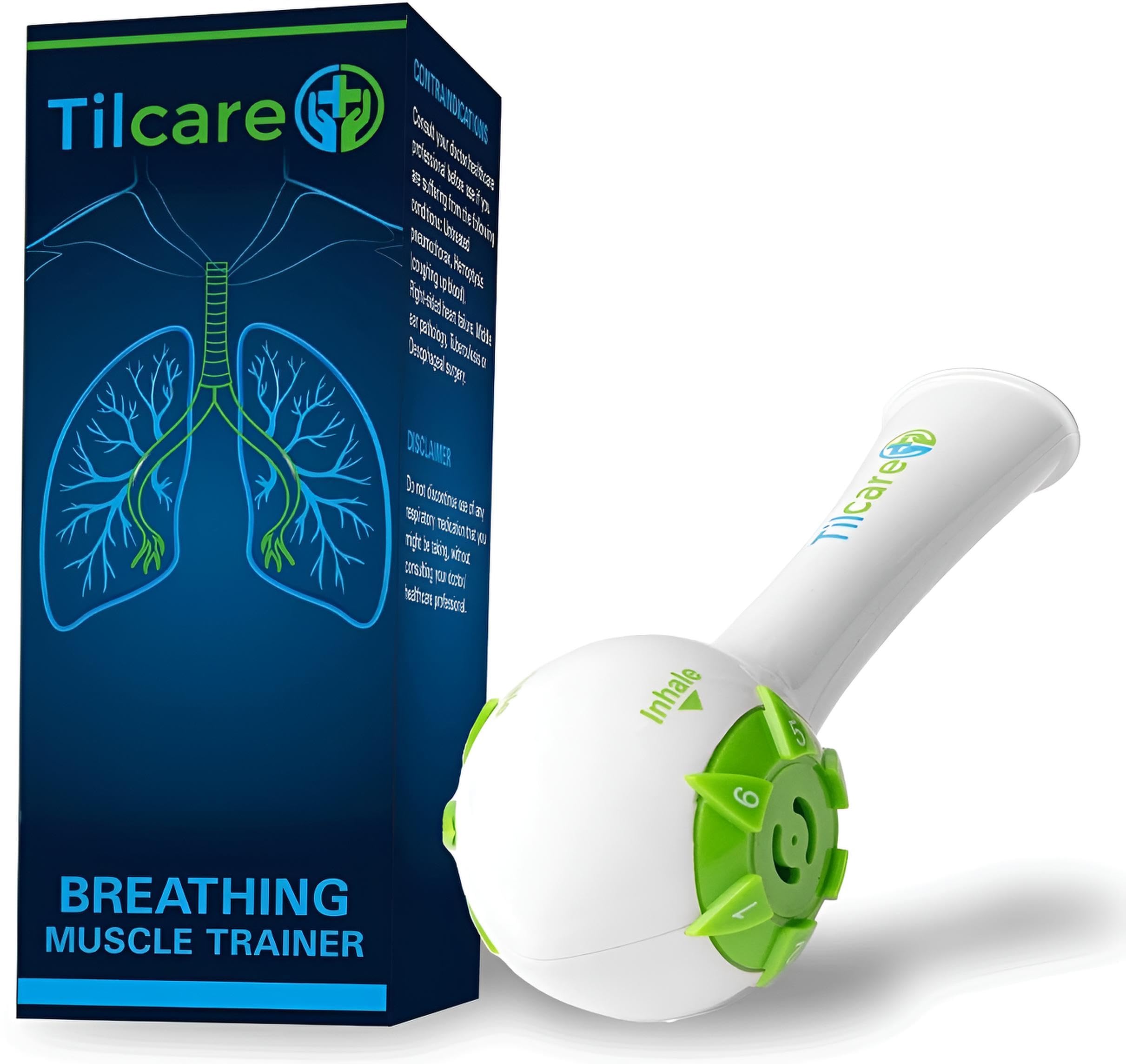
The Tilcare Respiratory Trainer punches well above its weight class by offering six levels of resistance in a device that costs significantly less than premium competitors. It uses a simple 6-level dial control that adjusts both inhale and exhale resistance, making it versatile for users who want to train both phases of breathing. The device is compact — just 1.76 ounces and small enough to slide into a pocket — and made from food-grade materials that can withstand daily cleaning without degrading.
Users with COPD reported that this device helped clear chest congestion and improved their breathing noticeably over time. One reviewer who compared it directly to a more expensive brand stated, “This has all the same features of the more expensive one. Save and choose this one.” The dual-resistance adjustment means you can set a harder inhale and an easier exhale, or vice versa, which is a flexibility usually reserved for premium models. The build quality, however, looks and feels more like a toy than a medical device — several reviewers noted the plastic construction appears cheap despite being functionally effective.
The main limitation is the resistance feel. While six levels provide good progression, the mechanism is not as precisely calibrated as the POWERbreathe’s spring valve. The resistance levels are also not independently marked for inhale and exhale, so you have to dial in by feel rather than by a specific numbered setting. For the price, though, the Tilcare delivers a solid training stimulus that competes well with devices costing twice as much, especially for beginners who want to test the waters of respiratory training without a large upfront investment.
Why it’s great
- 6-level adjustable dial for both inhale and exhale resistance
- Extremely lightweight and portable at just 1.76 ounces
- Food-grade materials safe for regular cleaning
- Excellent value — comparable features to expensive brands at lower cost
Good to know
- Plastic construction looks and feels less premium than it is
- Resistance levels not independently calibrated for inhale vs. exhale
- Mechanism may wear out faster than spring-valve designs
6. Expand-A-Lung (2 Pack)
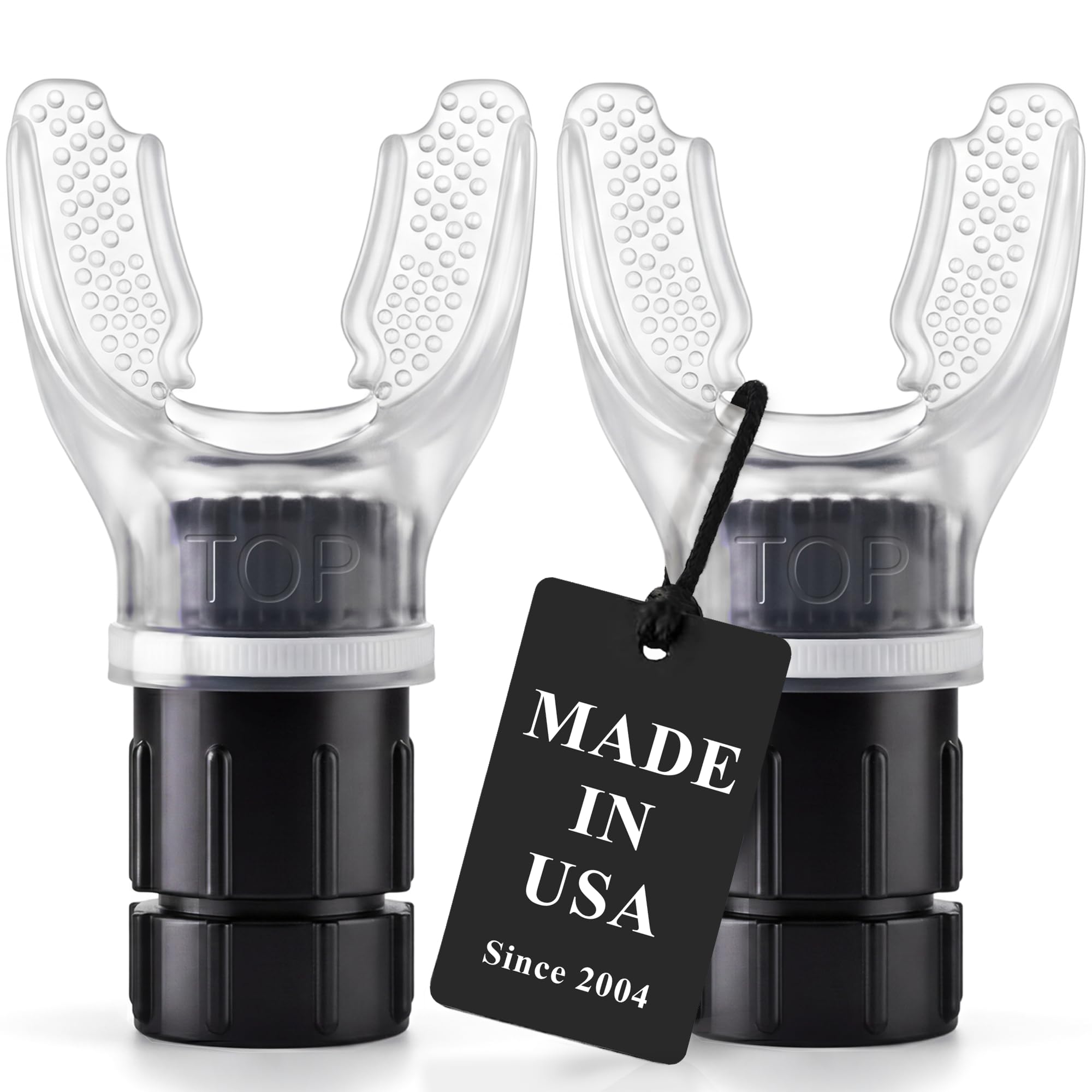
The Expand-A-Lung has been a staple in the breathing trainer category since 2004, and its 2-pack offering at this price makes it one of the most accessible entry points into respiratory muscle training. Unlike multi-level dial systems, Expand-A-Lung uses a single continuous knob that adjusts resistance smoothly from very light to extremely challenging, scaling up for advanced users. It provides dual-way resistance, meaning you inhale and exhale through the same adjustable valve, which builds both your diaphragm strength and your expiratory muscle power in one motion.
Users love its low-tech simplicity and portability — at just 4 inches long, it disappears into a gym bag or even a large pocket. The food-grade silicone mouthpiece is soft, comfortable, and easy to clean with water. One reviewer noted it helped their husband recover breathing function after a traumatic brain injury, enabling him to resume walking and physical therapy. Another user with high blood pressure found the resistance training effective for lowering BP readings, though they mentioned the lack of numbered markings or detented settings means you can accidentally bump the knob and change resistance mid-session without realizing it.
The 2-pack is a smart value play — you can keep one at home and one at work, or use one while the other dries after cleaning. However, the continuous knob design, while providing infinite adjustment, lacks tactile feedback. There are no clicks or numbers, so replicating the exact same resistance setting from one session to the next requires visual confirmation. Also, the device is purely a resistance trainer — no flutter valve or oscillation function for mucus clearance. For healthy athletes and general wellness users who want a straightforward, durable, and effective lung workout device, the 2-pack Expand-A-Lung delivers reliable performance that has stood the test of nearly two decades.
Why it’s great
- Continuous knob adjustment provides infinite resistance range
- 2-pack offers excellent value and convenience for home and travel
- Soft food-grade silicone mouthpiece is comfortable and easy to clean
- Proven USA-made design trusted since 2004
Good to know
- No numbered markings or detented settings — resistance can be bumped accidentally
- Pure resistance trainer with no oscillation or mucus clearance function
- Size may feel small in larger hands
7. Flutter Valve Breathing Exercise Device
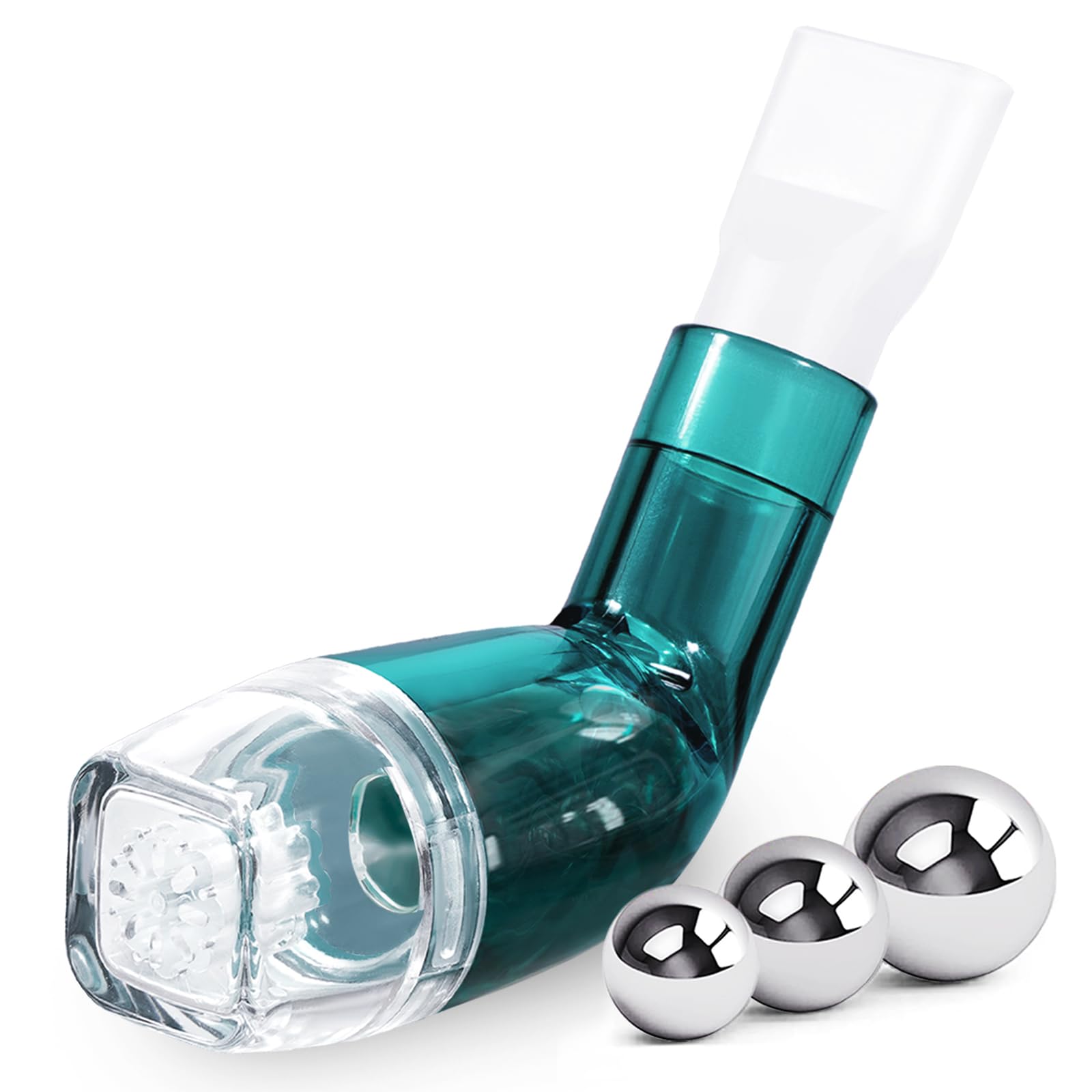
This flutter valve device is mechanically different from pure resistance trainers. Instead of just making you breathe against a restricted opening, it uses three steel balls of different sizes that rattle and vibrate during exhalation, creating oscillations in the airway that help loosen and mobilize mucus. This positive expiratory pressure (PEP) mechanism is clinically prescribed for people with cystic fibrosis, COPD, bronchiectasis, and chronic bronchitis — it is a genuine medical tool, not just a fitness accessory.
Users with post-nasal drip, chest congestion, and chronic mucus production report significant relief. One reviewer who used it daily for a month said it reduced thick mucus and cleared regular mucus effectively, though they noted an initial need to adjust breathing rhythm to avoid chest tightness. Another user, whose pulmonologist recommended the device, found the instructions clear and the results immediate — the flutter vibration sensation was particularly effective at breaking up stubborn congestion. The transparent medical-grade PC body lets you see the steel balls moving, providing visual feedback that the oscillation mechanism is working.
Construction is solid and not flimsy, and the device disassembles easily for thorough cleaning. The three steel balls give three levels of resistance — larger balls are heavier and create more oscillation amplitude — though the adjustment is not as granular as a multi-level dial. One reviewer noted their normally quiet voice became stronger after using the device, suggesting improved expiratory muscle control. The main limitation is that this is an exhalation-focused device — it does not provide inspiratory resistance training for the diaphragm. If your goal is purely athletic endurance, a resistance trainer like the POWERbreathe or Tilcare is more appropriate. But for mucus clearance and lung hygiene, this flutter valve design is exactly what the doctor ordered.
Why it’s great
- Flutter vibration mechanism effectively loosens and clears mucus
- Medical-grade PC construction is durable and shatter-resistant
- Three steel balls provide adjustable resistance levels
- Pulmonologist-recommended for mucus management conditions
Good to know
- Exhalation-focused — does not train inspiratory muscles for athletic performance
- Only three resistance levels, less granular than dial-based trainers
- Requires breathing rhythm adjustment for optimal oscillation effect
FAQ
How long should I use a breathing trainer each day?
Can a breathing trainer help with asthma or COPD?
What is the difference between a flutter valve and a resistance trainer for lungs?
Final Thoughts: The Verdict
For most users, the best breathing trainer winner is the POWERbreathe Blue, Medium Resistance because its calibrated spring-valve mechanism provides precise, measurable inspiratory muscle loading backed by clinical research and decades of use in pulmonary rehab and elite sports. If you want a beginner-friendly device with a guided app and independent inhale/exhale control, grab the The Breather Pink. And for mucus clearance or post-nasal drip management, nothing beats the Flutter Valve Breathing Exercise Device with its oscillating steel ball mechanism.