
A trapped attic traps trouble. Without a properly sized gable vent or air return grille to exchange hot, humid air for cooler outside air, you invite mold, rot, sky-high energy bills, and premature shingle failure. The difference between a functioning attic and a problem attic often comes down to a single square of louvered aluminum or steel screwed into the gable end wall.
I’m Min — the co-founder and writer behind Gadgets Feed. For this guide I combed through hundreds of customer reviews and dimensional specs on aluminum gable vents, steel return air grilles, and register covers to isolate the frames that seal tight, resist rust, and move air without rattling.
Whether you need a paintable cover for a shed gable or a steel return grille for a hallway ceiling, this guide identifies the best attic vent cover by material durability, mesh protection, and real-world fit precision.
How To Choose The Best Attic Vent Cover
Choosing the wrong attic vent cover means fighting drafts, pest intrusions, or a rattling death-metal sound every time the wind picks up. You need to match the rough opening, the frame material, and the type of louver to your specific wall or ceiling cutout and climate conditions.
Measure the Rough Opening, Not the Old Vent
Every product in this category lists two numbers: the outer flange dimension and the inner duct-opening size. Always measure the actual hole in your wall or ceiling — not the old vent cover you are removing. If the rough hole is 12 x 12 inches, you need a vent with a 12 x 12 duct opening, even if the outer flange is larger. An incorrect measurement leads to a gap that lets in rodents or requires a frame shim.
Aluminum vs. Steel Frame
In an unconditioned attic where humidity and temperature swing wildly, aluminum resists corrosion far better than steel. Powder-coated steel is heavier and feels more premium indoors (hallways, bathrooms, living rooms), but bare steel will eventually rust in a vented attic. For gable vents installed on exterior walls, go aluminum. For interior ceiling return grilles, steel is fine and offers a stiffer, quieter mount.
Mesh Screen Density and Louver Design
The mesh screen behind the louvers is your only defense against birds, wasps, and squirrels nesting inside your attic. Look for an aluminum alloy or steel mesh integrated into the frame — a wide-gap mesh lets small pests through. The louver angle matters for wind-driven rain: fixed louvers with a steeper pitch (around 30 degrees) deflect water better than shallow, short louvers that let moisture blow straight through onto your insulation.
Quick Comparison
On smaller screens, swipe sideways to see the full table.
| Model | Category | Best For | Key Spec | Amazon |
|---|---|---|---|---|
| Zepoty 14×14 Gable Vent (White) | Premium Gable Vent | Attic & Shed Gable | 12×12 in vent opening / Aluminum / Paintable | Amazon |
| Zepoty 14×14 Gable Vent (Black) | Premium Gable Vent | Shed & Container Ventilation | 12×12 in vent opening / Black finish / Metal screen | Amazon |
| Howeall 14×14 Return Air Grille | Return Air Grille | Ceiling & Sidewall Returns | 14×14 in duct opening / Steel / Fixed louvers | Amazon |
| Howeall 12×12 Air Vent Cover | Adjustable Register | Wall & Ceiling Supply | 12×12 in duct opening / Steel / Multi-shutter damper | Amazon |
| Handua 14×4 2-Way Diffuser | Supply Register | Sidewall & Ceiling Supply | 14×4 in duct opening / Steel / Back damper | Amazon |
| Hon&Guan 12×12 Gable Vent | Value Gable Vent | Shed & Generator Enclosure | 10×10 in vent opening / Aluminum / Powder coated | Amazon |
| Hicarer 12×12 Gable Vent | Budget Gable Vent | Shed & Small Enclosure | 10×10 in vent opening / Aluminum / Includes gloves | Amazon |
In‑Depth Reviews
1. Zepoty 14″ x 14″ Gable Vent with Screen (White)

The Zepoty 14×14 gable vent is the standout choice for homeowners who want a rust-proof aluminum frame that can be painted to match any siding color. With a 12×12 inch rough opening and a full-coverage aluminum alloy mesh screen, it stops birds and squirrels from nesting inside your attic while allowing maximum passive airflow. The powder-coated white finish is glossy and consistent, and the fixed louvers are pitched steeply enough to shed wind-driven rain without interior soaking.
Customers consistently report an easy DIY install using just exterior silicone caulk — no screws required thanks to small nubs that bite into wood siding. At roughly 1 pound, the frame is lightweight yet surprisingly rigid; the tack-welded corners hold their shape during handling. The paintable surface lets you blend the vent into a freshly painted gable or leave it white for a clean contrasting trim look.
One minor caveat: the outer frame is only about 3/4 of an inch deep, so on very thick siding the vent may sit slightly recessed. Also, a few buyers noted the packaging box arrived unsealed during shipping. But the build quality and corrosion resistance make this the most versatile option for long-term attic ventilation on a residential home or shed.
Why it’s great
- Aluminum frame will not rust in humid attic conditions
- Paintable white surface matches any exterior color scheme
- Fine aluminum mesh blocks pests while allowing high airflow
Good to know
- Shallow frame depth (under 1 inch) may not suit very thick siding
- Box packaging sometimes arrives unsealed; inspect before installing
2. Zepoty 14″ x 14″ Gable Vent with Screen (Black)

The black version of the Zepoty 14×14 gable vent offers the same aluminum alloy construction and 12×12 inch vent opening as the white model, but with a darker aesthetic that blends into black trim, dark siding, or a metal shed. The louvered design is identical — fixed, steeply angled slats that push air efficiently while resisting rain ingress. The integrated aluminum mesh screen is dense enough to keep even small wasps from squeezing through.
Installation is straightforward: the frame ships with a traceable paper template to mark your cutout, and the small nubs on the back bite into wood when secured with exterior silicone — no screws needed for most wood-sided applications. Owners installing on a greenhouse or generator enclosure praised the built-in bug screen and the clean, modern look. The black finish appears uniform across the entire frame, with no thin spots or overspray.
One detail to note: the vent does not come with pre-drilled mounting holes or reinforced backing tabs, so if you plan to screw it into masonry or metal, you will need to drill pilot holes very carefully near the outer edge. The black finish is also not paintable if you change your mind later. For a bold, low-maintenance look on a dark exterior, however, this vent is a top pick.
Why it’s great
- Black baked-on finish resists UV fading on south-facing gables
- Includes a paper template for accurate cutout marking
- Aluminum alloy will not rust or corrode
Good to know
- No pre-drilled screw holes; careful DIY drilling required for hard surfaces
- Black color is not intended to be painted over
3. Howeall 14″W x 14″H Steel Return Air Grille

This Howeall 14×14 return air grille is the right choice when you need a heavy-duty, rattle-free cover for a ceiling or sidewall return duct in a conditioned space. The all-steel construction with a matte white powder-coated finish gives it a rigid, commercial-grade feel that does not flex or drum against the wall under high HVAC system static pressure. Fixed louvers and slotted vanes eliminate moving parts that could buzz or vibrate over time.
The grille is meticulously packaged — reinforced cardboard on both sides with impact-resistant corner guards at all four corners — so it arrives without bent vanes or chipped paint. Customers report a perfect fit when ordering the exact duct opening size (not the old grille dimensions). The matte white finish blends into white ceilings and walls, and the slotted vanes are wide enough to allow high CFM return airflow without whistling.
Because the louvers are fixed (not adjustable), you cannot close off airflow to balance the system. This is a pure return grille, not a supply register. The outer flange is 15.75 x 15.75 inches, so verify your ceiling frame can accommodate that overhang. For a quiet, durable, and professional-looking return air cover, this Howeall model is hard to beat in its size class.
Why it’s great
- Steel construction eliminates flex and drumming sounds
- Premium corner-guard packaging prevents shipping damage
- Fixed slotted louvers are completely silent in operation
Good to know
- Louvers are fixed — no airflow adjustment possible
- Must order based on duct opening, not old grille size
4. Howeall 12″ x 12″ Air Vent Cover for Wall or Ceiling
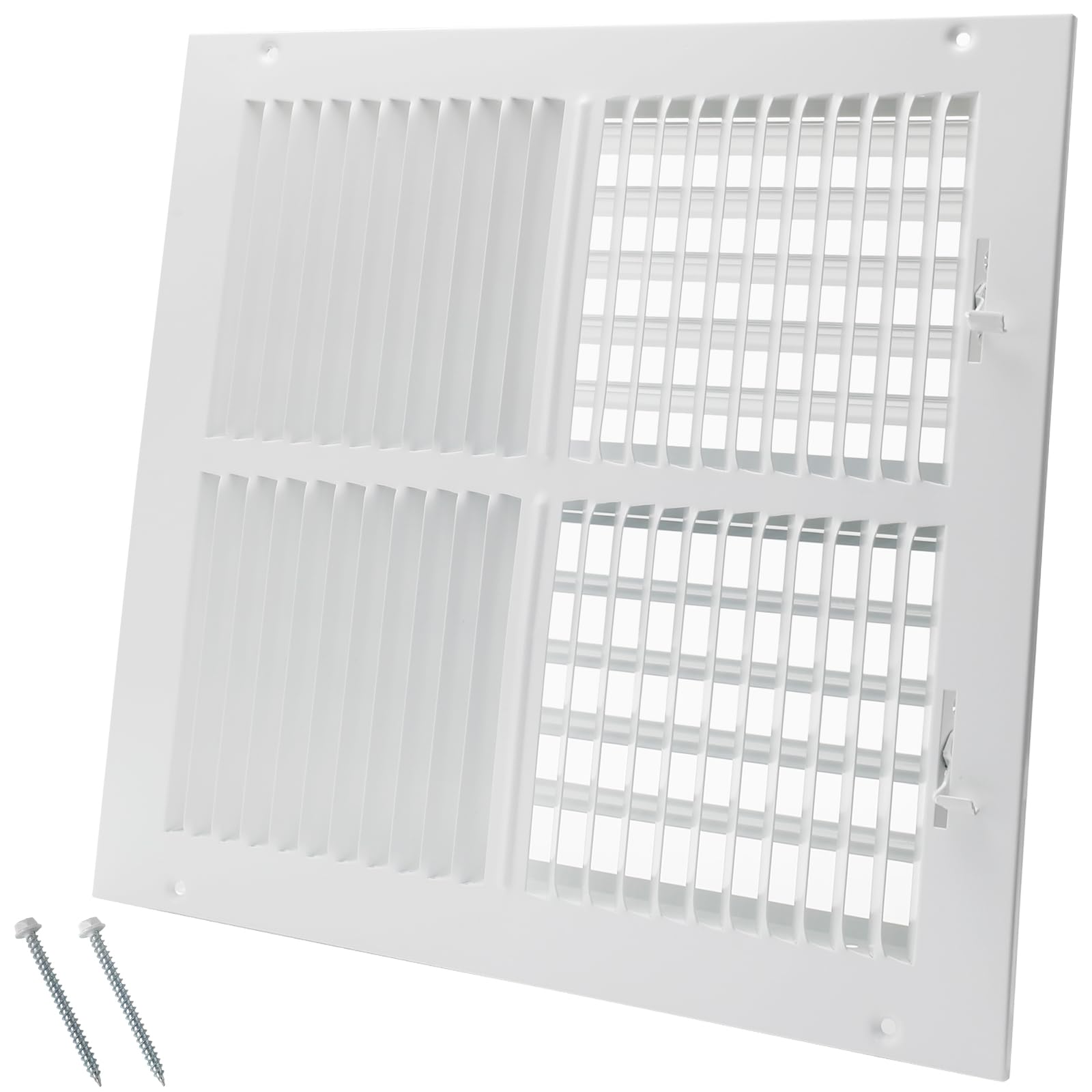
The Howeall 12×12 vent cover solves a common problem: an unregulated supply register that blasts air where you do not want it. Its multi-shutter damper lets you adjust airflow vertically from fully open to completely closed — the dampers seal tightly enough to stop drafts when turned off. Made from high-durability steel with a white powder coating, this cover resists warping under the temperature swings of furnace and AC cycles.
The outer flange measures 13.75 x 13.75 inches, so it neatly overlaps a standard 12-inch rough opening. Owners praise the strong metal construction and the smooth lever action that even a disabled user can reach and operate. The fixed outer frame and adjustable inner shutters work together to keep noise low — no rattles or metallic pings during operation. It suits sidewalls, ceilings, and even window-insert fresh-air applications.
One limitation: the shutters only adjust vertically, so you cannot redirect airflow horizontally. Also, the white paint finish is smooth but may show scuffs from handling during installation. For a supply register where you need on-demand control over how much conditioned air enters a room, this adjustable cover delivers premium functionality at a mid-range price point.
Why it’s great
- Multi-shutter damper allows fully closing off airflow
- Rustproof steel frame resists warping in temperature extremes
- Smooth lever action is easy to operate for all users
Good to know
- Shutters adjust only vertically, not horizontally
- White finish may scuff during installation
5. Handua 14×4 Duct Opening 2-Way Steel Air Supply Diffuser

The Handua 14×4 diffuser is built for narrow duct openings typically found in bathrooms, kitchens, and hallways where space is tight. Its 2-way louvered fins direct air to the left and right instead of straight down, reducing that unpleasant blast of cold air on the back of your neck while improving room air circulation. Made from heavy-gauge steel with a baked white powder coat, it has no sharp stamped edges — a safe choice for low-ceiling installations.
Back dampers are integrated into the design, allowing you to balance the system by partially closing off airflow to over-ventilated rooms. Installation is quick with the included color-matched screws, and the outer flange (15.75 x 5.75 inches) covers standard cutout imperfections. Owners consistently note the solid, non-flexing feel after tightening — the steel does not bow in the middle like thin aluminum alternatives. It also operates noise-free with no vibration.
The 2-way airflow pattern works best when the diffuser is mounted high on a sidewall or ceiling. If you need four-way (quad) diffusion for a central ceiling location, this directional design may leave corners of the room less conditioned. For tight, narrow runs where focused distribution matters, however, the Handua diffuser is the most effective unit in this size class.
Why it’s great
- 2-way louvered fins spread air without direct drafts
- Back damper gives airflow control in tight duct runs
- Stamped steel with no sharp edges — safe for low ceilings
Good to know
- 2-way pattern limited to left/right dispersion
- Outer overhang is only 1.75 inches — verify ceiling cutout margin
6. Hon&Guan 12″ x 12″ Gable Vent with Screen

The Hon&Guan 12×12 gable vent is a value-tier option that punches above its weight in build quality. The frame is heavy-duty aluminum with a premium powder-coated finish that resists fading and corrosion in outdoor exposure. The actual vent opening is 10.2 x 10.2 inches, so it fits a 10-inch rough cutout — a common size for sheds, generator enclosures, and crawlspace walls. The integrated fine mesh screen does an excellent job of keeping insects and small animals out.
Customers describe this vent as “almost commercial grade” thanks to the rigid aluminum louver slats and the snug fit within standard wall stud spacing. The fixed louvers are aerodynamically angled to encourage smooth airflow while minimizing wind noise — a real benefit for a generator enclosure or a sleeping-area wall. Installation requires only a screwdriver and the included hardware, and the white finish blends with most siding and trim colors.
Some owners note that the louver angle is relatively shallow, which means wind-driven rain can blow through the slots and reach the interior space. This vent is best suited for covered overhangs, soffit areas, or enclosures where direct rain exposure is limited. Also, the actual free-air area is about 6 x 6 inches due to the frame and louver obstruction, so do not expect the full 10-inch opening for CFM calculations.
Why it’s great
- Rigid aluminum frame with commercial-grade feel
- Fine mesh screen provides reliable pest protection
- Low wind noise due to aerodynamic louver design
Good to know
- Shallow louver angle lets wind-driven rain pass through
- Free-air area is smaller than the vent opening suggests
7. Hicarer 12″ x 12″ Aluminum Gable Vent (Black)
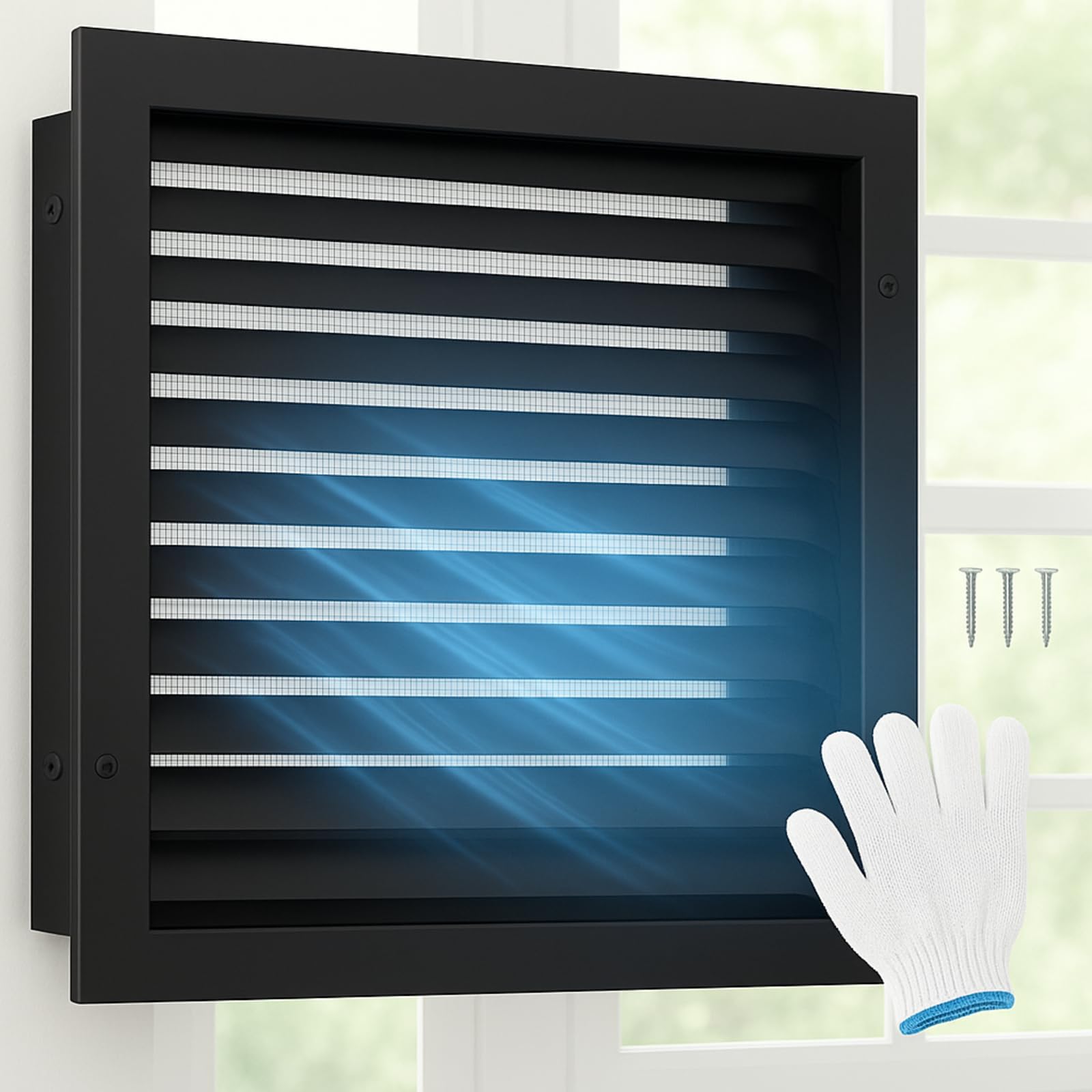
The Hicarer 12×12 gable vent is the most budget-friendly entry on this list, but it does not cut corners on the essentials — aluminum alloy construction, an integrated bug screen, and a complete installation kit that includes screws and gloves. The actual vent opening is 10 x 10 inches, making it a solid fit for small sheds, hot water heater closets, and generator enclosures where basic ventilation is the primary goal. The black finish is clean and uniform, adding a tidy appearance to any exterior wall.
Customer feedback consistently praises the easy installation and effective airflow. The louvered slats are noise-free — no rattling or whistling even in moderate wind. The included screen stops insects and debris from entering while still permitting passive ventilation. At just over a pound, the frame is light enough to handle with one hand during installation, yet the aluminum alloy holds its shape well against the pressure of screws and weather.
The main compromises are size limitations and the shallow louver depth: the frame only covers a 12-inch rough opening, so it will not suit larger gable cutouts. Some users also note that the aluminum is noticeably lighter gauge than the premium Zepoty or Hon&Guan units. For a quick, low-investment fix for a shed or enclosure that needs basic airflow, however, the Hicarer delivers exactly what it promises — no more, but no less.
Why it’s great
- Complete kit includes screws and gloves for immediate install
- Aluminum frame resists rust in unconditioned spaces
- Noise-free louvers in moderate wind conditions
Good to know
- Aluminum gauge is lighter than premium competitors
- Fits only 10×10 or 12×12 rough openings — not for larger cutouts
FAQ
Can I install a gable vent on a vinyl-sided house without removing siding?
Why does my attic feel hotter after installing a gable vent?
How do I stop wind-driven rain from coming through an attic vent cover?
Should I buy an aluminum or steel attic vent cover?
Final Thoughts: The Verdict
For most users, the best attic vent cover winner is the Zepoty 14×14 Gable Vent (White) because its paintable aluminum frame, full pest screen, and steep louver angle handle both residential attics and shed gables without rusting or warping. If you need a heavy-duty return air grille for a hallway ceiling, grab the Howeall 14×14 Steel Return Air Grille. And for a budget-friendly shed fix that still includes a bug screen and gloves, nothing beats the Hicarer 12×12 Gable Vent.