
Reviving an aging laptop or desktop means targeting the single biggest bottleneck: the spinning hard drive. Swapping a slow mechanical drive for a SATA solid-state drive cuts boot times from minutes to seconds, slashes game load screens, and makes an older system feel responsive again.
I’m Min — the co-founder and writer behind Gadgets Feed. I’ve spent hundreds of hours analyzing SATA SSD benchmarks, reading real-user reliability reports, and comparing controller and NAND configurations to help you navigate the entry-level upgrade market.
This guide focuses specifically on the 256 gb sata solid state drive market, breaking down which models use TLC versus QLC memory, how controller quality affects real-world speeds, and which drives offer the best endurance for daily use.
How To Choose The Best 256 GB SATA Solid State Drive
A 256GB SATA SSD is a calculated upgrade — enough capacity for an operating system, essential applications, and a handful of games, but not so large that cost spirals. Choosing the right one requires focusing on NAND cell type, controller intelligence, and the presence of a DRAM cache.
NAND Type: TLC vs QLC
TLC (Triple-Level Cell) NAND stores three bits per cell, hitting a sweet spot between cost, speed, and endurance. QLC (Quad-Level Cell) packs four bits per cell, which lowers the manufacturing cost per gigabyte but reduces write endurance and slows sustained write speeds. For a 256GB drive that will hold an operating system and see daily writes, TLC is the safer, more durable choice — which is why most of the top recommendations in this range use TLC chips.
Read and Write Speeds
SATA III limits theoretical throughput to about 560 MB/s. Look for sequential read speeds at or above 500 MB/s and write speeds at or above 450 MB/s. More important than peak sequential numbers is how the drive handles mixed random 4K reads and writes — this determines how snappy your desktop feels. Drives with SLC cache technology temporarily operate in pseudo-SLC mode to accelerate burst writes, which helps during file copies and application installations.
Physical Compatibility
These drives use the 2.5-inch form factor with a 7mm z-height, making them drop-in replacements for almost all modern laptops and desktop drive bays. Older systems may require a 9.5mm spacer — check your device’s bay depth. Compatibility extends to game consoles like the PlayStation 4 and Xbox One, which accept SATA III 2.5-inch drives. Double-check that your interface is SATA and not the shorter M.2 NVMe connector common in newer ultrabooks.
Quick Comparison
On smaller screens, swipe sideways to see the full table.
| Model | Category | Best For | Key Spec | Amazon |
|---|---|---|---|---|
| PNY CS900 250GB | Premium | Console storage upgrade | 535 MB/s seq. read | Amazon |
| Crucial BX500 240GB | Premium | Energy-efficient laptop upgrade | 540 MB/s seq. read | Amazon |
| Kingston A400 240GB | Premium | Older system power efficiency | 500 MB/s seq. read | Amazon |
| Silicon Power Ace A55 256GB | Mid-range | Budget-friendly OS drive | 500 MB/s seq. read | Amazon |
| RONGSHU RS550 256GB | Mid-range | Silent PC builds | 550 MB/s seq. read | Amazon |
| fanxiang S101 250GB | Budget | Cost-effective HDD replacement | 500 MB/s seq. read | Amazon |
| Vansuny 256GB | Budget | Entry-level desktop upgrade | 500 MB/s seq. read | Amazon |
In‑Depth Reviews
1. PNY CS900 250GB

The PNY CS900 hits the broadest sweet spot in the 256GB SATA category — it delivers a genuine 535 MB/s sequential read and 500 MB/s sequential write, which is right at the SATA III ceiling. The drive uses 3D NAND with a DRAMless controller that still manages snappy everyday responsiveness thanks to its firmware optimizations. Its 7mm z-height fits seamlessly inside PlayStation 4 and Xbox One consoles as a direct storage expansion.
Customer reports from the 2TB version indicate the drive runs cool under sustained load and remains completely silent — no vibration, no coil whine. The ultra-low power draw relative to competing models makes it a strong candidate for laptop upgrades where battery life matters. Backwards compatibility with SATA II connections means it still delivers a massive performance leap over an original HDD even in a backward interface.
The drive ships without any bundled cloning software, so plan for a free tool like Macrium Reflect or a manufacturer utility if migrating an existing OS image to this SSD.
Why it’s great
- Peak SATA III speeds at 535 MB/s read
- Ultra-slim 7mm design fits consoles and ultrabooks
- Runs cool and draws minimal power
Good to know
- No cloning software included in the box
- DRAMless design means sustained writes can slow after cache fills
2. Crucial BX500 240GB

Micron has been manufacturing NAND flash for over forty years, and the Crucial BX500 benefits directly from that engineering pedigree. The drive hits up to 540 MB/s sequential reads and uses a SLC cache layer that accelerates burst writes when you copy a large project folder or install a game. Crucial advertises this drive as 45 times more energy efficient than a typical hard drive — a genuine advantage for users running on battery.
Users migrating from a spinning 5400 RPM drive report boot times dropping from over two minutes to under fifteen seconds. The 7mm casing makes installation straightforward in slim laptops, though the drive does run warmer than some competitors during sustained large-file writes because of the DRAMless architecture. The Crucial Storage Executive software allows firmware updates and performance monitoring, adding a layer of ongoing support.
The BX500 ships with a standard three-year limited warranty, and Crucial’s customer service is known for handling replacements promptly. The drive has shown strong longevity in two review samples that operated continuously for over three years in a light server duty cycle. The biggest trade-off is write endurance: the 240GB capacity variant has a lower TBW rating than TLC-based competitors.
Why it’s great
- Excellent energy efficiency extends laptop battery runtimes
- Micron 3D NAND backed by decades of manufacturing expertise
- Dedicated maintenance software for firmware and health checks
Good to know
- Runs warmer during sustained large-file transfers
- Lower total bytes written (TBW) rating than TLC alternatives
3. Kingston A400 240GB

Kingston’s A400 is one of the most recognizable names in the entry-level SATA SSD space, and for good reason. The drive delivers 500 MB/s sequential reads and maintains low operating temperatures — reviews consistently show idle temperatures around 30 degrees Celsius, even inside poorly ventilated laptop chassis. The stainless steel enclosure adds physical rigidity compared to plastic-cased competitors, giving it a more durable feel during installation.
User reports from this 240GB variant show the drive retaining 90 percent health after several years of daily use, which suggests the controller does an adequate job of wear leveling even though it lacks a DRAM cache. The A400 is fully backwards compatible with SATA II controllers, meaning an immediate speed improvement in systems as old as 2010-era laptops. Sequential reads stay high in real-world use, though mixed random IO performance drops to around 350 MB/s during simultaneous read-write operations.
The bundled Acronis cloning software has received mixed feedback — some users reported failures when cloning 1.1TB to a 4TB drive, though the same utility works reliably for smaller migrations. For the 240GB capacity, using a free tool like Macrium Reflect is a safer bet. The 80 TBW endurance rating for this capacity is lower than TLC-equipped rivals, making it better suited for read-heavy workloads like web browsing and media consumption.
Why it’s great
- Stainless steel casing for enhanced physical durability
- Excellent long-term health retention reported by users
- Very low idle temperature — ideal for older laptops
Good to know
- 80 TBW endurance rating is low for write-intensive use
- Mixed IO performance drops significantly under concurrent reads and writes
4. Silicon Power Ace A55 256GB

Silicon Power packs an aggressive SLC cache implementation into the Ace A55, which gives burst write performance that exceeds many similarly-priced competitors. Sequential reads tick in at 500 MB/s consistently across CrystalDiskMark tests posted by users. The drive supports the TRIM command and garbage collection protocols, which maintain long-term performance by clearing invalid data blocks during idle periods.
The Ace A55’s 7mm slim casing slides easily into modern Ultrabooks, and users have successfully installed it in systems ranging from 2011-era HP TouchSmart all-in-ones to recent DIY gaming builds. One review noted the drive shipped pre-formatted as GPT, which required conversion to MBR for Windows 10 installation on older BIOS-based systems — a step easily handled through the diskpart utility but worth noting for less experienced builders.
Silicon Power offers a three-year warranty, though the manufacturer encourages online product registration to activate the full service. The drive’s endurance is middle-of-the-pack — adequate for an OS and daily applications but not ideal for heavy content creation scratch disks. The SLC cache fills relatively quickly on 256GB capacity, so sustained writes beyond a few gigabytes will drop to the native TLC write speed, which is roughly half the cached rate.
Why it’s great
- Aggressive SLC cache delivers fast burst writes
- Shock-resistant design with TRIM and ECC support
- Wide compatibility across very old and modern systems
Good to know
- SLC cache fills quickly — sustained writes slow significantly
- May require manual drive conversion from GPT to MBR on legacy BIOS systems
5. RONGSHU RS550 256GB
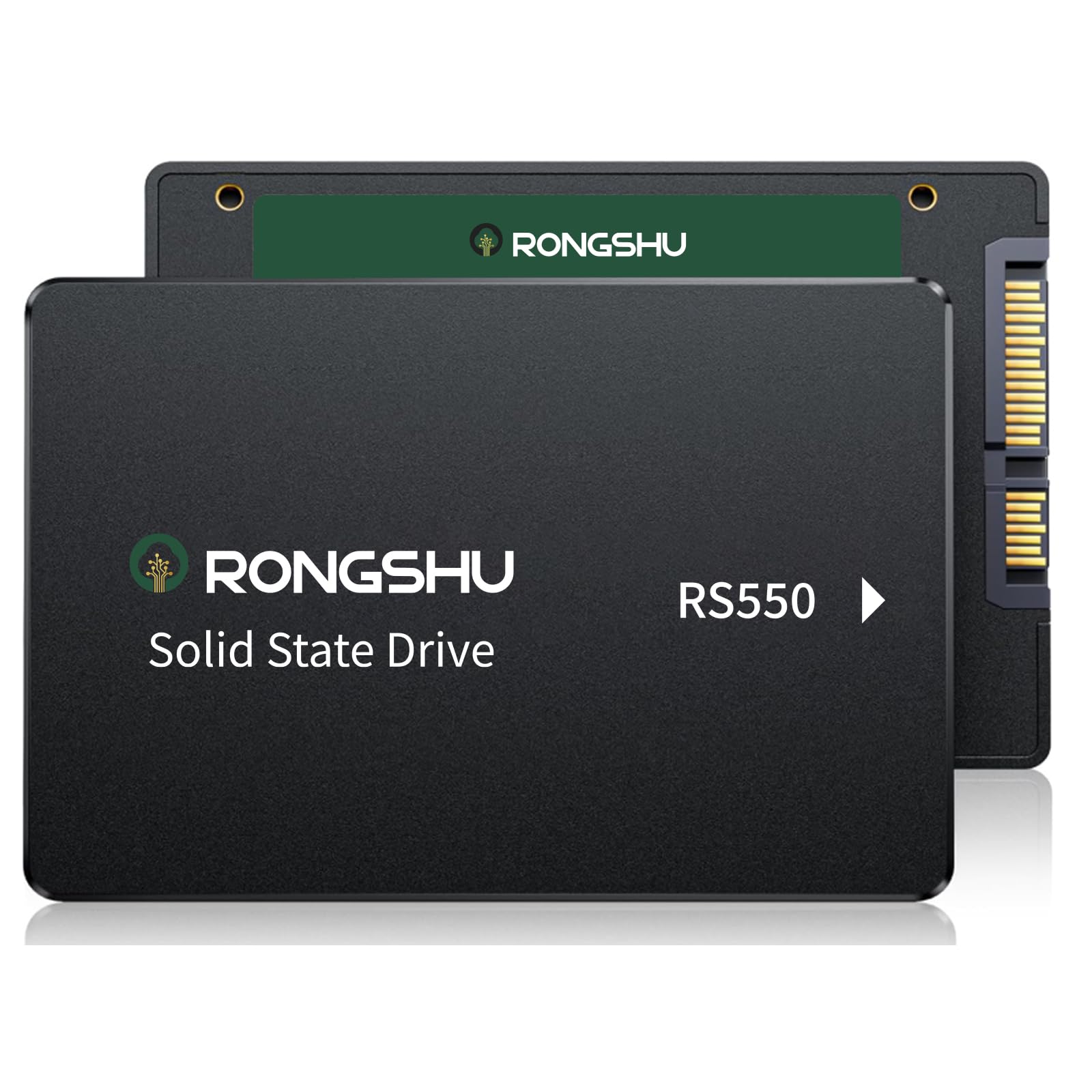
The RONGSHU RS550 claims 550 MB/s sequential reads and 500 MB/s sequential writes — numbers right at the SATA III cap. Testing inside a Z390-based test bench confirmed these figures with CrystalDiskMark 8.0. The drive uses an advanced 3D NAND TLC layer, which gives it a meaningful endurance advantage over QLC-based options at this capacity. At just 37 grams, it is one of the lightest 2.5-inch drives available, which reduces vibration potential in caddyless laptop mounts.
Users upgrading from failing HDDs in Windows 10 systems report that the drive eliminates 100% disk usage issues entirely, with boot drive activity dropping to 3-5% after cloning. One user paired it with a USB 3.0 to SATA adapter for cloning a 2013-era HP laptop and saw instantaneous improvements. The RS550 runs cool enough that active cooling is unnecessary, making it a strong candidate for quiet media center builds.
Compatibility is broad — the drive officially supports Windows 11, 10, 8, Vista, XP, macOS, and Linux. Some users noted that a fresh drive required formatting before the OS would recognize it, which is standard behavior for uninitialized storage. The three-year warranty offers baseline protection, though the brand’s customer service channels are less established than Crucial or Kingston, so factor that into your buying decision if warranty support is a priority.
Why it’s great
- Peak theoretical SATA III read and write speeds
- Ultra-light 37-gram construction reduces vibration
- TLC NAND provides superior write endurance vs QLC
Good to know
- May need initial formatting before the OS detects it
- Customer service network is less established than larger brands
6. fanxiang S101 250GB

The fanxiang S101 represents the most aggressive price-to-performance ratio in the 256GB SATA space, leveraging TLC NAND to deliver 500 MB/s reads and writes at a budget entry point. The use of TLC over QLC is a meaningful differentiator here — TLC provides significantly higher program/erase cycle endurance, which translates to a longer usable lifespan under write loads like frequent file editing or game patching.
User experiences are polarized. Several reviewers report flawless operation after six months, with instantaneous boot times and cool, quiet operation after cloning their original HDD. However, at least one verified review documented a corrupted drive after a couple of months in an older laptop, with the failure attributed to the age of the host system rather than the drive itself. This suggests the S101 is sensitive to power delivery from very old SATA controllers.
The drive is compatible with Xbox Series S/X consoles as external storage, and the polycarbonate enclosure keeps weight down. fanxiang backs it with a three-year limited warranty, which provides some recourse if you encounter an early failure. For a secondary storage role in a modern system, the S101 hits a cost point that is hard to beat, but I would hesitate to trust it as a primary OS drive in a mission-critical machine.
Why it’s great
- TLC NAND at the most competitive price point
- Good compatibility with Xbox Series consoles
- Three-year warranty for budget purchase protection
Good to know
- Mixed long-term reliability — some early failures reported
- Polycarbonate shell feels less premium than metal enclosures
7. Vansuny 256GB

Vansuny’s 256GB SATA SSD targets the pure entry-level buyer who just needs a boot drive that is dramatically faster than a mechanical hard disk. It delivers 500 MB/s reads and 450 MB/s writes — numbers that match the SATA III ceiling for a DRAMless controller with 3D NAND. The classic ABS plastic enclosure keeps the build weight low, though it lacks the premium feel of metal-clad competitors.
User reviews spanning nearly a year of daily use in a gaming PC report zero compatibility issues and stable performance. The drive runs silently — no mechanical noise to filter, which is the baseline expectation for an SSD but still a relief coming from a 5400 RPM HDD. The read speeds are consistent in sequential tasks, but the DRAMless architecture means multi-threaded random writes can bottleneck when the SLC cache is saturated.
The package includes a straightforward user manual. The manufacturer offers customer service, though response times from less-established brands can lag behind the major players. For a secondary cache drive or a boot drive in a non-critical system, the Vansuny delivers reliable performance at a low barrier to entry. The presence of a data recovery service mention in the specifications is unusual at this price bracket — the specifics of what that covers are not clearly defined.
Why it’s great
- Competitive read and write speeds for the price tier
- Silent operation — no moving parts
- Wide compatibility with desktops and laptops
Good to know
- Performance drops during sustained heavy writes due to DRAMless design
- Customer support response times are less predictable than established brands
FAQ
Is a 256 GB SATA SSD big enough for Windows and daily apps?
Can I use a 256 GB SATA SSD in a PlayStation 4 or Xbox One?
Final Thoughts: The Verdict
For most users, the 256 gb sata solid state drive winner is the PNY CS900 250GB because it combines peak SATA III speeds with console compatibility and a proven reputation for cool, reliable operation. If you want maximum energy efficiency and a trusted Micron pedigree, grab the Crucial BX500 240GB. And for a pure budget OS drive in a non-critical system, nothing beats the value-per-dollar of the fanxiang S101 250GB for the lowest entry cost to solid-state storage.