
A bikepacking sleeping bag faces a unique punishment: crammed into a handlebar roll or saddle pack, strapped to a frame that rattles over gravel, and deployed at the edge of a trail after a day of hard pedaling. The enemy isn’t just the cold — it’s the cubic inches your bag occupies inside your kit. Every liter of volume and every ounce of weight is a direct trade-off against water, food, or gear repair supplies. A bag that fits a backpacker’s 60-liter pack may be a deal-breaker for a bike, where space is measured in single-digit liters.
I’m Min — the co-founder and writer behind Gadgets Feed. For this guide, I’ve spent dozens of hours analyzing the specific demands bikepackers place on sleep systems — examining compressed volumes against handlebar roll diameters, comparing weight-to-warmth ratios across down fill powers and synthetic insulations, and cross-referencing temperature ratings with real-world user data from multi-day bikepacking trips across varied terrain.
Whether you’re chasing gravel doubletrack in the Appalachians or sleeping above treeline on a Colorado bikepacking route, the right sleep system defines your trip as much as your tires. This guide breaks down the most critical specs and real-world performance factors to help you find the best bikepacking sleeping bag for your bike and your backcountry ambitions.
How To Choose The Best Bikepacking Sleeping Bag
Most bikepackers overestimate how much pack volume they can dedicate to a sleeping bag. A typical handlebar roll holds 10 to 15 liters. A bag that stuffs to 8 liters leaves you 2–7 liters for a tent or tarp. That constraint drives every decision below.
Compressed Volume Over Trail Weight
A 2-pound bag that compresses to 10 inches by 7 inches fits inside a standard handlebar roll. A 2-pound bag that compresses to 15 inches by 8 inches may not. Look for the “stuffed size” dimension rather than just the listed weight. Down bags with 650+ fill power generally compress smaller than synthetic bags of the same warmth.
Temperature Rating and Bikepacking Microclimates
Bikepackers often camp near water sources or at elevation gain, where overnight temps drop harder than expected. A 20°F rating is the sweet spot for three-season bikepacking — warm enough for high-altitude summer nights yet light enough to pack small. Know that ISO limit ratings exist: a bag rated for 20°F limit means you can survive that temp, but comfort rating is typically 10–15°F higher.
Zipper Design and Shape
The zipper is a bag’s failure point. YKK #5 or larger zippers with anti-snag sliders last longer when packed against dirty frame bags. Mummy shapes save weight and volume but can feel restrictive for side sleepers; semi-rectangular shapes offer more wiggle room for similar warmth but add ounces. A footbox vent zipper is a major bonus for dialing temperature on variable nights.
Quick Comparison
On smaller screens, swipe sideways to see the full table.
| Model | Category | Best For | Key Spec | Amazon |
|---|---|---|---|---|
| Sea to Summit Spark | Premium Down | Ultralight bikepacking | 850+ FP down / 1.3 lbs / 30°F | Amazon |
| Kelty Cosmic 20 Down | Mid-Range Down | Value down performance | 550 FP down / 2 lbs 6 oz / 20°F | Amazon |
| Kelty Cosmic Synthetic 20°F | Mid-Range Synthetic | Damp conditions reliability | Cirroloft synthetic / 2 lbs 13 oz / 20°F | Amazon |
| TETON Sports ALTOS 20°F | Budget Synthetic | Roomier fit on a budget | Synthetic fill / 3.5 lbs / 20°F / 32″ wide | Amazon |
| QEZER Down Sleeping Bag | Budget Down | Winter-capable down at low cost | 600 FP down / 2.34 lbs / 15°F | Amazon |
| ZOOOBELIVES Alplive T400 | Budget Down | Summer bikepacking and dual-use | 650 FP down / 1.7 lbs / 32-50°F / 11″x6.7″ | Amazon |
| QEZER Semi-Rectangular | Budget Down | Larger sleepers needing room | 600 FP down / 2.54 lbs / 41-54°F / 86.6″ x 30.7″ | Amazon |
| Kelty Cosmic Synthetic Long | Mid-Range Synthetic | Tall bikepackers | Cirroloft synthetic / 2 lbs 13 oz / 20°F / fits 6’6″ | Amazon |
In‑Depth Reviews
1. Sea to Summit Spark Ultralight Down Sleeping Bag
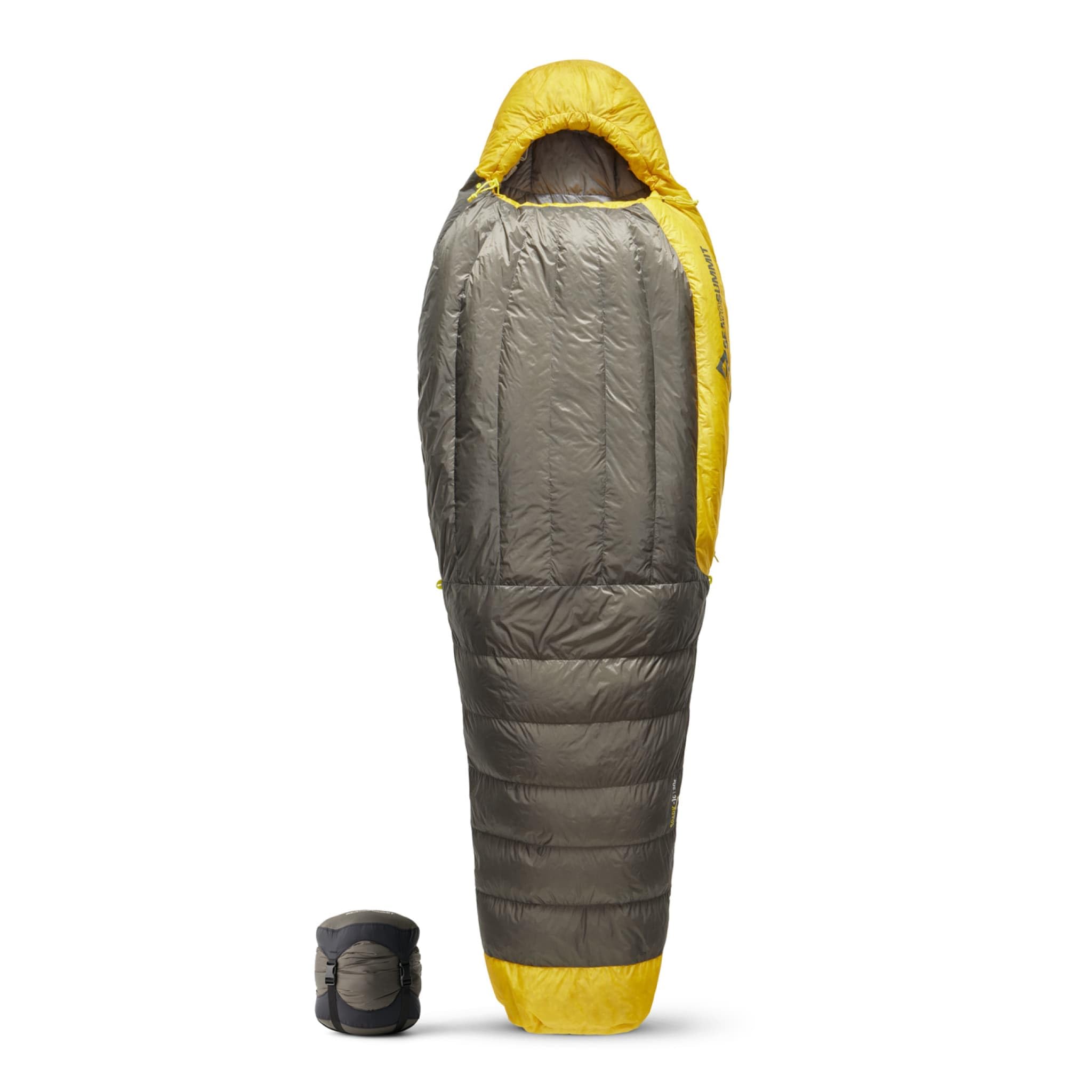
The Sea to Summit Spark is the lightest and most packable bag in this roundup — a 30°F mummy that weighs only 1.3 pounds and compresses small enough to fit inside a handlebar roll with room to spare for a bivy sack. The 850+ fill power down with Ultra-Dry treatment provides exceptional warmth-to-volume performance, while the 10D nylon shell with PFC-free DWR shrugs off overnight condensation without adding bulk.
Hybrid box baffles across the torso trap heat effectively, while sewn-through baffles in the leg area reduce weight where you don’t need as much loft. The contoured mummy shape allows a natural sleeping position without the tent-like dead air space that heavier bags carry. At 32.5 inches wide in the regular size, it accommodates broad shoulders better than most ultralight bags.
This is a dedicated summer-to-mild-spring bag — its 30°F rating means real-world comfort sits around 40°F or above with a proper sleeping pad. The YKK #5 zipper is reliable and snag-free, and the lifetime guarantee backs the premium construction. For bikepackers optimizing every gram, the Spark sets the high-water mark.
Why it’s great
- Unmatched 1.3 lb weight for a 30°F bag
- Comfort volume under 5 liters compressed
- 850+ FP down with hydrophobic treatment
Good to know
- Premium pricing suits weight-obsessed builders only
- 10D shell requires care against sharp frame bag edges
- Not warm enough for shoulder-season alpine nights
2. Kelty Cosmic 20 Down Mummy Sleeping Bag

The Kelty Cosmic 20 Down is a proven workhorse that brings Responsible Down Standard certified 550-fill down to a 20°F rating at a weight that competent bikepackers will tolerate — roughly 2 pounds 6 ounces for the regular. The stuffed size of 13 by 7 inches fits inside most handlebar roll setups, especially when using the included compression stuff sack to reduce volume further.
Kelty updated this classic with recycled nylon and polyester taffeta shell and liner fabrics, finished with a PFAS-free DWR that handles condensation without adding weight. The ISO limit rating of 21°F is genuine: real-world users report comfort down to the upper 20s with a base layer. The draft collar and hood effectively trap warm air, and the two-way zip allows venting from the footbox when temps climb above freezing.
Mummy shape fits snug at the shoulders — side sleepers or broad-shouldered riders may find the long version more comfortable. The 550 fill power doesn’t compress as tightly as higher-fill bags, but the price-to-performance ratio is among the best in the down sleeping bag category. For bikepackers who want a single three-season bag without paying premium ultralight prices, this is the smart buy.
Why it’s great
- Excellent warmth-to-cost ratio for a 20°F down bag
- RDS certified down with traceability tag
- Recycled fabrics with non-toxic DWR finish
Good to know
- Snug shoulder width for larger frames
- 550 FP packs less tightly than premium down
- Not a true ultralight at 2 lbs 6 oz
3. Kelty Cosmic Synthetic Fill 20 Degree Backpacking Sleeping Bag

The Kelty Cosmic Synthetic delivers reliable warmth in damp conditions where down loses its insulating properties. The Cirroloft synthetic insulation maintains loft even when wet, making this a smart choice for bikepackers who ride in rainy climates, cross rivers, or expect to pack a damp bag back into a frame bag after a rainy night. At 2 pounds 13 ounces, it’s heavier than down equivalents but still manageable for shorter trips.
The 380T nylon taffeta shell and 50D polyester lining are durable enough to handle the abrasion of being packed and unpacked next to camp tools or bike parts. The footbox measures a generous 28 inches wide, offering enough space for side sleepers to curl without compressing the insulation. A stash pocket on the exterior holds a phone or headlamp without digging inside the bag.
Compressed size with the integrated stuff sack lands around the size of a large watermelon — noticeably larger than a down bag of the same temperature rating. However, the damp-weather security is a real trade-off. Users consistently report comfort in the mid-30s with a fleece layer, and the draft tubes prevent cold air infiltration. For bikepacking in the Pacific Northwest or similar wet environments, this synthetic bag holds real advantages.
Why it’s great
- Insulation retains warmth when damp
- Durable nylon/polyester fabrics for rough handling
- Footbox vent zipper for temperature regulation
Good to know
- Bulky compression — needs 15+ liter pack space
- Heavier than down bags by about a pound
- Not as breathable as down in mild conditions
4. TETON Sports ALTOS 20 Degree Sleeping Bag

The TETON Sports ALTOS is a synthetic mummy bag that prioritizes interior space over weight savings. At 32 inches wide in the shoulder area and built with a generous footbox, it sleeps significantly roomier than tapered down bags. This makes it a strong option for side sleepers or larger-framed bikepackers who find standard mummy bags too restrictive for all-night comfort.
The water-resistant shell and highly compressible synthetic fill perform well in variable conditions — reviewers report comfort at 28°F with an appropriate pad, though the ISO comfort rating realistically sits in the low 30s. The compression sack features heavy-duty straps for reducing volume, but expect a final packed size around 11 by 8.5 by 8.5 inches, which requires a larger handlebar roll or dedicated dry bag on the frame triangle.
At 3.5 pounds, the ALTOS is the heaviest bag in this roundup. That weight penalty is meaningful for multi-day bikepacking trips where every pound climbs passes on your back. For weekend loops and bikepacking trips on moderate terrain where pack weight matters less than sleeping comfort, the ALTOS offers a compelling balance of space, warmth, and low price.
Why it’s great
- 32-inch width for unrestricted movement
- Water-resistant shell sheds tent condensation
- Accurate 20°F temperature rating testing
Good to know
- 3.5 lbs is heavy for serious bikepacking
- Compressed volume requires large bag space
- Not as compressible as down alternatives
5. QEZER Down Sleeping Bag (Mummy)
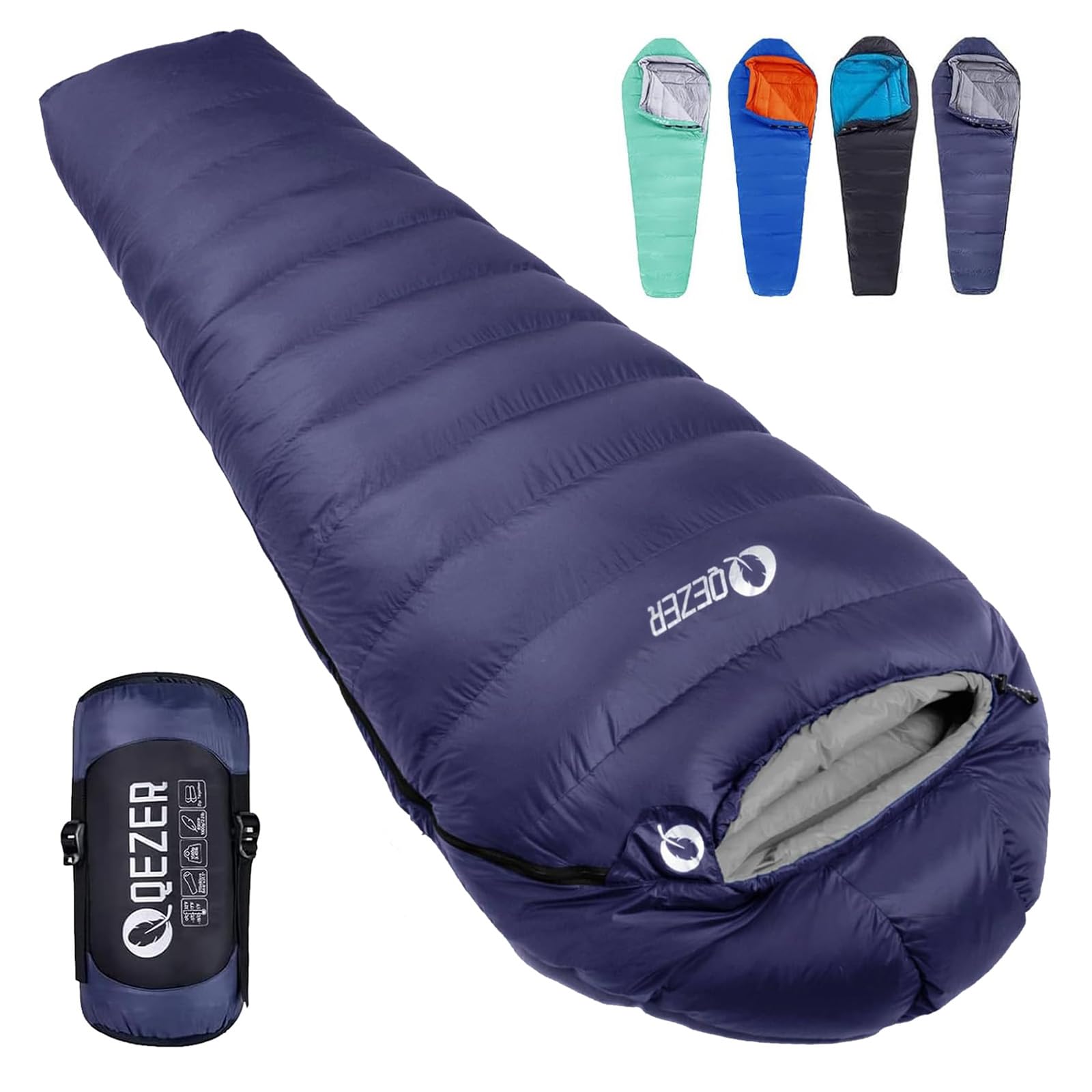
The QEZER mummy down bag punches above its weight class: 600-fill-power duck down inside a 400T tear-resistant nylon shell, rated to 15°F with an ISO extreme of 28°F. At 2.34 pounds and a compressed size of 13.8 by 6.3 inches, this bag fits easily into frame bags or a handlebar roll. The trapezoidal footbox design prevents the cramped toe feeling common in budget mummy bags.
Real-world reviews confirm comfort down to the upper 20s and even single-digit survival with proper layering — one user reported sleeping in Colorado mountain snow and freezing rain without issue. The dual zipper design allows left and right bags to couple into a two-person system, and the draft tube along the full zipper length prevents heat loss at a critical sealing point.
The bag’s shell feels less premium than the Kelty or Sea to Summit options — the nylon is thinner and the zipper lacks anti-snag refinement. Storage requires careful handling near sharp objects. For bikepackers on a tight budget who need a genuine winter-capable down bag, the QEZER delivers warmth and packability that punches well above its price point.
Why it’s great
- 15°F rating with real-world warmth to teens
- Packs to 13.8″ x 6.3″ for tight bike storage
- Two-way zip allows venting and pairing
Good to know
- Thin shell requires care near bike components
- Draft tube lacks baffle at zipper gap
- Not as loft-efficient as higher FP down
6. ZOOOBELIVES Ultralight Alplive T400 Down Sleeping Bag

The ZOOOBELIVES Alplive T400 is a down quilt-style bag designed for warm-weather bikepacking, weighing just 1.7 pounds and compressing to a ridiculously small 11 by 6.7 inches. The 650-fill-power duck down and 20D nylon shell create a package that disappears into a frame bag or handlebar roll with almost no volume penalty. The rectangular shape offers a spacious, comforter-like feel that side sleepers will appreciate.
This bag doubles as a quilt: the bottom zipper opens to vent feet, and it can fully unzip to become a large blanket covering two people. The envelope shape lacks the thermal efficiency of a mummy — reviewers confirm comfort stops at about 50°F, with 55°F being the realistic lower limit for most users. Below 50°F, a liner or extra clothing layer becomes necessary.
The 20D shell fabric feels plasticky and rustles during movement, but it’s durable and water-resistant for its weight class. The included compression sack is functional but basic. For bikepackers who primarily ride in summer months and want the absolute smallest packed size possible, the Alplive T400 offers a compelling down bag at a budget-friendly price.
Why it’s great
- Remarkable 1.7 lbs and 11″ x 6.7″ compressed size
- Converts to rectangular quilt for dual use
- Spacious envelope shape avoids mummy claustrophobia
Good to know
- Warm-weather only — not reliable below 50°F
- Fabric rustles and lacks soft hand feel
- Poor warmth-to-weight ratio compared to mummy shapes
7. QEZER Down Sleeping Bag (Semi-Rectangular)

The semi-rectangular QEZER down bag provides a generous 30.7-inch width at 86.6 inches long, offering ample space for larger sleepers or those who prefer not to be cocooned in a tight mummy shape. The 600-fill-power duck down and 400T nylon construction produce a bag that packs to 13.78 by 6.3 inches — manageable for mid-size handlebar rolls — while sleeping like a spacious cocoon.
The comfort rating of 41°F to 54°F limits this bag to three-season use above freezing. Reviewers confirm reliable warmth into the 40s, with some using it successfully in the 30s with a base layer and insulated pad. The double zipper design works well for pairing two bags together, and the foot zip provides venting when temperatures rise during the night.
Build quality is decent for the price bracket: dense stitching, even down distribution, and minimal down leakage reported. The outer fabric is thin — one user reported a puncture from a splinter that required a patch. For bikepackers who prioritize sleeping comfort and interior space over the last gram, this QEZER offers a compelling compromise between a mummy and a full rectangular bag.
Why it’s great
- 30.7-inch width for unrestricted sleep movement
- Good packability for a semi-rectangular shape
- Foot vent zipper improves temperature regulation
Good to know
- Warm-weather rating — not for near-freezing nights
- Thin shell prone to punctures from trail debris
- Heavier than mummy alternatives by ~8 ounces
8. Kelty Cosmic Synthetic Fill Long Sleeping Bag
The Long version of the Kelty Cosmic Synthetic extends the bag length to accommodate sleepers up to 6’6″, addressing a common pain point for taller bikepackers who find standard mummy bags leave their feet pressed against cold, compressed insulation. The 20°F Cirroloft synthetic fill retains the same warmth profile as the regular version, with total weight increasing slightly to about 3.16 pounds with the compression sack.
The packed size scales up proportionally: expect a compressed dimension around 14 by 9.5 inches. That requires a larger handlebar roll or frame bag, but the payoff is a bag that doesn’t sacrifice warmth at the feet. The natural-fit footbox provides genuine toe space — a frequent complaint among tall users in budget bags. The two-way zipper starts approximately 2 feet from the bottom, allowing foot venting without unzipping the entire bag.
For taller riders who also need damp-weather reliability, this is a niche but essential option. The shell is 380T nylon taffeta with a 50D polyester lining, both materials durable enough for repeated compression against frame bag edges. The integrated compression straps cinch down the extra material effectively. It’s not the lightest bag, but for riders over 6 feet, this may be the best-fitting bag that still works within a bikepacking volume budget.
Why it’s great
- Genuine fit for sleepers up to 6’6″
- Damp-weather reliable synthetic insulation
- Spacious footbox prevents cold toes
Good to know
- Compressed size needs a large handlebar roll
- 3.16 lbs with sack is heavy for long tours
- Zipper can snag if zipped too quickly
FAQ
What temperature rating should a bikepacking sleeping bag have for summer trips?
Can I use a backpacking sleeping bag for bikepacking or are they different?
Is synthetic or down better for bikepacking in wet conditions?
Final Thoughts: The Verdict
For most bikepackers, the best bikepacking sleeping bag winner is the Kelty Cosmic 20 Down because it balances genuine 20°F warmth with a compressed volume that fits inside a standard handlebar roll, all at a price that doesn’t break the bank. If you need the absolute lightest load for multi-day alpine routes, grab the Sea to Summit Spark — its 1.3-pound weight and 850+ FP down redefine what’s possible on a bike. And for bikepackers riding in consistently damp climates, nothing beats the Kelty Cosmic Synthetic for reliable warmth when everything is wet.