
Nothing kills a busy workday faster than a stack of invoices where the second copy is barely a whisper. Carbonless 2-ply paper is supposed to solve that, but the wrong roll or sheet set can turn a routine print job into a jam-fighting, smudge-ridden nightmare. Whether you’re running a restaurant kitchen, a construction office, or a veterinary clinic, the paper you choose directly determines whether your duplicate forms are crisp and professional or unreadable and tossed.
I’m Min — the co-founder and writer behind Gadgets Feed. I’ve spent dozens of hours cross-referencing manufacturer specs, customer failure rates, and real-world printer compatibility to separate the genuinely useful carbonless paper from the problematic reams that waste your time and budget.
This guide cuts through the confusion to deliver a curated list of the best 2 ply printer paper options for every scenario — from thermal-free receipt rolls to laser-compatible letter-size sheets that produce legible duplicates on the first pass.
How To Choose The Best 2 Ply Printer Paper
Selecting the right 2-ply paper isn’t just about size. You need to match the coating type, collation method, and sheet weight to your specific printer technology — laser, inkjet, impact dot matrix, or thermal-free POS. Buying the wrong configuration leads to double-feeds, invisible carbon transfer, and wasted reams.
Carbonless Coating: CB vs. CF vs. CFB
The magic behind NCR (No Carbon Required) paper lies in micro-encapsulated dye. The top sheet has a Carbon-Back (CB) coating on its underside, while the bottom sheet has a Carbon-Front (CF) coating on its topside. When pressure from a printer head or pen breaks the capsules, the dye reacts with the CF clay to form an image. Some premium papers use a CFB coating — a single sheet with CB on one side and CF on the other, used for the middle ply in multi-part forms. Always verify your printer’s transfer mechanism; impact printers transfer better than laser engines, which require careful toner adhesion to the CB coating.
Collation: Straight vs. Reverse
Straight-collated 2-ply paper places the white CF sheet on top and the canary CB sheet underneath — intended for impact printers where the print head strikes the top sheet directly. Reverse-collated paper flips this order, placing the canary CB sheet on top and the white CF sheet on the bottom. This configuration is designed for laser and inkjet printers that print on the top surface only, relying on the toner’s heat or ink to bond with the coating for transfer. Using the wrong collation results in no image on the duplicate.
Paper Weight and Brightness
The best 2-ply paper for legibility starts at 20 lb bond weight per sheet. Lighter 15 lb continuous-feed paper works for dot matrix forms but feels flimsy and tears easily. Brightness, measured between 90 and 100 Candela, determines contrast on the bottom copy — 92 brightness is the practical minimum for readable duplicates. Premium reams hitting 95-100 brightness produce near-original clarity on the canary sheet, critical for legal or medical records that must remain legible after years of storage.
Quick Comparison
On smaller screens, swipe sideways to see the full table.
| Model | Category | Best For | Key Spec | Amazon |
|---|---|---|---|---|
| Limited Papers 2 Part Reverse | Premium Letter Sheet | Laser & Inkjet Duplicates | 20 lb, 90 Brightness, 500 Sheets | Amazon |
| Buck Tape 2 Part Reverse NCR | Premium Letter Sheet | High-Clarity Contract Forms | 21 lb, 92 Brightness, 500 Sheets | Amazon |
| Giroform HiTec 2 Part | Premium Letter Sheet | Laser & Offset Printing | 20 lb, 100 Brightness, 500 Sheets | Amazon |
| Appleton NCR 5887 | Mid-Range Letter Sheet | Cost-Effective Bulk Forms | 20 lb, 95 Brightness, 250 Sets | Amazon |
| FirstZi Continuous Feed | Mid-Range Continuous | Dot Matrix Invoices | 15 lb, 15 lb, 1000 Sheets | Amazon |
| Clipra Carbonless Receipt Rolls | Budget POS Roll | High-Volume Restaurant Receipts | 48 lb, 3″x95′, 32 Rolls | Amazon |
| BuyRegisterRolls Kitchen Rolls | Budget POS Roll | POS Kitchen Printer Paper | 50 GSM, 3″x95′, 10 Rolls | Amazon |
In‑Depth Reviews
1. Limited Papers 2 Part Reverse Carbonless Sheets

This ream from Limited Papers delivers the most reliable balance of sheet stiffness and carbon transfer clarity for laser and inkjet users. The 20 lb bond weight prevents the curling that plagues lighter stock when run through heated fusers, and the reverse collation (canary CB on top, white CF on bottom) aligns perfectly with how desktop printers apply toner. At 90 brightness, the canary copy retains enough contrast for legal and medical records without being washed out.
What sets this apart is the FSC certification and plant-based material sourcing — not just a marketing badge but a real indicator that the paper fibers are long and uniform, which reduces jamming from sheet-to-sheet friction. The coated finish grabs toner without flaking, so the duplicate appears clean even on older monochrome laser engines. Users report that the first printed sheet may need discarding to calibrate the transfer, but subsequent pairs produce crisp results when stacked correctly.
For offices that generate multi-part forms in moderate volumes (500 sheets per ream), this paper eliminates the guesswork of collation. Just load the ream as-is, print on the top sheet, and the bottom copy emerges fully formed. The heavier basis weight also makes edge-padding with fan-apart glue more reliable than on flimsy 15 lb stock.
Why it’s great
- Thicker 20 lb stock resists curling in laser fusers
- Reverse collation matches desktop printer orientation
- Plant-based fibers reduce static cling and jams
Good to know
- First print may require a test sheet to align transfer
- 90 brightness is adequate but not as high-contrast as 100-rated paper
2. Buck Tape 2 Part Reverse NCR Carbonless Paper
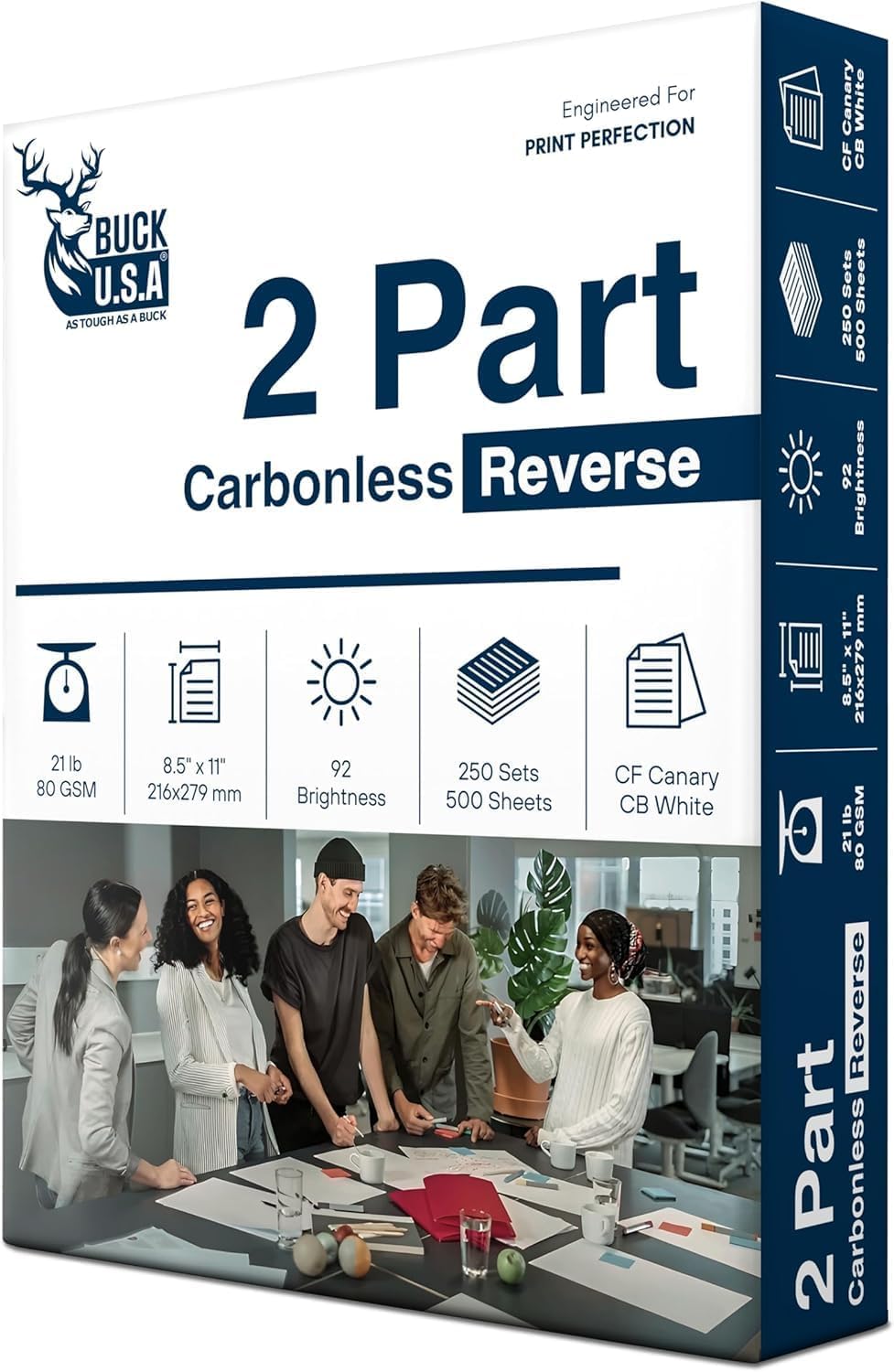
Buck Tape’s NCR paper pushes the weight to 21 lb with a 92 brightness rating, making it the densest sheet in this comparison. That extra basis weight translates directly to less show-through on the white original and a sharper CF image on the canary duplicate. The ultra-smooth finish is specifically engineered for laser printer compatibility — the toner bonds to the CB coating without the scattering that creates faint or patchy duplicates on rougher stock.
At 250 sets per ream, this is a targeted purchase for professionals who need high-clarity contracts, purchase orders, or medical forms where every character on the bottom copy must be readable. Users running HP Color LaserJets report zero jamming across full reams, with the caveat that a slight chemical smell is normal during the first few prints as the toner fuses with the carbonless coating. The package clearly marks the print side, reducing the common error of loading the wrong face up.
The 92 brightness is the practical sweet spot — bright enough for the canary sheet to look professional but not so high that the coating becomes brittle and flakes off during duplex printing. For offices that have struggled with carbonless paper that feels “waxy” or fails to transfer on the bottom sheet, this ream solves both problems at once.
Why it’s great
- 21 lb weight minimizes show-through and curling
- 92 brightness delivers exceptional duplicate clarity
- Ultra-smooth finish bonds toner without scattering
Good to know
- Higher weight may cause occasional double-feeds in friction-feed printers
- Some users report sheets sticking together if stored in humid environments
3. Giroform HiTec 2 Part Carbonless Paper

Giroform HiTec hits a 100 brightness rating — the highest of any sheet in this lineup — which means the white original looks like standard 24 lb bond, and the canary duplicate retains nearly identical contrast. This is critical for applications where the bottom copy will be scanned, faxed, or photographed, because higher brightness reduces the yellow cast that makes carbonless duplicates hard to read under office lighting.
The pre-collated 2-part sheets are optimized for laser, inkjet, copying, and offset printing, giving commercial print shops a single stock for multiple workflows. The 20 lb weight keeps sheets feeding reliably in high-speed copiers without the paper path skips common with heavier stock. Users running 55+ duplicate invoices through laser printers report that once you mark the top left corner to maintain orientation, the paper feeds consistently without jamming.
That said, the paper is not explicitly labeled as NCR — it is carbonless paper designed for transfer through pressure. Users who assumed it would work exactly like NCR paper in a standard printer had to manually separate and rearrange sheets to achieve transfer. Understanding this distinction before purchase is essential: Giroform HiTec delivers superior brightness and print quality when loaded correctly, but it demands attention to collation orientation.
Why it’s great
- Industry-leading 100 brightness for scan-ready duplicates
- Compatible with laser, inkjet, copier, and offset presses
- Includes reusable box and extra dividers for organization
Good to know
- Not labeled NCR — requires correct collation orientation for transfer
- Some users needed to separate and rearrange sheets manually
4. Appleton NCR 5887 Carbonless Paper

Appleton’s NCR 5887 is the original NCR paper formula now adapted for digital printers, and it offers the best cost-per-set in the mid-range tier. With 250 sets per pack at 95 brightness, the white original has a crisp, professional look, and the canary duplicate shows strong contrast for a 20 lb stock. The paper is both straight and reverse collated, meaning it can work in impact printers (straight) or laser printers (reverse) depending on how you load it.
The main trade-off is the learning curve. Users consistently report that sheets stick together out of the box, requiring manual separation before feeding to avoid double-feeds. The rough back side of the CF sheet can cause printer pickup roller issues if not properly fanned. However, once you master the fingernail test to identify the coated side and load correctly, the paper runs reliably for high-volume invoice printing. Applying fan-apart glue to stacks of 12-15 sets and clamping overnight creates professional padded forms.
Made in the USA with biodegradable materials, this is a solid choice for small businesses that print their own forms and don’t mind an initial setup investment. The 95 brightness outperforms many similarly priced options, and the sheer number of positive reviews from users who figured out the proper loading technique confirms that the paper itself is high quality — it just demands correct handling.
Why it’s great
- Original NCR formula with 95 brightness for sharp duplicates
- Bidirectional collation works with impact and laser printers
- Excellent cost-per-set for high-volume form printing
Good to know
- Sheets require manual fanning to prevent double-feeds
- Rough back side may cause pickup issues in some printers
5. FirstZi Continuous Feed Computer Paper 2-Ply

For businesses still dependent on legacy dot matrix printers — think fire alarm system logs, warehouse shipping manifests, or old-school accounting forms — FirstZi’s continuous feed 2-ply paper is the most practical option. At 9.5 x 11 inches with 1/2 inch margin perforations on both sides, it tears down to standard 8.5 x 11 inch sheets once the tractor-feed holes are removed. The 1000-sheet count (500 sets) provides a massive supply for high-volume environments.
The 15 lb paper weight is noticeably thinner than standard letter stock, but that’s intentional for continuous feed impact printers where thicker paper would cause jams around the platen. Users running the paper through OKI and Epson dot matrix units report bold, smudge-free letters once the paper is loaded with the correct orientation. The white/pink color combination is unusual but works well for color-coding invoice batches — the pink bottom copy stands out clearly in filing systems.
Quality control on perforations has been inconsistent. Some batches arrive with missing perforation holes on alternate sheets, causing the tractor feed to skip and jam the printer. The thin paper also lacks the stiffness needed for manual separation, and users who want tear-off tractor holes may find the perforations insufficient. Still, for the price per sheet, this remains the go-to choice for continuous feed dot matrix work.
Why it’s great
- High 1000-sheet count for uninterrupted batch printing
- Margin perforations tear down to standard letter size
- Bold, smudge-free ink adhesion on impact printers
Good to know
- Inconsistent perforation holes can cause tractor feed jams
- Thin 15 lb paper prone to tearing during separation
6. Clipra Carbonless Receipt Rolls
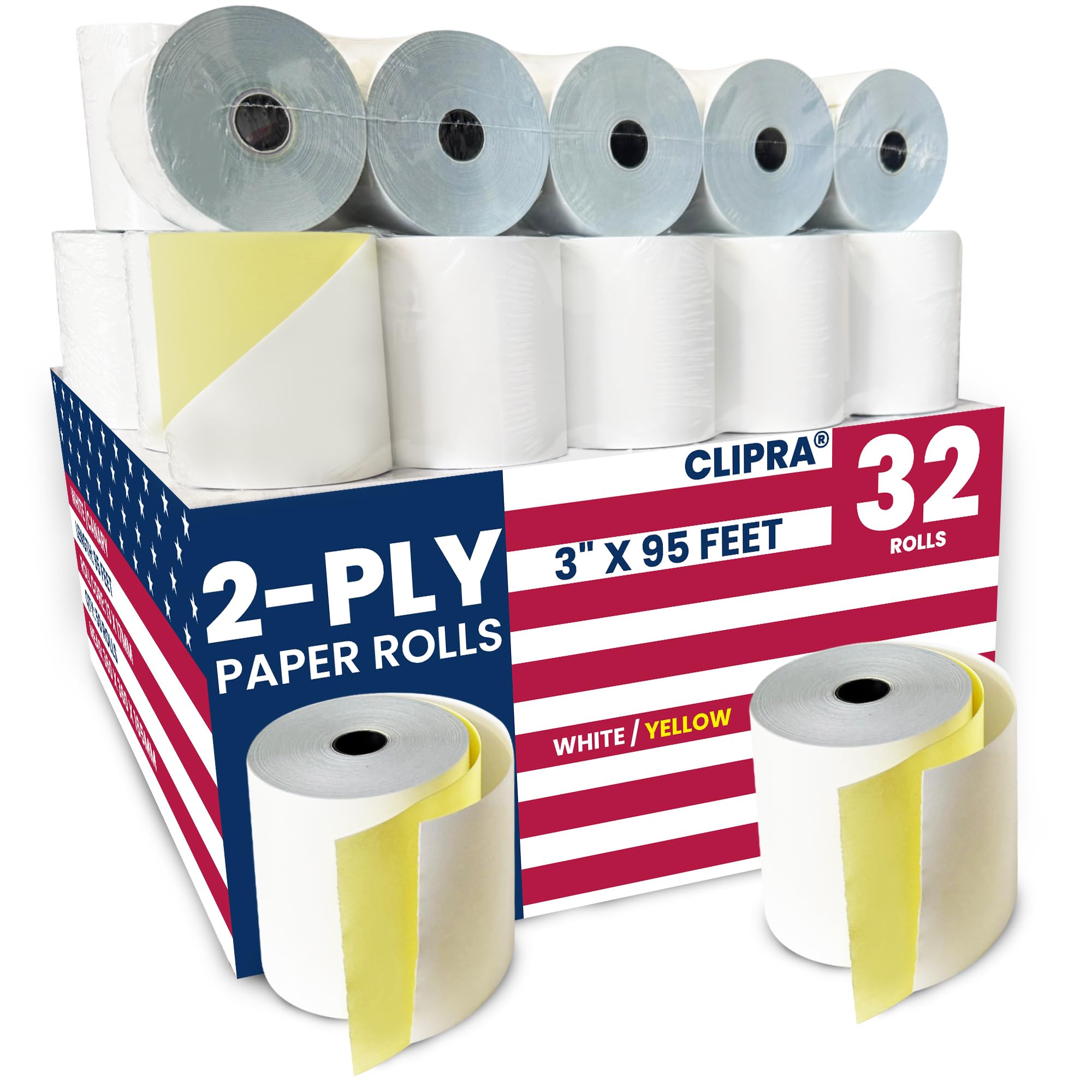
Clipra’s 32-roll box of 3-inch wide, 95-foot long carbonless receipt rolls is the volume play for busy restaurant and retail POS systems. The white/yellow 2-ply construction is non-thermal, meaning it requires a ribbon to print — this is important because thermal paper fades over time, while carbonless duplicates stored in a filing cabinet remain legible for years. The paper is BPA-free, a growing requirement for food service environments where receipts contact hands directly.
The 48 lb paper weight feels substantial compared to lightweight thermal stocks, and the roll length reduces changeover frequency during peak hours. Users feeding Star SP700 and SP2000 printers report zero jams and crisp, dark prints when paired with ERC-30 or ERC-34 ribbons. The rolls are shrink-wrapped in sets of four to prevent dust accumulation, a thoughtful detail for kitchen printers exposed to flour, grease, or humidity.
One limitation: these rolls are explicitly non-thermal, so they will not work in thermal-only POS terminals. You must confirm your printer supports carbonless ribbon-based printing. The white side must load facing up for proper image transfer to the yellow ply, a detail that first-time users sometimes miss, resulting in blank bottom copies.
Why it’s great
- 32 rolls per box minimizes reorder frequency
- BPA-free and non-fading for permanent record keeping
- Shrink-wrapped bundles protect against dust in kitchen environments
Good to know
- Requires ribbon — not compatible with thermal-only printers
- White side must face up for carbon transfer to yellow ply
7. BuyRegisterRolls Kitchen Printer Paper

BuyRegisterRolls offers a 10-roll starter pack of 3-inch wide, 95-foot carbonless paper in white/canary, purpose-engineered for kitchen display systems and compact POS terminals. The 50 GSM weight is slightly lighter than Clipra’s 48 lb equivalent but still feeds reliably through Star Micronics SP2000 and VeriFone Omni 480 printers. The red warning stripe at the end of each roll signals when a change is imminent — a small but practical feature for busy kitchens where surprise paper-outs cause order delays.
Compatibility is broad, covering POS-X, CBM, IDP, TSP100, and many other printer families. Users running Toast POS systems report flawless feeding with no jams, making this a safe default for restaurants that cannot afford paper misfeeds during dinner rush. The carbonless transfer produces legible yellow copies when loaded with the white ply on top, though a single negative review noted the yellow sheet image was too faint to read — likely a loading orientation error rather than a paper defect.
The shrink-wrapped packaging in 5-roll bundles keeps paper clean during storage, and the biodegradable material specification aligns with eco-conscious operations. At 10 rolls per order, this is an entry-level volume that lets you test compatibility before committing to a 32-roll bulk purchase from another brand.
Why it’s great
- Red warning stripe prevents unexpected paper-out during service
- Broad compatibility with Star, POS-X, VeriFone, and CBM printers
- Biodegradable material for eco-friendly operations
Good to know
- Yellow copy legibility depends on correct white-side-up loading
- Only 10 rolls per pack — higher-volume users may prefer the 32-roll option
FAQ
What is the difference between NCR paper and plain carbonless paper?
Why is my carbonless paper not transferring to the bottom sheet?
Can I use 2-ply carbonless paper in any laser printer?
How should I store carbonless paper to prevent coating degradation?
What does the red warning stripe on receipt rolls mean?
Final Thoughts: The Verdict
For most users, the best 2 ply printer paper winner is the Limited Papers 2 Part Reverse because it delivers the ideal combination of sheet stiffness, FSC-certified materials, and reliable laser printer compatibility at a moderate volume. If you need the absolute highest duplicate clarity for scanned contracts and medical forms, grab the Buck Tape 2 Part Reverse NCR with its 21 lb weight and 92 brightness. For continuous-feed dot matrix environments where tractor alignment is non-negotiable, nothing beats the FirstZi Continuous Feed 2-Ply for sheer sheet count and impact printer compatibility.