
The air you breathe indoors can harbor invisible threats — elevated CO₂ that saps focus, fine particulate matter from cooking or a nearby wildfire, and volatile organic compounds off-gassing from new furniture. Without a dedicated detector, you have no way to know when ventilation is needed or when a room has become a health hazard, leaving you tired, congested, or exposed to long-term risks you never see.
I’m Min — the co-founder and writer behind Gadgets Feed. I’ve spent hundreds of hours analyzing sensor technologies like NDIR CO₂ detection and laser particle counters, dissecting how air quality monitors handle PM2.5, TVOC, HCHO, and AQI in real home environments versus lab specs. This guide compiles that research into a clear, actionable comparison so you can spot the difference between a toy and a genuinely useful tool.
Whether you work from home, have allergies, or just want to understand the air you sleep in, this deep-dive into the best air pollution monitor choices on the market will help you find the right sensor package, battery life, and alert system for your specific indoor space.
How To Choose The Best Air Pollution Monitor
Choosing a monitor means deciding which pollutants matter most in your home, how long you need it to run untethered, and whether you want silent historical data or loud real-time alarms. These three criteria will guide you to the right tool for your indoor environment.
Sensor Type & Pollutant Coverage
The core of any air quality monitor lies in its sensor array. An NDIR (non-dispersive infrared) sensor is the gold standard for CO₂ readings — it’s stable, long-lasting, and accurate. For particulate matter (PM2.5, PM10), a laser particle counter is essential; cheap optical sensors drift over time. Ideally, your monitor should also include a dedicated VOC sensor for TVOC and HCHO (formaldehyde) detection, since those chemicals often come from paints, cleaning products, and furniture without any visible or olfactory cue.
Power, Portability & Display
Battery life ranges from a few hours to sixty days depending on the display technology used. A bright color LCD or LED screen is easier to read at a glance but drains power quickly, making these models best suited to a single room where they can stay plugged in. E-ink displays sip so little power that they can run for weeks or months on one charge, making them perfect for rotating between rooms or taking on trips. Decide whether you need the monitor in one fixed location or want to move it throughout your home.
Alerts, Connectivity & Data History
Some monitors offer audible alarms that buzz when CO₂ or PM2.5 passes a set threshold — great for immediate awareness but potentially annoying overnight. More advanced models connect to a smartphone app that logs historical data, graphs trends, and can even link to smart plugs or fans for automatic ventilation. If you’re a data-driven person tracking asthma triggers or optimizing a home office for cognitive performance, app connectivity and exportable CSV reports become valuable features. Simpler standalone units with just a screen and buzzer are sufficient for casual awareness.
Quick Comparison
On smaller screens, swipe sideways to see the full table.
| Model | Category | Best For | Key Spec | Amazon |
|---|---|---|---|---|
| GoveeLife Smart Air Quality Monitor | Premium | Smart home integration & CO₂ tracking | NDIR SCD4x CO₂ sensor, ±(40ppm+5%) accuracy | Amazon |
| Temtop M10+ | Premium | Long battery life & silent bedroom monitoring | E-ink display, 60-day battery, app connectivity | Amazon |
| KDWKD Air Quality Monitor | Premium | Comprehensive sensor suite | CO₂, PM2.5/PM10, HCHO, TVOC, temp/humidity | Amazon |
| 16 in 1 (7″ Display) | Mid-Range | Large readable display & visual alerts | 7-inch LED screen, 9 parameters + 7 alerts | Amazon |
| Coiliiot AirSense8 | Mid-Range | NDIR CO₂ + VOC detection on a budget | NDIR CO₂ sensor, 8-hour battery, laser PM | Amazon |
| Professional 16 in 1 (5.5″ Display) | Mid-Range | Portable multi-parameter testing | 5.5-inch display, 10-hour battery, 0.001 accuracy | Amazon |
| LifeBasis 11-in-1 | Budget | Entry-level whole-home awareness | NDIR CO₂ + laser PM sensor, 2500mAh battery | Amazon |
In‑Depth Reviews
1. GoveeLife Smart Air Quality Monitor
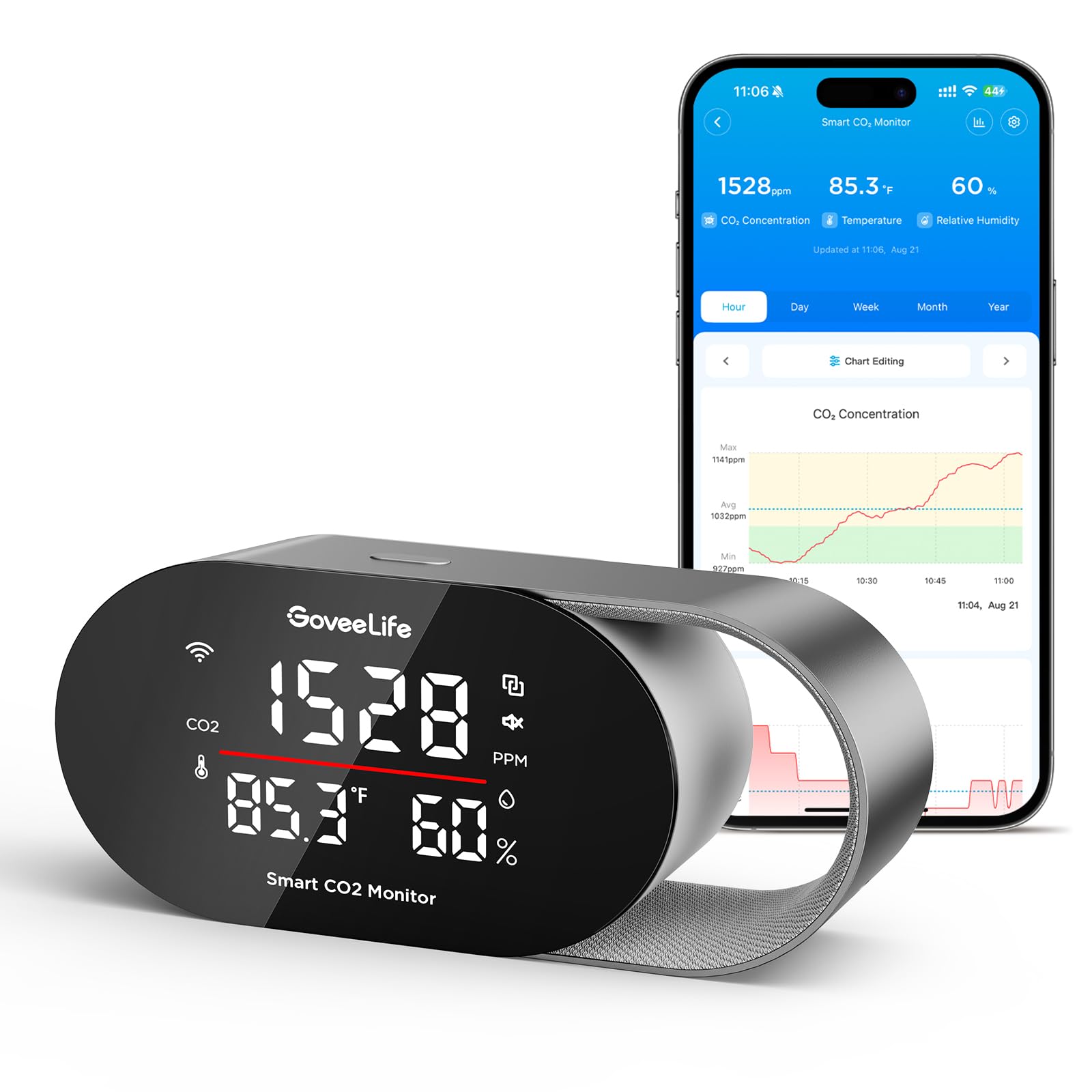
The GoveeLife monitor earns the top spot thanks to its premium photoacoustic NDIR CO₂ sensor (the SCD4x series) that delivers ±(40ppm + 5%) accuracy with a 5-second refresh rate. It logs CO₂, temperature, humidity, and a clock, but notably does not measure particulate matter or VOCs — this is a dedicated CO₂ station designed for cognitive performance and sleep quality. The tri-color light bar and programmable screen brightness automatically adjust via the app’s day/night schedule, eliminating disruptive light pollution in a bedroom.
Its triple alert system — built-in buzzer, push notification, and email report — ensures you never miss an unsafe CO₂ spike even when you’re in another room. The device is AC-powered, meaning it never runs out of battery, which is essential for 24/7 continuous monitoring. It also integrates with Alexa and Google Assistant, and can trigger a smart fan or humidifier through the GoveeLife ecosystem when CO₂ crosses your set threshold.
Reviewers consistently note a marked improvement in focus and reduced drowsiness after using the monitor to guide ventilation habits. The app stores up to two years of data and supports CSV export for medical or energy-audit purposes. If your primary concern is CO₂-driven fatigue and you already use smart home gear, this is the most capable and refined option available.
Why it’s great
- Industry-leading SCD4x NDIR sensor precision
- Smart home linkage with Alexa and Google Assistant
- 2-year data logging with CSV export
Good to know
- Does not measure PM2.5, TVOC, or HCHO
- Requires continuous AC power; no battery operation
2. Temtop M10+ Air Quality Monitor

The Temtop M10+ redefines portability in air quality monitoring with its e-ink display, the same low-power technology used in e-readers. This allows the unit to achieve up to sixty days of battery life from a single charge, a radical departure from the 8-to-12-hour runtime of color-screen competitors. It tracks CO₂, PM2.5, VOCs, temperature, and humidity, transmitting data to the Temtop app via Bluetooth for real-time updates and historical trend analysis.
The e-ink screen is deliberately non-backlit, making it invisible in a dark bedroom — a feature many users love for sleep environments. When you want to check readings, the app provides the same data in a clear graphical format. The external housing combines metal and plastic for a sturdy feel, and the device is compact enough to slip into a bag for hotel stays or office use.
Users report excellent correlation with reference monitors for PM2.5 and CO₂, and the app supports over-the-air firmware updates to keep the sensor algorithms current. The buzzer can be silenced for silent overnight monitoring. If you need to track air quality across multiple rooms without constantly recharging, the Temtop M10+ is the most practical and thoughtfully designed solution.
Why it’s great
- 60-day battery life on a single charge
- E-ink display is invisible in dark rooms, perfect for bedrooms
- Compact metal-and-plastic build for travel
Good to know
- No on-screen backlight; relies on app for dim-room viewing
- Bluetooth only, no Wi-Fi for remote access
3. KDWKD Air Quality Monitor
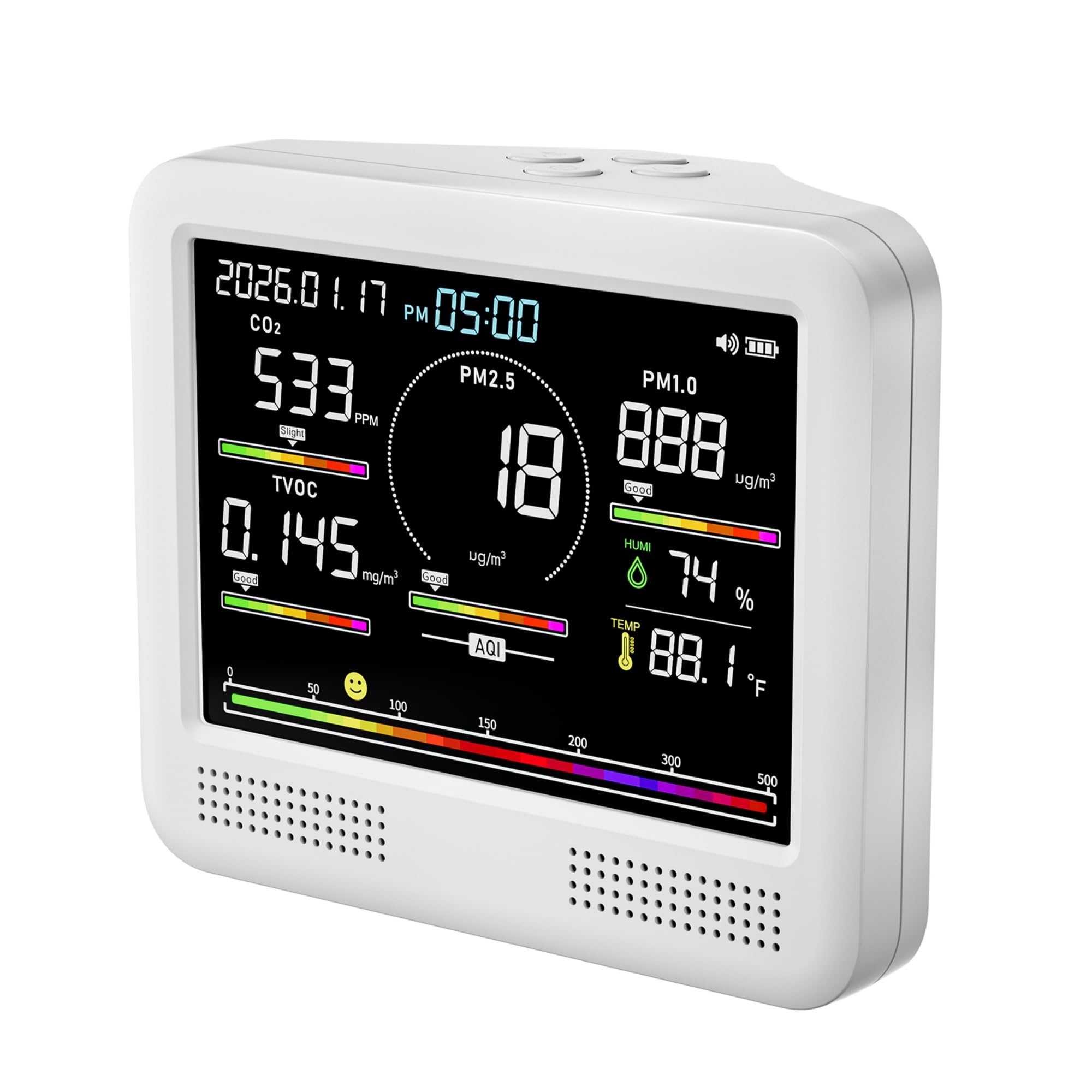
The KDWKD monitor packs the broadest sensor suite in this lineup, covering CO₂, PM0.3 through PM10, HCHO (formaldehyde), TVOC, temperature, and humidity. This makes it the go-to choice for anyone living in a newly renovated space, working in a home workshop with paints or adhesives, or concerned about VOCs from furniture and cleaning supplies. The large color screen presents all parameters simultaneously with an AQI band indicator, making it easy to interpret at a glance.
The internal rechargeable battery provides up to 9 hours of untethered operation, enough to move it between rooms or take it along on an RV trip. The device includes both a charging adapter and a USB-C cable, and the enclosure is lightweight ABS plastic that won’t scratch surfaces. Reviewers specifically highlight its usefulness in detecting fumes from new construction and its ability to distinguish between a VOC spike from cooking oil versus formaldehyde from particleboard.
Some early reviews pointed to inconsistent packaging during shipping, but the monitor itself has been praised for its sensitivity to rapid changes — it will show a TVOC spike within seconds of opening a bottle of nail polish remover. If you need maximum pollutant coverage in a single, relatively portable package, this is the most complete standalone monitor on the market.
Why it’s great
- Detects the widest range of pollutants including formaldehyde
- Large color screen with real-time AQI band colors
- Portable with 9-hour battery life
Good to know
- Some units arrived with loose packaging, verify upon delivery
- No Wi-Fi or app connectivity for data logging
4. 16 in 1 Air Quality Monitor (7″ Display)
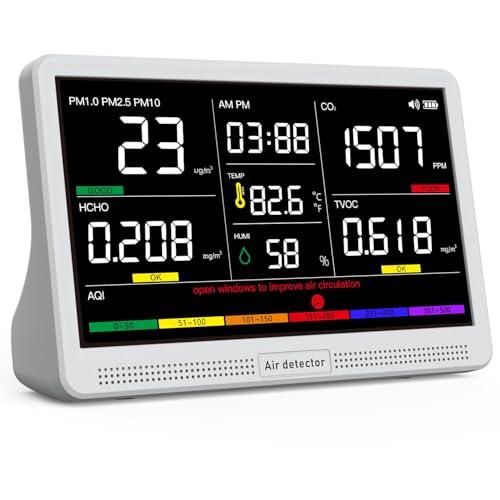
This model’s defining feature is its massive 7-inch LED display, which provides the most readable at-a-glance air quality readout in this comparison. It shows nine parameters simultaneously — CO₂, PM1.0, PM2.5, PM10, HCHO, TVOC, temperature, humidity, and AQI — alongside a clock and time display. The three brightness settings make it usable in both a bright kitchen and a dim bedroom without glare.
External high-precision sensors sampling directly from the air achieve a claimed accuracy of 0.001 units. The seven distinct AQI alert buzzers give you graded feedback: a green smiley face when air is clean, progressing through yellow, orange, and red as conditions worsen. The mute button silences alarms for nighttime use. A 2500mAh battery delivers up to 8 hours of cordless operation, though the screen brightness will impact that runtime.
Reviewers consistently note that the monitor responds instantly to cooking smoke, candle burning, and even hairspray, with PM2.5 readings climbing within seconds. The large screen makes it easy for family members of all ages to understand air quality at a glance. If you want a dedicated, always-visible station in a central living area, this monitor’s display clarity is unmatched.
Why it’s great
- Huge 7-inch LED screen viewable from across the room
- 7-level color-coded alert system with buzzer and mute
- Fast sensor response to cooking and aerosol sources
Good to know
- Battery life drops significantly at max brightness
- Large footprint (7.91 inches wide) requires dedicated desk space
5. Coiliiot AirSense8
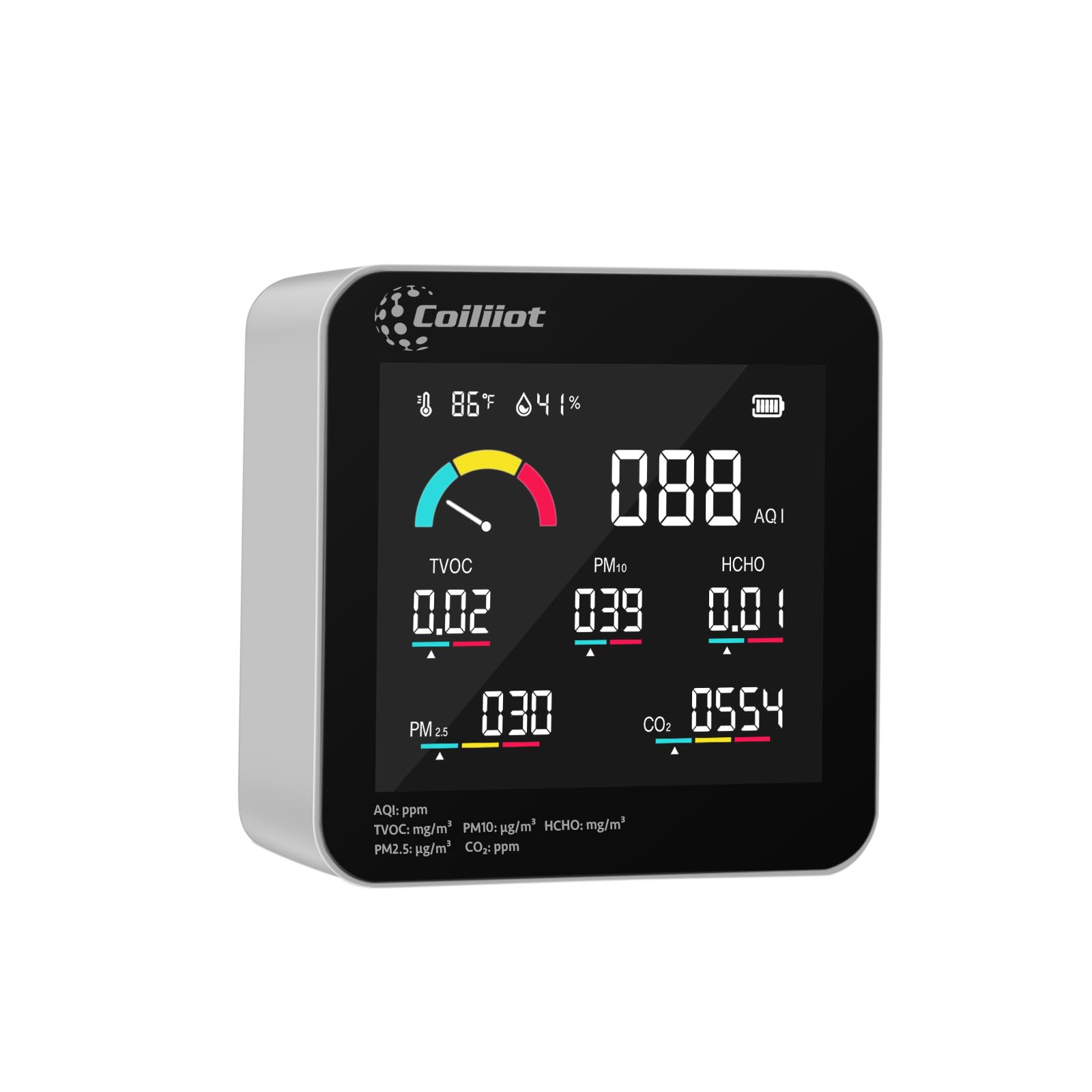
The Coiliiot AirSense8 hits a sweet spot for buyers who want serious sensor quality — a real NDIR CO₂ sensor and a laser-based PM2.5/PM10 counter — without paying for a massive screen or smart home integration. It tracks CO₂, TVOC, HCHO, PM2.5, PM10, temperature, and humidity on a compact 3.74-inch LCD display. The one-button operation keeps things dead simple: power on and read.
The NDIR CO₂ sensor provides stable, drift-resistant carbon dioxide readings that reviewers say match reference monitors. The VOC detector reacts quickly to cleaning products and cooking smells, distinguishing them from background TVOC levels. The battery delivers up to 8 hours of operation, and the USB-C charging port means you can top it off with any modern phone charger. The overall package is just half a pound, making it easy to toss into a bag for hotel or office use.
Some units have arrived with battery issues that require the device to stay plugged in, but when functioning properly the AirSense8 offers performance that rivals monitors costing significantly more. The display is slightly reflective in direct sunlight, but indoors it remains perfectly legible. For the price, this is the most technically sound entry-level monitor that includes a genuine NDIR sensor rather than a cheaper alternative.
Why it’s great
- Real NDIR CO₂ sensor at an entry-level price
- Laser particle counter for accurate PM2.5/PM10
- Compact, lightweight, and USB-C rechargeable
Good to know
- Some units require constant AC power due to battery defects
- No app support or historical data logging
6. Professional 16 in 1 (5.5″ Display)
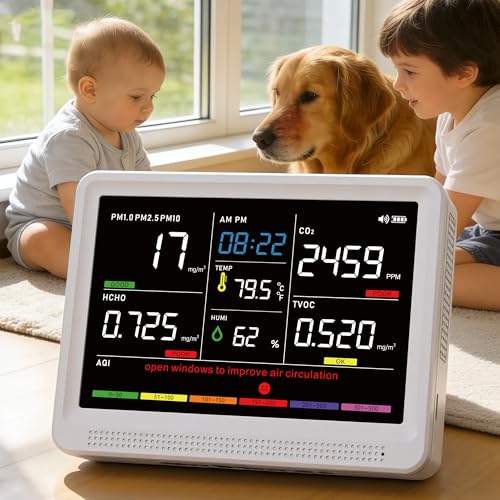
This monitor from Shenzhen Velocity Tech offers a 5.5-inch LED display with nine measurable parameters and seven AQI alert buzzers, making it very similar in capability to the larger 7-inch model but in a slightly more portable package at 1.23 pounds. The external high-precision sensors claim 0.001 accuracy, and the multi-sensor array includes dedicated NDIR for CO₂ and laser for particulate matter.
The device is particularly well-suited for workshop environments like a basement with 3D printers or laser engravers, where real-time TVOC and PM spikes from resin fumes or burned material need to be caught immediately. The 2500mAh battery is rated for up to 10 hours, though multiple reviewers report it lasts closer to 1-2 hours in practice, so it’s best used near an outlet. The time-setting interface is unusually detailed in the manual, but the brightness and alarm buttons remain intuitive after initial setup.
Users who keep it plugged in generally report satisfaction with its sensitivity to 3D printer emissions and quick feedback when ventilation is improved. The wall-mountable design is a nice bonus for permanent installation. If you need a large-screen monitor for a dedicated hobby space and don’t mind keeping it tethered to power, this is a capable and affordable option.
Why it’s great
- Excellent for workshop environments with 3D printers or lasers
- External high-precision sensors with 0.001 accuracy rating
- Wall-mountable for permanent placement
Good to know
- Battery life reportedly far shorter than the advertised 10 hours
- Basic interface with no app or data export
7. LifeBasis 11-in-1 Air Quality Monitor

The LifeBasis monitor brings 11 sensing parameters — AQI, CO₂, PM1.0, PM2.5, PM10, HCHO, TVOC, particles, temperature, and humidity — to a price point that makes it accessible for budget-conscious buyers. It uses a genuine NDIR infrared CO₂ sensor alongside a laser particle sensor, a semiconductor sensor for VOCs, and a photoelectric sensor for particles, giving it a legitimate multi-sensor array rather than a single combined chip.
The 2500mAh battery delivers a real-world 11 to 12 hours of continuous use, which is excellent for a color LCD monitor. The screen brightness is adjustable, and the device is surprisingly small at just 6.1 ounces and roughly the size of a deck of cards, making it genuinely pocket-portable. The dual alert system uses both color changes (green/yellow/orange/red) and audible ticking alerts when pollutant levels exceed safe thresholds.
Reviewers confirm its PM2.5 readings closely match a PurpleAir reference monitor, and the CO₂ sensor responds visibly to ventilation changes — dropping from 950 ppm to 450 ppm within minutes of opening a window. A few users note it does not detect carbon monoxide (CO), which is a different safety device entirely. For a first monitor or a gift for someone skeptical about air quality, the LifeBasis provides reliable, actionable data without overspending.
Why it’s great
- Genuine NDIR CO₂ sensor at a very accessible price
- Long 12-hour battery for a color LCD unit
- Ultrasonic and compact at 6.1 ounces
Good to know
- Does not detect carbon monoxide
- No Wi-Fi, Bluetooth, or app connectivity
FAQ
Can an air pollution monitor detect carbon monoxide?
How often should I calibrate the CO₂ sensor?
Why does my monitor show high TVOC when I cook or clean?
Will an air purifier reduce CO₂ levels?
Final Thoughts: The Verdict
For most users, the best air pollution monitor winner is the GoveeLife Smart Air Quality Monitor because its photoacoustic NDIR sensor, smart home connectivity, and extensive data logging make it the most capable and future-proof tool for improving indoor air quality. If you need silent, ultra-portable monitoring with exceptional battery life, grab the Temtop M10+. And for comprehensive pollutant coverage including formaldehyde and VOCs on a budget, nothing beats the KDWKD Air Quality Monitor.