
Cutting the speaker wire doesn’t mean you have to cut the quality. Bookshelf speakers with Bluetooth let you stream lossless or high-res audio from your phone, laptop, or turntable without burying a receiver in your cabinet. The trade-off used to be a gutless midrange and a thin low end, but that era is over. Today’s powered options pack enough amplifier headroom, driver surface area, and cabinet bracing to rival wired setups twice their price.
I’m Min — the co-founder and writer behind Gadgets Feed. I’ve spent countless hours cross-referencing driver materials, crossover topologies, Bluetooth codec support, and real customer measurements to separate the signal from the noise in this fast-growing segment.
Whether you’re outfitting a desktop workstation, upgrading a record-player corner, or building a small-room home theater without an AVR, this guide to finding the best bookshelf speakers with bluetooth will walk you through every critical spec and the models that actually deliver on their promises.
How To Choose The Best Bookshelf Speakers With Bluetooth
Not every powered speaker with Bluetooth sounds good. Many cheap units pair a tiny amplifier with thin MDF and no crossover, resulting in a harsh, boxy sound. To pick a winner, you need to evaluate three pillars: the amplification stage, the driver quality, and the connectivity suite.
Amplifier Power and RMS Rating
Ignore peak wattage — it is a marketing number. RMS (continuous) wattage tells you how much clean power the built-in amplifier can deliver without clipping. A pair delivering 30–50W RMS per channel is enough for a medium-sized room. Below 20W RMS, you will likely push the speakers into distortion at moderate listening levels.
Driver Configuration and Materials
A 1-inch soft-dome or titanium tweeter paired with a 4- to 5.5-inch woofer is the sweet spot for a Bluetooth bookshelf speaker. Look for woofers made of woven glass fiber, Kevlar, or cerametallic — these materials remain rigid under high excursion and produce cleaner mids and bass. Plain paper cones are cheaper and fine at low volumes, but they introduce distortion earlier.
Inputs and Connectivity
Bluetooth version matters for latency and stability: Bluetooth 5.0 and newer offer better range and multi-point pairing. Optical (TOSLINK) and coaxial digital inputs let you connect a TV or game console without converting the digital signal to analog twice, preserving timing and clarity. A subwoofer output with a dedicated crossover circuit is crucial if you want true deep-lows without overworking the speaker’s small woofer.
Quick Comparison
On smaller screens, swipe sideways to see the full table.
| Model | Category | Best For | Key Spec | Amazon |
|---|---|---|---|---|
| Edifier MR3 | Powered Monitor | Desktop mixing & critical listening | 52Hz–40kHz, 18W×2 RMS | Amazon |
| Klipsch R-40PM | Powered Bookshelf | Room-filling clarity with horn tweeters | 4″ TCP woofer, 90°×90° horn | Amazon |
| Marshall Stanmore III | Powered Speaker | Style-focused living room listening | 5″ woofer, Bluetooth 5.2 | Amazon |
| Fluance Ai41 | Powered Bookshelf | Turntable & TV setups needing sub out | 5″ woven glass-fiber driver, 90W amp | Amazon |
| Polk ES10 | Passive Surround | Surround channel in a home theater system | 4″ woofer, Power Port bass | Amazon |
| Edifier R1280DB | Powered Bookshelf | Entry-level upgrade with optical input | 4″ woofer, 42W RMS total | Amazon |
| Pyle PBKSP25NC | Powered Bookshelf | Budget-conscious versatile connectivity | 4″ woofer, 80W RMS, DSP | Amazon |
| BESTISAN 50W×2 | Powered Bookshelf | RGB lighting & desktop multimedia | 3″ woofer, 100W MAX, RC | Amazon |
| Klipsch RP-600M II | Passive Bookshelf | Audiophile reference system (needs amplifier) | 6.5″ Cerametallic woofer, LTS titanium tweeter | Amazon |
In‑Depth Reviews
1. Edifier MR3 Powered Studio Monitor Speakers

The Edifier MR3 is a studio monitor disguised as a consumer bookshelf speaker. Its 3.5-inch mid-low driver and 1-inch silk-dome tweeter deliver a remarkably flat frequency response from 52Hz up to 40kHz, which means you hear the recording exactly as it was mixed — no exaggerated bass or hyped treble. The Hi-Res Audio certification confirms the tweeter can reproduce ultrasonic detail that standard CD-quality speakers cannot touch.
Connectivity is the most generous at this tier: balanced TRS inputs for pro audio gear, RCA and AUX for consumer sources, and Bluetooth 5.4 with multi-point pairing so you can switch between your phone and laptop without re-pairing. The 18W×2 RMS output may seem modest, but paired with a peak SPL of 92.5dB, it fills a 12×12-foot room cleanly without distortion. The Edifier ConneX app adds three listening modes — Music, Monitor, and Custom — plus a parametric EQ for fine-tuning the crossover region.
The MDF cabinet is internally braced to reduce panel resonance, a detail usually reserved for twice-the-price monitors. Some users report a non-intuitive Bluetooth pairing sequence that requires consulting the manual, but once connected, the connection is rock-solid up to 30 feet with no dropouts.
Why it’s great
- Neutral, reference-grade frequency response from 52Hz to 40kHz.
- Balanced TRS inputs allow direct connection to audio interfaces and mixers.
- App-based EQ and listening modes give fine control over the sound profile.
Good to know
- Bluetooth pairing mode is not entirely intuitive — plan to read the quick-start guide.
- 18W RMS per channel may not satisfy those wanting party-level volume in a large room.
2. Klipsch Reference R-40PM Powered Bookshelf Speakers
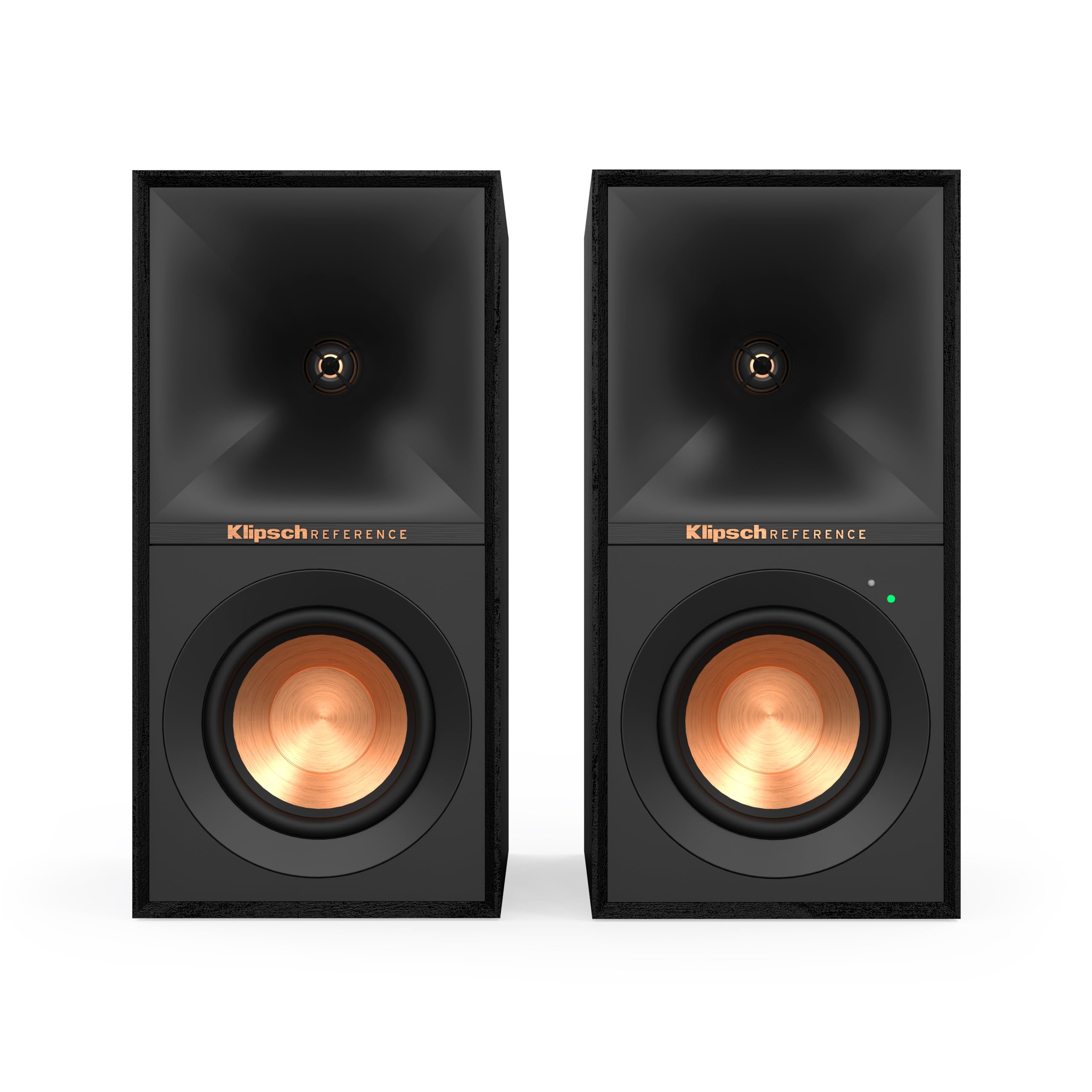
The R-40PM brings Klipsch’s legendary horn-loaded tweeter technology to a fully powered Bluetooth bookshelf format. The 1-inch aluminum LTS tweeter paired with a 90°×90° Tractrix horn delivers extremely high sensitivity — meaning you get loud, clean output with very little amplifier strain. This design also makes the soundstage far wider than a typical dome-tweeter speaker, so vocals and cymbals lock into precise positions in the room.
Under the hood, a 4-inch spun-copper TCP woofer handles low frequencies, and the built-in amplifier is custom-tuned to the drivers, removing the need for any external receiver. Inputs include Bluetooth, a phono pre-amp with a ground screw for turntables (rare at this price), plus optical and analog RCA. The low-profile magnetic grilles snap on and off cleanly, giving you the option to show off that copper woofer.
Bass output from the 4-inch driver is surprising for its size, though users chasing chest-thumping low-end for movies should add a sub via the speaker’s subwoofer output. A small quirk: the speakers may power back on after you manually turn them off if the audio source sends a wake signal, but this can be worked around by switching sources before powering down.
Why it’s great
- Horn-loaded tweeter provides exceptional clarity, high sensitivity, and a huge soundstage.
- Built-in phono pre-amp with ground terminal for direct turntable connection.
- Custom-tuned amplifier perfectly matched to the drivers for plug-and-play performance.
Good to know
- Speakers may auto-power on from standby when a signal is detected, which can be inconvenient.
- 4-inch woofer cannot deliver deep sub-bass without a separate subwoofer.
3. Marshall Stanmore III Bluetooth Home Speaker
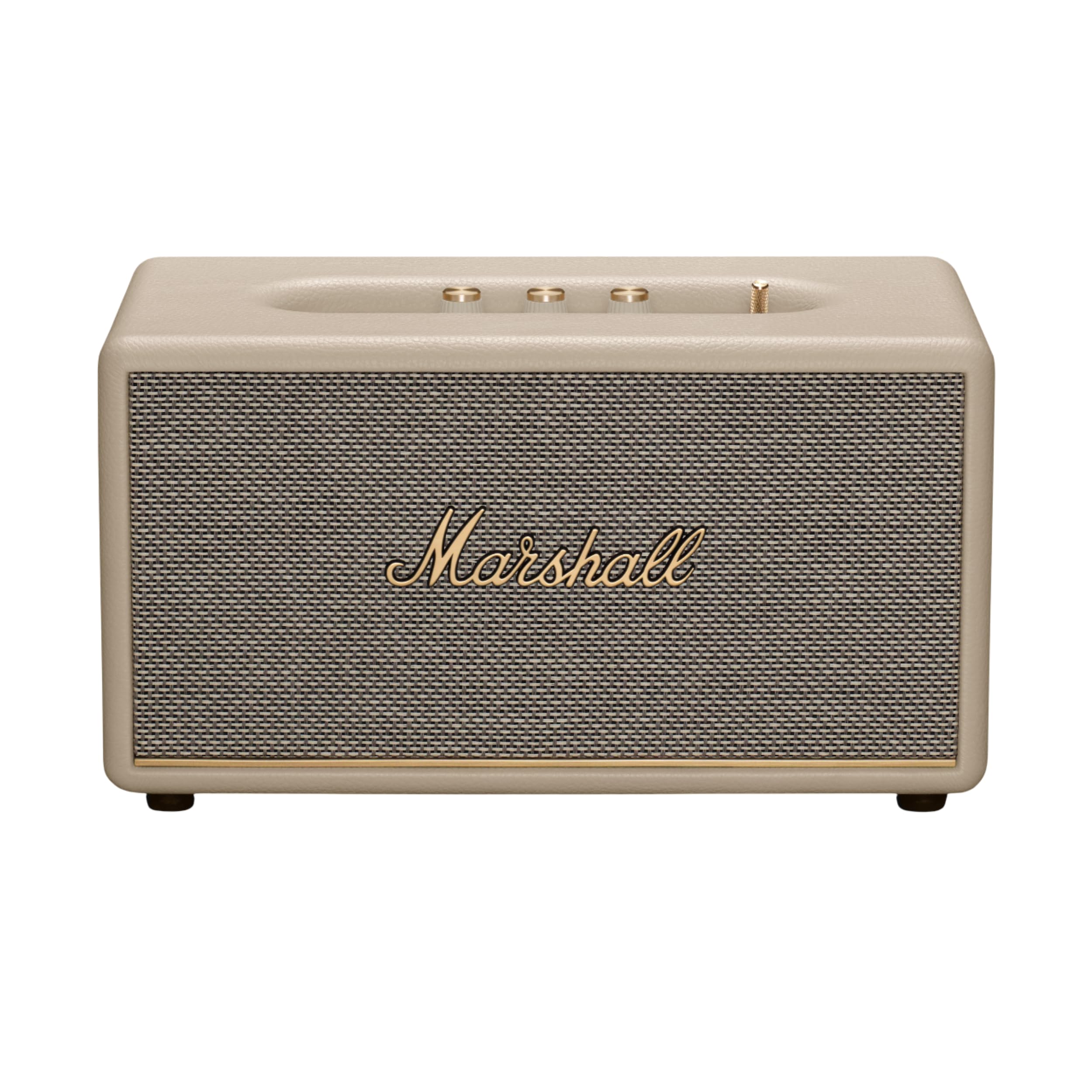
The Stanmore III is a single-piece powered speaker that leans heavily into Marshall’s rock-and-roll heritage while delivering legitimate hi-fi performance. The 5-inch woofer and dual tweeters inside the cabinet produce a bigger, more room-filling sound than the previous generation, thanks to a re-engineered waveguide that widens the stereo image even from a mono enclosure. Bass is punchy and controlled, with the analog treble and bass knobs on the top panel giving you immediate EQ access without an app.
Bluetooth 5.2 provides future-ready connectivity and a stable range of about 33 feet through walls. The RCA and 3.5mm inputs allow connection to turntables, CD players, or computers, and the speaker automatically switches to the active source. The build is PVC-free with 70% recycled plastic, and the vegan leather exterior feels premium without the environmental cost. The single-box design means you get one stereo image from one location, so it works best as a living room or bedroom centerpiece.
At this price, you are paying a premium for the Marshall aesthetic and the non-detachable power cable. The sound quality is excellent for casual listening, but the lack of a subwoofer output and the single-point stereo limitation means it cannot compete with a true left-right pair of bookshelf speakers for soundstage width and imaging precision.
Why it’s great
- 5-inch woofer delivers authoritative bass that fills a living room without distortion.
- Analog bass and treble knobs let you adjust the sound signature instantly without software.
- Iconic retro design with sustainable materials — 70% recycled plastic and vegan leather.
Good to know
- Single-box design cannot create a true left-right stereo separation like a pair of separate speakers.
- No subwoofer output for expanding into deeper low-end frequencies.
4. Fluance Ai41 Powered 2-Way Bookshelf Speakers

Fluance targets the sweet spot between entry-level and premium with the Ai41, and it hits. The 5-inch woven glass-fiber driver is larger than most competitors in its price bracket, giving it a significant advantage in midrange presence and bass extension. The integrated 90W total amplifier (45W per channel) provides enough headroom to drive these speakers cleanly to near-field and mid-field listening levels without audible compression.
The rear port is tuned to minimize chuffing, and the internally braced MDF cabinet prevents the boxy coloration that plagues cheaper speakers. Inputs include Bluetooth 5.0, optical, and RCA, plus a dedicated subwoofer output that integrates at 80Hz — a standard crossover point for seamless bass management. The remote controls volume, input selection, and bass/treble trim, though the IR sensor requires a clear line of sight.
Bass response is surprisingly robust for a 5-inch driver, but users wanting the lowest register for action movies or electronic music will appreciate the subwoofer output. Some reviewers note that the optical input is slightly louder than the RCA input due to the DAC’s voltage level, which requires a minor volume adjustment when switching sources.
Why it’s great
- 5-inch woven glass-fiber driver outperforms smaller 4-inch woofers for bass depth and midrange clarity.
- 90W total amplifier delivers clean power for both near-field and room-filling listening.
- Dedicated subwoofer output with standard 80Hz crossover for easy system expansion.
Good to know
- Optical input produces a slightly higher volume level than RCA, requiring input-specific volume adjustment.
- IR remote needs unobstructed line of sight to the active speaker panel.
5. Polk Signature Elite ES10 Surround Sound Speakers

The Polk ES10 is a passive speaker, meaning it requires an external amplifier or AV receiver — it does not have built-in Bluetooth by itself. However, when paired with a Bluetooth-capable receiver (or a simple Bluetooth amp adapter), it becomes a formidable bookshelf option for surround sound or dedicated stereo listening. The Dynamically Balanced Acoustic Array uses a 1-inch Terylene tweeter and a 4-inch polymer woofer with Polk’s patented Power Port technology, which extends the port downward to reduce turbulence and increase bass output by roughly 3dB over a conventional front-ported design.
The ES10’s high sensitivity (88dB) means it needs relatively little power to play loud, making it an excellent match with modest receivers. The enclosure is a rigid MDF cabinet with a modern, chamfered baffle that reduces diffraction for a cleaner soundstage. Keyhole slots and screw inserts give you flexible mounting options as side, rear, or elevation speakers in a surround setup.
Bass rolls off steeply below 80Hz, so a subwoofer is necessary for full-range performance. The ES10 is best appreciated as part of a timbre-matched Signature Elite system, but even as a stereo pair they deliver clear, uncolored sound that outperforms similarly priced powered speakers in imaging precision.
Why it’s great
- Power Port technology delivers deeper, cleaner bass than conventional ports of the same size.
- High sensitivity (88dB) produces high output with minimal amplifier power.
- Versatile wall-mounting and keyhole options for use as surrounds or elevation channels.
Good to know
- Passive design requires an external amplifier or receiver with Bluetooth — not plug-and-play for a simple Bluetooth setup.
- Bass extension drops off below 80Hz, making a subwoofer essentially mandatory for full-range playback.
6. Edifier R1280DB Powered Bluetooth Bookshelf Speakers

The R1280DB is a perennial entry-level champion, and for good reason. At 42W RMS total (21W per channel), it drives a 4-inch woofer and 13mm silk-dome tweeter to produce a sound that is far more refined than its price suggests. The MDF wood cabinet finished in walnut-effect vinyl looks elegant on a bookshelf or desk, and the removable cloth grille adds a touch of mid-century modern style.
Bluetooth connectivity is seamless with any iOS, Android, MacOS, or Windows device, and the inclusion of optical and coaxial digital inputs sets it apart from cheaper competitors — you can plug a TV or game console directly without an external DAC. The side panel offers bass and treble knobs for quick EQ shaping, and the remote control lets you switch inputs, adjust volume, and put the speakers into standby from across the room.
The sound signature is slightly warm and forgiving, making it excellent for casual music listening and vocals. Bass is present but not deep — the 4-inch woofer simply cannot move enough air for cinema-level low-end. For general desktop enjoyment or small-room background audio, the R1280DB is a proven performer. Just keep a hand on the tiny remote, as it can disappear between couch cushions.
Why it’s great
- Optical and coaxial digital inputs allow a direct, high-quality connection to TVs and game consoles.
- Warm, non-fatiguing sound signature that is pleasant for long listening sessions.
- Remote control, bass/treble knobs, and standby mode make daily use very convenient.
Good to know
- 4-inch woofer produces limited bass depth — a subwoofer is needed for impactful low-end.
- Included remote is quite small and easy to misplace.
7. Pyle Powered Bookshelf Speaker System PBKSP25NC
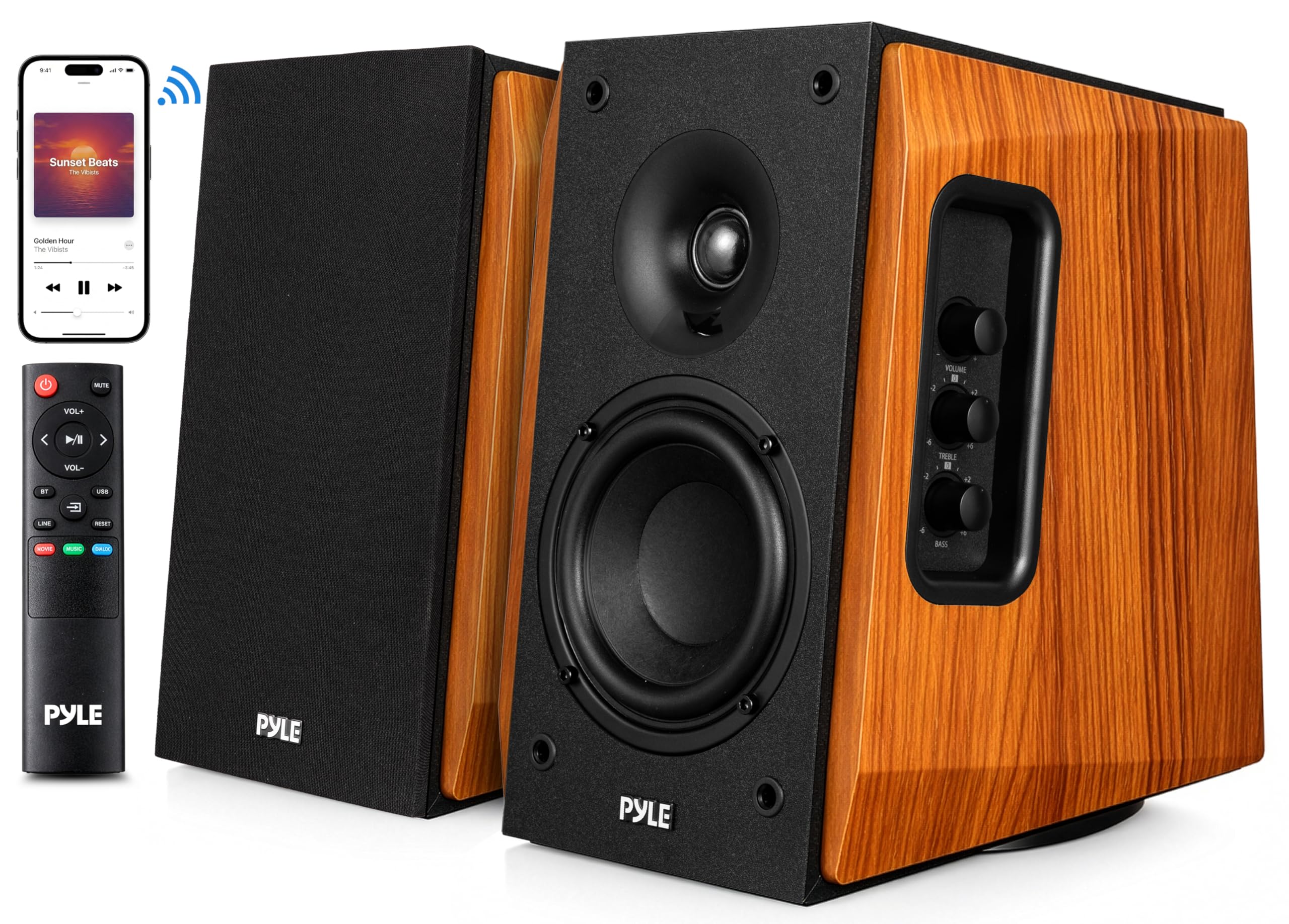
Pyle takes a straightforward approach with the PBKSP25NC: a pair of 80W RMS powered speakers in a medium maple wood cabinet with a fabric mesh grille. The 4-inch woofer and silk-dome tweeter are tuned to deliver a bass-reflex response that emphasizes warmth and projection. The DSP digital circuit with a 12dB crossover slope keeps the woofer and tweeter from interfering in the critical midrange.
Connectivity includes Bluetooth 5.3 for the latest wireless stability, plus ARC, optical, coax, and RCA inputs — enough to hook up a TV, turntable, PC, and game console simultaneously. The subwoofer output gives you an upgrade path for deeper bass, and the independent volume, treble, and bass knobs allow precise tonal adjustment. The compact footprint (9.92 inches high) fits on most shelves without overhang.
Build quality at this price point uses ABS plastic for the baffle rather than solid MDF, which may contribute to a slightly boxy resonance at high volumes. Some users have reported a defective remote control unit that fails to power the speakers on reliably — while not universal, it is worth testing the remote immediately and requesting a replacement if it is unresponsive.
Why it’s great
- 80W RMS total power delivers solid volume and headroom for small to medium rooms.
- ARC, optical, and coax inputs provide modern TV and console connectivity.
- DSP circuit with independent bass/treble knobs gives flexible tonal control.
Good to know
- Baffle material is ABS plastic rather than MDF, which can affect cabinet resonance at higher volumes.
- Remote control quality appears inconsistent — test and replace early if faulty.
8. BESTISAN 50W×2 Active Bookshelf Speakers
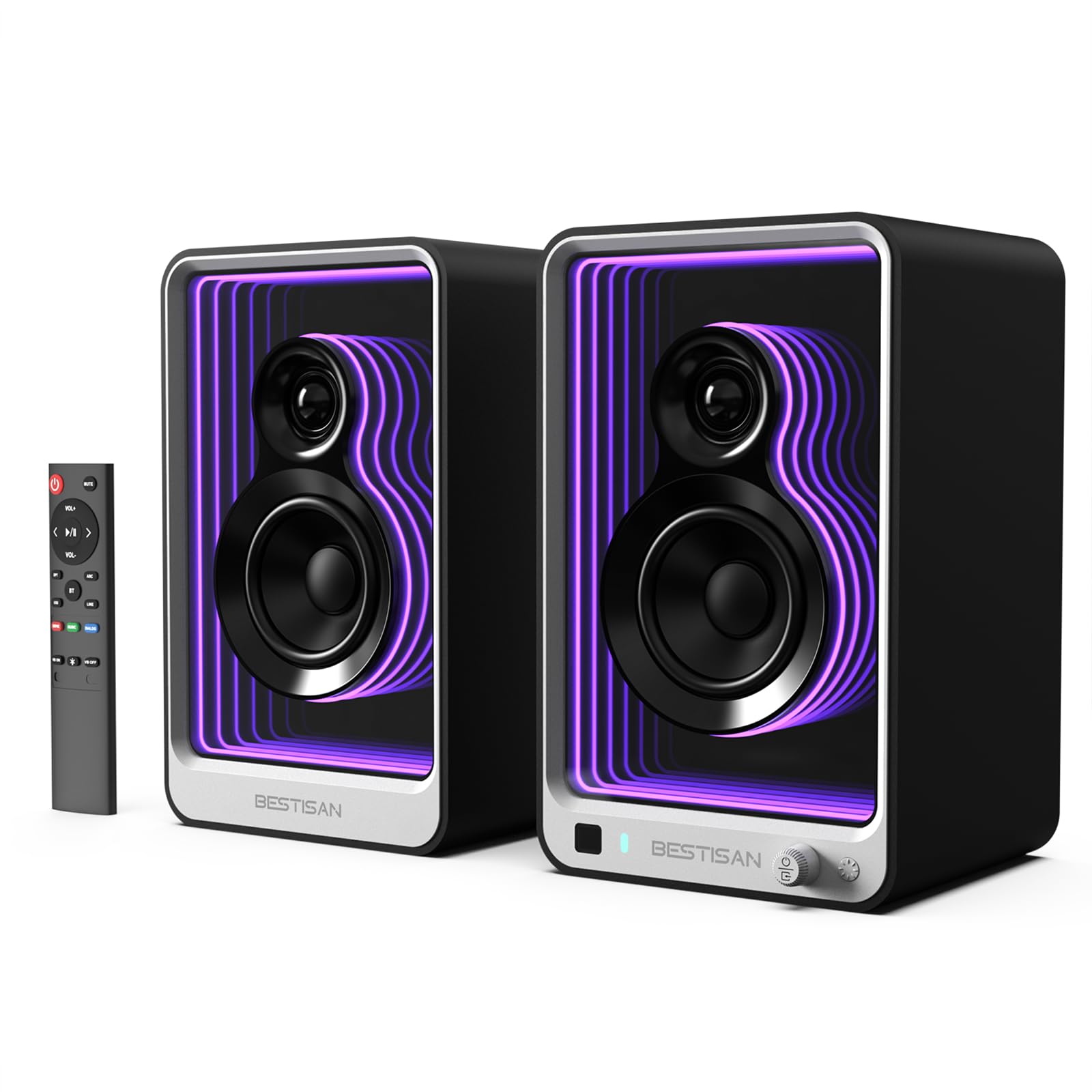
BESTISAN has created a desktop speaker that prioritizes visual flair alongside acoustic performance. The 3-inch woofers and 1.25-inch tweeters are powered by a 100W MAX amplifier that can drive the pair to impressive volumes, and the cabinet features an infinity-mirror lighting panel with nine selectable RGB effects. For a gaming desk or a modern entertainment center, these speakers are as much a decorative element as an audio tool.
Inputs include HDMI ARC for TV connection, optical, RCA, USB (flash drive playback only), and a dedicated SUB OUT port for adding a powered subwoofer. Bluetooth 5.2 streams from any device with low latency, and the included remote control works from up to 33 feet away. The compact dimensions — 9.5×6×5.5 inches — keep desk clutter to a minimum.
Sound quality out of the box leans toward a V-shaped curve, with boosted highs and lows that can sound exciting for gaming but slightly thin in the midrange. Several users discovered that adjusting the EQ on their source device transforms the signature into a much more balanced profile. The bass is adequate for a 3-inch driver but not deep — the subwoofer output is effectively mandatory for anyone who wants true low-end rumble.
Why it’s great
- Nine RGB lighting effects with infinity-mirror design create a dramatic desktop visual centerpiece.
- HDMI ARC input allows direct TV connection with one-cable control.
- SUB OUT port lets you add a subwoofer to compensate for the small woofer size.
Good to know
- 3-inch woofers cannot produce deep sub-bass — a subwoofer is essential for full-range performance.
- Stock tuning is V-shaped; EQ adjustment on the source device is recommended for neutral listening.
9. Klipsch Reference Premiere RP-600M II Bookshelf Speakers

The RP-600M II is a passive bookshelf speaker — it requires a separate amplifier or receiver with Bluetooth — but it represents the absolute peak of what a bookshelf speaker can achieve in clarity, efficiency, and build quality. The 6.5-inch Cerametallic woofer (a ceramic-coated aluminum cone) is exceptionally rigid, allowing it to move large volumes of air with zero cone breakup, while the 1-inch titanium LTS tweeter paired with a 90°×90° Tractrix horn delivers stunning detail and a wide, precise soundstage.
The cabinet is a furniture-grade ebony vinyl veneer over MDF, with magnetic grilles that offer a clean, unobtrusive look. Bi-wiring/bi-amping terminals allow advanced crossover configurations for those with high-end amplification. The Tractrix ports on the rear minimize port noise and chuffing, enabling clean, fast bass transients that belie the speaker’s relatively modest footprint.
To use these as Bluetooth speakers, you must pair them with a Bluetooth receiver or a streaming amplifier like a WiiM Amp or a Denon HEOS receiver. Once properly driven, the RP-600M II delivers sound that competes with speakers costing twice as much. The bass response from the 6.5-inch woofer is deep enough that many users find a subwoofer optional for music. The RP-600M II is a long-term investment in sound quality that will reveal new details in your music for years.
Why it’s great
- 6.5-inch Cerametallic woofer delivers exceptional bass extension and zero cone flex even at high output.
- Titanium LTS tweeter with Tractrix horn provides stunning clarity, detail, and soundstage width.
- Furniture-grade cabinet with magnetic grilles and bi-wiring terminals for high-end system integration.
Good to know
- Passive speakers — require a separate amplifier or receiver with Bluetooth, not a standalone Bluetooth solution.
- High sensitivity means they reveal the quality (and weaknesses) of upstream amplification and source material.
FAQ
Can I connect a turntable directly to a Bluetooth bookshelf speaker?
Do I need a subwoofer to enjoy Bluetooth bookshelf speakers?
What is the difference between active and passive bookshelf speakers?
How important is the optical (TOSLINK) input on a Bluetooth speaker?
Final Thoughts: The Verdict
For most users, the best bookshelf speakers with bluetooth winner is the Edifier MR3 because it pairs near-field monitor accuracy with a full suite of inputs and app-based EQ — all at a price that undercuts the competition. If you want horn-loaded clarity and a built-in phono pre-amp, grab the Klipsch R-40PM. And for those building a reference-grade system with no compromises, nothing beats the Klipsch RP-600M II paired with a high-quality Bluetooth streaming amplifier.