
The step from a 4- or 5-inch beginner scope to an 8-inch Dobsonian is the single most meaningful leap in aperture you can make. That extra four inches of mirror diameter more than doubles the light-gathering area, turning faint smudges into resolved globular clusters and ghostly nebulae into detailed structures. But not every 8-inch Dob gets you there with the same optical quality, mount stability, or user-friendly features — the differences in mirror coatings, focuser design, and finder scope quality separate the tools that deliver sharp, high-contrast views from those that frustrate.
I’m Min — the co-founder and writer behind Gadgets Feed. My deep market research and analysis of hundreds of technical specifications across this category’s major brands reveal which build details and accessory packages actually translate into better nights under the stars.
The right optical tube assembly transforms casual stargazing into deep-sky exploration, which is why this guide breaks down the best 8 inch dobsonian telescope options for every skill level and budget tier.
How To Choose The Best 8 Inch Dobsonian Telescope
An 8-inch Dobsonian offers a sweet spot between light-gathering power and portability. Before you buy, understanding three key aspects will ensure you pick the right one for your observing goals, storage constraints, and patience for setup.
Solid Tube vs. Collapsible (Flextube)
A solid-tube 8-inch Dob provides the most rigid optical path, meaning collimation holds longer and the image stays stable. But its 48-inch assembled length can be difficult to fit in smaller cars or carry through doorways. Collapsible designs like Sky-Watcher’s Flextube reduce the tube’s length by roughly half for transport, trading a small amount of structural stiffness for significant portability. Both perform identically optically when properly collimated, so the choice comes down to how far you drive to your dark site.
Manual vs. Computerized (GoTo / App-Assisted)
A manual Dob requires you to star-hop — using a finder scope and star charts to locate objects. This is the most cost-effective approach and teaches the sky well. Computerized options, whether via a smartphone app (StarSense Explorer) or full GoTo with a hand controller (SynScan), automate finding deep-sky targets. Beginners often prefer app-assisted models because they remove the frustration of not knowing where to point. But digital systems add weight, complexity, and often require a clear sky for initial alignment.
Focuser and Finderscope Quality
The focuser is the mechanical interface you’ll interact with every session. A 2-inch dual-speed Crayford focuser allows precise fine-focus at high magnification and accepts wider-field 2-inch eyepieces. Single-speed helical focusers, common on lower-cost models, can make it difficult to achieve sharp focus, especially at 200x and above. Equally important is the finder scope: 8×50 right-angle correct-image (RACI) finders are far more comfortable for use near the zenith compared to straight-through optical finders.
Quick Comparison
On smaller screens, swipe sideways to see the full table.
| Model | Category | Best For | Key Spec | Amazon |
|---|---|---|---|---|
| Celestron StarSense Explorer 8-inch | App-Enabled Dob | Beginners needing navigation help | 203mm / 1200mm f/5.9; XLT coatings | Amazon |
| Sky-Watcher Classic 200 | Solid-Tube Dob | Traditional manual viewing | 203mm / 1200mm f/5.9; 94% reflective mirrors | Amazon |
| Sky-Watcher Flextube 200 | Collapsible Dob | Portable deep-sky observing | 203mm / 1200mm f/5.9; collapsible truss | Amazon |
| Sky-Watcher Virtuoso GTI 150P | Tabletop GoTo | Portable GoTo for planets | 150mm / 750mm f/5; Wi-Fi GoTo | Amazon |
| Celestron StarSense Explorer 130AZ | Tabletop Dob | Ultra-portable starter scope | 130mm / 650mm f/5; StarSense app | Amazon |
| HSL 203EQ | EQ Reflector | Budget 8-inch with EQ mount | 203mm / 800mm f/3.9; EQ4 mount | Amazon |
| Sky-Watcher Flextube 250 | Collapsible 10-inch | Deep-sky enthusiasts | 254mm / 1200mm f/4.7; 94% reflective mirrors | Amazon |
| Unistellar Equinox 2 | Digital Smartscope | Instant astrophotography | 114mm / 450mm f/4; 11h battery | Amazon |
| Sky-Watcher Flextube 300 SynScan | GoTo Dob | Serious deep-sky and tracking | 305mm / 1500mm f/4.9; GoTo with 42k database | Amazon |
| Celestron NexStar Evolution 8 EdgeHD | SCT GoTo | High-end visual / AP | 203mm / 2032mm f/10; EdgeHD optics | Amazon |
| Unistellar Odyssey PRO | Digital Smartscope | Premium app-based astronomy | 85mm / 320mm f/3.9; 5h battery | Amazon |
In‑Depth Reviews
1. Celestron StarSense Explorer 8-inch Dobsonian

The Celestron StarSense Explorer 8-inch is the most beginner-friendly entry into full-size Dobsonian observing. Its patent-pending StarSense dock holds your smartphone, and the dedicated app analyzes star patterns overhead to show exactly where the scope is pointed. The 203mm parabolic primary mirror with XLT enhanced coatings delivers high-contrast lunar detail and resolves Saturn’s rings easily at 60x, while the 2-inch Crayford focuser handles heavy 2-inch eyepieces without image shift.
Assembly requires about 30 minutes, and the base uses a smooth Teflon bearing system for steady azimuth tracking. The included 25mm Plossl provides 48x — a good starting point, but most users will add an 8-12mm eyepiece for planetary work. The StarPointer red-dot finder is adequate, though upgrading to a RACI finder makes zenith viewing more comfortable. At 43 pounds total, it’s manageable for a single person to move in two trips (tube and base separate).
The StarSense app works reliably on iOS and most Android devices, though a few users report compatibility issues with lower-end phones. Collimation is straightforward with the included collimation cap, and the tension control handles let you adjust balance when swapping heavy eyepieces. For anyone who wants a no-guesswork introduction to 8-inch aperture without paying for a full GoTo system, this is the strongest recommendation.
Why it’s great
- StarSense smartphone navigation eliminates frustration of learning the sky
- XLT coatings boost light throughput by ~10% over standard aluminum
- Dual-speed Crayford focuser allows fine-tuning at high magnification
Good to know
- App requires a clear sky for initial alignment
- Stock 25mm eyepiece is functional but not premium
- Solid tube is 45 inches long — may not fit in some car trunks
2. Sky-Watcher Classic 200 Dobsonian

The Sky-Watcher Classic 200 is a no-frills 8-inch Dob that puts every dollar into the optics and mount. Its fully multi-coated borosilicate mirrors achieve 94% reflectivity — noticeably brighter than uncoated glass. The 1200mm focal length (f/5.9) is the standard for this aperture class, giving good planetary magnification with a 10mm eyepiece (120x) while keeping a wide enough field for large deep-sky objects like the Orion Nebula and Andromeda Galaxy.
The patented tension control handles are a standout feature: they let you adjust altitude friction on the fly, preventing the scope from dropping when you attach a heavy eyepiece or Barlow. The 2-inch Crayford-style single-speed focuser is smooth and accepts 1.25-inch adapters, although a dual-speed upgrade would be welcome for high-power lunar observing. The 9×50 straight-through finder scope is usable but forces awkward neck angles when pointed overhead.
Assembly takes under an hour, and the base is made from 5/8-inch particle board with Teflon pads — sturdy but heavy at 25 pounds for the base alone. The total weight of 45 pounds is typical for this type, so plan for two trips. The included 25mm and 10mm Super eyepieces are decent starters, but the 25mm shows slight edge blurriness in fast scopes. A laser collimator is highly recommended for maintaining mirror alignment.
Why it’s great
- Exceptional mirror quality at a mid-range price point
- Tension handles prevent balance headaches with heavy accessories
- Simple, reliable design with no electronics to fail
Good to know
- Single-speed focuser makes fine-tuning at 200x+ difficult
- Base uses particle board — avoid moisture exposure
- No collimation tool included; budget for a laser collimator
3. Sky-Watcher Flextube 200 Dobsonian

When the same 8-inch aperture needs to fit into a compact car, the Sky-Watcher Flextube 200 solves the problem with a collapsible truss tube design. The optical tube collapses from 47 inches to 29.5 inches for transport, while the strut system maintains structural rigidity when extended. At 40 pounds total (24-pound tube, 26-pound base), it shaves 5 pounds off the solid-tube Classic 200 — a meaningful difference when carrying gear to a dark site.
The optics are identical to the Classic 200: fully multi-coated borosilicate mirrors with 94% reflectivity and a 1200mm focal length. The 2-inch Crayford focuser is smooth, and the included 8×50 right-angle correct-image (RACI) finder is a significant upgrade over straight-through designs — it shows an upright image and allows comfortable viewing at any altitude. The aluminum tube sections are lighter than steel, and the tension control handles work identically to the solid-tube version.
Collimation is critical with this design because the truss poles can shift slightly during setup. Many owners pair it with a laser collimator for quick alignment before each session. The base uses standard Teflon bearings, and the azimuth motion can feel slightly sticky — some users add a lazy Susan bearing for improvement. The 10mm and 25mm Plossl eyepieces are decent, but this scope rewards investment in 2-inch wide-field eyepieces for sweeping views of the Milky Way.
Why it’s great
- Collapses to under 30 inches for easy transport and storage
- RACI finder makes star-hopping much more comfortable
- Same excellent mirror quality as the solid-tube version
Good to know
- Requires collimation check after every transport
- No Barlow lens included
- Lower truss nut can come loose — check before each session
4. Sky-Watcher Virtuoso GTI 150P Tabletop GoTo

While not a full 8-inch, the Sky-Watcher Virtuoso GTI 150P delivers a remarkable GoTo experience in a tabletop package. Its 150mm aperture and 750mm focal length (f/5) gather enough light for sharp views of Jupiter’s cloud bands, Saturn’s rings, and brighter deep-sky objects like the Orion Nebula. The built-in Wi-Fi connects to the SynScan Pro app on iOS and Android, enabling automated slewing to over 10,000 objects using a smartphone or tablet as the controller.
The patented Freedom Find technology uses dual encoders on the altitude and azimuth axes, allowing you to manually push the scope during a GoTo session without losing alignment — a standout feature that competitive systems lack. The mount accepts up to 11 pounds of payload, which is enough for the 150P tube plus a basic finder. The helical focuser is single-speed and can be finicky at high magnifications, leading some users to perform DIY modifications or upgrade to a Crayford unit.
At 25.8 pounds total, it’s genuinely portable and fits on any sturdy table or picnic bench. The GoTo accuracy varies: in suburban locations with good Wi-Fi and a clear sky, the system reliably places objects within the field of view of the 25mm eyepiece. However, heavy light pollution can confuse the star-matching algorithm. The SynScan app works well after initial pairing, and the included 25mm and 10mm Super Plossl eyepieces provide 30x and 75x respectively — good for lunar and planetary observing.
Why it’s great
- Wi-Fi GoTo in a highly portable tabletop package
- Freedom Find dual encoders allow manual overriding without losing alignment
- Great for beginners who want automated object finding
Good to know
- Helical focuser quality is a weak point — upgrade recommended
- GoTo accuracy degrades in heavily light-polluted skies
- 150mm aperture is significantly less than a full 8-inch
5. Celestron StarSense Explorer 130AZ Tabletop Dobsonian

For those who can’t store a full-size tube, the Celestron StarSense Explorer 130AZ offers a 130mm aperture in a tabletop Dobsonian format with the same smart navigation found on its larger sibling. The 650mm focal length (f/5) provides a wide 1.3-degree field of view with the 25mm eyepiece, making it ideal for sweeping star fields and locating bright deep-sky objects. The StarSense app smartphone dock is the same design as the 8-inch version — simply mount your phone and follow the on-screen arrows.
The manual altazimuth tabletop base uses Teflon bearings for smooth motion, and the scope weighs about 15 pounds, making it easy to carry to a backyard table. Assembly takes 10 minutes, and the 25mm and 10mm eyepieces provide 26x and 65x magnification respectively. The StarPointer red-dot finder is quick to align, and the included collimation cap ensures basic mirror alignment. Views of the Moon are crisp, and Jupiter shows its four Galilean moons clearly, though the 130mm aperture shows less detail on Saturn’s rings than an 8-inch version.
The main limitation is the tabletop form factor: you need a stable, waist-high table to use it comfortably, and the shorter 650mm focal length means lower maximum usable magnification (around 260x) compared to 8-inch models. The pressboard base is functional but heavy — some users wish it were lighter for transport. The included software is excellent, and the 2-year US warranty from Celestron adds peace of mind for first-time buyers.
Why it’s great
- Excellent StarSense navigation at a budget-friendly price
- Lightweight and compact — fits on any table
- Fast setup with clear lunar and planetary views
Good to know
- 130mm aperture limits deep-sky detail compared to 8-inch
- Requires a sturdy table; not ideal for remote dark sites
- Pressboard base is heavy relative to the small tube
6. HSL 203EQ Equatorial Reflector
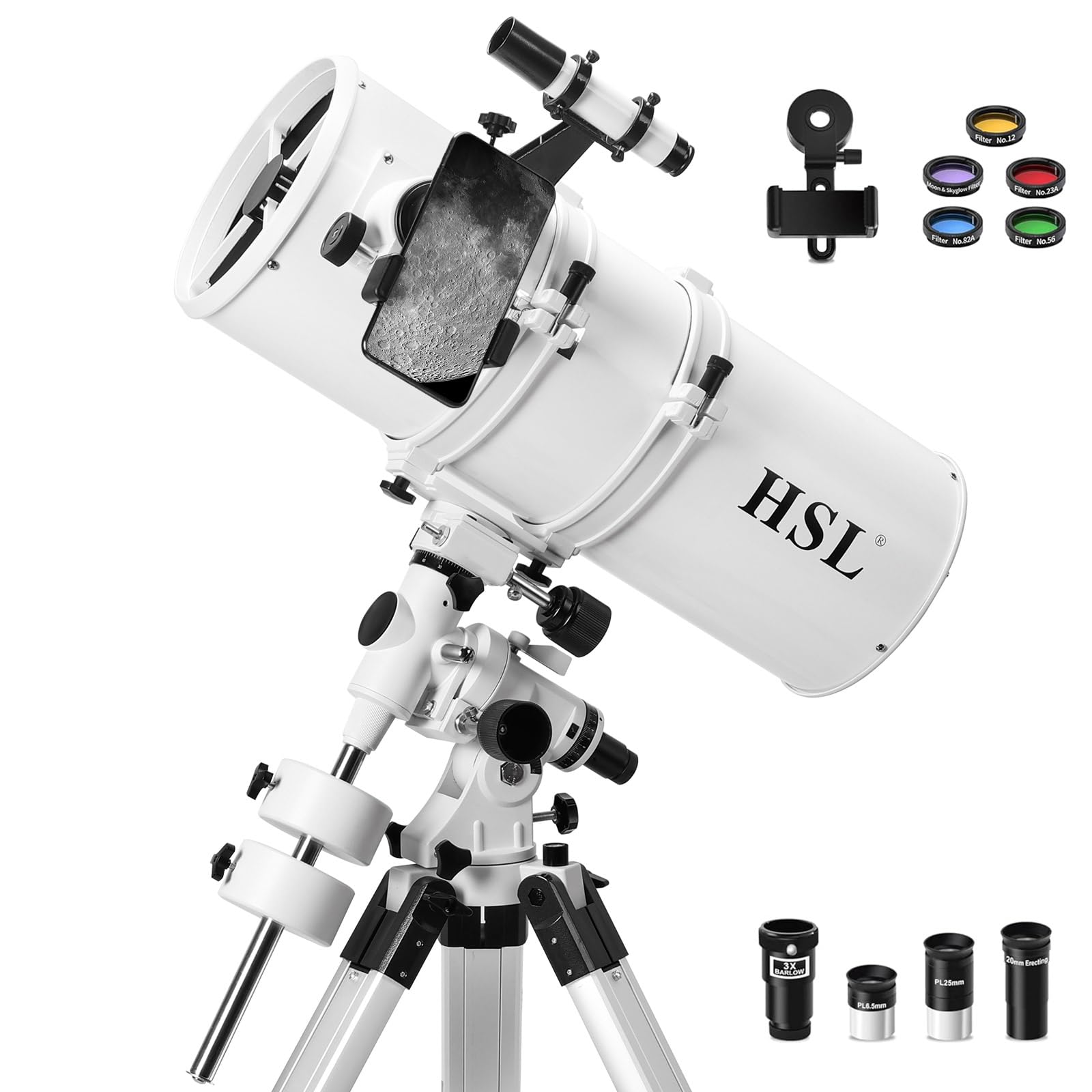
The HSL 203EQ offers a 203mm primary mirror on an EQ4 equatorial mount, making it an alternative to Dobsonian designs for users who want to track objects manually with a single axis. The 800mm focal length (f/3.9) is fast, providing a short tube that’s easier to handle, but the fast focal ratio also makes collimation and eyepiece selection more demanding — budget eyepieces may show significant astigmatism in the outer field. The EQ4 mount has 1.75-inch steel tripod legs and a heavier-duty structure than entry-level EQ2/EQ3 mounts.
The package includes five color filters (red, blue, orange, green, yellow) for enhancing planetary detail, along with a smartphone adapter and wireless remote for basic astrophotography. Triple magnification is achievable with the 3x Barlow lens: 90x with the 25mm, 112.5x with the 20mm, and 345x with the 6.5mm — though 345x exceeds the useful limit under average seeing conditions. The straight-through finder is adequate for initial object location, and the optical tube uses a standard 1.25-inch rack-and-pinion focuser.
The EQ mount introduces a steeper learning curve than a Dobsonian: you must polar-align the mount to track accurately, which can be time-consuming for beginners. The tripod has been reported as flimsy by some users, with vibration damping being a concern at higher magnifications. The included padded backpack is a nice addition for transporting the optical tube. Overall, this is a budget entry into 8-inch aperture with a mount better suited for planets than deep-sky observing.
Why it’s great
- 203mm aperture at a very accessible price point
- EQ4 mount allows single-axis tracking for longer observing
- Color filter set enhances planetary contrast
Good to know
- EQ mount has a steep learning curve for beginners
- Fast f/3.9 optics require high-quality eyepieces for sharp edge views
- Rack-and-pinion focuser may have backlash
7. Sky-Watcher Flextube 250 Dobsonian 10-Inch

For those who want more than 8 inches without jumping to a 12-inch, the Sky-Watcher Flextube 250 takes the same collapsible truss design and scales it up to 10 inches of aperture. The 254mm primary mirror gathers 56% more light than an 8-inch, transforming galaxies like M51 into detailed spiral structures under dark skies. The 1200mm focal length (f/4.7) keeps the tube short when collapsed — about 30 inches for transport — while still delivering enough focal length for planetary work with a 5mm eyepiece (240x).
The optical suite includes the same 94% reflective mirrors and 2-inch Crayford focuser as the 8-inch Flextube, but the 8×50 RACI finder is a welcome inclusion for easier sky navigation. The tension control handles handle the heavier tube without issue, and the base uses oversize Teflon pads for smooth altitude and azimuth movement. Total weight is 42 pounds — heavier than the 8-inch version but still manageable for one person.
Collimation is more critical at f/4.7 than at f/5.9 — the faster focal ratio means mirror misalignment is more visible. A quality laser collimator is essential, and some users report needing to collimate after every transport. The azimuth bearings can feel sticky out of the box; many owners add a lazy Susan bearing for improvement. This scope rewards with stunning views but demands more setup time and skill to reach its potential.
Why it’s great
- 10-inch aperture reveals deep-sky detail invisible in smaller scopes
- Collapsible to 30 inches for easy transport and storage
- RACI finder and 2-inch Crayford focuser are premium features
Good to know
- Faster f/4.7 optics require precise collimation each session
- Heavier than 8-inch — plan for two trips to carry
- Azimuth may need modification for smooth motion
8. Unistellar Equinox 2 Smart Telescope
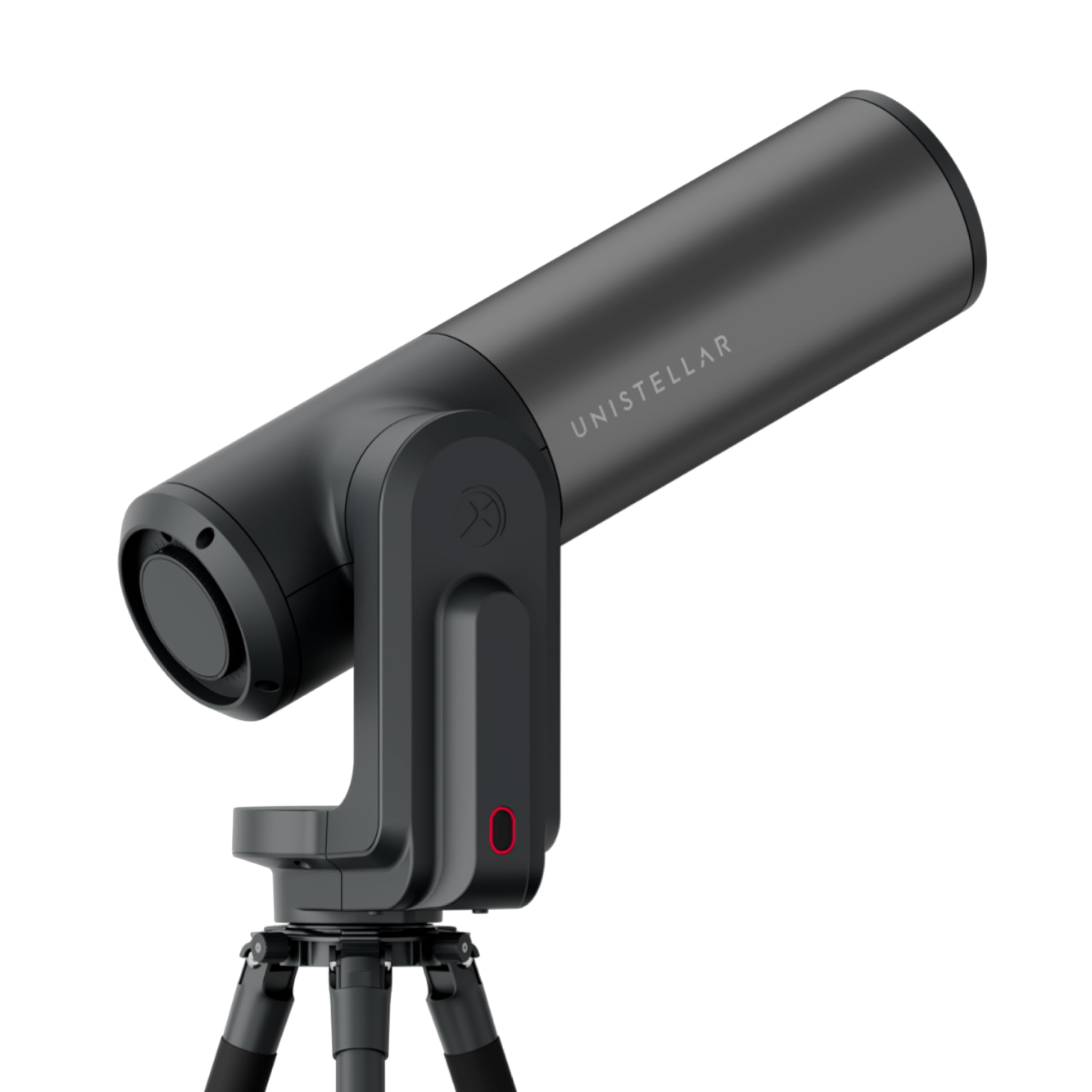
The Unistellar Equinox 2 represents a fundamentally different approach: a fully digital, no-eyepiece smart telescope designed for app-based viewing. Its 114mm aperture and 450mm focal length (f/4) feed a built-in digital sensor that captures images and displays them on your smartphone or tablet. The motorized Alt-Az mount with precise GoTo automatically aligns and slews to over 5,000 objects, and the 11-hour internal battery allows extended sessions without external power.
The system enhances images through dynamic signal amplification, revealing deep-sky objects like the Whirlpool Galaxy with structure and color that a standard eyepiece of this aperture cannot show to the eye. The RAW/FITS export capability satisfies intermediate astrophotographers who want to process images in PixInsight or Photoshop. The built-in 64GB storage holds thousands of captures, and the Wi-Fi connection to the app is stable at typical backyard distances.
The main trade-off is the lack of a traditional eyepiece — you observe through the screen, not through glass. Some users find this disconnected from the tactile experience of visual astronomy. The 114mm aperture is less than half the light-gathering area of an 8-inch Dob, so real-time visual detail on planets is limited. Setup is under 5 minutes, and the system works from heavily light-polluted city balconies, but the premium price tag puts it in a different tier from the Dobsonians.
Why it’s great
- Instant GoTo with no polar alignment required
- 11-hour battery enables all-night sessions
- RAW/FITS export for real astrophotography processing
Good to know
- No eyepiece — viewing is entirely through a phone/tablet screen
- 114mm aperture cannot match 8-inch for visual detail
- Premium pricing compared to similarly sized manual scopes
9. Sky-Watcher Flextube 300 SynScan 12-Inch GoTo

The Sky-Watcher Flextube 300 SynScan merges a 12-inch (305mm) collapsible Dobsonian with full computerized GoTo tracking. The 1500mm focal length (f/4.9) provides 60x with the included 25mm eyepiece, and the GoTo system can automatically locate and track any of over 42,000 objects in the database. The built-in Wi-Fi allows control from a smartphone or tablet via the SynScan app, supplementing the hand controller — no external dongle needed.
The all-metal gearing on DC servo motors provides smooth tracking suitable for visual observation and short-exposure imaging (up to about 30 seconds before field rotation becomes visible). The dual-encoder Freedom Find technology lets you nudge the scope manually during a GoTo session without resetting the alignment. The collapsible truss brings the 46-pound tube down to a compact 42-inch length for transport.
At 99.2 pounds total (46-pound tube, 53-pound base), this is a heavy instrument — moving it requires planning and possibly a hand truck. The base is made from MDF, and some users express concern about its long-term durability under the load of the heavy tube. The secondary mirror adjustment can be tricky, and collimation must be checked after each transport. Customer support experiences vary, but the optical performance when properly set up is truly spectacular, resolving details in globular clusters and showing nebula structure that smaller apertures only hint at.
Why it’s great
- 12-inch aperture with automated GoTo tracking
- Built-in Wi-Fi and smartphone control
- Collapsible tube for manageable transport
Good to know
- Nearly 100 lbs — requires serious transport planning
- Collimation critical and may need adjustment every session
- MDF base durability is a concern at this weight
10. Celestron NexStar Evolution 8 EdgeHD with StarSense

The Celestron NexStar Evolution 8 EdgeHD is not a Dobsonian but the premier Schmidt-Cassegrain alternative with a built-in StarSense AutoAlign system. Its 203mm aperture combined with the flat-field, coma-free EdgeHD optical design delivers pinpoint stars across the entire field of view — critical for both visual observing and astrophotography. The 2032mm focal length (f/10) provides high native magnification for planets: 203x with a 10mm eyepiece, and up to 400x with a Barlow on steady nights.
The Evolution mount contains a built-in rechargeable battery that lasts a full night, Wi-Fi for wireless control via the Celestron SkyPortal app, and brass worm gears for superior tracking accuracy. StarSense AutoAlign uses a camera to plate-solve and align the telescope automatically in under 5 minutes with no user input beyond powering on. The mount is rated for 30 pounds of payload, easily handling the 13-pound optical tube plus cameras, filters, and a guidescope.
Wi-Fi reliability varies — some users experience intermittent disconnections at close range, requiring the use of a handheld SkySync GPS accessory for consistent performance. The single-speed focuser is adequate but sensitive at f/10; a motorized focuser upgrade is common among imagers. The 69-pound total weight makes it less portable than a Dobsonian of similar aperture. Despite these quirks, the tracking accuracy, built-in battery, and thermal stability of the EdgeHD optics make it a benchmark for serious lunar, planetary, and deep-sky enthusiasts.
Why it’s great
- EdgeHD optics deliver diffraction-limited stars edge-to-edge
- Built-in battery and Wi-Fi for cable-free operation
- StarSense AutoAlign eliminates manual alignment procedures
Good to know
- Wi-Fi connectivity can be unreliable in some setups
- Single-speed focuser is less precise at high focal ratios
- 69 lbs with tripod — not a grab-and-go design
11. Unistellar Odyssey PRO Smart Telescope

The Unistellar Odyssey PRO is the only smart telescope that offers both a traditional eyepiece and app-based digital viewing. Its 85mm aperture and 320mm focal length (f/3.9) feed a high-resolution sensor for digital imaging, but the proprietary eyepiece technology lets you switch to direct visual observation — a first in this category. The motorized Alt-Az mount with precise GoTo automates object finding, and the system aligns in under 2 minutes with no polar alignment or calibration.
The built-in camera captures deep-sky objects with enhanced vision technology, and the RAW/FITS export allows serious post-processing. The 64GB onboard storage holds hundreds of exposures, and the 5-hour battery is sufficient for a typical session. The compact design — 6.5 kg scope plus 2.5 kg tripod — makes it truly portable, fitting into a backpack with the optional carrying case. The 37-million-star database and 5,000+ object catalog cover everything from planets to galaxies.
At this price point, the 85mm aperture limits real-time visual detail compared to an 8-inch Dob — the lunar and planetary views through the eyepiece will show less contrast and resolution. The app connection can be inconsistent, with some users reporting frustrating drops. For those who prioritize instant setup, compact portability, and the ability to share views on a screen while still having the option of direct visual observation, the Odyssey PRO is a category-defining instrument.
Why it’s great
- Only smart telescope with a built-in eyepiece for direct viewing
- Ultra-portable 9 kg total weight
- 2-minute setup with automated GoTo and autofocus
Good to know
- 85mm aperture is a fraction of an 8-inch Dob’s light-gathering
- App connectivity issues reported by some users
- Very high price for the aperture size
FAQ
Do I need to collimate an 8-inch Dobsonian every time I use it?
Which eyepieces should I buy for an 8-inch Dobsonian?
Can I use an 8-inch Dobsonian for astrophotography?
What is the maximum useful magnification of an 8-inch Dobsonian?
Final Thoughts: The Verdict
For most users, the 8 inch dobsonian telescope winner is the Celestron StarSense Explorer 8-inch because it pairs a high-quality 203mm parabolic mirror with smartphone-based navigation that eliminates the learning curve for finding faint objects. If you want a solid-tube manual scope with excellent mirror coatings and tension control handles, grab the Sky-Watcher Classic 200. And for portable deep-sky exploring where every inch of trunk space matters, nothing beats the Sky-Watcher Flextube 200.