
A handheld camera that shoots true 4K is no longer a luxury—it’s the baseline for anyone serious about content creation, travel vlogging, or independent filmmaking. The problem is separating real performance from marketing hype, especially when specs like “60fps” and “stabilization” get thrown around without context.
I’m Min — the co-founder and writer behind Gadgets Feed. I’ve spent countless hours cross-referencing sensor sizes, gimbal architectures, bitrates, and low-light noise floors to find the models that actually deliver on their 4K promises.
This guide cuts through the noise to help you find the absolute best 4k handheld camera for your specific workflow and budget, whether that means a pocket-sized gimbal for smooth walking shots or a full-featured camcorder for professional productions.
How To Choose The Best 4K Handheld Camera
Choosing the right 4K handheld camera hinges on understanding the interplay between the sensor, the stabilization system, and your intended shooting style. A larger sensor will always give you cleaner footage in dim conditions, but the best camera for a cinematographer is very different from the best camera for a travel vlogger.
Sensor Size and Low-Light Performance
The sensor is the heart of any camera. A 1-inch CMOS sensor (like those in the DJI Osmo Pocket 3 or the Xtra Muse) collects significantly more light than the smaller 1/2.3-inch or 1/2.5-inch sensors found in most budget action cameras and camcorders. This translates directly into less noise, better color depth, and usable footage in twilight or indoor settings. If you plan to shoot in anything less than bright sunlight, a 1-inch sensor should be at the top of your priority list.
Stabilization: Mechanical vs. Digital vs. Optical
Not all stabilization is created equal. A 3-axis mechanical gimbal physically moves the camera lens to counteract your hand movements, delivering silky-smooth walking shots without jello artifacts. In contrast, electronic or digital stabilization crops into the sensor and can introduce warping. Balanced optical steadyshot (found on Sony’s Handycam) is effective for zoom, but for dynamic movement, gimbal-based systems reign supreme. For most creators, a camera with a built-in gimbal is the gold standard.
Frame Rate and Resolution Trade-Offs
True 4K resolution (3840×2160) at 30fps is the standard. However, 4K at 60fps or 120fps allows for high-quality slow-motion playback. Be aware that some cameras claim “4K” but only achieve it at a very low bitrate or with significant crop. Look for specifications that mention the codec (like H.265 or Apple ProRes) and the bitrate in Mbps. Higher bitrates preserve more detail, especially in fast-moving scenes.
Quick Comparison
On smaller screens, swipe sideways to see the full table.
| Model | Category | Best For | Key Spec | Amazon |
|---|---|---|---|---|
| DJI Osmo Pocket 3 | Premium Compact | All-around vlogging & travel | 1-inch CMOS / 4K 120fps | Amazon |
| Blackmagic Pocket Cinema 4K | Professional Cinema | Filmmaking & narrative work | 4/3” sensor / 13 stops DR | Amazon |
| Xtra Muse | Mid-Range Compact | Budget-friendly 1-inch gimbal | 1-inch CMOS / 4K 120fps | Amazon |
| Sony FDR-AX43 Handycam | Premium Camcorder | Optical zoom & events | 20x Optical Zoom / B.O.S.S. | Amazon |
| Canon VIXIA HF G70 | Premium Camcorder | Long-form recording & streaming | 20x Optical Zoom / UVC Live | Amazon |
| Canon PowerShot SX740 HS | Compact Zoom | Travel zoom & 4K stills | 40x Optical Zoom / 20.3MP | Amazon |
| ORDRO AX65 | Budget Camcorder | Starter zoom & low-light | 12x Optical Zoom / Sony Sensor | Amazon |
| ORDRO M5 | Budget Compact | Entry-level gimbal experience | 3-Axis Gimbal / 5K upscale | Amazon |
| Feiyu Pocket 3 Kit | Budget Gimbal | Unique magnetic mounting | 3-Axis Gimbal / Detachable head | Amazon |
In‑Depth Reviews
1. DJI Osmo Pocket 3 Creator Combo

The DJI Osmo Pocket 3 remains the undisputed king of the pocket gimbal category, and for good reason. Its 1-inch CMOS sensor is a full stop more sensitive than the smaller sensors found in almost every competitor in this price bracket, capturing clean, detailed 4K footage even as the sun dips below the horizon. The 3-axis mechanical gimbal eliminates walking jutter entirely, and the 2-inch rotatable touchscreen makes switching between horizontal and vertical shooting effortless.
ActiveTrack 6.0 locks onto subjects with a tenacity that borders on magical—you can spin, duck, and dance, and the camera keeps you centered. The Creator Combo sweetens the deal with a wireless DJI Mic 2 transmitter, a wide-angle lens, and a battery handle, effectively turning this into a complete vlogging studio that fits in a coat pocket. The 10-bit D-Log M color profile gives grading flexibility that rivals cameras costing three times as much.
Some users may find the 2-inch screen small for precise manual focus, and the fixed lens means no optical zoom beyond the 20mm equivalent wide angle. But for pure image quality and stabilization density, nothing in the sub-premium tier touches it.
Why it’s great
- Industry-best 3-axis stabilization
- Large 1-inch sensor for low light
- Excellent tracking with ActiveTrack 6.0
Good to know
- No optical zoom
- Limited manual control without app
- Small display for critical focus
2. Blackmagic Design Pocket Cinema Camera 4K

This is a professional cinema camera that happens to be handheld. The Four Thirds sensor delivers 13 stops of dynamic range and dual native ISO up to 25,600, producing images that hold up in a Hollywood-grade color pipeline. Recording in 12-bit Blackmagic RAW or Apple ProRes gives editors immense flexibility for color grading without generational loss. The 5-inch LCD is large and bright enough to pull focus without an external monitor.
The included DaVinci Resolve Studio activation key is a massive value—it’s the same software used on major studio productions. The MFT lens mount opens up a vast ecosystem of affordable and vintage glass, allowing you to adapt lenses for a fraction of the cost of cinema PL mounts. For narrative filmmaking, corporate videos, or high-end documentary work, the BMPCC 4K is unmatched at its price tier.
Be warned: this camera has no autofocus of any kind, no in-body stabilization, and a notoriously short battery life (roughly 30 minutes on an LP-E6). You will need a rig, external batteries, and a gimbal or tripod to get reliable footage. It is a tool for filmmakers who want full manual control, not a point-and-shoot vlogging camera.
Why it’s great
- Cinematic 13-stop dynamic range
- ProRes and Blackmagic RAW recording
- Large 5-inch touchscreen monitor
Good to know
- No autofocus or stabilization
- Very short battery life
- Requires extensive rigging
3. Xtra Muse

The Xtra Muse is the budget-friendly alternative that captures the spirit of the DJI Osmo Pocket 3 without matching its ecosystem polish. It boasts the same critical hardware spec—a 1-inch CMOS sensor paired with a 3-axis gimbal—and can record 4K video at a buttery 120fps for stunning slow motion. The 2-inch touchscreen is responsive, and the Master Follow feature does a respectable job of keeping subjects centered.
Where the Xtra Muse impresses most is in its color science. The 10-bit X-Log mode captures a broad color gamut, and users report that footage grades very well for a camera at this price. The standard bundle includes a carrying bag, wrist strap, and a threaded handle, giving you everything you need to start shooting immediately. Its 161-minute battery life outlasts the DJI Pocket 3’s standard configuration.
The autofocus is quick but not as sticky as DJI’s ActiveTrack, occasionally losing lock in fast-paced scenes. Image quality in bright light is superb, but noise creeps in faster than the Sony sensor in the Pocket 3. For creators on a budget who want a dedicated 4K gimbal camera, however, the Xtra Muse is a compelling choice.
Why it’s great
- 1-inch sensor for sharp 4K/120fps
- 10-bit X-Log color grading
- Great battery life for its size
Good to know
- Autofocus not as reliable as DJI
- Some noise in low light
- Basic accessory ecosystem
4. Sony FDR-AX43 UHD 4K Handycam

When your subject is far away—whether it’s a child on a soccer field or a bear in a national park—the Sony FDR-AX43 is the right 4K handheld camera for the job. Its 20x optical Zeiss lens with Balanced Optical SteadyShot provides genuine telephoto reach without the massive weight of a traditional camcorder. The Exmor R CMOS sensor and BIONZ X processor work together to deliver clean 4K video with accurate color reproduction.
Fast Intelligent AF tracks subjects reliably, and the built-in gimbal mechanism keeps zoomed footage impressively steady compared to competing camcorders that rely solely on digital stabilization. The Highlight Movie Maker automatically assembles short highlight clips from your footage, a handy feature for parents or event videographers who need quick social media cuts. NFC and Wi-Fi make transferring clips to a phone straightforward.
The physical size is slightly larger and the battery protrudes noticeably from the back, making it less ideal for pocket carry or lightweight selfie sticks. Some users report that the date/time resets quickly after removing the battery. For anyone who needs reach—real optical zoom, not digital crop—this Sony is a workhorse.
Why it’s great
- True 20x optical zoom reach
- Balanced Optical SteadyShot stabilizer
- Fast Intelligent AF tracking
Good to know
- Battery protrudes awkwardly
- No internal memory
- Date/time resets quickly
5. Canon VIXIA HF G70

For those who demand a traditional camcorder form factor with modern 4K internals, the Canon VIXIA HF G70 is an excellent choice. It records crisp 4K UHD video using a 1/2.3-inch CMOS sensor paired with the DIGIC DV 6 image processor, and its 20x optical zoom lens with an 8-blade aperture delivers pleasing bokeh in the background of interviews or focused shots. The Hybrid AF system with face detection provides sharp, reliable focus.
A standout feature is the UVC livestreaming capability—connect the camera to a PC via USB and it acts as a high-quality webcam, perfect for live events or Zoom calls where you want a real camcorder. The dual SD card slots allow for relay recording, ensuring you never miss a moment during long shoot days. The On-Screen Display Time Stamp feature embeds real-time data directly into the video file, which is essential for legal or evidence-gathering uses.
Low-light performance is a clear weakness—gain levels above 4 introduce significant noise, making it less suitable for candlelit or night scenes. The optical dynamic stabilization is good but cannot match a mechanical gimbal for walking shots. For controlled indoor events and daytime outdoor recording, however, this Canon is a dependable, feature-rich tool.
Why it’s great
- UVC live streaming ready
- Dual SD card slots for relay
- 8-blade aperture for bokeh
Good to know
- Poor low-light performance
- No 4K over HDMI output
- Stabilization is optical, not gimbal
6. Canon PowerShot SX740 HS
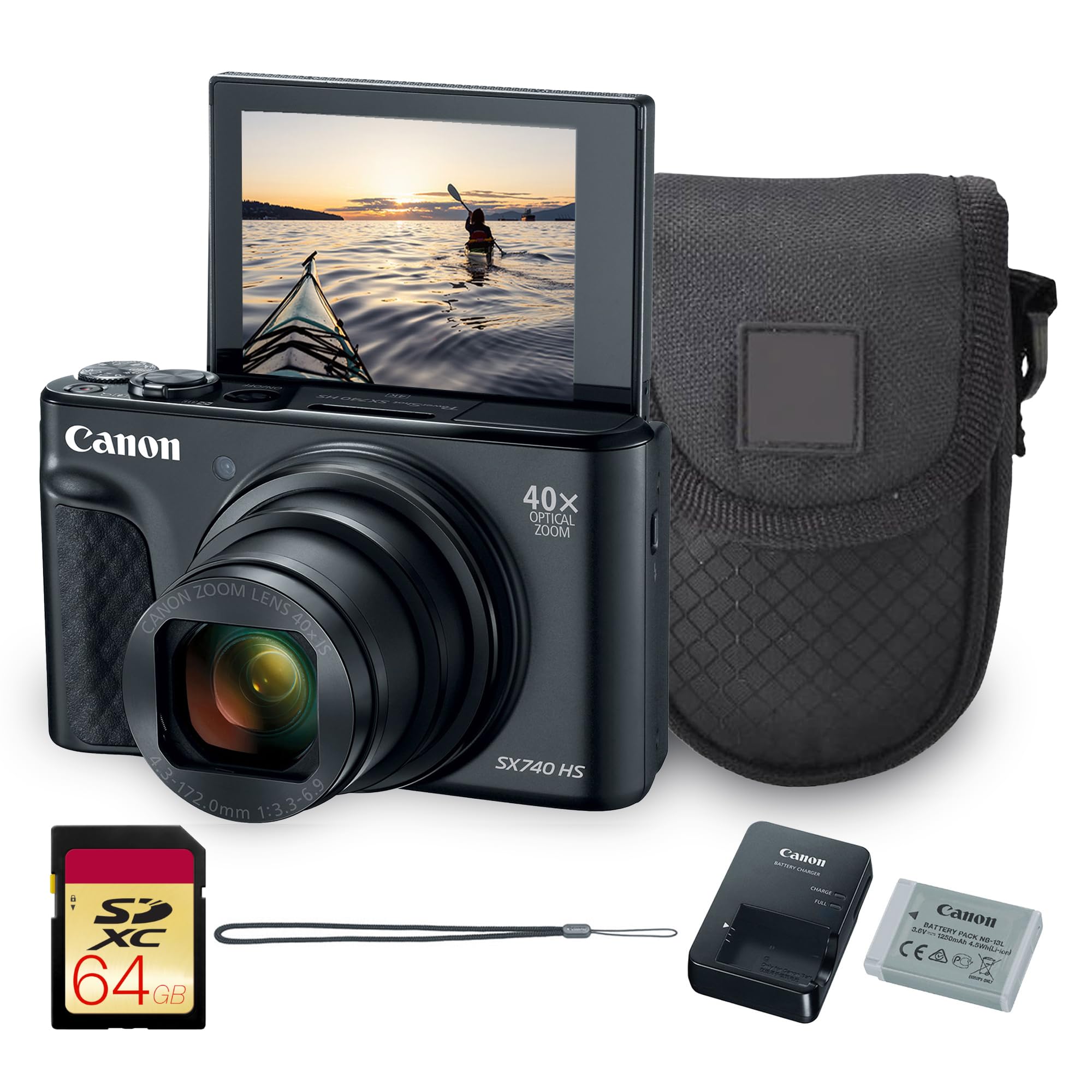
The Canon PowerShot SX740 HS fits in a pants pocket yet brings distant subjects incredibly close with its 40x optical zoom lens (24-960mm equivalent). For concerts, wildlife, or stadium events where you can’t get near the action, this is the most portable solution for 4K recording. The 20.3MP CMOS sensor and DIGIC 8 processor produce vibrant stills and 4K UHD video at 30fps.
Built-in 5-axis stabilization helps keep telephoto shots reasonably steady, though a tripod is strongly recommended at maximum zoom for crisp results. Wi-Fi and Bluetooth connectivity allow you to transfer files and control the camera remotely via the Canon Camera Connect app. The bundle with a carrying bag and 64GB memory card adds immediate value.
Autofocus can hunt in low-contrast scenes, and the 1/2.3-inch sensor produces softer images in low light compared to a 1-inch option. The battery life is good, with many users reporting a full day of casual travel shooting without needing to recharge. For the ultimate reach-to-size ratio, the SX740 HS is a category leader.
Why it’s great
- Phenomenal 40x optical zoom range
- Ultra-compact pocketable body
- Wi-Fi and Bluetooth sharing
Good to know
- Small sensor struggles in low light
- Autofocus hunts occasionally
- Digital stabilization, not a gimbal
7. ORDRO AX65 4K Camcorder
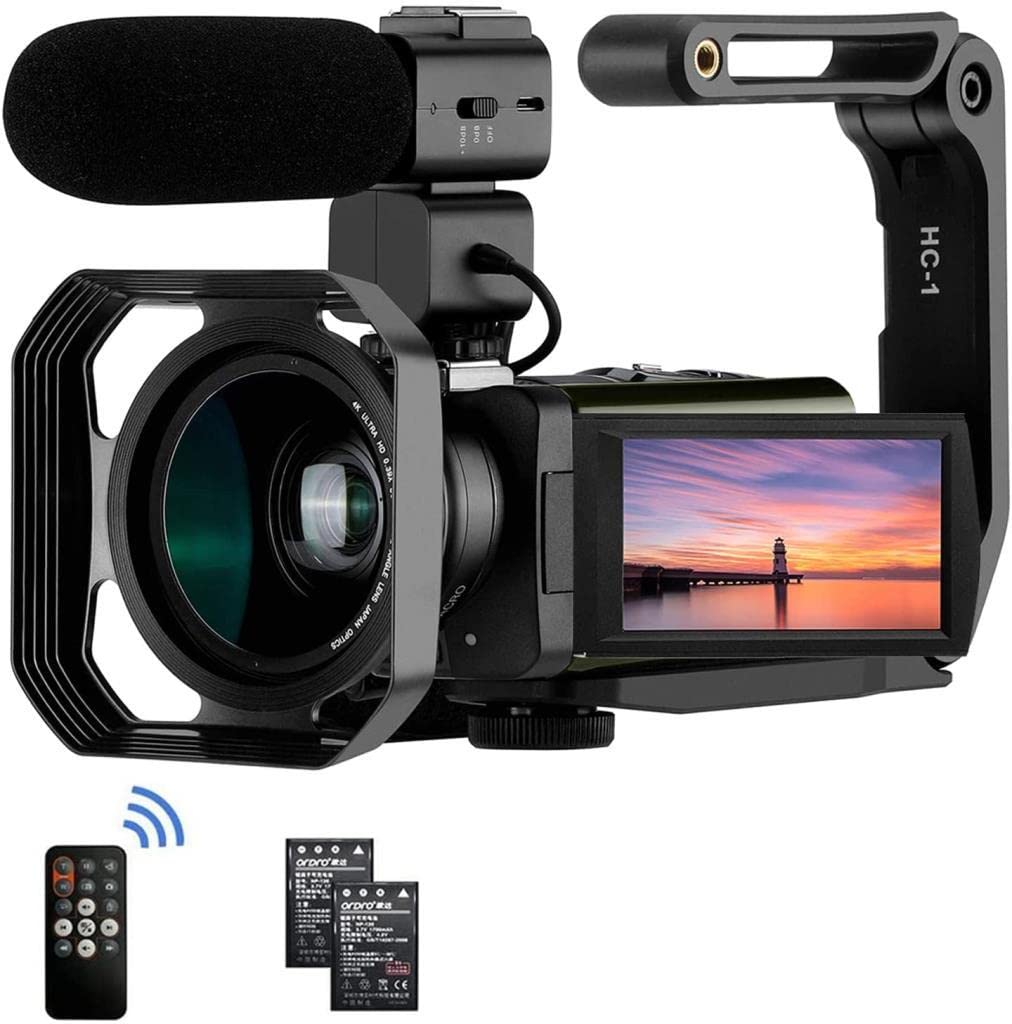
The ORDRO AX65 punches well above its price class by incorporating a genuine Sony 1/3-inch CMOS sensor, which provides noticeably better low-light performance than the generic sensors found in other budget camcorders. The 12x optical zoom lens is paired with a 100x digital zoom (best avoided for serious work, but useful for reach). 4K video at 24fps captures decent detail for the price point.
This camcorder is packed with beginner-friendly features: a 3.5-inch IPS touchscreen that rotates 270 degrees, a hot shoe for external lights, and a 2-in-1 wide-angle/macro lens included in the box. The external microphone jack is a critical inclusion for improving audio quality, which tends to be the weakest link in budget cameras. Two rechargeable batteries ensure you can shoot through a full event without stopping to charge.
The included app for remote control is finicky and sometimes fails to connect. The maximum 4K resolution is limited to 24fps, which can appear jittery in panning shots unless you’re careful. Colors can shift noticeably in mixed lighting. For a starter 4K camcorder with genuine optical zoom and a Sony sensor, though, the AX65 offers solid value.
Why it’s great
- Sony sensor for better low-light
- 12x optical zoom with macro lens
- Great accessory bundle included
Good to know
- 4K limited to 24fps
- App connectivity is unreliable
- Color accuracy varies in mixed light
8. ORDRO M5 Handheld Camera
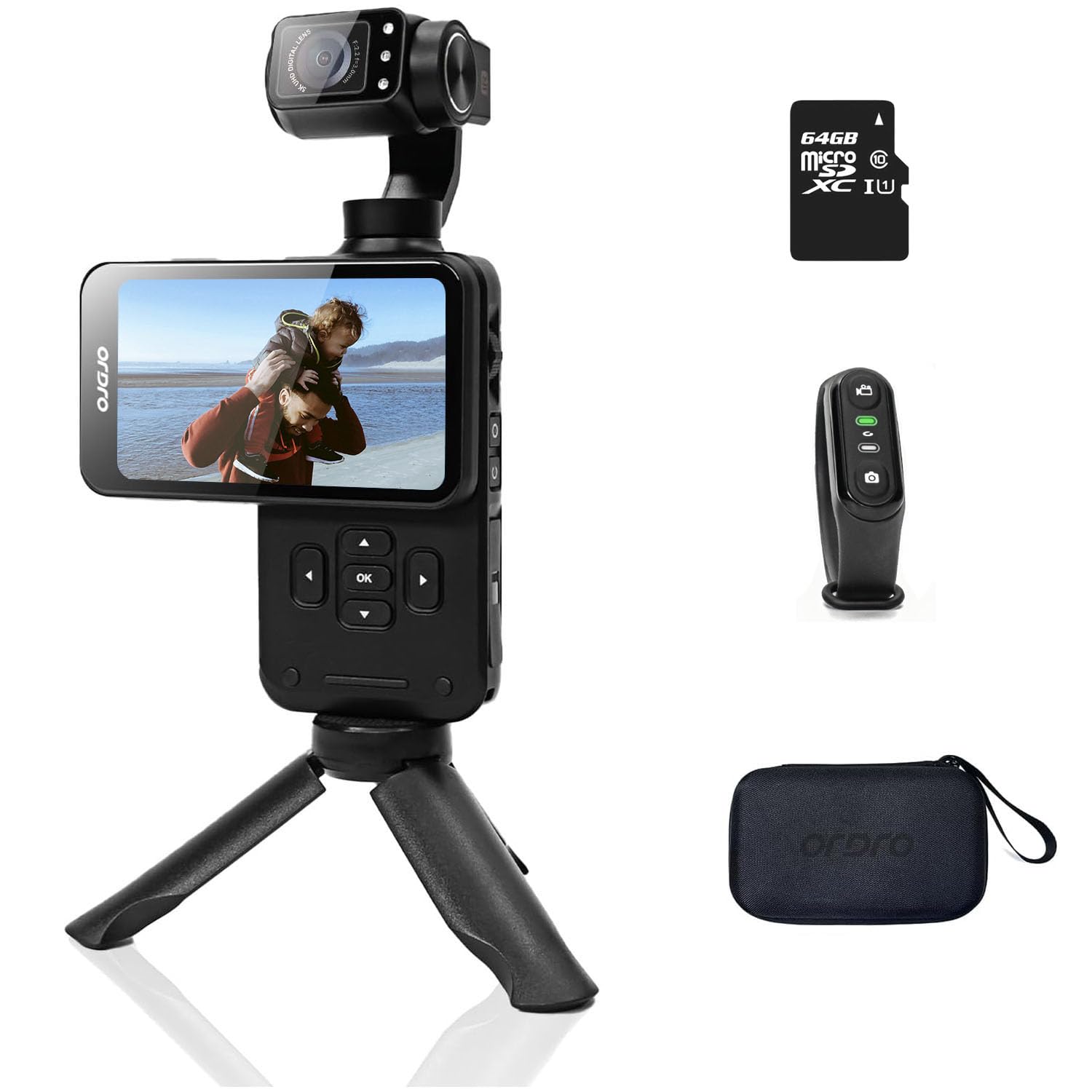
The ORDRO M5 brings a 3-axis mechanical gimbal and night vision into a single, very affordable package—making it a unique proposition for budget-conscious creators who need stabilization and the ability to shoot in complete darkness. It records up to 5K at 30fps (effectively upscaled 4K) and 4K at 60fps, with a 120-degree wide-angle lens that is well-suited for vlogging and selfie framing.
The 3.5-inch IPS touchscreen is a pleasure to use, and the 180-degree rotating lens means you can point it toward yourself or your subject without moving the entire camera body. It includes a 64GB SD card, a remote control, and a mini stand, providing everything a beginner needs to start shooting. The face tracking works reasonably well for stationary framing.
Video quality is acceptable in good light but softens noticeably indoors, and the audio from the built-in microphone is poor—an external USB mic is almost essential. The gimbal is good but not perfect, occasionally drifting during slow pans. For the price, it competes more as a creative accessory than a primary camera, but the gimbal stabilization alone justifies the investment for beginners.
Why it’s great
- Built-in 3-axis gimbal stabilization
- Infrared night vision capability
- Rotating lens for selfies
Good to know
- Poor onboard audio quality
- Soft video in low light
- Gimbal can drift during pans
9. Feiyu Pocket 3 Kit

The Feiyu Pocket 3 is the only camera in this list with a truly detachable magnetic camera head, allowing you to place the lens in locations no other gimbal camera can reach—stuck to a metal fence, inside a car, or on a fridge door. The wireless remote handle includes a live preview display, so you can frame the shot from a distance. The 130-degree ultra-wide lens captures immersive first-person perspectives.
The mechanical 3-axis gimbal keeps 4K at 60fps footage steady, and the AI face tracking works effectively once locked onto a subject. The compact metal build feels premium, and the magnetic mount base is genuinely innovative for creative angles. It’s also one of the lighter options, making it ideal for mounting on hats or bikes.
Video quality is acceptable in daylight but degrades significantly in low light, where noise becomes apparent. The audio from the built-in mic is notably poor, described as usable only for voiceovers. The wireless remote connection can also lag, and some units have been reported to lock up or fail. As a creative secondary camera for B-roll and unconventional angles, the Feiyu Pocket 3 is unmatched, but it is not a reliable primary shooter.
Why it’s great
- Detachable magnetic lens head
- Wireless remote with live view
- Very compact and lightweight
Good to know
- Poor low-light image quality
- Terrible built-in audio
- Wireless connection can lag
FAQ
Does a 1-inch CMOS sensor really make a difference for 4K video?
What is the real-world battery life I should expect from a gimbal camera?
Can I use a 4K handheld camera for professional streaming?
Final Thoughts: The Verdict
For most users, the best 4k handheld camera winner is the DJI Osmo Pocket 3 because it combines a large 1-inch sensor, flawless 3-axis stabilization, and intelligent tracking into the most polished pocketable package available. If you want the absolute best image quality for filmmaking, grab the Blackmagic Pocket Cinema Camera 4K and pair it with a gimbal. And for maximum optical zoom reach in a compact form, nothing beats the Canon PowerShot SX740 HS.