
Capturing clean dialogue or a live performance is a constant battle against room echo, rumble, and the subtle hiss that cheap preamps introduce. The difference between a usable take and one that requires hours of spectral repair often comes down to a single decision: the microphone capsule, the bit depth, and the noise floor of the recorder you choose.
I’m Min — the co-founder and writer behind Gadgets Feed. I’ve spent hundreds of hours cross-referencing datasheets, decoding marketing claims about self-noise and SPL limits, and analyzing user reports from podcasters, journalists, and field recordists to cut through the hype in this crowded space.
Whether you are a student archiving lectures, a journalist conducting interviews, or a musician tracking multi-instrument demos, finding the right audio recorder depends on understanding mic patterns, bit-depth capabilities, and storage expandability rather than just brand familiarity.
How To Choose The Best Audio Recorder
Audio recorders are not all built the same, and the wrong choice can mean sifting through distorted, noisy, or thin-sounding files that ruin your project. The core decision points narrow down to how you capture sound, how much headroom you have, and how you get those files off the device.
Microphone Capsules and Polar Patterns
The microphone is the heart of the recorder. An X/Y stereo pair with large 19.4mm capsules delivers a wide stereo image and high sensitivity, while a smaller omnidirectional mic is better for capturing ambient room tone or multi-person conversations around a table. For isolating a single voice in a noisy room, look for recorders with switchable polar patterns or at least a cardioid setting to reject off-axis sound.
Bit Depth and Floating Point Recording
Standard 16-bit or 24-bit recording forces you to set gain levels correctly before the take. If a sudden loud noise hits, you clip and the audio is lost. 32-bit float recording captures an enormous dynamic range, so you can record without setting gain at all and simply normalize the level in post-production. This feature alone makes an audio recorder more forgiving in live or unpredictable environments.
Input Connectivity and Expandability
If you plan to use external microphones, XLR inputs with phantom power are essential for condenser mics. Combo XLR/TRS inputs add line-level options for instruments. For file management, a built-in USB-C port that supports direct mass storage transfer is far more convenient than removing a microSD card. Expandable storage via microSD or SDXC allows you to record long events at high sample rates without worrying about running out of space.
Quick Comparison
On smaller screens, swipe sideways to see the full table.
| Model | Category | Best For | Key Spec | Amazon |
|---|---|---|---|---|
| Zoom H4 Essential | Premium | Music Production & Multi-Track | 19.4mm Capsule, 32-bit Float, 4 Tracks | Amazon |
| Zoom H1 XLR | Mid-Range | Podcasters & Filmmakers | 2 XLR/TRS Inputs, 32-bit Float | Amazon |
| iFLYTEK 302Pro | Premium | AI Transcription & Meetings | Offline 5-Language Transcription, 6-Mic Array | Amazon |
| TASCAM DR-05XP | Mid-Range | Field Recording & USB-C Interface | 32-bit Float, 125dB SPL Max | Amazon |
| OM System DM-720 | Mid-Range | Clear Dictation & Meetings | TRESMIC 3-Mic System, 48kHz/16-bit PCM | Amazon |
| Sony ICD-PX370 | Budget | Simple Voice Memos | 57hr Battery, Built-in USB | Amazon |
| Yegolito 128GB | Budget | Lectures & Note-Taking | 128GB Storage, 35hr Battery, 360° Mic | Amazon |
In‑Depth Reviews
1. Zoom H4 Essential

The Zoom H4 Essential features the largest microphone capsules ever put on a handheld recorder — 19.4mm in an X/Y configuration — delivering a rich, detailed stereo image that rivals larger studio setups. Its 32-bit float recording completely removes the need to set gain levels; you can capture a whisper and a drum hit in the same file without any clipping.
Dual XLR/TRS combo inputs let you connect external microphones or line-level instruments, and the device records up to four simultaneous tracks at 192kHz. The dedicated gain knobs offer hands-on level riding during live sessions, and the unit weighs only 243 grams, making it genuinely portable for field work or music rehearsals.
Battery life sits at around 20 hours on two AA batteries, and the recorder charges over USB-C or can be powered via an external battery pack for extended sessions. Some handling noise has been reported in early units, and the interface can feel dense without reading the manual, but for multi-track flexibility and pro-level audio, this is the most capable recorder in its price tier.
Why it’s great
- Massive 19.4mm X/Y capsules produce full, wide stereo captures
- 32-bit float recording means zero gain adjustment needed before takes
- Four-track simultaneous recording at 192kHz for complex productions
Good to know
- Onboard mics are sensitive to wind noise without a windscreen
- Menu navigation can be unintuitive for first-time users
2. Zoom H1 XLR

The Zoom H1 XLR brings professional XLR connectivity into a compact form factor without breaking your budget. It features two locking XLR/TRS combo inputs, allowing you to use high-quality dynamic or condenser microphones for interviews, podcasts, or film dialogue. The built-in 32-bit float recording at up to 96kHz ensures you never have to worry about level-setting again.
A dedicated OLED waveform display gives you real-time visual feedback of your audio levels and recording status, which is crucial when you are focused on the content rather than the device. The unit also includes a 3.5mm stereo input for external microphones and a headphone output for live monitoring. It supports SDXC cards up to 1TB for unlimited session length.
The plastic body is lightweight at 0.4 pounds, but it feels solid enough for location work. Battery life is rated at about 10 hours of continuous recording on two AA batteries. While the build is not ruggedized for heavy drops, the audio quality and input flexibility at this price point are exceptional, making it a top choice for content creators who rely on external mics.
Why it’s great
- Two XLR/TRS inputs with phantom power for pro microphones
- OLED waveform display provides instant level monitoring
- 32-bit float recording up to 96kHz for distortion-free audio
Good to know
- Plastic build may not survive a hard drop on concrete
- Battery life is shorter than many dedicated voice recorders
3. iFLYTEK Offline Voice Recorder 302Pro

The iFLYTEK 302Pro is a specialized tool that combines a high-quality digital recorder with offline AI voice-to-text transcription in five languages: English, Chinese, Japanese, Korean, and Russian. Its six-microphone array with AI noise cancellation effectively suppresses crowd noise and echoes, making it ideal for trade shows, courtrooms, and confidential meetings where cloud transcription is not an option.
The 2-inch touch screen provides an intuitive interface for controlling four recording modes — Intelligent, Conference, Interview, and Speech — each optimizing the mic sensitivity and noise reduction for the specific scenario. You can import external audio files via USB for transcription, and export the final text as PDF, Word, or TXT. The device also supports bookmarking key moments for quick review.
Battery life is impressive at 175 hours of standby operation, charging to full in about one hour via USB-C. The device has 8GB of internal storage and offers a timeline-based playback for reviewing long recordings. While the transcription accuracy can be affected by heavy accents or background noise, the offline capability and long battery life make this a unique productivity asset for professionals who deal with hours of spoken content daily.
Why it’s great
- Offline AI transcription in 5 languages for confidential environments
- Six-microphone array with excellent background noise rejection
- 175-hour battery with fast USB-C charging
Good to know
- Transcription accuracy degrades in highly dynamic or loud settings
- No headphone jack for live monitoring
4. TASCAM DR-05XP

The TASCAM DR-05XP is a streamlined handheld recorder that focuses on core functionality: capturing pro-quality stereo audio without unnecessary complexity. Its omnidirectional condenser microphones can handle sound pressure levels up to 125dB SPL, which means you can place it near loud instruments or PA systems without distortion. The unit records in 32-bit float, 24-bit, or 16-bit at up to 96kHz.
A unique feature here is the dual role as a 2-in/2-out USB-C audio interface, allowing you to route audio directly into your DAW for podcasting or voiceover work. The 3.5mm headphone jack provides real-time monitoring, and the built-in USB-C port handles both file transfer and charging. The recorder runs for up to 17.5 hours on two AA alkaline batteries.
The build quality is solid with a textured grip that feels secure in the hand. Some users report that the internal microphones produce minimal stereo separation compared to dedicated X/Y units, and the line input can be sensitive when connecting to external mixers. However, as a backup recorder or a primary field unit for spoken word and ambient capture, the DR-05XP delivers reliable 32-bit float performance at a mid-range price.
Why it’s great
- 32-bit float recording with 125dB SPL handling for loud sources
- USB-C audio interface for direct computer recording
- 17.5-hour battery life on standard AA batteries
Good to know
- Built-in mics lack wide stereo separation of X/Y capsule designs
- Line input needs a low pre-amp signal to avoid noise
5. OM System Olympus DM-720
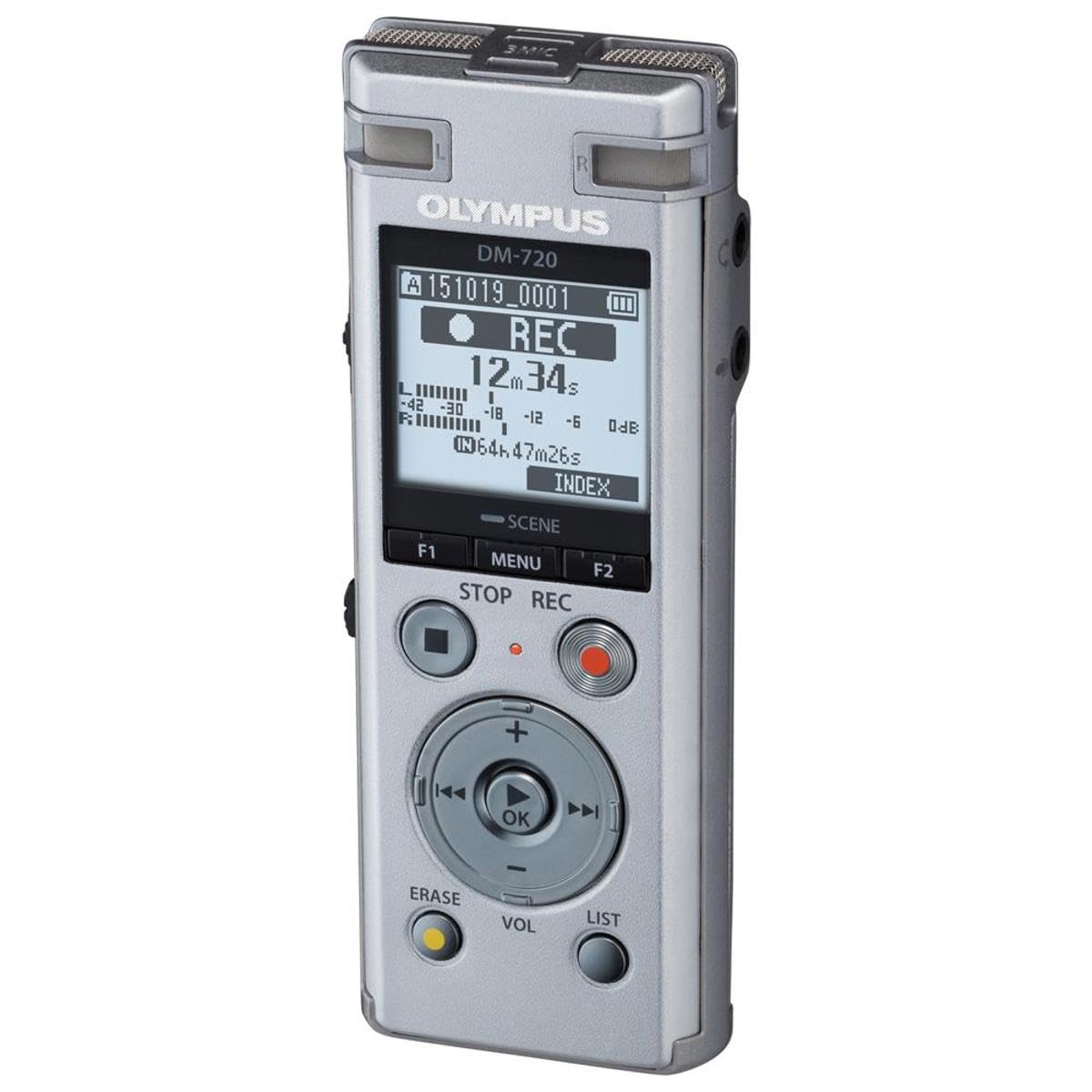
The OM System (formerly Olympus) DM-720 is a transcription-focused voice recorder with a TRESMIC three-microphone system that captures a wide sound field and adjusts sensitivity automatically via Intelligent Auto Mode. It records in 48kHz/16-bit linear PCM format, providing clean, detailed audio for meetings and dictation without the compression artifacts of MP3.
A low-cut filter eliminates sounds below 300Hz, such as projector hum or HVAC rumble, while you record. The unit has 4GB of internal memory and a microSD slot that supports up to 32GB cards. The built-in USB connector pops out for direct charging and file transfer to a computer, eliminating the need for a separate cable. The device runs on a single AAA battery for up to 985 hours in the extended recording mode.
The interface is straightforward with dedicated buttons for recording, playback, and folder navigation. The speaker is adequate for quick playback review. It is worth noting that the DM-720 uses a USB plug that can obstruct adjacent ports on a laptop, and the startup time is slightly longer than simpler recorders. However, for dictation work, legal depositions, or classroom capture, the audio clarity and battery efficiency of this recorder are very hard to match.
Why it’s great
- TRESMIC 3-microphone system adapts to room acoustics automatically
- Low-cut filter removes HVAC and projector rumble during recording
- 985-hour battery life on a single AAA battery is industry-leading
Good to know
- Built-in USB connector may block adjacent ports on laptops
- Only supports microSD up to 32GB (SDHC)
6. Sony ICD-PX370

The Sony ICD-PX370 is a no-frills mono digital voice recorder that prioritizes simplicity and long battery life. It records directly to MP3 format at 128kbps on a built-in 4GB memory, and the built-in USB connector flips out for direct file transfer to any PC. The unit runs on two AAA batteries that last up to 57 hours of continuous recording, making it a set-and-forget device for long lectures or meetings.
The microphone picks up voices clearly from several feet away, and the user interface is minimal with dedicated buttons for record, play, and folder navigation. The speaker on the body allows for quick playback without headphones, and the device is small enough to slip into a shirt pocket. It weighs just 136 grams, so it is comfortable for extended handheld use.
While it lacks stereo recording, expandable storage, or any form of noise reduction circuitry, the ICD-PX370 is incredibly reliable for spoken word capture. The internal microphone can pick up ambient hiss in noisy environments, and the build feels plastic and budget-conscious. However, for students or professionals who just want a dead-simple tool to capture voice memos, this Sony recorder has been a trusted standard for years.
Why it’s great
- 57-hour battery life on two AAA batteries handles multi-day events
- Built-in USB connector enables instant file transfer without cables
- Simple, intuitive controls require no learning curve
Good to know
- Mono recording limits audio depth and spatial accuracy
- No memory expansion slot; limited to 4GB internal storage
7. Yegolito 128GB Voice Recorder
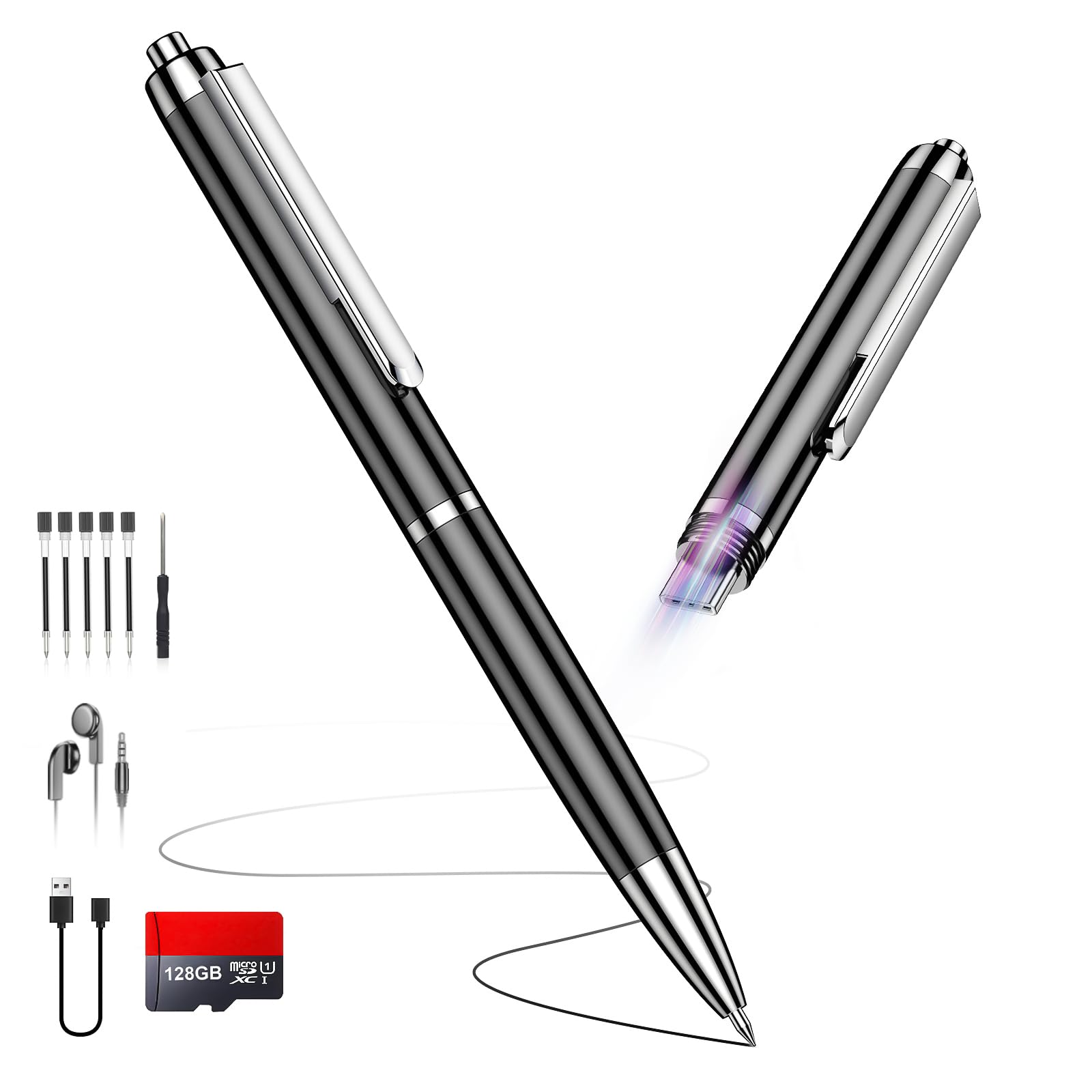
The Yegolito 128GB Voice Recorder offers a massive 128GB of built-in storage at an entry-level price point, capable of holding over 9,800 hours of audio. It features a 360-degree omnidirectional microphone paired with a DSP noise reduction chip that filters out low-level ambient noise. The voice-activated recording (VOR) mode automatically pauses when the room goes quiet, saving storage and making playback more efficient.
The one-touch recording mechanism works like a ballpoint pen — press to start, press again to save — which is satisfyingly tactile and ensures you never accidentally leave it recording. A built-in Type-C port allows for direct file transfer to smartphones, tablets, and computers without needing a separate cable. It also functions as a USB external hard drive and MP3 player for music playback.
The device also includes a ballpoint pen tip, replacing the cap when not recording, which adds a layer of discretion for lecture capture. Battery life is around 35 hours, and files are automatically saved with timestamped file names and configurable segment lengths. While the audio quality is not at the level of professional studio recorders, the sheer storage capacity and ease of use make this an excellent budget-friendly companion for students or anyone who just needs to capture audio reliably.
Why it’s great
- 128GB built-in storage provides enormous capacity out of the box
- Type-C port enables direct connection to phones and laptops
- One-touch ballpoint-pen mechanism is intuitive and discreet
Good to know
- Audio fidelity does not match professional field recorders
- Voice-activated mode can occasionally miss the start of speech
FAQ
What is the difference between 24-bit and 32-bit float recording?
Why does my voice recorder need XLR inputs?
How much storage do I need for a full day of recording?
Final Thoughts: The Verdict
For most users, the audio recorder winner is the Zoom H4 Essential because its 19.4mm X/Y capsules combined with 32-bit float and four-track recording offer professional audio fidelity and flexibility that outclasses every handheld unit in this tier. If you need external microphone inputs and a compact form factor, grab the Zoom H1 XLR. And for offline AI transcription that turns meetings into searchable text documents, nothing beats the iFLYTEK 302Pro.