
A stiff blade gouges meat, and a dull one shreds the silver skin you are trying to save. Processing a deer carcass demands a narrow, sharp, and controllable edge that can slip around the ball joint of a front shoulder without nicking the tenderloin. The difference between a clean, fast breakdown and a frustrating, messy hour is sitting in your hand.
I’m Min — the co-founder and writer behind Gadgets Feed. I’ve spent countless hours comparing blade geometries, steel chemistries, handle ergonomics, and edge-retention claims across dozens of models to identify the tools that actually make a difference when you are working a hind quarter in the garage.
Whether you are breaking down your first buck or your fiftieth, the right blade saves meat and time. This guide breaks down the top contenders for the best boning knife for deer, cutting through marketing hype to focus on real-world performance around bone and sinew.
How To Choose The Best Boning Knife For Deer
Selecting a boning knife for deer is different from picking a general-purpose kitchen knife. The key factors are blade length, flexibility, steel hardness, handle grip, and overall tang construction. Getting these wrong can cost you meat or safety during a long processing session.
Blade Length and Flexibility
A 5 to 7-inch blade is the sweet spot for deer. Shorter blades lose reach when working deep inside the rib cage, while longer blades become unwieldy around the tight ball-and-socket joints of the front shoulders. Stiffer blades handle the dense connective tissue of an adult buck, while a more flexible tip helps separate the thin flank membrane from the loin without tearing.
Steel Type and Hardness (HRC)
High-carbon stainless steel with a Rockwell hardness between 56 and 62 HRC offers the best balance of edge retention and ease of sharpening for deer work. Softer steel (sub-56 HRC) dulls quickly against bone and cartilage. Very hard steel (above 62 HRC) holds an edge longer but becomes brittle and can chip if you accidentally scrape a vertebra. VG-10, AUS-10, and German X50CrMoV15 are common candidates.
Handle Ergonomics and Grip
Deer processing involves gripping the knife for extended periods, often with wet, fatty hands. A contoured handle with a textured, non-slip surface — such as thermoplastic rubber (TPR) or G10 — provides superior control. Smooth pakkawood handles are beautiful but can become slippery. A full tang construction ensures the handle won’t loosen over time, which is critical for safety when applying lateral pressure around joints.
Quick Comparison
On smaller screens, swipe sideways to see the full table.
| Model | Category | Best For | Key Spec | Amazon |
|---|---|---|---|---|
| Victorinox Fibrox 5″ | Mid-Range | All-around deer breakdown | 5″ blade, HRC 56, TPR handle | Amazon |
| Cutluxe Curved 6″ | Mid-Range | Curved cuts on round joints | 6″ blade, HRC 56+, Forged | Amazon |
| HENCKELS Forged Premio 5.5″ | Mid-Range | Forged durability on a budget | 5.5″ blade, Forged, Dishwasher-safe | Amazon |
| KYOKU Shogun 7″ | Mid-Range | VG-10 edge for heavy sessions | 7″ blade, HRC 58-60, G10 handle | Amazon |
| HOSHANHO Damascus 7″ | Premium | Flexible tip for delicate trimming | 7″ blade, HRC 62, Olive wood handle | Amazon |
| Shun Classic 6″ | Premium | Precision work with VG-MAX core | 6″ blade, HRC 61, Pakkawood handle | Amazon |
| ZWILLING Professional S 5.5″ | Premium | German forged resilience for bone contact | 5.5″ blade, HRC 57, Friodur blade | Amazon |
In‑Depth Reviews
1. Victorinox Fibrox 5 Inch Boning Knife

Victorinox delivers a stamped blade that stays razor-sharp longer than many forged alternatives in this category. The 5-inch narrow profile is ideal for the tight spaces around a deer’s ball joints, and the Fibrox handle provides a secure, non-slip grip even when your hands are coated in fat. Multiple verified reviews confirm it holds its edge through multiple deer quarters before needing a touch-up on the steel.
The Swiss-made stainless steel blade on this model is a proven performer for game processing. Users specifically note its superior edge holding compared to the popular Dexter brand, and many call it their go-to knife for breaking down deer. The extra-narrow blade lets you work cleanly around bone without scraping off meat.
It is dishwasher safe, which simplifies cleanup after a long processing session. The 0.1-pound weight keeps your wrist fresh when you are breaking down a whole animal, and the simple construction means there are fewer parts to fail over time.
Why it’s great
- Industry-standard edge retention for deer work
- Non-slip TPR handle performs well with wet, fatty hands
- Lightweight design reduces fatigue during multi-animal processing
Good to know
- Stamped construction may feel less substantial than forged knives
- 5-inch length is short for very large hind quarters
2. Cutluxe Curved Boning Knife – 6″

The Cutluxe offers a forged, full-tang construction at a price point that typically only gets you stamped blades. The high-carbon German steel is hand-sharpened to 14-16 degrees per side, delivering a factory edge that cuts through deer connective tissue with minimal resistance. The curved blade shape is specifically engineered to follow the contour of a round joint, making it a strong option for de-boning shoulders and hams.
The triple-riveted pakkawood handle provides a stable, comfortable grip, though a few users noted the handle can become slippery when cutting through fatty sections. At 0.38 kilograms, it has a solid, reassuring heft that helps drive through tougher sinew without applying excessive downward force. The included storage sheath protects the edge between uses.
Customer reviews highlight its immediate out-of-box sharpness and its ability to make de-boning “really easy.” The lifetime warranty adds peace of mind for a tool that will see hard use during deer season. It is not dishwasher safe, so hand wash and dry after processing.
Why it’s great
- Forged full-tang construction at a mid-range price
- Curved blade excels on round deer joints
- Lifetime warranty against defects
Good to know
- Pakkawood handle can get slick with fat
- Requires hand washing only
3. KYOKU Shogun Series 7″ Boning Knife
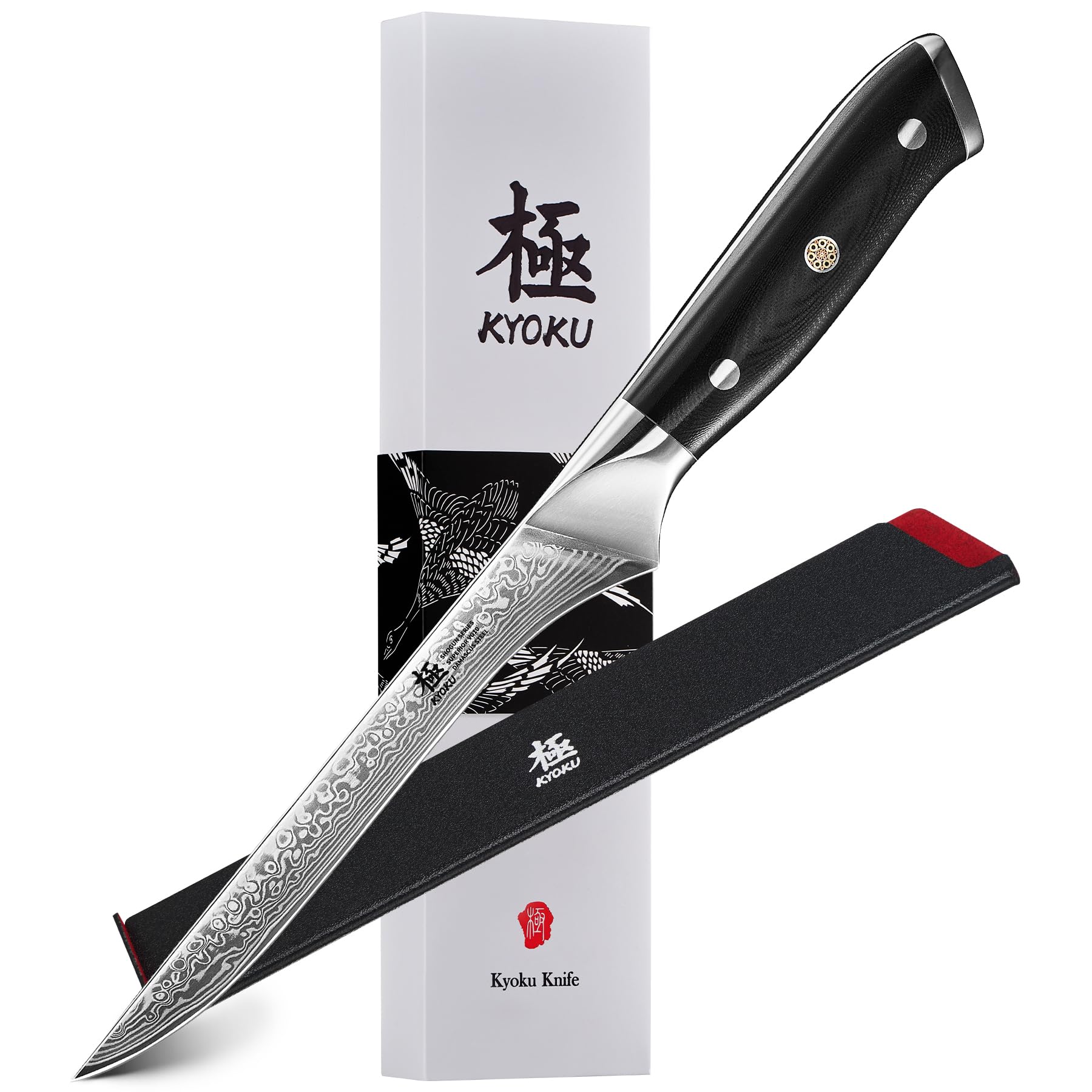
KYOKU brings a 7-inch VG-10 Japanese super steel core to this boning knife, rated at 58-60 HRC. This hardness level holds an edge through the heavy connective tissue of adult bucks far longer than standard German stainless. The Damascus cladding looks striking, but the real benefit is the cobalt-enhanced VG-10 steel, which outperforms AUS-10 in durability while remaining easier to sharpen than higher-HRC alternatives.
The G10 handle is a standout feature for deer processing. G10 is a military-grade glass-fiber laminate that is impervious to moisture, heat, and cold, maintaining a secure grip even when your hands are covered in blood and fat. One verified review noted this knife processed two 300-pound hogs and only needed sharpening once halfway through the second day, confirming its endurance for large game.
It comes with a protective sheath and case, which is essential for safe storage after a long night of butchering. The included guard adds a layer of security during transport. The knife is heavy at 16.6 ounces, which provides good momentum but may cause fatigue during extended sessions.
Why it’s great
- VG-10 core with HRC 58-60 holds edge through multiple deer
- Moisture-proof G10 handle provides secure grip when wet
- Includes sheath and case for safe storage
Good to know
- 7-inch length may be too long for some users’ preference
- Not dishwasher safe; hand wash required
4. ZWILLING Professional S 5.5″ Boning Knife

The ZWILLING Professional S is an America’s Test Kitchen pick for good reason. The SIGMAFORGE process forges the entire knife from a single piece of special-formula high-carbon stainless steel, creating a robust, seamless transition from blade to handle. The Friodur ice-hardening process results in a blade at 57 HRC that resists chipping even when you accidentally scrape a deer vertebra.
At 5.5 inches, the blade is compact enough for the tight confines of the rib cage while offering the stiffness needed to separate the silver skin from the backstrap. The ergonomic polymer handle is contoured for a secure grip and bonded to the full tang for longevity. Users who process venison, poultry, and pork consistently praise this knife for its maneuverability around bones.
It is dishwasher safe, which is a practical advantage for hunters who want to quickly sanitize tools after a field dressing. The 15-degree edge angle per side delivers precise cuts without feeling fragile. While it is a premium investment, multiple owners report replacing decades-old Zwilling knives with this exact model, confirming its lifespan.
Why it’s great
- One-piece forged construction for maximum durability
- Friodur blade resists chipping against bone
- Dishwasher safe for convenient sanitation
Good to know
- Premium price point may exceed casual user budget
- Stiffer blade less suited for delicate fish filleting
5. HOSHANHO 7″ Damascus Fillet Knife

The HOSHANHO stands out with its 67-layer Damascus steel and a Rockwell hardness of 62 HRC, making it one of the hardest blades on this list. This extreme hardness translates to exceptional edge retention, but it also means the blade is more brittle and requires careful use around bone. The 7-inch blade has a flexible, pointed tip that excels at separating the flank membrane from the loin without tearing the meat.
The olive wood handle is ergonomically shaped and treated to resist heat and cold. Users report it is comfortable and provides good control for fine trimming work. The 12-degree edge angle per side, achieved through the traditional Honbazuke hand-sharpening method, produces a scalpel-like sharpness that glides through muscle fiber.
This knife is best suited for the final trimming and portioning stages of deer processing, where you are working on a cutting board rather than hanging a carcass. It is not designed for scraping against bone or cutting through joints. The included blue gift box makes it a premium addition to any hunter’s kit.
Why it’s great
- Extremely hard 62 HRC blade for prolonged sharpness
- Flexible pointed tip ideal for trimming silver skin
- Ergonomic olive wood handle for comfortable control
Good to know
- Hard and thin blade is prone to chipping on bone
- Hand wash only; olive wood requires oiling maintenance
6. Shun Classic 6″ Boning & Fillet Knife

Shun’s Classic series brings Japanese craftsmanship to the deer processor with a VG-MAX steel core clad in 68 layers of Damascus stainless steel. The 16-degree edge angle on both sides delivers exceptional sharpness for precise cuts around the tenderloin and sirloin. The 6-inch length strikes a versatile balance between reach and maneuverability for both hanging and table-top work.
The D-shaped Pakkawood handle is ergonomically designed to fit comfortably in either hand, providing a balanced feel that makes detailed trimming less fatiguing. The knife is handcrafted in Japan, and the attention to detail in the blade geometry is immediately apparent when you work around a deer’s backstrap. Its thin profile glides through meat with minimal drag.
While it is the most expensive option on this list, users consistently report that the edge retention and performance justify the cost for dedicated home butchers. It is an investment piece that, with proper hand-washing and storage, will last for many seasons. The included sheath provides essential blade protection.
Why it’s great
- VG-MAX core offers premium edge retention for deer work
- Ergonomic D-shaped handle fits both hand orientations
- Handcrafted Japanese construction with meticulous blade geometry
Good to know
- Highest price point on this list
- Thin, sharp blade requires careful handling around bones
7. HENCKELS Forged Premio 5.5″ Boning Knife

HENCKELS delivers a forged German stainless steel boning knife at a price that undercuts many stamped rivals. The forged bolster construction provides a seamless transition from blade to handle, improving balance and control when working around deer joints. The 5.5-inch blade is long enough for most boning tasks while keeping the tip accessible for detailed work.
The triple-rivet handle is curved to fit your hand naturally, and the satin-finished blade is finely honed for lasting sharpness. Users report it arrives razor sharp out of the package and holds its edge well through trimming tasks. The dishwasher-safe rating adds convenience for post-processing cleanup, though hand washing will extend the edge life.
While the steel composition is an unspecified German stainless, this knife performs well as a working tool for the home processor who needs an affordable, durable blade that is easy to hone. The 0.4-pound weight feels substantial without being fatiguing, making it a solid entry-level choice for hunters new to breaking down their own deer.
Why it’s great
- Forged construction at an entry-level price point
- Comfortable triple-rivet handle for extended use
- Dishwasher safe for easy cleanup
Good to know
- Unspecified German steel may not match premium options’ edge retention
- Some units may have minor burrs requiring initial honing
FAQ
What blade length is best for boning out a deer?
Is a flexible or stiff boning knife better for deer?
Can I use a deer boning knife for other types of meat?
How do I maintain a boning knife for deer season?
Final Thoughts: The Verdict
For most hunters, the best boning knife for deer is the Victorinox Fibrox 5-inch because it combines proven edge retention, a secure non-slip handle, and a price that makes it painless to own. If you want a full-tang forged blade that can handle heavy sessions, grab the Cutluxe Curved 6-inch. And for precision trimming of backstrap and tenderloin, nothing beats the flexible tip of the HOSHANHO 7-inch Damascus.