
Building a truly immersive home theater demands more than just a speaker stack—it requires a brain that can render object-based audio with precision across multiple channels. A 9.2 Dolby Atmos receiver unlocks vertical soundscapes, directing effects overhead and around you, transforming a flat 5.1 or 7.1 layout into a three-dimensional sound bubble. This is the sweet spot for enthusiasts who want height channels without jumping to an 11-channel flagship.
I’m Min — the co-founder and writer behind Gadgets Feed. I’ve spent countless hours cross-referencing THX certifications, HDMI 2.1 bandwidth capabilities, and Dirac Live versus Audyssey calibration curves to identify which models deliver the most convincing phantom height effects and cleanest channel separation in this competitive price bracket.
After deep-diving into real-world firmware stability and multi-subwoofer management across the latest receivers, I’ve filtered the market down to the models that truly justify their place. This guide will help you find the right 9.2 dolby atmos receiver for your specific setup and budget without getting lost in marketing speak.
How To Choose The Best 9.2 Dolby Atmos Receiver
Choosing a 9.2 receiver is a commitment to a multi-year centerpiece of your home theater. The right choice hinges on room correction sophistication, amplification headroom, and HDMI 2.1 feature parity. Here are the critical factors to weigh before you click buy.
Room Correction & EQ Capabilities
Your room’s acoustics are the single biggest variable. A receiver with basic EQ sounds different in every room; one with professional-grade room correction like Dirac Live or Audyssey MultEQ XT32 adapts to your space, smoothing out bass nodes and timing alignment. This is the difference between hearing your speakers and hearing the mix as intended.
Channel Configuration Flexibility
9.2 channels give you two popular paths: a 7.1.2 setup (seven ear-level speakers, two subs, two height channels) or a 5.1.4 setup (five ear-level, two subs, four height channels). Your room layout dictates which works best. If your seating is against a wall, 5.1.4 with front and rear overheads creates a more convincing dome of sound than side surrounds.
HDMI 2.1 & Gaming Features
ALLM, VRR, QFT, and 4K/120Hz passthrough are no longer optional if you own a PlayStation 5, Xbox Series X, or a high-refresh-rate PC. Look for receivers with full 40 Gbps HDMI 2.1 inputs that support eARC. Without these, you introduce lag or lose frame-rate fidelity. 8K/60 passthrough is a bonus for future-proofing, but 4K/120 is the real battleground spec today.
Quick Comparison
On smaller screens, swipe sideways to see the full table.
| Model | Category | Best For | Key Spec | Amazon |
|---|---|---|---|---|
| Onkyo TX-RZ50 | Premium | Best Overall Value | 120W x 9 CH / Dirac Live / THX | Amazon |
| Sony STRAZ3000ES | Premium | Sony Ecosystem & 360SSM | 120W x 9 CH / 360 Spatial Sound Mapping | Amazon |
| Yamaha RX-A6A | Premium | Auro-3D & Build Quality | 150W x 9 CH / Surround:AI / 11.2 Processing | Amazon |
| Marantz Cinema 50 | Premium | Hi-Fi Warmth & Build | 110W x 9 CH / Audyssey XT32 / HDAM | Amazon |
| Onkyo TX-NR7100 | Mid-Range | Dirac Live on a Budget | 100W x 9 CH / Dirac Live / THX | Amazon |
| JBL MA9100HP | Mid-Range | Class D Efficiency & White Chassis | 140W x 9 CH / Class D / Chromecast | Amazon |
| Yamaha RX-A4A | Mid-Range | Surround:AI & YPAO | 110W x 7 CH / Surround:AI / MusicCast | Amazon |
| Sony STR-AN1000 | Mid-Range | Virtual Height & Google Integration | 165W x 7 CH / DCAC IX / Chromecast | Amazon |
| Denon AVR-S770H | Mid-Range | Entry-Level 8K Features | 75W x 7 CH / HEOS / Dolby Virtualization | Amazon |
| Marantz Cinema 40 | Premium | Reference Class Sound | 125W x 9 CH / Audyssey XT32 / HDAM | Amazon |
| Klipsch + Onkyo TX-RZ30 Bundle | Bundle | Complete Speaker & Receiver Kit | 100W x 9 CH / Dirac Live / THX | Amazon |
In‑Depth Reviews
1. Onkyo TX-RZ50 9.2-Channel AV Receiver

The Onkyo TX-RZ50 hits the performance-per-dollar sweet spot with 120 watts per channel across nine amplified channels and a full THX certification. Its current-feedback amplification topology keeps distortion low even when driving low-impedance speakers at reference levels, and the heavy chassis (over 30 pounds) dampens mechanical resonance effectively. The pre-outs for 7.2.4 allow you to swap in outboard amplification later if your speaker demands grow.
Dirac Live room correction arrives out of the box, and it’s the headline feature here. The full-bandwidth version (20 Hz–20 kHz) measures your room across multiple listening positions, applying corrective filters that tighten bass response and improve center-image focus dramatically over standard AccuEQ. The Dirac Live Bass Control option (a paid upgrade) lets you manage dual subwoofers independently, though the dual sub outputs are not individually routable without it.
HDMI 2.1 support includes VRR, ALLM, and QFT at 40 Gbps, making it a clean fit for PS5 and Xbox Series X gaming. The rear panel provides three HDMI outputs (one with eARC), useful for running both a TV and a projector. The built-in Sonos integration via a Sonos Port is a nice extra for whole-home audio, though the Onkyo app remains less polished than competitors like MusicCast.
Why it’s great
- Dirac Live outperforms most built-in EQ systems
- THX Certified Select ensures consistent reference-level performance
- 11.2 channel processing for future expansion
Good to know
- Dual subwoofer outputs are not independently adjustable without paid Dirac Bass Control
- WiFi card can be faulty on some early units (warranty coverage varies)
2. Sony STRAZ3000ES Premium ES 9.2 CH 8K A/V Receiver

Sony’s ES series brings a distinct advantage in spatial audio processing with its 360 Spatial Sound Mapping technology. Unlike standard Dolby Atmos rendering, this creates multiple phantom speakers around your ears using phase manipulation and psychoacoustic algorithms, effectively making a 5.1.2 setup sound like a 7.1.4 array. The Digital Cinema Auto Calibration IX (DCAC IX) runs a thorough multi-point measurement that adjusts timing and EQ for each speaker individually.
The power section delivers 120 watts per channel into 8 ohms, and the ES lineage means higher-grade capacitors and a more robust power supply than Sony’s standard STR-AN1000. On the video side, you get six HDMI 2.1 inputs with full 48 Gbps bandwidth, supporting 8K/60 and 4K/120. Note that HDR10+ support is absent here, which may matter if you own a Panasonic or Philips TV that relies on it.
Thermal management is a real consideration—multiple owners report chassis temperatures that warrant an external fan, especially when driving five or seven channels near reference levels. The front panel includes a motorized cover that hides connections cleanly, a nice touch for rack or cabinet installations. The remote is backlit, a rare and welcome detail in this price tier.
Why it’s great
- 360SSM creates convincing phantom height channels
- Full 48 Gbps HDMI 2.1 bandwidth on all inputs
- Backlit remote with ES build quality
Good to know
- Runs hot—external cooling recommended for sustained high-volume use
- No HDR10+ or QMS support
3. Yamaha RX-A6A AVENTAGE 9.2-Channel AV Receiver

The Yamaha RX-A6A is one of the few receivers in this category to support Auro-3D alongside Dolby Atmos and DTS:X, making it the best option if you prioritize native three-layer soundstage (ear-level, height, and top-layer). Its Surround:AI engine analyzes sound scenes in real time and adjusts dialog clarity, surround effects, and bass extension on the fly—noticeable during action sequences where it keeps vocals intelligible amid explosions without manual tweaking.
Power is rated at 150 watts per channel into 8 ohms, and the AVENTAGE series uses a fifth-foot anti-resonance chassis design to reduce vibration and improve DAC jitter performance. The ESS SABRE ES9026PRO DAC handles 32-bit/384kHz decoding and delivers a noticeably blacker background in pure direct mode for two-channel music listening. CINEMA DSP HD3 adds additional Yamaha proprietary sound field processing for legacy content upmixing.
HDMI inputs are limited to seven, with three outputs supporting eARC, but the full 40 Gbps bandwidth ensures 4K/120 and 8K/60 work without compression. The MusicCast app is among the most stable multi-room platforms available, and the receiver supports Roon Tested certification for advanced music server integration. The main drawback is the lack of a front-panel display—most information is only visible via the on-screen GUI or the phone app.
Why it’s great
- Auro‑3D support for three-layer immersive audio
- Surround:AI dynamically optimizes audio in real time
- ESS SABRE DAC for high-fidelity stereo music
Good to know
- No front-panel information display
- MusicCast app lacks intuitive workflow compared to HEOS
4. Marantz Cinema 50 9.4-Ch Receiver

The Cinema 50 occupies a sweet spot in Marantz’s lineup, offering nine amplified channels (110W each) with four independent subwoofer outputs—rare at this price point. The HDAM (Hyper Dynamic Amplifier Module) circuitry is the star here, delivering a warmer, more musical character than typical Class AB designs. In blind comparisons, listeners often describe the Marantz sound as more “analog” and less fatiguing for extended movie sessions.
Audyssey MultEQ XT32 handles room correction with 512x filter resolution on each channel. The included calibration microphone measures up to eight positions, capturing a 3D volume rather than a single listening point. The subwoofer EQ is particularly effective, taming room modes that muddy bass—essential for a dual- or quad-sub setup. HEOS multi-room streaming is integrated, and the receiver works with Alexa, Siri, and Google Assistant.
The rear panel packs six 8K HDMI inputs and three outputs, all supporting 40 Gbps HDCP 2.3. One potential pain point: initial setup relies heavily on the Marantz app, which can be buggy. If the app fails, you may face a factory reset. Owners also note the unit runs very warm—adequate ventilation is non-negotiable. For music-first listeners, the Cinema 50 offers a phono input with a high-quality MM stage.
Why it’s great
- HDAM circuitry delivers signature Marantz warmth
- Four independent subwoofer outputs for deep bass control
- Audyssey XT32 provides professional-grade room EQ
Good to know
- Setup app can be unreliable, requiring factory reset in worst cases
- Runs hot—needs 5-6 inches clearance above chassis
5. Onkyo TX-NR7100 9.2-Channel AV Receiver
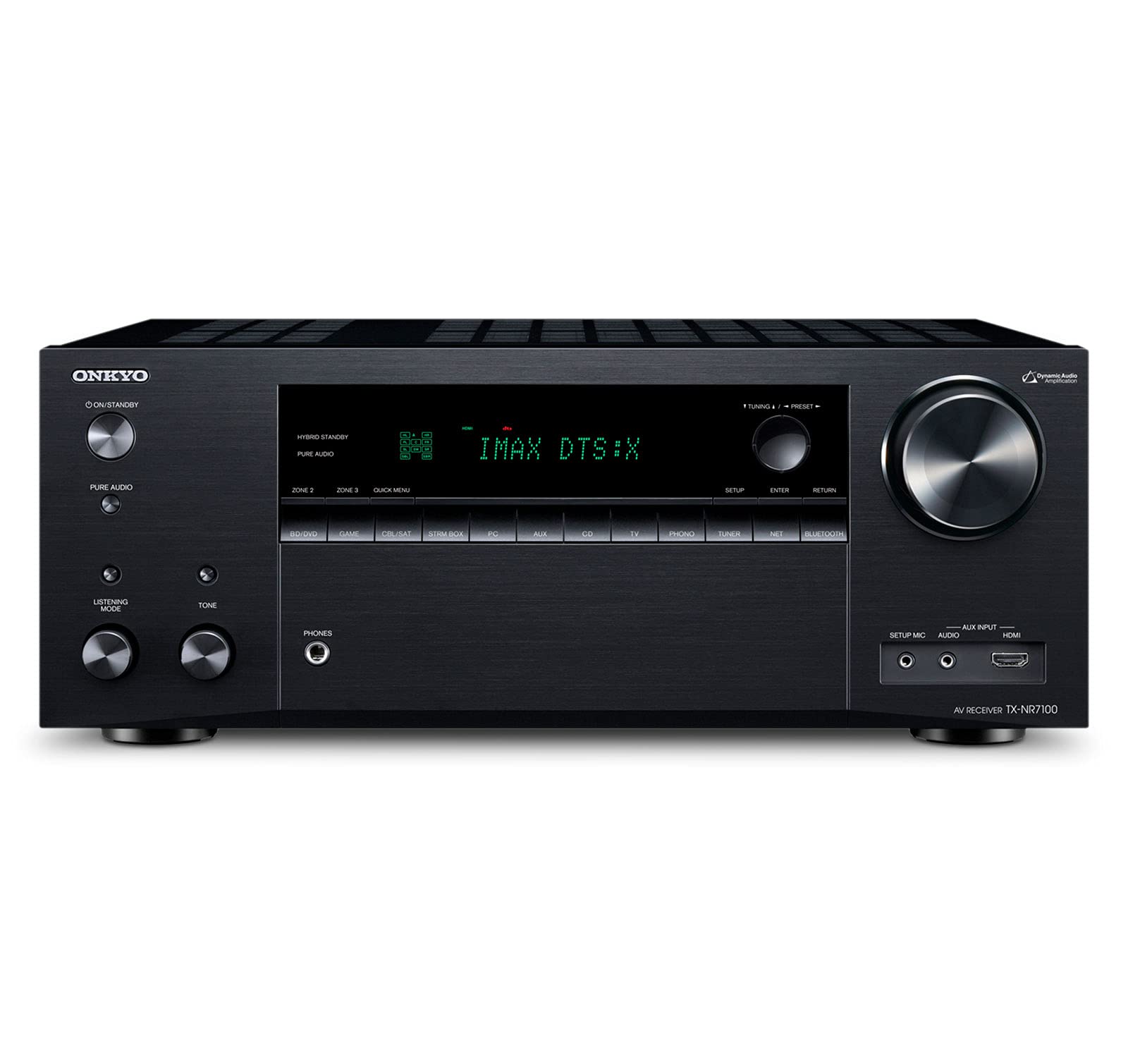
The TX-NR7100 brings Dirac Live and THX certification to a more approachable price point, making it the best entry into high-end room correction without sacrificing build quality. It amplifies nine channels at 100 watts per channel, which is sufficient for moderate-efficiency speakers in medium-sized rooms (up to 3,000 cubic feet). The THX Select certification ensures it meets stringent power and noise floor standards for reference-level playback.
Dirac Live out of the box is the differentiator here. Unlike the TX-RZ50, it includes the full-bandwidth license without requiring an upgrade for basic multi-sub control, though you’ll still need the paid Dirac Bass Control for independent subwoofer management. The on-screen setup wizard is straightforward, but advanced Dirac tuning via the PC/Mac application yields noticeably better results than the smartphone app, as it allows manual target curve editing.
HDMI 2.1 connectivity is present across all inputs with 40 Gbps throughput, supporting 8K/60 and 4K/120 with VRR and ALLM. Bluetooth is bi-directional—you can stream to the receiver or transmit audio to wireless headphones. A recurring complaint involves the remote’s poor IR range (about 0.5 feet in some reports) and non-backlit buttons, which makes dark-room operation difficult. A universal remote or app control solves this.
Why it’s great
- Dirac Live included without premium price premium
- THX Select certified for reference-level playback
- Bi-directional Bluetooth with aptX HD support
Good to know
- Remote has poor IR range and no backlight
- Some units report crackling/static after 1-2 months (warranty required)
6. JBL MA9100HP 9.2 Channel AV Receiver
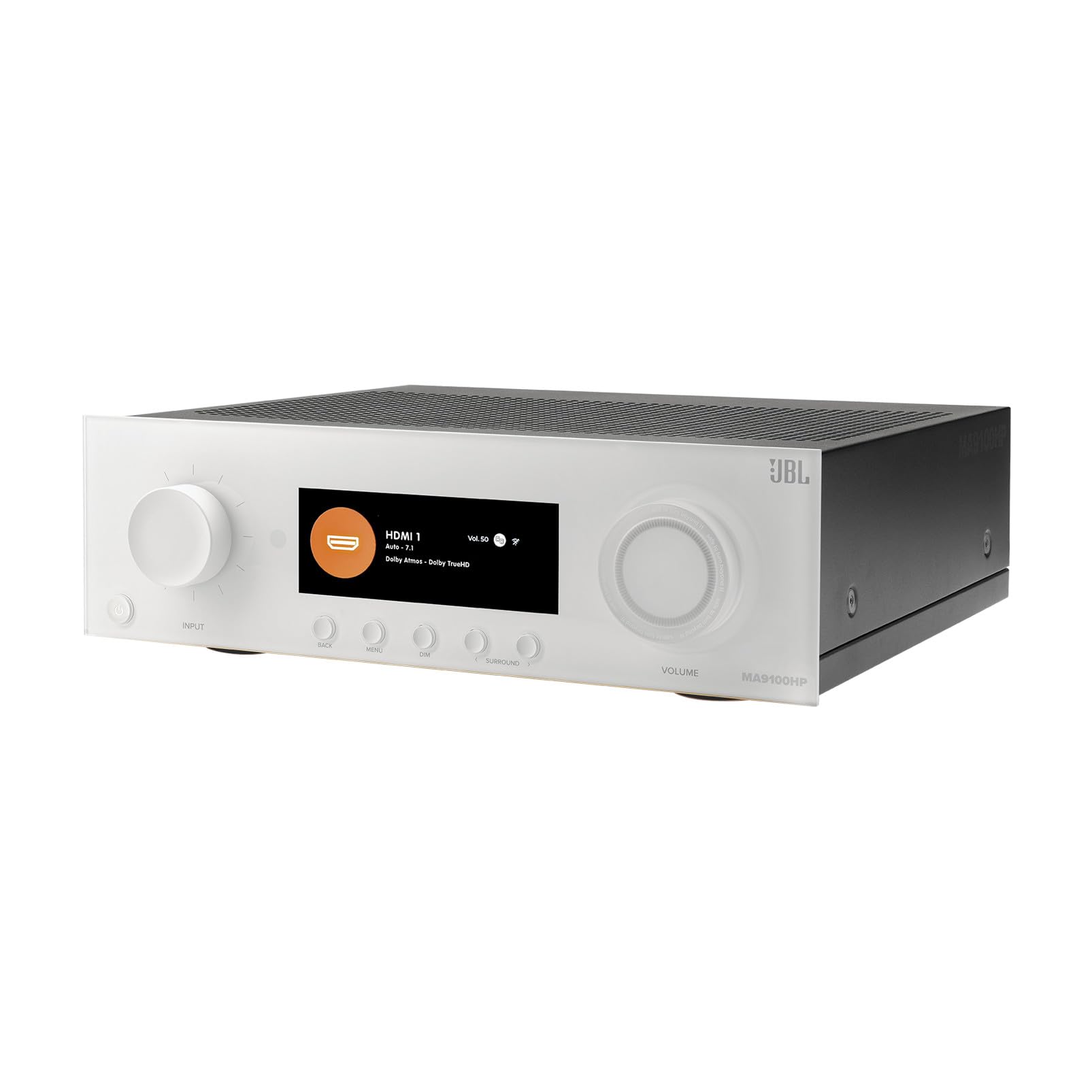
JBL’s MA9100HP is a 9.2-channel receiver that leverages Class D amplification to deliver 140 watts per channel in a chassis that is significantly shallower (5.3 inches tall) than traditional Class AB competitors. This makes it a strong candidate for media consoles with limited vertical clearance. The white finish (also available in black) gives it a distinct aesthetic that matches white speakers and modern furniture.
Dolby Atmos and DTS:X decoding support up to 5.1.4 or 7.1.2 configurations. The built-in Chromecast, Apple AirPlay 2, and Bluetooth cover wireless streaming comprehensively. The six HDMI inputs all support 8K/60 and 4K/120 passthrough, though VRR and ALLM support is present—QMS (Quick Media Switching) is not mentioned in the spec sheet, so switching between different refresh rates may show a brief black screen.
Audio format handling has one notable limitation: the MA9100HP does not downmix DTS-HD Master Audio to 2.1 channels correctly, producing no sound from center and surrounds when driving a stereo-only setup. For 5.1 or 7.1 systems, Dolby TrueHD and PCM work flawlessly. The non-backlit remote remains a common annoyance in dark rooms.
Why it’s great
- Slim profile fits shallow media consoles
- Class D amplification runs cooler than Class AB
- White color option for design-conscious setups
Good to know
- No DTS-HD Master Audio downmix to 2.1 (firmware issue)
- Remote is not backlit
7. Yamaha RX-A4A AVENTAGE 7.2-Channel AV Receiver

The RX-A4A is a 7.2-channel receiver, not a 9.2 model, but it earns a spot here for AVENTAGE-series buyers who value Sound:AI processing and YPAO R.S.C. with 3D multipoint equalization. It amplifies seven channels at 110 watts per channel and supports Dolby Atmos and DTS:X through a 5.1.2 configuration. The Surround:AI engine analyzes audio scenes every 0.2 seconds and adjusts dialog, effects, and bass dynamically.
The YPAO R.S.C. (Reflected Sound Control) calibration goes beyond basic EQ by measuring early reflections from room surfaces and applying corrective filters to sharpen imaging. Multi-point measurement captures data across multiple listening positions, which helps maintain soundstage consistency if you move around the room. The included microphone and stand make setup straightforward, though the initial firmware update requires a USB flash drive—WiFi-based updates are not supported out of the box.
HDMI connectivity includes seven inputs and three outputs, all supporting 40 Gbps 8K/60 and 4K/120 with ALLM and VRR. A phono input is built in for turntable users. The MusicCast multi-room platform works reliably with Yamaha wireless speakers. The main caveat is the lack of an on-screen volume display when using Apple TV or Roku—the receiver’s OSD does not overlay properly over HDMI sources controlled by CEC. This is a known software behavior, not a defect.
Why it’s great
- Surround:AI delivers real-time scene-adaptive audio
- YPAO R.S.C. with multipoint calibration sharpens imaging
- Phono input for vinyl enthusiasts
Good to know
- Firmware update requires USB flash drive (no WiFi update)
- OSD volume display does not overlay on HDMI ARC/CEC sources
8. Sony STR-AN1000 7.2 CH Surround Sound Home Theater 8K A/V Receiver

The STR-AN1000 offers a compelling mid-range package with 7.2 channels and Sony’s 360 Spatial Sound Mapping technology, which synthesizes height effects from a 5.1.2 layout without physical height speakers in some configurations. The Digital Cinema Auto Calibration IX (DCAC IX) runs a nine-point measurement and compensates for room reflections, providing a surprisingly immersive soundstage for a 7-channel receiver. It officially supports up to 5.1.2.
Power is rated at 165 watts per channel into 6 ohms (1 kHz, 1% THD), which translates to roughly 100–110W into 8 ohms for music playback. The six HDMI inputs support 8K/60 and 4K/120 with eARC, HDR10, HLG, Dolby Vision, and IMAX Enhanced. One known quirk: the receiver struggles to passthrough Dolby Vision from Apple TV 4K—the workaround is to connect the Apple TV directly to the TV and use eARC for audio return.
Google Chromecast built-in, Apple AirPlay 2, and Spotify Connect cover streaming, and the unit works with Sonos via a Sonos Port. The setup GUI is clean and walks through speaker configuration step-by-step. A few users report the auto-calibration adds excessive distance (up to 12 feet) to the subwoofer channel, requiring manual correction. Dialogue enhancement via S-Center output (with compatible Sony TVs) improves vocal clarity without raising overall volume.
Why it’s great
- 360 Spatial Sound Mapping creates convincing virtual height
- S-Center output for clearer dialog with Sony TVs
- DCAC IX provides thorough nine-point room calibration
Good to know
- Dolby Vision passthrough fails with Apple TV 4K (workaround needed)
- Auto-calibration may set incorrect subwoofer distance
9. Denon AVR-S770H 7.2 Ch Home Theater Receiver

The Denon AVR-S770H is a 7.2-channel receiver that provides a no-fuss entry into the 8K/4K120 ecosystem with Dolby Height Virtualization and DTS Virtual:X for creating overhead effects without height speakers. At 75 watts per channel (8 ohms, 20 Hz–20 kHz, 0.08% THD), it’s best paired with efficient bookshelf or tower speakers (over 88 dB sensitivity). It supports 5.1.2 speaker layouts for true Dolby Atmos if you add physical height channels.
HDMI connectivity includes six inputs (one on front) and one output with eARC, all supporting 8K/60 and 4K/120 with HDR10+, Dolby Vision, and HLG. The front HDMI port is handy for quick connection of a laptop or camera. HEOS multi-room streaming is built-in, providing access to Spotify, TIDAL, and Amazon Music. Audyssey MultEQ (not XT) handles room calibration with a single measurement position—adequate for basic correction but less precise than the XT32 variant found in higher Denon models.
Firmware stability has been a reported issue for some users, with random volume drops to zero and rare picture loss on startup that requires a power cycle. For most users, these events are infrequent, but the receiver’s reliability record is not as consistent as more expensive Denon models like the X-series. The on-screen setup assistant is excellent for beginners, walking through speaker configuration and source assignment step-by-step.
Why it’s great
- Front HDMI input for easy device connections
- HEOS provides stable multi-room audio streaming
- On-screen setup assistant is beginner-friendly
Good to know
- Some units experience volume drops and picture loss (requires power cycle)
- Audyssey MultEQ (basic) lacks XT32 resolution
10. Marantz Cinema 40 9.4-Ch Receiver
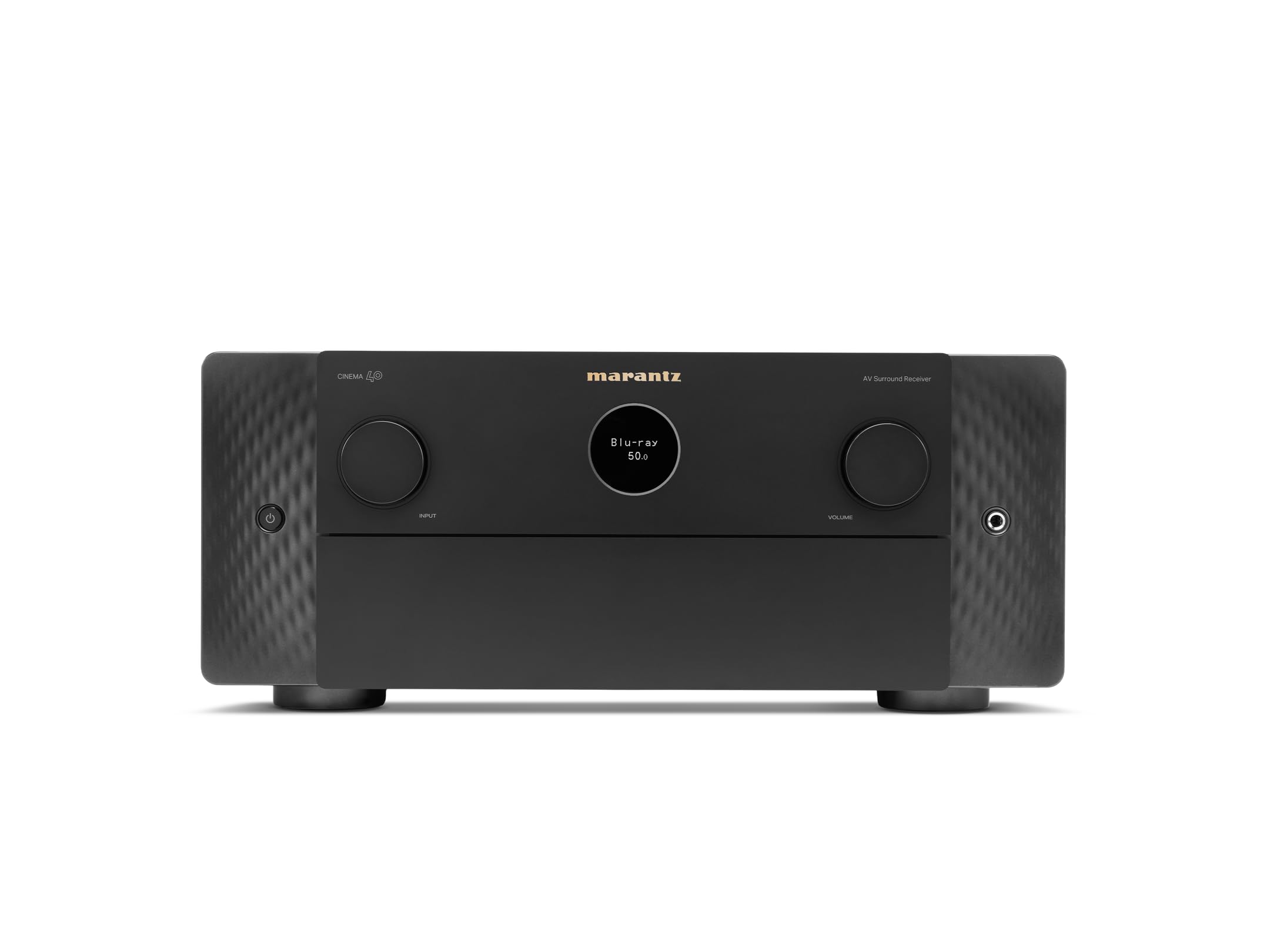
The Cinema 40 is Marantz’s 9.4-channel reference receiver, delivering 125 watts per channel through HDAM discrete circuitry. The sonic signature is noticeably smoother and more organic than typical Class AB designs, with a midrange that renders vocals with a natural, unforced quality. It includes four subwoofer outputs with independent calibration in Audyssey MultEQ XT32, allowing for precise time alignment and phase correction across a quad-sub array.
HDMI connectivity is generous: seven inputs (all 8K/60, 4K/120 capable) and three outputs supporting eARC. All inputs handle the full 40 Gbps bandwidth with HDCP 2.3, ensuring compatibility with future source devices. The build quality includes a thick aluminum faceplate, a motorized volume knob, and a backlit remote with a premium feel. HEOS streaming is integrated, and the receiver works with Alexa, Siri, and Google Assistant for hands-free control.
A known pain point is HDMI-CEC behavior, which some owners report as buggy—the receiver may fail to wake from standby or switch inputs correctly when using TV remote control. This is more noticeable when multiple CEC devices (Apple TV, game console, cable box) are connected. For pure direct two-channel music, the Cinema 40’s DAC performance is excellent, but the front-panel display is minimal, showing only input name and volume level.
Why it’s great
- HDAM circuitry provides reference-class audio resolution
- Four independent subwoofer outputs with XT32 calibration
- Premium build with aluminum faceplate and backlit remote
Good to know
- HDMI-CEC behavior can be unreliable with multiple sources
- Runs hot—adequate ventilation is essential
11. Klipsch Reference Cinema 5.1.4 System with Onkyo TX-RZ30 Bundle

This bundle pairs the Klipsch Reference Cinema 5.1.4 speaker system with the Onkyo TX-RZ30 9.2-channel receiver, providing a complete Dolby Atmos solution straight out of the box. The speaker system includes four Atmos-enabled satellite speakers with up-firing drivers for overhead effects, a dedicated center channel, and a 10-inch powered subwoofer. The TX-RZ30 receiver delivers 9.2 channels with Dirac Live room correction, THX certification, and HDMI 2.1 support.
The Klipsch Tractrix horn tweeters produce the signature high-efficiency sound that makes dialog crisp and effects punchy without needing massive amplifier power. The 10-inch subwoofer moves enough air for a medium-sized room (up to 2,500 cubic feet) but may leave larger spaces wanting—the bundle does not include a second sub, but the receiver supports two outputs. The up-firing Atmos speakers project sound off the ceiling, so a flat, low ceiling (8–10 feet) yields the best overhead illusion.
Several owners have reported reliability issues with the Onkyo TX-RZ30 receiver, particularly amplifier channel failures in the front left and right terminals after a few months of use. While warranty service exists, the failure rate appears higher than average for the Onkyo brand. The bundle does not include speaker cables, and the system is quite heavy (116 pounds total). For a hassle-free all-in-one package, this works, but prospective buyers should budget for a cooling fan and high-quality 4-conductor speaker wire.
Why it’s great
- Complete 5.1.4 Atmos system in one box
- Klipsch horn tweeters deliver high efficiency and clear dialog
- Dirac Live calibration included with the receiver
Good to know
- Onkyo TX-RZ30 has reported reliability issues with channel failures
- No speaker cables included; bundle is very heavy (116 lbs)
FAQ
Is a 9.2 channel receiver worth it over a 7.2 model?
Can I add external amplification to a 9.2 receiver?
What gauge speaker wire do I need for a 9.2 Atmos setup?
Final Thoughts: The Verdict
For most users, the best 9.2 dolby atmos receiver is the Onkyo TX-RZ50 because it combines THX certification, Dirac Live room correction, and 11.2-channel processing at a price that undercuts other feature-matched competitors. If you want the warmest musical reproduction and quad-sub control, grab the Marantz Cinema 50. And for a complete one-box solution that includes speakers, the Klipsch + Onkyo TX-RZ30 Bundle removes the guesswork for first-time Atmos buyers.