
A small 12V battery isn’t a commodity — it’s the invisible lifeline for fish finders, security cameras, backup routers, toy cars, and portable ham radio rigs. The wrong chemistry or undersized capacity means dead equipment mid-trip, and the wrong terminal layout means an afternoon of jury-rigging wires.
I’m Min — the co-founder and writer behind Gadgets Feed. I’ve analyzed hundreds of battery listings, cross-referencing chemistry types, discharge curves, BMS protection circuits, and real user longevity reports to separate reliable cells from short-lived disappointments.
This guide covers LiFePO₄, NiMH, SLA, and AGM options from 8Ah to 22Ah to help you find the most reliable small 12v battery for your specific device and use case.
How To Choose The Best Small 12V Battery
Selecting the right battery comes down to three factors: chemistry, capacity, and physical fit. Lead-acid (SLA/AGM) is cheap but heavy and short-lived. NiMH offers moderate performance with no memory effect. LiFePO₄ is lightweight, lasts thousands of cycles, and includes a BMS for safety — but requires a compatible charger.
Chemistry Determines Weight and Cycle Life
LiFePO₄ batteries typically weigh half as much as an equivalent SLA and deliver 3,000 to 5,000+ deep cycles versus 300-500 for lead-acid. NiMH sits in between — lighter than SLA but with roughly 500-1,000 cycles. If your device sees daily use or frequent recharges, LiFePO₄ pays for itself quickly.
Capacity (Ah) Directly Dictates Runtime
An 8Ah LiFePO₄ battery running a fish finder drawing 1A will last roughly 6-7 hours of usable power before the BMS cuts off. For a 10-quart fridge drawing 3-4A average, you want at least 20Ah to get through a full day. Calculate your device’s average current draw in amps and multiply by desired runtime in hours — then add 20% buffer for losses.
Physical Dimensions and Terminal Type Matter
Many drop-in replacements exist for specific devices like UPS units, ice fishing kits, and lawn mowers. Always check the terminal layout — F1 (small spade), F2 (larger spade), M5 threaded, or bare leads. A battery that is technically the right voltage but has the wrong terminal orientation may not fit your device’s battery tray.
Quick Comparison
On smaller screens, swipe sideways to see the full table.
| Model | Category | Best For | Key Spec | Amazon |
|---|---|---|---|---|
| GOLDENMATE 12V 16Ah LiFePO₄ | Mid-Range LiFePO₄ | Fish finder / security cameras | IP67 waterproof, 5000+ cycles | Amazon |
| ZapLitho 12V 22Ah LiFePO₄ | Premium LiFePO₄ | Portable ham radio / camping fridge | 22Ah capacity, LCD voltage display | Amazon |
| CYCLENBATT 12V 10Ah LiFePO₄ | Mid-Range LiFePO₄ | UPS / solar backup / trail cameras | 10Ah, 10-year life, 5-year warranty | Amazon |
| EverExceed 12V 8Ah LiFePO₄ | Budget LiFePO₄ | Fish finder / ice fishing / power wheels | 8Ah, 3000+ cycles, 2.2 lbs | Amazon |
| Mighty Max ML9-12 SLA | Budget SLA | UPS replacement / kid ride-ons | 9Ah sealed lead-acid, F2 terminals | Amazon |
| Tenergy NiMH 12V 2000mAh | Specialty NiMH | Light kit / RC models / game cameras | 2000mAh, bare leads, no memory effect | Amazon |
| WEIZE U1-350 AGM | Heavy-Duty AGM | Lawn tractor / mower starting battery | 350 CCA, Group U1 size, 21.45 lbs | Amazon |
In‑Depth Reviews
1. GOLDENMATE 12V 16Ah LiFePO₄ Battery
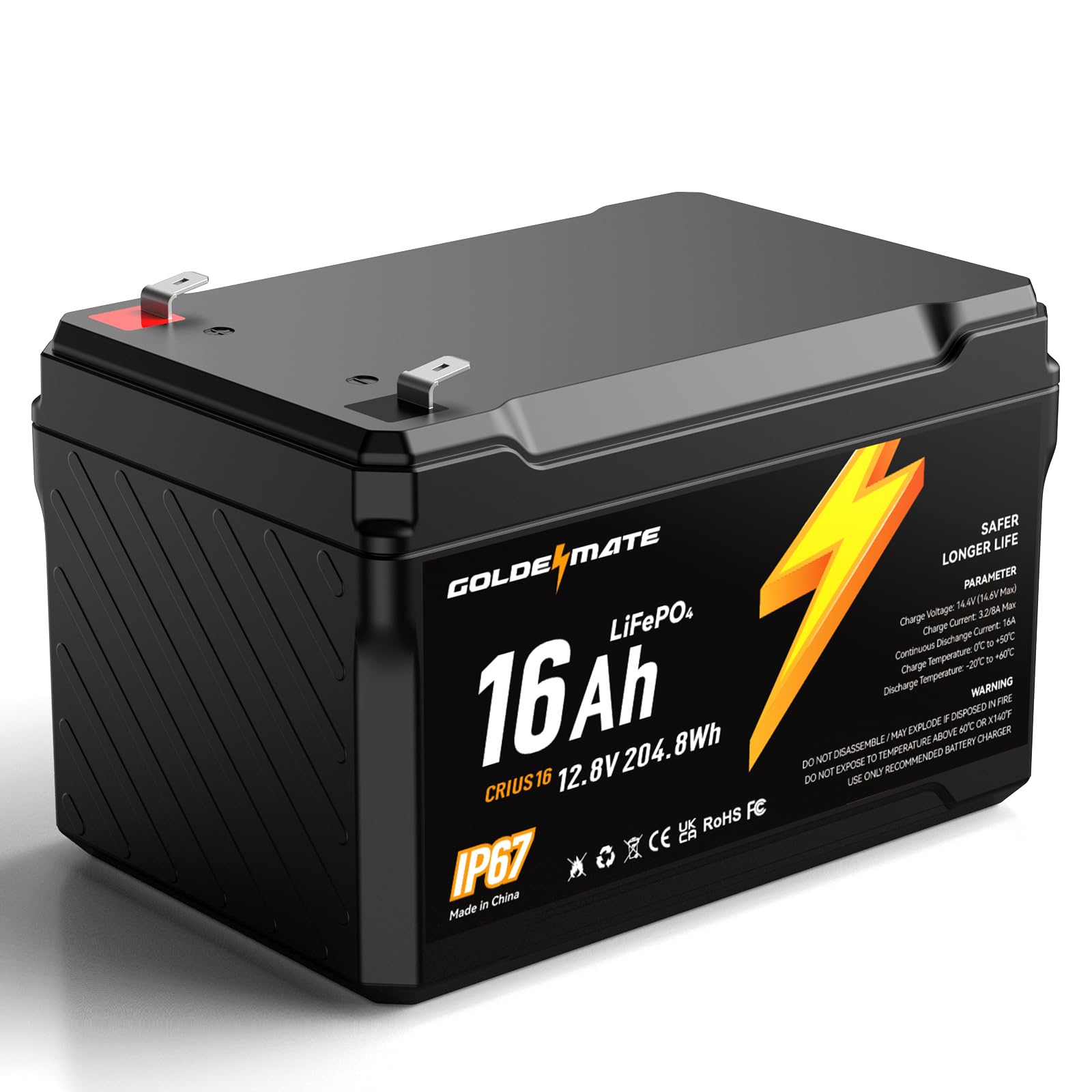
This GOLDENMATE battery packs 16Ah of LiFePO₄ power into a compact 3.86 x 5.94 x 3.66-inch shell that weighs only 3.97 pounds. Its IP67 waterproof rating means you can mount it in a kayak hatch or outdoor security camera box without worrying about rain or splashes. The built-in 16A BMS handles overcharge, over-discharge, over-current, and short-circuit protection — a safety net that SLA and NiMH packs don’t offer at this price tier.
Real users report running fish finders and live scope units for full day sessions without voltage sag. In a solar setup, two of these in parallel (32Ah total) kept a camera drawing 0.2-0.4A and LED lights drawing 1A running all night with minimal depletion. The 5000+ cycle rating means this battery could outlast a decade of weekend camping trips before noticeable capacity fade.
The flexible expansion is a bonus — you can wire up to 8 identical units in series or parallel to hit 25.6V or 64Ah for larger off-grid builds. Just remember you’ll need a LiFePO₄-specific charger (14.6V target) rather than a standard lead-acid charger to avoid tripping the BMS prematurely.
Why it’s great
- IP67 waterproof rating for outdoor and marine use.
- Very lightweight at under 4 lbs for 16Ah capacity.
- 5000+ deep cycles vastly outlasts lead-acid alternatives.
Good to know
- Requires a dedicated LiFePO₄ charger — standard SLA chargers won’t work efficiently.
- 16A BMS limits peak discharge to 15A continuous, not for high-current starting applications.
2. ZapLitho 12V 22Ah LiFePO₄ Battery
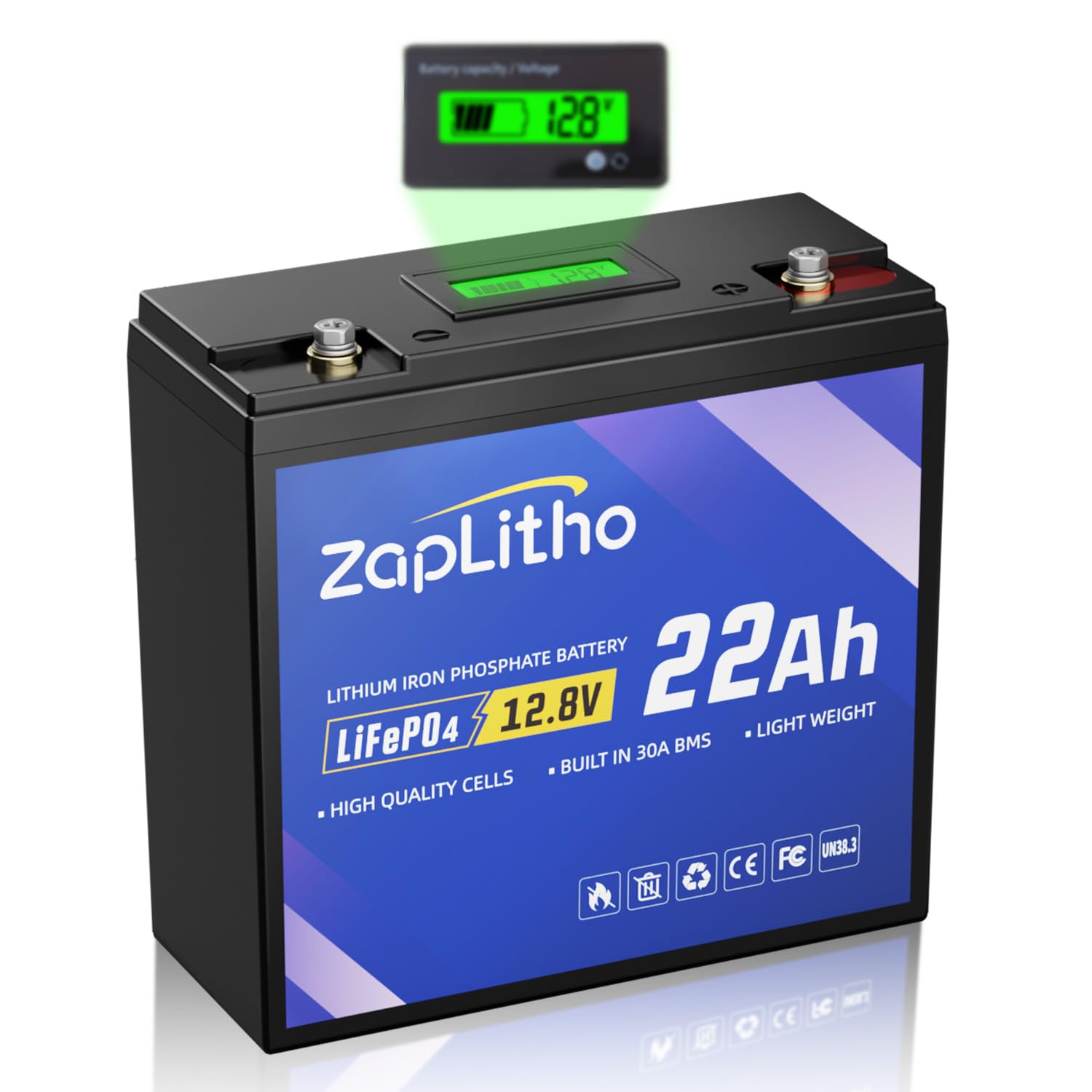
The ZapLitho 12V 22Ah battery steps up the capacity game without a massive weight penalty — 5.5 pounds for over double the amp-hours of the typical 8-10Ah options. Grade A LiFePO₄ cells and a 30A BMS handle higher continuous loads (up to 30A discharge) making this suitable for powering a 100W ham radio at full transmit power or running a 12V portable fridge. The built-in LCD voltage display lets you check remaining charge at a glance, a feature usually reserved for much pricier units.
Real-world testing from users shows this battery ran a 10-quart Vevor fridge for 4.5 days before the display dropped to two bars. For clay throwers, it managed 180 throws without any bar loss — a massive upgrade over lead-acid. The 4000+ cycle rating and 4P4S expansion capability (up to 4 in series or parallel) gives you headroom to scale for bigger setups like solar generators or larger camp builds.
One caveat: the manufacturer warns against submersion and heavy rain — this isn’t IP67 rated like the GOLDENMATE. The M5 terminals are standard but some users found them a tight fit for 60A connectors on kid toy cars. Still, for medium-to-high drain portable gear, the 22Ah capacity hits a sweet spot that most competitors don’t offer in this price bracket.
Why it’s great
- Large 22Ah capacity in a portable 5.5 lbs package.
- 30A BMS supports high-drain devices like ham radios and 12V fridges.
- LCD voltage display gives clear real-time state of charge.
Good to know
- Not waterproof — avoid submersion and heavy rain exposure.
- Requires a LiFePO₄ charger (14.6V) for proper charging.
3. CYCLENBATT 12V 10Ah LiFePO₄ Battery

The CYCLENBATT 10Ah is dimensionally identical to a standard 12V 7Ah SLA battery (5.95 x 2.56 x 3.7 inches) but packs higher energy density and weighs just 2.2 pounds — roughly half the heft of the lead-acid it replaces. That makes it an effortless drop-in for devices like UPS backups, fish finders, and trail cameras where existing battery trays are exactly sized for an SLA. The 10A BMS provides the standard protection suite plus IP67 waterproofing, adding splash resilience for outdoor deployments.
User feedback highlights the battery’s ability to power a deer feeder or trail camera for extended periods with a very low self-discharge rate — some owners report months of standby without a recharge. The 5000+ cycle rating and 5-year warranty signal strong confidence from the manufacturer. For those running solar gate openers or backup monitoring systems, the 4S4P expansion capability (up to 51.2V 40Ah) offers future scalability without replacing the base battery.
Two practical considerations: the continuous discharge is capped at 10A (20A peak for 5 seconds), so it’s not ideal for high-draw motors or inverters. And like all LiFePO₄ cells, you’ll want a compatible charger — topping off with a standard lead-acid charger won’t reach the required absorption voltage and may leave the battery undercharged long-term.
Why it’s great
- Direct form-factor replacement for 7Ah SLA batteries — fits existing trays.
- IP67 waterproof with very low self-discharge for long storage.
- 5-year warranty and 5000+ cycles per Grade A cells.
Good to know
- 10A continuous discharge limit restricts use in high-drain applications.
- Requires a dedicated LiFePO₄ charger — standard SLA chargers won’t fully charge it.
4. EverExceed 12V 8Ah LiFePO₄ Battery
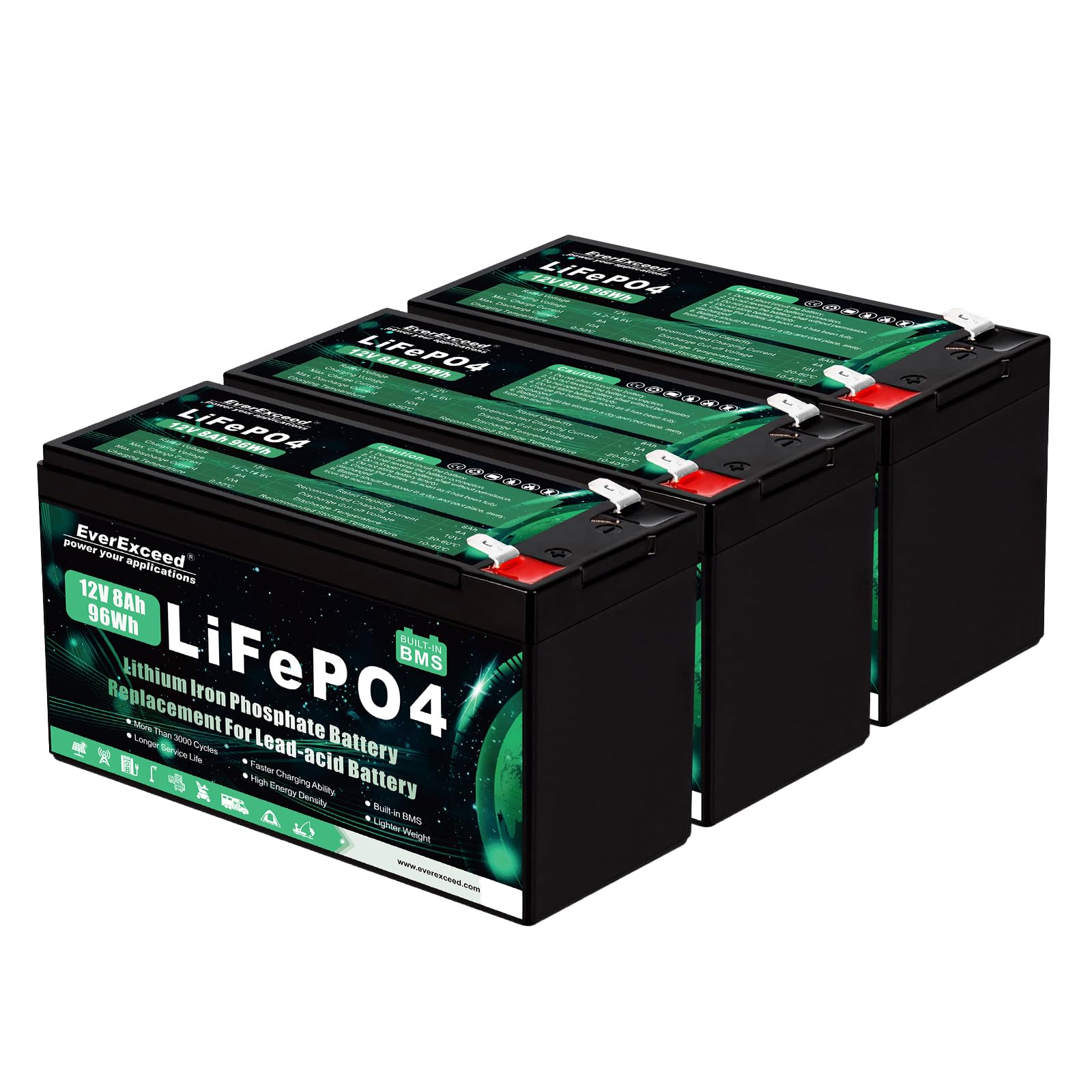
The EverExceed 12V 8Ah is an entry-level gateway into LiFePO₄ technology at a price that competes directly with SLA. Weighing only 2.2 pounds, it replaces a 5.5-pound lead-acid of similar capacity — a huge portability win for ice fishing boxes, tennis ball launchers, and portable fish finders. The built-in 10A BMS covers overcharge, over-discharge, over-current, and short-circuit protection, and F2 terminals make it compatible with standard SLA connectors.
Real reviews confirm it ran fish finders all day and powered dash cam auxiliary systems reliably. One user noted it kept their car computer powered during a battery swap — a testament to the BMS handling low-current loads gracefully. The 3000+ cycle rating at 100% DOD is a massive improvement over typical SLA (300 cycles), so even with daily use, this battery should run for years before noticeable degradation.
The catch is capacity — 8Ah is enough for light sensor loads and small devices, but power a 12V fridge or a high-draw radio and you’ll drain it in under two hours. Also, multiple users stress that you must use a LiFePO₄-compatible charger; a standard lead-acid charger won’t push the voltage high enough to fully charge the cells, leading to premature capacity loss.
Why it’s great
- Extremely lightweight at 2.2 lbs — half the weight of equivalent SLA.
- 3000+ deep cycles at 100% DOD vastly outlasts lead-acid.
- Budget-friendly price point makes LiFePO₄ accessible for light-duty use.
Good to know
- 8Ah capacity limits runtime for power-hungry devices.
- Requires a LiFePO₄-specific charger — SLA charger will undercharge it.
5. Mighty Max ML9-12 12V 9Ah SLA Battery

When you need a direct replacement for an existing SLA battery in a UPS, kid’s ride-on toy, or ice fishing sonar unit, the Mighty Max ML9-12 is the most broadly compatible option on this list. Its 5.94 x 2.56 x 3.94-inch dimensions with standard F2 terminals match hundreds of devices from CyberPower UPS units to Razor electric scooters and Vexilar ice fishing kits. The sealed lead-acid AGM construction is maintenance-free and can be mounted in any position without leaking.
User reports consistently highlight its role as a UPS replacement: multiple owners saw 3-4 years of service from the original ML9-12 before needing a swap. It handled a Monster Rockin’ Roller 270 speaker replacement effortlessly and fit perfectly into CyberPower 1500 units. The battery holds an initial voltage of around 12.8V out of the box and self-tests at 100% capacity when installed fresh.
The trade-offs are real: at 5.5 pounds, this battery is more than double the weight of a LiFePO₄ with the same or higher capacity. Its 300-500 cycle lifespan means you’ll replace it far more often than a lithium alternative. And unlike LiFePO₄, an SLA battery will sulfate if left deeply discharged for extended periods, so it requires periodic topping charges during storage.
Why it’s great
- Universal compatibility with hundreds of UPS, toy, and fishing devices using F2 terminals.
- Sealed AGM — no maintenance, no leaks, mountable in any position.
- Very affordable entry price for drop-in replacements.
Good to know
- Heavy at 5.5 lbs compared to LiFePO₄ alternatives of similar capacity.
- Short cycle life (300-500 cycles) — needs replacement more often than lithium chemistry.
6. Tenergy NiMH 12V 2000mAh Battery Pack

Not every application needs deep-cycle lithium — the Tenergy NiMH pack serves a niche for lightweight RC planes, motorcycle light kits, and game cameras where bare leads and a compact brick shape (2.13 x 2.91 x 1.22 inches) matter more than amp-hour density. At 2000mAh, this is a 2Ah equivalent, not a high runtime battery, but its no-memory-effect chemistry means you can top it off after short use without degrading the cells.
Users report this pack as a perfect drop-in replacement for Baja Designs light kits on dirt bikes like the XR650R — it powers the LED light and keeps the odometer memory alive for weeks. For game cameras, it far outperformed 8 individual NiMH rechargeable AA cells, maintaining stable voltage over two weeks where the AAs dropped below usable voltage in 24 hours. The bare leads give you flexibility to add any connector you need for custom builds.
The limitations are clear: 2Ah is insufficient for any power-hungry device — a fish finder drawing 1A would drain this in under 2 hours. The recommended charging rate is capped at 1A maximum, so a full recharge takes roughly 2-3 hours. And unlike LiFePO₄, NiMH has higher self-discharge, losing about 1% per day at room temperature, so it’s not ideal for long-term standby applications.
Why it’s great
- Bare leads allow custom connector wiring for specialized devices.
- No memory effect — can be recharged after partial use without capacity loss.
- Very compact form factor fits tight engine compartments and small RC bays.
Good to know
- Only 2Ah capacity — not suitable for high-drain or long-runtime devices.
- Requires a NiMH-specific charger at max 1A charge rate.
- Higher self-discharge than LiFePO₄ — loses power during long storage.
7. WEIZE U1-350 AGM Battery
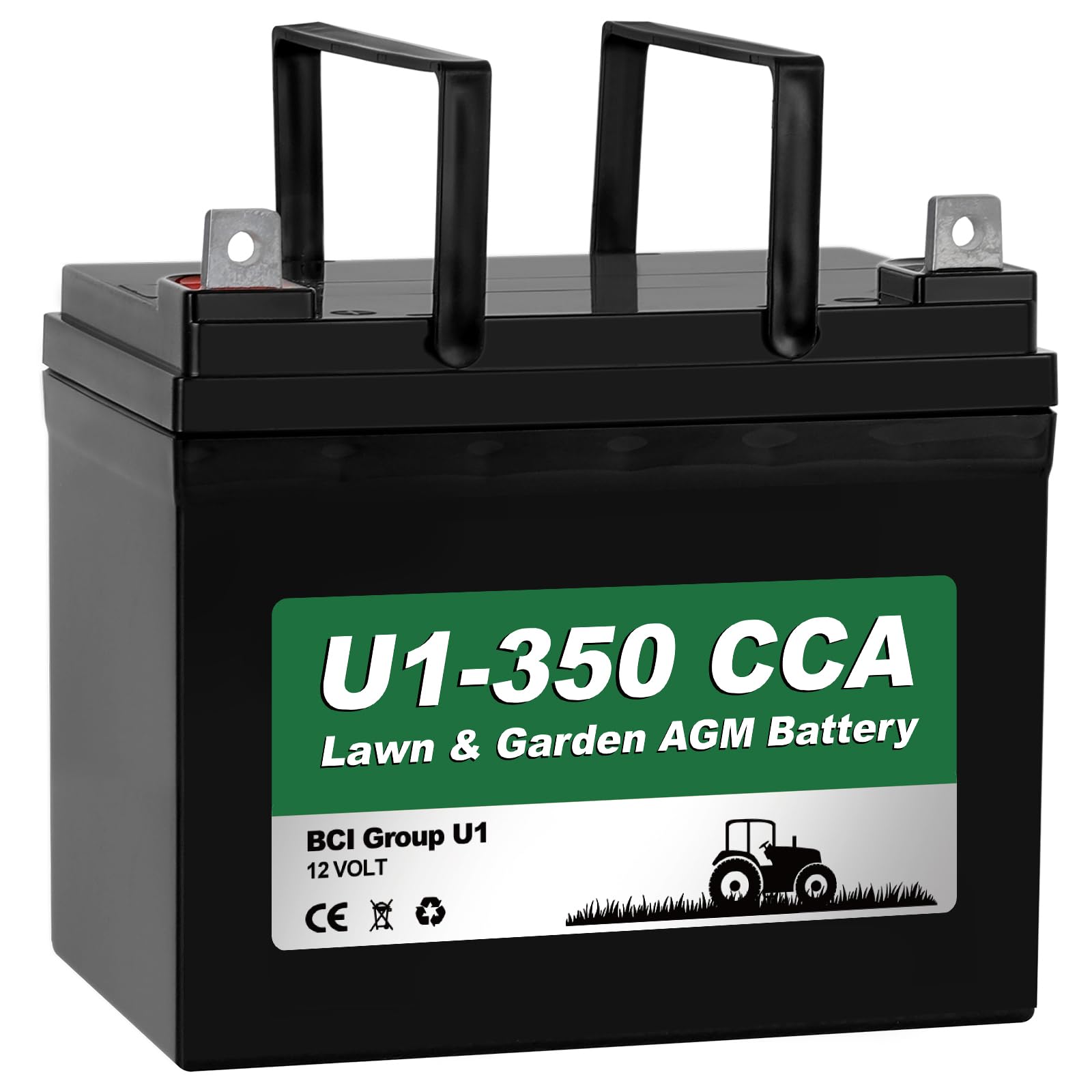
The WEIZE U1-350 is built for a different job than the other batteries on this list — it’s a starting battery for lawn tractors, mowers, and utility vehicles, not a deep-cycle pack for electronics. With 350 Cold Cranking Amps (CCA), it delivers the high burst of current needed to crank a small engine in cold weather. The AGM construction handles vibration better than flooded lead-acid, and the Group U1 form factor (7.68 x 5.12 x 6.22 inches) is the standard size for John Deere, Toro, Cub Cadet, and Craftsman mowers.
Real-world reports confirm it’s an exact fit for Country Clipper mowers and Yamaha Wolverine X4 UTVs. Users note that it cranks the engine noticeably faster than the factory battery and deals with cold winter starts without hesitation. The 1-year manufacturer warranty covers defects, and the square-hole nut-and-bolt terminals are standard for the U1 size — though one user reported the terminal holes were slightly too small for original bolts and had to enlarge them slightly.
The catch: this is not a deep-cycle battery. If you plan to run lights, a radio, or accessories for hours without the engine running, the AGM chemistry will tolerate it better than a standard wet-cell, but repeated deep discharges will shorten its life. At 21.45 pounds, it’s also the heaviest battery here — not something you want to carry around for portable use. It’s purpose-built for one job: starting and recharging in short cycles.
Why it’s great
- 350 CCA provides reliable cold-weather engine starting for lawn tractors.
- Group U1 size fits most major mower brands (John Deere, Toro, Cub Cadet).
- AGM construction resists vibration better than flooded lead-acid.
Good to know
- Not designed for deep-cycle use — repeated deep discharges shorten its life.
- Very heavy at 21.45 lbs — not suited for portable applications.
FAQ
Can I charge a LiFePO₄ battery with a standard lead-acid charger?
What is the difference between AGM and sealed lead-acid (SLA)?
How do I choose between a LiFePO₄ battery and an SLA battery for my fish finder?
Final Thoughts: The Verdict
For most users, the small 12v battery winner is the GOLDENMATE 12V 16Ah LiFePO₄ because its IP67 waterproofing, 5000-cycle lifespan, and 16Ah capacity cover the widest range of portable power needs from fishing to security cameras. If you want maximum runtime in a still-portable package, grab the ZapLitho 22Ah LiFePO₄. And for a direct, no-hassle drop-in replacement for a UPS or kid’s ride-on toy, nothing beats the reliable and affordable Mighty Max ML9-12 SLA.