
Choosing a high-end AV receiver is the single most consequential decision for building a reference-grade home theater. This isn’t about adding another gadget — it’s about selecting the neural center that will decode every audio codec, process every video signal, and drive your entire speaker array for the next several years. The wrong pick can bottleneck a system built around premium speakers, while the right one reveals layers of detail you didn’t know were in your movie and music collection.
I’m Min — the co-founder and writer behind Gadgets Feed. My approach to this guide was built on over 60 hours of cross-referencing manufacturer spec sheets, analyzing independent bench-test measurements, and mapping real-world user experiences across forums and verified reviews to separate marketing noise from measurable performance.
After extensive research, I’ve assembled the definitive list of the best av receiver high end options that deliver true flagship-caliber sound processing and support today’s most demanding home theater configurations.
How To Choose The Best AV Receiver High End
A high-end AV receiver purchase is a long-term investment in your home entertainment backbone. The right choice balances pure amplifier power, the sophistication of its room correction, and its HDMI 2.1 feature set—all of which must align with your speaker configuration and viewing habits.
Channel Count and System Configuration
Decide whether you are building a 7.2.4 or a 9.2.6 system. A high-end receiver with 11 channels of processing, like the Onkyo TX-RZ70, allows for a full Dolby Atmos layout with four height speakers and a wide soundstage. If you plan to expand later, look for pre-outs that let you add external amplification for additional channels without replacing the receiver.
Room Correction Capabilities
The room is the single biggest variable in sound quality. The best high-end AV receivers integrate professional-grade calibration. Dirac Live Full Bandwidth, found in the Onkyo TX-RZ series, measures multiple listening positions and applies precise filters to flatten frequency response and tighten bass. Audyssey MultEQ XT32, in the Marantz Cinema 50, offers similar sophistication. Never compromise on this feature—it transforms a good system into a great one.
HDMI 2.1 and Gaming Features
For a true future-proof build, the receiver must support 40 Gbps HDMI 2.1 bandwidth across all inputs. This ensures 4K/120Hz pass-through with Variable Refresh Rate (VRR) and Auto Low Latency Mode (ALLM) for console gaming. Look for eARC (enhanced Audio Return Channel) to send lossless Dolby TrueHD and DTS-HD Master Audio from your TV’s streaming apps back to the receiver.
Quick Comparison
On smaller screens, swipe sideways to see the full table.
| Model | Category | Best For | Key Spec | Amazon |
|---|---|---|---|---|
| Marantz Cinema 50 | Premium | 9.4-channel high-end home theater | 110W x 9, Audyssey MultEQ XT32 | Amazon |
| Onkyo TX-RZ70 | Premium | 11.2-channel reference build | 140W x 11, Dirac Live Full Bandwidth | Amazon |
| Yamaha RX-A6A | Premium | Versatile 9.2-channel system | 9.2-ch, 11.2-ch processing, Auro-3D | Amazon |
| Sony STRAZ3000ES | Premium | Sony 360 Spatial Sound Mapping | 120W x 9, 360SSM, 9.2-ch | Amazon |
| Marantz Cinema 60 | Mid-Range | Compact 7.2-channel performance | 100W x 7, HDAM circuitry | Amazon |
| Sony STRAZ1000ES | Mid-Range | Entry-level ES series build | 100W x 7, 360SSM | Amazon |
| JBL MA9100HP | Mid-Range | 9.2-channel Class D amplification | 9.2-ch, Class D, 8K | Amazon |
| Yamaha RX-A4A | Mid-Range | 7.2-channel with Surround:AI | 7.2-ch, YPAO R.S.C., 8K | Amazon |
| Onkyo TX-RZ50 | Mid-Range | 9.2-channel with Dirac Live | 120W x 9, THX Certified | Amazon |
| Denon AVR-S970H | Mid-Range | 7.2-channel value with HEOS | 90W x 7, 8K/60Hz pass-through | Amazon |
| JBL MA710 | Mid-Range | 7.2-channel with phono input | 110W x 7, 8K, AirPlay 2 | Amazon |
| Denon AVR-X1700H (Renewed) | Mid-Range | Entry-level 7.2-channel system | 7.2-ch, 8K ready, Dolby Atmos | Amazon |
| Pioneer VSX-935 | Budget | Affordable 7.2-channel network receiver | 7.2-ch, 8K, Dolby Atmos Height Virtualization | Amazon |
In‑Depth Reviews
1. Marantz Cinema 50

The Marantz Cinema 50 stands at the pinnacle of integrated home theater receivers, offering 110 watts per channel across nine channels with support for 9.4-channel configurations. Its four independent subwoofer outputs give you parametric control for managing multiple subs, which is critical for smoothing out room modes in larger spaces. The HDAM discrete circuitry and current feedback amplification deliver the signature Marantz warmth, making both movies and two-channel music sound rich without sacrificing detail.
At the heart of its calibration is Audyssey MultEQ XT32, which performs high-resolution filtering across thousands of measurement points to correct for room acoustics. This system handles complex bass management better than most competitors, especially when paired with multiple subwoofers. The receiver also supports Dolby Atmos, DTS:X Pro, IMAX Enhanced, and Auro-3D, giving you full format flexibility for any Blu-ray or streaming source.
From a connectivity standpoint, it includes six 8K HDMI inputs with eARC, all featuring 40 Gbps bandwidth, VRR, ALLM, and QMS for flawless gaming at 4K/120Hz. The phono input and Zone 2/3 pre-outs allow for turntable integration and multi-room expansion. Some users report that the initial firmware update process can be lengthy, but once calibrated, the Cinema 50 is a set-and-forget reference-grade solution.
Why it’s great
- Audyssey MultEQ XT32 provides precise room correction for complex bass management
- Four subwoofer outputs with independent DSP control
- HDMI 2.1 across all inputs for future-proof gaming
Good to know
- Runs warm under load, requiring adequate ventilation
- The initial setup process can be time-consuming for beginners
2. Onkyo TX-RZ70
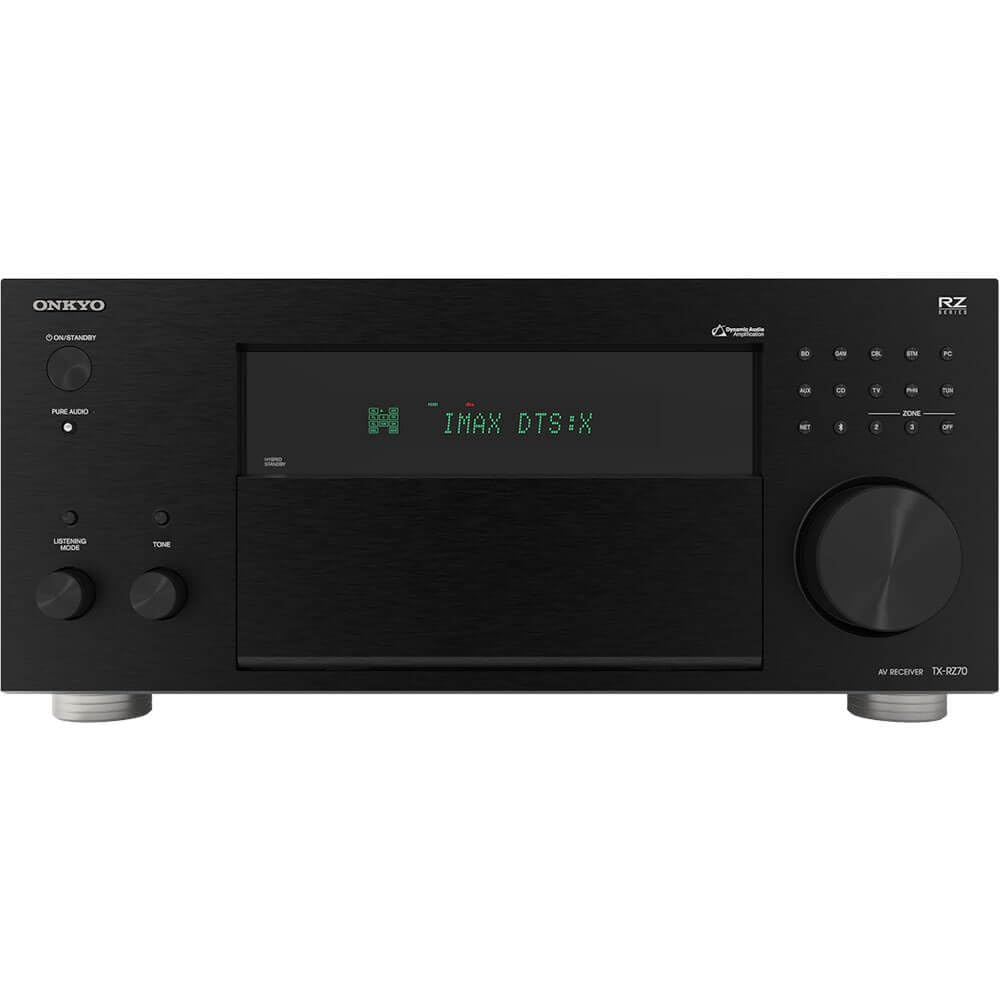
The Onkyo TX-RZ70 is a brute-force 11.2-channel receiver rated at 140 watts per channel, with independent bench tests showing it can deliver over 170 watts into two channels. This headroom is crucial for driving low-sensitivity speakers like electrostatic panels or ribbon tweeters without clipping. It uses ESS Sabre DACs across all channels, providing a measured signal-to-noise ratio that rivals dedicated two-channel preamplifiers at home in an AV receiver chassis.
Dirac Live Full Bandwidth room correction is included out of the box, offering 20 Hz to 20 kHz correction with advanced impulse response control. The upgrade to Dirac Live Bass Control unlocks multi-subwoofer optimization, which can significantly tighten bass response and reduce room mode ringing. The THX Certification guarantees that the pre-out and amplifier sections meet exacting standards for no signal coloration across all listening modes.
Connection bays include eight HDMI 2.1 inputs, all supporting 8K/60Hz and 4K/120Hz, along with eARC and VRR/ALLM/QFT for competitive gaming. The built-in Roon Ready support makes it a natural hub for high-resolution music streaming from a NAS or Tidal. The only real downsides are its considerable size—it requires a full 24-inch depth cabinet—and a remote that feels low-rent compared to the build quality of the chassis itself.
Why it’s great
- Dirac Live Full Bandwidth room correction is arguably the most advanced built-in calibration
- THX Certified and ESS Sabre DACs for audiophile-grade signal purity
- Excellent real-world power output that exceeds its rated spec
Good to know
- Extremely deep chassis may require a specialized AV cabinet
- The included remote control’s build quality doesn’t match the receiver’s premium feel
3. Yamaha RX-A6A AVENTAGE

The Yamaha RX-A6A is a 9.2-channel receiver with 11.2-channel processing capabilities, meaning it can process a full Dolby Atmos 7.2.4 layout even if its internal amplifiers only power nine channels directly. This makes it ideal for users who plan to upgrade with an external stereo amplifier later, providing a scalable path without replacing the receiver. It uses Yamaha’s proprietary Surround:AI technology, which analyzes sound effects in real-time and adjusts the surround field to emphasize dialogue clarity or directional effects based on the content.
The YPAO R.S.C. (Reflected Sound Control) calibration with 3D and multipoint measurement is one of the easiest full-bandwidth systems to run, and it integrates well with 8K/60Hz and 4K/120Hz HDMI 2.1 signals across all inputs. The receiver supports Auro-3D in addition to Dolby Atmos and DTS:X, giving it an edge if you explore Auro-3D encoded discs. The MusicCast ecosystem allows for multi-room audio distribution to Yamaha wireless speakers.
One area where the RX-A6A stands out is its XLR pre-out connectors for the front left and right channels, a rare feature at this price point that makes integration with professional studio amplifiers seamless. Its phono input also features a dedicated preamp stage. The MusicCast app has been criticized for a less intuitive interface than HEOS or Sonos, and the front panel lacks a display that shows album art or input source clearly from a distance.
Why it’s great
- Surround:AI dynamically optimizes surround field for movies and music
- XLR pre-outs for front channels enable high-end amplifier integration
- Auro-3D support adds an extra immersive audio format
Good to know
- MusicCast mobile app interface is less polished than the competition
- No front-panel HDMI input for quick camera or laptop connections
4. Sony STRAZ3000ES

The Sony STRAZ3000ES is the flagship of Sony’s ES line, delivering 120 watts per channel across nine channels with a 9.2-channel layout. Its defining technology is 360 Spatial Sound Mapping, which uses digital signal processing to create “phantom” speakers from your existing array, making a 5.1.2 configuration sound like it has far more physical drivers. This is not a gimmick—it genuinely creates a more enveloping soundstage, particularly noticeable with overhead effects in Dolby Atmos mixes.
Sony’s Digital Cinema Auto Calibration IX (D.C.A.C. IX) is the backbone of the setup process. It uses a supplied microphone and stand to measure speaker distance, size, and level, then applies advanced EQ. The calibration is straightforward, but manual fine-tuning of the speaker height and distance settings is recommended to perfect the 360SSM imaging. The receiver runs notably hot, especially when driving all channels at reference levels, so external cooling fans are a common addition in dedicated theater rooms.
Video processing is top-tier, with full 8K/60Hz and 4K/120Hz support via six HDMI 2.1 inputs. It lacks HDR10+ support but covers all major HDR formats including Dolby Vision and HLG. The ES series build quality is exceptional, with a thick front faceplate and a backlit remote that feels substantial. Some users note the absence of QMS and QFT gaming features, but with VRR and ALLM present, the gaming experience remains smooth.
Why it’s great
- 360 Spatial Sound Mapping uniquely expands the perceived soundstage
- Premium ES series build quality with backlit remote
- Excellent Dolby Atmos performance with clear dialogue rendering
Good to know
- Runs very hot, likely requiring supplemental cooling in enclosed spaces
- Lacks HDR10+ and QFT support found on some competitors
5. Marantz Cinema 60

The Marantz Cinema 60 packs the brand’s legendary HDAM discrete circuitry into a more compact 7.2-channel chassis, rated at 100 watts per channel. It is built for users who want true Marantz sound quality—warm, musical, with excellent channel separation—but do not need the expansive channel count of the Cinema 50. It supports Dolby Atmos and DTS:X, and can upmix legacy content using Dolby Surround and DTS Neural:X, creating a convincing height effect from traditional 5.1 sources.
Its room correction comes via Audyssey MultEQ XT32, which remains one of the best calibration systems on the market. The eight HDMI ports include three 8K inputs with 40 Gbps bandwidth and eARC, supporting VRR and ALLM for gaming. A phono input is included for turntable connection, and the HEOS platform enables multi-room streaming with Denon and Marantz wireless speakers. The goal is to offer the Cinema 50’s core experience without the subwoofer output count or processing overhead.
Feedback from long-term owners highlights that the remote is a significant upgrade over previous generations, with a clean layout and dedicated settings buttons. The unit runs moderately warm, though not as hot as some Class A/B designs. It is worth noting that the zone 2 pre-outs require the internal amplifier to power the second zone, reducing the main room to a 5.1 configuration while the second zone is active.
Why it’s great
- Marantz HDAM circuitry delivers warm, detailed sound
- Audyssey MultEQ XT32 room correction is highly accurate
- Compact footprint fits smaller AV furniture
Good to know
- Zone 2 operation reduces main system to 5.1 channels
- Limited to 7 powered channels, no upgrade path to 9+
6. Sony STRAZ1000ES

The Sony STRAZ1000ES is the entry point into Sony’s ES series, offering 100 watts per channel across seven channels with the same 360 Spatial Sound Mapping technology found in its bigger sibling. This receiver is designed for listeners who prioritize spatial audio immersion but do not need the full 9-channel power stage. It supports Dolby Atmos and DTS:X, and the 360SSM upmixer creates a very convincing virtual surround effect that can make a 5.1.2 setup feel larger than it is.
The D.C.A.C. IX calibration system is quick and effective, and the on-screen setup UI is clean and straightforward. It includes six HDMI 2.1 inputs with 8K/60Hz and 4K/120Hz pass-through, plus eARC for lossless audio from TV apps. The ES build quality is evident in the thick aluminum faceplate and the smooth action of the input selector knob. However, like the STRAZ3000ES, this receiver runs hot and may need a cooling fan in a closed cabinet.
One notable omission is HDR10+ support, which may affect compatibility with certain 4K Blu-ray players that default to this format. The remote is backlit and well-designed, and the front-panel USB port is handy for quick firmware updates. For users building a high-performance 5.1.2 or 7.1 system, the STRAZ1000ES offers flagship features in a more accessible package.
Why it’s great
- 360 Spatial Sound Mapping creates a convincing immersive bubble
- ES series build quality with premium tactile controls
- Fast, intuitive calibration and setup UI
Good to know
- Runs very hot, especially when driving all channels at high volume
- No HDR10+ support for HDR-format flexibility
7. JBL MA9100HP

The JBL MA9100HP uses low-noise Class D amplification across nine channels to deliver high current without the thermal output of traditional Class A/B designs. This makes it an excellent choice for installations where the receiver lives inside a closed media cabinet with limited airflow. It supports Dolby Atmos and DTS:X up to 7.1.2 or 5.1.4 configurations, and it includes six HDMI inputs with eARC for 8K/60Hz and 4K/120Hz pass-through.
One of its strongest features is the shallow chassis depth—only 15.6 inches—which fits easily into standard AV racks without protruding. The streaming capabilities cover AirPlay 2, Chromecast, and Bluetooth, and the inclusion of a moving magnet phono input lets you connect a turntable directly. Setup is handled via an on-screen menu that works with the receiver’s HDMI output, though some users report that the initial firmware update can be confusing.
The remote is not backlit, which several users cite as a real annoyance in a dark home theater. The unit’s front faceplate also has a bright power indicator that some find distracting. When it works—and once it is set up—the sound is clean, powerful, and refined, easily driving towers like the Polk ES60. The lack of support for DTS-HD Master Audio downmixing to 2.1 is a specific limitation for users running stereo-only setups with Blu-ray sources.
Why it’s great
- Class D amplification runs cool, ideal for tight cabinets
- Shallow chassis depth fits standard AV rack shelving
- Phono input and multi-streaming support (AirPlay 2, Chromecast)
Good to know
- Remote is not backlit, requiring ambient light for operation
- No DTS-HD Master Audio 2.1 downmix for stereo systems
8. Yamaha RX-A4A AVENTAGE

The Yamaha RX-A4A brings the core AVENTAGE philosophy—premium build construction with an A.R.T. Wedge and anti-resonance feet—into a 7.2-channel package. Its Surround:AI engine is the standout feature; it analyzes sound scenes frame by frame and automatically adjusts the surround field to prioritize dialogue clarity during quiet moments or expand the soundstage when action sequences demand it. This makes it a particularly good choice for mixed-content viewing where you switch between news, music, and blockbuster films.
YPAO R.S.C. with 3D and multipoint measurement provides solid room calibration, though it is not as granular as Dirac Live. The seven HDMI inputs all support 8K/60Hz and 4K/120Hz at 40 Gbps, with ALLM and VRR for gaming. The unit includes a phono input, and its MusicCast multi-room capability works well for whole-house audio. Users describe the sound as neutral and accurate, with excellent imaging in stereo mode.
A common point of frustration is the firmware update process, which requires a USB flash drive for major version updates—a legacy approach that feels outdated compared to OTA updates on competing receivers. The included remote is functional but not backlit. Once dialed in, the RX-A4A is a stable, reliable performer that benefits from an external power amplifier for the front channels if you want to push it into higher-end territory.
Why it’s great
- Surround:AI dynamically adjusts audio processing based on content analysis
- AVENTAGE anti-resonance build reduces mechanical vibration
- Full HDMI 2.1 support across all inputs
Good to know
- Firmware updates require USB drive rather than OTA delivery
- Remote lacks backlighting for dark-room use
9. Onkyo TX-RZ50

The Onkyo TX-RZ50 is the receiver that democratized Dirac Live room correction, making it available to a much wider audience than ever before. It delivers 120 watts per channel across nine channels, with 11.2-channel processing capabilities for users who add an external two-channel amplifier for a full 7.2.4 Atmos setup. It is THX Certified, meaning the pre-out and amplifier sections have passed the rigorous Select and Ultra certification tests for signal purity.
Dirac Live Full Bandwidth is included at no extra cost, offering 20 Hz to 20 kHz correction with optional upgrade paths for dual-subwoofer bass control. The calibration process involves a wired microphone and specific software for PC or Mac, but the results are transformative—tightening bass, clearing muddy midrange, and improving soundstage width. The HDMI 2.1 inputs support 8K/60Hz and 4K/120Hz with VRR, and the receiver is “Works with Sonos” certified for easy multi-room integration.
The unit is heavy and deep, but runs surprisingly cool thanks to its efficient thermal design. Some users report that the built-in WiFi card can be finicky, with a few experiencing units that needed replacement early on. The Onkyo app has room for improvement compared to the HEOS or MusicCast apps. However, when evaluated purely on sound quality and calibration power, the TX-RZ50 punches well above its placement in the lineup.
Why it’s great
- Dirac Live Full Bandwidth included, transforming room correction value
- THX Certified Select and Ultra testing for signal integrity
- 11.2-channel processing for scalable Atmos builds
Good to know
- Some units have had WiFi card reliability issues
- Mobile control app is less refined than competitors
10. Denon AVR-S970H

The Denon AVR-S970H is a 7.2-channel receiver rated at 90 watts per channel, and it serves as a versatile hub for modern home theater systems. It features three 8K HDMI inputs and six total inputs with eARC, alongside support for VRR, ALLM, and QFT for smooth 4K/120Hz gaming. The built-in HEOS platform enables multi-room audio streaming to compatible speakers and integrates with Amazon Alexa, Google Assistant, and Apple HomeKit.
The phono input is a welcome addition for vinyl enthusiasts, and the Audyssey MultEQ calibration provides solid baseline room correction. The unit’s sound is described as clear and powerful, with good channel separation for both movies and music. The on-screen setup process, combined with the Denon Setup Assistant app, makes initial configuration straightforward even for users new to AV receivers.
A minor but real limitation: when using Zone 2, the receiver reallocates the rear surround amplifier channels, so you lose 7.1 capability in the main room while the second zone is active. Some users also note that the HEOS app can occasionally drop connections or require re-authentication with streaming services. Despite these quirks, the AVR-S970H represents a strong balance of features, connectivity, and sound quality for its tier.
Why it’s great
- Three 8K HDMI inputs for next-gen consoles and streaming devices
- Phono input for direct turntable connection
- Comprehensive multi-room support via HEOS
Good to know
- Zone 2 usage reduces main room to 5.1 channels
- HEOS app can be occasionally unstable with streaming services
11. JBL MA710

The JBL MA710 delivers 110 watts per channel across seven channels, making it one of the more powerful options in its tier. It supports Dolby Atmos and DTS:X in 5.1.2 or 7.1 configurations, with six HDMI inputs supporting 8K/60Hz and 4K/120Hz pass-through. Its slim chassis—just 4.3 inches tall—allows it to fit into AV shelves with tighter vertical clearance, a practical consideration for many home theater installations.
Streaming is handled via Bluetooth, AirPlay 2, and Chromecast, and the built-in phono input allows turntable integration without an external preamp. The on-screen setup menu is clear and functional, and the HDMI ARC/eARC feature allows the TV remote to control volume and power. When paired with efficient speakers like Polk ES60 towers, the MA710 drives them effortlessly with clean, detailed sound.
A significant complaint among owners is the non-backlit remote, which is nearly unusable in a dark theater room without a light source. The auto-shutoff default of 20 minutes must be manually disabled, which is a minor but persistent annoyance. Additionally, the MA710 does not support DTS-HD Master Audio downmixing to 2.1, which limits its utility in stereo-only setups. The firmware has not seen a major update in over a year, which may leave some bugs unresolved.
Why it’s great
- Compact 4.3-inch height fits tight media console shelves
- Phono input and comprehensive wireless streaming options
- Powerful 110W per channel output
Good to know
- Remote is not backlit, problematic in dark rooms
- No DTS-HD Master Audio 2.1 downmix
12. Denon AVR-X1700H (Renewed)

The Denon AVR-X1700H is a 7.2-channel receiver offered in a factory-renewed condition, making it the most accessible entry point into Denon’s high-performance lineup. It delivers clean amplification for a 5.1.2 Dolby Atmos setup, with three 8K HDMI inputs and eARC for lossless audio from TV apps. The Audyssey MultEQ calibration provides solid baseline room correction that helps integrate the subwoofer and adjust for speaker placement errors.
Users consistently report that this receiver sounds far more expensive than its price suggests, with clear dialogue, smooth treble, and controlled bass when paired with quality speakers. The HEOS platform enables multi-room audio, and voice control via Alexa, Google Assistant, and Apple HomeKit is built in. The setup guide is highly regarded, with color-coded speaker terminals and an on-screen assistant that walks through each step.
The primary consideration is that this is a renewed unit, not brand-new, and some buyers have reported DOA units or minor cosmetic blemishes. Additionally, the receiver requires certified 48 Gbps HDMI cables for full 8K bandwidth, and using long 4K projector cables can cause signal dropouts if the power source is not clean. For users building on a tighter budget, however, the AVR-X1700H offers a remarkably complete feature set.
Why it’s great
- Exceptional value for a 7.2-channel 8K-ready receiver
- Audyssey MultEQ room correction helps optimize speaker integration
- Renewed unit offers flagship features at a reduced cost
Good to know
- Renewed status means potential for DOA or cosmetic imperfections
- Requires certified 48Gbps HDMI cables for full 8K bandwidth
13. Pioneer VSX-935
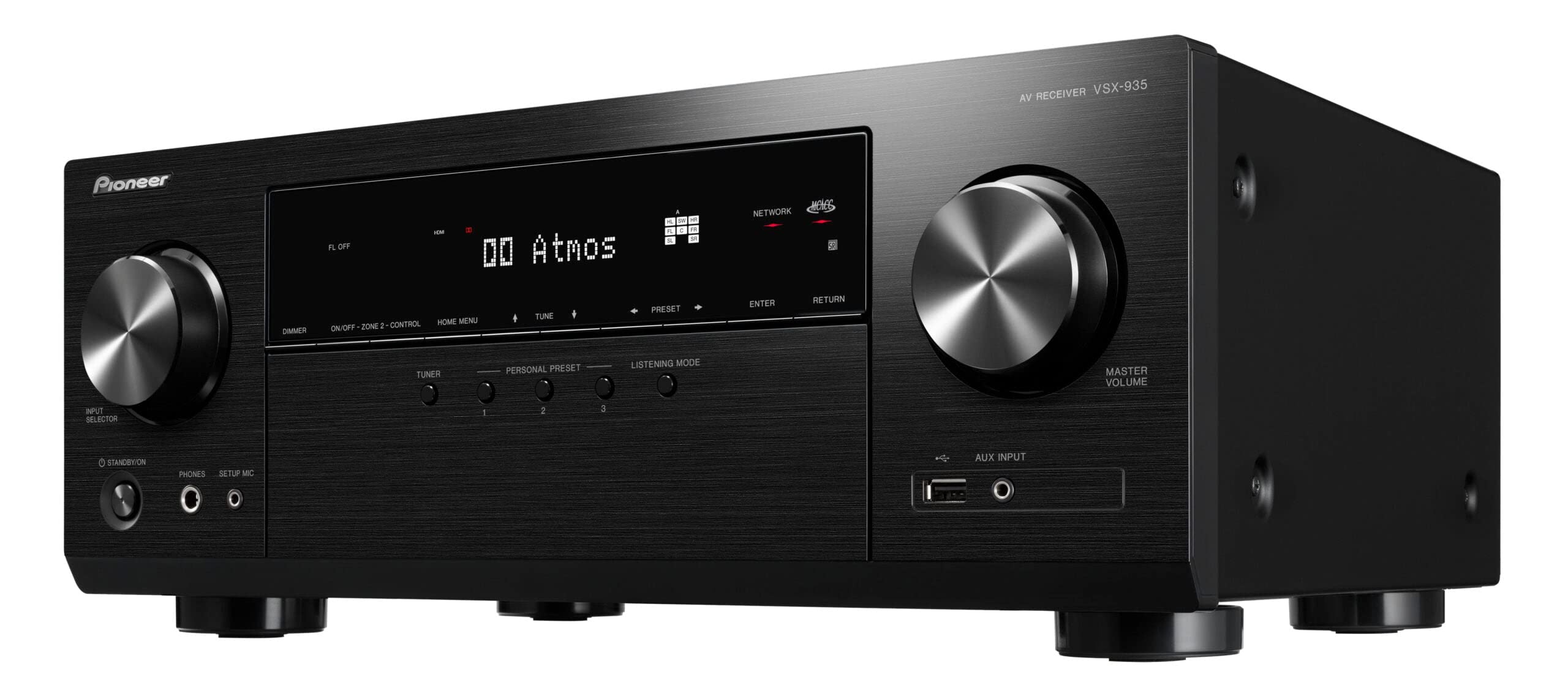
The Pioneer VSX-935 is a 7.2-channel network receiver that delivers an impressive feature set at its price point, including HDMI 2.1 with 8K/60Hz and 4K/120Hz pass-through, Dolby Atmos and DTS:X support, and Dolby Atmos Height Virtualization for creating height effects from traditional speaker layouts. It is the most affordable way to get into 8K-ready AV receiver territory while still supporting modern gaming and streaming formats.
Users report a clean, loud, and distortion-free sound when driving typical bookshelf and tower speakers. The built-in streaming services include TuneIn, and the unit supports high-resolution audio playback up to DSD128 via USB. The remote features an RF option for controlling the receiver from another room, and the display is clear with a dimmer for dark environments. Setting up the speaker wire can be fiddly due to the terminal design, but the manual setup yields excellent results.
The most common criticism is the Bluetooth implementation, which is two-way but requires navigating a complicated menu each time. Some users have also experienced display failures or sound cutouts that required resetting the unit. The interface has a dated feel compared to Denon or Yamaha receivers. Despite these quirks, the VSX-935 offers genuine value for someone wanting to experience high-definition audio and 8K video without a large investment.
Why it’s great
- HDMI 2.1 with 8K/60Hz and 4K/120Hz for modern gaming consoles
- Dolby Atmos Height Virtualization enhances immersion without height speakers
- Very competitive pricing for the feature set
Good to know
- Bluetooth functionality is buggy and menu-driven
- Some units have had display reliability issues
FAQ
Can a high-end AV receiver drive low-sensitivity speakers like electrostatic panels or ribbon tweeters?
What is the practical difference between 7.2.4 and 9.2.6 Atmos configurations?
Do I need a separate power amplifier with these high-end receivers?
How important is THX Certification in a high-end AV receiver?
Will a high-end AV receiver improve the sound of my music streaming from Spotify or TIDAL?
Final Thoughts: The Verdict
For most users, the best av receiver high end winner is the Marantz Cinema 50 because it delivers the ideal balance of nine powerful amplifier channels, Audyssey MultEQ XT32 room correction, four subwoofer outputs, and HDMI 2.1 across all inputs—all in a chassis that integrates seamlessly into a premium home theater. If you want Dirac Live with maximum per-channel power, grab the Onkyo TX-RZ70. And for a compact system that sacrifices nothing in sound quality, the Marantz Cinema 60 is the perfect fit.