
A single 4×8 plexiglass sheet is the difference between a drafty, exposed workspace and a sealed, protected project you can see through. Whether you are framing a photo, building a sneeze guard, or winterizing a chicken coop, the wrong thickness or material choice turns a weekend job into a return-to-sender headache.
I’m Min — the co-founder and writer behind Gadgets Feed. My deep market research and spec-by-spec analysis of over forty acrylic and polycarbonate panels focused on optical clarity, impact resistance, and ease of fabrication to separate the pro-grade sheets from the shipping-warped disappointments.
Budget sheets scratch in a single wipe, while premium polycarbonate survives hailstorms and casual drops alike. This guide breaks down the exact thicknesses, materials, and coatings that define the best 4′ x 8′ plexiglass sheets your next build deserves.
How To Choose The Best 4′ X 8′ Plexiglass Sheets
Four by eight feet is a large span, so the material you pick determines whether the sheet stays flat, resists yellowing, or survives a toolbox dropping on it. Three decisions matter most: base material, thickness, and whether you need UV resistance.
Material: PETG vs Acrylic vs Polycarbonate
PETG (glycol-modified PET) bends slightly without cracking and wipes clean with dry-erase markers, making it ideal for display overlays and shields. Acrylic (PMMA) offers brilliant optical clarity but shatters under point impact — fine for framing, risky for outdoor barriers. Polycarbonate is the toughest option: it flexes, resists shattering, and handles heat bending, but it scratches more easily and costs more per sheet.
Thickness: Lightweight 0.03″ vs Rigid 0.12″
A 0.03-inch (30-mil) sheet is lightweight and easy to cut with a utility knife, but it will bow over a full 4×8 span unless supported. Stepping up to 0.06-inch (1/16″) adds enough rigidity for framed windows and machine guards. For load-bearing applications like greenhouse roofing or door panels, 0.118-inch (1/8″) or thicker prevents sagging and resists wind uplift.
Quick Comparison
On smaller screens, swipe sideways to see the full table.
| Model | Category | Best For | Key Spec | Amazon |
|---|---|---|---|---|
| Superior Graphic Supplies PETG 0.03″ | PETG | DIY overlays & sneeze guards | 0.030 inch thickness | Amazon |
| Roowest Acrylic 1/8″ (4-pack) | Acrylic | Window inserts & tabletop protectors | 0.13 inch thickness | Amazon |
| Robosource Polycarbonate 1/16″ Clear | Polycarbonate | Melt-free bending & machine guards | 0.06 inch thickness | Amazon |
| Superior Graphic Supplies PETG 0.04″ | PETG | Draft barriers & chick brooders | 0.040 inch thickness | Amazon |
| Robosource Polycarbonate 1/16″ Smoke | Polycarbonate | Deer blind & tinted privacy screens | 0.06 inch thickness | Amazon |
| Robosource ABS Black 1/8″ | ABS | Auto underpanels & door cards | 0.118 inch thickness | Amazon |
| Sinimaka Twin-Wall Polycarbonate 0.24″ (8-pack) | Polycarbonate | Greenhouse roofs & animal winter panels | 0.24 inch thickness | Amazon |
In‑Depth Reviews
1. PETG Clear Plexiglass Plastic Sheet (48″ x 96″) 30mil by Superior Graphic Supplies

This 30-mil PETG sheet hits the sweet spot between weight and versatility. At 0.030 inches, it is thin enough to pierce with a standard hole punch for hanging with 3M hooks, yet stiff enough to stand upright as a catio weather shield. Reviewers consistently confirm that dry-erase markers wipe off without ghosting — a critical detail for anyone using it as a protective cover for wall art or whiteboard overlays.
The PETG formulation provides genuine impact resistance above glass, and the sheet arrives rolled in a tube to minimize creasing. Multiple buyers used this exact panel as a secondary storm pane for arched windows, noting that the 0.030 thickness reduces drafts and street noise without the weight of a second glass sash. The 32-square-foot coverage is generous enough for framing two large posters side by side.
One potential trade-off: the material is PETG, not polycarbonate, so it lacks the extreme shatter resistance needed for high-traffic machine guarding. But for display projects, draft barriers, and DIY crafts, the balance of clarity, light weight, and easy cutting makes this the most versatile single sheet in the lineup.
Why it’s great
- Crystal-clear optical finish with protective film on both sides
- Easy to cut with a utility knife and square
- Light enough to hang with adhesive hooks
Good to know
- PETG scratches more easily than glass or polycarbonate
- Shipped rolled — must unroll immediately to flatten
2. Sinimaka 8-Pack Twin-Wall Polycarbonate Greenhouse Panels 8′ x 4′ x 0.24″

This eight-panel set uses a twin-wall design — two polycarbonate layers separated by vertical struts — to create an insulated barrier that retains heat while diffusing light.
UV-resistant coating blocks 99.9% of UV radiation while transmitting 89% of visible light — the ideal ratio for seedlings that need brightness without leaf burn. Multiple reviewers installed these as winter enclosures for chicken coops and screened porches, and the panels survived high winds that had blown out prior untreated glass. The ability to cold-bend the sheets into curved roofs is a bonus that solid acrylic cannot match.
Buyers should note that the claimed 2-foot width is actually 23 inches, requiring greenhouse tape or silicone caulk to splice gaps. The price per panel is excellent for the durability, but the pack is best suited for someone covering a whole structure rather than a single window replacement.
Why it’s great
- Twin-wall insulation reduces heat loss in winter greenhouses
- Cold-bendable for curved roof designs
- Withstands hail, snow load, and extreme temperature swings
Good to know
- Panels are 23 inches wide, not a true 24 inches
- UV coating may yellow after several years of direct sun
3. Robosource Polycarbonate Clear Sheet 48″ x 96″ x 0.06″ (1/16″)
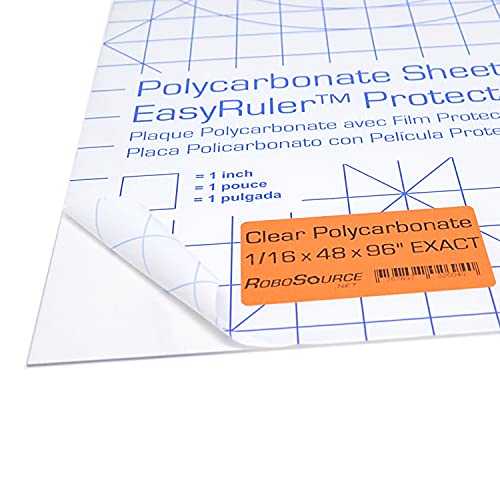
Robosource’s polycarbonate sheet is the go-to when you need something tougher than PETG but lighter than 1/8-inch acrylic. The 1/16-inch thickness is rigid enough to stand vertically as a cabinet window or custom machine guard yet flexible enough to be cut with tin snips without chipping. The exclusive EasyRuler film printed with measurement guides makes layout cuts faster — score, snap, and peel.
Reviewers praised its clarity: one built a front cabinet door replacement and could not tell the window was plastic. Another used it to winterize a cat house and cut the full sheet into multiple pieces without any cracking. The polycarbonate handles heat gun bending for custom shapes, unlike acrylic which tends to craze under direct heat. UV stabilization is included for moderate sun exposure, though extended direct sun may eventually require a UV-coated variant.
The sheet ships rolled to a 14-inch diameter. Most buyers report it flattens within hours, but a small number noted a faint yellow or brown streak — likely a manufacturing burn mark — in the otherwise clear surface. For non-critical applications like counter protectants or workshop dividers, the clarity-to-toughness ratio still wins.
Why it’s great
- Shatter-resistant and cold-bendable for curved applications
- EasyRuler film simplifies layout and cutting
- Precisely 48×96 inches, not a nominal undersized panel
Good to know
- Shipped rolled — can take a day to fully flatten
- Scratches easier than glass if wiped with abrasive cloths
4. Roowest 4-Pack 24″ x 48″ x 1/8″ Clear Cast Acrylic Sheets
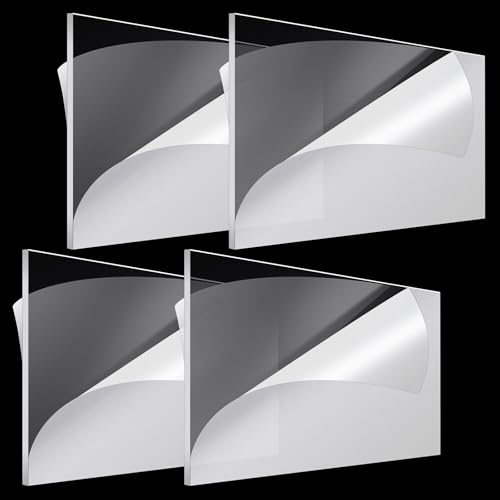
This four-pack gives you four 24×48-inch panels at 1/8-inch thickness for roughly the same price as a single premium 4×8 sheet. If your project requires multiple separate pieces — multiple window inserts, desk protectors for several workstations, or sign blanks for a craft fair — this pack is more economical than cutting a single large sheet and discarding waste.
The cast acrylic provides glass-like clarity and resists yellowing better than extruded alternatives. Reviewers used it to replace house windows and reported it was as clear as glass. The 1/8-inch thickness adds rigidity: these panels do not bow or flex across a 48-inch span the way 0.03-inch PETG would. Weather resistance holds from -40°F to 190°F, and the film protects against scratches during transport.
Quality control appears variable — one reviewer received a sheet with a yellow cast that distorted heat bending, and another found a chipped edge upon arrival. For indoor uses like desk protectors and photo frames, the optical quality is strong; for outdoor installations requiring precise heat forming, the inconsistency is a risk to weigh against the low per-sheet cost.
Why it’s great
- Four panels for one low price — ideal for multi-part projects
- 1/8-inch thickness resists sagging across 48-inch spans
- Indoor/outdoor rated from -40°F to 190°F
Good to know
- Some sheets arrived with a slight yellow tint
- Acrylic can shatter if dropped; not ideal for high-impact areas
5. Superio Graphic Supplies PETG 0.04″ (40mil) 48″ x 96″
Stepping up from 30-mil to 40-mil PETG adds 33% more thickness without requiring heavier tools. This sheet remains cuttable with standard scissors — a genuine time-saver if you are trimming it to fit irregular openings like a chick brooder or odd-shaped porch window. Reviewers who used it as a wind barrier on screened porches reported it survived multiple seasons and survived reinstallation without tearing at the edges.
The glycol-modified PETG is BPA-free, odorless, and laser-cuttable for precision sign work. The optical clarity is high enough for display cases and retail signage, and the material accepts paint, vinyl, and adhesives well. One buyer was disappointed that the sheet arrived rolled rather than flat, but most found the film-protected surface remained pristine after unrolling.
The primary drawback is thickness relative to rigidity: at 0.040 inches, the sheet will still bow if unsupported across the full 4×8 width. For draft-stopping applications where the panel is framed or fastened at intervals, this is not an issue. But if you need a free-standing vertical panel, step up to the 1/8-inch acrylic or polycarbonate options.
Why it’s great
- Cuttable with standard scissors, no power tools needed
- Higher impact resistance than standard acrylic
- BPA-free and recyclable for eco-conscious projects
Good to know
- Ships in a roll; may retain slight curl for a day
- Not UV-stabilized — prolonged direct sunlight may cause cloudiness
6. Robosource ABS Black Plastic Sheet 48″ x 96″ x 0.118″ (1/8″)
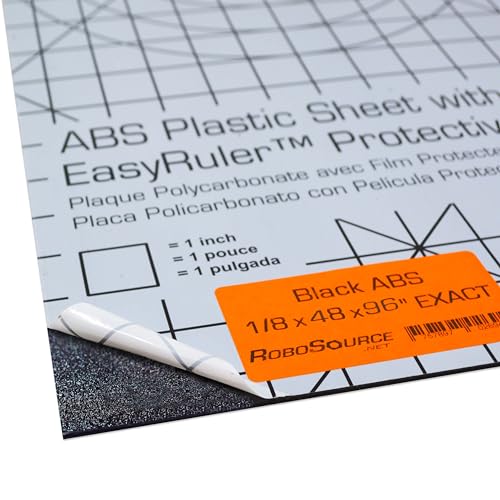
This is not a transparent sheet — it is a black ABS panel with a haircell texture on one side and a smooth back. It belongs in this guide because many builders who start with clear plexiglass discover they need a durable, non-shattering opaque alternative for automotive and structural uses. The 0.118-inch thickness provides structural rigidity that thin PETG cannot match.
Reviewers used this panel to fabricate custom car door cards, underbody panels, and camper van headliner substrates. ABS cuts cleanly with a razor knife (score and snap) or a jigsaw without melting the edges — a common complaint with polycarbonate. The haircell surface hides dirt and scratches, which is invaluable for horizontal panels in a workshop or truck bed. The material is also waterproof and will not delaminate like plywood.
One practical warning: the box is heavy (over 20 pounds) and the rolled sheet can spring open aggressively. Wear gloves and eye protection when unrolling. For anyone building vehicle interiors, kick panels, or durable storage bins, this ABS sheet outperforms any flexible plastic option at a lower cost than aluminum.
Why it’s great
- Rigid 1/8-inch thickness holds shape without framing
- Haircell texture hides scratches and dirt
- Cuts cleanly with hand tools or power saws
Good to know
- Black and opaque — no visibility through the sheet
- Shipped rolled; may require weighting to flatten
7. Robosource Smoke Grey Polycarbonate Sheet 48″ x 96″ x 0.06″ (1/16″)
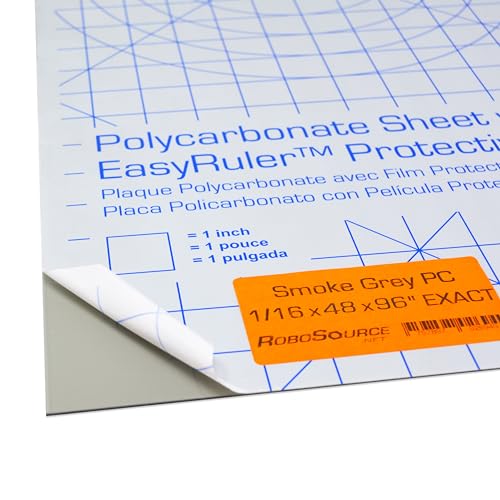
For applications where you want privacy with some light transmission, this translucent smoke-grey polycarbonate is a cost-effective alternative to tinted acrylic. The 1/16-inch thickness provides the same shatter resistance and cold-bending capability as the clear Robosource sheet, but the grey tint reduces glare and hides smudges better.
The same EasyRuler film carries through, making cutting to window dimensions simpler. One builder used it to replace garage door windows over existing plexiglass and found the flexibility made installation easier than cutting glass. UV stabilization is moderate, so it holds up well in covered outdoor locations like porches and carports.
Several buyers noted the sheet arrived with a warp from being rolled too tightly. Creases can be difficult to remove entirely if left rolled for days, so open the package immediately and place heavy books or weights along the edges. For the price point, this tinted polycarbonate delivers reliable performance for semi-private enclosures.
Why it’s great
- Translucent grey tint provides daytime privacy without blocking light
- Shatter-resistant and easy to cut with tin snips
- 100% virgin polycarbonate resin for consistent quality
Good to know
- May ship with a permanent warp if stored rolled too long
- Shade is semi-transparent — not suitable for full-clear windows
FAQ
Can I cut a 4×8 plexiglass sheet with a standard utility knife?
How do I prevent a rolled sheet from staying curled?
Which 4×8 sheet is best for outdoor greenhouse use?
Final Thoughts: The Verdict
For most users, the best 4′ x 8′ plexiglass sheets winner is the PETG 0.03-inch sheet because it balances optical clarity, easy cutting, and lightweight handling for the widest range of DIY and display projects. If you need impact resistance and cold bending, grab the Robosource polycarbonate 1/16-inch. And for greenhouse insulation with UV protection, nothing beats the Sinimaka twin-wall 8-pack.