
Choosing a camera for a professional photoshoot is a decision that directly impacts your final image quality, workflow efficiency, and client satisfaction. A camera that excels in controlled studio lighting may struggle in a dynamic outdoor environmental shoot, making the selection process a critical one for any photographer.
I’m Min — the co-founder and writer behind Gadgets Feed. I’ve spent hundreds of hours analyzing sensor specifications, autofocus systems, and real-world user feedback to separate marketing claims from tangible performance gains in the camera market.
Whether you are a studio portraitist or a product photographer, this guide breaks down the top contenders to help you find the perfect camera for photoshoot based on your specific technical and creative needs.
How To Choose The Best Camera For Photoshoot
Selecting a camera for a photoshoot requires you to balance resolution, autofocus speed, and handling ergonomics. The right choice depends on your primary subject—whether it’s a static product in a studio or a fast-moving model on location.
Sensor Size and Resolution
The sensor is the heart of any camera. Full-frame sensors (35.6 x 23.8mm) provide superior dynamic range, better high-ISO performance, and shallower depth of field compared to APS-C or Micro Four Thirds sensors. For a photoshoot, a 24MP to 45MP sensor offers enough resolution for large prints and detailed cropping without creating unmanageably large file sizes.
Autofocus System and Speed
Reliable autofocus is non-negotiable in a shoot. Phase-detection AF points, especially those covering a high percentage of the frame, ensure your subject stays sharp. Look for eye-detection or face-detection AF if you photograph people. Models with 693 or more AF points provide the tracking precision needed when working with shallow apertures like f/1.4.
Build, Durability, and Workflow
A photoshoot involves hours of handling, so weather sealing, a comfortable grip, and intuitive button layout are important. Dual card slots (SD + CFexpress or SD + XQD) give you instant backup, protecting your work if one card fails. A high shutter life rating of 150,000 to 400,000 actuations indicates a camera built for heavy professional use.
Quick Comparison
On smaller screens, swipe sideways to see the full table.
| Model | Category | Best For | Key Spec | Amazon |
|---|---|---|---|---|
| Sony a7 IV | Mid-Range | Hybrid Shooters | 33MP F-E Mount Sensor | Amazon |
| Canon EOS R5 | Premium | High-Resolution & Video | 45MP Stacked CMOS | Amazon |
| Nikon D850 | Premium | Stills-Centric Work | 45.7MP BSI Sensor | Amazon |
| Canon EOS 5D Mark IV | Premium | Versatile Studio DSLR | 30.4MP Full-Frame | Amazon |
| Sony a7 III | Mid-Range | Balanced Full-Frame | 24.2MP BSI Sensor | Amazon |
| Panasonic LUMIX S5II | Mid-Range | Video & Stills Hybrid | 24.2MP L-Mount Sensor | Amazon |
| Nikon Z 7II | Premium | Ultra-High Resolution | 45.7MP Z-Mount Sensor | Amazon |
| Canon EOS RP | Mid-Range | Entry Full-Frame | 26.2MP RF-Mount Sensor | Amazon |
| OM SYSTEM E-M10 Mark IV | Budget-Friendly | Travel & Casual Shoot | 20MP Micro Four Thirds | Amazon |
| Panasonic LUMIX G85 | Budget-Friendly | IBIS Reliability | 16MP Micro Four Thirds | Amazon |
| Canon EOS Rebel T7 Bundle | Budget-Friendly | Beginners & Bundles | 24.1MP APS-C Sensor | Amazon |
In‑Depth Reviews
1. Sony Alpha 7 IV

The Sony a7 IV brings a 33MP full-frame Exmor R sensor paired with the BIONZ XR processor, delivering a 7K oversampled 4K 30p video with no pixel binning. For a photoshoot, this sensor provides a sweet spot of resolution without the massive file sizes of 45MP bodies. The 693 phase-detection and 425 contrast-detection AF points cover 93% of the sensor, making sure your subject stays locked even at f/1.4 for portrait work.
Real-time Eye AF for humans, animals, and birds works exceptionally well during portrait sessions, keeping the focus directly on the iris as models move between poses. The S-Cinetone color profile also allows you to produce video clips that match the stills’ color science with minimal grading. The dual card slots accept CFexpress Type A and SDXC cards, giving you redundancy during a paid shoot.
The 10-bit 4:2:2 4K 60p recording with full pixel readout makes this a true hybrid, but note the 60-120p crop factor limits your wide-angle video options. The fully articulating screen helps with overhead and low-angle composition, though the menu system remains dense. If you need a single camera for both high-quality stills and back up video, the a7 IV’s 33MP sensor and reliable AF make it a strong candidate for a mid-range investment.
Why it’s great
- Excellent 33MP resolution with great dynamic range for cropping and large prints.
- Reliable Real-time Eye AF for accurate focus on moving subjects.
- Dual card slots (CFexpress Type A / SD) for secure backup storage.
Good to know
- Menu system is complex and requires time to learn.
- Video above 60p introduces a crop factor.
- Battery life, while improved, may still require a spare for a full day of shooting.
2. Canon EOS R5

The Canon EOS R5 is a 45-megapixel powerhouse using a stacked, back-side illuminated full-frame CMOS sensor and the DIGIC X processor. This sensor achieves a mechanical shutter burst rate of 12 fps and an electronic shutter of 20 fps. In a photoshoot, the 1053 Dual Pixel CMOS AF points give near 100% frame coverage, with deep-learning based subject tracking for people, animals, and vehicles, perfect for capturing candid moments between posed shots.
Its in-body image stabilization provides up to 8 stops of correction, translating to very sharp handheld shots at slower shutter speeds inside a studio with controlled lighting. The 8K RAW and 4K 120 fps internal recording are class-leading, though most photographers will benefit more from the 45MP resolution allowing extensive cropping without obvious detail loss. The EVF is bright and has minimal blackout during continuous shooting, which is a significant upgrade over earlier Canon mirrorless models.
Heat management for long video sessions was an early concern, but real-world usage shows it handles 4K HQ recording adequately for most shoot durations. The battery life is rated around 650 shots, which may require multiple batteries for an all-day event. The RF lens mount requires native lenses or an adapter for EF glass, adding to the total system cost. For a premium hybrid camera that excels in both high-resolution stills and professional video, the R5 is a top-tier choice.
Why it’s great
- 45MP sensor gives exceptional detail and cropping flexibility.
- Incredible IBIS for handheld low-light shots.
- Excellent AF with 100% coverage and intelligent subject tracking.
Good to know
- High price point, especially when paired with high-quality RF lenses.
- Battery life is shorter than professional DSLR counterparts.
- 8K video recording is thermally limited for extended takes.
3. Nikon D850

The Nikon D850 remains a benchmark DSLR with a 45.7MP back-side illuminated full-frame sensor and no optical low-pass filter, ensuring maximum sharpness and dynamic range for a photoshoot. Its 153 AF points, including 99 cross-type sensors, deliver fast and accurate autofocus even in low-light studio conditions. The 7 fps continuous shooting can be boosted to 9 fps with the optional battery grip, making it capable for fashion shoots requiring quick sequences.
The tilting touchscreen is invaluable for tripod-based product photography, allowing precise focus point selection without adjusting your posture. The 4K UHD time-lapse and 8K interval timer modes are added benefits for creative projects that combine stills and video. The D850’s build quality is exceptional, with a weather-sealed magnesium alloy body that withstands field use. Its optical viewfinder remains one of the largest and brightest in any DSLR, preferred for compositional precision.
File sizes from the 45.7MP sensor are large, demanding high-speed XQD or UHS-II SD cards and significant storage space. Live view and touchscreen usage drains the battery noticeably faster than using the optical viewfinder. Video autofocus is not as reliable as modern mirrorless competitors, so manual focus is recommended for video. The D850 is an excellent choice for photographers who value the optical viewfinder experience and want the highest resolution in a DSLR body.
Why it’s great
- Exceptional 45.7MP resolution with superb dynamic range.
- Large, bright optical viewfinder for precise composition.
- Fast and accurate 153-point AF system.
Good to know
- Bulky and heavy for extended handheld use.
- Large file sizes require fast and expensive memory cards.
- Video autofocus is less reliable than top mirrorless cameras.
4. Canon EOS 5D Mark IV
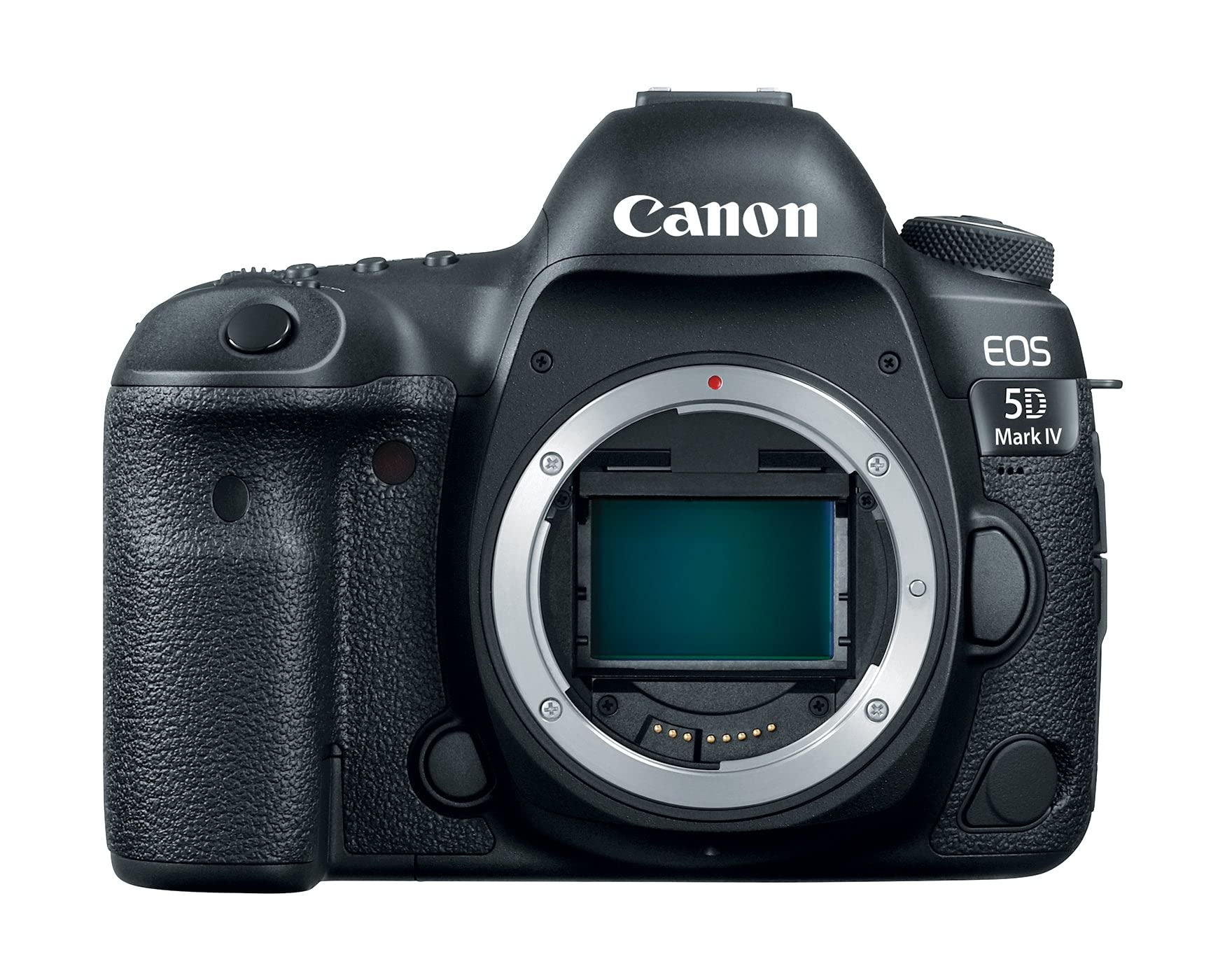
The Canon EOS 5D Mark IV is a professional full-frame DSLR with a 30.4MP CMOS sensor and the DIGIC 6+ processor. This camera is a reliable workhorse for studio and event photography. Its Dual Pixel CMOS AF provides smooth and responsive autofocus during live view and video, and its 61-point AF system delivers fast phase detection through the optical viewfinder. The 7 fps continuous shooting is enough for most portrait and product shoots.
The 4K Motion JPEG video at 30 fps is a bit large in file size and less efficient than modern codecs, but the ability to shoot Full HD at up to 60 fps and HD at 120 fps gives flexibility for creating short clips. The built-in Wi-Fi and NFC allow easy image transfer to a phone for quick client previews. The touchscreen interface simplifies menu navigation and focus point selection. The 5D Mark IV’s build quality is legendary, with extensive weather sealing and a metal chassis that stands up to daily professional use.
The 30.4MP sensor is a balanced resolution for professional use, but it has noticeably less dynamic range than newer 45MP competitors like the Nikon D850. The GPS feature drains battery life if kept active, so it’s easy to accidentally leave this on and shorten your shooting time. The 4K video has a 1.74x crop factor, limiting wide-angle video options. For a professional who wants a time-tested, durable DSLR with excellent color science and ergonomics, the 5D Mark IV is a solid investment.
Why it’s great
- Time-tested professional build quality and reliability.
- Excellent Dual Pixel CMOS AF for live view and video.
- Great ergonomics with intuitive menu and controls.
Good to know
- 4K video has a significant crop factor and uses large Motion JPEG files.
- Dynamic range is not class-leading compared to newer full-frame sensors.
- GPS feature can drain battery quickly if not managed.
5. Sony a7 III

The Sony a7 III is a 24.2MP full-frame mirrorless camera that set a benchmark for value when it was released, and it remains relevant for photoshoots thanks to its 15-stop dynamic range and excellent ISO performance up to 204,800. Its 693 phase-detection and 425 contrast-detection AF points provide fast and reliable autofocus in most lighting conditions. The 10 fps silent or mechanical shutter allows you to capture fast-moving subjects without disturbing the scene.
The 5-axis in-body image stabilization is effective for handheld shots, making it a versatile option for location shoots where a tripod isn’t always practical. Battery life is excellent, allowing for over 2,000 shots per charge, which reduces the need for spare batteries during a long day. The menu system is inherited from Sony’s older generation, which is not the most intuitive but is functional once configured. The dynamic range is particularly impressive, giving you significant latitude for shadow and highlight recovery in post-processing.
The 4K video is oversampled from a 6K readout, producing sharp footage without the heavy crop of some competitors. The 24.2MP sensor is considered a minimum for professional work and may not offer enough resolution for very large commercial prints or aggressive cropping. The single card slot limitation for UHS-II speeds, combined with a slower UHS-I slot, is a concern for backup. For photographers looking for a highly capable full-frame camera that balances features with cost, the a7 III is a very reliable choice.
Why it’s great
- Excellent battery life for long shooting days.
- Impressive 15-stop dynamic range for flexible editing.
- Fast and reliable 693-point phase-detection AF system.
Good to know
- Menu system can be cluttered and slow to learn.
- Only one UHS-II SD card slot; second is UHS-I.
- 24.2MP resolution is a minimum for professional large-format prints.
6. Panasonic LUMIX S5II
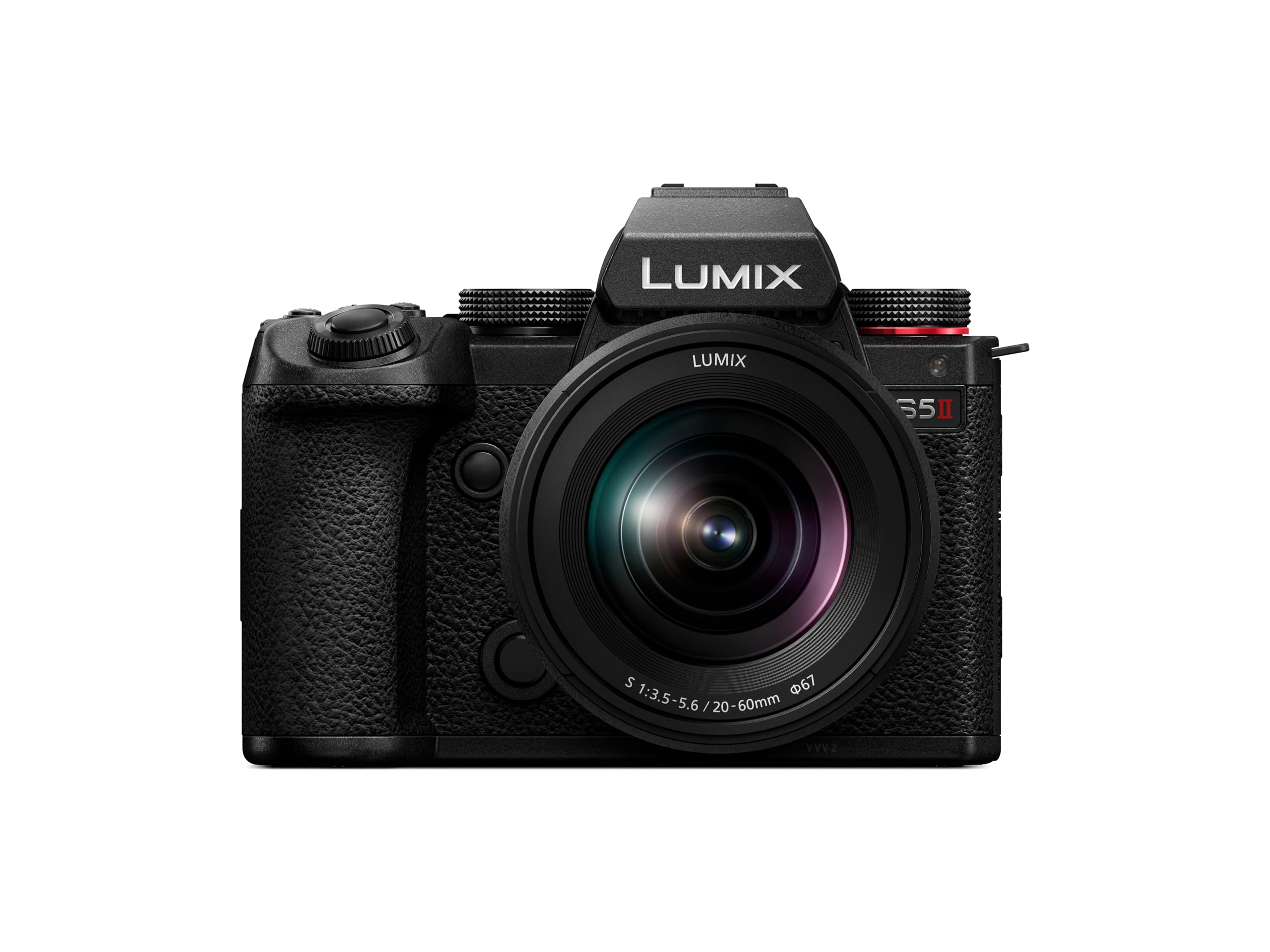
The Panasonic LUMIX S5II introduces a 24.2MP full-frame CMOS sensor with the new Phase Hybrid Autofocus system, a significant upgrade from Panasonic’s previous contrast-only detection. This makes it much more viable for a photoshoot where reliable subject tracking is required. It features 5-axis Active I.S. technology, which is particularly effective for walking shots and handheld video, but also benefits still photographers shooting in unstable conditions.
The unlimited 4:2:2 10-bit 4K 60p video recording, supported by a built-in heat dissipation fan, ensures you never hit recording limits during a shoot. The 14+ stop V-Log/V-Gamut capture provides exceptional dynamic range for color grading, and the REAL TIME LUT feature allows you to apply color profiles in-camera for instant client approvals. The body is well-built with magnesium alloy and weather sealing, and the L-mount system grants access to lenses from Panasonic, Sigma, and Leica.
Battery life is noticeably shorter than some competitors, and the camera lacks a built-in flash, making it reliant on external strobes. The 24.2MP resolution is decent but not high enough for massive commercial prints. Some users report settings not saving properly, requiring a reload after power-off. The S5II offers excellent value for hybrid shooters who prioritize video features and efficient cooling but want a solid still camera for product and portrait work.
Why it’s great
- Phase Hybrid AF is a major improvement for reliable tracking.
- Excellent video features with unlimited 4K 60p 10-bit.
- Strong IBIS and Active I.S. for handheld shots.
Good to know
- Battery life is below average for the category.
- No built-in flash, may need external strobes.
- Some user reports of settings resetting on power-off.
7. Nikon Z 7II

The Nikon Z 7II features a 45.7MP full-frame CMOS sensor with no optical low-pass filter, delivering exceptionally high resolution and 14-bit RAW files. This makes it a prime choice for a photoshoot requiring the utmost detail, like product or fashion photography. The 493 phase-detection AF points cover 90% of the frame, with improved subject detection for people and animals. The 10 fps continuous shooting is useful for capturing fleeting expressions.
The dual card slots accept CFexpress/XQD and UHS-II SD cards, providing flexibility and backup security. The 5-axis in-body image stabilization helps achieve sharp images even at low shutter speeds. The 4K UHD 60p video from the sensor’s full width provides high-quality footage alongside your stills. The Z 7II is also compatible with Nikon’s extensive F-mount lens lineup via an optional FTZ adapter, which is helpful for photographers upgrading from my DSLR system.
Battery life with the Z 7II is moderate; you’ll likely need a spare for a full day of heavy shooting. The file sizes from the 45.7MP sensor are very large, requiring ample storage and a fast computer for editing. The menu system has a learning curve, especially for users new to Nikon. For photographers who demand the highest resolution and are willing to manage large file sizes, the Z 7II is a fantastic mirrorless option built around the excellent Z-mount optics.
Why it’s great
- 45.7MP resolution provides amazing detail and cropping ability.
- Excellent 5-axis IBIS for sharp handheld shots.
- Dual card slots offer secure backup.
Good to know
- Large file sizes demand fast post-processing hardware.
- Battery life can be a limiting factor without spares.
- Native Z-mount lens ecosystem is still growing.
8. Canon EOS RP

The Canon EOS RP is a compact and lightweight full-frame mirrorless camera with a 26.2MP CMOS sensor and RF lens mount. It is the most accessible entry point into Canon’s full-frame system, making it an attractive option for photographers who want the shallow depth of field and wide-angle benefits of a full-frame sensor without the high cost. Its Dual Pixel CMOS AF provides reliable and fast focusing during live view and video.
The included RF 24-105mm F4-7.1 IS STM lens offers a versatile zoom range, and the in-lens optical stabilization provides up to 5 stops of correction. The body is significantly smaller and lighter than traditional DSLRs, making it ideal for travel and location shoots. The vari-angle touchscreen is useful for shooting from creative angles. The EOS RP lacks a built-in EVF of the highest resolution, but it’s functional and clear.
The 4K video has a heavy crop factor and is limited to 30 minutes, which hinders its use for serious video work. The single SD card slot also lacks backup security for professional work. The 26.2MP sensor’s dynamic range is not on par with newer full-frame bodies. The EOS RP is best for hobbyists upgrading from APS-C or as a budget-conscious full-frame body for specific studio tasks where its limitations can be managed.
Why it’s great
- Lightweight and compact full-frame body.
- Budget-friendly entry into the Canon RF system.
- Good Dual Pixel CMOS AF performance.
Good to know
- 4K video has a significant crop and 30-min limit.
- Single SD card slot lacks professional backup.
- Dynamic range is behind newer full-frame competitors.
9. OM SYSTEM Olympus E-M10 Mark IV

The OM SYSTEM E-M10 Mark IV is a compact mirrorless camera featuring a 20MP Live MOS Micro Four Thirds sensor and 5-axis in-body image stabilization rated for 4.5 stops. This IBIS is exceptional for a camera in this class, allowing for 1-second handheld exposures—very useful for low-light product sets or detail shots. The flip-down monitor with dedicated selfie mode makes it convenient for vlog-style content alongside your stills.
The camera is lightweight and compact, and the 14-42mm EZ pancake kit lens makes it one of the smallest interchangeable lens cameras you can buy. It includes 16 Art Filters for creative effects and has good automatic scene modes for beginners. The autofocus uses contrast detection with 121 points, which is fast enough for casual shooting. Its build quality feels sturdy despite its size.
The 20MP resolution is a limit for large commercial prints, especially compared to larger sensors. The Micro Four Thirds sensor has inherently less dynamic range and more noise at higher ISOs than APS-C or full-frame. The kit lens is decent but upgrading to a sharper lens like the OM System 12-45mm f/4 PRO adds bulk. The E-M10 Mark IV is ideal for a travel-ready secondary camera or for a beginning photographer learning the ropes on a compact platform.
Why it’s great
- Extremely compact and lightweight for its performance class.
- Very effective 5-axis IBIS for clear handheld shots.
- Great for beginners with art filters and auto modes.
Good to know
- 20MP resolution is low for professional commercial work.
- Micro Four Thirds sensor has more noise than larger sensors in low light.
- No external charger included; battery charges in-camera via Micro-USB.
10. Panasonic LUMIX G85

The Panasonic LUMIX G85 is a 16MP Micro Four Thirds camera with class-leading Dual Image Stabilization, combining the in-body 5-axis IS with the lens-based Power O.I.S. This system allows for extremely smooth handheld video and sharp stills even at moderate telephoto focal lengths. It is a mirrorless interchangeable lens camera with a robust build, featuring a magnesium alloy front frame and weather sealing for added durability in unpredictable conditions.
The 4K video recording, along with exclusive 4K Photo and Post Focus modes, gives you options to extract high-resolution stills from video or adjust focus after capture. The OLED live viewfinder (2360K dots) is bright and clear, and the 3-inch touchscreen with 1040K dots is responsive. The 12-60mm Power O.I.S. kit lens covers a useful landscape-to-portrait zoom range and is a partner to the excellent in-body stabilization.
The 16MP sensor is low by modern standards and has less dynamic range than APS-C or full-frame cameras. The autofocus is contrast-detection based, which can struggle in very low light with moving subjects. Battery life is also a known weak point. For a videographer or hybrid shooter on a budget who prioritizes stabilization, the G85 remains a very capable system, though its still photography resolution is showing its age.
Why it’s great
- Outstanding Dual I.S. 2 stabilization for smooth shots.
- Weather-sealed, durable build for outdoor use.
- Excellent value for a feature-rich mirrorless system.
Good to know
- 16MP resolution is outdated for modern commercial work.
- Contrast AF can hunt in low-light conditions.
- Battery life is below average.
11. Canon EOS Rebel T7 Bundle
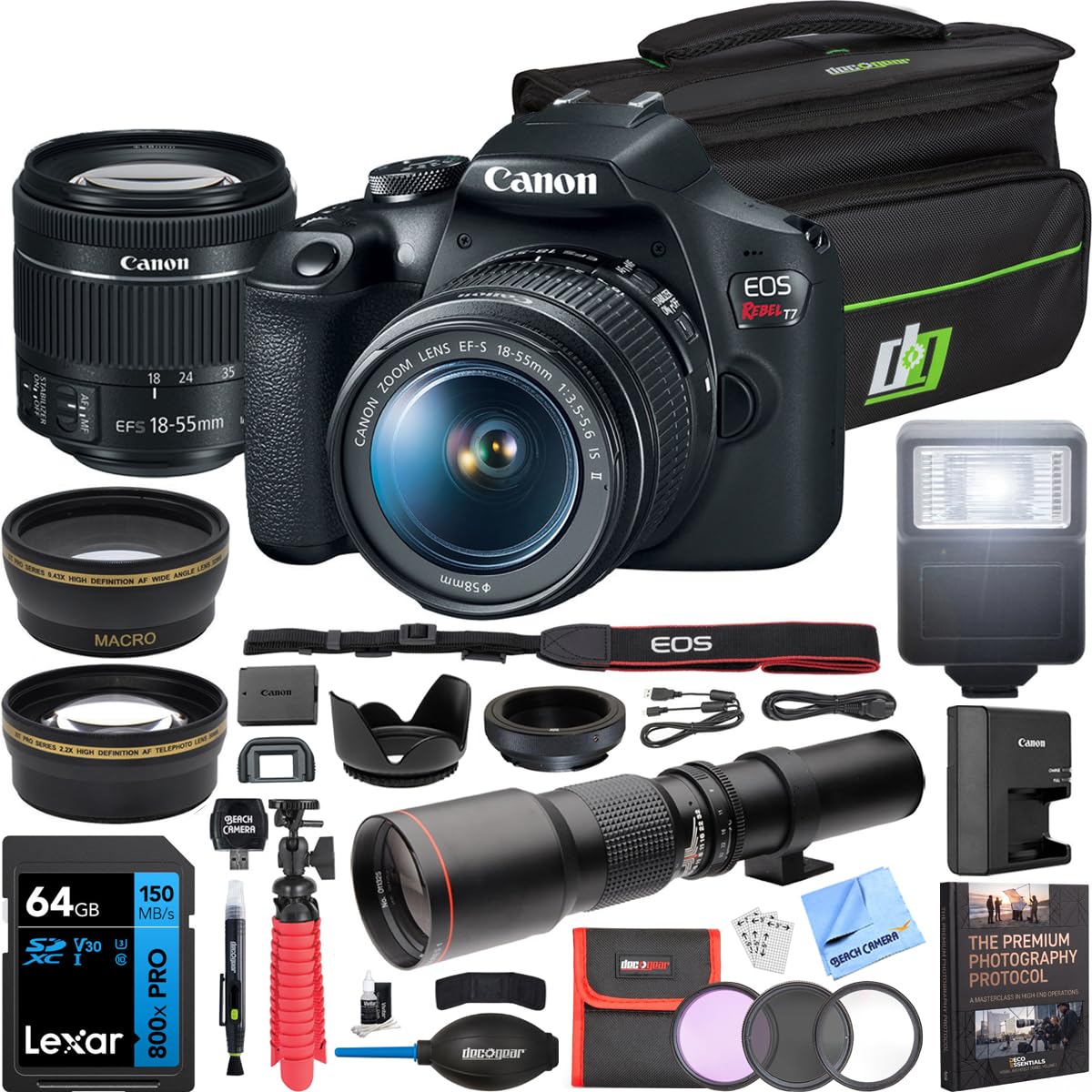
The Canon EOS Rebel T7 is an entry-level DSLR with a 24.1MP APS-C CMOS sensor and the DIGIC 4+ processor. This bundle includes the standard 18-55mm IS II lens plus a 500mm preset telephoto lens, a camera bag, a 64GB memory card, and numerous accessories, providing a complete starter kit for learning photography. The 9-point AF system is basic but sufficient for static subjects and careful composition.
The camera includes built-in Wi-Fi and NFC for quick image transfer to a smartphone, and its Scene Intelligent Auto mode helps beginners capture correct exposures easily. The 3.0-inch LCD with 920K dots is adequate for review. It supports Full HD 1080p video recording. For someone starting a photoshoot journey on a strict budget, the T7 provides a solid platform to learn on a DSLR with a full set of accessories.
The 500mm telephoto lens is a preset, fixed-aperture lens that is not ideal for general use and is limited in quality. The 9-point AF system is quite slow and simple for moving subjects, and the 3 fps continuous shooting is not for action. The APS-C sensor will produce more noise at higher ISOs than larger sensors. Despite its limitations, the T7’s massive bundle gives the absolute beginner everything they need to start practicing a photoshoot workflow without any extra purchases.
Why it’s great
- Very affordable complete bundle with many accessories.
- 24.1MP sensor provides decent resolution for beginners.
- Built-in Wi-Fi simplifies image sharing.
Good to know
- Basic 9-point AF system is slow and limited.
- Bundle accessories, including the 500mm lens, are low quality.
- 3 fps burst is not suitable for action photography.
FAQ
Is it safe to use an electronic shutter during a photoshoot with flash?
How many autofocus points do I really need for portrait photography?
What is a C-AF or continuous autofocus mode used for in a photoshoot?
Final Thoughts: The Verdict
For most users, the camera for photoshoot winner is the Sony Alpha 7 IV because its 33MP sensor offers a near-perfect balance of resolution, file management, and autofocus reliability for building a professional portfolio. If you want a stack of 45 megapixels for high-end commercial prints, grab the Canon EOS R5. And for a durable, DSLR-based workhorse with a bright optical viewfinder, nothing beats the Nikon D850.