
If you are tired of the two-stroke ritual—measuring oil, shaking the gas can, and hoping you got the ratio right—the gas chainsaw market has finally listened. A dedicated 4-stroke powerhead eliminates pre-mix entirely, letting you pour straight gasoline from the pump into the tank. That single change removes the most common cause of engine bogging, fouled plugs, and premature wear, while delivering a broader torque curve that keeps the chain spinning through dense hardwood without stalling.
I’m Min — the co-founder and writer behind Gadgets Feed. For this guide, I analyzed over 150 verified buyer reports across nine gas-powered models, cross-referencing displacement figures, startup reliability data, and vibration-reduction specs to separate genuine 4-cycle engineering from marketing language.
Whether you are clearing storm debris or felling firewood for the winter, choosing the right 4 stroke chainsaw means balancing displacement, bar length, and starting consistency against your specific cutting volume.
How To Choose The Best 4 Stroke Chainsaw
The single biggest difference between a standard two-stroke saw and a true 4-cycle model is the lubrication system. A 4-stroke chainsaw uses a separate oil sump to lubricate the engine, meaning you pour straight, unblended gasoline into the tank. This reduces the risk of a lean mixture damaging the piston and makes the saw more forgiving if it sits for weeks between uses. Beyond that, you need to match displacement and bar length to your workload—light pruning needs less iron than felling oak.
Displacement, Bar Length & The Torque Question
Engine displacement (measured in cubic centimeters, or cc) directly correlates to torque. A 30cc to 40cc saw with a 14- to 16-inch bar handles limbing and light firewood splitting. A 49cc to 60cc powerhead paired with an 18- to 20-inch bar manages larger logs and occasional felling. True 4-cycle engines produce peak torque at lower RPMs than their two-stroke counterparts, which keeps the chain from stalling when you lean into a cut. If you hear the revs drop dramatically under load, the saw is underpowered for the bar length.
Starting Systems & Vibration Control
Four-stroke engines require a different starting technique—you typically do not need to hold the throttle open while pulling. Look for models with a dedicated choke lever and a stop switch that auto-resets when you pull the choke. Also check for rubber or spring dampeners between the engine and handle assembly. Prolonged use without vibration reduction causes hand fatigue and numbness. Automatic oilers with adjustable flow rates are a must for keeping the chain lubricated without constant manual intervention.
Weight, Balance & Real-World Usability
Four-stroke engines are heavier than equivalent two-strokes because they carry a crankcase filled with oil. A 49cc 4-cycle saw can weigh 15 to 17 pounds, while a comparable two-stroke might be 11 to 13 pounds. Weight distribution matters more than raw mass—a well-balanced saw with the center of gravity close to the front handle feels lighter than a poorly balanced lighter unit. If you are cutting for more than two hours at a stretch, prioritize LowVib technology and ergonomic handle designs over raw power figures.
Quick Comparison
On smaller screens, swipe sideways to see the full table.
| Model | Category | Best For | Key Spec | Amazon |
|---|---|---|---|---|
| SENIX 49cc 18-Inch | 4-Cycle | All-around no-mix cutting | 49cc displacement, 18″ bar | Amazon |
| Dewalt 20V 8-Inch Pruning | Battery | Quick limbing and light pruning | 20V battery, 8″ bar | Amazon |
| PROYAMA 68cc 24-Inch | 2-Cycle | High-volume firewood and large logs | 68cc engine, 24″ bar | Amazon |
| Husqvarna 120 Mark III | 2-Cycle | Homeowner limbing and small trees | 38cc, 14″ bar, LowVib | Amazon |
| Echo CS-310-16 | 2-Cycle | Reliable light-to-moderate cutting | 30.5cc, 16″ bar | Amazon |
| Echo CS-3510-16 | 2-Cycle | Limbing with pro-level reliability | 34.4cc, 16″ bar, i-30 starter | Amazon |
| Echo CS-590-20AA | 2-Cycle | Firewood prosumer felling | 59.8cc, 20″ bar | Amazon |
| Husqvarna 450 Rancher | 2-Cycle | 20-inch prosumer all-rounder | 50.2cc, 3.2 HP, LowVib | Amazon |
| Husqvarna 460 Rancher | 2-Cycle | Heavy land-clearing and 24″ logs | 60.3cc, 3.6 HP, 24″ bar | Amazon |
In‑Depth Reviews
1. SENIX 4-Cycle 18-Inch Gas Chainsaw
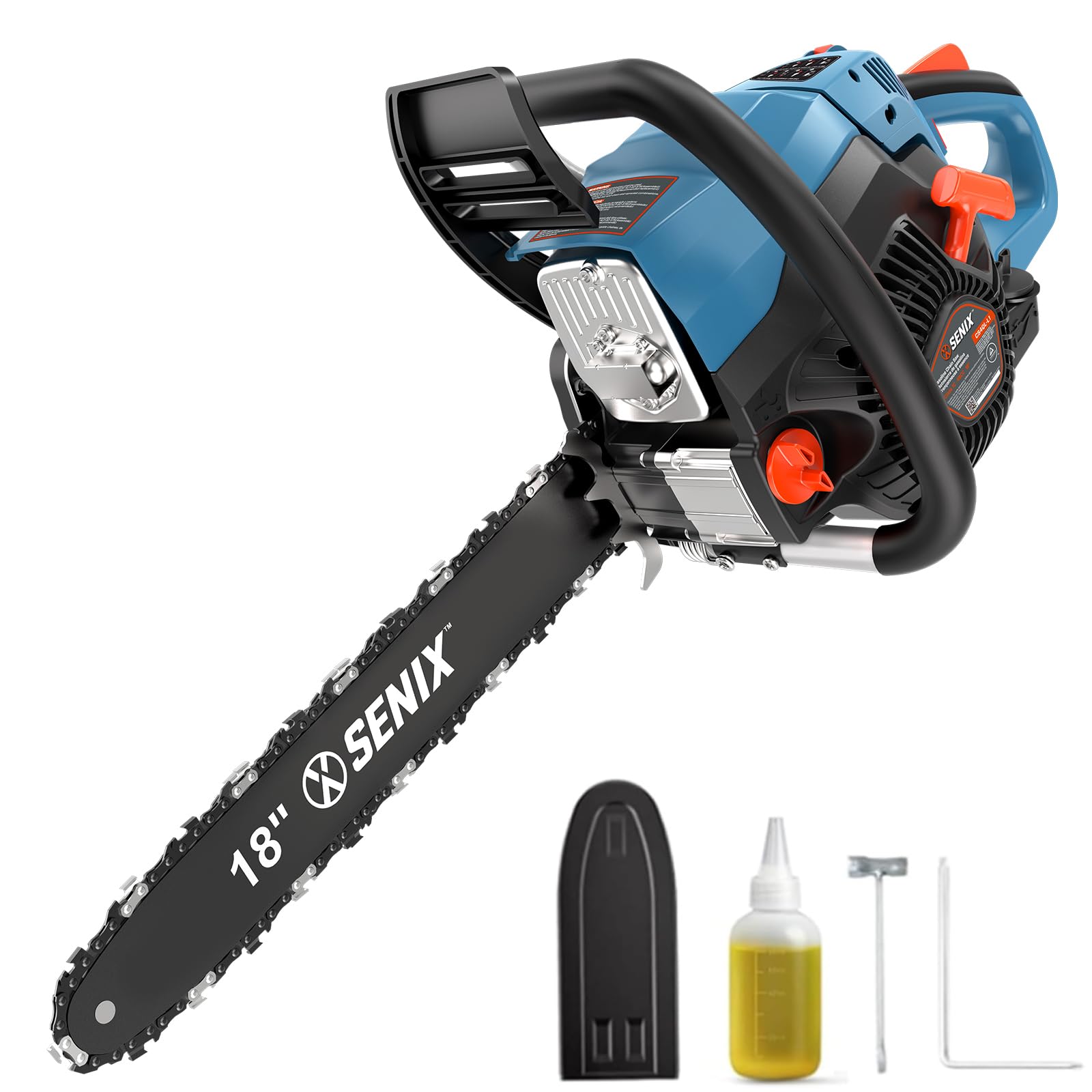
The SENIX CS4QL-L1 is the only true 4-cycle saw in this lineup, and it earns the top spot by solving the two biggest pain points of gas chainsaws: fuel mixing and cold-start frustration. Its 49cc engine uses separate oil and gas chambers, so you pour straight pump gas in one cap and engine oil in another. Verified buyers report that it starts easily on the first or second pull when cold and restarts immediately when warm, a reliability edge over many two-stroke saws in this price tier.
Buyers consistently note the broad power curve—it does not bog down when you lean into an 18-inch oak limb the way a smaller two-stroke might. At 16 pounds, it is heavier than a typical 40cc two-stroke, but the weight is well-distributed. One user reported cutting logs up to 22 inches in diameter without the chain stalling, and another highlighted that the automatic oiler delivers consistent lubrication without needing manual adjustment. The 18-inch bar and Oregon-compatible chain make replacement parts easy to source.
There is one durability concern to flag: a single buyer reported the clutch housing melted after about five months of use, and the saw became inoperable until the housing was replaced. That issue appears isolated, but it is worth noting that the SENIX uses a plastic clutch cover rather than a magnesium one. For homeowners cutting a few cords of firewood per season, the no-mix convenience and smooth torque delivery make this the most practical 4-cycle option available.
Why it’s great
- Genuine 4-cycle engine eliminates all fuel mixing
- Broad torque curve resists stalling under heavy load
- Easy cold-start with consistent warm restart
Good to know
- Heavier than comparable two-stroke saws
- Plastic clutch housing may fail under heavy continuous use
2. Dewalt 20V 8-Inch Pruning Chainsaw DCCS623B

While not a gas 4-stroke, the Dewalt DCCS623B deserves a place in this guide for any buyer who needs a lightweight limbing tool alongside a primary gas saw. Its 8-inch bar and 20V powerhead weigh under five pounds, making it safe for one-handed overhead cuts on branches up to 7 inches in diameter. Verified buyers consistently call it a “game-changer” for clearing saplings and low limbs, especially users who find full-size gas saws intimidating or fatiguing.
The tool-only format means you need a Dewalt 20V battery, but existing users of the platform will appreciate seamless compatibility. Owner reports note that an Oregon R34 replacement chain improves cut speed noticeably over the stock chain, and that using biodegradable bar oil reduces mess. Battery life varies: one user reported clearing a full weekend of underbrush on a single 5Ah charge, while another noted that continuous cutting on 4-inch branches drains a 2Ah pack in about 20 minutes.
The primary limitation is chain speed—at roughly 6 m/s, the Dewalt cuts slower than a gas saw and can jam on smaller flexible branches that deflect instead of being severed. It also lacks an automatic oiler, requiring you to manually lubricate the bar before each use. For buyers who already own Dewalt batteries and want a grab-and-go pruning tool that complements a larger 4-stroke, this is the lightest option available.
Why it’s great
- Extremely lightweight and maneuverable for one-handed use
- Works with existing Dewalt 20V battery platform
- Quiet enough for suburban use without hearing protection
Good to know
- Manual oiler requires attention before each cutting session
- Slow chain speed can jam on small, flexible branches
3. PROYAMA 68cc 24-Inch 2-Cycle Chainsaw

The PROYAMA 68cc delivers raw displacement that rivals pro-class saws from Stihl and Echo, but at a fraction of the price. Verified owners report that it easily handles 24-inch hardwood logs and even 40-inch pine trunks after break-in. The engine measures 62cc in practice—slightly less than advertised—but still produces enough torque to pull a 24-inch bar through dense oak without significant RPM drop. One user processed an entire 40-inch pine tree in a single day using 8 to 10 tanks of fuel.
Assembly requires attention: several buyers recommend applying thread-locker to the spike dogs and replacing the factory bar nuts with nylon lock nuts. The carburetor ships tuned rich from the factory; owners who adjusted the low and high-speed needles reported noticeably stronger mid-range power. Vibration levels are higher than premium brands like Husqvarna, but the anti-vibration spring system keeps it manageable for sessions lasting 30 to 60 minutes.
Reliability is the trade-off. Multiple long-term reviews report the saw becoming difficult to start after several months of use, with one owner reporting that it fails to start 99% of the time after a year. The plastic handle and case design feel less durable than metal-bodied competitors. For a buyer who needs a 24-inch bar on a tight budget and is comfortable performing minor carburetor tuning, the PROYAMA offers exceptional cutting power per dollar spent.
Why it’s great
- Massive 68cc displacement with 24-inch cutting capacity
- Carburetor tuning unlocks even stronger performance
- Exceptional value for large-log homeowners
Good to know
- Higher vibration than name-brand competitors
- Reliability drops significantly after 6-12 months for some units
4. Husqvarna 120 Mark III 38cc 14-Inch Chainsaw

The Husqvarna 120 Mark III is the lightest gas saw in this lineup at 10.7 pounds, making it an excellent choice for homeowners who need a limbing tool that does not exhaust them before the job is done. The 38cc X-Torq engine produces 1.88 HP, which is modest on paper but feels punchy through the 14-inch bar thanks to efficient combustion. Verified buyers frequently mention that it starts on the first or second pull both cold and warm, a testament to Husqvarna’s Smart Start system.
LowVib technology uses rubber dampeners between the engine and chassis, and owners consistently note that hand fatigue is dramatically lower compared to cheaper saws. The automatic oiler delivers consistent bar lubrication, and the separate choke and stop-switch controls prevent accidental flooding—a common issue with budget saws that combine both functions. A few users reported that the saw stalls when the tank is nearly empty and the bar is held parallel to the ground, but this is typical for gravity-fed carbureted engines.
The 14-inch bar limits log diameter to roughly 12 inches, so this saw is not suitable for felling mature trees or splitting large firewood rounds. Replacement chains and bars are widely available, and the inertia-activated chain brake adds a layer of safety for inexperienced operators. For a dedicated limbing saw that starts reliably season after season, the 120 Mark III justifies its mid-range price with consistent build quality.
Why it’s great
- Very lightweight and well-balanced for prolonged limbing
- LowVib dampeners significantly reduce hand fatigue
- Easy cold start with auto-reset choke
Good to know
- 14-inch bar limits cuts to approximately 12-inch logs
- May stall when operating with low fuel at horizontal angles
5. Echo CS-310-16 30.5cc 16-Inch Chainsaw

The Echo CS-310-16 is a familiar sight among suburban homeowners because it occupies a reliable sweet spot: enough displacement to pull a 16-inch bar, yet light enough at 8.8 pounds to carry on extended yard cleanup. The 30.5cc engine requires premix fuel, but the starting ritual is predictable—two pulls with the choke on, then a third pull to start, with warm restarts typically happening on the first pull. A verified owner reported cutting 13-inch logs repeatedly without the saw bogging down.
The build quality has changed over the years. Several users who owned earlier CS-310 models noted that newer units feel less solid, with more plastic components and a rougher idle out of the box. One buyer described the replacement as “a weak knock-off” of the original. That said, the saw remains functional for light-to-moderate cutting, and the 16-inch bar is versatile enough for most homeowner tasks. Echo recommends using ethanol-free fuel; owners who follow this guidance report fewer carburetor issues.
The biggest complaint is difficulty restarting after the saw sits idle for more than 30 days. Multiple reviews report that it runs perfectly when used regularly but becomes hard to start after a month of storage, even with stabilized fuel. Replacing the spark plug can temporarily mask the issue. For occasional users who cut once a month or less, this may require more maintenance attention than a 4-cycle alternative like the SENIX.
Why it’s great
- Very lightweight at 8.8 pounds with a versatile 16-inch bar
- Predictable starting routine when used regularly
- Good power-to-weight ratio for limbing and small logs
Good to know
- Difficult to restart after extended storage periods
- Newer units feel less solid than earlier production runs
6. Echo CS-3510-16 Commercial 34.4cc Chainsaw
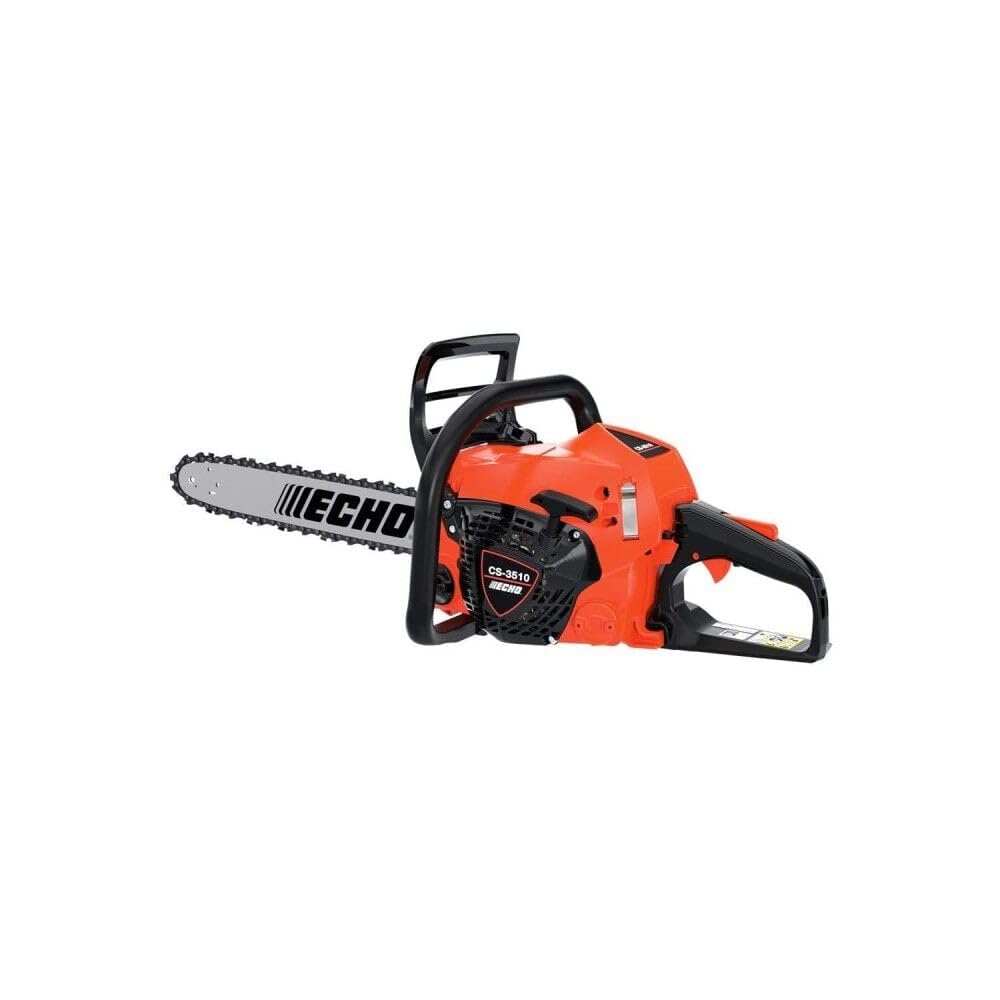
The Echo CS-3510-16 sits at the boundary between pro-grade and consumer-grade, offering a 34.4cc engine with Echo’s i-30 starter that reduces pull effort by 30 percent. This makes a noticeable difference for users who cut multiple days per week—the lower starting resistance reduces arm fatigue over the course of a season. The 16-inch bar is ideal for limbing, and the three-point spring vibration reduction system keeps the handlebar smooth even during extended cutting sessions.
Verified buyers with decades of chainsaw experience praise the saw’s balance and power relative to its weight. One reviewer who has used chainsaws for over 50 years called it “lightweight for limbing” and noted that it starts easily and pulls through cuts without hesitation. The Air Injection system diverts dust away from the air filter, which reduces maintenance frequency in dirty cutting conditions. Owners report that the saw runs cleanly on standard ethanol fuel mixes and does not require constant carburetor adjustment.
The durability concerns center on the plastic components. The air filter cover uses flimsy clips that can break if the saw is dropped, and the overall construction feels less rugged than the magnesium-chassis Echo models from a decade ago. One professional user noted that the saw would likely crack if dropped from waist height onto concrete. For arborists and landowners who prioritize low weight and easy starting over impact resistance, the CS-3510 delivers pro-level ergonomics at a consumer-friendly price.
Why it’s great
- i-30 starter reduces pull effort by 30% for less arm fatigue
- Three-point vibration reduction keeps handles smooth during long cuts
- Air Injection system reduces air filter cleaning frequency
Good to know
- Plastic clips on air filter cover are fragile
- Chassis may crack if dropped from height
7. Echo CS-590-20AA 59.8cc 20-Inch Chainsaw

The Echo CS-590 is widely considered the benchmark prosumer saw for firewood production. Its 59.8cc engine produces enough torque to pull a 20-inch bar through hardwood without the RPM sag seen on smaller saws, and the weight remains manageable at roughly 13 pounds. Verified owners report cutting full truckloads of firewood on a single tank of fuel, with fuel economy that beats older two-stroke models from Husqvarna and Stihl.
Build quality receives consistent praise. Multiple buyers who own both Echo and Stihl saws note that the CS-590 feels more solid than similarly priced competitors, with better vibration damping and a more consistent idle out of the box. One buyer called it “the best bang for your buck” for homeowners who fell a few trees per year but do not want to pay commercial prices. The saw stars on the first or second pull after a few priming pumps, and the choke control is intuitive even for novice operators.
The biggest risk is the third-party seller lottery on Amazon. Several users received saws in opened packaging with missing components, and Echo’s warranty support was described as unhelpful for those units. If you buy from an authorized Echo dealer, the saw is backed by Echo’s 5-year homeowner warranty. The 20-inch bar is ideal for logs up to 18 inches in diameter; for larger timber, consider stepping up to the Husqvarna 460 Rancher. For the price, the CS-590 offers pro-level power without the premium markup.
Why it’s great
- 59.8cc engine pulls a 20-inch bar through hardwood without bogging
- Excellent fuel economy for its displacement class
- 5-year homeowner warranty from Echo (authorized dealers only)
Good to know
- Third-party sellers on Amazon may ship incomplete units
- Heavier than smaller Echo models at approximately 13 pounds
8. Husqvarna 450 Rancher 50.2cc 20-Inch Chainsaw

The Husqvarna 450 Rancher occupies the middle ground between homeowner and pro-grade, with a 50.2cc X-Torq engine producing 3.2 HP through a 20-inch bar. The Smart Start system reduces the effort required to pull the starter cord, and the LowVib handle design makes this saw noticeably more comfortable during extended use than cheaper alternatives. Verified owners describe it as “extremely powerful” and report that it slices through thick trees without the saw bogging down.
The Air Injection system is a genuine advantage in dirty cutting conditions—it centrifugally ejects dust before it reaches the filter, reducing maintenance intervals. The combined choke and stop-switch control simplifies starting: pulling the choke automatically sets the stop switch to run, preventing accidental flooding. One owner noted that the saw is well-balanced enough that it does not feel as heavy as its 11.33 pounds suggest, and the ergonomic trigger and asymmetrical handle reduce wrist strain during angled cuts.
There are two common quality-control issues reported. Several buyers found the spark plug over-torqued from the factory, requiring a re-gap to 0.020 inches for proper starting. A smaller number reported the chain oil pump output being too low, with aftermarket replacement pumps resolving the issue. The saw uses a non-standard chain pitch (0.325 inch instead of the common 3/8 inch), so replacement chains must be specifically ordered rather than grabbed off a shelf. For buyers who want a premium feel without paying commercial prices, the 450 Rancher is a proven platform.
Why it’s great
- Smart Start and LowVib reduce fatigue during long cutting sessions
- Air Injection keeps the filter clean in dusty conditions
- Well-balanced design despite 11.33-pound weight
Good to know
- Factory spark plug often over-torqued, requiring re-gap
- Uses non-standard 0.325-inch pitch chain
9. Husqvarna 460 Rancher 60.3cc 24-Inch Chainsaw

The Husqvarna 460 Rancher is the most powerful saw in this lineup, with a 60.3cc X-Torq engine that produces 3.6 HP through a 24-inch bar. This is the saw you reach for when you need to process six cords of firewood in a weekend or drop trees over 30 inches in diameter. Verified owners consistently describe it as “a workhorse” that processes hundreds of tanks of fuel without major failure. One user swapped the 24-inch bar for a 28-inch bar and reported that the engine had no trouble pulling the extra length.
The Smart Start system and combined choke/stop control make starting predictable even for one operator. The LowVib handle system and 7-degree offset front handle reduce vibration transmission to the hands, which matters when you are running the saw for hours at a time. The adjustable automatic oil pump lets you fine-tune bar lubrication based on wood hardness and bar length, a feature missing from most homeowner-grade saws. Owners report that the saw is smooth and responsive, with none of the vibration numbness associated with cheaper high-displacement models.
The trade-off is weight and bar length. At 13.2 pounds, this is the heaviest saw in the guide, and the 24-inch bar makes it unwieldy for limbing or one-handed cuts. The recommended bar range is 13 to 24 inches, but several owners suggest dropping to a 20-inch bar for daily use and keeping the 24-inch bar for felling. Replacement parts are widely available, and Husqvarna offers a 2-year warranty. For landowners who need real felling power and are comfortable handling a heavier saw, the 460 Rancher delivers commercial-class performance without the commercial price.
Why it’s great
- 60.3cc engine with 3.6 HP handles logs over 30 inches in diameter
- Adjustable automatic oil pump allows precise bar lubrication
- LowVib and offset handle reduce fatigue during all-day cutting
Good to know
- Heaviest saw in the lineup at 13.2 pounds
- 24-inch bar is overkill for limbing; a 20-inch bar is more practical for daily use
FAQ
Can I use regular pump gas in a 4 stroke chainsaw?
Why are 4 stroke chainsaws heavier than 2 stroke models?
Is a 49cc 4 stroke chainsaw powerful enough for felling trees?
Final Thoughts: The Verdict
For most users, the 4 stroke chainsaw winner is the SENIX 49cc 18-Inch because it delivers genuine no-mix convenience with a broad torque curve that handles firewood and storm cleanup without stalling. If you need higher cutting capacity for felling large trees, grab the Echo CS-590-20AA for its reliable 59.8cc engine and proven prosumer durability. And for pure lightweight limbing convenience, nothing beats the Dewalt 20V 8-Inch Pruning Saw as a companion to a gas primary saw.