
A dead battery miles from the dock isn’t just an inconvenience—it’s a safety hazard that ends your day on the water prematurely. Choosing the right marine power source means understanding the difference between a starting battery that fires your engine and a deep-cycle battery that runs your trolling motor, fish finder, and livewells all day long. The wrong choice leaves you stranded with a depleted bank and a motor that won’t turn over.
I’m Min — the co-founder and writer behind Gadgets Feed. I’ve spent hundreds of hours researching battery chemistries, analyzing cold cranking amp ratings, and comparing real-world cycle life data from lithium iron phosphate and AGM manufacturers to build this guide.
After evaluating 9 top contenders across price tiers and chemistries, I’ve identified the best battery for a boat for every type of boater, from kayak anglers to offshore cruisers.
How To Choose The Best Battery For A Boat
Selecting a marine battery isn’t about grabbing the heaviest box on the shelf. You need to match the chemistry, capacity, and physical size to your boat’s electrical demands and the space you have available. Prioritize your primary use case—trolling motor runtime, engine starting, or house power—before looking at any other spec.
Chemistry: LiFePO4 vs AGM vs Flooded Lead-Acid
Lithium iron phosphate (LiFePO4) batteries weigh about 60% less than equivalent AGM batteries, deliver 4,000 to 15,000 deep cycles, and maintain steady voltage until they are nearly depleted. AGM batteries are sealed, vibration-resistant, and cost less upfront, but they typically last 200 to 500 cycles and lose capacity faster under heavy discharge. Flooded lead-acid batteries are the cheapest option but require regular maintenance, venting for hydrogen gas, and have the shortest service life.
Capacity and Cold Cranking Amps
Amp-hours (Ah) determine how long your battery can run your trolling motor or accessories before needing a recharge—a 100Ah battery running a 30-amp trolling motor at full speed gives you just over three hours of runtime. Cold Cranking Amps (CCA) measures the battery’s ability to start an outboard or inboard engine in cold weather; if you need a starting battery, look for at least 800 CCA for a standard V6 outboard. Dual-purpose batteries offer a compromise, but they rarely excel at either task compared to dedicated starting or deep-cycle units.
Group Size and Terminal Configuration
Marine battery group sizes (24, 27, 31, 34M) define the physical footprint and terminal placement. Measure your existing battery tray before purchasing—a Group 31 battery measures roughly 13 x 6.8 x 9.4 inches and won’t fit in a tray designed for a smaller Group 24. Marine terminals accept both SAE posts for accessories and 5/16-inch studs for high-current connections like trolling motor plugs, so confirm your cable ends match the terminal type.
Quick Comparison
On smaller screens, swipe sideways to see the full table.
| Model | Category | Best For | Key Spec | Amazon |
|---|---|---|---|---|
| Power Queen 12V 100Ah | Lithium | Best Overall Trolling Motor | 15,000 cycles | Amazon |
| Litime 12V 100Ah TM | Lithium | Marine-Specific Design | TVS spike protection | Amazon |
| Dyness 12V 100Ah | Lithium | Cold Weather Boating | Low-temp charge cutoff | Amazon |
| DUMFUME 12V 150Ah | Lithium | High Capacity for Long Days | 1920Wh energy | Amazon |
| GOLDENMATE 12V 20Ah (2-Pack) | Lithium | Kayak & Fish Finder | IP67 waterproof | Amazon |
| WEIZE 12V 100Ah AGM | AGM | Budget Backup Power | 100Ah lead-acid | Amazon |
| Newport 12V 50Ah AGM | AGM | Lightweight Entry-Level | 32 lbs | Amazon |
| Optima D31M BLUETOP | AGM | Dual Purpose Premium | SpiralCell technology | Amazon |
| Interstate 34M-AGM | AGM | Trusted Brand Cranking | 800 CCA | Amazon |
In‑Depth Reviews
1. Power Queen 12V 100Ah LiFePO4
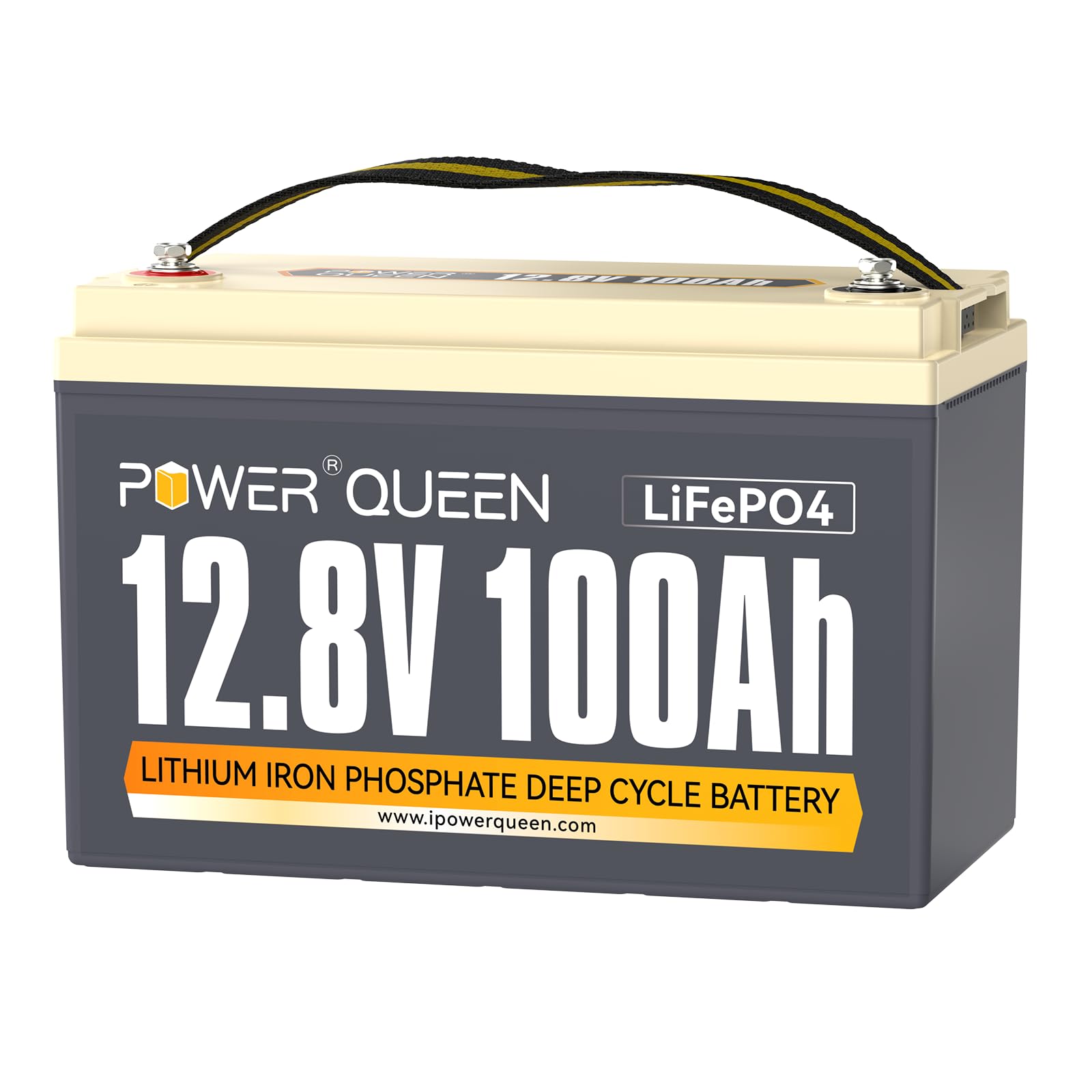
The Power Queen 12V 100Ah LiFePO4 represents the sweet spot of marine lithium technology, delivering 1,280Wh of usable energy in a Group 31 case that weighs just 24 pounds. Users report running a trolling motor, LiveScope, and dual Garmin graphs from 6 AM to 6 PM with voltage dropping only from 13.2V to 13.1V, then repeating that performance for three full days on a single charge. The Grade-A LiFePO4 cells and 100A BMS handle the vibration and moisture of a saltwater fishing boat without issue.
The 15,000-cycle rating means this battery will outlast your current boat and likely your next one—a stark contrast to AGM batteries that degrade after 200 to 500 cycles. Multiple verified reviews confirm it powers a 36V trolling motor system for two weeks of daily use by teenagers before needing a recharge, and the 100Ah capacity tests at 102 Ah from a full charge. The 5-year warranty adds security, and the battery’s ability to connect in 4S4P configurations allows scaling up to 20.48kWh for larger vessels.
One concern is the M8 terminal bolts can cross-thread if over-torqued, so using an adapter kit with a torque wrench is recommended. The battery lacks low-temperature charging protection, which means you cannot charge it below freezing without risking permanent damage—a common limitation across most LiFePO4 batteries. For boaters running a 30 to 70-pound thrust trolling motor who want the lightest weight and longest cycle life, this is the benchmark to beat.
Why it’s great
- Weighs only 24 lbs—about 60% less than AGM equivalents
- 15,000-cycle lifespan eliminates frequent replacements
- Delivers consistent 13.2V output until fully depleted
Good to know
- No low-temperature charging cutoff protection
- M8 terminal bolts prone to cross-threading
- Requires a LiFePO4-compatible charger
2. Litime 12V 100Ah Trolling Motor LiFePO4

The Litime 12V 100Ah TM is engineered specifically for marine applications, meeting the ABYC E-13 standard with triple protection against dust, water, and salt spray. Its built-in TVS (Transient Voltage Suppression) technology shields 12V to 36V trolling motors from voltage spikes that can damage electronics when the motor is engaged or disengaged in rough water. One reviewer pushed a 36V brushed Minnkota Ultrex for five hours and only used 10% of capacity, with the reduced 22.16-pound weight (compared to a 60-pound lead-acid) improving hole shot and adding 4 mph to top speed.
The smart low-temperature charging protection stops charging below 32°F and discharging below -4°F, a critical feature for boaters who store their vessels in unheated garages or launch in early spring conditions. The battery delivers 4,000+ cycles at 100% depth of discharge, translating to a 10-year service life that outpaces AGM batteries by a factor of three. Running a 45-pound thrust trolling motor for eight hours on a jon boat left the battery nearly fully charged, and the ability to expand to 4P4S (20.48kWh) makes it viable for larger systems.
The battery arrives in a “sleep” state from storage and requires a wake-up charge—the manual and charger compatibility details could be clearer. Some users needed to use a Noco charger’s force mode to revive the battery, which adds a step for first-time lithium buyers. The 5-year warranty and responsive customer service offset this minor onboarding friction, making it a top choice for dedicated trolling motor users who want marine-grade protection and peak performance.
Why it’s great
- TVS protection prevents voltage spike damage to brushless motors
- Low-temp charge cutoff protects battery in cold storage
- 64% lighter than equivalent AGM batteries
Good to know
- Battery arrives in sleep mode needing a force charge
- Flat voltage curve can mislead—12.8V at rest means near depletion
- Higher upfront investment than AGM alternatives
3. Dyness 12V 100Ah LiFePO4
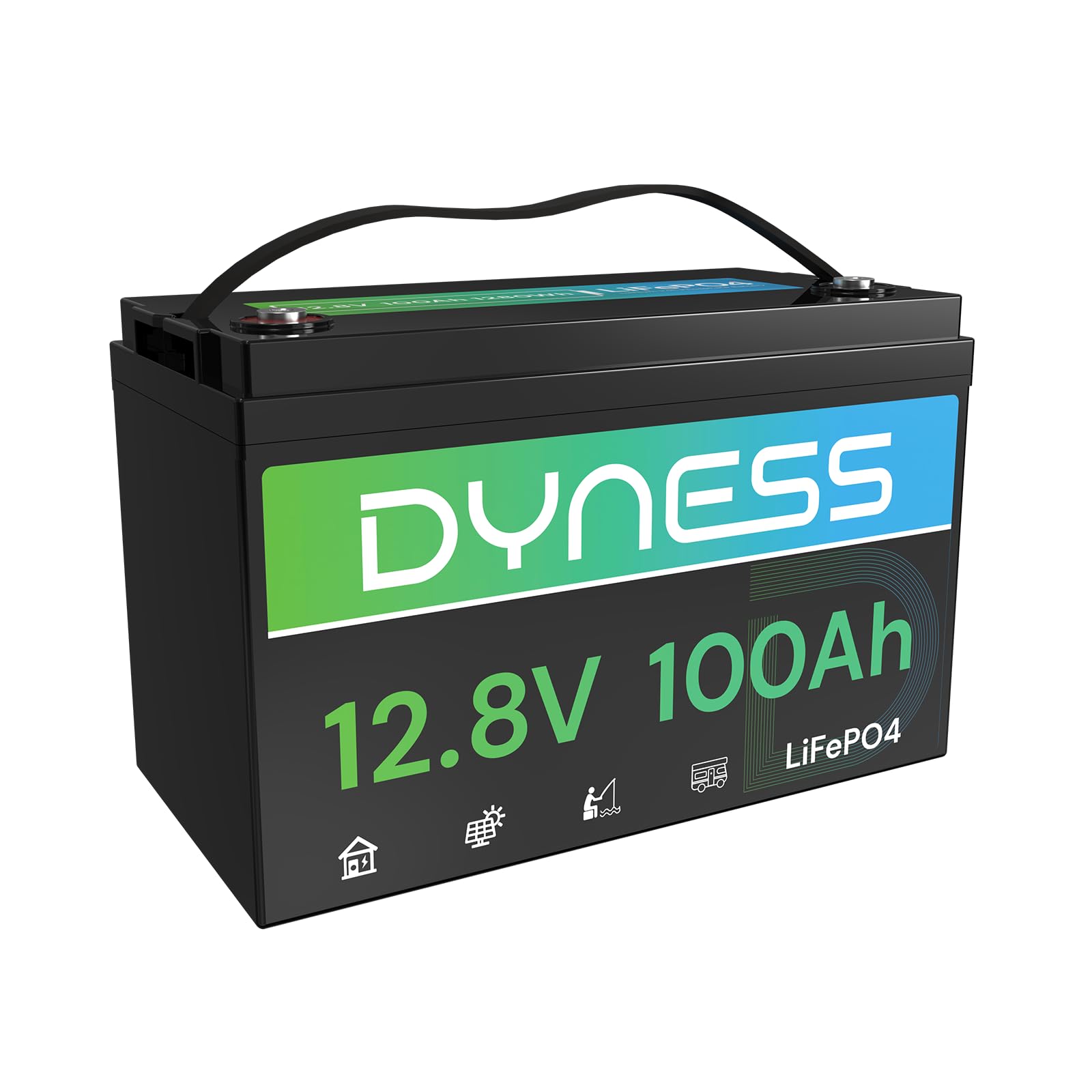
The Dyness 12V 100Ah LiFePO4 stands out for its comprehensive environmental sealing, combining IP65 water resistance, dust protection, and salt spray resistance in a standard Group 31 footprint. The low-temperature charging protection is particularly robust—it automatically disconnects charging below 32°F (0°C), resumes at 41°F (5°C), and cuts off discharge at -4°F (-20°C) to prevent cell damage. The A+ grade lithium cells are individually tested with traceable production parameters, a level of quality control rarely seen at this price point.
At 25.3 pounds, the Dyness is slightly heavier than some lithium competitors but still 60% lighter than a 63-pound AGM battery of similar capacity. The built-in 100A BMS covers overcharge, over-discharge, overcurrent, overheating, and short circuit protection, and the battery can expand to 4P4S configurations for up to 20.48kWh of total energy storage. Verified buyers praise the double-layer packaging and clear manual, noting the battery powers winches and accessories on boats without voltage sag.
The 10-year lifespan projection depends on proper charging habits—using a non-LiFePO4 charger or charging below freezing voids the low-temp protection’s effectiveness. The battery’s 100Ah capacity is adequate for weekend runs with a trolling motor and electronics, but heavy users running multiple sonar units and a livewell pump may find it tight for multi-day trips without solar recharging. For boaters who face freezing conditions and want a lithium battery that won’t self-destruct in cold weather, the Dyness delivers exactly that.
Why it’s great
- IP65 and salt spray resistance for harsh marine environments
- Intelligent low-temp charge/discharge cutoff down to -4°F
- A+ grade cells with traceable production data
Good to know
- 25.3 lbs is heavier than some LiFePO4 alternatives
- 100Ah capacity limits multi-day use without solar charging
- Requires specific LiFePO4 charger for optimal performance
4. DUMFUME 12V 150Ah LiFePO4
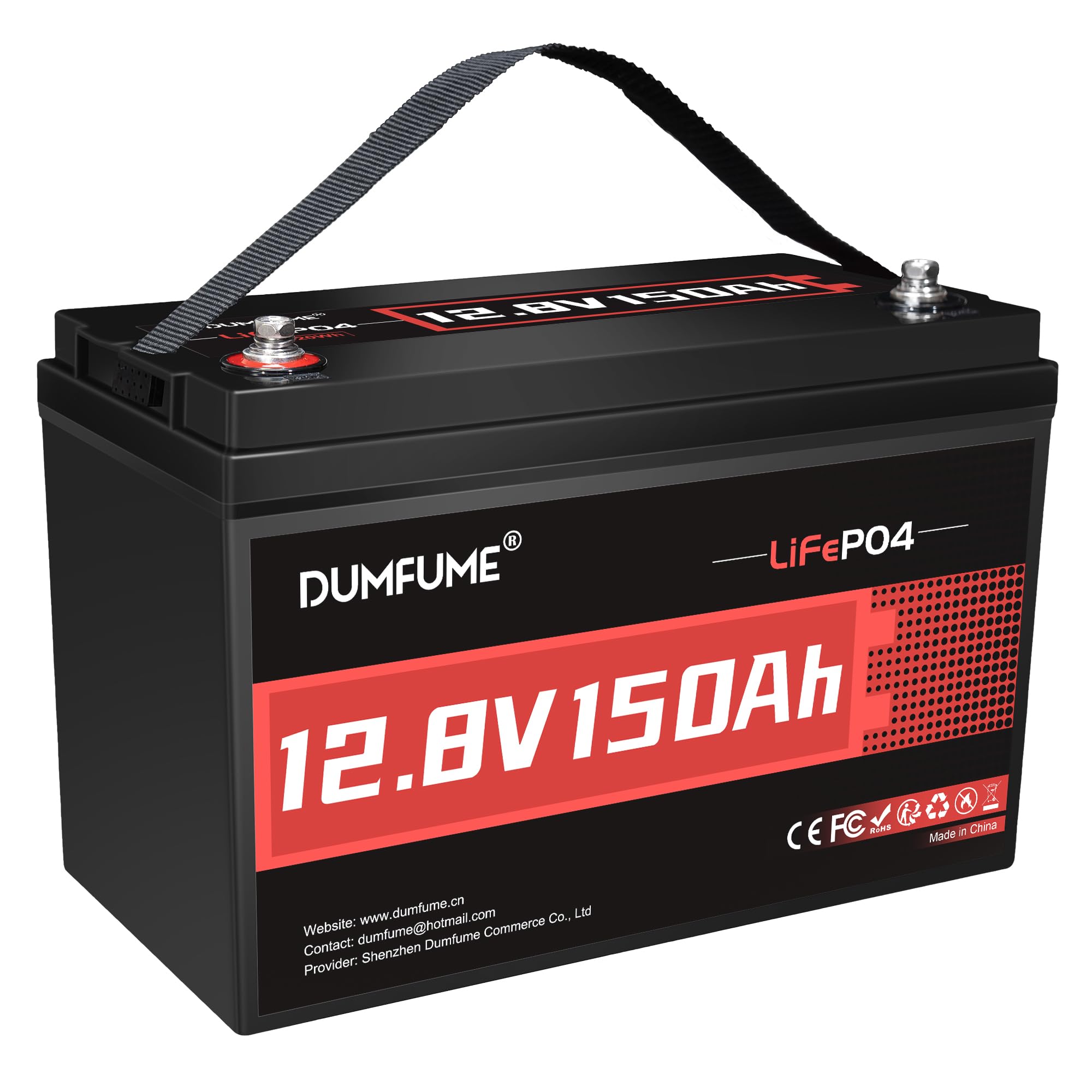
This extra capacity translates to running a 55-pound thrust trolling motor at moderate speeds for over six hours, or powering a full suite of marine electronics, LED lighting, and a 12V refrigerator for an entire weekend without recharging. The 4,000+ cycle rating at 80% depth of discharge ensures a service life measured in years, not months.
The built-in 100A BMS provides comprehensive protection, and many users have verified the batteries exceed their rated capacity by approximately 7 amp-hours when tested. The ability to connect in series or parallel up to 4S4P gives flexibility for custom system builds—ideal for larger boats or house banks. One reviewer reported using four 150Ah units in a solar-powered off-grid setup with stable performance and simple installation, though they noted the manual could be more detailed for first-time lithium users.
A cautionary review reported a unit failing after one year in a campervan, with the BMS entering low-voltage cutoff and refusing to recharge—the key detail being that the 5-year warranty applies only to direct purchases, not Amazon orders. The battery requires temperatures above 41°F for charging, and return shipping for low-temperature issues isn’t covered. Despite this, the overwhelming majority of reviews praise the value, lightweight design, and capacity, making it an excellent choice for boaters who need the extra runtime of 150Ah.
Why it’s great
- 1920Wh capacity for extended trolling or multi-day anchoring
- 22.05 lbs—astonishingly light for a 150Ah battery
- 4S4P expansion capability for large system builds
Good to know
- Warranty and support tied to direct purchases, not Amazon
- Battery requires temperatures above 41°F for safe charging
- Limited documentation for complex setup configurations
5. GOLDENMATE 12V 20Ah LiFePO4 (2-Pack)

The GOLDENMATE 12V 20Ah LiFePO4 2-Pack is purpose-built for portable, low-draw marine applications like kayak fish finders, LiveScope units, and small LED lighting systems. Each battery weighs just 5.95 pounds and carries an IP67 waterproof rating, meaning it can survive full submersion in up to one meter of water for 30 minutes—a critical spec for kayakers and paddleboarders. The built-in 20A BMS protects against overcharging, over-discharging, over-current, and short circuits, and the low self-discharge rate allows up to one year of storage between uses.
Verified kayak anglers report these batteries power a LiveScope and fish finder all day without performance degradation, and the parallel connection capability allows combining both 20Ah units into a 40Ah bank for longer trips. The 5,000+ cycle rating ensures years of seasonal use, and the LiFePO4 chemistry delivers steady 12.8V output until the battery is nearly empty, unlike lead-acid batteries that gradually lose voltage as they drain. The pair can also be configured in series for 24V applications if needed.
The 20Ah capacity is limiting for larger trolling motors—a 30-pound thrust motor at full speed will drain a single battery in about 40 minutes. The included charger is functional but slow at 2A, so upgrading to a higher-amp LiFePO4 charger is recommended for faster turnaround between trips. For kayak fishermen, stern-mount trolling motor users, or anyone needing a compact, waterproof power source for sensitive electronics, this 2-pack is the most practical solution available.
Why it’s great
- IP67 waterproof rating allows full submersion
- Each battery weighs under 6 lbs for easy transport
- 5,000+ cycles from premium lithium cells
Good to know
- 20Ah capacity insufficient for larger trolling motors
- Included 2A charger is slow for quick turnaround
- Series/parallel cables sold separately
6. WEIZE 12V 100Ah Deep Cycle AGM

The WEIZE 12V 100Ah AGM battery offers a maintenance-free, spill-proof solution for boaters who want the reliability of sealed lead-acid without the upfront cost of lithium. At 63 pounds, it’s heavy compared to lithium alternatives, but the AGM construction handles marine vibration better than flooded batteries and doesn’t require watering or venting. Verified users report running two of these in parallel with a 2,000W inverter for emergency backup, powering fans, garage doors, and 120V outlets with consistent performance over two years.
The 3% self-discharge rate allows winter storage without constant trickle charging, and the 1150A maximum discharge current means it can handle brief high-draw situations like starting a small outboard. The dimensions of 12.99 x 6.73 x 8.43 inches match standard Group 31 trays, and dual SAE terminals accommodate both accessory wiring and high-current connections. Multiple reviews note the AGM outperforms standard flooded batteries in holding charge and doesn’t require the fluid checks that employees or family members forget to perform.
The 100Ah capacity is real and tested, but AGM batteries lose capacity faster under repeated deep discharges—running below 50% depth of discharge regularly can halve the battery’s service life. The battery weighs 63 pounds, making installation and removal a two-person job in tight boat compartments. For budget-conscious boaters who need a dependable house battery or backup power source and don’t want to invest in a lithium charger, the WEIZE AGM is a proven, no-surprises choice.
Why it’s great
- Maintenance-free AGM construction with no watering needed
- 1150A max discharge for brief high-power demands
- 3% self-discharge rate for worry-free off-season storage
Good to know
- 63 lbs is heavy and cumbersome to install
- Repeated deep discharges reduce cycle life significantly
- No BMS—relies on external charger management
7. Newport 12V 50Ah Deep Cycle AGM
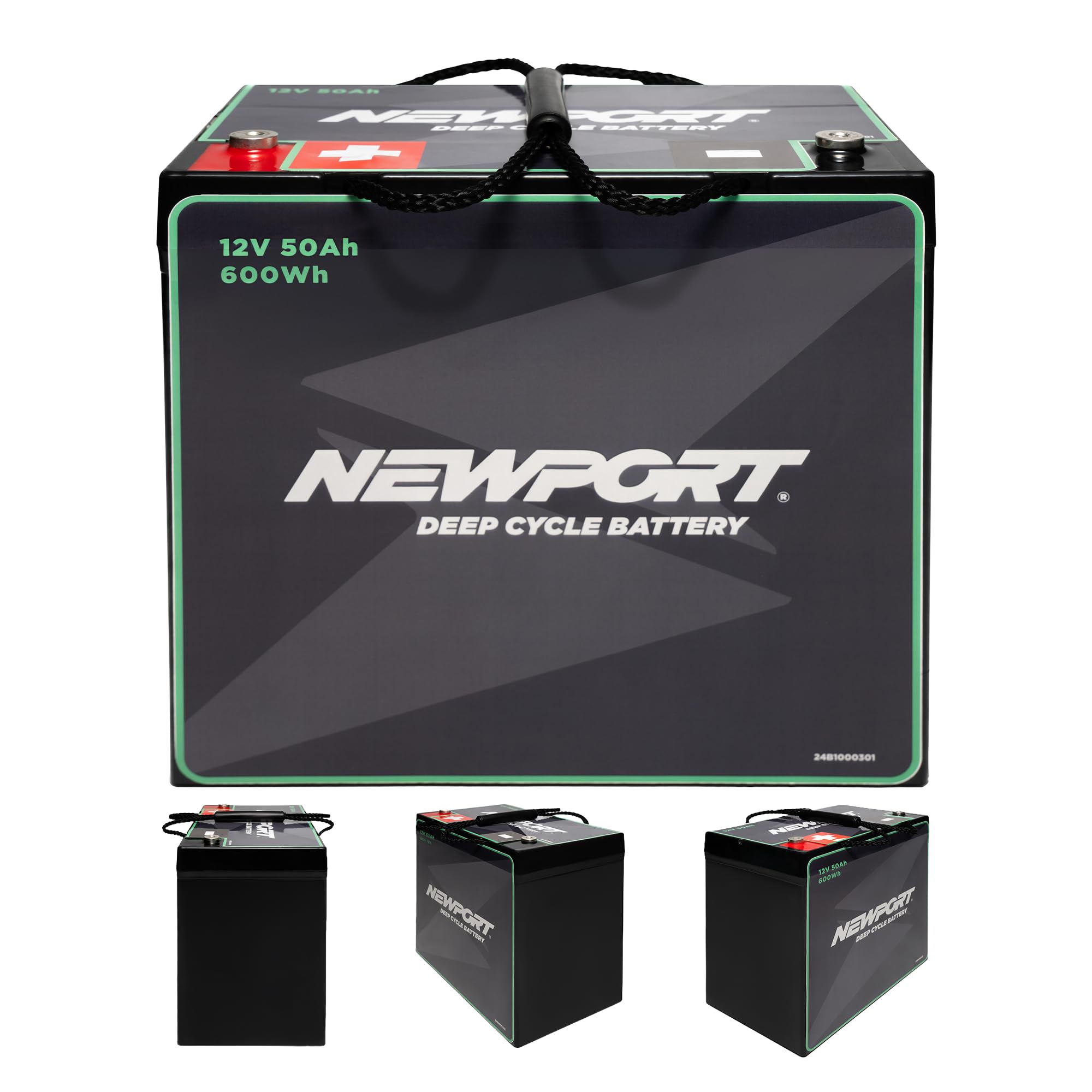
The Newport 12V 50Ah AGM battery is the lightest sealed lead-acid option at 32 pounds, making it a practical choice for kayaks, small jon boats, or as a secondary battery for electronics. Trolling motor users report running a 25-pound thrust motor at full power for approximately 7 hours on a single charge, and a 55-pound thrust motor at moderate speeds for over 4 hours with stable voltage output. The sealed, leak-proof construction allows mounting in any orientation without risk of acid spills, and the marine terminals fit standard trolling motor plugs and SAE connectors.
The battery survived a 20 MPH tumble from a truck bed onto asphalt with only cosmetic damage, no internal swelling, and no performance issues—a testament to the rugged AGM construction. The 50Ah capacity makes it well-suited for day trips with moderate power demands, and the battery’s weight allows one-handed carry from truck to boat. The included 1-year limited warranty provides basic coverage, and the low self-discharge rate of AGM chemistry means the battery holds its charge during off-season storage.
The 50Ah capacity runs out quickly for heavy users—a 55-pound thrust trolling motor at full power will drain this battery in about two hours. There’s no built-in charge indicator, so users need to pair it with an external voltmeter or battery monitor to avoid deep discharging. Some reviewers noted that lithium gel batteries provided longer runtime per charge, but the Newport AGM offers a lower entry price point for weekend anglers who fish local waters and can recharge between trips.
Why it’s great
- Lightweight 32 lbs—easy one-handed carry
- Leak-proof and vibration-resistant AGM construction
- Proven to survive a 20 MPH tumble impact
Good to know
- 50Ah capacity limits runtime for high-draw motors
- No built-in charge indicator or voltage display
- Shorter total cycle life compared to lithium alternatives
8. Optima D31M BLUETOP AGM

The Optima D31M BLUETOP is the gold standard for dual-purpose marine batteries, combining 900 cold cranking amps for reliable engine starts with 75 amp-hours of deep-cycle capacity for accessories. Its SpiralCell technology wraps 99.99% pure lead plates into a cylindrical cell design, delivering 15 times more vibration resistance than standard flooded batteries and up to 3 times longer service life. Multiple long-term users report their BLUETOPs lasting 9 to 14 years in marine service, starting engines and running down riggers, trolling motors, and electronics for full fishing days without failure.
The dual SAE and 5/16-inch stainless steel stud posts give flexibility for connecting both starting cables and high-current trolling motor wiring without adapters. The 1,125 marine cranking amps and 155-minute reserve capacity mean the battery can sustain a significant electrical load even if the alternator fails. In real-world use, two BLUETOPs in parallel sustained a 1,500W inverter load at 137.5 amps for 27 minutes, demonstrating impressive deep-cycle capability for a dual-purpose battery.
Quality control on Amazon shipments is inconsistent—multiple reviews report batteries arriving with cracked plastic cases from insufficient packaging, and the thin styrofoam inserts don’t protect the 59.8-pound battery during transit. The upfront investment is significantly higher than any other battery in this guide, and some users experienced premature failure within the first year, with Optima’s warranty support described as difficult to navigate. For boaters who want a single battery that both starts a V8 outboard and powers a day of fishing, and who are willing to inspect the packaging upon delivery, the D31M BLUETOP remains the proven choice.
Why it’s great
- 900 CCA starts large outboards and diesel engines reliably
- SpiralCell design delivers 15x vibration resistance
- Proven 9-14 year lifespan in aggressive marine use
Good to know
- High risk of damage from inadequate Amazon packaging
- Premium price—significantly more than AGM competitors
- Warranty support process can be challenging
9. Interstate 34M-AGM Marine/RV

The Interstate 34M-AGM is a pure lead dual-purpose battery designed for boaters who need trustworthy cranking power first and deep-cycle capability second. Its 800 cold cranking amps reliably start V6 and V8 outboards even after periods of accessory draw, and the pure lead construction delivers 2-3 times longer life than conventional alloy AGM or flooded batteries. Verified owners report Interstate batteries lasting over five years with more than 800 engine hours on pontoons, and one user’s past Interstate battery served for 10.5 years before replacement.
The 62Ah reserve capacity provides enough power for lights, a water pump, and basic electronics during short anchoring sessions, and the thick plate design allows repeated deep discharges without the capacity loss seen in thinner-plate batteries. The battery weighs 47.6 pounds, making it lighter than equivalent Group 31 AGM batteries but still noticeably heavy. The 3-year performance warranty adds confidence, and the brand’s nationwide network of Interstate All Battery Centers makes recycling and warranty claims straightforward.
Some units ship with older date codes, reducing the effective warranty period from the delivery date. The Group 34M size is smaller than Group 31, so it may not fit trays designed for larger batteries without an adapter. For boaters prioritizing starting reliability and brand support over maximum runtime, the Interstate 34M-AGM is a sound investment.
Why it’s great
- 800 CCA provides reliable engine starts in all conditions
- Pure lead construction lasts 2-3x longer than standard AGM
- National support network for recycling and warranty service
Good to know
- 62Ah capacity limits deep-cycle application runtime
- Group 34M size may require tray modification
- Date codes on shipped units may reduce effective warranty
FAQ
Can I use a regular car battery in my boat?
How do I charge a LiFePO4 marine battery?
What size battery do I need for a 55lb thrust trolling motor?
Final Thoughts: The Verdict
For most users, the best battery for a boat is the Power Queen 12V 100Ah because it combines a 24-pound weight with a 100Ah capacity and 15,000-cycle lifespan at a fair price. If you need cold-weather charging protection for a boat stored in freezing conditions, grab the Dyness 12V 100Ah. And for boaters who want a legendary dual-purpose starting and deep-cycle battery with a proven 10-year service record, nothing beats the Optima D31M BLUETOP.