
You want faster level loads and smoother open-world traversal, but your current drive is the bottleneck turning every firefight into a loading screen safari. The difference between a sluggish HDD and a responsive NVMe drive is the single most impactful upgrade for any gaming PC, yet the market is flooded with confusing spec sheets and inflated price tags. We’ve sifted through the stack to find the drives that deliver genuine performance gains without demanding your entire paycheck.
I’m Min — the co-founder and writer behind Gadgets Feed. For this guide, I’ve spent countless hours cross-referencing technical specifications, real-world user benchmarks, and sequential read/write speeds across dozens of budget-tier solid state drives to isolate the ones that actually hold up under sustained gaming loads.
After comparing seven contenders across SATA and NVMe form factors, these are the storage upgrades that give you the best bang for your buck. This is the definitive authority on the best budget ssd for gaming.
How To Choose The Best Budget SSD For Gaming
Choosing a gaming SSD on a budget means balancing raw speed, capacity, and interface compatibility with your motherboard and console. Prioritize the factors that directly affect load times and texture streaming rather than chasing peak sequential numbers that only show up in synthetic tests.
Interface and Form Factor: NVMe vs SATA
The interface dictates the ceiling of your transfer speeds. An NVMe M.2 drive connects directly to the PCIe bus, delivering sequential read speeds that can exceed 7000 MB/s on Gen4 lanes. A SATA 2.5-inch drive, even the fastest one, is capped at around 550 MB/s. For modern games that stream large open-world assets directly from storage, NVMe is the clear winner — but your motherboard must have an M.2 slot. If your rig is older and only supports SATA, a SATA SSD is still a massive upgrade over a hard drive.
NAND Flash Type and Cache Strategy
The type of NAND flash inside the drive influences both performance consistency and long-term endurance. 3D TLC (Triple-Level Cell) is the sweet spot for budget gaming: it offers a solid balance of speed, durability, and cost. QLC (Quad-Level Cell) is cheaper but slows down significantly after its pSLC cache fills up, which can cause frame-time hitches during extended gaming sessions. A dedicated DRAM cache or Host Memory Buffer (HMB) paired with SLC caching helps maintain peak performance during heavy read/write operations.
Quick Comparison
On smaller screens, swipe sideways to see the full table.
| Model | Category | Best For | Key Spec | Amazon |
|---|---|---|---|---|
| acer Predator GM7 1TB | Premium NVMe Gen4 | Enthusiast builds & PS5 | 7400 MB/s Read / 6500 MB/s Write | Amazon |
| Western Digital 512GB Gaming Gen4 | Premium NVMe Gen4 | High-speed OS drive | 5000 MB/s Read / 4000 MB/s Write | Amazon |
| TEAMGROUP T-Force G50 512GB | Mid-Range NVMe Gen4 | Gen4 value & PS5 storage | 5000 MB/s Read / 2500 MB/s Write | Amazon |
| fanxiang S500 Pro 256GB NVMe | Budget NVMe Gen3 | Entry-level NVMe boot drive | 3000 MB/s Read (Gen3x4) | Amazon |
| Crucial BX500 1TB SATA III | Budget SATA III | High-capacity SATA upgrade | 540 MB/s Read / 500 MB/s Write | Amazon |
| PNY CS900 500GB SATA III | Budget SATA III | Secondary storage & PS4 | 550 MB/s Read / 500 MB/s Write | Amazon |
| fanxiang S101 512GB SATA III | Budget SATA III | Low-cost laptop upgrade | 550 MB/s Read / 500 MB/s Write | Amazon |
In‑Depth Reviews
1. acer Predator GM7 1TB
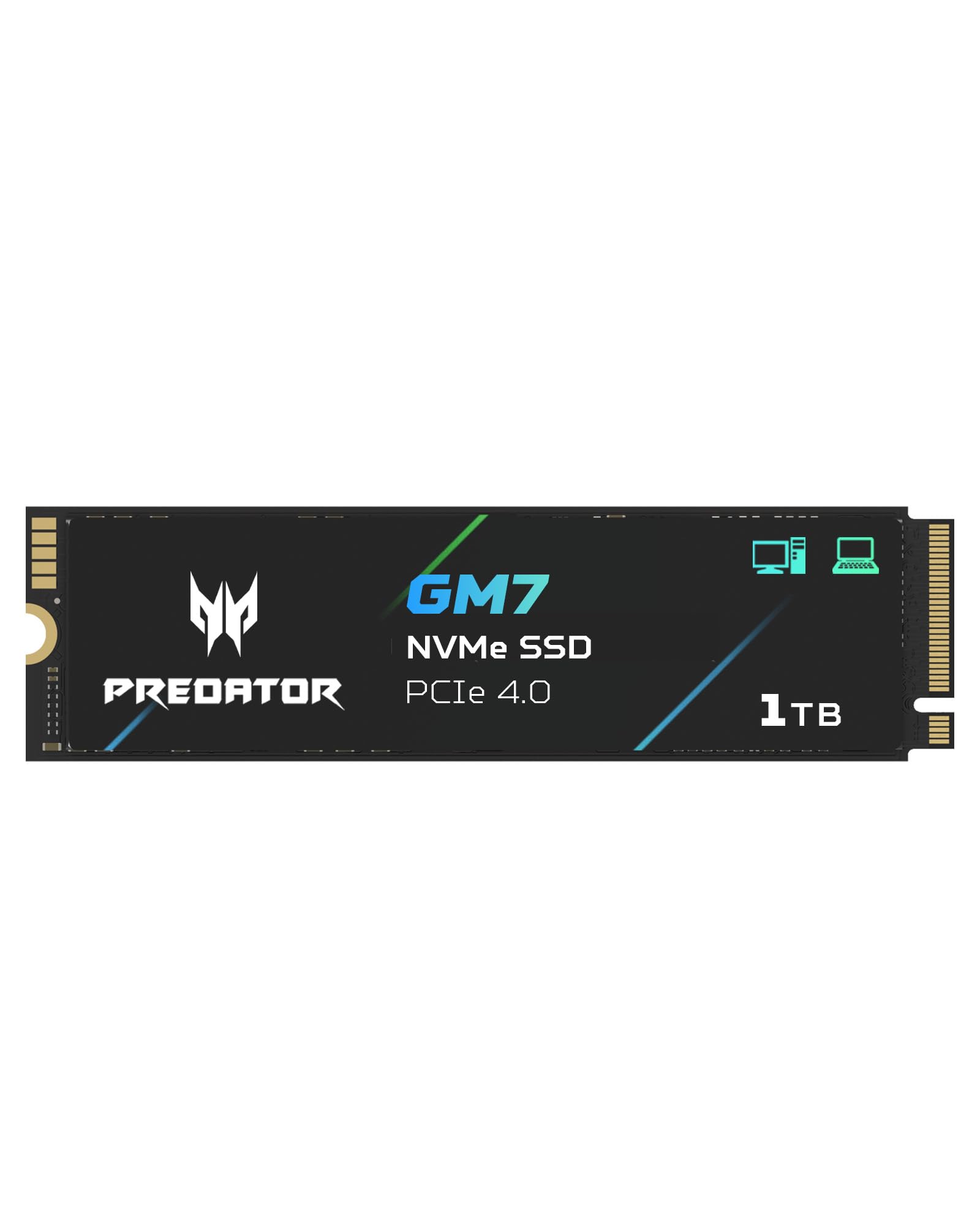
The acer Predator GM7 pushes the absolute ceiling of PCIe Gen4 performance with sequential read speeds reaching up to 7400 MB/s and write speeds hitting 6500 MB/s. This is the drive that eliminates stutter in massive open-world titles like Cyberpunk 2077 and Starfield, where texture streaming demands every bit of bandwidth the interface can provide.
It supports HMB (Host Memory Buffer) and SLC caching to maintain consistent throughput during extended gaming sessions. The Thermal Throttling and Power Management features prevent overheating even under sustained heavy write workloads, which is critical for a drive operating at Gen4 speeds inside a compact build or a PS5.
The 1TB capacity is the sweet spot for a modern game library, giving you room for several AAA titles plus your operating system. The bundled Biwin Intelligence management software also includes a performance test and data migration tool, adding genuine utility out of the box.
Why it’s great
- Blazing 7400 MB/s read speed ideal for DirectStorage-ready games
- HMB and SLC cache reduce frame-time hitches
- Fully compatible with PlayStation 5 expansion slot
Good to know
- Requires a PCIe Gen4 motherboard to reach full speeds
- Black/white color scheme may not match all build aesthetics
2. Western Digital 512GB Gaming Gen4

Western Digital brings trusted reliability to the Gen4 table with sequential reads hitting 5000 MB/s and writes reaching 4000 MB/s. The random read and write performance of 460K IOPS and 800K IOPS respectively makes this drive exceptionally snappy for OS boot times and application launching, shaving seconds off your daily workflow.
The M.2 2280 form factor is standard and fits most modern laptops and desktops, but note this is OEM packaging with a 1-year limited hardware warranty through Computer Upgrade King. For gamers focused on a fast boot drive for Windows and a handful of frequently played titles, the 512GB capacity provides a clean separation from bulk storage.
It runs notably cooler than many Gen4 competitors, which is a real advantage in ITX or small-form-factor builds where airflow is limited. The drive is also backward compatible with PCIe Gen3 slots, so you can use it as an upgrade path until you upgrade your platform.
Why it’s great
- Strong 460K random read IOPS for responsive Windows performance
- Runs cooler than many competing Gen4 SSDs
- Backward compatible with Gen3 M.2 slots
Good to know
- OEM packaging with a shorter 1-year warranty
- 512GB capacity fills quickly with modern AAA titles
3. TEAMGROUP T-Force G50 512GB

The T-Force G50 delivers Gen4-grade read speeds of 5000 MB/s paired with write speeds of 2500 MB/s, using an InnoGrit controller and 3D TLC NAND. The patented ultra-thin graphene heat spreader keeps thermals in check without adding bulk, making it an easy fit in tight notebook chassis or PS5 consoles.
The SLC caching algorithm on this drive is particularly well-tuned for gaming scenarios, maintaining high burst performance during level loads and texture streaming. The 5-year limited warranty is a strong vote of confidence from TEAMGROUP, standing well above most budget competitors that cap out at 3 years.
Where this drive truly shines is as a cost-effective Gen4 upgrade for users moving from SATA or Gen3 NVMe. The 512GB capacity is sufficient for a primary game library of 4-6 modern titles, and the graphene spreader eliminates the need for a bulky metal heatsink.
Why it’s great
- Ultra-thin graphene heatsink simplifies installation in tight spaces
- 5-year limited warranty provides long-term peace of mind
- Strong SLC caching for sustained gaming performance
Good to know
- 512GB capacity may feel limiting for massive game libraries
- Write speed of 2500 MB/s is slower than some premium Gen4 drives
4. fanxiang S500 Pro 256GB NVMe

The fanxiang S500 Pro is a Gen3x4 NVMe drive that delivers up to 3000 MB/s sequential reads, which places it firmly at the top of the Gen3 performance bracket. For gamers still on a B450 or B360 motherboard that lacks Gen4 support, this is the best way to maximize your platform’s storage throughput without leaving performance on the table.
It uses 3D NAND with TLC particles and intelligent SLC caching to ensure consistent speeds during file transfers and game installations. The included graphite heat dissipation sticker helps manage thermal throttling, a common issue with budget NVMe drives under sustained load.
The 256GB capacity is best suited as a dedicated boot drive for Windows and a couple of primary games, with the expectation that you’ll pair it with a bulk SATA drive for the rest of your library. The 3-year warranty and the inclusion of a mounting screw and screwdriver in the box make it a genuinely hassle-free entry into NVMe storage.
Why it’s great
- Excellent 3000 MB/s Gen3 speed fully leverages PCIe 3.0 bandwidth
- Graphite heat sticker prevents thermal throttling during extended sessions
- Includes mounting hardware and screwdriver for easy installation
Good to know
- 256GB capacity is too small for a primary game library
- Limited to PCIe Gen3 bandwidth; no upgrade path to Gen4
5. Crucial BX500 1TB SATA III

The Crucial BX500 offers 1TB of SATA III storage with sequential read speeds up to 540 MB/s and writes up to 500 MB/s, making it roughly 300% faster than a typical 2.5-inch hard drive. For gamers upgrading an older laptop or booting a PS4, this is the affordable high-capacity drop-in replacement that transforms load times overnight.
Micron’s 3D NAND technology under the hood delivers the same memory and storage expertise that Crucial has refined for over 40 years. The drive is also 45 times more energy efficient than a standard HDD, which translates to noticeably better battery life in laptops during gaming sessions away from a wall outlet.
The 3-year limited warranty from a brand as established as Crucial provides confidence that budget drives from lesser-known names cannot match. The 2.5-inch 7mm form factor fits virtually any laptop or desktop that has a SATA bay available.
Why it’s great
- 1TB capacity at a budget-friendly price point
- 45x more energy efficient than HDDs, extending laptop battery life
- Trusted 3-year warranty from Crucial/Micron
Good to know
- SATA III bandwidth caps out at 550 MB/s — no match for NVMe
- Runs warm during large sustained file transfers
6. PNY CS900 500GB SATA III

The PNY CS900 is a straightforward 2.5-inch SATA III drive with sequential reads reaching 550 MB/s and writes hitting 500 MB/s, making it an ideal secondary storage drive for legacy games and general file storage. Its ultra-low power consumption makes it particularly well-suited for older laptops where heat and battery drain are genuine concerns.
Backward compatibility with SATA II 3 Gb/s means this drive will work in almost any machine from the past decade, giving new life to systems that would otherwise struggle with modern operating system demands. The 500GB capacity provides enough room for a healthy mix of older games and productivity applications.
Users have reported using this drive successfully with PS4 consoles and even as a primary drive for Eufy Homebase security systems, demonstrating its reliability across diverse platforms. The trust in the PNY brand name adds a layer of security that some no-name budget drives simply cannot offer.
Why it’s great
- Ultra-low power consumption ideal for aging laptops
- Backward compatible with SATA II interfaces
- Proven reliability across PS4, PC, and NAS applications
Good to know
- 500GB fills quickly with modern game installs
- No DRAM cache means slower sustained write speeds
7. fanxiang S101 512GB SATA III

The fanxiang S101 is a 2.5-inch SATA III SSD that offers read speeds up to 500 MB/s and uses 3D NAND TLC chips for better long-term write endurance than cheaper QLC-based alternatives. For the price-conscious builder, this drive boots your system at least 50% faster than a mechanical hard drive.
Its extensive compatibility with Windows, Linux, and Mac OS makes it a no-brainer for reviving any old machine. The 512GB capacity is enough for an operating system, a couple of favorite games, and essential applications without immediately running out of space.
The 3-year quality assurance from fanxiang gives reasonable protection for the price tier, though some user reports mention occasional longevity issues in older laptops — a risk inherent to the budget SATA segment. This drive is best viewed as a cost-effective stopgap or secondary storage solution rather than a primary drive for a high-end gaming rig.
Why it’s great
- Uses 3D TLC NAND for better write endurance than QLC drives
- Wide OS compatibility across Windows, Linux, and macOS
- Dramatic speed upgrade over HDDs at a minimal cost
Good to know
- Some user reports of drive corruption after extended use in older laptops
- 500 MB/s SATA cap leaves performance on the table versus NVMe
FAQ
Is a SATA SSD still good enough for gaming in 2025?
Does an SSD need a heatsink for gaming?
What capacity should a budget gaming PC have?
Final Thoughts: The Verdict
For most users, the best budget ssd for gaming winner is the TEAMGROUP T-Force G50 because it delivers genuine PCIe Gen4 speed and a 5-year warranty at a price that undercuts the premium competition. If you need maximum raw throughput for DirectStorage-ready games, grab the acer Predator GM7. And for squeezing the most capacity out of a legacy SATA-only system, nothing beats the Crucial BX500.