
Spotting a distant spout or a breach happening 500 yards out requires binoculars engineered to fight glare, salt spray, and unsteady hands on a rocking deck. Standard binoculars often fog up, slip when wet, or lack the light-gathering power needed to distinguish a fin from a wave in the low-angle light of early morning. A purpose-built marine optic changes that entirely.
I’m Min — the co-founder and writer behind Gadgets Feed. For this guide, I’ve dissected prism types, exit pupil math, nitrogen-purging standards, and anti-reflective coating stacks across nine models to determine which binoculars actually deliver the combination of brightness, stability, and weatherproofing that ocean observation demands.
After evaluating light transmission specs, field-of-view numbers, and real-world feedback from coastal guides and open-water cruisers, I’ve assembled the definitive shortlist of the best binoculars for whale watching on the market today.
How To Choose The Best Binoculars For Whale Watching
Choosing binoculars for open water is different than picking a pair for a forest trail. The ocean environment demands specific optical formulas and construction standards that aren’t optional for sustained use near salt spray, bright glare, and constant motion. The following criteria separate a capable marine optic from one that will disappoint on your first excursion.
Magnification and Objective Lens Size
The 7×50 configuration remains the gold standard for marine use because 7x magnification keeps the image steady on a moving boat, and the 50mm objective lens creates a 7.1mm exit pupil that fills the human eye’s dilated pupil in low light. A 10×42 configuration offers more reach for scanning distant shorelines or breaches, but the smaller exit pupil (4.2mm) requires brighter conditions and a steadier platform. For most whale watching from boats, 7x or 8x magnification paired with a 42mm or 50mm objective strikes the best balance between reach and stability.
Waterproofing and Fogproofing Standards
O-ring seals and nitrogen purging are the baseline for any binocular intended for marine environments. Nitrogen gas inside the housing prevents internal fogging when moving between the cool air-conditioned cabin and warm, humid ocean air. The IPX7 rating found on many modern compact models confirms submersibility to 3 feet for 30 minutes, but even without a formal IP rating, a nitrogen-purged, O-ring-sealed design will withstand repeated salt spray exposure. Rubber armoring with a raised texture or wave grip pattern also ensures the binoculars won’t slip from wet hands.
Prism Type and Glass Coatings
BAK-4 glass prisms are essential for edge-to-edge brightness and a perfectly round exit pupil. Porro prism designs, common in 7×50 marine models, provide a wider field of view and often deliver better depth perception than compact roof prisms. Fully multi-coated optics (FMC) layer anti-reflective compounds on every glass-to-air surface, boosting light transmission above 95% and reducing the flare that whitecaps and low sun create. Dielectric or phase-correction coatings on roof prism models further improve resolution and color fidelity at long range.
Quick Comparison
On smaller screens, swipe sideways to see the full table.
| Model | Category | Best For | Key Spec | Amazon |
|---|---|---|---|---|
| Steiner 7×50 Military-Marine | Premium | Rugged open-ocean stability | 7.1mm exit pupil | Amazon |
| Nikon Monarch M5 8×42 | Premium | ED glass color fidelity | 8.2 ft close focus | Amazon |
| Steiner 10×50 Military-Marine | Premium | Long-distance breach detail | 10x magnification | Amazon |
| Bushnell Marine 7×50 | Mid-Range | Proven Coast Guard recommendation | Porro prism design | Amazon |
| Vortex Triumph HD 10×42 | Mid-Range | Unconditional lifetime warranty | HD optical system | Amazon |
| Bushnell H2O Xtreme 10×42 | Mid-Range | Compact boat-packable design | 4.2mm exit pupil | Amazon |
| Barska Floatmaster 7×50 | Mid-Range | Floating safety for the water | Floating buoyant chassis | Amazon |
| Nocs Provisions 10×25 | Budget | Ultra-portable coastal hiking | 11.85 oz weight | Amazon |
| Sogries 10-30×50 Zoom | Budget | Variable magnification on a budget | Zoom joystick 10-30x | Amazon |
In‑Depth Reviews
1. Steiner Military-Marine 7×50

The Steiner Military-Marine 7×50 delivers exactly what the name promises: an optic built to survive the harshest marine conditions while providing a bright, steady image. Its Sports-Auto-Focus system allows you to set each eyepiece to your vision once, after which everything from 20 yards to infinity remains sharp — a huge advantage when tracking a surfacing whale without fumbling for a focus wheel. The 7.1mm exit pupil from the 7×50 configuration is the largest in this roundup, flooding your retina with light even in the dim conditions of an overcast sea at dawn.
The Makrolon polycarbonate housing absorbs 11 Gs of impact, and the NBR Long Life rubber armoring provides a non-slip, noise-dampening grip that stands up to oil, salt, and temperature swings. The Floating Prism System uses a flexible silicone mount to keep the optical train aligned even after a drop onto a fiberglass deck. At roughly 37 ounces, it’s heavy, but that mass also steadies the image against the natural sway of a boat. The unlimited, transferable “No Questions Asked” lifetime warranty means this is the last binocular you’ll buy for open-water use.
Users consistently report crystal-clear images with minimal chromatic aberration and excellent color rendition across the entire field of view. Several reviewers noted that the “auto-focus” requires a one-time per-eye calibration but then performs flawlessly for continuous viewing at varying distances. The only recurring caveat is weight — this is not a binocular you’ll casually carry on a short hike, but for dedicated whale watching from a vessel, the stability and robustness justify every ounce.
Why it’s great
- Sports-Auto-Focus eliminates constant refocusing on moving targets at sea
- 7.1mm exit pupil provides exceptional brightness in overcast ocean light
- Military-grade Makrolon housing withstands 11 Gs of impact
- Floating Prism System maintains alignment after drops and shocks
Good to know
- Heavy at roughly 37 ounces, less ideal for extended hiking
- Sports-Auto-Focus is a per-eye calibration, not a true auto-focus system
2. Nikon Monarch M5 8×42
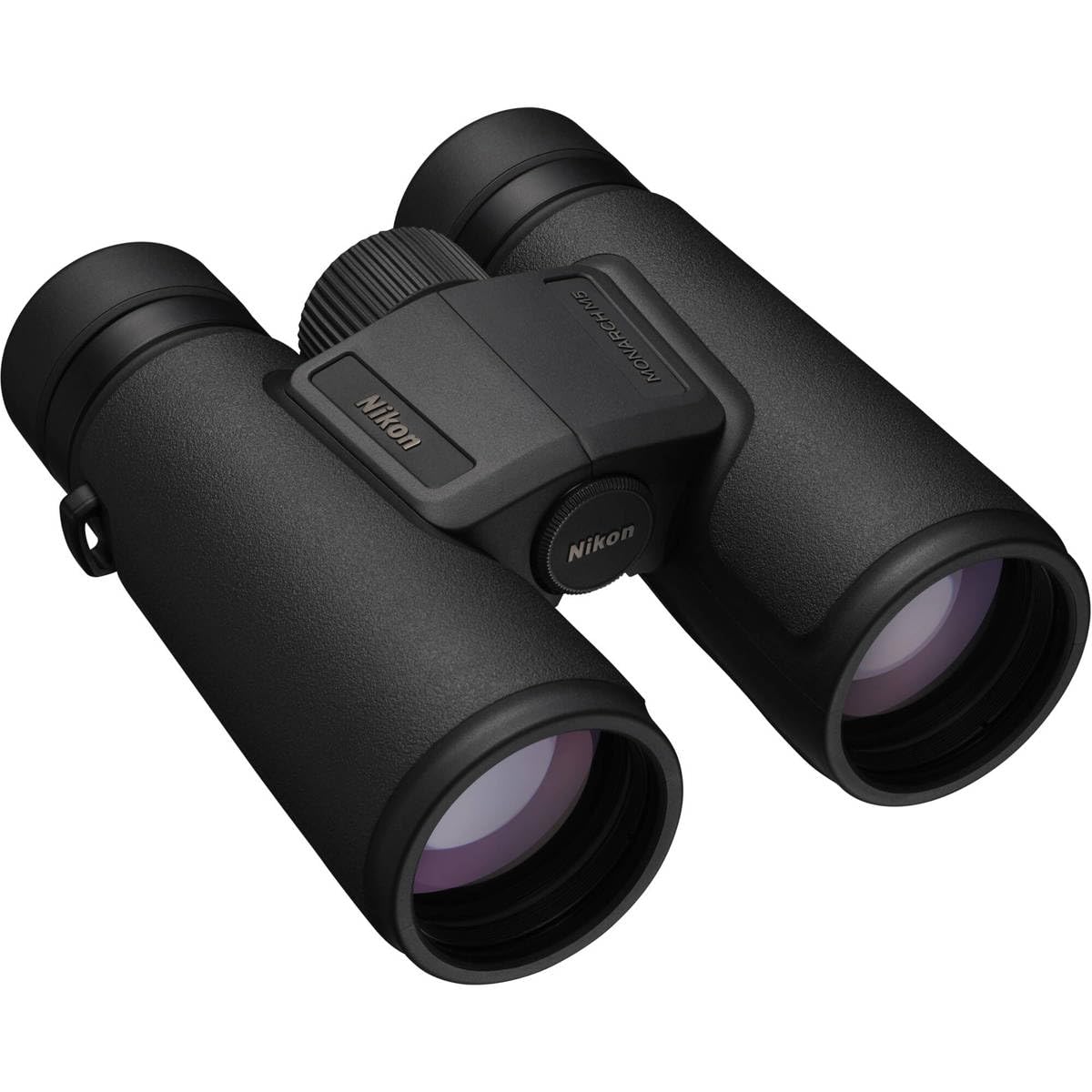
The Nikon Monarch M5 8×42 uses Extra-low Dispersion (ED) glass to virtually eliminate chromatic aberration — that color fringing you sometimes see along the edge of a whale’s back against bright water. The 8x magnification provides a slightly wider field of view (335 feet at 1000 yards) than a typical 10x model, making it easier to track a pod that’s surfacing unpredictably across a broad swath of ocean. Dielectric high-reflective multilayer prism coatings push light transmission to premium levels, delivering natural color accuracy even in the flat light of a foggy morning.
At just 5.3mm exit pupil, the 8×42 configuration balances brightness and daytime versatility without the bulk of a 50mm objective. The nitrogen-purged, O-ring sealed housing is fully waterproof and fogproof, and the rubber-armored body ensures a secure grip when your hands are damp from spray. The close-focus ability down to 8.2 feet also makes these useful for inspecting gear or onboard wildlife up close, which a dedicated 7×50 marine model can’t match. The turn-and-slide eyecups with click stops accommodate eyeglass wearers easily, with 19.5mm of eye relief.
Reviewers who took these on safari and open-water trips praise the sharp-edge-to-sharp-edge clarity and the smooth, precise focus knob. One long-time Swarovski user noted that the Monarch M5 offers comparable optical quality at a fraction of the weight, making it preferable for longer days on the water where packing light matters. The field of view is narrower than some competitors, but the raw resolution and color fidelity make it the premium choice for anyone who prioritizes image quality above all else.
Why it’s great
- ED glass virtually eliminates chromatic aberration around distant whales
- Dielectric-coated prisms deliver exceptional light transmission and color
- Smooth, precise focus knob with 8.2 ft close-focus capability
- Lightweight rubber-armored build for comfortable all-day use
Good to know
- Narrower field of view compared to some wide-angle marine models
- Not as rugged as dedicated military-grade 7×50 options
3. Steiner Military-Marine 10×50

The Steiner Military-Marine 10×50 takes the same battle-ready Makrolon chassis and Floating Prism System as its 7×50 sibling but adds two extra stops of magnification for spotting details at extreme range. When a humpback is breaching 800 yards out, the 10x magnification pulls that splash close enough to see individual barnacle patterns. The 50mm objective lenses still provide a 5mm exit pupil — sufficient for bright daytime viewing and the golden hours of early morning and late afternoon when whales are most active.
The Sports-Auto-Focus system works identically to the 7×50 version: set each eyepiece once and enjoy sharp focus from 20 yards to infinity without touching a center wheel. This is particularly valuable on a moving boat where the distance to the subject changes rapidly and you need to keep both hands on the binoculars. The 10x power does amplify hand shake, so the extra weight of the steel and polycarbonate construction actually helps dampen motion — users report a more stable view than with lighter 10x models. The NBR rubber armoring remains grippy even when soaked in salt spray.
Owners note that the 10×50 is excellent for open-terrain maritime use, especially from larger vessels with less sway. Several reviewers who own both the 7×50 and 10×50 Steiner models recommend the 10x for daytime open-water scanning while reserving the 7x for low-light or astronomy use. The weight is a consistent theme — at over two pounds, this isn’t a casual carry — but for serious whale watchers who want maximum detail at distance and can handle the heft, the 10×50 delivers an uncompromising view.
Why it’s great
- 10x magnification pulls distant breaches and tail slaps into clear view
- Sports-Auto-Focus eliminates refocusing at varying ocean distances
- Floating Prism System protects alignment during boat impacts
- 5mm exit pupil provides bright images during prime whale-watching hours
Good to know
- Significantly heavier than 8x or 7x models, tiring on long trips
- 10x magnification amplifies hand shake on small, choppy boats
4. Bushnell Marine 7×50
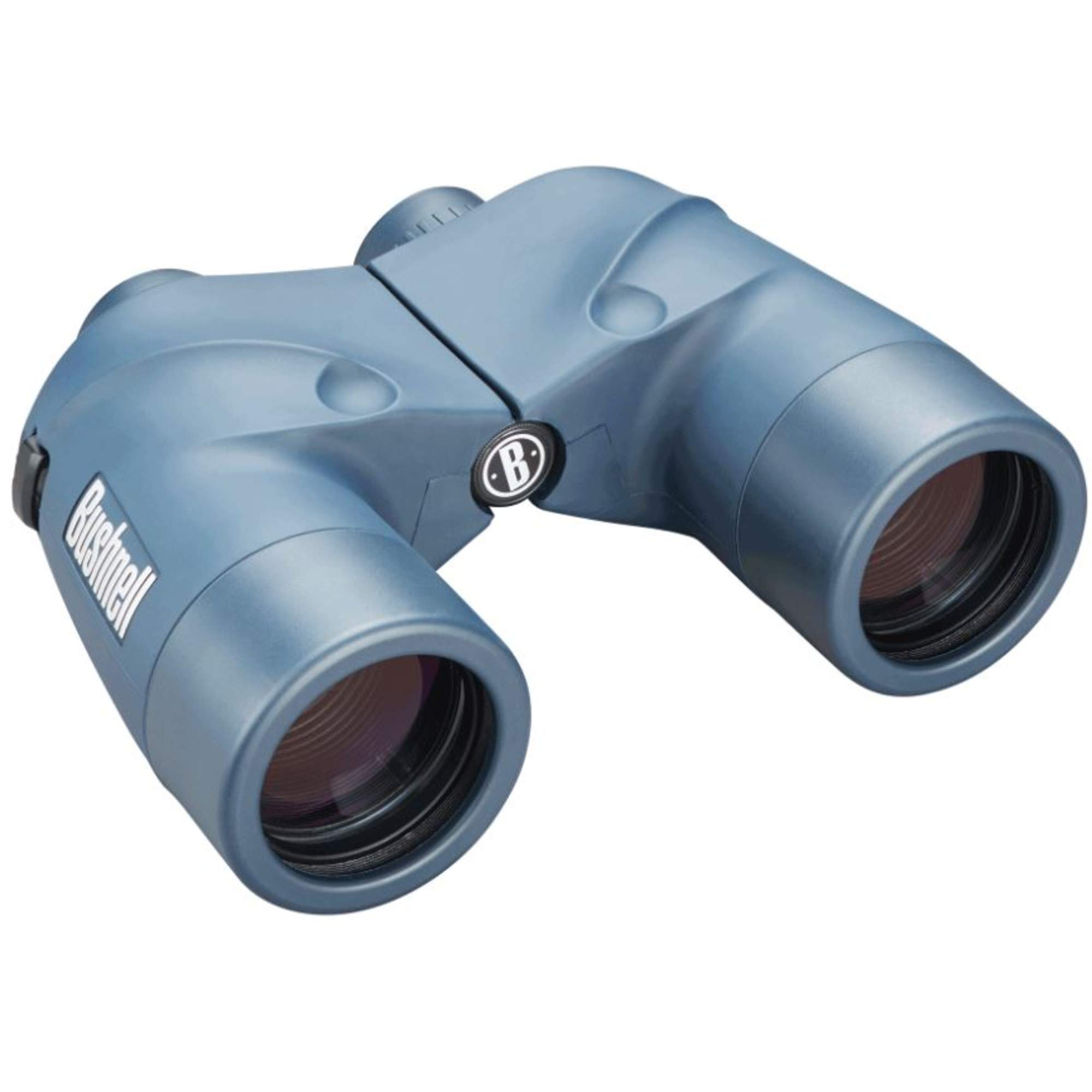
The Bushnell Marine 7×50 has earned its reputation as a Coast Guard-recommended design through decades of service in the most demanding saltwater environments. The Porro prism system delivers a wide field of view with excellent depth perception, making it easier to gauge the distance between your boat and a surfacing whale. The 7×50 configuration provides the classic 7.1mm exit pupil that fills the eye in low light, and the fully multi-coated optics with UV protection resist the harsh glare of open water.
The hermetically sealed, nitrogen-purged housing is corrosion-resistant and built to withstand constant exposure to salt spray. The non-slip, non-skid rubber armor provides a secure grip even when the binoculars are wet, and the individual focus design — each eyepiece focuses independently — means fewer moving parts to fail in a marine environment. Some users prefer individual focus because it eliminates the internal mechanisms that can leak or break, and once set for your distance, it stays locked. The limited lifetime warranty adds peace of mind for a purchase that will live on a boat.
Reviews from Alaskan cruise passengers and powerboat owners consistently praise the clarity and brightness of the Bushnell Marine 7×50. One user noted that the binoculars made the entire whale-watching experience dramatically better, calling them essential equipment for any open-water trip. The weight and bulk are the primary trade-offs — these are large, heavy binoculars built for durability, not portability — but the optical performance and weatherproofing justify the size for dedicated marine use.
Why it’s great
- Coast Guard-recommended 7×50 design proven in saltwater environments
- Porro prism system offers wide field of view and depth perception
- Hermetically sealed and nitrogen-purged for total waterproofing
- Individual focus eliminates complex internal mechanisms prone to failure
Good to know
- Individual focus requires adjustment for each user, less convenient for sharing
- Large Porro prism body is bulky and heavy for travel
5. Vortex Triumph HD 10×42

The Vortex Triumph HD 10×42 brings exceptional value to the whale-watching category through its HD optical system and the legendary VIP Warranty — an unlimited, unconditional, lifetime guarantee that transfers with the binoculars if you sell them. The HD glass elements are optimized to cut chromatic aberration and deliver edge-to-edge sharpness, which is critical when you’re scanning a horizon line where the blue of the sea meets the sky. The 10×42 configuration trades some low-light brightness for more reach and a compact profile that’s easier to pack.
The nitrogen-purged chassis is both waterproof and fogproof, and the polycarbonate body with full rubber armor provides shockproof protection against hard knocks on deck. The adjustable rubber eyecups and smooth diopter make it easy to dial in a comfortable view, and the included GlassPak harness keeps the binoculars accessible without swinging around while you’re handling camera gear or sunscreen. At roughly 22 ounces, it’s notably lighter than the 7×50 marine behemoths, making it a better choice for coastal hikes that include whale-watching viewpoints.
Customer reviews highlight the clear, bright image quality and the smooth, quick focus mechanism. Several buyers specifically chose the Triumph HD over other budget-priced models because of the warranty — they know that if anything ever goes wrong, Vortex will repair or replace it regardless of how the damage occurred. The 10×42 format is versatile enough for dock-and-deck use plus evening stargazing, and the lightweight build reduces fatigue during extended viewing sessions. The only notable omission is a tripod adapter socket, though a generic adapter can be used with some models.
Why it’s great
- HD optical system delivers exceptional resolution edge-to-edge
- VIP unconditional lifetime warranty covers all damages and transfers
- Lightweight 22-ounce build reduces fatigue during long watches
- Includes GlassPak harness for hands-free carry on deck
Good to know
- 10×42 configuration has smaller exit pupil than 7×50 marine models
- No built-in tripod adapter socket for extended stable viewing
6. Bushnell H2O Xtreme 10×42

The Bushnell H2O Xtreme 10×42 builds on the brand’s popular H2O series with fully multi-coated glass surfaces that maximize clarity and light transmission through the roof prism optical path. The 10×42 configuration offers a 4.2mm exit pupil, which is adequate for daytime whale watching and provides a noticeable step up in reach compared to a 7x or 8x model. The O-ring sealed, nitrogen-purged construction guarantees 100% waterproof and fogproof performance, exactly what you need when salt spray is landing on the lenses every time the boat cuts through a swell.
The compact roof prism design makes these significantly more packable than a traditional Porro prism 7×50. The rugged rubber armor with soft grip panels ensures a non-slip hold even when your hands are wet, and the twist-up eyecups with 17mm of eye relief work well for eyeglass wearers. The included strap, case, and lens covers round out a complete package that’s ready to travel directly from the box. Bushnell’s 70-plus years of optics manufacturing experience shows in the consistent quality control and reliable mechanical action of the center focus wheel.
Buyers consistently rate these highly for boating, fishing, and coastal wildlife observation. Several users upgraded from older 7×35 models and reported a dramatic improvement in brightness, clarity, and close-focus capability. The compact size means they fit easily in a boat’s glove box or a daypack without taking up the space that a full-size marine binocular demands. The tripod adapter socket is absent on some models, so users who want long-duration stable viewing should confirm compatibility before purchase.
Why it’s great
- Compact roof prism design fits easily in boat storage or daypacks
- Fully multi-coated optics maximize light transmission for clear views
- O-ring sealed and nitrogen-purged for 100% waterproof/fogproof use
- Rubber armor with soft grip panels stays secure when wet
Good to know
- No tripod adapter socket on some models for stable long-viewing
- 4.2mm exit pupil requires brighter conditions than 7×50 alternatives
7. Barska Floatmaster 7×50
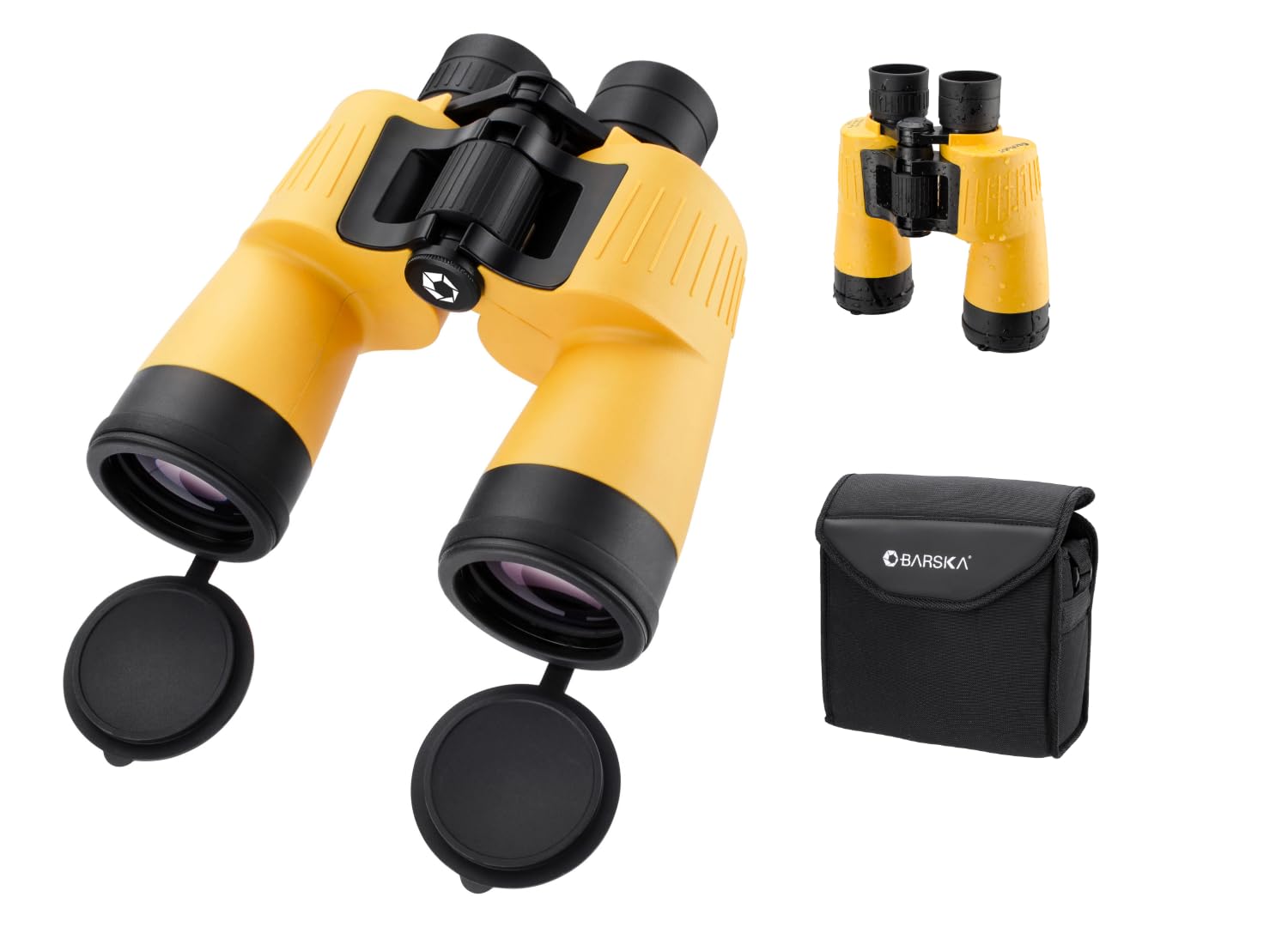
The Barska Floatmaster 7×50 solves a very specific marine problem: what happens when your binoculars go overboard. Unlike conventional models that sink instantly, the Floatmaster’s buoyant chassis keeps it floating on the surface where you can retrieve it before it’s lost to the deep. The 7×50 configuration provides the full 7.1mm exit pupil that marine enthusiasts prize for low-light performance, and the fully multi-coated optics deliver bright, clear images during the critical dawn and dusk hours when whales are feeding most actively.
The dry nitrogen-purged body is fogproof, waterproof, and shockproof, with a non-slip ergonomic rubber design that feels secure in wet hands. The 23mm of eye relief is one of the highest in this roundup, making these binoculars ideal for users who wear eyeglasses while scanning the horizon. The diopter adjustment range of +/-5 diopters accommodates a wide variety of vision prescriptions. At roughly 8 inches long and 7.75 inches wide, they occupy a similar footprint to other 7×50 Porro prism models, but the bright yellow color makes them easy to spot if they go over the side.
Customer reviews consistently praise the optical quality relative to the price point, with several comparing the clarity favorably to much more expensive models. Boaters with multiple vessels have equipped each boat with a pair, citing the floatation feature as a critical differentiator that prevents costly losses. Some users note that the center focus wheel is stiff out of the box and requires two fingers to turn, and the minimum focus distance is roughly 75-80 feet, which means these are optimized for distant viewing rather than close-in gear inspection.
Why it’s great
- Floating chassis prevents loss if dropped overboard
- 23mm eye relief is excellent for eyeglass wearers
- Nitrogen-purged and waterproof for reliable marine use
- Bright yellow color increases visibility if dropped in water
Good to know
- Focus wheel is stiff initially, may require break-in period
- Minimum focus of 75-80 ft limits close-range viewing capability
8. Nocs Provisions Standard Issue 10×25

The Nocs Provisions Standard Issue 10×25 redefines what it means to have binoculars on a whale-watching trip: these are binoculars you’ll actually carry because they weigh just 11.85 ounces and slip into a jacket pocket or small purse. The 10x magnification in a 25mm objective package provides surprising reach for its size, though the 2.4mm exit pupil means you’ll need good daylight to get a bright image. The fully multi-coated optics and Swiss-designed BAK-4 prism deliver sharp, color-accurate images that make this tiny optic feel larger than its dimensions suggest.
The IPX7 waterproof rating means these survive full submersion in three feet of water for 30 minutes, and the injected nitrogen gas prevents internal fogging — an impressive spec for such a compact body. The patented Rugged Wave Grip provides a secure hold even in damp conditions, and the multi-stop twist-up eyecups accommodate eyeglass wearers. The “No-Matter-What” Lifetime Warranty encourages rough use without worry, and the brand’s 1% For The Planet commitment adds an environmental dimension that resonates with many whale-watching enthusiasts.
Owners love the portability and durability, frequently describing these as perfect for coastal hiking that includes whale-watching viewpoints. The compact size means they’re always available rather than left behind in a car or cabin. The neck strap attachment slots are narrow, requiring patience or a small tool for installation, and the 10mm eye relief is tight for some glasses wearers. These are not the binoculars for dedicated all-day boat-based whale watching, but as a packable companion for spontaneous sightings, they’re unmatched in this list.
Why it’s great
- Ultra-light 11.85 oz design fits in a jacket pocket or small bag
- IPX7 waterproof rating ensures survival in wet conditions
- Lifetime “No-Matter-What” warranty encourages worry-free adventure use
- Rugged Wave Grip provides secure hold when hands are damp
Good to know
- 2.4mm exit pupil requires bright daylight for optimal viewing
- Narrow neck strap slots make installation difficult
- 10mm eye relief may be insufficient for some glasses wearers
9. Sogries 10-30×50 Zoom Binoculars
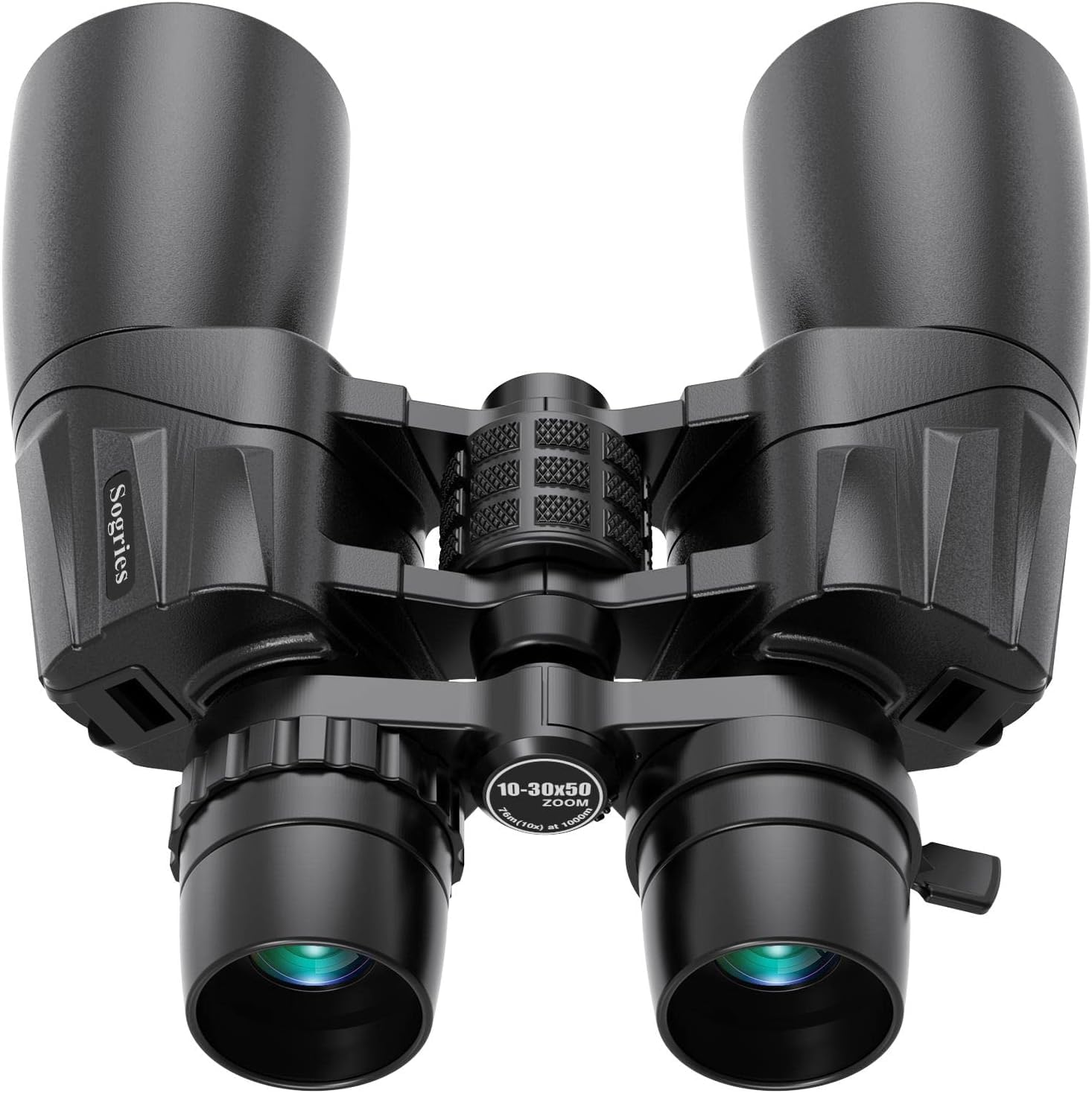
The Sogries 10-30×50 Zoom Binoculars offer the flexibility of variable magnification in a single package, allowing you to scan wide at 10x and zoom to 30x when you need to inspect a whale’s tail fluke pattern in detail. The BAK-4 prisms and fully multi-coated broadband green film achieve up to 99.5% light transmittance, producing bright, high-contrast images even at the upper end of the zoom range. The 50mm objective lenses maintain a bright image across the zoom range, though the effective exit pupil shrinks as you zoom in.
The O-ring sealed lenses and anti-fog coating protect against moisture and dust, and the unscented rubber armor coating with non-slip grip provides comfortable handling in various weather conditions. The smooth zoom joystick allows one-handed adjustment between 10x and 30x without losing your target — a useful feature when a whale surfaces at an unpredictable distance. The adjustable eyecups work for both glasses and naked-eye use, and the included 10-year warranty demonstrates confidence in the build quality.
Customer reviews highlight the clear optics and smooth zoom mechanism, with several users noting that these binoculars perform well for port observation and birdwatching alongside whale watching. The weight and size are notable — the metal barrel construction required for stability at high magnification makes these heavy, and a tripod is recommended for comfortable viewing at 30x. The minimum focus distance is longer than fixed-magnification binoculars, and the zoom mechanism introduces more moving parts that could fail over time compared to a fixed-ratio design.
Why it’s great
- Variable 10-30x zoom provides wide scanning and close-up detail in one unit
- BAK-4 prisms and FMC coatings achieve 99.5% light transmission
- Smooth zoom joystick allows one-handed magnification adjustment
- 10-year warranty provides long-term purchase confidence
Good to know
- Heavy metal construction requires a tripod for steady high-power viewing
- Zoom mechanism adds complexity and potential failure points
- Minimum focus distance is longer than fixed-magnification binoculars
FAQ
Why is 7×50 the standard magnification for marine binoculars?
Will my whale-watching binoculars need a tripod?
Can I use compact 10×25 binoculars for serious whale watching?
Final Thoughts: The Verdict
For most users, the best binoculars for whale watching winner is the Steiner Military-Marine 7×50 because it combines the ideal 7.1mm exit pupil for low-light ocean viewing with a battle-proof chassis that withstands salt, drops, and boat vibration. If you want superior color fidelity and edge-to-edge sharpness in a lighter package, grab the Nikon Monarch M5 8×42. And for the budget-conscious cruiser who values an unconditional lifetime warranty, nothing beats the Vortex Triumph HD 10×42.