
The signal drops the moment you step into the bedroom. The backyard is a dead zone. Streaming stutters in the garage while the router sits forty feet away. A quality WiFi range extender solves exactly this — it captures your router’s existing signal and rebroadcasts it, pushing reliable coverage into every corner of your home without running new Ethernet cables through the walls.
I’m Min — the co-founder and writer behind Gadgets Feed. I evaluate network extenders by their real-world throughput degradation, antenna configuration, Ethernet port capability, and multi-band latency performance so you don’t end up with a repeater that halves your speed while doubling your frustration.
This guide breaks down seven of the most capable range extenders on the market right now, from a budget-friendly AC1200 unit to a tri-band Wi-Fi 7 beast. If you want consistent coverage with minimal speed loss, the best wifi repeater is the one that matches your router’s standard and your home’s layout — not the one with the highest number on the box.
How To Choose The Best WiFi Repeater
A WiFi extender works by receiving your router’s signal, amplifying it, and transmitting it to areas the router can’t reach. But not all repeaters handle this process equally — the right choice depends on your router generation, square footage, and the number of devices competing for bandwidth.
Antenna Configuration and Gain
Two external antennas are the baseline, but four high-gain antennas provide significantly better beamforming and wall penetration. Higher dBi (gain) values mean a more focused signal that travels farther in a specific direction, which matters for long, narrow layouts or multi-story homes where the extender sits at one end of the house.
Wireless Standard: Wi-Fi 5 vs. Wi-Fi 6 vs. Wi-Fi 7
A Wi-Fi 5 (802.11ac) extender paired with a Wi-Fi 6 router will bottleneck your network at the extender’s ceiling. Wi-Fi 6 (802.11ax) repeaters bring OFDMA and MU-MIMO for better multi-device handling, while Wi-Fi 7 (802.11be) units introduce 6 GHz bands and 320 MHz channels for multi-gigabit backhaul. Match the repeater’s standard to your router’s generation for optimal throughput.
Ethernet Port and Wired Backhaul
An Ethernet port on the extender serves two distinct functions. It can connect a wired device like a gaming console or smart TV directly to the network, or it can be used as a wired backhaul connection from the router to the extender, eliminating the half-duplex penalty that wireless repeating imposes. A Gigabit (or 2.5 Gbps) port is essential for maximizing throughput in AP Mode.
Quick Comparison
On smaller screens, swipe sideways to see the full table.
| Model | Category | Best For | Key Spec | Amazon |
|---|---|---|---|---|
| TP-Link BE10000 RE653BE | Tri-Band Wi-Fi 7 | Future-proof whole-home coverage | 10 Gbps, 6 GHz MLO | Amazon |
| NETGEAR WiFi 7 EXS25 | Dual-Band Wi-Fi 7 | Plug-and-play Wi-Fi 7 mesh | 4.5 Gbps, 2.5 GbE port | Amazon |
| Oaitree AX3000 WiFi 6 | Dual-Band Wi-Fi 6 | High-performance Wi-Fi 6 extension | 3000 Mbps, 19k sq. ft. | Amazon |
| TP-Link AC1900 RE550 | Dual-Band Wi-Fi 5 | Reliable EasyMesh expansion | 1.9 Gbps, 3 antennas | Amazon |
| ROQRL AC1200 15,999 Sq. Ft. | Dual-Band Wi-Fi 5 | Large-area budget coverage | 1200 Mbps, 4 antennas | Amazon |
| GEYILO AC1200 12,880 Sq. Ft. | Dual-Band Wi-Fi 5 | Max device count at low cost | 1200 Mbps, 105 devices | Amazon |
| ROQRL AC1200 10,000 Sq. Ft. | Dual-Band Wi-Fi 5 | Entry-level single-room extension | 1200 Mbps, Ethernet port | Amazon |
In‑Depth Reviews
1. TP-Link BE10000 Wi-Fi 7 Range Extender RE653BE

The RE653BE is a tri-band Wi-Fi 7 extender with a total bandwidth ceiling of 10 Gbps spread across 6 GHz, 5 GHz, and 2.4 GHz bands. Its 6-stream architecture and 320 MHz channel support make it the only unit on this list capable of true Multi-Link Operation (MLO) when paired with a Wi-Fi 7 router, which combines bands for lower latency and higher throughput.
Four high-gain directional antennas with Beamforming technology push coverage up to 2800 sq. ft. and support up to 128 simultaneous devices. The 2.5 Gbps Ethernet port enables wired backhaul or multi-gig wired connections to a gaming PC or NAS. EasyMesh compatibility means it can integrate into a seamless whole-home mesh network with other compatible TP-Link routers.
Setup takes under two minutes through the Tether app or WPS. Users report transforming 2,500 sq. ft. homes and eliminating garage and patio dead zones entirely. The 6 GHz band penetrates walls effectively, and MLO with a Wi-Fi 7 router delivers the lowest latency of any extender tested here. The primary trade-off is that MLO does not carry over through EasyMesh, so users wanting the absolute fastest backhaul should run the extender as a wired access point.
Why it’s great
- Tri-band 10 Gbps with 6 GHz MLO support for ultra-low latency
- 2.5 Gbps Ethernet port for wired backhaul or device connection
- EasyMesh compatible for seamless whole-home mesh expansion
Good to know
- Full MLO benefits require a Wi-Fi 7 router
- Premium price tier reflects the Wi-Fi 7 hardware
2. NETGEAR WiFi 7 Range Extender EXS25 (BE4500)
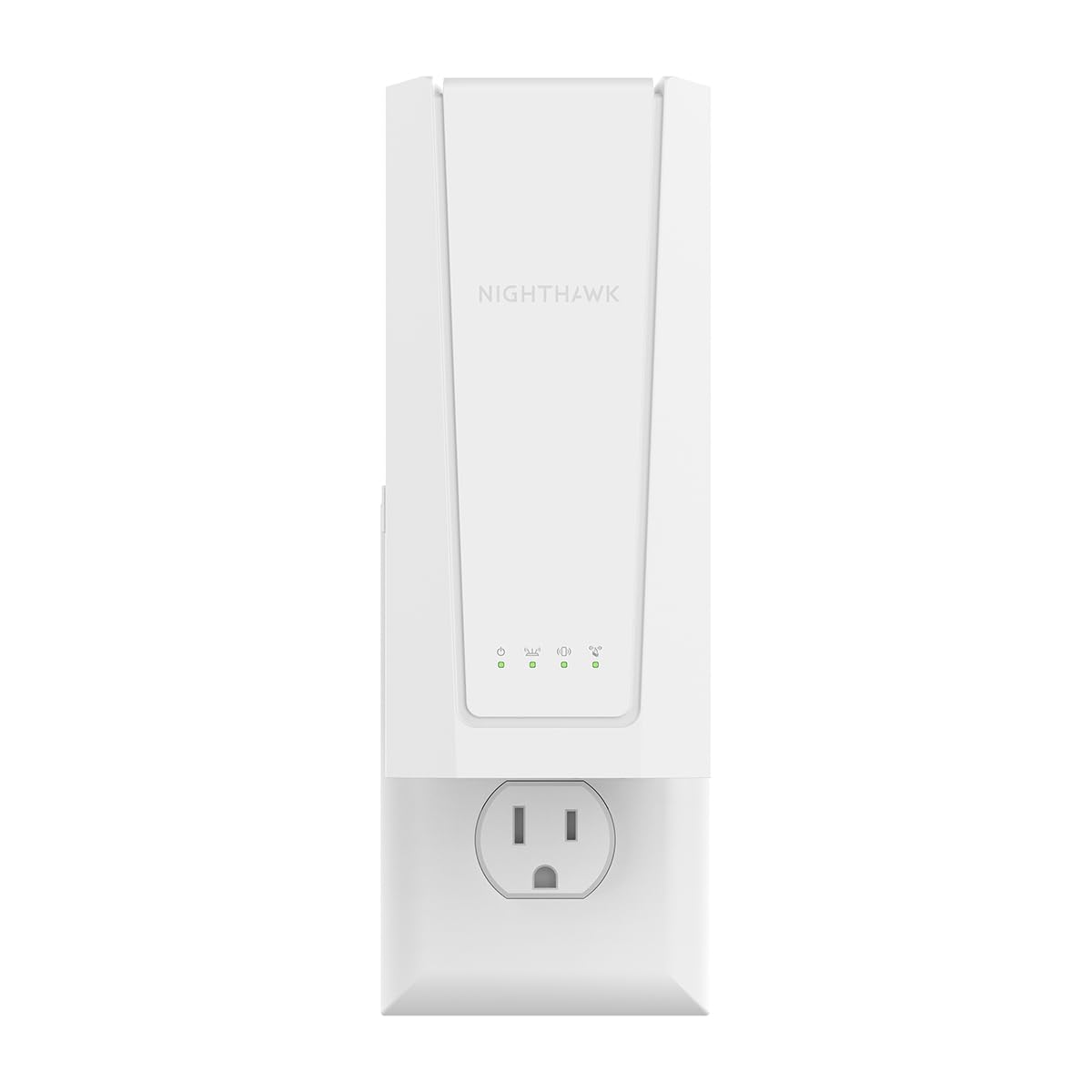
The EXS25 is NETGEAR’s dual-band Wi-Fi 7 extender, delivering up to 4.5 Gbps aggregate speed with support for 2.4 GHz and 5 GHz bands. It does not include a 6 GHz band, but its Wi-Fi 7 chipset still provides roughly 2.7x better performance than Wi-Fi 6 equivalents through 4K-QAM and multi-link enhancements. It covers up to 1,500 sq. ft. and supports up to 45 devices simultaneously.
A 2.5 Gig Ethernet port enables multi-gig wired connections to a computer, game console, or streaming player, and Smart Roaming ensures devices switch seamlessly to the strongest signal as you move through the house. WPA3 security is included, which matters for future-proofing against brute-force attacks on your network. The compact internal-antenna design keeps the unit small and wall-plug-friendly, but it lacks the high-gain external antennas found on some competitors.
Setup is straightforward via WPS or the NETGEAR app. Users report strong performance in homes with thicker plaster walls and reliable elimination of camera dead spots. The extender works best when paired with a Wi-Fi 7 router, but it remains backward-compatible with any wireless router. A small number of users experienced connectivity drops on specific game consoles, though most found the signal stability excellent after optimal placement.
Why it’s great
- Wi-Fi 7 BE4500 speeds with 2.7x boost over Wi-Fi 6
- 2.5 Gig Ethernet port for multi-gig wired connections
- WPA3 encryption and Smart Roaming for security and seamless handoff
Good to know
- No 6 GHz band — dual-band only
- Internal antennas limit directional control
3. Oaitree AX3000 WiFi 6 Extender
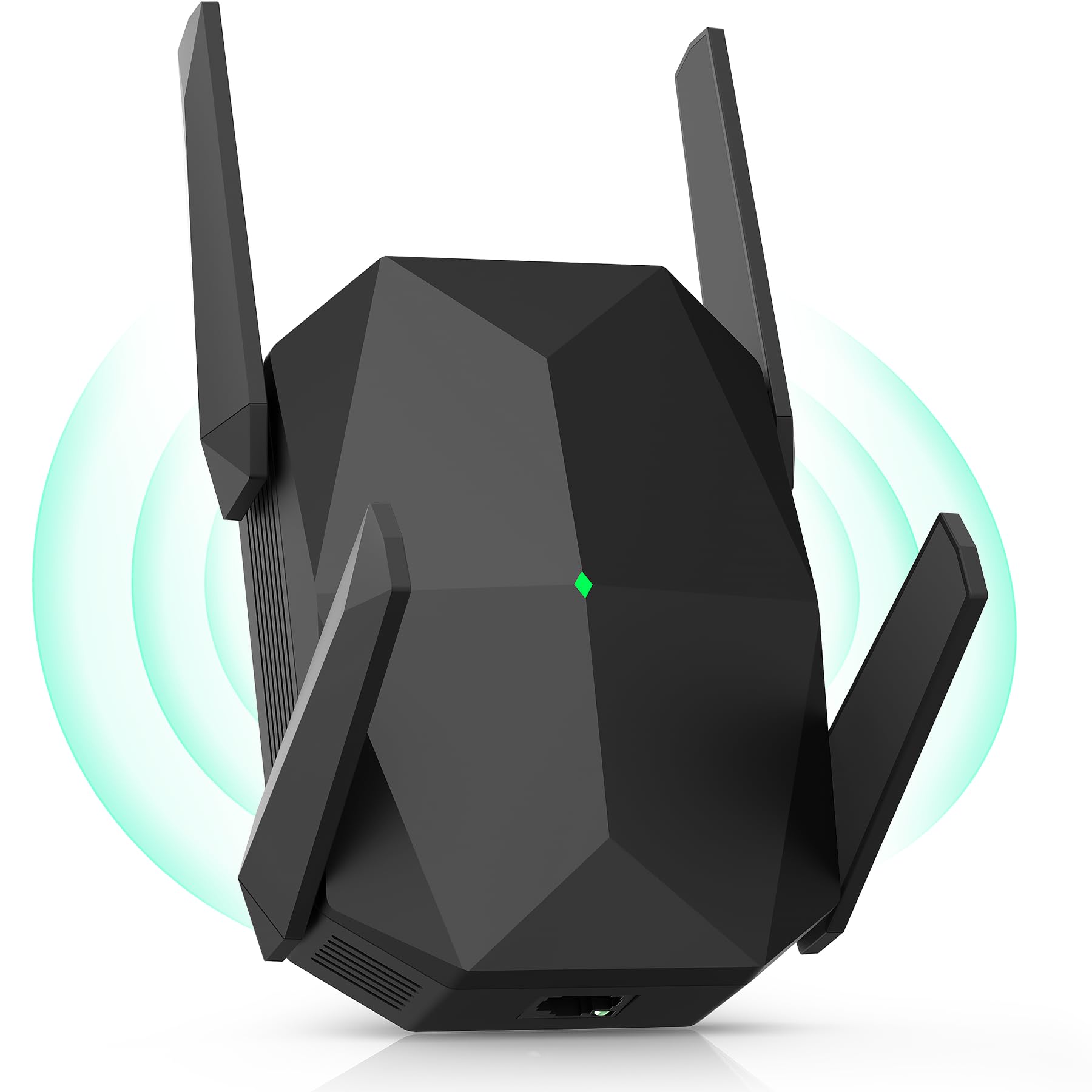
The Oaitree AX3000 is a dual-band Wi-Fi 6 extender that claims 200% faster throughput than Wi-Fi 5 repeaters, with aggregate speeds up to 3000 Mbps (5 GHz) and 650 Mbps (2.4 GHz). Its four high-gain external antennas deliver coverage rated up to 19,000 sq. ft. under ideal line-of-sight conditions, making it the widest-coverage extender on this list by raw square footage.
Wi-Fi 6 brings OFDMA and MU-MIMO, which allow the extender to communicate with multiple devices simultaneously rather than serially. This reduces latency when the network is under load from smart home devices, phones, and laptops. The unit includes three-sided heat dissipation for 24/7 operation, and supports both Repeater and AP modes. WPA/WPA2 encryption is standard, though WPA3 is absent.
Users report extending a house WiFi signal 300 feet to a shop with usable performance, and eliminating dead zones in duplex back bedrooms. The extender retains the same WiFi password as the main router, simplifying setup. For homes already running a Wi-Fi 6 router, this extender offers the best performance-to-cost ratio. The coverage numbers should be taken with a grain of salt — real-world range depends heavily on wall construction and interference.
Why it’s great
- Wi-Fi 6 OFDMA and MU-MIMO for reduced multi-device latency
- Four high-gain antennas with wide 19,000 sq. ft. coverage claim
- Three-sided heat dissipation for stable 24-hour operation
Good to know
- No WPA3 security — capped at WPA2
- Rated coverage is optimistic for real-world construction
4. TP-Link AC1900 WiFi Range Extender RE550
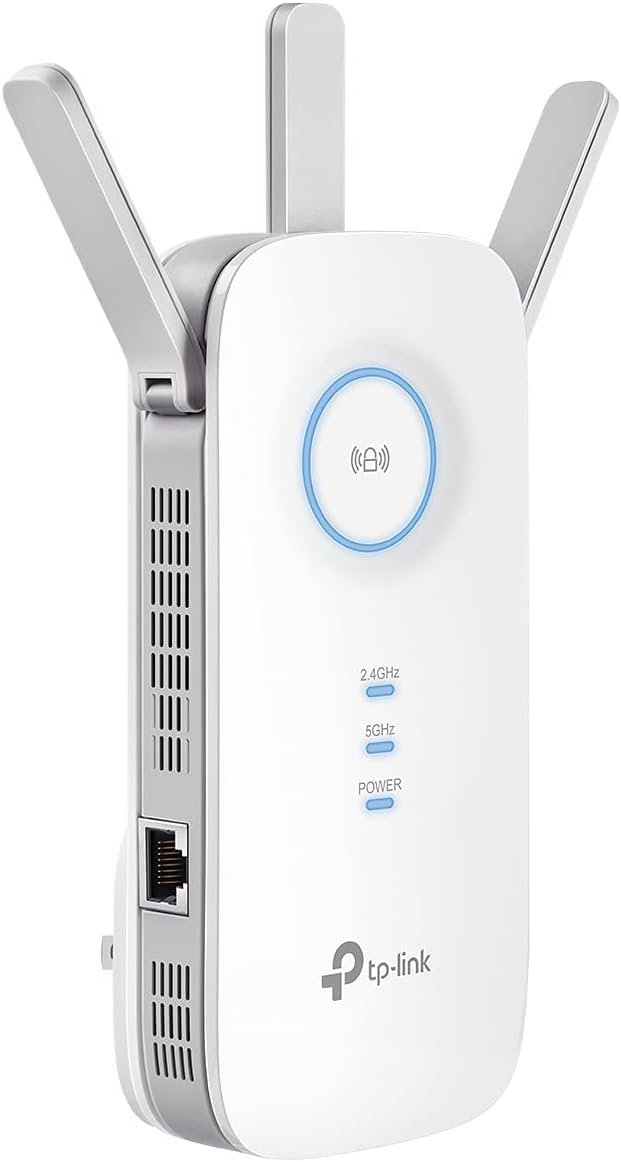
The RE550 is TP-Link’s AC1900 dual-band extender with 1.9 Gbps aggregate bandwidth (1300 Mbps on 5 GHz, 600 Mbps on 2.4 GHz). Three adjustable external antennas with Beamforming provide coverage up to 2,100 sq. ft. for up to 32 devices. The Gigabit Ethernet port supports AP Mode, turning any wired connection into a Wi-Fi hotspot.
EasyMesh compatibility is the RE550’s standout feature. It can join a TP-Link EasyMesh network and share the same SSID across the entire home, allowing devices to roam seamlessly between the main router and the extender without dropping connections. The Tether app provides intelligent signal indicators to find the optimal placement spot. WPA/WPA2 encryption is standard, and the device is a signatory of the CISA Secure-by-Design pledge.
Users solving dead zones in rear rooms and large garages report speed improvements from 1-2 Mbps to 12-15 Mbps wirelessly, and 300-400 Mbps when running in AP Mode via Ethernet. Setup is straightforward through the app, though some users needed a YouTube guide for AP Mode configuration. This extender is a strong choice for TP-Link router owners who want EasyMesh roaming without upgrading to a Deco mesh system.
Why it’s great
- EasyMesh compatible for seamless roaming with TP-Link routers
- Gigabit Ethernet port with AP Mode for wired backhaul
- Three adjustable external antennas with intelligent signal indicator
Good to know
- Wi-Fi 5 (AC) technology — not Wi-Fi 6
- AP Mode setup may require extra steps for non-tech users
5. ROQRL WiFi Extender AC1200 (15,999 Sq. Ft.)
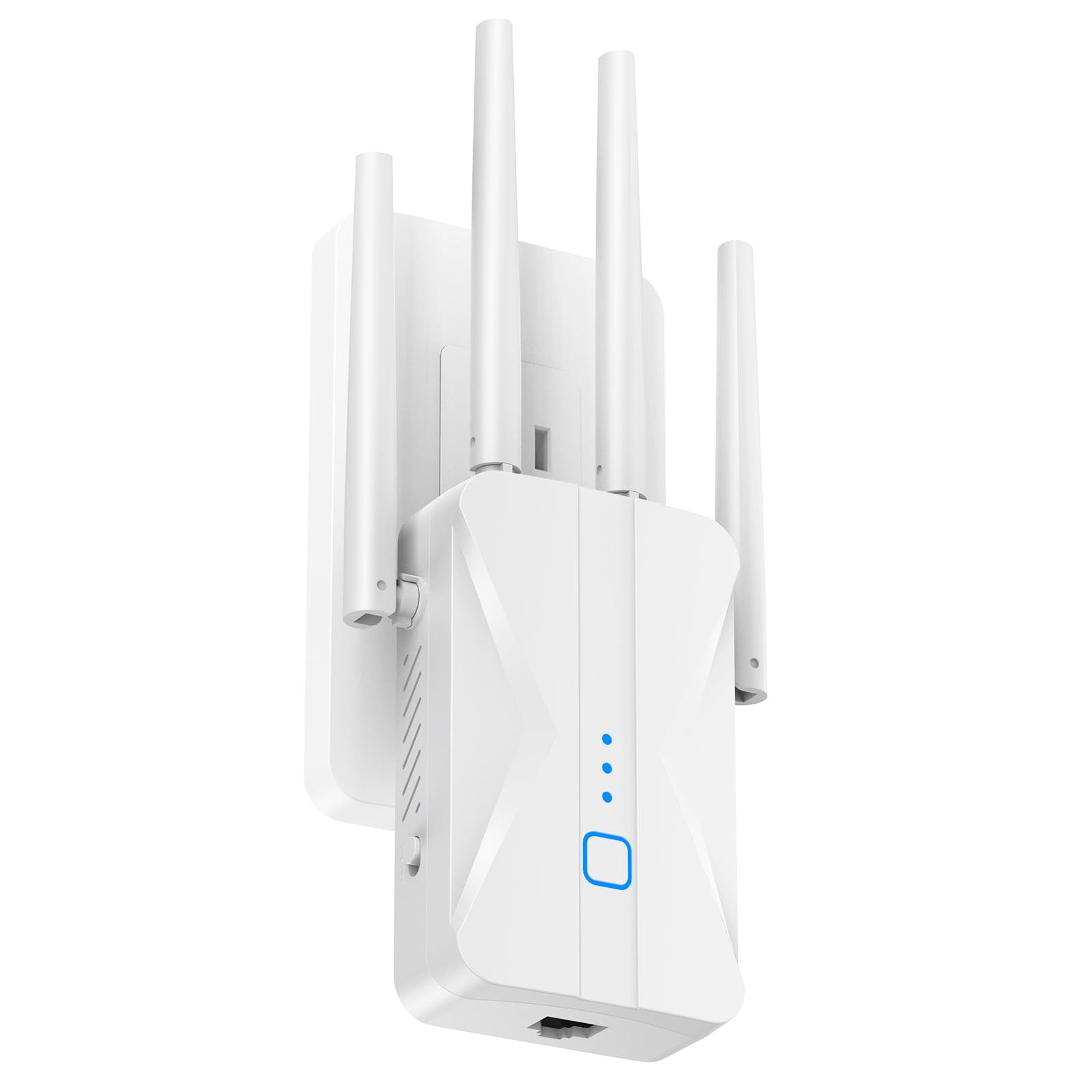
The ROQRL AC1200 extender is a dual-band unit rated for coverage up to 15,999 sq. ft., thanks to its four high-gain external antennas. It delivers 1200 Mbps aggregate speed (300 Mbps on 2.4 GHz, 867 Mbps on 5 GHz) and offers three operating modes: Repeater, AP, and Ethernet Port Mode. The compact wall-plug design saves socket space while providing 360-degree signal distribution.
One-tap WPS setup makes installation accessible for non-technical users — press the WPS button on your router, then on the extender, and the devices pair automatically. The extender supports WPA/WPA2 encryption and is compatible with 99% of mainstream routers. MU-MIMO support helps the extender handle multiple devices without congestion, making it suitable for homes with several phones, tablets, and smart TVs streaming simultaneously.
Users consistently praise the elimination of dead zones in basements, garages, and garden areas. The dual-band design allows 2.4 GHz for range and 5 GHz for streaming, and the Ethernet port provides a stable wired connection for devices that need it. Several reviewers noted that the extender’s performance exceeded expectations for its price tier, with stable signal throughout multi-story buildings.
Why it’s great
- Four high-gain antennas deliver wide 15,999 sq. ft. coverage
- 1-tap WPS setup works in seconds for non-tech users
- Three smart modes (Repeater/AP/Ethernet) adapt to any setup
Good to know
- Wi-Fi 5 (AC1200) limits maximum throughput
- Actual range depends heavily on wall materials
6. GEYILO WiFi Extender AC1200 (12,880 Sq. Ft.)
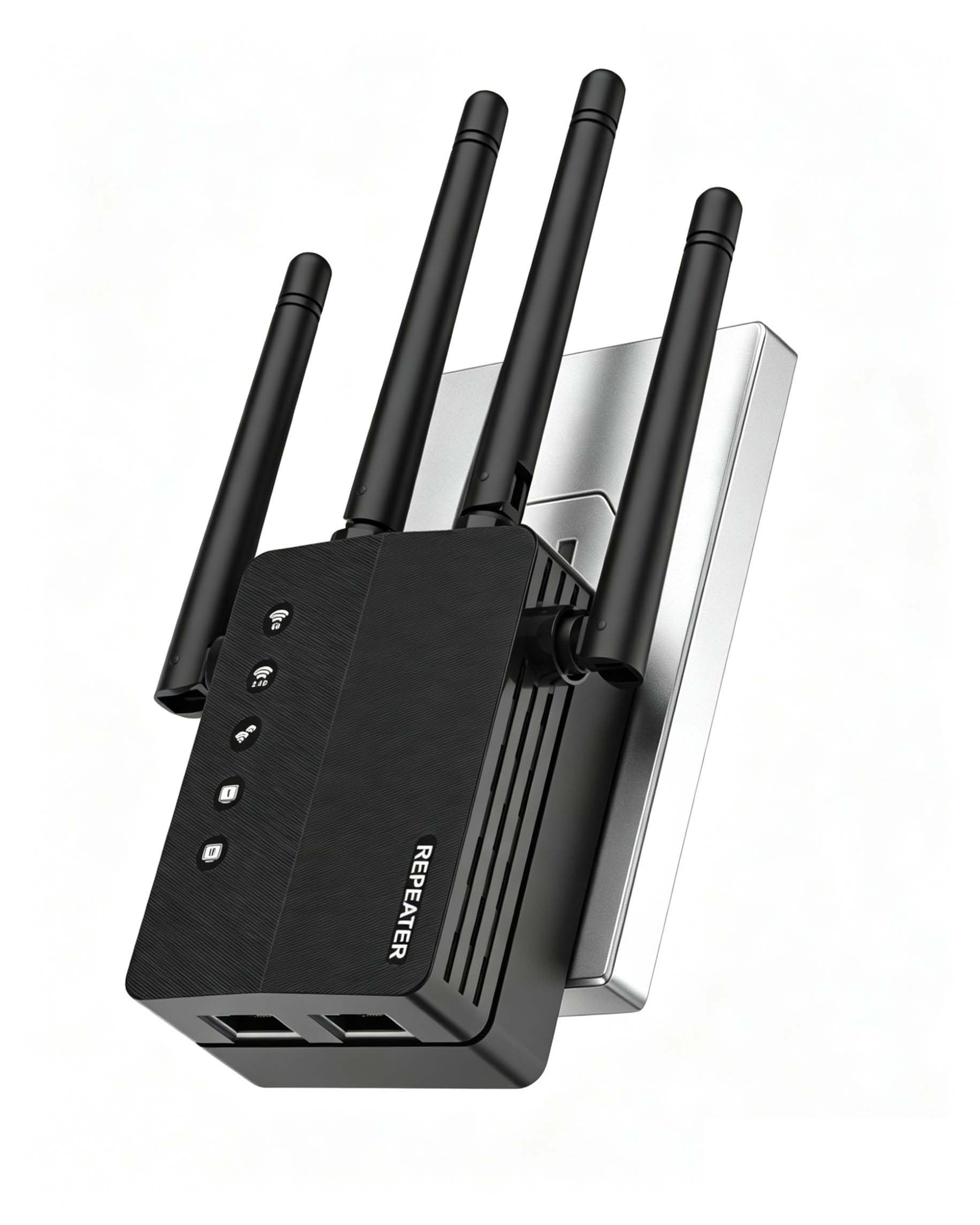
The GEYILO AC1200 extender is a dual-band unit rated for 12,880 sq. ft. of coverage with an aggregate speed of 1200 Mbps (300 Mbps on 2.4 GHz, 867 Mbps on 5 GHz). Its headline feature is support for up to 105 simultaneous devices, which is unusually high for the AC1200 class and suggests efficient MU-MIMO handling for dense smart home environments.
The extender includes two Ethernet ports (a rarity at this price point), allowing wired connections for a desktop PC and a smart TV simultaneously. Three modes are available: Repeater, AP, and a 2-port Ethernet switch mode. One-tap WPS setup pairs with a router in seconds, and WPA/WPA2 encryption secures the network. The black four-antenna design is compact and unobtrusive.
Users report eliminating dead zones across entire single-story homes, including attics, sheds, and balconies. The 5 GHz band handles streaming and gaming smoothly, while the 2.4 GHz band covers browsing and smart devices. One reviewer noted that Zoom calls no longer buffer in the back bedroom after installation. The dual Ethernet ports are frequently cited as a differentiator for homes needing wired connection points in media rooms or home offices.
Why it’s great
- Two Ethernet ports at an entry-level price point
- Supports up to 105 simultaneous devices
- One-click WPS setup with wide 12,880 sq. ft. coverage claim
Good to know
- Wi-Fi 5 technology limits per-device throughput
- Coverage claims are optimistic in dense urban environments
7. ROQRL WiFi Extender AC1200 (10,000 Sq. Ft.)

The ROQRL AC1200 extender covers up to 10,000 sq. ft. via four high-performance antennas and delivers dual-band speeds up to 1200 Mbps. It supports three operating modes — WiFi Repeater, AP, and Ethernet Port Mode — making it flexible for different network architectures. The unit is compact at 7.78 x 1.19 x 3.54 inches and weighs only 145 grams.
WPA/WPA2 security protocols with advanced encryption are included, though the extender lacks the 5.8 GHz band specificity of some competitors. Setup instructions are provided, though some users found the QR code led to a product page rather than the setup guide. The Ethernet port functions flawlessly for connecting wired devices, and the extender is compatible with a wide range of routers and devices including IP cameras, PCs, and smart TVs.
Users replacing dead brand-name extenders report that this unit works perfectly out of the box, providing full signal to downstairs areas that previously received only one bar. The extender maintained a connection in a garage hundreds of feet from the router and extended WiFi to the backyard. One reviewer noted that speed is slightly slower than the main router’s direct signal but nothing noticeable for daily browsing and streaming. This is the most accessible entry point for anyone needing to solve a single dead zone on a tight budget.
Why it’s great
- Four antennas provide solid 10,000 sq. ft. coverage
- Three versatile modes (Repeater/AP/Ethernet) for any network need
- WPA/WPA2 encryption with broad compatibility
Good to know
- Wi-Fi 5 (AC1200) caps speed potential
- Setup documentation could be clearer for first-time users
FAQ
Does a WiFi repeater halve my internet speed in half?
Can I use a Wi-Fi 7 extender with a Wi-Fi 5 router?
What is the difference between Repeater Mode and AP Mode?
Final Thoughts: The Verdict
For most users, the best wifi repeater winner is the Oaitree AX3000 WiFi 6 Extender because it brings Wi-Fi 6 OFDMA and MU-MIMO benefits to the mid-range price tier, balancing coverage and latency without requiring a premium router upgrade. If you want the absolute fastest, most future-proof setup with Wi-Fi 7 MLO and a 2.5 Gbps port, grab the TP-Link BE10000 RE653BE. And for budget-friendly whole-home coverage without breaking the bank, nothing beats the ROQRL AC1200 15,999 Sq. Ft. Extender.