
Dropped calls during client meetings, video conferences that freeze mid-sentence, and emails that refuse to send — these are the daily realities of an office trapped in a cellular dead zone. A reliable cell booster isn’t a luxury; it’s the difference between a productive workspace and a frustrating one where your phone is essentially a paperweight.
I’m Min — the co-founder and writer behind Gadgets Feed. My approach to evaluating these boosters is rooted in hundreds of hours analyzing gain specifications, coverage area claims, multi-carrier compatibility, and real-world installation feedback from commercial and home office users to separate marketing noise from genuine performance.
Whether you manage a bustling open-plan office or run a business from a basement suite, finding the right cell phone booster for office requires understanding how gain, antenna type, and carrier band support translate to reliable connectivity across multiple rooms and concrete walls.
How To Choose The Best Cell Phone Booster For Office
An office booster is a fundamentally different purchase from a vehicle or single-room signal amplifier. You need to account for building materials, floorplans, multiple carriers used by employees, and the sheer number of simultaneous connections. Three technical pillars define your decision.
Gain (dB) vs. Coverage Area (Sq Ft)
Gain, measured in decibels (dB), is the raw amplification power of the booster. Higher gain (70 dB–72 dB) allows the unit to pull a usable signal from a weaker outside source. Coverage area is the indoor square footage the booster can fill once it has that signal. A booster with 72 dB gain and an 8,000 sq ft rating can service a medium-sized office floor, but only if the outdoor antenna receives at least one bar of signal. Don’t confuse “coverage” with “gain” — a high-gain booster will beat a low-gain one in a fringe area, even if its rated square footage is smaller.
Carrier Band Support and Multi-User Capacity
Not all boosters amplify every carrier equally. Critical bands for U.S. carriers include Band 12/17 (700 MHz, Verizon/AT&T/T-Mobile), Band 5 (850 MHz, Verizon/AT&T), and Band 4/66 (1700/2100 MHz, T-Mobile/AT&T). A booster that supports all these bands is truly carrier-agnostic. For offices, the unit must also handle multiple simultaneous data sessions without performance degradation — look for Automatic Gain Control (AGC) which dynamically adjusts power to maintain stability when several users stream or call at once.
Single vs. Dual Indoor Antenna Configurations
Open-plan offices and multi-room layouts benefit from dual indoor antennas. These allow you to place one antenna in the main workspace and another in a back office, conference room, or basement area. Single-antenna systems are simpler to install and sufficient for a single large room, but they often leave dead spots in corridors or behind elevator shafts. For two-story offices or spaces exceeding 5,000 sq ft, a kit with two indoor antennas and 30+ feet of cable is non-negotiable.
Quick Comparison
On smaller screens, swipe sideways to see the full table.
| Model | Category | Best For | Key Spec | Amazon |
|---|---|---|---|---|
| HiBoost 15K 2.0 | Premium | Large Offices | 72dB Gain, 12,000 sq ft | Amazon |
| weBoost Home Complete | Premium | Reliable Brand | 7,500 sq ft, 100X Boost | Amazon |
| SureCall FusionPro | Premium | Pro Install | 72dB, 2XP Uplink Tech | Amazon |
| HiBoost 10K SL | Mid-Range | Mid-Size Offices | 6,000 sq ft, App Support | Amazon |
| HiBoost 8K | Mid-Range | Versatile Layouts | 70dB, Dual Indoor Antennas | Amazon |
| Metarepeater X1 Pro | Mid-Range | Easy Setup | 10,000 sq ft, LCD Display | Amazon |
| ZORIDA 5S Ultra | Budget | Small Offices | 72dB, 4,500 sq ft | Amazon |
| CEL-FI GO G41 | Premium | Maximum Coverage | 100dB, 15,000 sq ft | Amazon |
In‑Depth Reviews
1. Hiboost 15K 2.0 Cell Phone Booster

The HiBoost 15K 2.0 is the sweet spot for a demanding office environment. With a maximum gain of 72dB and coverage rated up to 12,000 sq ft, this kit handles two-story layouts and multi-room floorplans without breaking a sweat. The inclusion of two indoor panel antennas means you can anchor coverage in a main bullpen and still serve a rear conference room or private office.
Band support covers 2/4/5/12/13/17/25, which translates to full compatibility with Verizon, AT&T, and T-Mobile LTE and 5G DSS networks. The upgraded 400-type outdoor cable reduces signal loss over longer runs, a critical feature when the outdoor antenna must be mounted 30–50 feet from the booster unit. Users consistently report moving from 1 Mbps to 25 Mbps downloads after proper antenna alignment.
The LCD display and Bluetooth app provide real-time signal metrics and installation guidance, taking the guesswork out of positioning the outdoor Yagi antenna. The AGC (Automatic Gain Control) adjusts power dynamically, preventing oscillation feedback even when multiple devices are active simultaneously.
Why it’s great
- Two indoor antennas with industry-leading 400-type cable
- Bluetooth app with real-time signal tuning
- AGC prevents self-oscillation in multi-user scenarios
Good to know
- Does not support Band 71 (600 MHz T-Mobile)
- Installation requires mounting the outdoor antenna at least 15 ft high
2. weBoost Home Complete

weBoost is a household name in signal boosting, and the Home Complete lives up to its reputation for reliability. It’s designed to cover up to 7,500 sq ft, making it suitable for a sizable single-floor office or a smaller two-story building. The kit includes a directional outdoor antenna and an indoor panel antenna with a drill-free wall mount bracket.
Band selection targets the most common frequencies for Verizon, AT&T, and T-Mobile. Verified users report dramatic improvements — one rural user saw 30+ dB gain on AT&T, jumping from no usable data to 25–30 Mbps download speeds near the indoor antenna. Another user in a hollow with zero service achieved 3 LTE bars after mounting the outdoor antenna 18 ft high and aiming it at the nearest tower.
The weBoost app helps identify the nearest cell tower and displays signal strength before and after installation. One limitation to note: the directional antenna firmly locks onto a single carrier’s tower, so if your office has employees on different carriers, consider a booster with a wider beam or omnidirectional antenna.
Why it’s great
- Proven reliability from a top brand
- App-assisted tower location and setup
- Strong gains for AT&T and Verizon users
Good to know
- Coverage drops significantly beyond 15–20 ft from the indoor antenna
- Directional antenna locks to one carrier only
3. SureCall Fusion Professional

SureCall’s Fusion Professional is built for the commercial installer or the office manager who wants a bulletproof system. It covers up to 8,000 sq ft and features SureCall’s patented 2XP technology, which doubles the uplink power — critical for maintaining stable data connections when multiple staff are uploading files or joining video calls from weak-signal zones.
The kit ships with a Yagi outdoor antenna and a panel indoor antenna, both built with high-quality components. SureCall designs and assembles its units in Silicon Valley, and the attention to detail shows in the robust metal housing and weather-sealed connectors. Band support covers 698–2155 MHz, encompassing all major U.S. carrier bands.
Users praised the boost for T-Mobile voice and data, with one ham radio operator noting that after installation, speed and signal-to-noise ratio dramatically improved. The downside is that installation complexity is higher — the Yagi antenna requires precise aiming, and some users advise using external tower-finding apps (like Open Signal) to locate the best signal before mounting.
Why it’s great
- 2XP uplink technology for stable multi-user performance
- Assembled in the USA with high-quality components
- Covers all major carrier bands
Good to know
- Installation requires careful antenna aiming
- Heavier unit (11 lbs) than most competitors
4. HiBoost 10K SL Cell Phone Booster

The HiBoost 10K SL occupies a smart middle ground for mid-size offices around 4,000–6,000 sq ft. It provides 5G and 4G LTE amplification across bands 2/4/5/12/13/17/25, covering all major U.S. carriers. The “SL” in the name stands for slim line — the unit is compact enough to mount discreetly on a wall or shelf.
What sets this model apart is the Signal Supervisor app and onboard LCD screen. You can monitor booster status, signal strength, and gain settings remotely from your phone, which is invaluable for troubleshooting without climbing a ladder. The kit includes a directional outdoor antenna and a through-window cable that avoids drilling if you have a suitable window.
Real-world performance is strong: one user in a forested valley went from less than 1 Mbps to 25 Mbps downloads after tuning the antenna via the Bluetooth app. The AGC system kept the signal stable even with multiple devices streaming.
Why it’s great
- App and LCD screen for remote monitoring
- Through-window cable option for drill-free install
- Stable AGC for multi-device offices
Good to know
- Coverage limited to 6,000 sq ft
- Outdoor antenna cable is only 30 ft
5. Hiboost 8K Cell Phone Booster

The HiBoost 8K is a proven workhorse that balances coverage (8,000 sq ft), gain (70dB), and price. It comes with two indoor antennas — one panel and one built into the main unit — which effectively covers 5–6 rooms. This configuration is ideal for an office with a large main room plus several smaller side offices.
Band support is identical to the 10K SL and 15K 2.0 models, ensuring true carrier-agnostic performance. The AGC system intelligently adjusts gain to prevent feedback, and the LCD screen provides real-time installation feedback. Users consistently report going from 1–2 bars to 4–5 bars in basements and metal buildings.
One thoughtful inclusion is the through-window cable, which allows the outdoor antenna cable to pass through a closed window without drilling. This is a lifesaver for rented office spaces where permanent modifications are not allowed. The only catch is that the 70dB gain is slightly lower than the 72dB found on the top-tier models, which can matter in fringe areas with extremely weak outside signal.
Why it’s great
- Dual indoor antennas for multi-room coverage
- Through-window cable for renters
- Proven 5-bar improvement in challenging environments
Good to know
- 70dB gain not as high as 72dB models
- USB 2.0 connector limits data transfer
6. Metarepeater X1 Pro

Metarepeater’s X1 Pro is a strong contender for offices that want an easy installation process without sacrificing coverage. It’s rated for up to 10,000 sq ft and includes two indoor antennas, a splitter, and 30 ft of RG6 cable for each antenna. The 70dB max gain ensures solid amplification for medium-sized offices in suburban or exurban areas.
The standout feature is the large 4.3-inch HD LCD screen. It displays real-time signal strength, gain levels, and troubleshooting prompts — essentially guiding you through installation like a co-pilot. The AGC (Automatic Gain Control) automatically adjusts performance to prevent oscillation when multiple devices are active.
Band support covers 12/17, 13, 5, 4/66, and 2/25, making it compatible with all the major carriers. Users in metal buildings (like barndominiums) reported that the X1 Pro solved their complete signal block, and property owners with wooded, multi-building lots saw immediate coverage improvements. The main complaint is that the 5G DSS support is conditional on the carrier’s deployment in your area, so verify before purchasing.
Why it’s great
- Large LCD screen simplifies installation
- Two indoor antennas with long cables
- AGC prevents oscillation in busy offices
Good to know
- 5G support depends on carrier’s 4G band deployment
- Some users report coverage below 10,000 sq ft in dense structures
7. ZORIDA 5S Ultra Cell Phone Booster
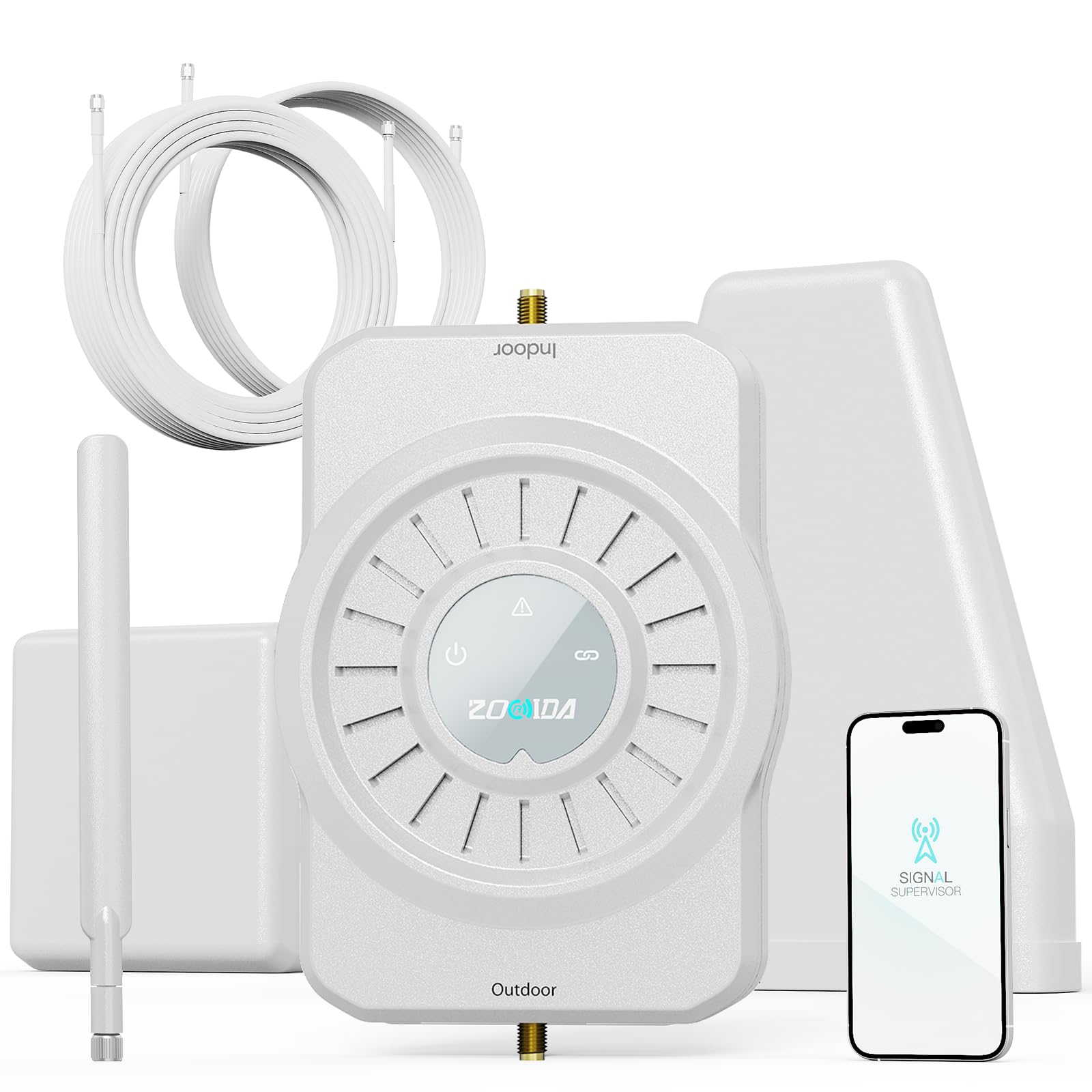
The ZORIDA 5S Ultra punches above its weight class with 72dB gain — the same amplification power as the premium HiBoost 15K — but is designed for smaller spaces up to 4,500 sq ft. This makes it an excellent fit for a single-floor office suite, a basement workspace, or a small medical practice where the budget is tighter.
It supports all major U.S. carriers across bands 12/17/13/5/25/2/4, ensuring your entire team benefits regardless of their provider. The ZORIDA app provides step-by-step installation guidance with real-time signal measurements, and the US-based technical support team is frequently praised in reviews for being responsive and helpful.
Real users in semi-rural areas reported going from 1–2 bars to 5 solid bars, with clear calls and HD streaming. The 3-year warranty and 90-day return policy provide peace of mind. The trade-off is the single indoor antenna — you’ll get strong coverage in one primary area, but may need to reposition the indoor antenna to cover a second room effectively.
Why it’s great
- 72dB gain at a competitive price point
- App-based installation with real-time signal meter
- 3-year warranty and US-based tech support
Good to know
- Single indoor antenna limits multi-room coverage
- Requires 30+ ft horizontal separation between antennas
8. CEL-FI GO G41
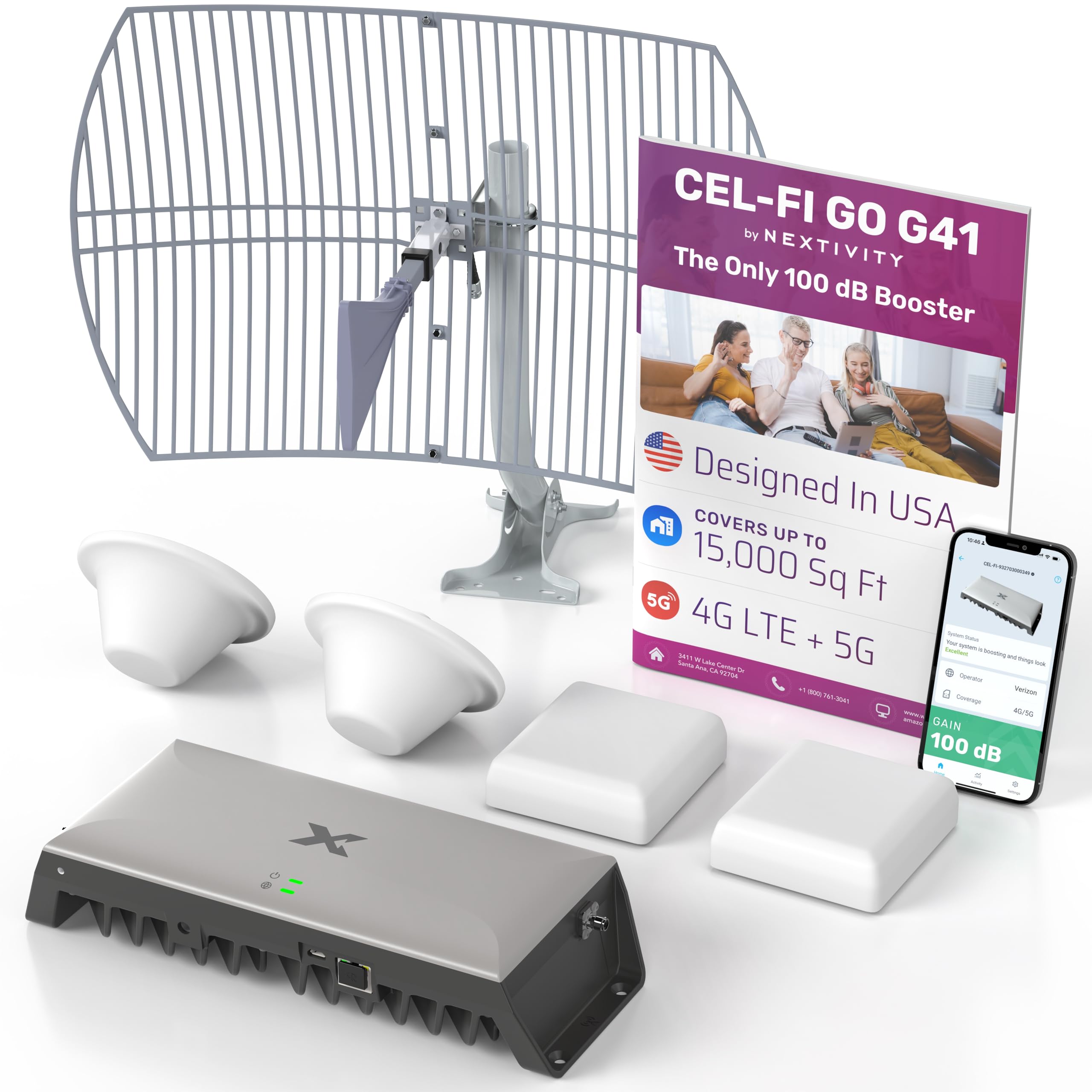
The CEL-FI GO G41 is an industrial-grade solution for the most demanding office environments. It’s the only booster in this lineup with a true 4th-generation IntelliBoost chipset, supporting 4G LTE, 5G-DSS, and 5G NR.
The kit includes two dome and two panel antennas (you choose which to deploy), plus a heavy-duty outdoor grid antenna. This flexibility allows you to optimize for either omnidirectional coverage in an open plan or directional coverage across a multi-wing office. Coaxial cables of professional-grade length are included, supporting long runs from roof to closet.
In extreme rural settings, users reported going from zero usable service to 3–4 bars of consistent 4G LTE across a 2,000 sq ft farmhouse, with enough bandwidth for Netflix streaming. The trade-off is cost and installation complexity — expect to spend a full day mounting antennas and routing cables, and be prepared for a steeper learning curve with the WAVE app for tower alignment.
Why it’s great
- 100 dB gain — 30 dB more than any competitor
- True 5G NR support with 4th-gen chipset
- Multiple antenna options for custom coverage
Good to know
- Very expensive initial investment
- Installation requires professional-level effort
- May not work with carrier aggregation on some bands
FAQ
Can I use a vehicle cell booster in my office?
Will a cell booster work if I have no signal outside at all?
What is FCC certification and why does it matter for office boosters?
How do I prevent oscillation (feedback loop) between indoor and outdoor antennas?
Do I need one booster per carrier in a multi-carrier office?
Final Thoughts: The Verdict
For most users, the cell phone booster for office winner is the HiBoost 15K 2.0 because it delivers 72dB gain, two indoor antennas, app-based tuning, and coverage for up to 12,000 sq ft — enough for a dynamic, multi-room office without jumping to the extreme premium tier. If you need a reliable brand with straightforward setup and 7,500 sq ft of coverage, grab the weBoost Home Complete. And for a budget-friendly 4,500 sq ft workspace with impressive 72dB gain, nothing beats the ZORIDA 5S Ultra.