
Forgetting to carry an umbrella is one thing; trusting a vague weather app over live data from your own backyard is another. A 5-in-1 weather sensor cuts through the uncertainty by consolidating temperature, humidity, wind speed, wind direction, and rainfall into a single rugged outdoor unit, giving you hyperlocal conditions that town-wide forecasts always miss.
I’m Min — the co-founder and writer behind Gadgets Feed. I’ve spent months cross-referencing technical specifications, transmission protocols, and sensor accuracy claims to find the models that actually deliver reliable data through every season.
Whether you tend a garden, manage a farm, or simply hate being caught off guard by sudden downpours, choosing the right 5 in 1 weather sensor means understanding which build quality, wireless range, and solar-assist features genuinely improve daily accuracy.
How To Choose The Best 5 In 1 Weather Sensor
A 5-in-1 sensor seems simple — mount it, read data. But accuracy, durability, and how the data reaches your console vary enormously across models. Focus on these three factors before deciding.
Wireless Protocol and Range
Dedicated 433 MHz radios (used by AcuRite) punch through walls and rain better than standard Wi-Fi and typically achieve 330 feet of open-air range. Wi-Fi sensors, like the VEVOR, allow app-based remote monitoring but may require a 2.4 GHz network and can suffer interference from crowded home bands. Choose RF if your console sits far from the sensor; choose Wi-Fi if you want to check conditions from anywhere.
Solar Aspiration and Temperature Accuracy
A sensor sitting in direct sun without active airflow reports temperatures several degrees too high. Premium models use a solar-powered fan (aspirator) to pull ambient air over the thermometer. The standard AcuRite Iris lacks this; the Iris PRO+ adds a dual-panel aspirator that drops temperature error from 8–10°F to under 2°F on sunny afternoons. If you care about precision, solar aspiration is non-negotiable.
Sensor Lifespan and Battery Strategy
Outdoor electronics face UV, freezing rain, and 100°F temperature swings. Budget sensors often fail within 18–24 months when moisture seeps into the battery compartment. Look for models with IPX6-rated housings (the VEVOR), user-replaceable sensors, and lithium battery recommendations. A unit that lasts 7 years without drifting — like the AcuRite Iris — proves that initial build quality outweighs any cheap upfront saving.
Quick Comparison
On smaller screens, swipe sideways to see the full table.
| Model | Category | Best For | Key Spec | Amazon |
|---|---|---|---|---|
| AcuRite Iris PRO+ (06014M) | Premium Sensor | Accurate temp readings in direct sun | Dual solar panels + aspirator fan | Amazon |
| AcuRite Iris (06004M) | Mid-Range Sensor | Replacing a failed sensor on old display | 433 MHz, 330-ft range | Amazon |
| AcuRite 01512M | Full Console Bundle | All-in-one station with color display | 55+ data points, color LCD | Amazon |
| AcuRite 01517RM | Premium Bundle | Comprehensive home weather station | Weather Ticker, 20,000-hr batt life | Amazon |
| VEVOR Wi-Fi Station | Wi-Fi Value | Remote app access on a budget | IPX6, 492-ft range, 7.5-in display | Amazon |
| Bresser PC Station | PC-Connected | USB data logging to computer | USB out, 868 MHz, LED backlight | Amazon |
In‑Depth Reviews
1. AcuRite Iris PRO+ (5-in-1) Weather Sensor (06014M)
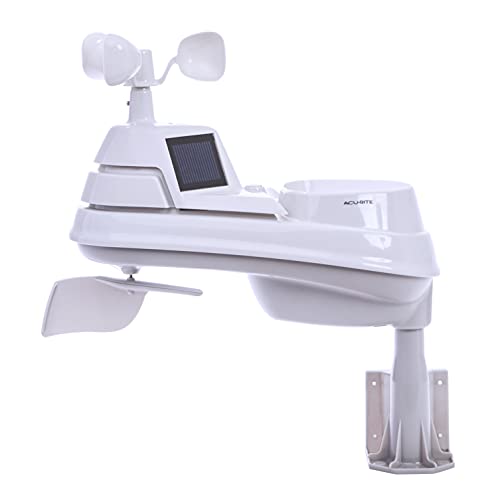
The Iris PRO+ is the sensor that solves the single biggest flaw in budget weather stations: solar-induced temperature error. Its dual solar panels power a built-in aspirator fan that actively pulls ambient air across the thermometer, keeping readings within 1–2°F of true ambient temperature even when the sensor sits in full midday sun. The standard Iris version, without aspiration, can report temperatures 8–10°F too high in the same conditions.
This is a sensor-only unit transmitting at 433 MHz every 36 seconds over a 330-foot range. It pairs with any existing AcuRite 5-in-1 display or the AcuRite Access hub for online data. Build quality is robust — owners report 7-year lifespans before the temperature sensor drifts, though a few note that the aspirator fan can fail after 18 months in windy coastal environments. Four AA batteries deliver roughly 5,000 hours of operation; lithium cells help performance in sub-freezing weather.
If you already own an AcuRite console and want the most accurate temperature readings your budget can buy without replacing the whole station, the PRO+ is the definitive upgrade. It costs more upfront than the standard Iris, but the dual-panel fan eliminates one of the few real accuracy compromises in this ecosystem.
Why it’s great
- Dual-panel aspirator fan prevents solar-heating bias on temp readings
- Drop-in replacement for any AcuRite 5-in-1 display console
- Proven 5000-hour battery life with proper lithium cells
Good to know
- Aspirator fan can fail prematurely in high-salt or high-wind environments
- No console included — requires separate display or Access hub
- Does not measure wind gusts, only sustained speed
2. AcuRite 01512M Wireless Weather Station

The 01512M bundles AcuRite’s standard Iris 5-in-1 sensor with a large color LCD display console that surfaces over 55 data points: indoor/outdoor temperature and humidity, wind speed and direction, barometric pressure with trend arrows, rainfall totals, heat index, dew point, and a personalized 12-hour forecast based on your elevation and pressure trends. The color-coded display makes it easy to spot heat waves or pressure drops at a glance.
Setup takes about 15 minutes — mount the sensor on a pole, insert four AA batteries, and the console self-pairs. The console includes adjustable brightness and a weather ticker that scrolls moon phase and comfort level, though the ticker text is small enough that you need to be within a few feet to read it. Some owners note that the single solar panel on the standard Iris sensor can overheat the housing, causing temperature readings to run high on still, sunny days — a limitation shared by the 06004M sensor.
For anyone buying their first complete weather station, this bundle delivers the most intuitive console experience and the broadest data set at this price tier. The trade-off is the sensor’s thermal accuracy ceiling.
Why it’s great
- Complete system with color console — no separate display purchase needed
- 55+ data points including heat index, dew point, and pressure trends
- Color-coded alarm thresholds for temperature and wind
Good to know
- Standard Iris sensor lacks aspirator fan — temp can read high in sun
- Weather ticker text is very small on the console
- Console needs AC power; battery backup runs only for short outages
3. AcuRite 01517RM Wireless Weather Station

The 01517RM builds on the 01512M platform by adding a richer feature set and longer battery life estimates (20,000 hours in the sensor). The illuminated color display includes an adjustable dimmer for night viewing and a Weather Ticker that scrolls real-time data streams — moon phase, feels-like temperature, indoor comfort level, and historical rainfall totals by day, month, year, and all-time. The console also tracks wind chill and dew point without extra buttons.
Owners consistently praise the temperature accuracy, which closely matches local NOAA readings after the sensor auto-calibrates to its elevation. The sensor mounts easily on a 3/4-inch galvanized pipe or deck post. One common criticism: the display’s viewing angle is narrow, making it hard to read from across a room or from a seated position. The console loses all user settings during a power interruption unless battery backup is installed, and there is no Wi-Fi or app access on this model — data lives only on the console.
This is the best choice for someone who wants a polished, self-contained station with deep historical tracking and does not need remote smartphone monitoring. The sensor reliability is proven across many years of user reports.
Why it’s great
- Long 20,000-hour sensor battery life with lithium cells and solar assist
- Comprehensive rainfall tracking by day, month, year, and all-time
- Auto-calibrates to elevation for accurate barometric forecast
Good to know
- Narrow console viewing angle — wall mounting recommended
- No Wi-Fi or app connectivity; no remote data access
- Console drops settings if AC power is lost and no backup batteries installed
4. VEVOR 5-in-1 Wi-Fi Weather Station
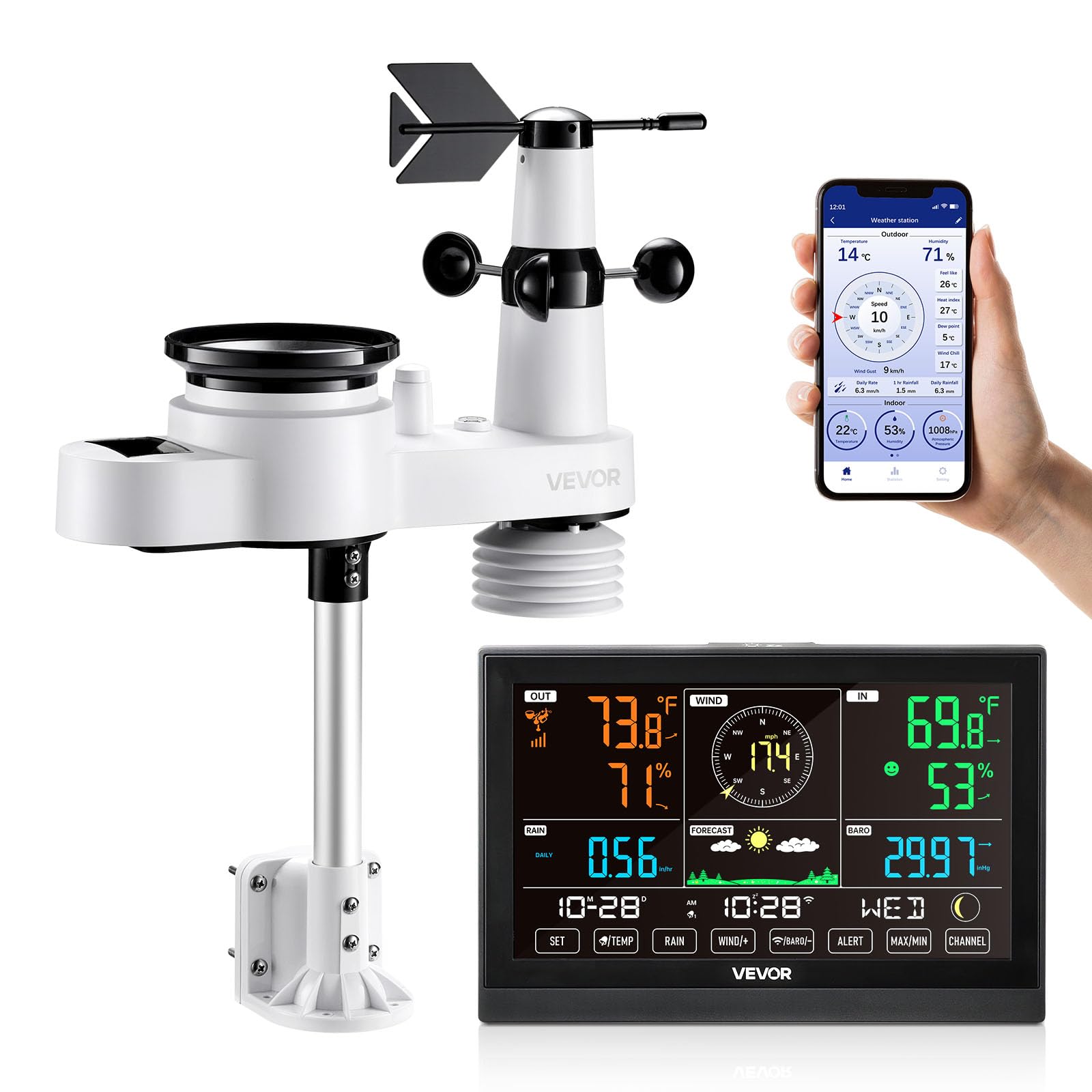
The VEVOR brings two things to the table that AcuRite bundles don’t: native Wi-Fi with smartphone app integration and an IPX6 waterproof rating on the outdoor sensor. The 7.5-inch HD console display shows temperature, humidity, wind, and rainfall along with moon phases and a 6–12 hour forecast. Through the Smart Life app (2.4 GHz only), you can view, store, and share data remotely — a feature that normally costs twice as much in dedicated weather systems.
The sensor uses an ultrasonic transducer for wind measurement rather than mechanical cups, which reduces moving-part failures. Solar panel keeps the battery charged during daylight; when the sun drops, three AA batteries take over. Range is rated at 492 feet, comfortably exceeding the AcuRite 330-foot limit. Some owners note that the included mounting bracket could be more robust, and the plastic housing feels slightly less premium than AcuRite’s polyresin construction.
If app-based monitoring is your priority and you want the lowest-cost entry point into a connected weather station, the VEVOR delivers reliable data with a solid IPX6 seal against rain intrusion. It’s a strong mid-range value for farms, gardens, and remote monitoring.
Why it’s great
- Native Wi-Fi and smartphone app for remote data access
- IPX6 weatherproof housing resists heavy rain and moisture ingress
- Ultrasonic wind sensor — no mechanical cups to wear out
Good to know
- Wi-Fi requires 2.4 GHz band — no 5 GHz or mesh compatibility
- The plastic mounting bracket is less sturdy than metal alternatives
- Sensor must remain plugged into adapter for real-time clock sync
5. AcuRite Iris (5-in-1) Weather Sensor (06004M)
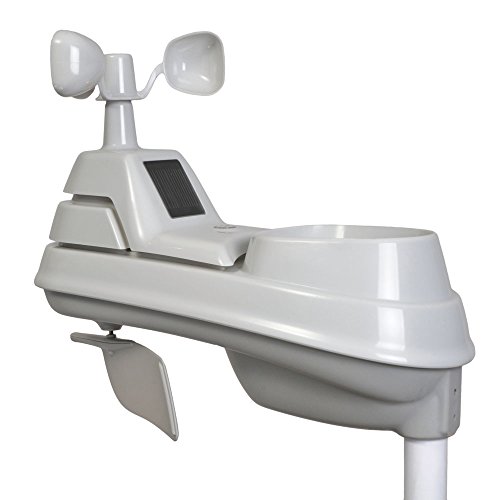
The standard AcuRite Iris 06004M is the sensor-only version designed for people whose display console is still working but whose outdoor sensor has died. It transmits the same five weather parameters on 433 MHz at 36-second intervals, with a 330-foot open-air range. Because it matches the older sensor’s protocol exactly, it pairs instantly without reprogramming — a clean, one-to-one swap.
Many owners report the standard Iris lasting 7+ years before the temperature sensor drifts to a -40°F error state, at which point replacing this sensor is cheaper than shipping the original for repair. The unit uses four AA batteries for roughly 5,000 hours; the single solar panel helps extend battery life but does not power an aspirator fan, so direct-sun temperature readings still run a few degrees warm. There is no wind gust measurement — only sustained speed — which is a common omission at this price.
If your AcuRite console is still going strong and you need the most straightforward, compatible replacement sensor on the market, the 06004M is the logical purchase. It keeps your existing station alive without any setup headache.
Why it’s great
- Drop-in replacement for older AcuRite 5-in-1 displays — zero configuration
- Proven 7-year lifespan in real outdoor use across multiple climates
- Solar panel extends AA battery life to roughly 5,000 hours
Good to know
- No solar aspirator — temperature reads high in direct afternoon sun
- Does not report wind gust data, only average wind speed
- No console included; requires an existing AcuRite display
6. Bresser 5-in-1 PC Weather Station
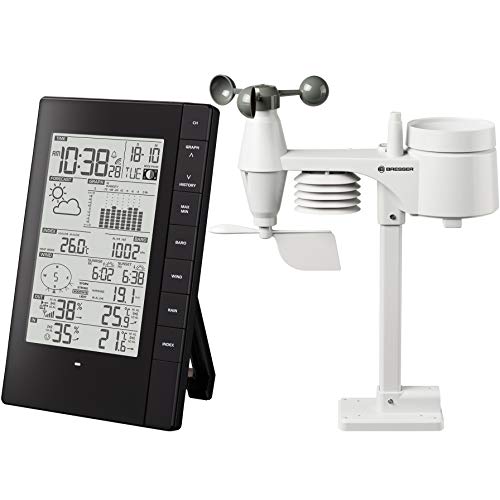
Bresser takes a different approach: instead of a standalone console, this station sends data over USB to your PC. The base station includes a built-in display with LED backlight (activated by a button on top), and the 5-in-1 outdoor sensor measures temperature, humidity, wind speed, wind direction, atmospheric pressure, and precipitation. The system displays moon phases, sunrise/sunset times, and a 24-hour weather forecast alongside live readings.
For data loggers, the USB output works with third-party software like Weewx (via WS6in1 driver) for archiving and sharing online via Weathercloud. However, Bresser’s own Weather Tools software has known stability issues on Windows 10 and Windows 7, which frustrates users who want a native PC interface. The sensor runs on three AA batteries (plus six more for the console, which can also run off USB power). The 868 MHz frequency provides clean transmission at up to 40 meters, though the range is shorter than AcuRite’s 330 feet.
This is a niche pick for the PC-centric weather enthusiast who is comfortable troubleshooting software quirks. If you want reliable out-of-the-box live data streaming, a dedicated console model is simpler. But for hardcore logging and cloud publishing, the Bresser’s USB connectivity is unmatched in this price tier.
Why it’s great
- USB output allows direct PC data logging without additional hubs
- Compatible with Weewx and Weathercloud for online publication
- LED backlight on console activates with a single button press
Good to know
- Bresser’s Weather Tools software crashes frequently on modern Windows
- Shorter wireless range (40m) compared to AcuRite’s 100m
- No dedicated mobile app; data access requires a PC
FAQ
Why does my weather sensor read 10 degrees too high in sunlight?
Can I use an old AcuRite display with a new 5-in-1 sensor?
How often should I replace the batteries in a 5-in-1 sensor?
Final Thoughts: The Verdict
For most users, the 5 in 1 weather sensor winner is the AcuRite Iris PRO+ (06014M) because its dual-panel aspirator fan delivers the most accurate temperature readings in direct sunlight, the feature that makes or breaks a real weather station. If you want a complete console bundle without hunting for separate parts, grab the AcuRite 01512M. And for remote app-based monitoring at a low entry cost, nothing beats the VEVOR Wi-Fi station.