
A 220-volt thermostat isn’t just a switch for your baseboard heater — it’s the brain that decides whether you burn cash on electricity or stay quietly comfortable all winter. The wrong choice means rooms that fluctuate between sauna and icebox, or a unit that fails to fully disconnect power, leaving a dangerous live circuit even when the dial says “off.”
I’m Min — the co-founder and writer behind Gadgets Feed. I’ve analyzed hundreds of line-voltage thermostat spec sheets from Stelpro, Honeywell, Mysa, and King to build a guide that separates precise electronic control from dated bimetal mechanics that drift by six degrees or more.
This guide ranks the most accurate, safest, and easiest-to-install models on the market so you can find the ideal best 220 volt thermostat for your heating system and never waste another watt on poor regulation.
How To Choose The Best 220 Volt Thermostat
Heating an entire home with electric baseboards means your thermostat is the single most impactful device for both comfort and monthly costs. A dated mechanical thermostat can drift by 6°F, forcing your heater to overcompensate constantly. Here are the three specs that matter most.
Single-Pole vs. Double-Pole Wiring
A single-pole thermostat breaks only one leg of the 220V supply. When the dial is turned to Off, the heater still sits at line voltage — a shock hazard for anyone who assumes a cold heater is a dead heater. A double-pole model, like the Stelpro SWT2F, breaks both hot wires and delivers a true disconnect. If you’re in a region with strict electrical codes, double-pole is non-negotiable.
Mechanical vs. Electronic (TRIAC) Sensing
Mechanical bimetal strips are cheap but sloppy — they swing 5–6°F before cycling the heater on or off. Electronic thermostats like the Honeywell RLV3150 use a TRIAC to modulate power silently, holding temperature within ±0.3°C. The energy saving comes from eliminating the overshoot that mechanical units depend on.
Programmable vs. Non-Programmable
A non-programmable thermostat is fine for a workshop you only visit occasionally. For a living space, a 7-day programmable unit or a Wi-Fi model with geofencing can cut heat output automatically when you leave and resume before you return. The Mysa LITE and Meross Smart Thermostat both let you set schedules from an app and track per-room energy usage in watts.
Quick Comparison
On smaller screens, swipe sideways to see the full table.
| Model | Category | Best For | Key Spec | Amazon |
|---|---|---|---|---|
| Honeywell RLV3150A1004 | Non-Programmable | Precise silent control | 3000W @ 240V / TRIAC | Amazon |
| Meross Smart Thermostat | Wi-Fi Programmable | Smart home & energy tracking | 3840W @ 240V / 16A | Amazon |
| Mysa Smart Thermostat LITE | Wi-Fi Programmable | Multi-room scheduling | 7-day schedule / HomeKit | Amazon |
| King ES230-R MAX22 | Electronic Non-Prog | High-amp baseboards | 22A / 3-wire / backlit | Amazon |
| Honeywell RLV4305A1014 | 5-2 Programmable | Silent, accurate scheduling | 3500W @ 240V / TRIAC | Amazon |
| Dayton 6EDY5 | Mechanical | Freezer / well house duty | 20A / SPDT / rugged | Amazon |
| Stelpro SWT2F | Mechanical Double-Pole | Full safety disconnect | 22A / 50–90°F dial | Amazon |
In‑Depth Reviews
1. Honeywell Home RLV3150A1004

The RLV3150 uses a TRIAC instead of a clicking mechanical relay, so it switches the load silently at zero-crossing points — no audible click, no relay chatter, and far tighter regulation. It holds temperature within ±0.3°C, which eliminates the 5–6°F overshoot that bimetal dials produce. For a non-programmable unit, this is the gold standard for comfort.
Installation is a straightforward 2-wire non-polarized connection. The backlit display shows current room temperature by default, and the push-button interface is intuitive enough to set without the manual. It supports up to 3000W at 240V, which covers most residential baseboard zones up to 12.5 amperes.
The only catch is the minimum-load requirement of 500W. Fan-forced heaters that draw less than 2A may not trigger the TRIAC reliably, so verify your heater’s wattage before buying. If it passes that check, this is the quietest, most accurate non-programmable option available.
Why it’s great
- Silent TRIAC switching with zero relay noise
- ±0.3°C accuracy eliminates temperature swings
- Easy 2-wire install with backlit display
Good to know
- Requires a 500W minimum load to function
- No physical On/Off switch — must dial to lowest setpoint
2. Meross Smart Thermostat
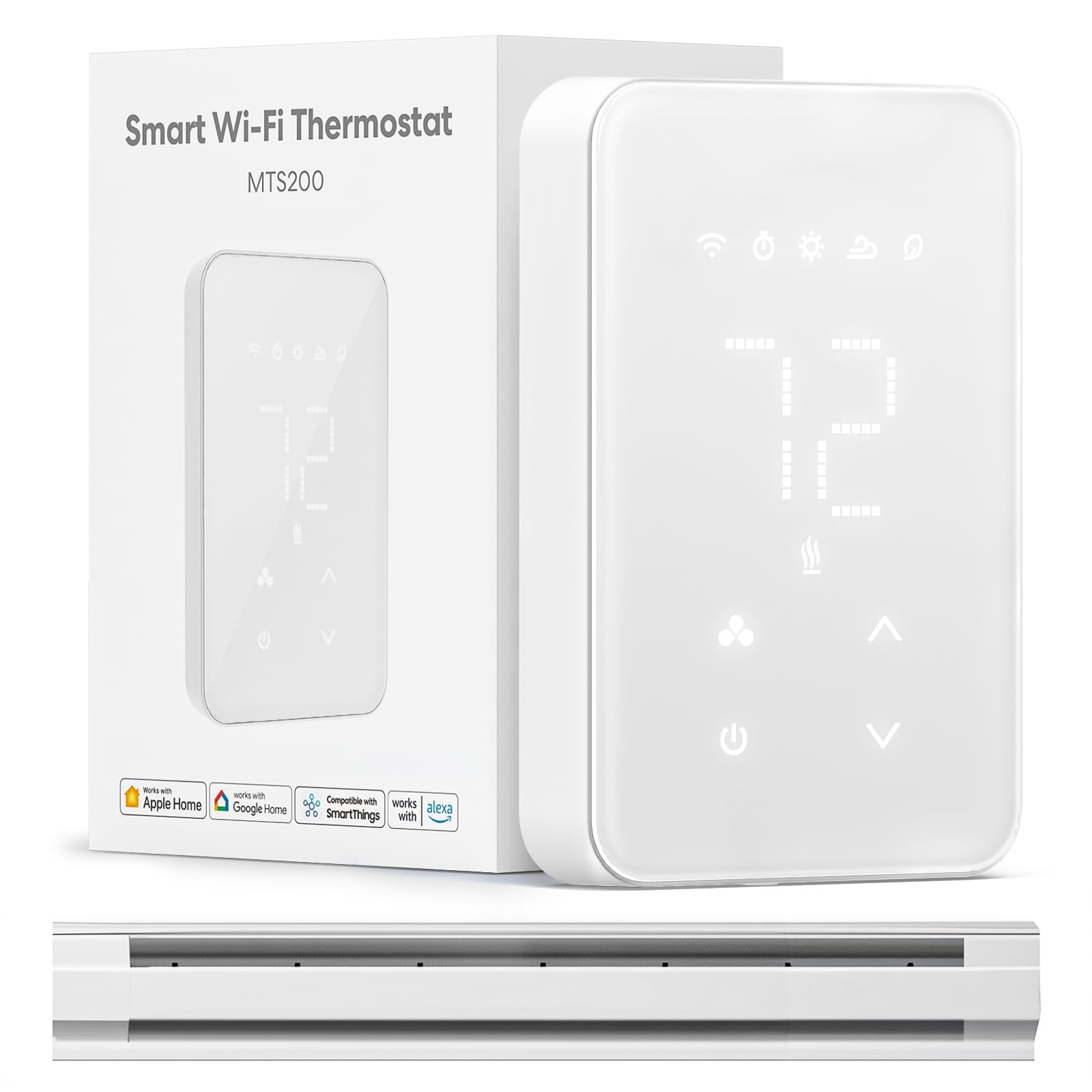
The Meross is the most affordable smart thermostat that works natively with Apple HomeKit, Alexa, Google Home, and SmartThings — no hub required. It handles up to 3840W at 240V (16A), which is enough for large baseboard zones or even multiple heaters on one circuit. The white LCD display is clean and flush-mounted, blending into any wall.
Beyond basic scheduling, the Meross app includes an energy monitor that charts power consumption in real-time, an open-window detection mode that pauses heat when it senses a rapid temperature drop, and a summer mode for systems with integrated cooling. The 1°F accuracy and adjustable differential let you fine-tune how often the heater cycles.
Wiring requires 4 or more wires in the electrical box (neutral plus two line wires and a load wire), which is more demanding than a 2-wire mechanical swap. If your junction box only has two wires, this model won’t work without running a new cable. Verify your box wiring before ordering.
Why it’s great
- Full smart-home ecosystem (HomeKit, Alexa, Google)
- Built-in energy monitor tracks kWh usage
- Open-window detection saves heat automatically
Good to know
- Requires 4-wire electrical box — not a drop-in for 2-wire systems
- Needs 2.4 GHz Wi-Fi; no 5 GHz support
3. Mysa Smart Thermostat LITE
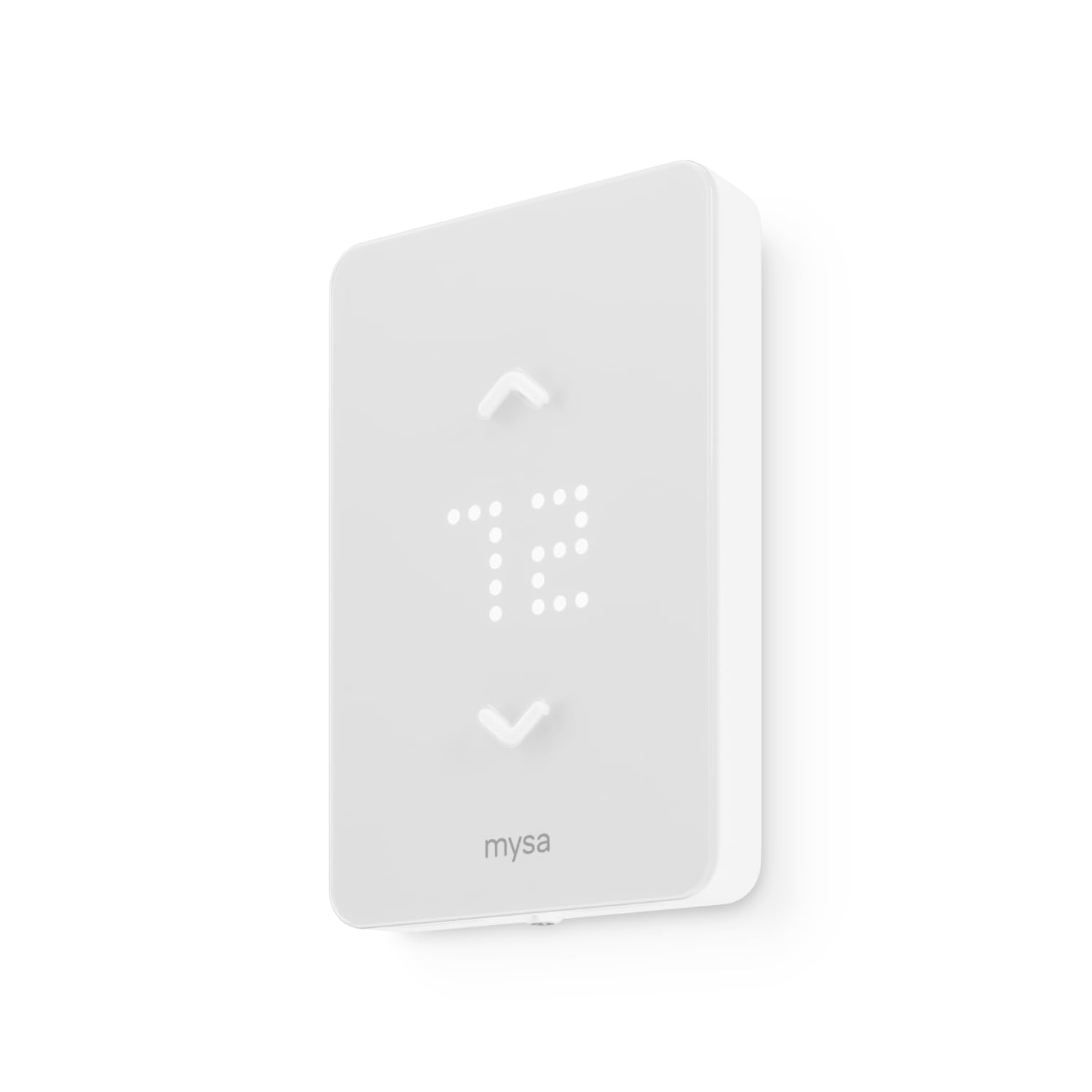
Mysa designed the LITE specifically for electric baseboard heaters in 120V–240V systems, supporting both single-pole and double-pole wiring. The app-based installation wizard guides you through every step, and most users have it running in under 15 minutes. The faceplate is generously sized with large physical buttons that respond instantly — no frustrating touch delays like earlier Mysa models.
Where the LITE truly shines is scheduling. You can create a custom 7-day program with up to six setpoints per day, and the geofencing feature automatically lowers the temperature when your phone leaves the home perimeter. The free monthly runtime report emails you a breakdown of which rooms consumed the most energy, so you can adjust schedules without guessing.
The LITE is slightly less feature-rich than the full Mysa V2 — it lacks a humidity sensor and grouped multi-room control within a single app view. For most homeowners, the LITE’s combination of physical buttons, robust scheduling, and 5-year warranty makes it the smarter buy over the flagship model.
Why it’s great
- Excellent 7-day scheduling with geofencing
- Physical buttons are more responsive than touch
- 5-year manufacturer warranty included
Good to know
- No humidity sensor or adaptive display
- Multi-room grouping only in the full Mysa app
4. King ES230-R MAX22

The King ES230-R is a 3-wire electronic non-programmable thermostat rated for 22 amps at 208/240V — the highest capacity in this roundup. That makes it the go-to for oversized baseboard heaters or commercial-grade fan-forced units that would exceed the 16A limit of most smart thermostats. The 3-wire design uses a dedicated neutral to power the display, leaving both hot legs switched for a true disconnect.
Temperature accuracy is excellent: the electronic sensor keeps the room within 1.5°F of the setpoint, and the 3-minute cycle rate prevents the short-cycling that plagues cheap mechanical units. The color-changing backlight glows red at 75°F and blue at 65°F, giving an instant visual cue without walking up to the display. A physical System On/Off switch provides a hard power cut for servicing.
Installation requires three wires (two line, one load, plus neutral), which rules out 2-wire replacement. Some users report the display temperature reading slightly off — up to 2°F — but the actual control temperature remains accurate. If you need high amperage and absolute reliability, this is the best non-programmable choice.
Why it’s great
- Industry-leading 22A capacity for heavy loads
- Color-changing backlight for at-a-glance feedback
- On/Off switch for safe servicing
Good to know
- Requires 3-wire + neutral — not a 2-wire retrofit
- Display temperature may read 2°F high for some users
5. Honeywell RLV4305A1014
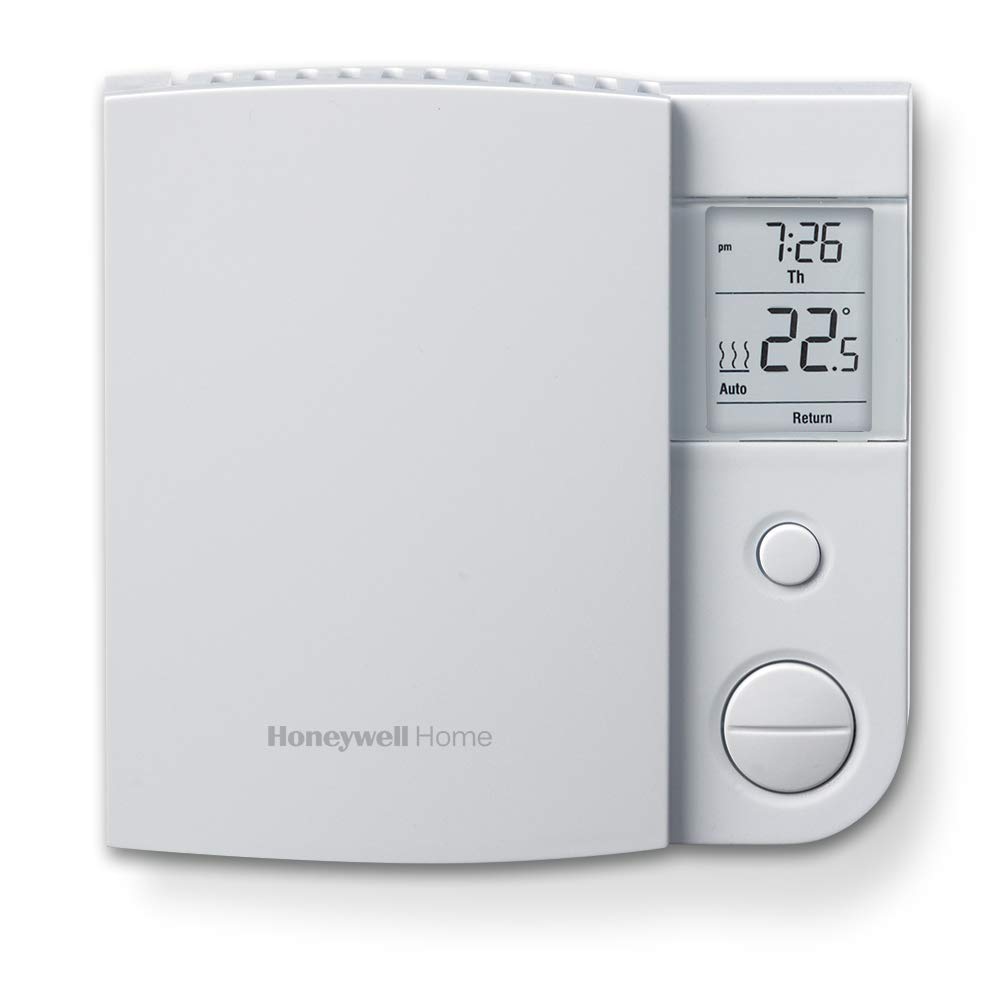
The RLV4305 is the programmable sibling of the RLV3150. It keeps the same TRIAC switching technology for silent, drift-free temperature control within ±0.3°C, but adds a 5-2 day schedule — one program for weekdays and a separate program for weekends. The backlit display makes setup simple, and the temporary override button lets you bump the temperature for a few hours without altering the main schedule.
Power handling reaches 3500W at 240V (14.6A), which is enough for most residential baseboard zones. The 2-wire non-polarized installation is identical to the RLV3150, making it an easy swap. The matte white finish blends with standard decor, and the push-button interface is responsive without feeling cheap.
One caution: a small number of users reported catastrophic failure during installation. While this is not representative (the overwhelming majority of reviews are positive), the risk makes it worth double-checking your wiring is correct before connecting power. If you want the comfort of a TRIAC with weekday/weekend scheduling, this is the most affordable programmable option.
Why it’s great
- Silent TRIAC with ±0.3°C accuracy
- 5-2 day programming for work/life schedules
- Easy 2-wire install with temporary override
Good to know
- Some wiring issues reported with faulty units
- No Wi-Fi or app connectivity
6. Dayton 6EDY5

The Dayton 6EDY5 is a straightforward mechanical line-voltage thermostat with a single-pole double-throw (SPDT) snap-acting contact rated for 20 amps. It can be wired for either heating or cooling (selectable by a jumper), making it a rare find for a 220V thermostat. The plastic enclosure is thick and durable, with a 1/2-inch threaded conduit opening and four mounting tabs for secure installation in harsh environments.
This is not a thermostat for your living room. The mechanical bimetal strip has a wider differential — around 3–4°F — which produces noticeable temperature swings. But for a workshop, greenhouse, well house, or garage where precise comfort isn’t critical, the rugged construction and simple wiring make it incredibly reliable. It’s also freeze-protection capable: set it to 40°F and forget it.
The main tradeoff is availability and price — it’s often cheaper from industrial distributors than on Amazon. If you’re comfortable with the mechanical swing and want something that will survive dust, humidity, and temperature extremes without an electronics board to fail, the 6EDY5 delivers.
Why it’s great
- Damage-resistant enclosure with conduit knockouts
- SPDT for heat or cool with a simple jumper change
- 20A contacts handle heavy commercial/industrial loads
Good to know
- 3–4°F mechanical swing — not for comfort-critical rooms
- No backlight or easy-read markings on the dial
7. Stelpro SWT2F Double-Pole Mechanical
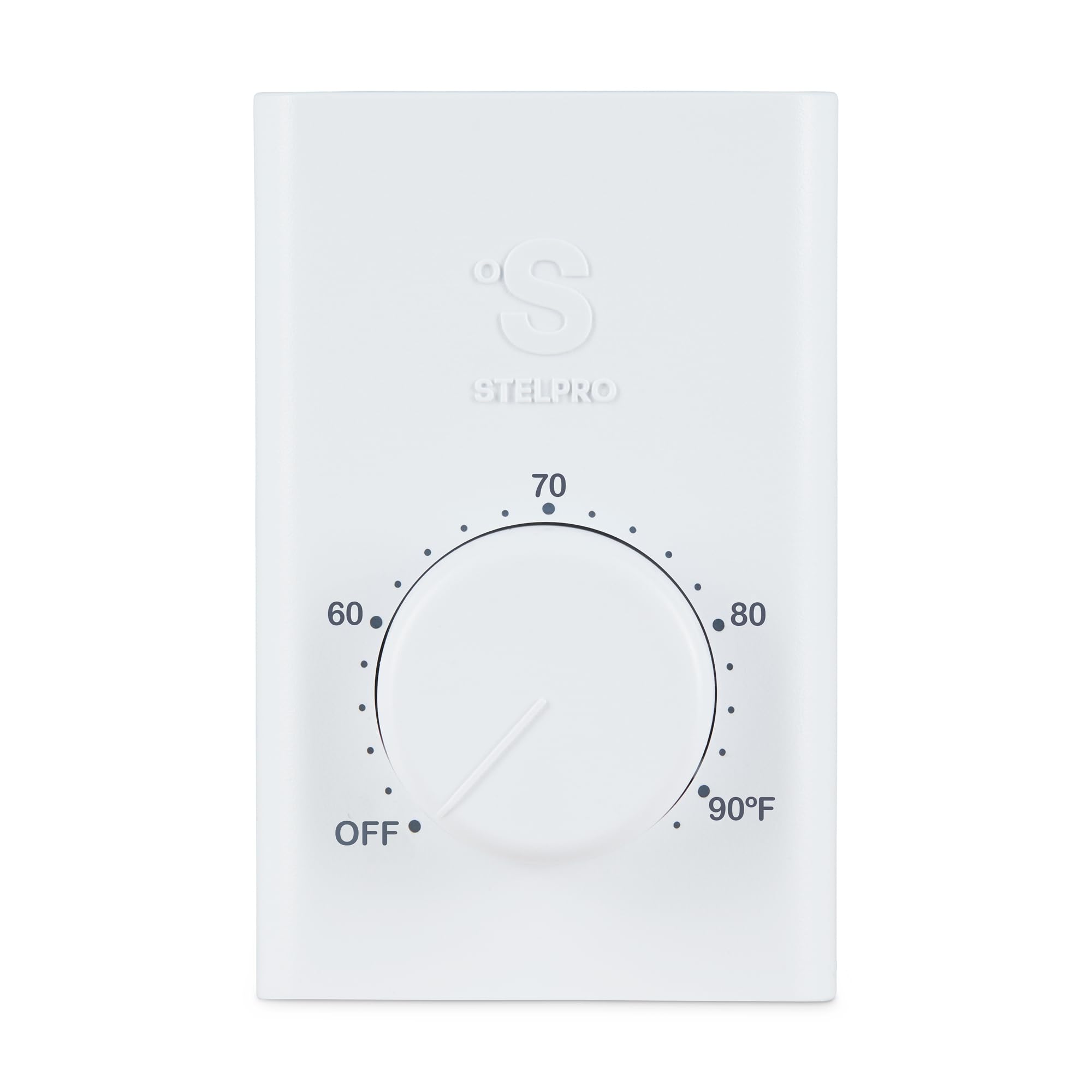
The Stelpro SWT2F is a double-pole mechanical thermostat that handles up to 22 amps on 120–277V systems. The double-pole design breaks both hot legs when turned to Off, providing a full safety disconnect that single-pole models cannot match. In many jurisdictions, double-pole is required by code for 220V heaters, and this is the most affordable CSA/UL-approved option that meets that standard.
The mechanical dial is simple and intuitive — turn to your desired temperature between 50°F and 90°F. There’s no backlight, no digital display, and no programming, which keeps the cost low and the reliability high. The low-profile white rectangular housing blends into any wall and is built for long-term use in both residential and light commercial settings.
Accuracy is typical for a bimetal thermostat — expect a swing of roughly 5–6°F before the contacts close again. Some users have reported calibration issues where the actual switch point is 20°F off from the dial marking, though this seems to be unit-specific rather than a design flaw. For a budget-friendly retrofit that gives you legal double-pole safety, the SWT2F is hard to beat.
Why it’s great
- Double-pole for full electrical disconnect and safety
- 22A capacity handles large commercial-grade heaters
- Low cost and CSA/UL certified for code compliance
Good to know
- 5–6°F swing — less precise than electronic units
- Calibration can vary; one in five units may run cold
FAQ
Can I use a 220V thermostat on a 120V heater?
What is the difference between single-pole and double-pole wiring?
Do smart thermostats work with 240V baseboard heaters?
Why does my mechanical thermostat cause temperature swings?
Final Thoughts: The Verdict
For most users, the best 220 volt thermostat is the Honeywell RLV3150A1004 because it delivers silent TRIAC-controlled accuracy without the complexity or wiring demands of a smart thermostat. If you want app-based scheduling and energy tracking, grab the Meross Smart Thermostat. And for high-amp commercial-grade reliability, nothing beats the King ES230-R MAX22.