
Stepping into the world of a 65-inch OLED is a commitment to visual fidelity that an LED or QLED simply cannot match. The core difference isn’t just about brightness — it is the absolute control of over 8 million self-illuminating pixels, turning off individually to deliver perfect black that makes every color beside it seem to radiate its own light. This guide examines the current leaders in this specific screen size, focusing on the real-world metrics that separate a good OLED from a truly great one: sustained HDR brightness in nits, color volume coverage, and the processing power of the AI-driven chipset that drives the entire experience.
I’m Min — the co-founder and writer behind Gadgets Feed. This guide is the result of weeks of cross-referencing technical data sheets, analyzing customer feedback on HDR peak brightness and motion handling, and ranking each model based on its 2024-2026 processor generation, HDMI 2.1 port configuration, and validated panel uniformity to ensure every recommendation is built on spec-level detail rather than brand hype.
To find your ideal investment, you need to navigate the nuanced differences in panel brightness grades, AI upscaling capabilities, and gaming-specific features. This is the definitive guide to finding the best 65 inch oled tv for your home theater setup right now, built on hard data rather than marketing noise.
How To Choose The Best 65 Inch OLED TV
Buying a 65-inch OLED means entering a premium tier where small spec differences create massive real-world gaps in image quality. You are not just choosing a brand; you are choosing between panel sub-types, processor generations, and software ecosystems that dictate how your content looks every single time you press play. Here are the three criteria that matter most for this specific category.
Panel Technology & Brightness: OLED vs. OLED evo vs. QD-OLED
Standard OLED panels (like those in the Sony BRAVIA 8) excel at deep blacks and wide viewing angles but peak around 600-800 nits in a 10% HDR window. OLED evo panels (found in the LG G-series and C-series) add a light-boosting layer to push brightness past 1000 nits, making them far more viable for rooms with ambient daylight. The new QD-OLED panels (used in the Samsung S95F and Sony BRAVIA 8 II) go further, adding a quantum dot layer to achieve over 1500 nits peak brightness and significantly higher color volume, meaning reds and greens are more saturated at high luminance. If you prioritize HDR impact and watch in a bright room, an OLED evo or QD-OLED model is essential.
The Processor is the Brain, Not the Panel
Two TVs using the exact same LG Display panel can look vastly different because the processor determines how the image is rendered. Sony’s XR Processor and LG’s a9 AI Processor Gen6 use different algorithms for upscaling, motion interpolation, and tone mapping. For example, the Sony XR excels at cleaning up low-bitrate streaming artifacts, while the LG a9 Gen6 is better at maintaining shadow detail in HDR gaming. The Samsung NQ4 AI Gen3 processor leverages 128 neural networks for object-based upscaling. The newer the processor generation, the better the TV will handle future codecs and software updates. Always prioritize the processor over the panel when choosing between two similarly priced models.
HDMI 2.1 Port Allocation for Gaming and Audio
All modern OLEDs support 4K at 120Hz, but the number of full-bandwidth 48Gbps HDMI 2.1 ports varies. LG and Samsung generally offer four HDMI 2.1 ports, allowing you to connect a PS5, Xbox Series X, and a soundbar simultaneously without sacrificing bandwidth on any input. Sony’s mid-range OLEDs often ship with only two HDMI 2.1 ports, which can be a dealbreaker for multi-console gamers. Additionally, check for eARC support on a dedicated HDMI port—this is non-negotiable for passing Dolby Atmos TrueHD from a Blu-ray player to your soundbar or AVR without audio lag or compression.
Quick Comparison
On smaller screens, swipe sideways to see the full table.
| Model | Category | Best For | Key Spec | Amazon |
|---|---|---|---|---|
| Samsung S90F | Mid-Range | Best Value with Vision AI | NQ4 AI Gen3 Processor / 144Hz | Amazon |
| Sony BRAVIA 8 | Mid-Range | Studio Calibrated Picture | XR Processor / OLED Contrast | Amazon |
| LG G3 OLED evo | Mid-Range | Bright Room Performance | a9 Gen6 Processor / 70% Brighter | Amazon |
| LG G4 OLED evo | Premium | Brightness Booster Max | a11 AI Processor / 4K Upscaling | Amazon |
| Samsung S95F | Premium | Glare-Free Viewing | NQ4 AI Gen3 / 165Hz VRR | Amazon |
| LG C6 OLED evo | Premium | Gaming with Soundbar Bundle | α11 AI Gen3 / 165Hz VRR | Amazon |
| LG G5 OLED evo | Premium | Bright Room Ready | Alpha 11 Gen2 / Brightness Booster Max | Amazon |
| LG G5 Bundle | Premium | Ultimate Protection Bundle | Alpha 11 Gen2 / Brightness Booster Ultimate | Amazon |
| Panasonic Z95 | High-End | Built-in Sound Quality | HCX Pro AI MKII / 144Hz | Amazon |
| Sony BRAVIA 8 II | High-End | PS5 Integration | XR Processor / QD-OLED / 120Hz | Amazon |
In‑Depth Reviews
1. Samsung 65 inch OLED 4K S90F Smart TV
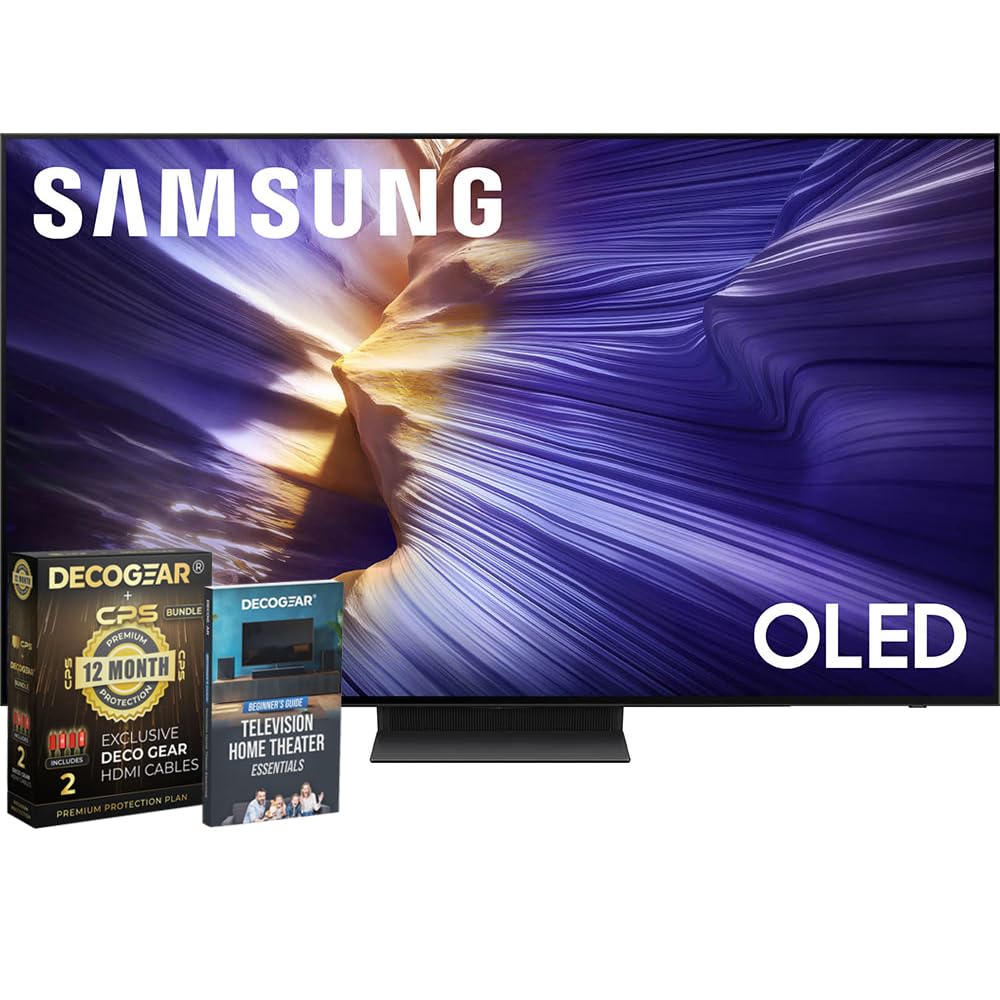
The Samsung S90F lands as the top overall pick because it delivers a 2025-spec OLED experience — including the NQ4 AI Gen3 processor with 128 neural networks and a 144Hz Motion Xcelerator — at a sticker price that undercuts the premium flagships by a wide margin. This is an OLED evo-class panel with OLED HDR+ that applies dynamic tone mapping scene-by-scene, producing punchy highlights and deep blacks that compete directly with panels costing hundreds more. The Glare-Free finish is a real asset for bright living rooms, significantly reducing mirror-like reflections without sacrificing perceived contrast.
Gamers will appreciate the VRR support at 4K 144Hz, making it a true fit for both PC and next-gen console play. The AI Motion Enhancer Pro sharpens fast-moving objects like soccer balls and racing cars, reducing the blur that plagues lower-tier processors. The bundle includes the Deco Gear Home Theater Beginner’s Guidebook and a CPS 1-year extended protection plan, adding genuine value for first-time OLED owners who want peace of mind beyond the standard warranty.
One subtle caveat is the remote and menu navigation — several users mention a learning curve with the SolarCell remote and Tizen interface, particularly when switching between inputs. The motion smoothing defaults may also require manual adjustment in the settings to achieve a film-like 24p cadence for movies. Overall, this is the most balanced 65-inch OLED for buyers who want the latest AI processing and gaming specs without jumping into the flagship price bracket.
Why it’s great
- NQ4 AI Gen3 processor delivers excellent 4K upscaling for all content sources.
- 144Hz VRR support makes it a serious gaming display for PC and console.
- Glare-free coating handles bright room reflections better than standard OLEDs.
Good to know
- Tizen smart platform has a learning curve and can feel less responsive than webOS.
- SolarCell remote requires ambient light to charge; no USB-C backup charging option.
2. Sony 65 Inch OLED BRAVIA 8 (K-65XR80)

The Sony BRAVIA 8 is the reference for those who prioritize image processing above all else. The XR Processor analyzes each scene in real time to boost color, contrast, and clarity, and it pairs this with XR Triluminos Pro for accessing billions of real-world colors. The result is that lower-bitrate streams from Netflix or Prime Video look cleaner and more artifact-free than on any competing OLED in this price range — Sony’s XR Clear Image upscaling is genuinely class-leading. The XR Contrast Booster 15 pushes highlights to a satisfying peak without clipping details, making dark room movie viewing spectacular.
For PlayStation 5 owners, the integration is seamless. Auto HDR Tone Mapping and Auto Genre Picture Mode kick in automatically when a PS5 is detected, optimizing the picture parameters for gaming without manual menu diving. The support for Dolby Vision, IMAX Enhanced, and DTS:X means it handles every major HDR format, so you never have to worry about compatibility. The Acoustic Surface Audio+ technology, which vibrates the screen itself to produce sound, is surprisingly good for dialogue clarity in movies, though a dedicated soundbar is still recommended for bass-heavy scenes.
Build quality is excellent, but the TV is notably heavy due to the acoustic actuator panel. The Google TV interface is smooth overall, but some users report intermittent sound drops in apps and aggressive privacy agreement prompts. Also, the BRAVIA 8 only offers two full HDMI 2.1 ports, which is a limitation if you plan to connect a PS5, Xbox, and a soundbar simultaneously. For the purest image quality with Sony’s unmatched motion handling, this is still a top-tier choice.
Why it’s great
- XR Processor delivers the best upscaling and artifact reduction in this class.
- Auto HDR Tone Mapping with PS5 provides a plug-and-play gaming experience.
- Acoustic Surface Audio+ offers clear dialogue without a separate soundbar.
Good to know
- Only two HDMI 2.1 ports; fewer than LG and Samsung competitors.
- Significantly heavier than other 65-inch OLEDs due to acoustic panel.
3. LG G3 Series 65-Inch OLED evo (OLED65G3PUA)

The LG G3 OLED evo is the model that redefined what brightness an OLED panel could achieve. Using the a9 AI Processor Gen6 and Brightness Booster Max—a Micro Lens Array (MLA) layer that focuses light through individual pixels—this TV reaches up to 70% higher brightness than standard OLEDs, sustaining over 900 nits in real HDR scenes. This makes it one of the few OLEDs that actively looks great in a sunlit living room, retaining specular highlights and shadow detail where older panels would wash out. The One Wall Design means it mounts flush against the wall with the included bracket, and the Always Ready mode lets it display art when idle, seamlessly blending into your decor.
Gamers get four full HDMI 2.1 ports, meaning you can connect a PS5, Xbox Series X, PC, and a soundbar without compromise. The 120Hz support with NVIDIA G-Sync and AMD FreeSync Premium ensures tear-free gameplay. The webOS 23 interface with the Magic Remote is the fastest and most intuitive smart TV platform available. The Quick Cards system groups apps by category—gaming, sports, music—for a more organized browsing experience. The 5-year panel warranty is a major confidence booster for a premium investment.
The primary downside is that this model is now a generation behind the current G4 and G5, which means it lacks the latest a11 AI processing for even more refined upscaling. Some users also report that the optical audio output can produce crackling or jitter with certain soundbars, requiring an HDMI eARC connection instead. If you can find this model at a discount, it remains an exceptional value for its brightness and build quality.
Why it’s great
- MLA technology delivers class-leading brightness for a bright room OLED.
- Four full HDMI 2.1 ports for multi-device gaming setups.
- 5-year panel warranty provides long-term peace of mind.
Good to know
- Now a generation behind current models; lacks a11 Gen6-level upscaling of newer units.
- Optical audio output can have jitter issues; use HDMI eARC for best sound.
4. LG 65-Inch OLED evo G4 Series (OLED65G4SUB)

The LG G4 takes the G3’s brightness foundation and refines it with the a11 AI Processor, which focuses on object-based upscaling and AI Director Processing that analyzes each scene’s creator intent. The Brightness Booster Max technology here is slightly refined over the G3, pushing sustained brightness into the 1000-1100 nit range, making HDR content pop with an intensity that feels genuinely high-end. The One Wall Design is identical to the G3 in execution—flush mount, art mode—but the internal software is more responsive, with the webOS Re:New program guaranteeing 5 years of software updates.
Color accuracy is superb, with 100% Color Volume and 100% Color Fidelity ensuring that skin tones stay natural and saturated reds and greens don’t clip. The AI Super Upscaling is noticeably better at handling 1080p content than the previous generation, with sharper edges and less noise. For gaming, the 120Hz refresh rate and sub-1ms response time are excellent, and the Game Optimizer dashboard gives you granular control over black stabilizer and response time settings without leaving the game.
The main trade-off is that the G4 does not include a stand—it is designed exclusively for wall mounting using the included flush mount bracket. If you need a tabletop stand, you will have to purchase a third-party VESA stand separately, adding to the overall cost. Additionally, some users report that the interface, while faster, still has a few too many menu layers for quick picture adjustments. This is the definitive mid-cycle OLED evo that balances brightness, processing, and price.
Why it’s great
- a11 AI Processor provides excellent object-based upscaling for 1080p content.
- Brightness Booster Max sustains over 1000 nits for impactful HDR.
- 5-year software update guarantee via webOS Re:New program.
Good to know
- No stand included; wall mount only — required VESA stand is an extra purchase.
- Menu interface can feel cluttered for quick picture mode adjustments.
5. Samsung 65-Inch OLED S95F (2025)

The Samsung S95F is a QD-OLED panel that takes a radical approach to the bright room problem: instead of fighting reflections with brightness, it uses a Glare-Free matte coating that diffuses ambient light across the surface, eliminating sharp reflected images. The result is a picture that maintains its contrast and color saturation even when sunlight streams directly onto the screen, making it the clear choice for living rooms with large windows. This panel also reaches a peak brightness of around 1500 nits, and the NQ4 AI Gen3 processor uses its 128 neural networks to apply HDR tone mapping that reveals detail in both shadows and specular highlights.
The Motion Xcelerator supports 165Hz VRR, which is a step above the standard 120Hz and 144Hz found on competing models, making it ideal for high-refresh-rate PC gaming. The combination of QD-OLED color volume (deeper reds and greens than WOLED) and the anti-glare surface produces an image that feels uniquely vibrant in any lighting condition. Samsung’s Tizen platform is snappy, and the Vision AI features allow for content-based picture optimization that learns your preferences over time.
The software experience does have some notable friction. Users report that casting from an Android device can trigger a screensaver after a few minutes, and the YouTube app can take 20-30 seconds to load. The remote and menu navigation also require an adjustment period. Despite these software quirks, the S95F’s hardware—specifically its QD-OLED panel and the game-changing anti-glare coating—makes it the best option for buyers who cannot control their room’s ambient light.
Why it’s great
- QD-OLED panel delivers superior color volume and 1500-nit peak brightness.
- Glare-Free matte coating eliminates reflections in bright rooms.
- 165Hz VRR support is the highest refresh rate in this comparison.
Good to know
- Tizen software can be slow to load apps and inconsistent with casting.
- No Dolby Vision support — relies on HDR10+ and HDR10.
6. LG 65 inch OLED evo AI C6 (2026) with Soundbar Bundle
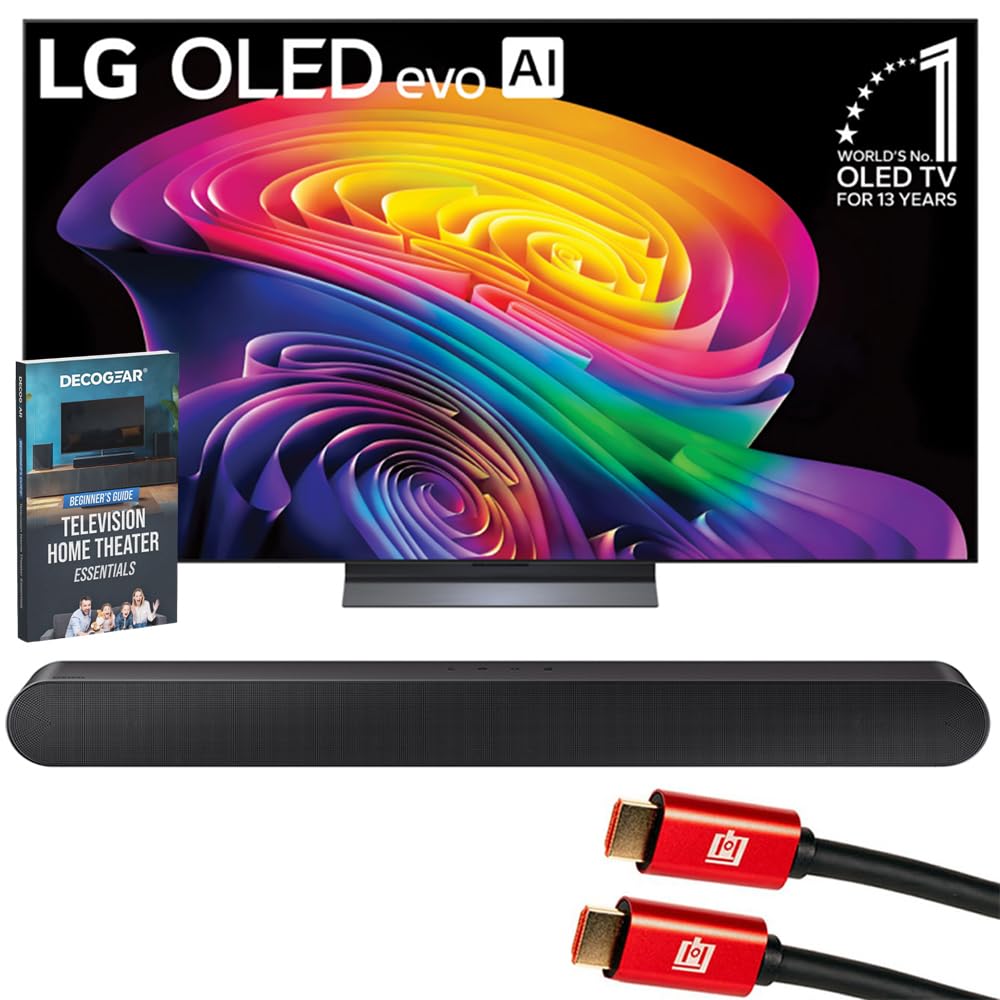
The LG C6 is the latest-generation C-series model, powered by the α11 AI Processor Gen3, making it one of the most future-proofed OLEDs on this list. It pairs the familiar Perfect Black and Perfect Color OLED evo panel with Brightness Booster technology for enhanced vibrancy in moderately lit rooms. The real differentiator here is the gaming performance: native support for VRR up to 165Hz, NVIDIA G-Sync and AMD FreeSync compatibility, and an ultra-low 0.1ms response time. The LG Game Optimizer puts every gaming variable—black level, response time, input lag—in one quick-access menu.
This specific SKU adds tremendous value by including a Samsung 3.0ch All-in-One Soundbar with Dolby 5.1 DTS Virtual:X, two HDMI cables, and the Deco Gear Home Theater Beginner’s Guidebook. For a buyer starting from scratch, this bundle effectively solves the audio problem immediately, providing a proper soundstage without requiring a separate research project on audio gear. The soundbar alone typically costs a significant portion of the bundle’s premium, making this a smart logical option for those who want both visual and audio upgrades in one purchase.
The MR26 Magic Remote is a nice upgrade over previous versions, with better voice recognition and a more ergonomic shape. The webOS interface remains the gold standard for smart TV menus, and the LG Channels service offers free access to over 300 channels. For users who want the absolute newest processor generation and a complete home theater bundle, this is a compelling all-in-one solution.
Why it’s great
- Latest α11 AI Gen3 processor ensures top-tier processing and future updates.
- 165Hz VRR with 0.1ms response time is elite for competitive gaming.
- Bundled Samsung soundbar provides immediate audio upgrade out of the box.
Good to know
- Premium price point due to bundle; base C6 model is more affordable alone.
- Soundbar is a 2022 model, not the latest Samsung audio generation.
7. LG 65-Inch OLED evo G5 Series (OLED65G5WUA)

The LG G5 is the pinnacle of LG’s current OLED evo lineup, featuring the Alpha 11 AI Processor Gen2 and Brightness Booster Max technology that pushes peak HDR brightness past the 1200-nit mark. It is also UL-verified for Discomfort Glare Free (UGR less than 22), meaning it is officially rated to perform well in bright rooms without the eye strain that comes from highly reflective glossy panels. The Perfect Black and Perfect Color technology on 8.3 million self-lit pixels remains the gold standard for contrast, and the processing improvements in the Gen2 chipset deliver notably better shadow detail in dark scenes compared to the a9 Gen6.
For gaming, the G5 supports up to 165Hz variable refresh rate with a 0.1ms response time, and all four HDMI inputs are full 48Gbps HDMI 2.1 ports. This means you can run a PS5 at 4K 120Hz HDR, an Xbox Series X at the same, a gaming PC at 165Hz, and still have a port for a soundbar — all simultaneously. The Game Optimizer interface is the most comprehensive in the industry, offering real-time overlays for frame rate, input lag, and HDR metadata. The inclusion of NVIDIA G-Sync and AMD FreeSync Premium ensures compatibility with any GPU.
The main criticism is the remote. The Magic Remote lacks backlit buttons, which is a surprising omission for a flagship TV at this price point. Navigating in a dark room requires memorizing button positions. The sound quality, while improved over the G4, is still not a replacement for a dedicated soundbar. For the absolute best in brightness, gaming specs, and bright-room performance, the G5 is the definitive flagship.
Why it’s great
- Brightness Booster Max exceeds 1200 nits for spectacular HDR impact.
- Four full HDMI 2.1 ports for the ultimate multi-device gaming setup.
- UL Glare Free certification ensures excellent performance in bright rooms.
Good to know
- Magic Remote lacks backlit buttons, inconvenient for dark room use.
- Built-in speakers still require a soundbar for a full home theater experience.
8. LG 65″ G5 OLED evo Bundle with 26-Month Protection
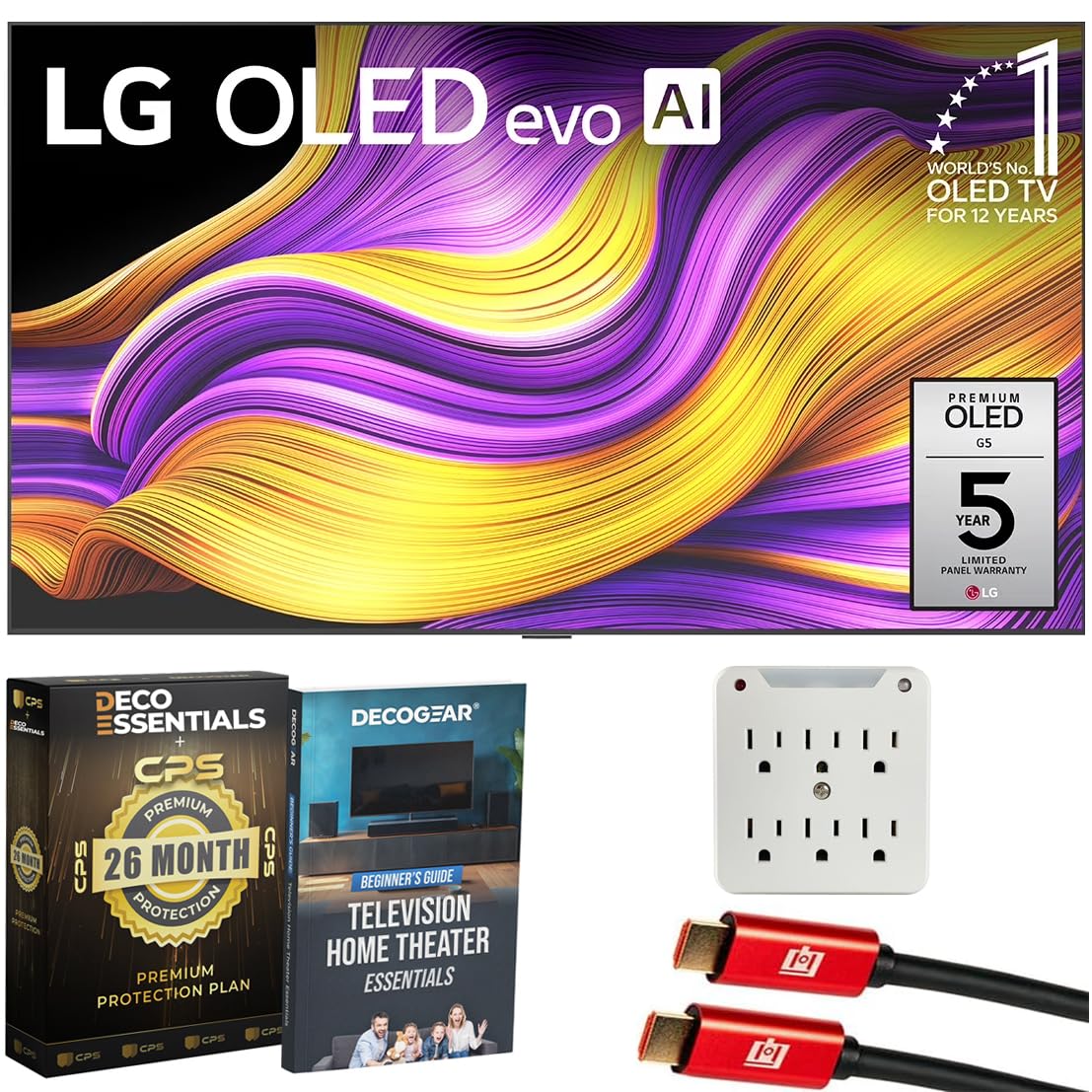
This bundle takes the G5 and elevates it with the Deco Essentials CPS exclusive extended protection plan (26 months) that explicitly covers accidental damage and burn-in — something the standard manufacturer warranty does not address. This is a critical addition for OLED buyers who worry about permanent image retention from static elements like news tickers or game HUDs. The bundle also includes a Stanley SurgePro 6-outlet surge adapter and two 4K HDMI 2.0 cables, ensuring your entire setup is surge-protected from day one.
The G5 itself features the Alpha 11 AI Processor Gen2 with Brightness Booster Ultimate, which LG claims produces up to 45% brighter images than standard OLED. The One Wall Design with the included flush mount allows the TV to sit almost flat against the wall, and the Always Ready mode transforms it into a digital art canvas when idle. The webOS 25 interface is fast and intuitive, and the 5-year panel warranty adds a layer of assurance on top of the extended bundle plan.
Because this is a bundle model, the packaging is bulkier, and delivery logistics can be more complex (some users report dual tracking numbers). The TV itself does not come with a standalone tabletop stand — wall mounting is the intended setup. If you are building a dedicated home theater and want the maximum possible protection for your investment, this is the most worry-free configuration available on this list.
Why it’s great
- 26-month CPS protection plan covers accidental damage and burn-in.
- Brightness Booster Ultimate delivers the highest luminance in the G series.
- Includes surge adapter and HDMI cables for a complete setup package.
Good to know
- No tabletop stand included; requires wall mounting or separate VESA stand.
- Bundle packaging is large, and delivery may require freight coordination.
9. Panasonic Z95 Series 65-inch OLED (65Z95AP)

The Panasonic Z95 is a unique entry in this list because it focuses heavily on built-in audio performance. The 360 Soundscape Pro system uses an array of up-firing and side-firing speakers to create a convincing Dolby Atmos bubble without requiring a separate soundbar. The HCX Pro AI Processor MKII is specifically tuned for color accuracy (Panasonic is a partner in the Hollywood color grading industry), and the Master OLED Ultimate panel delivers excellent shadow detail and near-reference black levels. The center-mount swivel stand is a thoughtful design touch, allowing the TV to be rotated without lifting.
The Filmmaker Mode with Intelligent Sensing goes a step beyond standard Filmmaker Mode by automatically adjusting the picture based on ambient light levels, so the image stays accurate whether you watch at noon or midnight. The Fire TV operating system provides hands-free Alexa integration, which is convenient for voice control and smart home integration, though the OS itself can feel slightly slower than webOS or Tizen. The 144Hz refresh rate supports high-frame-rate gaming, and the VRR support is solid.
The biggest drawback for the Z95 is the software. The Fire TV OS has a reputation for privacy concerns, and the TV will not function fully if it cannot connect to the internet, which can be a problem for users who want a purely local experience. The Ethernet port is limited to 100Mbps, which can cause stuttering with very high-bitrate 4K Blu-ray remuxes. For movie enthusiasts who want the best built-in sound and near-studio-grade color accuracy, the Z95 is a compelling specialist pick.
Why it’s great
- 360 Soundscape Pro delivers a convincing Dolby Atmos soundstage from the TV itself.
- HCX Pro AI MKII processor is calibrated for Hollywood-grade color accuracy.
- Center-mount swivel stand provides flexible viewing angle adjustments.
Good to know
- Fire TV OS requires internet connectivity for full functionality.
- 100Mbps Ethernet port can bottleneck high-bitrate 4K streaming.
10. Sony BRAVIA 8 II 65 Inch TV (K-65XR80M2)

The Sony BRAVIA 8 II is the pinnacle of picture performance in this roundup, combining a QD-OLED panel with Sony’s XR Processor and XR Triluminos Max to deliver the widest color gamut and highest peak brightness—estimated around 1800 nits—of any TV on this list. The self-lit pixel control here is the industry benchmark, producing zero blooming in split-screen HDR content and maintaining near-perfect black levels even in challenging bright highlights. The XR Processor’s AI-driven scene decomposition ensures that every frame is analyzed pixel-by-pixel, resulting in image sharpness and depth that competitors simply cannot replicate.
For PlayStation 5 owners, this is the ultimate match. Auto HDR Tone Mapping and Auto Genre Picture Mode integrate seamlessly, and the XR Clear Image AI upscaling makes even the oldest Blu-ray content look crisp and detailed. The acoustic multi-audio system projects sound from specific points on the screen to match the action, creating an unusually cohesive audio-visual experience. The Google TV interface is clean and fast, and the inclusion of Sony Pictures CORE with 5 free movie credits is a nice bonus for cinephiles.
The price is the primary barrier—this is the most expensive standard model on the list. The weight is also substantial due to the acoustic architecture. Some early buyers report audio distortion issues (a muffled or underwater sound) that requires a repair dispatch, which is concerning at this price tier. For those who demand the absolute best picture quality and already have a high-end audio system, the BRAVIA 8 II is the ultimate investment in visual fidelity.
Why it’s great
- QD-OLED panel with XR Triluminos Max delivers the widest color gamut available.
- XR Processor provides the most refined upscaling and motion handling.
- Perfect PS5 integration with Auto HDR Tone Mapping and low input lag.
Good to know
- Highest price point in this comparison; significant investment.
- Heavy chassis and some early reports of audio processing issues.
FAQ
Is 65 inches too big for a standard living room?
What is the difference between OLED evo and QD-OLED?
Do I need a soundbar for a 65-inch OLED?
Can a 65-inch OLED TV suffer from burn-in?
Final Thoughts: The Verdict
For most users, the best 65 inch oled tv winner is the Samsung S90F because it balances a 2025 NQ4 AI processor, 144Hz gaming support, and a glare-free panel at a price that sits below the premium flagships without cutting corners on HDR performance or smart features. If you want the absolute best bright-room performance and high-refresh-rate gaming, grab the Samsung S95F for its QD-OLED panel and anti-glare coating. And for cinema-grade color accuracy with a reference-tier processor, nothing beats the Sony BRAVIA 8 II.